DEPARTMENT OF ELECTRONICS AND COMMUNICATION ENGINEERING
ENHANCING SOLAR SYSTEM EFFICIENCY BASED
ON PRECISE REAL-TIME ENERGY DATAANALYSIS
AND SUN POSITION TRACKING
NAME OF THE GUIDE :
Mrs. N.LALITHA, M. tech,
ASSISTANT PROFESSOR
PROJECT ASSOCIATES :
N.MAHESH - 21711A0441
M.ABHISHEK - 21711A0438
V.SRINADH - 21711A0463
Y.SUNDAR - 21711A0466
G.MAHESH - 22715A0404
CONTENTS :
 ABSTRACT
 INTRODUCTION
 LITERATURE SURVEY
 EXISTING METHOD
 PROPOSED METHOD
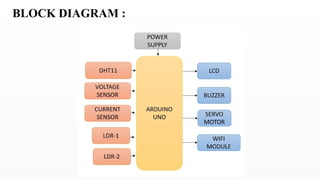
 HARDWARE COMPONENTS
 METHODOLOGY
 BLOCK DIAGRAM
 SOURCE CODE
 RESULTS
 APPLICATIONS
 CONCLUSION AND FUTURE SCOPE
ABSTRACT :
 The Internet of Things (IoT) is becoming increasingly important for global
civilization, as it can achieve various goals. As global temperatures rise, people
are turning to alternative energy sources, such as solar energy, which can be
used efficiently in various areas.
 Regular maintenance and development of solar systems can save on
electricity costs.
 This study aims to improve solar power generation efficiency and reliability
by using a combination of sensors, microcontrollers, and IoT technologies to
monitor solar panel performance, track sun movement, and calculate energy
production.
 The system also includes a user interface providing real-time data on solar
panel performance and energy production.
INTRODUCTION :
 Solar panels use photovoltaic cells to convert sunlight into
electricity through the Photovoltaic Effect, where sunlight knocks
electrons free, generating a current.
 They are made of crystalline silicon or gallium arsenide, with
efficiency depending on the number and quality of solar cells.
 The solar panels must be perpendicular to the sun's rays for
maximum energy generation.
 Solar trackers improve efficiency by adjusting panels to follow the
sun, increasing energy output by 30-40%.
 An active tracker uses motors to direct the panel toward the sun by
relying on a sensing circuit to detect light intensity.
LITERATURE SURVEY :
Single Axis Automatic Solar Tracking System Using Microcontroller
Microcontroller-based single-axis solar tracking system is designed to
maximize solar power harvesting by keeping solar panels aligned with the
sun. Using light-dependent photoresistors (LDRs) as sensors, the system
detects light intensity changes and automatically adjusts the panel’s
position via a stepper motor.
Efficient solar tracking system using image processing using LDR
This paper proposes an automatic solar tracking system that integrates
sensors and image processing for precise solar panel alignment. Using
image processing software, the system analyzes the sun’s position and
adjusts panels accordingly, combining hardware and software for
enhanced accuracy.
EXISTING METHOD :
 The existing system utilizes a single-axis solar tracker that follows
the sun’s daily motion from east to west but does not account for
seasonal changes.
 Since the Earth's rotation is complex, the annual motion affects the
tilt angle of the panel.
 A chronological tracking system with a real-time clock (RTC)
calculates the sun’s position, adjusting the panel by 15° per hour
for daily tracking. However, tilt angle adjustments for seasonal
variations require additional calculations to improve accuracy in
sunlight tracking.
PROPOSED SYSTEM :
 The proposed system is an autonomous and embedded solar tracking
instrumentation system using an Arduino microcontroller.
 It consists of Light Dependent Resistor (LDR) sensors for detecting
sunlight and servo/DC motors for adjusting the panel’s position.
 The system ensures that the solar panel remains perpendicular to the
sun, optimizing power output.
 Additionally, voltage and current sensors monitor the generated
power, and sensor data can be accessed remotely via the
ThingSpeak website, enhancing real-time monitoring and
efficiency.
HARDWARE COMPONENTS :
 Microcontroller
 Power Supply
 LDR Sensors
 LCD Display
 Servo Motor
 Solar Panel
 Current Sensor
 Voltage Sensor
 DHT-11 Sensor
 Wifi Module
METHODOLOGY :
 System Components & Setup
The proposed system consists of an Arduino microcontroller, Light
Dependent Resistor (LDR) sensors, servo/DC motors, and voltage &
current sensors. The solar panel is mounted on a movable platform,
which is controlled by the Arduino to adjust its position for maximum
sunlight absorption.
 Sunlight Detection & Tracking
LDR sensors detect the intensity of sunlight and send signals to the
Arduino. Based on this data, the Arduino activates the servo/DC
motors, adjusting the solar panel to align with the highest light
intensity, ensuring maximum efficiency.
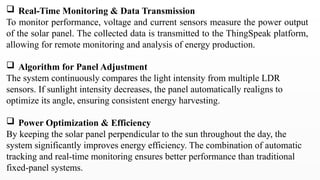
 Real-Time Monitoring & Data Transmission
To monitor performance, voltage and current sensors measure the power output
of the solar panel. The collected data is transmitted to the ThingSpeak platform,
allowing for remote monitoring and analysis of energy production.
 Algorithm for Panel Adjustment
The system continuously compares the light intensity from multiple LDR
sensors. If sunlight intensity decreases, the panel automatically realigns to
optimize its angle, ensuring consistent energy harvesting.
 Power Optimization & Efficiency
By keeping the solar panel perpendicular to the sun throughout the day, the
system significantly improves energy efficiency. The combination of automatic
tracking and real-time monitoring ensures better performance than traditional
fixed-panel systems.
BLOCK DIAGRAM :
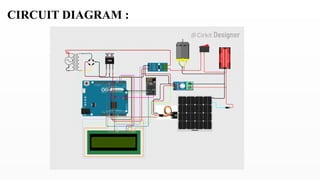
CIRCUIT DIAGRAM :
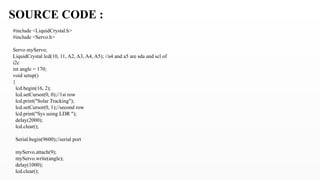
SOURCE CODE :
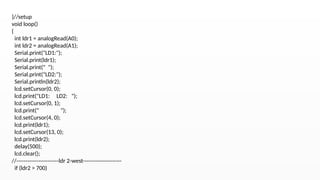
#include <LiquidCrystal.h>
#include <Servo.h>
Servo myServo;
LiquidCrystal lcd(10, 11, A2, A3, A4, A5); //a4 and a5 are sda and scl of
i2c
int angle = 170;
void setup()
{
lcd.begin(16, 2);
lcd.setCursor(0, 0);//1st row
lcd.print("Solar Tracking");
lcd.setCursor(0, 1);//second row
lcd.print("Sys using LDR ");
delay(2000);
lcd.clear();
Serial.begin(9600);//serial port
myServo.attach(9);
myServo.write(angle);
delay(1000);
lcd.clear();
}//setup
void loop()
{
int ldr1 = analogRead(A0);
int ldr2 = analogRead(A1);
Serial.print("LD1:");
Serial.print(ldr1);
Serial.print(" ");
Serial.print("LD2:");
Serial.println(ldr2);
lcd.setCursor(0, 0);
lcd.print("LD1: LD2: ");
lcd.setCursor(0, 1);
lcd.print(" ");
lcd.setCursor(4, 0);
lcd.print(ldr1);
lcd.setCursor(13, 0);
lcd.print(ldr2);
delay(500);
lcd.clear();
//-----------------------ldr 2-west---------------------
if (ldr2 > 700)
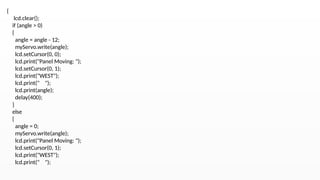
{
lcd.clear();
if (angle > 0)
{
angle = angle - 12;
myServo.write(angle);
lcd.setCursor(0, 0);
lcd.print("Panel Moving: ");
lcd.setCursor(0, 1);
lcd.print("WEST");
lcd.print(" ");
lcd.print(angle);
delay(400);
}
else
{
angle = 0;
myServo.write(angle);
lcd.print("Panel Moving: ");
lcd.setCursor(0, 1);
lcd.print("WEST");
lcd.print(" ");
lcd.print(angle);
delay(400);
}
}
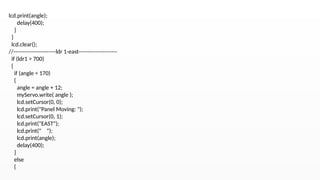
lcd.clear();
//-----------------------ldr 1-east---------------------
if (ldr1 > 700)
{
if (angle < 170)
{
angle = angle + 12;
myServo.write( angle );
lcd.setCursor(0, 0);
lcd.print("Panel Moving: ");
lcd.setCursor(0, 1);
lcd.print("EAST");
lcd.print(" ");
lcd.print(angle);
delay(400);
}
else
{
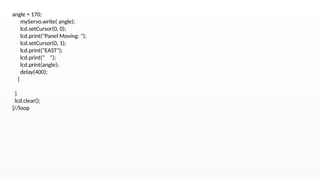
angle = 170;
myServo.write( angle);
lcd.setCursor(0, 0);
lcd.print("Panel Moving: ");
lcd.setCursor(0, 1);
lcd.print("EAST");
lcd.print(" ");
lcd.print(angle);
delay(400);
}
}
lcd.clear();
}//loop
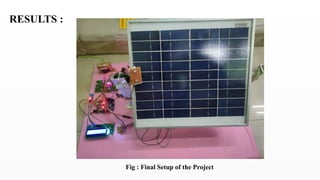
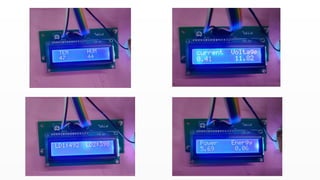
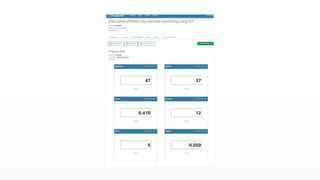
RESULTS :
Fig : Final Setup of the Project
ADVANTAGES :
 Increased Energy Output
 Improved Efficiency
 Reduced Operational Costs
 Adaptability to Environmental Conditions
 Extended System Lifespan
 Sustainable and Environmentally Friendly
 Scalability and Flexibility
 Minimized Downtime
APPLICATIONS :
Residential Solar Power Systems
Enhances energy generation for homes by maximizing sunlight absorption.
Reduces dependence on conventional electricity and lowers energy bills.
Commercial and Industrial Solar Plants
Used in large-scale solar farms to improve efficiency and increase power
output.Helps industries reduce operational costs by utilizing optimized solar
energy.
Remote and Off-Grid Areas
Provides a reliable power source in rural areas, disaster-prone regions, and
military bases where grid electricity is unavailable.
Smart Agriculture
Supports solar-powered irrigation systems, greenhouses, and remote farming
equipment by ensuring continuous power supply.
Space and Satellite Applications
Can be integrated into satellites and space stations to enhance solar energy
harvesting in space.
Electric Vehicle Charging Stations
Used in solar-powered EV charging stations to optimize energy collection and
support sustainable transportation.
Internet of Things (IoT)-Based Monitoring
Enables real-time monitoring of solar panel performance through ThingSpeak
for better efficiency and remote management.
CONCLUSION :
The proposed Arduino-based solar tracking system effectively
enhances solar energy harvesting by ensuring the solar panel remains
perpendicular to the sun throughout the day. By utilizing LDR sensors,
servo/DC motors, and an Arduino microcontroller, the system automatically
adjusts the panel’s position for maximum sunlight absorption, significantly
improving efficiency compared to traditional fixed-panel systems.
Additionally, the integration of voltage and current sensors allows
for real-time monitoring via ThingSpeak, enabling remote performance
tracking. This system is highly beneficial for residential, industrial, and off-
grid applications, contributing to a sustainable and efficient solar power
solution.
FUTURE SCOPE :
 AI and Machine Learning Integration
Implementing AI-based predictive analysis to optimize tracking based on
weather conditions and solar patterns for improved performance.
 Wireless Monitoring and IoT Integration
Expanding IoT capabilities by integrating wireless communication modules (Wi-
Fi, LoRa, or GSM) for real-time remote control and data monitoring.
 Energy Storage Optimization
Incorporating smart battery management systems (BMS) to store excess energy
and optimize power usage efficiently.
Self-Cleaning Solar Panels
Developing an automated cleaning mechanism to remove dust
and debris, ensuring maximum energy absorption in harsh
environments.
Hybrid Energy Systems
Integrating with wind or hydro energy systems for a hybrid
renewable energy solution, ensuring power availability in
varying weather conditions.
THANK YOU

ENHANCING SOLAR SYSTEM EFFICIENCY BASED ON PRECISE REAL-TIME ENERGY DATA ANALYSIS AND SUN POSITION TRACKING

  • 1.
    DEPARTMENT OF ELECTRONICSAND COMMUNICATION ENGINEERING ENHANCING SOLAR SYSTEM EFFICIENCY BASED ON PRECISE REAL-TIME ENERGY DATAANALYSIS AND SUN POSITION TRACKING NAME OF THE GUIDE : Mrs. N.LALITHA, M. tech, ASSISTANT PROFESSOR PROJECT ASSOCIATES : N.MAHESH - 21711A0441 M.ABHISHEK - 21711A0438 V.SRINADH - 21711A0463 Y.SUNDAR - 21711A0466 G.MAHESH - 22715A0404
  • 2.
    CONTENTS :  ABSTRACT INTRODUCTION  LITERATURE SURVEY  EXISTING METHOD  PROPOSED METHOD  HARDWARE COMPONENTS  METHODOLOGY  BLOCK DIAGRAM  SOURCE CODE  RESULTS  APPLICATIONS  CONCLUSION AND FUTURE SCOPE
  • 3.
    ABSTRACT :  TheInternet of Things (IoT) is becoming increasingly important for global civilization, as it can achieve various goals. As global temperatures rise, people are turning to alternative energy sources, such as solar energy, which can be used efficiently in various areas.  Regular maintenance and development of solar systems can save on electricity costs.  This study aims to improve solar power generation efficiency and reliability by using a combination of sensors, microcontrollers, and IoT technologies to monitor solar panel performance, track sun movement, and calculate energy production.  The system also includes a user interface providing real-time data on solar panel performance and energy production.
  • 4.
    INTRODUCTION :  Solarpanels use photovoltaic cells to convert sunlight into electricity through the Photovoltaic Effect, where sunlight knocks electrons free, generating a current.  They are made of crystalline silicon or gallium arsenide, with efficiency depending on the number and quality of solar cells.  The solar panels must be perpendicular to the sun's rays for maximum energy generation.  Solar trackers improve efficiency by adjusting panels to follow the sun, increasing energy output by 30-40%.  An active tracker uses motors to direct the panel toward the sun by relying on a sensing circuit to detect light intensity.
  • 5.
    LITERATURE SURVEY : SingleAxis Automatic Solar Tracking System Using Microcontroller Microcontroller-based single-axis solar tracking system is designed to maximize solar power harvesting by keeping solar panels aligned with the sun. Using light-dependent photoresistors (LDRs) as sensors, the system detects light intensity changes and automatically adjusts the panel’s position via a stepper motor. Efficient solar tracking system using image processing using LDR This paper proposes an automatic solar tracking system that integrates sensors and image processing for precise solar panel alignment. Using image processing software, the system analyzes the sun’s position and adjusts panels accordingly, combining hardware and software for enhanced accuracy.
  • 6.
    EXISTING METHOD : The existing system utilizes a single-axis solar tracker that follows the sun’s daily motion from east to west but does not account for seasonal changes.  Since the Earth's rotation is complex, the annual motion affects the tilt angle of the panel.  A chronological tracking system with a real-time clock (RTC) calculates the sun’s position, adjusting the panel by 15° per hour for daily tracking. However, tilt angle adjustments for seasonal variations require additional calculations to improve accuracy in sunlight tracking.
  • 7.
    PROPOSED SYSTEM : The proposed system is an autonomous and embedded solar tracking instrumentation system using an Arduino microcontroller.  It consists of Light Dependent Resistor (LDR) sensors for detecting sunlight and servo/DC motors for adjusting the panel’s position.  The system ensures that the solar panel remains perpendicular to the sun, optimizing power output.  Additionally, voltage and current sensors monitor the generated power, and sensor data can be accessed remotely via the ThingSpeak website, enhancing real-time monitoring and efficiency.
  • 8.
    HARDWARE COMPONENTS : Microcontroller  Power Supply  LDR Sensors  LCD Display  Servo Motor  Solar Panel  Current Sensor  Voltage Sensor  DHT-11 Sensor  Wifi Module
  • 9.
    METHODOLOGY :  SystemComponents & Setup The proposed system consists of an Arduino microcontroller, Light Dependent Resistor (LDR) sensors, servo/DC motors, and voltage & current sensors. The solar panel is mounted on a movable platform, which is controlled by the Arduino to adjust its position for maximum sunlight absorption.  Sunlight Detection & Tracking LDR sensors detect the intensity of sunlight and send signals to the Arduino. Based on this data, the Arduino activates the servo/DC motors, adjusting the solar panel to align with the highest light intensity, ensuring maximum efficiency.
  • 10.
     Real-Time Monitoring& Data Transmission To monitor performance, voltage and current sensors measure the power output of the solar panel. The collected data is transmitted to the ThingSpeak platform, allowing for remote monitoring and analysis of energy production.  Algorithm for Panel Adjustment The system continuously compares the light intensity from multiple LDR sensors. If sunlight intensity decreases, the panel automatically realigns to optimize its angle, ensuring consistent energy harvesting.  Power Optimization & Efficiency By keeping the solar panel perpendicular to the sun throughout the day, the system significantly improves energy efficiency. The combination of automatic tracking and real-time monitoring ensures better performance than traditional fixed-panel systems.
  • 11.
  • 12.
  • 13.
    SOURCE CODE : #include<LiquidCrystal.h> #include <Servo.h> Servo myServo; LiquidCrystal lcd(10, 11, A2, A3, A4, A5); //a4 and a5 are sda and scl of i2c int angle = 170; void setup() { lcd.begin(16, 2); lcd.setCursor(0, 0);//1st row lcd.print("Solar Tracking"); lcd.setCursor(0, 1);//second row lcd.print("Sys using LDR "); delay(2000); lcd.clear(); Serial.begin(9600);//serial port myServo.attach(9); myServo.write(angle); delay(1000); lcd.clear();
  • 14.
    }//setup void loop() { int ldr1= analogRead(A0); int ldr2 = analogRead(A1); Serial.print("LD1:"); Serial.print(ldr1); Serial.print(" "); Serial.print("LD2:"); Serial.println(ldr2); lcd.setCursor(0, 0); lcd.print("LD1: LD2: "); lcd.setCursor(0, 1); lcd.print(" "); lcd.setCursor(4, 0); lcd.print(ldr1); lcd.setCursor(13, 0); lcd.print(ldr2); delay(500); lcd.clear(); //-----------------------ldr 2-west--------------------- if (ldr2 > 700)
  • 15.
    { lcd.clear(); if (angle >0) { angle = angle - 12; myServo.write(angle); lcd.setCursor(0, 0); lcd.print("Panel Moving: "); lcd.setCursor(0, 1); lcd.print("WEST"); lcd.print(" "); lcd.print(angle); delay(400); } else { angle = 0; myServo.write(angle); lcd.print("Panel Moving: "); lcd.setCursor(0, 1); lcd.print("WEST"); lcd.print(" ");
  • 16.
    lcd.print(angle); delay(400); } } lcd.clear(); //-----------------------ldr 1-east--------------------- if (ldr1> 700) { if (angle < 170) { angle = angle + 12; myServo.write( angle ); lcd.setCursor(0, 0); lcd.print("Panel Moving: "); lcd.setCursor(0, 1); lcd.print("EAST"); lcd.print(" "); lcd.print(angle); delay(400); } else {
  • 17.
    angle = 170; myServo.write(angle); lcd.setCursor(0, 0); lcd.print("Panel Moving: "); lcd.setCursor(0, 1); lcd.print("EAST"); lcd.print(" "); lcd.print(angle); delay(400); } } lcd.clear(); }//loop
  • 18.
    RESULTS : Fig :Final Setup of the Project
  • 21.
    ADVANTAGES :  IncreasedEnergy Output  Improved Efficiency  Reduced Operational Costs  Adaptability to Environmental Conditions  Extended System Lifespan  Sustainable and Environmentally Friendly  Scalability and Flexibility  Minimized Downtime
  • 22.
    APPLICATIONS : Residential SolarPower Systems Enhances energy generation for homes by maximizing sunlight absorption. Reduces dependence on conventional electricity and lowers energy bills. Commercial and Industrial Solar Plants Used in large-scale solar farms to improve efficiency and increase power output.Helps industries reduce operational costs by utilizing optimized solar energy. Remote and Off-Grid Areas Provides a reliable power source in rural areas, disaster-prone regions, and military bases where grid electricity is unavailable.
  • 23.
    Smart Agriculture Supports solar-poweredirrigation systems, greenhouses, and remote farming equipment by ensuring continuous power supply. Space and Satellite Applications Can be integrated into satellites and space stations to enhance solar energy harvesting in space. Electric Vehicle Charging Stations Used in solar-powered EV charging stations to optimize energy collection and support sustainable transportation. Internet of Things (IoT)-Based Monitoring Enables real-time monitoring of solar panel performance through ThingSpeak for better efficiency and remote management.
  • 24.
    CONCLUSION : The proposedArduino-based solar tracking system effectively enhances solar energy harvesting by ensuring the solar panel remains perpendicular to the sun throughout the day. By utilizing LDR sensors, servo/DC motors, and an Arduino microcontroller, the system automatically adjusts the panel’s position for maximum sunlight absorption, significantly improving efficiency compared to traditional fixed-panel systems. Additionally, the integration of voltage and current sensors allows for real-time monitoring via ThingSpeak, enabling remote performance tracking. This system is highly beneficial for residential, industrial, and off- grid applications, contributing to a sustainable and efficient solar power solution.
  • 25.
    FUTURE SCOPE : AI and Machine Learning Integration Implementing AI-based predictive analysis to optimize tracking based on weather conditions and solar patterns for improved performance.  Wireless Monitoring and IoT Integration Expanding IoT capabilities by integrating wireless communication modules (Wi- Fi, LoRa, or GSM) for real-time remote control and data monitoring.  Energy Storage Optimization Incorporating smart battery management systems (BMS) to store excess energy and optimize power usage efficiently.
  • 26.
    Self-Cleaning Solar Panels Developingan automated cleaning mechanism to remove dust and debris, ensuring maximum energy absorption in harsh environments. Hybrid Energy Systems Integrating with wind or hydro energy systems for a hybrid renewable energy solution, ensuring power availability in varying weather conditions.
  • 27.