Branch : ME – D1
Prepared by: MEHUL VORA (140120119249)
Guided by: Prof. Maulik Sukhadiya
RENEWABLE ENERGY ENGINEERING
(2181910)
Solar energy applications
Flow of presentation
• Storage of solar thermal energy
• Solar water heater
• Solar heating & cooling of buildings
• Solar pumping
• Solar cooker
• Solar still
• Solar drying
• Solar refrigeration & air conditioning
• Solar pond
• Solar power plants
• Solar chimney
• Solar furnace
Thermal storage of solar energy
• Intermittent in nature
• Significant fluctuation
• Storage can be done by electrical devices or physical
media
• Frequency can be maintained
Storage methods
• Thermal
– Molten salt
• Electrical
– Capacitors
• Chemical
– Bio fuels
• Electrochemical
– Batteries
• Biological
– Starch
• Mechanical
– Hydraulic storage
Methods to store solar thermal
energy
• Sensible heat storage
– Liquid storage system
– Solid storage system
• Latent heat storage
• Odd energy method
Advantages of energy storage
• Quantifiable return
• Reduces emission
• Size and cost of a system can be reduced
• Saves fossil fuel
• Increases load factor of generation up to 25%
• Delay the need of additional power plant
Solar water heater
• Steps in operation
– Collection
– Transfer
– Storage
Solar water heater
• Advantages of solar water heater
– Low operation cost
– Low vibration and noise
– Free from smoke and clean
– Long life span
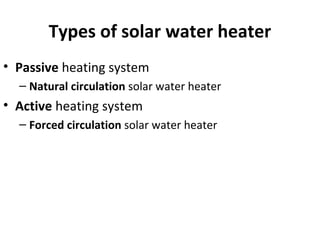
Types of solar water heater
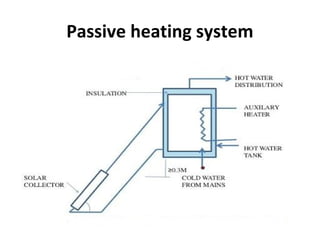
• Passive heating system
– Natural circulation solar water heater
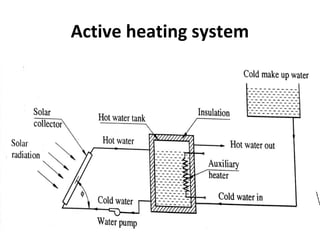
• Active heating system
– Forced circulation solar water heater
Passive heating system
Active heating system
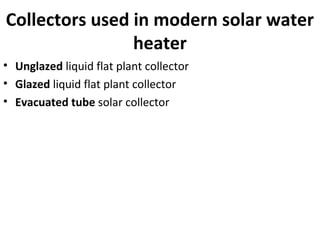
Collectors used in modern solar water
heater
• Unglazed liquid flat plant collector
• Glazed liquid flat plant collector
• Evacuated tube solar collector
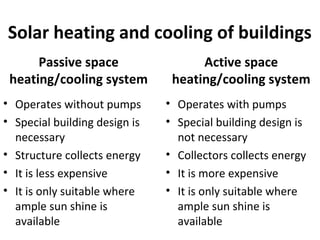
Solar heating and cooling of buildings
Passive space
heating/cooling system
• Operates without pumps
• Special building design is
necessary
• Structure collects energy
• It is less expensive
• It is only suitable where
ample sun shine is
available
Active space
heating/cooling system
• Operates with pumps
• Special building design is
not necessary
• Collectors collects energy
• It is more expensive
• It is only suitable where
ample sun shine is
available
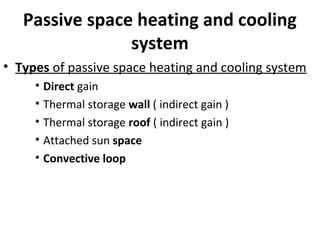
Passive space heating and cooling
system
• Types of passive space heating and cooling system
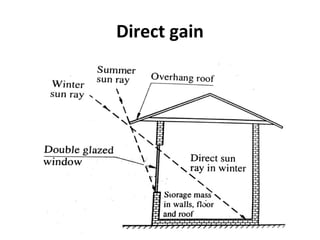
• Direct gain
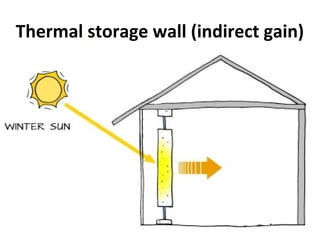
• Thermal storage wall ( indirect gain )
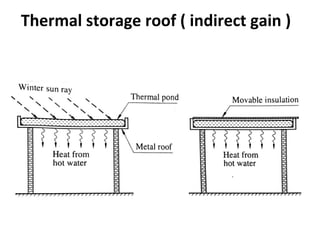
• Thermal storage roof ( indirect gain )
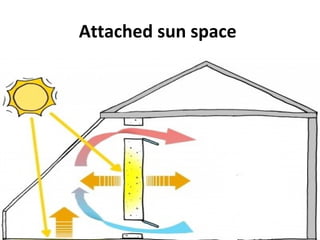
• Attached sun space
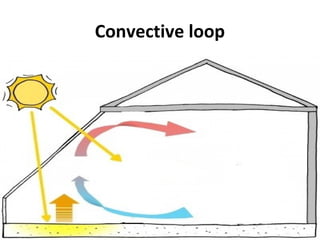
• Convective loop
Direct gain
Thermal storage wall (indirect gain)
Thermal storage roof ( indirect gain )
Attached sun space
Convective loop
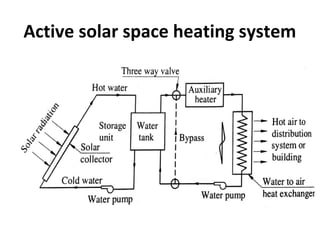
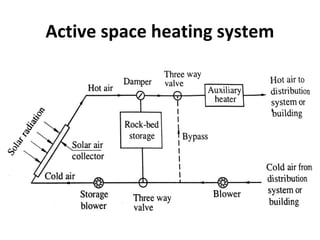
Active solar space heating system
Active space heating system
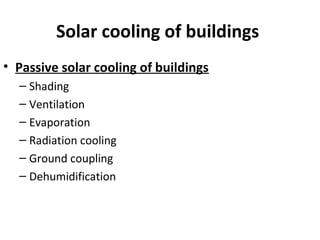
Solar cooling of buildings
• Passive solar cooling of buildings
– Shading
– Ventilation
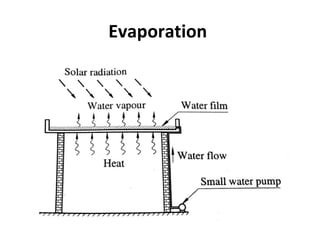
– Evaporation
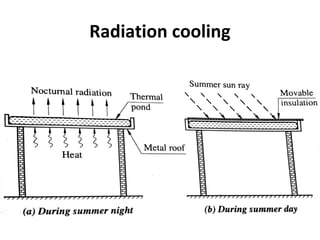
– Radiation cooling
– Ground coupling
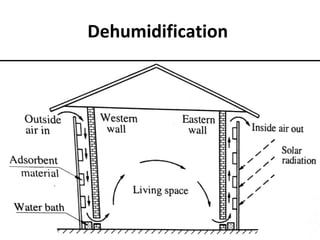
– Dehumidification
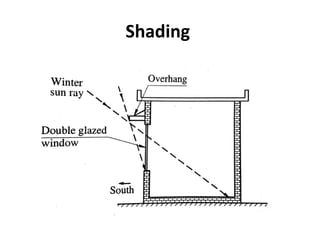
Shading
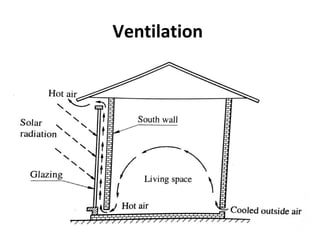
Ventilation
Evaporation
Radiation cooling
Dehumidification
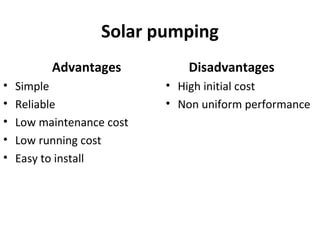
Solar pumping
• It has following types
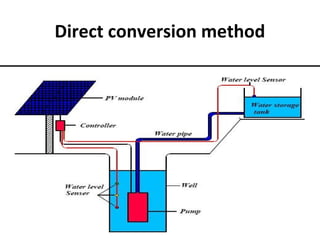
– Direct conversion method
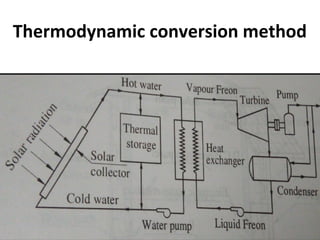
– Thermodynamic conversion method
• It is most attractive technology in remote areas
• It maintains socio - economic benefits
• It is used for agriculture, industrial and domestic
applications
Direct conversion method
Thermodynamic conversion method
Solar pumping
Advantages
• Simple
• Reliable
• Low maintenance cost
• Low running cost
• Easy to install
Disadvantages
• High initial cost
• Non uniform performance
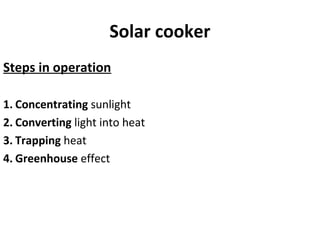
Solar cooker
Steps in operation
1. Concentrating sunlight
2. Converting light into heat
3. Trapping heat
4. Greenhouse effect
Solar cooker
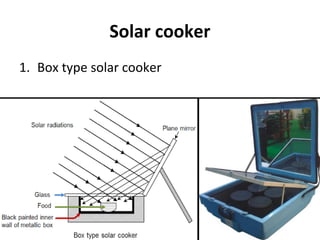
1. Box type solar cooker
Solar cooker
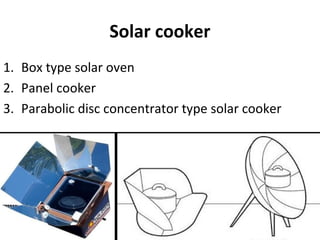
1. Box type solar oven
2. Panel cooker
3. Parabolic disc concentrator type solar cooker
Solar cooker
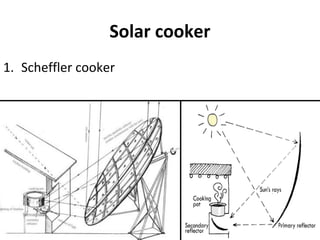
1. Scheffler cooker
Solar cooker
Advantages
• No fuel requirement and
hygienic
• 1 time investment and less
maintenance
• No residues
• Easy to handle
• Low fuel cost
• No fire hazard
Disadvantages
• Time consuming
• Difficult using in rainy
season
• Can perform limited
functions
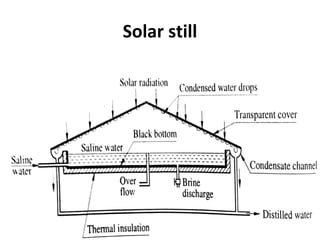
Solar still
• It generates fresh water having impurities lower than
500ppm with solar distillation method.
• It has 5-10cm level of water with air tight cover and
transparent roof.
• It have efficiency of 30% to 35% in sunny days.
Solar still
Solar drying
• Sun drying
• Solar drying is divided as following
1. DIRECT type with NATURAL convection type solar
dryer
2. DIRECT type with FORCED convection type solar dryer
3. INDIRECT type with FORCED convection type solar
dryer
Sun drying
• Sun drying takes place by storing the products under direct
sunlight
• It does not require skill and running cost as well as
investment cost
• Products are unsafe from foreign objects so it is not
preferable
• It dependence on many factors
Solar drying
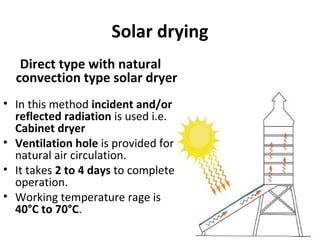
Direct type with natural
convection type solar dryer
• In this method incident and/or
reflected radiation is used i.e.
Cabinet dryer
• Ventilation hole is provided for
natural air circulation.
• It takes 2 to 4 days to complete
operation.
• Working temperature rage is
40°C to 70°C.
Solar drying
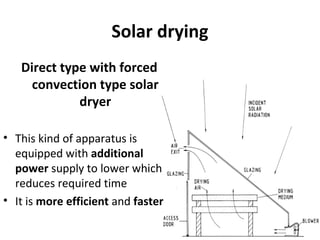
Direct type with forced
convection type solar
dryer
• This kind of apparatus is
equipped with additional
power supply to lower which
reduces required time
• It is more efficient and faster
Solar drying
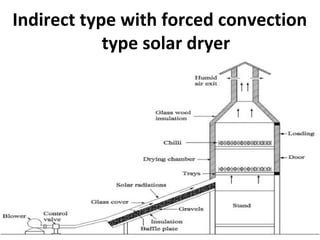
Indirect type with forced convection type solar dryer
• This is the most advance method with additional power
which is used at low as well as high temperature
• It is a low running cost machine with multi product system
• It suitable for grains, spices, ceramics, leathers etc
Indirect type with forced convection
type solar dryer
Solar drying
• Advantages
– It is rapid process
– It reduce risk of spoilage and humidity
– It improves quality of products
– It works above than ambient temperature from 10°C to
30°C
– Running and maintenance costs are much lesser
– It saves product from foreign debris
Solar refrigeration & air conditioning
• ozone layer depletion
• Global warming
• Types of solar R & AC
• PV operated refrigeration system
• Refrigeration system with thermal collectors
– Vapour Compression Refrigeration system (VCR)
– Vapour Absorption Refrigeration system (VAR)
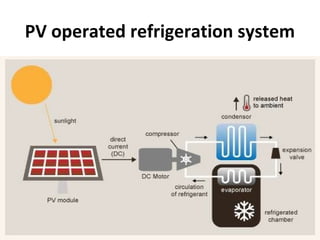
PV operated refrigeration system
• Direct electricity is generated from semiconductors by
means of PV cells.
• The consideration in designing the PV refrigeration cycle
involves appropriately matching the electrical
characteristics of the motor driving the compressor with
available current and voltage being produced by the pv
array.
PV operated refrigeration system
Refrigeration system with thermal
collectors
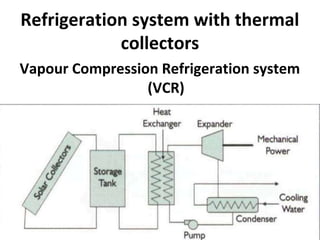
Vapour Compression Refrigeration system
(VCR)
Refrigeration system with thermal
collectors
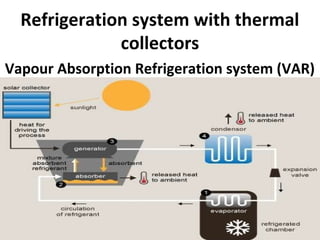
Vapour Absorption Refrigeration system (VAR)
Solar refrigeration & air conditioning
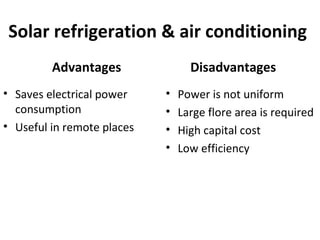
Advantages
• Saves electrical power
consumption
• Useful in remote places
Disadvantages
• Power is not uniform
• Large flore area is required
• High capital cost
• Low efficiency
Solar pond
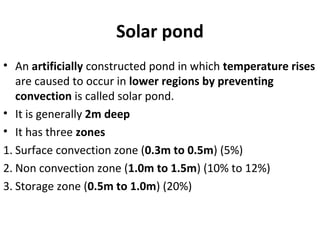
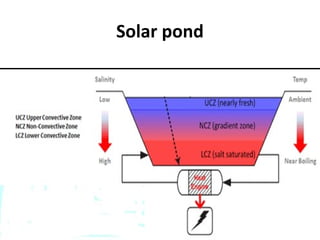
• An artificially constructed pond in which temperature rises
are caused to occur in lower regions by preventing
convection is called solar pond.
• It is generally 2m deep
• It has three zones
1. Surface convection zone (0.3m to 0.5m) (5%)
2. Non convection zone (1.0m to 1.5m) (10% to 12%)
3. Storage zone (0.5m to 1.0m) (20%)
Solar pond
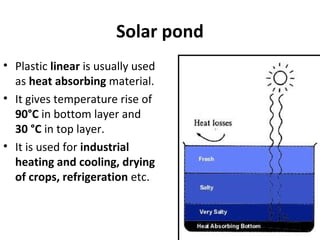
• Plastic linear is usually used
as heat absorbing material.
• It gives temperature rise of
90°C in bottom layer and
30 °C in top layer.
• It is used for industrial
heating and cooling, drying
of crops, refrigeration etc.
Solar pond
Solar power plants
• Solar photovoltaic technology
• Solar thermal power plant is
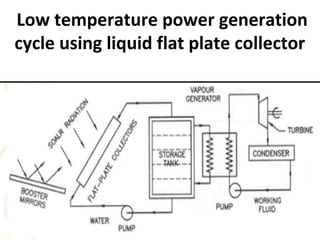
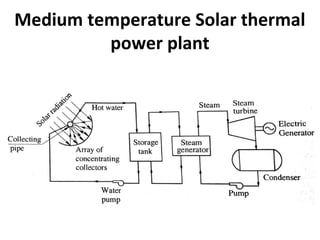
– Low / Medium / High temperature cycle
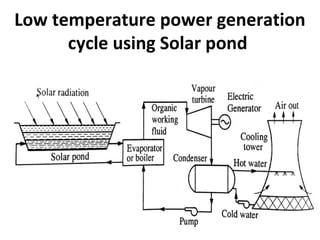
– Solar pond power plant
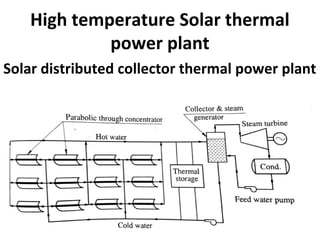
– Solar distributed collector thermal power plant
– Central receiver system or power tower heliostat
– Solar chimney power plant
Low temperature power generation
cycle using liquid flat plate collector
Low temperature power generation
cycle using Solar pond
Medium temperature Solar thermal
power plant
High temperature Solar thermal
power plant
Solar distributed collector thermal power plant
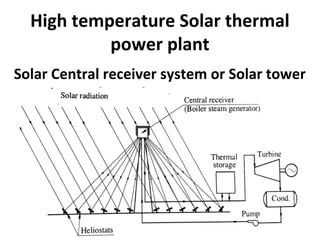
High temperature Solar thermal
power plant
Solar Central receiver system or Solar tower
thermal power tower
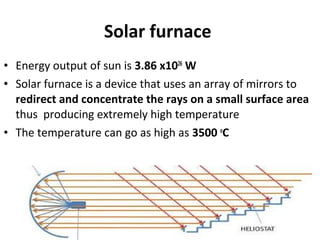
Solar furnace
• Energy output of sun is 3.86 x1026
W
• Solar furnace is a device that uses an array of mirrors to
redirect and concentrate the rays on a small surface area
thus producing extremely high temperature
• The temperature can go as high as 3500 o
C
Solar furnace
Advantages
• Heat produced is very
clean
• Low operating cost
• Reduces the need to burn
fossil fuels
Disadvantages
• Never been fully explored
or used on a widespread
commercial basis.
• Highly setup expensive.
• Large flore area required.
Solar furnace
• Applications
– Perform scientific experiments which require extreme
temperature
– Running steam turbines
– Domestic uses
– Agricultural uses as drying of farm produce
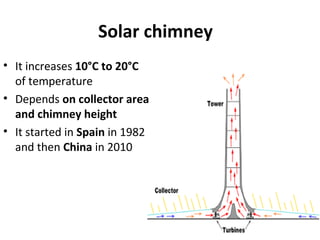
Solar chimney
• It increases 10°C to 20°C
of temperature
• Depends on collector area
and chimney height
• It started in Spain in 1982
and then China in 2010
Solar energy applications

Solar energy applications

  • 1.
    Branch : ME– D1 Prepared by: MEHUL VORA (140120119249) Guided by: Prof. Maulik Sukhadiya RENEWABLE ENERGY ENGINEERING (2181910) Solar energy applications
  • 2.
    Flow of presentation •Storage of solar thermal energy • Solar water heater • Solar heating & cooling of buildings • Solar pumping • Solar cooker • Solar still • Solar drying • Solar refrigeration & air conditioning • Solar pond • Solar power plants • Solar chimney • Solar furnace
  • 3.
    Thermal storage ofsolar energy • Intermittent in nature • Significant fluctuation • Storage can be done by electrical devices or physical media • Frequency can be maintained
  • 4.
    Storage methods • Thermal –Molten salt • Electrical – Capacitors • Chemical – Bio fuels • Electrochemical – Batteries • Biological – Starch • Mechanical – Hydraulic storage
  • 5.
    Methods to storesolar thermal energy • Sensible heat storage – Liquid storage system – Solid storage system • Latent heat storage • Odd energy method
  • 6.
    Advantages of energystorage • Quantifiable return • Reduces emission • Size and cost of a system can be reduced • Saves fossil fuel • Increases load factor of generation up to 25% • Delay the need of additional power plant
  • 7.
    Solar water heater •Steps in operation – Collection – Transfer – Storage
  • 8.
    Solar water heater •Advantages of solar water heater – Low operation cost – Low vibration and noise – Free from smoke and clean – Long life span
  • 9.
    Types of solarwater heater • Passive heating system – Natural circulation solar water heater • Active heating system – Forced circulation solar water heater
  • 10.
  • 11.
  • 12.
    Collectors used inmodern solar water heater • Unglazed liquid flat plant collector • Glazed liquid flat plant collector • Evacuated tube solar collector
  • 13.
    Solar heating andcooling of buildings Passive space heating/cooling system • Operates without pumps • Special building design is necessary • Structure collects energy • It is less expensive • It is only suitable where ample sun shine is available Active space heating/cooling system • Operates with pumps • Special building design is not necessary • Collectors collects energy • It is more expensive • It is only suitable where ample sun shine is available
  • 14.
    Passive space heatingand cooling system • Types of passive space heating and cooling system • Direct gain • Thermal storage wall ( indirect gain ) • Thermal storage roof ( indirect gain ) • Attached sun space • Convective loop
  • 15.
  • 16.
    Thermal storage wall(indirect gain)
  • 17.
    Thermal storage roof( indirect gain )
  • 18.
  • 19.
  • 20.
    Active solar spaceheating system
  • 21.
  • 22.
    Solar cooling ofbuildings • Passive solar cooling of buildings – Shading – Ventilation – Evaporation – Radiation cooling – Ground coupling – Dehumidification
  • 23.
  • 24.
  • 25.
  • 26.
  • 27.
  • 28.
    Solar pumping • Ithas following types – Direct conversion method – Thermodynamic conversion method • It is most attractive technology in remote areas • It maintains socio - economic benefits • It is used for agriculture, industrial and domestic applications
  • 29.
  • 30.
  • 31.
    Solar pumping Advantages • Simple •Reliable • Low maintenance cost • Low running cost • Easy to install Disadvantages • High initial cost • Non uniform performance
  • 32.
    Solar cooker Steps inoperation 1. Concentrating sunlight 2. Converting light into heat 3. Trapping heat 4. Greenhouse effect
  • 33.
    Solar cooker 1. Boxtype solar cooker
  • 34.
    Solar cooker 1. Boxtype solar oven 2. Panel cooker 3. Parabolic disc concentrator type solar cooker
  • 35.
  • 36.
    Solar cooker Advantages • Nofuel requirement and hygienic • 1 time investment and less maintenance • No residues • Easy to handle • Low fuel cost • No fire hazard Disadvantages • Time consuming • Difficult using in rainy season • Can perform limited functions
  • 37.
    Solar still • Itgenerates fresh water having impurities lower than 500ppm with solar distillation method. • It has 5-10cm level of water with air tight cover and transparent roof. • It have efficiency of 30% to 35% in sunny days.
  • 38.
  • 39.
    Solar drying • Sundrying • Solar drying is divided as following 1. DIRECT type with NATURAL convection type solar dryer 2. DIRECT type with FORCED convection type solar dryer 3. INDIRECT type with FORCED convection type solar dryer
  • 40.
    Sun drying • Sundrying takes place by storing the products under direct sunlight • It does not require skill and running cost as well as investment cost • Products are unsafe from foreign objects so it is not preferable • It dependence on many factors
  • 41.
    Solar drying Direct typewith natural convection type solar dryer • In this method incident and/or reflected radiation is used i.e. Cabinet dryer • Ventilation hole is provided for natural air circulation. • It takes 2 to 4 days to complete operation. • Working temperature rage is 40°C to 70°C.
  • 42.
    Solar drying Direct typewith forced convection type solar dryer • This kind of apparatus is equipped with additional power supply to lower which reduces required time • It is more efficient and faster
  • 43.
    Solar drying Indirect typewith forced convection type solar dryer • This is the most advance method with additional power which is used at low as well as high temperature • It is a low running cost machine with multi product system • It suitable for grains, spices, ceramics, leathers etc
  • 44.
    Indirect type withforced convection type solar dryer
  • 45.
    Solar drying • Advantages –It is rapid process – It reduce risk of spoilage and humidity – It improves quality of products – It works above than ambient temperature from 10°C to 30°C – Running and maintenance costs are much lesser – It saves product from foreign debris
  • 46.
    Solar refrigeration &air conditioning • ozone layer depletion • Global warming • Types of solar R & AC • PV operated refrigeration system • Refrigeration system with thermal collectors – Vapour Compression Refrigeration system (VCR) – Vapour Absorption Refrigeration system (VAR)
  • 47.
    PV operated refrigerationsystem • Direct electricity is generated from semiconductors by means of PV cells. • The consideration in designing the PV refrigeration cycle involves appropriately matching the electrical characteristics of the motor driving the compressor with available current and voltage being produced by the pv array.
  • 48.
  • 49.
    Refrigeration system withthermal collectors Vapour Compression Refrigeration system (VCR)
  • 50.
    Refrigeration system withthermal collectors Vapour Absorption Refrigeration system (VAR)
  • 51.
    Solar refrigeration &air conditioning Advantages • Saves electrical power consumption • Useful in remote places Disadvantages • Power is not uniform • Large flore area is required • High capital cost • Low efficiency
  • 52.
    Solar pond • Anartificially constructed pond in which temperature rises are caused to occur in lower regions by preventing convection is called solar pond. • It is generally 2m deep • It has three zones 1. Surface convection zone (0.3m to 0.5m) (5%) 2. Non convection zone (1.0m to 1.5m) (10% to 12%) 3. Storage zone (0.5m to 1.0m) (20%)
  • 53.
    Solar pond • Plasticlinear is usually used as heat absorbing material. • It gives temperature rise of 90°C in bottom layer and 30 °C in top layer. • It is used for industrial heating and cooling, drying of crops, refrigeration etc.
  • 54.
  • 55.
    Solar power plants •Solar photovoltaic technology • Solar thermal power plant is – Low / Medium / High temperature cycle – Solar pond power plant – Solar distributed collector thermal power plant – Central receiver system or power tower heliostat – Solar chimney power plant
  • 56.
    Low temperature powergeneration cycle using liquid flat plate collector
  • 57.
    Low temperature powergeneration cycle using Solar pond
  • 58.
    Medium temperature Solarthermal power plant
  • 59.
    High temperature Solarthermal power plant Solar distributed collector thermal power plant
  • 60.
    High temperature Solarthermal power plant Solar Central receiver system or Solar tower thermal power tower
  • 61.
    Solar furnace • Energyoutput of sun is 3.86 x1026 W • Solar furnace is a device that uses an array of mirrors to redirect and concentrate the rays on a small surface area thus producing extremely high temperature • The temperature can go as high as 3500 o C
  • 62.
    Solar furnace Advantages • Heatproduced is very clean • Low operating cost • Reduces the need to burn fossil fuels Disadvantages • Never been fully explored or used on a widespread commercial basis. • Highly setup expensive. • Large flore area required.
  • 63.
    Solar furnace • Applications –Perform scientific experiments which require extreme temperature – Running steam turbines – Domestic uses – Agricultural uses as drying of farm produce
  • 64.
    Solar chimney • Itincreases 10°C to 20°C of temperature • Depends on collector area and chimney height • It started in Spain in 1982 and then China in 2010