Solar Energy AndTechnology Volume 2
Encyclopedia download
https://ebookbell.com/product/solar-energy-and-technology-
volume-2-encyclopedia-51025808
Explore and download more ebooks at ebookbell.com
2.
Here are somerecommended products that we believe you will be
interested in. You can click the link to download.
Solar Energy And Technology Volume 1 Englishgerman Dictionary
Deutschenglisch Wrterbuch
https://ebookbell.com/product/solar-energy-and-technology-
volume-1-englishgerman-dictionary-deutschenglisch-wrterbuch-51025810
Solar Energy And Technology Encyclopedia Goran Mijic
https://ebookbell.com/product/solar-energy-and-technology-
encyclopedia-goran-mijic-23947062
Nonimaging Optics In Solar Energy Synthesis Lectures On Energy And The
Environment Technology S 1st Edition Joseph J Ogallagher
https://ebookbell.com/product/nonimaging-optics-in-solar-energy-
synthesis-lectures-on-energy-and-the-environment-technology-s-1st-
edition-joseph-j-ogallagher-1205988
Solar Hydrogen Energy Systems Science And Technology For The Hydrogen
Economy 2012th Edition Gabriele Zini
https://ebookbell.com/product/solar-hydrogen-energy-systems-science-
and-technology-for-the-hydrogen-economy-2012th-edition-gabriele-
zini-4070716
3.
Wind And SolarBased Energy Systems For Communities Rupp Carriveau
https://ebookbell.com/product/wind-and-solar-based-energy-systems-for-
communities-rupp-carriveau-7027932
Solar Photovoltaic Energy Anne Labouret Michel Villoz
https://ebookbell.com/product/solar-photovoltaic-energy-anne-labouret-
michel-villoz-4148950
Advanced Characterization Of Thin Film Solar Cells Energy Engineering
Mowafak Aljassim Editor
https://ebookbell.com/product/advanced-characterization-of-thin-film-
solar-cells-energy-engineering-mowafak-aljassim-editor-33122642
The Research Report On Application Of Lowcarbon Technology In Expo
2010 Shanghai 1st Edition Unido International Solar Energy Center For
Technology Promotion And Transfer Unidoisec
https://ebookbell.com/product/the-research-report-on-application-of-
lowcarbon-technology-in-expo-2010-shanghai-1st-edition-unido-
international-solar-energy-center-for-technology-promotion-and-
transfer-unidoisec-4935252
Solar Energy Technology Handbook Part B Applications Systems Design
And Economics Cheremisinoff Paul N
https://ebookbell.com/product/solar-energy-technology-handbook-part-b-
applications-systems-design-and-economics-cheremisinoff-paul-n-7160506
Also of interest
SolarEnergy and Technology
Volume 1: English-German Dictionary / Deutsch-Englisch Wörterbuch
Mijic, 2016
ISBN 978-3-11-047575-3, e-ISBN 978-3-11-047717-7
Green Energy
Efficient Processes for Functional Materials
Lublow, 2018
ISBN 978-3-11-049690-1, e-ISBN 978-3-11-049694-9
Power-to-Gas
Renewable Hydrogen Economy for the Energy Transition
Boudellal, 2018
ISBN 978-3-11-055881-4, e-ISBN 978-3-11-055981-1
Solar Cells and Energy Materials
Oku, 2017
ISBN 978-3-11-029848-2, e-ISBN 978-3-11-029850-5
Organic and Hybrid Solar Cells
An Introduction
Schmidt-Mende, Weickert, 2016
ISBN 978-3-11-028318-1, e-ISBN 978-3-11-028320-4
To my wifeAmira, my daughter Lara, and my mother Brana:
The light in my life
11.
Preface
The Sun isan immense, constant, inexhaustible source of energy. The amount of
energy the Sun sends down to the Earth over a 24-h day averages 164 W/m2.
After a sudden burst of radiation from the Sun, particles are accelerated to nearly
the speed of light and released into the Sun’s atmosphere. It takes approximately
8 minutes and 20 seconds for moving particles without mass called photons to travel
across the vacuum of space from the Sun to the Earth. Photon is both wave and particle.
These packets of energy act as waves when traveling through space. When a photon hits
a solar panel, it acts as a particle, giving up its energy to an electron. The photosensitive
semiconductor material, such as silicon, absorbs the energy of the photons, which is
strong enough to knock electrons out of the silicon atoms. The minimum photon energy
required to induce photoconductivity and generate mobile electrons and holes is 1.1 eV.
With this amount of energy, the excited electrons from the p-type layer are able to cross
the p–n junction barrier and enter the n-type layer, starting a current flow. The elec-
trons flow outside of the solar cell to the load and return through the back contact to the
p-type semiconductor layer, occupying the vacant positions (holes) and thus closing
the circuit. The solar cell output in direct sun is between 3 and 6 A and around 0.5 V.
Although humans had been aware of and used, to some extent, the tremendous
potential of solar energy dating back to as far as seventh century BC, it was only after
the invention of the first silicon photovoltaic cell in 1954 that the science and indus-
try embarked on a rapid solar journey, which is characterized by an ever-accelerat-
ing pace of new technologies. Over the past five decades, three generations of solar
cells have been developed, competing in today’s global market for best performance,
quality, and price: 1. conventional monocrystalline and polycrystalline silicon solar
cells; 2. thin-film polymer solar cells; and 3. multijunction solar cells. Solar panels
are mainly deployed in three sectors: residential (on home rooftops), commercial (on
companies’ rooftops), and utility scale (in solar power plants).
In recent years, solar companies and countries have been in a race to maximize
energy density, which is the amount of energy that can be produced by a solar module
per unit area – Watts per square meter or foot (W/m2 or W/ft2). Nanotechnology plays
an important role in the development of miniature structures, such as carbon nano-
tubes(fullerene,C60),quantumdots,nanowires,nanopillar,nanocrystals,nanofibers,
nanoporous filters, nanoparticulate metal oxides, dispersion nanoparticles, nanopin
film, and polymer nanocomposites. The tendency in photovoltaic nanoindustry to
design and build structures on a very small scale, from 1 to 100 nm, has the capability
to significantly increase the energy conversion efficiency. The more efficient the solar
panel, the more electricity (W/m2 or W/ft2) can be generated from the same aperture
surface of a solar array, which is of vital importance in densely populated urban areas
with limited space for solar installation.
The rapid development of a wide variety of solar technologies, new semiconductor
materials, and solar infrastructure has brought a flood of new words and technical
https://doi.org/10.1515/9783110477214-201
12.
VIII Preface
terms. Newlycoined words, expressions, and acronyms from the solar field are appear-
ing at an astonishing speed. Due to their novelty and their use as modern technical
buzzwords, they often have a vague and ambivalent meaning for users. The goal of this
volume is to provide precise definitions of solar terms and ensure the correct usage
of neologisms, helping them become widely accepted into the mainstream language.
Volume 2 intends to cover all main aspects of solar energy and technology. It
serves as a reference for quick learning of particular topics. Students, solar novices,
researchers, and solar practitioners of all kinds may use the solar encyclopedia to
quickly understand the basics of a specific concept. After reading a brief but thorough
entry, users can follow the trace of cross-references to widen the semantic scope of a
term and further explore the topic.
The development of solar energy and technology holds promise for a brighter
future. Together with other renewable energy sources, such as wind and hydro,
solar technology promotes the generation of carbon-free sustainable energy. We can
manage our development, construction, businesses, and civilization in such a way
that we do not deplete the Earth’s natural resources and permanently damage our
environment for today’s and future generations. Sustainability maintains or improves
the quality of life and supports a long-term ecological balance. The search for life on
distant planets is an important endeavor. However, it is more urgent to save the life on
the only habitable planet we know so far – the Earth.
According to the latest U.S. Energy Information Administration’s International
Energy Outlook 2017, global energy consumption is expected to increase by 28% by
2040. In order to prevent the emission of millions of additional tons of harmful pol-
lution (greenhouse gases) into the atmosphere, potentially leading to unexpected
weather patterns and climate changes, a serious paradigm shift is necessary: solar and
other renewable energies must grow significantly faster than fossil fuels. This encyclo-
pedia is my contribution to rethinking the future and focusing all our attention and
solar surfaces toward the sun. In conversation with his friends Henry Ford and Harvey
Firestone in 1931, Thomas Edison said: “I’d put my money on the sun and solar energy.
What a source of power! I hope we don’t have to wait till oil and coal run out before
we tackle that.” Volume 2 fosters the adoption and spreading of solar economy, infra-
structure, and culture. Solar, wind, and other types of sustainable power generation
can meet the majority of our energy demand. Solar power gives nations as well as indi-
viduals an opportunity to gain more control over their energy supply or even complete
energy independence. It is a quiet but powerful way to defuse international conflicts
that are all too often associated with the control of oil and other fossil fuels and arbi-
trary price fluctuations. Solar energy is a peaceful, clean, environmentally friendly
power source that is freely available to everyone on the planet. So, why not use it?
Sandy, UT, USA Goran Mijic
June 2018
12-V system 3
12-Vsystem An off-grid system that uses →direct current (DC) from
photovoltaic (PV) panels with a voltage of about 12 V
to power camping appliances that can be operated at
the same voltage, such as lights, water pump, fan, TV,
coffee maker, or microwave oven. Small PV systems on
an RV or a boat use small battery banks that are wired
to provide a constant 12-V power source for electrical
equipment.
2D nanoscale electrodes Advanced nanomaterial, such as graphene nanosheets
and nanoparticle–nanowire hybrids, that has 2D architec-
ture and is utilized for solar energy conversion and storage.
3D architecture Visualization technology that allows a user to design a
future small- or large-scale solar system in three dimen-
sions with the help of realistic drawings that can be
easily modified and looked at from different directions.
3D architecture software gives the user a general view
of the entire structure as well as a more detailed view of
complex areas, such as wiring or mounting components.
A row of solar modules can cast shade on adjacent rows
of solar panels. A shadow visualization across differ-
ent seasons can help calculate an appropriate distance
between the rows of solar modules, thus avoiding energy
losses due to shading. 3D architecture is also helpful
when integrating solar panels into existing as well as
new building design.
3D nanoscale electrodes Advanced nanomaterial, such →carbon nanotubes, that
has 3D architecture and is used for solar energy conversion
and high-performance energy storage.
3-phase current See →three-phase current.
A
abrasion A wearing away of a surface, such as a protective cover
glass of a solar panel, as a result of applied friction.
abrasion resistance The ability of a surface to resist →abrasion and keep the
material’s original structure and look.
16.
4 abrasion strength
abrasionstrength See →abrasive hardness.
abrasion-proof coating See →abrasion-resistant coating.
abrasion-resistant
coating
A coating that is applied to the top protective glass sheet of
a solar panel or a solar reflector to resist the deterioration of
the surface material caused by scratching, rubbing, or other
types of mechanical wear. The improved scratch resistance
allows more aggressive cleaning methods and provides a
good protection against wind-blown sand and other debris.
abrasive hardness A measure of the wearing qualities of a surface material sub-
jectedto→abrasionbyscratchingorothermechanicalimpact.
ABS Abbreviation for acrylonitrile butadiene styrene. See →ABS
plastic.
ABS plastic (Acrylonitrile butadiene styrene) Low-cost engineering
plastic, which is a part of thermoplastic polymers family.
Due to its light weight and resistance to impact, sun, and
moisture, it is commonly used for the manufacturing of
outdoor →solar lighting systems, such as →garden lights or
→solar-powered LED lights, junction and other electronic
boxes and enclosures, and solar panel mounting brackets.
absence detector See →presence detector.
absolute humidity Water vapor amount present in a given volume of air.
absolute permittivity Measure of the resistance that is encountered when
forming an electric field in a medium.
absolute zero The lowest possible temperature at which the fundamental
particles have minimal vibrational motion.
absorbance Solarenergyratioformeasuringtheefficiencyofasolarcellor
module. It is a proportion of solar radiation a surface absorbs.
absorbed glass mat (AGM) A fiberglass mat, sandwiched between the battery
cell plates, in which the electrolyte is held. AGM batteries
utilize absorbent glass mats instead of liquid electrolyte
that is used in traditional flooded batteries. See →absorbed
glass mat battery.
absorbed glass mat
battery
Absorbed glass mat (AGM) battery is a type of a sealed lead-
acid (SLA) rechargeable battery that uses absorbent glass
mats instead of liquid electrolyte. Unlike the liquid electro-
lyte surrounding the electrodes, a very fine fiberglass mat
17.
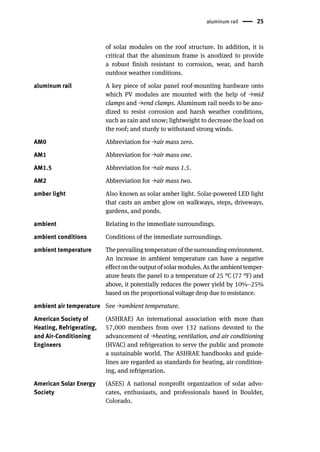
absorbed light 5
Plateblock
Negative plate
Negative grid
Positive grid
Positive plate
Positive plate with
fiberglass separator
Absorbed Glass Mat Battery
is saturated with the sulfuric acid, encapsulated, and
sandwiched between the positive and negative battery
plates. Even though the battery acid is immobilized by the
fiberglass mat, it is still available to the plates. As a result,
the battery is spill-proof and at the same time also still
highly reactive due to the close proximity between acid and
plates. This configuration improves both the discharge and
recharge efficiency. AGM batteries can charge up to five
times faster than flooded battery systems. They are more
resistant to cold weather and vibration and enable high
cranking. Disadvantages of AGM batteries include higher
manufacturing costs and environmental hazards.
absorbed light The amount of light that is neither reflected from the cell
surface nor transmitted through the semiconductor mate-
rial and lost. Only the absorbed photons lead to the gener-
ation of charge carriers, →electrons and →holes.
absorbent glass mat (AGM) A fiberglass mat, sandwiched between the battery
cell plates, in which the electrolyte is held. AGM batteries
utilize absorbent glass mats instead of liquid electrolyte
that is used in traditional flooded batteries. See →absorbed
glass mat battery.
absorber Also known as solar collector plate or collector plate. A
dark-coated plate in a solar collector that actively absorbs
18.
6 absorber area
thesolar radiation and converts it into heat. The collected
heat is then transferred to the fluid (water or glycol heat
transfer fluid) running through the copper tubes of the
thermal collector. The quality of an absorber is measured
by the absorption–emission ratio. A good ratio would be
10 and higher, for example, 0.90% absorption–0.10%
emission, which can be achieved through the application
of →selective surface coatings to the surface of an absorber.
absorber area Dark-coated area of a solar collector that actively absorbs
the solar radiation and converts it into heat.
absorber body Body of a solar collector absorber that actively absorbs the
solar radiation and converts it into heat.
absorber coating Most absorbers of solar collectors are painted with flat
black paint. Black paint has high solar absorptance, but
its infrared emittance is also high, resulting in higher
thermal losses. To mitigate this thermal deficiency, special
coatings have been developed in past years with high solar
absorptance and low thermal emittance features called
→selective surface coatings.
absorber layer Layer of a solar collector absorber that actively absorbs the
solar radiation and converts it into heat.
absorber pipe See →absorber tube.
absorber plate See →absorber.
absorber tube Alsoknownasabsorberpipeorcalledheatcollectionelement
(HCE). A long metal tube that runs the length of a →concen-
trating parabolic trough or →linear Fresnel reflector (LFR).
The→heattransferfluidisheatedintheparabolictrough
absorber tubes and then circulated to a heat exchanger,
converting water into steam that powers a steam turbine.
In order to achieve a maximum absorption of solar radia-
tion, the metal tube is coated with special materials, such
as black chrome or cermet. To minimize heat losses, the
metal tube is covered with glass, creating a vacuum effect
in the empty space between glass and metal. This →Dewar
tubelike insulation keeps thermal losses at 10%.
The LFR tube consists of numerous small boiler tubes
through which water flows. The heated water evaporates
in the tubes, generating superheated steam, reaching a
high temperature of about 270 °C (518 °F).
19.
absorbing 7
absorbing See→absorption.
absorptance The ratio of solar radiation absorbed by a surface to that
incident on the surface.
absorption A process by which photons of light are absorbed as they
enter the aperture area of a solar module.
absorption capacity Capacity of an aperture area of a solar module to absorb
solar radiation.
absorption charge See →absorption charge stage.
absorption charge
stage
The second stage in a three-stage lead-acid battery charge
cycle to which the charge controller automatically switches
when the battery has reached 80% state of charge. At
this stage, the battery is charged at a slowly diminish-
ing rate to prevent overheating. The controller holds the
voltage at a constant level and decreases the current until
the battery has reached between 95% and 98% state of
charge, depending on the charger brand, when it switches
to →float charge stage.
absorption charging See →absorption charge stage.
absorption chiller A cooling device that can use hot water heated by solar
thermal collectors to cool air and thereby provide air con-
ditioning for a residential or commercial building.
absorption coefficient Solar energy ratio for measuring the efficiency of a solar
cell or module. It is a proportion of solar radiation a surface
absorbs.
absorption cooling See →solar absorption system.
absorption depth Indicates how deep an electromagnetic wave can pene-
trate into a material.
absorption factor See →absorption coefficient.
absorption glass mat (AGM) A fiberglass mat, sandwiched between the battery
cell plates, in which the electrolyte is held. AGM batteries
utilize absorbent glass mats instead of liquid electrolyte
that is used in traditional flooded batteries. See →absorbed
glass mat battery.
absorption loss The part of electromagnetic radiation incident on a PV
surface that is not absorbed by the semiconductor mate-
rial. The maximum solar cell efficiency was around 30% in
20.
8 absorption ofelectromagnetic radiation
2017. About 70% of radiant energy is lost due to various
causes. A little bit less than half of solar radiation is lost as
heat and around 18% of the photons pass straight through
the PV cell and vanish. One part is reflected off the solar
cell surface and there are also losses due to manufacturing
impurities in the semiconductor and the resistance at the
junction between metallic contacts and the silicon semi-
conductor.
absorption of
electromagnetic
radiation
A process by which photons of light are absorbed by atoms
of the semiconductor material and converted into other
forms of energy, such as electricity or heat. The interac-
tion between the photons of light and the semiconductor
promotes →valence band electrons to excited states in
which they are able to bridge the →band gap and jump to
the →conduction band. As a result, electron–hole pairs are
created that are responsible for the flow of current in the
semiconductor.
absorption of light See →absorption of electromagnetic radiation.
absorption rate The rate at which radiant energy is absorbed by a surface.
absorption refrigerator See →absorption chiller.
absorption stage See →absorption charge stage.
absorptivity See →absorptance.
AC Abbreviation for →alternating current.
AC disconnect A safety component that disconnects the inverter from the
electrical grid.
AC grid stability A prerequisite for a stable electricity grid is a continuous
balance between energy production and consumption.
With a higher penetration of renewable energy resources,
such as solar systems or wind turbines, the stability of
the grid is seriously challenged. For an AC electrical grid
to remain stable, the frequency and phase of all energy
generation units must remain synchronous within narrow
limits. Voltage control, load shedding, energy storage,
and the use of synchronous condensers are some of the
methods for improving the grid stability.
AC inverter and battery
power allowance
A small amount of power needed to keep an AC inverter
and batteries running. The AC inverter and battery power
21.
AC inverter powerallowance 9
allowance should be included in →total daily power budget
estimate, as this power is also drawn from a battery bank
just like the regular load (all household appliances con-
nected to the circuit).
AC inverter power
allowance
See →AC inverter and battery power allowance.
acceptance angle The angular range over which the sun’s rays optimally
fall onto a solar panel or solar concentrator enabling high
throughput (>90%).
acceptor Dopant material with fewer electrons in the outer shell that
enables the atom to accept a free electron from another
atom.
acceptor doping Doping of the semiconductor substrate with →acceptor
atoms (→boron) that are likely to accept free electrons
when incorporated into a balanced silicon crystal struc-
ture, creating a →p-type semiconductor layer in a solar cell.
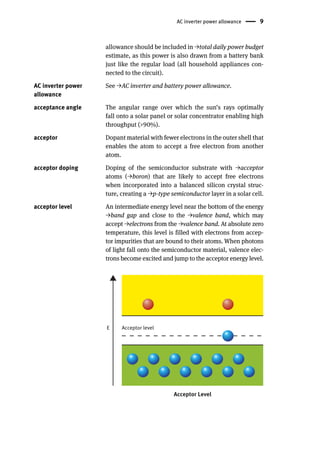
acceptor level An intermediate energy level near the bottom of the energy
→band gap and close to the →valence band, which may
accept →electrons from the →valence band. At absolute zero
temperature, this level is filled with electrons from accep-
tor impurities that are bound to their atoms. When photons
of light fall onto the semiconductor material, valence elec-
trons become excited and jump to the acceptor energy level.
Acceptor level
Acceptor Level
E
22.
10 accumulated energy
accumulatedenergy Stored energy for later use, for example, in a battery, an
elevated water reservoir, aquifer, cavern, borehole, or com-
pressed air.
accumulated power See →accumulated energy.
accumulator A rechargeable battery that can be discharged and
recharged numerous times, as opposed to disposable bat-
teries. The following rechargeable battery types are used
for solar battery banks: →lead acid battery (→flooded-cell
battery and →sealed lead-acid battery), lithium-ion battery,
→redox flow battery, and →nickel–cadmium battery.
accuracy error A difference between a specific measurement and the true
value of the quantity being measured.
acid cleaning See →acid rinsing.
acid rinsing Also known as acid cleaning. A phase in a solar cell manu-
facturing process preceded by the texturing phase in which
wafers are cleaned with acids, such as hydrogen fluoride
vapor and hydrogen chloride, to remove any unwanted
particle remains caused during the texturing process.
acid stratification Acid stratification occurs when a battery is not in use for
a long period of time. In a static lead-acid battery, the sul-
furic acid electrolyte tends to accumulate at the bottom of
the cell, resulting in increased →sulfation, reduced capac-
ity, and shortened battery life. The stratification can be
corrected and an even distribution of acid electrolyte in
various layers of battery cells restored by periodic →equal-
ization, a process of a controlled 5%–10% overcharging of
the batteries.
ACR Abbreviation for →active cavity radiometer.
ACRIM Abbreviation for →active cavity radiometer irradiance
monitor.
ACRIMSat Abbreviation for →active cavity radiometer irradiance
monitor satellite.
Acrylate® See →acrylic glass.
acrylic See →acrylic glass.
acrylic glass Also known as an Acrylate® and Plexiglas®. Acrylic glass
(polymethyl methacrylate, PMMA) is a synthetic polymer
23.
acrylonitrile 11
of methylmethacrylate that is frequently used as a
replacement for glass. This transparent and rigid thermo-
plastic finds an application in the solar industry as a top
surface material for greenhouse glazing and photovoltaic
modules due to its glasslike qualities. The PMMA acrylic
film exhibits good solar energy and light transmittance,
heat resistance, and glare control. As PMMA sheets are
two-thirds lighter than glass, they are easier to transport
and they reduce the weight impact of solar modules on the
roof structure. They are also more impact resistant than all
types of glass, withstanding high winds, hail, and vandal-
ism. Another important advantage of PMMA is cost-effec-
tiveness, as they are cheaper to produce than glass. The
biggest shortcoming of the PMMA film is its sensitivity to
high temperatures. This may pose a problem in warmer
climates, as PV panels are exposed to high temperatures
all the time. In spite of this disadvantage, the PMMA expe-
riences a widespread use and growth in the thin-film flex-
ible solar cell market.
The PMMA is also used as a templating agent for the
growth of →perovskite photovoltaic cells. The PMMA tem-
plate offers a better control of the sensitive perovskite crys-
tallization process. The acrylic glass can also be employed
as a binder material in the solar cell →screen printing.
acrylonitrile A toxic, colorless, volatile, flammable liquid compound
CH2=CH.CN, synthesized from propylene and ammonia.
Acrylonitrile is used in the manufacture of acrylic fibers
and resins, rubber, and thermoplastics.
acrylonitrile butadiene
styrene
(ABS) See →ABS plastic.
activated shelf life The period of time that a charged battery can be stored
at a specific temperature and still perform according
to its intended use and specification before it becomes
unusable.
activated stand life See →activated shelf life.
activation energy Minimum energy required to liberate a free electron and
penetrate the cell barrier.
activation voltage Minimum voltage required to liberate a free electron and
penetrate the cell barrier.
24.
12 active areaof the solar cell
active area of the solar
cell
See →aperture.
active cavity radiometer ACR, device for measuring →total solar irradiance.
active cavity radiometer
irradiance monitor
ACRIM, device for measuring →total solar irradiance.
Active Cavity Radiometer
Irradiance Monitor
Satellite
ACRIMSat, research satellite with ACRIM – device for
measuring →total solar irradiance.
active region See →active solar region.
active solar cooling A cooling process in which photovoltaic panels convert
solar energy into electricity to power a cooling unit. During
the summer, cooling accounts for more than half of the
energy use in an average household in warmer and mod-
erate climates. Solar cooling systems offer a possibility
of cutting over 50% of the electric bill by using free and
environmental friendly solar energy in summer months.
Many modern air conditioning systems are equipped with
a special port that enables an easy connection with a solar
system.
active solar energy
system
A system that utilizes electrical devices, such as →invert-
ers or →tracking systems, to generate electricity from sun-
light. Unlike →passive solar energy systems that are able
to heat and cool buildings without the use of electrical
equipment, active solar energy systems employ electri-
cal devices, such as sensors, controls, and motor-driven
systems, such as pumps and fans, to transfer the collected
solar energy across the building or to remove unwanted
heat from the house. See also →active solar heating.
active solar energy use See →active solar energy system and →active solar heating.
active solar energy
utilization
See →active solar energy system and →active solar heating.
active solar gain Utilizes photovoltaic modules to generate electricity,
as opposed to passive solar gain that uses south-facing
windows and walls to convert sunlight to heat and spread
it throughout the building.
active solar heater See →active solar heating system.
25.
active solar heating13
active solar heating In contrast to the more natural →passive solar heating, the
active solar heating techniques use moving parts, electri-
cal devices, and motor-driven systems. Both active as well
as passive solar heating systems collect and store solar
radiation, but the difference is in distribution, since the
active system utilizes mechanical equipment to circulate
the fluid throughout the building.
The active heating process can be described as follows:
the sun’s energy captured by solar collectors heats a fluid,
either liquid or air. The mechanical equipment, pumps or
fans, is then used to transfer the fluid through a system of
pipes or air ducts directly to the interior space of a building
or to a heat storage tank.
It is a more complex and involved process with higher
upfront costs, but it produces much more heat and offers
a higher level of control with the help of sensors than a
passive solar heating method. Depending on the climate
and the size of the system, at least a half of the heating
costs, and often way more than that, can be covered by an
active solar heating system.
active solar heating
system
Unlike →passive solar heating system, active solar
heating system is any solar water or air heating system
that employs pumps, fans, controls, and other electri-
cal equipment to circulate heated air or water from the
collectors to a storage tank or further throughout the
house. There are two types of active solar water-heat-
ing systems: an →open-loop system and a →closed-loop
system.
active solar region A bright active region in the outer layers of the Sun where
→solar activity, such as violent →solar flare eruptions,
occurs.
active solar retrofit The integration of →photovoltaic or →solar thermal systems
into existing structures, for example, house or yard.
active solar water-
heating system
See →active solar heating system.
active system See →active solar heating system.
actual yield Actual power output on the AC side of a photovoltaic
system; generated electricity that is ready to be used by
loads, such as household appliances or lights.
26.
14 adhesion layer
adhesionlayer An additional layer in the range of 10 nm that is added to
thin films to improve adhesion in thin-film manufactur-
ing technology. As the poor adhesion, related to surface
uncleanliness due to dirt and debris, is recognized as the
main issue in the thin-film production, the adhesion layer
is deposited immediately before the structural film depo-
sition to ensure cleanliness and thus enhance adhesion.
adhesive A material for holding materials together by bonding their
surfaces. See also →solar adhesive.
adiabat Process without heat transfer.
adiabatic Referring to a process in which volume, pressure, and tem-
perature can change without heat entering or leaving the
system.
adjustable mirror Flat-plate, parabolic, or dish mirrors that have an adjust-
able tilt mechanism guided by a →solar tracking system,
which tracks the sun as it traverses the sky.
adjustable mount See →adjustable mounting system.
adjustable mounting
system
Unlike a →fixed mounting system, an adjustable mounting
system has a rotating bearing or bracket for manual adjust-
ment of the tilt angle. The bracket usually has several
locking tilt angle settings for adjusting the tilt of the PV
panels according to the season.
adjustable rack mount An adjustable rack mount is an adaptable PV mounting
structure whose tilt angle can be manually adjusted, often
with help of telescoping legs, to optimize the solar power
output. Telescoping legs are either limited to four seasonal
angle settings or they are freely adjustable to any desired
angle.
adjustable set point A desired value, a minimum and maximum voltage or tem-
perature value, that is maintained by an automatic control
system. A battery controller cuts the electric current when
the battery reaches a set voltage value (is fully charged) to
prevent overcharge and turns it on when a low-voltage set
point is reached (the battery is discharged). Similarly, in
solar water-heating systems such as →batch collectors, the
temperature set points of a hot water controller prevent the
storage tank from overheating and the solar tube-type col-
lectors from freezing.
27.
adsorption 15
adsorption See→adsorption process.
adsorption cooling See →solar desiccant system.
adsorption process Adhesion of atoms, ions, or molecules to the solid surface.
There are two major types of adsorption: physical and
chemical adsorption. While in a physical adsorption or
physisorption no chemical bond between the adsorbate
and the adsorbent is created, a chemical bond between the
adsorbate (gas or liquid) and the adsorbent (solid surface)
is formed in a chemical adsorption or chemisorption.
AEC Abbreviation for →atomic energy commission.
aerosol Aerosols are miniature particles suspended in the atmos-
phere. Natural aerosols form fog and clouds through the
condensation of vapor species, whereas artificial, human-
made aerosols, coming primarily from the burning of
tropical and subtropical rain forests as well as of coal and
oil (sulfate aerosols), are responsible for the formation of
dust, smoke, haze, and perturbed (polluted) clouds.
Human-made aerosols have a big impact on climate
and the Earth’s energy budget. By scattering the sunlight,
they reduce visibility and the amount of solar radiation
reaching the Earth’s surface. When comparing unper-
turbed and perturbed clouds, it has been noticed that
natural unperturbed aerosols, tiny water droplets, are
several times larger than human-made, perturbed aero-
sols. The clean air clouds, consisting of bigger droplets,
allow light to a large extent to pass through, whereas the
polluted, more dense clouds, consisting of smaller water
droplets with higher concentration, reflect and scatter sun-
light back into space. Accordingly, in opposition to →green-
house gases that warm the atmosphere and are responsible
for →global warming, most human-made aerosols exert a
cooling influence on Earth’s climate by blocking a signifi-
cant part of the sun’s radiant energy.
aerosol optical depth See →aerosol optical thickness.
aerosol optical thickness (AOT) Also known as aerosol optical depth. The degree to
which natural and human-made →aerosols, such as fog,
clouds, urban haze, smoke particles, and desert dust,
block the transmission of light by absorption or scattering
of light. It can be defined as the extinction of the solar beam
28.
16 AES
per unitpath length by aerosol particles. The AOT coeffi-
cient calculates the amount of direct solar radiation that is
prevented from reaching the ground by dust and haze. The
lowest value of the AOD range is 0.01, which stands for
an exceptionally clean atmosphere, whereas the highest
value 0.4 represents an extremely hazy atmosphere.
AES Abbreviation for Atmospheric Environment Service. See
today’s name →Meteorological Service of Canada.
AFC Abbreviation for →alkaline fuel cell.
afflux A flow toward an area or a point.
aggregation A nonequilibrium process in which a number of particles
come together to form a cluster. The state of aggregation of
a material depends on the material’s temperature.
aging See →degradation.
AGM Abbreviation for →absorption glass mat.
AGM battery See →absorbed glass mat battery.
Ah Abbreviation for →ampere-hour.
AIC Abbreviation for →amperage interrupt capability.
air circulation In →HVAC systems, the warm or cool air is circulated
through duct work into different rooms of a home or a build-
ing. In →solar air heating systems, the warm air is circulated
with the help of a fan through a solar air collector and then
further through a network of ducts around the home.
air collector See →solar air collector.
air conditioner See →heating, ventilation, and air conditioning.
air conditioning The process of controlling the ambient air temperature and
humidity in a room or a building.
air conditioning with
geothermal energy
The use of →geothermal energy to cool the building during
summer. The heat from the interior of a building is moved
through a system of underground or underwater pipes into
the ground for cooling. See →geothermal heat pump.
air cushion tank See →expansion vessel.
air density The mass per unit volume of air. The density of the air
depends on altitude and temperature. As altitude and tem-
perature increase, air density decreases.
29.
air heater 17
airheater See →air collector.
air inlet Opening(s) at the bottom of a →solar kiln through which
air is drawn in. Together with an air outlet at the top, the
air inlet allows air circulation around the stacked firewood
inside the solar kiln, speeding up the drying process.
air leakage Also known as infiltration. The air that escapes uncontrol-
lably through cracks, joints, closed doors and windows,
and other openings in the fabric of the building, causing
heat loss. The accidental flow of air in and out of a build-
ing is caused by air pressure, wind, and differences in the
indoor and outdoor temperatures. Air leakage is measured
by the volume of air that escapes the building in a given
length of time, for example, per hour per square meter of
envelope area.
air leakage testing See →airtightness testing.
air mass Describes the length of a path a solar beam travels through
the Earth’s atmosphere. When the sun is low in the sky, in
the morning or in the evening (e.g., at a low 30° angle),
the sun ray needs to travel through twice as much air mass
as it would at solar noon (at a 90° angle) when it passes
through the least amount of air mass. In the solar energy
field, the air mass is the ratio of the actual solar beam path
(in our example at the 30° angle, air mass of 2) compared
to the optimal path, when the sun is directly overhead, at
the zenith (90° angle to the horizontal surface, air mass of
1), and produces the highest amount of energy.
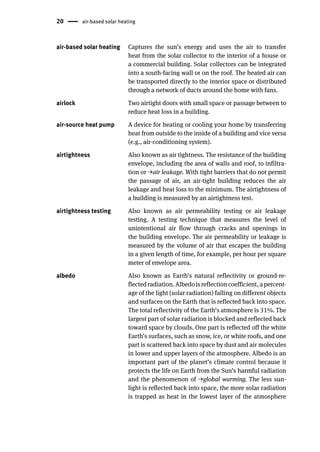
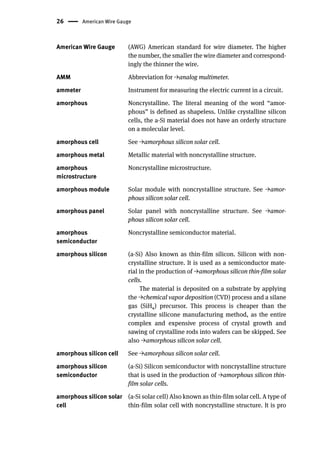
air mass 1.5 (AM1.5) In contrast to →air mass one (AM1), when the
sun is directly overhead at noon, air mass 1.5 (AM1.5)
expresses the sunbeam path through the earth’s atmos-
phere that is one and a half as long as the optimal, short-
est AM1 path, because the sun is lower in the sky during
the day – around 41.8° above the horizon or 48.2° of the
solar zenith. In the midlatitudes of the continental USA or
Europe, AM1.5 takes place sometime before 9 am and after
3 pm solar time in the summer. As the position of the sun
constantly changes during the day, the air mass or atmos-
pheric thickness value will be less or more than 1.5. AM1.5
is used as an overall yearly average value for midlatitudes
for solar panel measurements. The AM1.5 standard repre-
sents the typical conditions under which a photovoltaic
30.
18 air masscoefficient
cell is used when the sunbeam travels through one and a
half “typical” Earth atmospheres, where a typical Earth
atmosphere stands for air mass one (AM1) or the shortest
sun path to the Earth’s surface. To determine a power con-
version efficiency of new photovoltaic cell appliances, air
mass 1.5 or normal irradiance conditions are simulated in
a →solar test center for the purpose of measuring the I–V
response of PV cells.
Air Mass: AM0, AM1, and AM1.5
ζ=48.2°
AM0 AM1.5
AM1
h1
h
1
.
5
Zenith
Atmosphere
Earth
Earth
Sun
Sun
air mass coefficient The angle between the actual sunbeam path and the vector
pointing straight upward to the →zenith of the sky – 90°
angle to the horizontal surface. The air mass coefficient
formula expresses the cosine of solar zenith angle: AM =
1/cos(θz).
air mass one (AM1) The shortest possible solar beam path through the
atmosphere, when the sun is directly overhead, at the
zenith (90° angle to the horizontal surface). The higher the
sun in the sky, the smaller the air mass.
air mass ratio See →air mass.
air mass two (AM2) In contrast to →air mass one (AM1), when the sun
is directly overhead at noon, air mass two (AM2) expresses
the sunbeam path through the earth’s atmosphere that is
twice as long as the optimal, shortest AM1 path, because
the sun is low in the sky – 30° above the horizon – in the
morning or in the evening. The lower the sun in the sky, the
larger the air mass.
31.
air mass zero19
air mass zero (AM0) The extraterrestrial solar spectrum outside the
earth’s atmosphere, where there is no air. The zero
atmosphere AM0 is often measured from satellites at the
top of the atmosphere, space shuttle missions, or rocket
soundings.
air outlet Opening(s) at the top of a →solar kiln through which air
is released. Together with an air inlet at the bottom, the
air outlet allows the air circulation around the stacked
firewood inside the solar kiln, speeding up the drying
process.
air permeability testing See →airtightness testing.
air pollution The presence of foreign or toxic substances in the air in
concentrations that pose a threat to the health and welfare
of humans, animals, and the environment.
air pollution control All techniques and measures employed to limit and pref-
erably eliminate the emission of harmful substances into
the atmosphere. The air pollution control utilizes a wide
variety of air measuring devices and continuous emis-
sion monitoring systems (CEMS) to constantly monitor
the levels of pollutants, such as carbon monoxide, sulfur
dioxide, ozone, nitrogen dioxide, and lead. Several
attempts have been made, for example, by the →EPA
and other organizations, to enact regulations that would
control the emission levels of greenhouse gases, such as
→carbon dioxide, →chlorofluorocarbons, →methane, and
→nitrous oxide.
air pollution protection See →air pollution control.
air pressure Also known as atmospheric pressure. The force with
which the weight of all the air above our heads presses
down onto Earth’s surface. In addition, the collisions
between molecules contribute to air pressure. Warm air
molecules possess more energy than cold air molecules.
As they vibrate energetically and bump into each other,
they occupy more space and exert more pressure on their
surroundings. In contrast, cold air molecules move slowly
and occupy less space, which results in reduced air pres-
sure. See also →atmospheric pressure.
air tightness See →airtightness.
32.
20 air-based solarheating
air-based solar heating Captures the sun’s energy and uses the air to transfer
heat from the solar collector to the interior of a house or
a commercial building. Solar collectors can be integrated
into a south-facing wall or on the roof. The heated air can
be transported directly to the interior space or distributed
through a network of ducts around the home with fans.
airlock Two airtight doors with small space or passage between to
reduce heat loss in a building.
air-source heat pump A device for heating or cooling your home by transferring
heat from outside to the inside of a building and vice versa
(e.g., air-conditioning system).
airtightness Also known as air tightness. The resistance of the building
envelope, including the area of walls and roof, to infiltra-
tion or →air leakage. With tight barriers that do not permit
the passage of air, an air-tight building reduces the air
leakage and heat loss to the minimum. The airtightness of
a building is measured by an airtightness test.
airtightness testing Also known as air permeability testing or air leakage
testing. A testing technique that measures the level of
unintentional air flow through cracks and openings in
the building envelope. The air permeability or leakage is
measured by the volume of air that escapes the building
in a given length of time, for example, per hour per square
meter of envelope area.
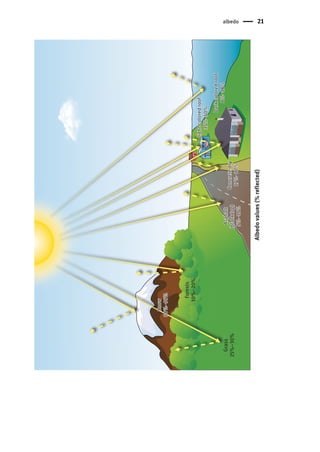
albedo Also known as Earth’s natural reflectivity or ground-re-
flectedradiation.Albedoisreflectioncoefficient,apercent-
age of the light (solar radiation) falling on different objects
and surfaces on the Earth that is reflected back into space.
The total reflectivity of the Earth’s atmosphere is 31%. The
largest part of solar radiation is blocked and reflected back
toward space by clouds. One part is reflected off the white
Earth’s surfaces, such as snow, ice, or white roofs, and one
part is scattered back into space by dust and air molecules
in lower and upper layers of the atmosphere. Albedo is an
important part of the planet’s climate control because it
protects the life on Earth from the Sun’s harmful radiation
and the phenomenon of →global warming. The less sun-
light is reflected back into space, the more solar radiation
is trapped as heat in the lowest layer of the atmosphere
22 ALCVD
and themore difficult the life on Earth becomes. One of the
biggest global challenges in the upcoming years will be the
melting of snow and ice in the polar regions. As the icecap
melts, the reflectivity decreases and proportionately the
global temperature increases.
ALCVD Abbreviation for atomic layer chemical vapor deposition.
See →atomic layer deposition.
ALD Abbreviation for →atomic layer deposition.
ALE Abbreviation for atomic layer epitaxy. See →atomic layer
deposition.
alignment of a solar
array
Optimum alignment of a solar photovoltaic array to the
sun throughout the whole year is achieved by position-
ing the panels to face the optimal south and finding the
best year-round →tilt angle, which is 30° for photovoltaic
modules on average.
alignment of a solar
system
See →alignment of a solar array.
alignment of
photovoltaic panels
See →alignment of solar modules.
alignment of solar
modules
Optimum alignment of solar photovoltaic modules to the
sun throughout the whole year is achieved by positioning
the panels to face the optimal south and finding the best
year-round →tilt angle. The average optimal inclination for
PV modules is 30° measured from the horizontal; however,
the latitude of a specific location must be taken into account,
because the position of the sun in the sky varies by geo-
graphic location. Thus, a year-around tilt angle in a northern
state, such as Alaska, will be significantly different than a
tilt angle in one of the southern states, for example, Arizona.
alignment of solar
thermal collectors
Optimum alignment of solar thermal collectors to the sun
throughout the whole year is achieved by positioning the
collectors to face the optimal south and finding the best
year-round →tilt angle, which is 45° for thermal collectors
on average.
aliphatic hydrocarbon Acarbon-basedcompoundthatconsistsofcarbonandhydro-
gen combined together in straight chains, branched trains,
or nonaromatic rings. Aliphatic hydrocarbon is present in
materials for inhibiting the corrosion of metal components.
35.
alkali silicate gel23
alkali silicate gel An amorphous material that can be used as a fire protec-
tion layer in a multipane glass of a solar panel.
alkaline fuel cell (AFC) One of the first fuel cell technologies developed by
the British engineer Francis Thomas Bacon. The AFC uses
a solution of potassium hydroxide as the electrolyte. Power
is produced by a redox reaction between hydrogen and
oxygen. The oxidation of hydrogen occurs at the anode,
forming water, heat, and electricity.
alkane An organic solvent (saturated hydrocarbon) with only
single bonds between atoms, such as hexanes, cyclohex-
anes, octanes, used in the manufacture of dopant ink.
alkyl-based alcohol An organic solvent, such as ethanol or propanol, used in
the manufacture of dopant ink.
alligator clamp See →alligator clip.
alligator clip A metal clip resembling the jaws of an alligator that is used
to attach solar panels to the mounting frame. In addition
to their securing function, they may also be used to ground
PV modules.
allowed band See →energy band.
alloy A mixture of two or more elements that has metallic prop-
erties.
almucantar A circle on the celestial sphere parallel to the horizon.
alternating current (AC) An electric current that reverses the direction of elec-
tron flow at regular intervals, 60 times per second (USA,
60 Hz) and 50 times per second (Europe and many other
countries, 50 Hz). As solar panels generate →direct current
(DC), an →inverter is needed in every →grid-tie system
to convert DC into alternating current in order to power
household appliances.
alternative energy A different kind of energy than the one in widespread use,
purchased from a utility company and generated from
fossil fuels. Alternative energy comes from renewable,
environmentally sound sources such as solar, wind, hydro-
gen, wave, or geothermal energy.
alternative energy
resource
See →alternative energy source.
36.
24 alternative energysource
alternative energy
source
An environmentally sound source of energy, such as solar,
wind, hydrogen, wave, or geothermal energy. Any energy
source other than a →fossil fuel.
alternator An electric device that generates →alternating current (AC).
altitude angle See →solar altitude angle.
aluminum (Al) A light silvery-white metal that is one of the most abun-
dant elements in the earth’s crust. Due to its lightweight
and corrosion-resistant features, aluminum is a preferred
material for →solar module frames and other outdoor solar
mounting equipment.
aluminum alloy A chemical compound in which alloying elements, such as
copper, zinc, magnesium, silicon, manganese and lithium,
are added to pure aluminum to enhance its properties.
Aluminum alloys are used for →solar module frames,
mounting rails, and other outdoor mounting components
that require a lightweight but sturdy, weather- and corro-
sion-resistant material.
aluminum contact See →aluminum electrode.
aluminum electrode Also known as aluminum contact. Usually a rear, cathodic
contact consisting of pure aluminum or an aluminum
alloy, such as an aluminum/silicon (Al–Si) or calcium/alu-
minum (Ca–Al) cathode in silicon or polymer solar cells.
In →thin-film solar cells, the organic, photoactive semi-
conductor material is sandwiched between the negative
aluminum electrode and the transparent positive indium
tin oxide (ITO) electrode. In contrast to transparent elec-
trodes, the opaque aluminum electrode on the bottom
enhances light trapping in thin-film solar cells by reflect-
ing some of the incoming light back into the photovoltaic
cell. The reflective aluminum electrode covers the entire
back side of the cell. The rear aluminum electrode is typi-
cally manufactured by a screen printing method. The alu-
minum contact sample is then immersed in a plating bath
to provide high wear and corrosion resistance.
aluminum frame A frame made of aluminum that provides a strong support
structure for the →photovoltaic laminate. The aluminum
frame needs to be lightweight to reduce the weight impact
37.
aluminum rail 25
ofsolar modules on the roof structure. In addition, it is
critical that the aluminum frame is anodized to provide
a robust finish resistant to corrosion, wear, and harsh
outdoor weather conditions.
aluminum rail A key piece of solar panel roof-mounting hardware onto
which PV modules are mounted with the help of →mid
clamps and →end clamps. Aluminum rail needs to be ano-
dized to resist corrosion and harsh weather conditions,
such as rain and snow; lightweight to decrease the load on
the roof; and sturdy to withstand strong winds.
AM0 Abbreviation for →air mass zero.
AM1 Abbreviation for →air mass one.
AM1.5 Abbreviation for →air mass 1.5.
AM2 Abbreviation for →air mass two.
amber light Also known as solar amber light. Solar-powered LED light
that casts an amber glow on walkways, steps, driveways,
gardens, and ponds.
ambient Relating to the immediate surroundings.
ambient conditions Conditions of the immediate surroundings.
ambient temperature The prevailing temperature of the surrounding environment.
An increase in ambient temperature can have a negative
effectontheoutputofsolarmodules.Astheambienttemper-
ature heats the panel to a temperature of 25 °C (77 °F) and
above, it potentially reduces the power yield by 10%–25%
based on the proportional voltage drop due to resistance.
ambient air temperature See →ambient temperature.
American Society of
Heating, Refrigerating,
and Air-Conditioning
Engineers
(ASHRAE) An international association with more than
57,000 members from over 132 nations devoted to the
advancement of →heating, ventilation, and air conditioning
(HVAC) and refrigeration to serve the public and promote
a sustainable world. The ASHRAE handbooks and guide-
lines are regarded as standards for heating, air condition-
ing, and refrigeration.
American Solar Energy
Society
(ASES) A national nonprofit organization of solar advo-
cates, enthusiasts, and professionals based in Boulder,
Colorado.
38.
26 American WireGauge
American Wire Gauge (AWG) American standard for wire diameter. The higher
the number, the smaller the wire diameter and correspond-
ingly the thinner the wire.
AMM Abbreviation for →analog multimeter.
ammeter Instrument for measuring the electric current in a circuit.
amorphous Noncrystalline. The literal meaning of the word “amor-
phous” is defined as shapeless. Unlike crystalline silicon
cells, the a-Si material does not have an orderly structure
on a molecular level.
amorphous cell See →amorphous silicon solar cell.
amorphous metal Metallic material with noncrystalline structure.
amorphous
microstructure
Noncrystalline microstructure.
amorphous module Solar module with noncrystalline structure. See →amor-
phous silicon solar cell.
amorphous panel Solar panel with noncrystalline structure. See →amor-
phous silicon solar cell.
amorphous
semiconductor
Noncrystalline semiconductor material.
amorphous silicon (a-Si) Also known as thin-film silicon. Silicon with non-
crystalline structure. It is used as a semiconductor mate-
rial in the production of →amorphous silicon thin-film solar
cells.
The material is deposited on a substrate by applying
the →chemical vapor deposition (CVD) process and a silane
gas (SiH4) precursor. This process is cheaper than the
crystalline silicone manufacturing method, as the entire
complex and expensive process of crystal growth and
sawing of crystalline rods into wafers can be skipped. See
also →amorphous silicon solar cell.
amorphous silicon cell See →amorphous silicon solar cell.
amorphous silicon
semiconductor
(a-Si) Silicon semiconductor with noncrystalline structure
that is used in the production of →amorphous silicon thin-
film solar cells.
amorphous silicon solar
cell
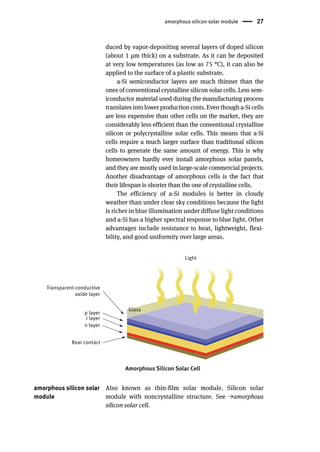
(a-Si solar cell) Also known as thin-film solar cell. A type of
thin-film solar cell with noncrystalline structure. It is pro
39.
amorphous silicon solarmodule 27
duced by vapor-depositing several layers of doped silicon
(about 1 μm thick) on a substrate. As it can be deposited
at very low temperatures (as low as 75 °C), it can also be
applied to the surface of a plastic substrate.
a-Si semiconductor layers are much thinner than the
ones of conventional crystalline silicon solar cells. Less sem-
iconductor material used during the manufacturing process
translates into lower production costs. Even though a-Si cells
are less expensive than other cells on the market, they are
considerably less efficient than the conventional crystalline
silicon or polycrystalline solar cells. This means that a-Si
cells require a much larger surface than traditional silicon
cells to generate the same amount of energy. This is why
homeowners hardly ever install amorphous solar panels,
and they are mostly used in large-scale commercial projects.
Another disadvantage of amorphous cells is the fact that
their lifespan is shorter than the one of crystalline cells.
The efficiency of a-Si modules is better in cloudy
weather than under clear sky conditions because the light
is richer in blue illumination under diffuse light conditions
and a-Si has a higher spectral response to blue light. Other
advantages include resistance to heat, lightweight, flexi-
bility, and good uniformity over large areas.
Amorphous Silicon Solar Cell
Transparent conductive
oxide layer
p layer
i layer
n layer
Rear contact
Glass
Light
amorphous silicon solar
module
Also known as thin-film solar module. Silicon solar
module with noncrystalline structure. See →amorphous
silicon solar cell.
40.
28 amorphous siliconsolar panel
amorphous silicon solar
panel
Silicon solar panel with noncrystalline structure. See
→amorphous silicon solar cell.
amorphous silicon
thin-film solar cell
Silicon thin-film solar cell with noncrystalline structure.
See →amorphous silicon solar cell.
amorphous silicon
thin-film solar module
Silicon thin-film solar module with noncrystalline struc-
ture. See →amorphous silicon solar cell.
amorphous silicon
thin-film solar panel
Silicon thin-film solar panel with noncrystalline structure.
See →amorphous silicon solar cell.
amorphous solar cell See →amorphous silicon solar cell.
amorphous solar
module
Solar module with noncrystalline structure. See →amor-
phous silicon solar cell.
amorphous solar panel Solar panel with noncrystalline structure. See →amor-
phous silicon solar cell.
amortisation UK See →amortization.
amortization An act of repaying a debt or returning invested funds over a
period of time. In solar investments, it is crucial to be able
to amortize the costs of a solar system over its useful life,
which is typically 25 years for crystalline solar panels. For
instance, if a PV system amortizes its cost in 10 years, it
pays back the invested funds from the energy yield and
will continue generating free electricity for a household for
15 more years. To roughly calculate the payback period for
a photovoltaic system, the following formula can be used:
payback period = total system cost (initial investment)/
value of electricity generated/annual electricity usage.
amortization period The period of time it takes for a solar system to pay back
its initial cost.
amortization time See →amortization period.
Amp Abbreviation for →ampere.
ampacity Word coined by blending “ampere capacity” into a single
word. It designates the amount of current (in amperes) a
conductor can carry without exceeding its temperature
rating, which is specified by the →National Electrical
Code (NEC) in the United States. Going beyond the indi-
cated maximum current value might lead to degradation,
damage, or even wire melting, as ampacity ratings rest on
the thermal limits of the insulation.
41.
amperage 29
amperage Currentintensity.
amperage interrupt
capability
(AIC) The maximum fault current (in amperes) that a pro-
tective device, such as a fuse or circuit breaker, can safely
interrupt without causing damage to equipment or people.
ampere (A, Amp) SI unit of electric current that expresses the rate
at which electrons (charge) are flowing in a circuit. Ampere
is equal to volts divided by resistance: A = V/R or A = V/Ω.
ampere interrupting
capacity
See →amperage interrupt capability.
ampere meter Instrument for measuring the electric current in a circuit.
ampere-hour (Ah) Is equal to the flow of electrical current of one ampere
for one hour. It is used to measure the electrical quantity,
for example, the capacity of a battery.
ampere-hour meter Instrument for measuring the electric current over time.
amp-hour See →ampere-hour.
amps clamp Measuring instrument with a clamp that measures the
electric current in a circuit.
amps interrupting
capacity
See →amperage interrupt capability.
anaerobic digester A sealed tank in which bacteria act upon organic matter
without oxygen, breaking down waste and gathering the
biogas released in the process. Solar collectors can be
added to anaerobic digester to reduce thermal losses in
the digester, in particular in cold winter days, as well as to
increase the temperature of the biomass slurry to acceler-
ate the degradation process.
anaerobic digestion A chemical process in which bacteria break down organic
materials, such as manure, in the absence of oxygen.
analog meter A meter that uses a dial hand to indicate a value.
analog multimeter (AMM) A →multimeter that uses a dial hand as opposed to
a digital multimeter with a digital display.
analog voltmeter (AVM) A →voltmeter that uses a dial hand as opposed to a
digital voltmeter with a digital display.
ancillary services All services that assist the transmission of electricity
from generating sources to the customer and manage the
42.
30 anemometer
complex renewableenergy smart meter infrastructure and
grid stability. These services typically include: load follow-
ing, scheduling and dispatch, system protection, system
monitoring, reactive power and voltage control, loss com-
pensation, energy imbalance, and harmonic cancellation.
anemometer An instrument for measuring the speed of the wind.
angle calculator See →angle finder.
angle finder A device, usually an application, which helps find the
sun’s angle and calculate the best seasonal or monthly
angle for solar panels.
angle of incidence See →solar angle of incidence.
angle of inclination Angle between the horizontal and the solar panel.
angle of insolation See →solar angle of incidence.
angle of installation An optimal angle of installation of solar panels can be
determined by finding an optimal south position as well as
the optimal tilt angle, taking into account the latitude of a
specific location.
angle-dependent
deposition
A technique for manufacturing nanostructures, for
example, inclined columns, helices, and zigzag shapes, to
optimize the optical →anisotropy, porosity, and crystallo-
graphic orientation of thin films.
angstrom See →Ångström.
Ångström (Å) Unit of length equal to 10−8 cm, approximately the size
of an atom. It is used to measure the wavelength of electro-
magnetic radiation or distances between atoms.
anion Negative →ion. When an atom gains one or more electrons,
it becomes a negative ion (anion), carrying a negative
charge as a result of the chemical reaction.
anisotropic Referring to anisotropic material whose properties vary
with different crystallographic orientations.
anisotropic etch1 See →anisotropic etching.
anisotropic etch2 Type of chemical used for anisotropic etching.
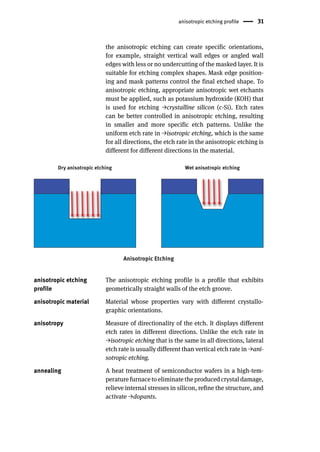
anisotropic etching Orientation-dependent etching along crystallographic
planes. Compared to curved edges of →isotropic etching,
43.
anisotropic etching profile31
the anisotropic etching can create specific orientations,
for example, straight vertical wall edges or angled wall
edges with less or no undercutting of the masked layer. It is
suitable for etching complex shapes. Mask edge position-
ing and mask patterns control the final etched shape. To
anisotropic etching, appropriate anisotropic wet etchants
must be applied, such as potassium hydroxide (KOH) that
is used for etching →crystalline silicon (c-Si). Etch rates
can be better controlled in anisotropic etching, resulting
in smaller and more specific etch patterns. Unlike the
uniform etch rate in →isotropic etching, which is the same
for all directions, the etch rate in the anisotropic etching is
different for different directions in the material.
Anisotropic Etching
Dry anisotropic etching Wet anisotropic etching
anisotropic etching
profile
The anisotropic etching profile is a profile that exhibits
geometrically straight walls of the etch groove.
anisotropic material Material whose properties vary with different crystallo-
graphic orientations.
anisotropy Measure of directionality of the etch. It displays different
etch rates in different directions. Unlike the etch rate in
→isotropic etching that is the same in all directions, lateral
etch rate is usually different than vertical etch rate in →ani-
sotropic etching.
annealing A heat treatment of semiconductor wafers in a high-tem-
perature furnace to eliminate the produced crystal damage,
relieve internal stresses in silicon, refine the structure, and
activate →dopants.
44.
32 annual currentrequirement
annual current
requirement
See →annual electricity requirement.
annual electrical demand See →annual electricity requirement.
annual electricity
consumption
The size of a new photovoltaic system to be installed
depends on the average electricity consumption of a house-
hold. The straightforward way to determine the annual
electricity consumption in an existing building is to look at
your electric utility bills. The electric bill usually displays
your average kWh electricity usage by month, and in some
areas even by year. The new PV system should be sized to
meet the annual electricity requirement of a given home.
annual electricity
requirement
Average annual amount of electricity needed to power a
home. This information is crucial when sizing a new pho-
tovoltaic system to be installed. This information can be
easily obtained from past electric utility bills; however, it
gets more complicated in new houses that are being built
with no previous average electricity consumption informa-
tion. In such cases, an annual electricity requirement for
the new building should be estimated by performing an
electrical →load analysis with help from →load analysis
worksheets. A load analysis worksheet should list all the
electronic devices that consume electricity and will be used
in the new house. For a more accurate estimate, a seasonal
electrical energy consumption in watt-hours for each elec-
trical appliance can be applied. As measuring each device
individually with a power meter might be a time-consum-
ing and challenging endeavor, PV system designers typi-
cally use wattage from rating labels of electronic devices.
Some devices do not specify wattage, but only voltage and
amps. By multiplying amps by volts, the power consump-
tion of an appliance in wattage may still be calculated.
annual energy
consumption
See →annual electricity consumption.
annual energy output It is important to know how much electricity (how many
watts) a photovoltaic array can generate per year. A solar
array must be sized so that it is able to supply the total elec-
trical load of the house and meet the →annual electricity
requirement.
annual energy yield See →annual energy output.
45.
annual power requirement33
annual power
requirement
See →annual electricity requirement.
annual solar irradiance The amount of sunlight a surface receives per year. PV
system designers use maps with average annual energy
values to calculate an accurate →annual energy output of
a future solar array.
annual solar savings An estimate showing how much energy one home with a
solar array can save per year when compared with a nonso-
lar house and its yearly average cost of electricity.
anode The positive electrode in a battery.
anode rod An easily corroded metallic rod deliberately placed inside a
water storage tank to attract corrosive elements and reduce
the corrosion of the protected material. The anode rod
must be replaced when it is severely corroded; otherwise,
the water tank and its components will start to corrode.
anodic bonding A method for graphene production in which graphite is
first pressed onto a glass substrate with the help of an elec-
trostatic field and then cleaved off to leave few layers of
graphene on the substrate.
antifreeze A liquid, such as a →glycol–water mixture, that is used in
solar water-heating systems to prevent heat transfer fluid
in pipes from freezing.
antifreeze solution See →antifreeze.
antireflection coating (ARC) A thin coating on solar cells that reduces the reflec-
tion and improves light transmission. Silicon nitride (SiN)
is a preferred antireflection coating material, which is
usually deposited on a semiconductor surface using →plas-
ma-enhanced chemical vapor deposition (PECVD) process.
anti-reflection coating See →antireflection coating.
antireflection glass A glass with antireflection coating that reduces the reflec-
tion of incident light and increases the transmittance of
the glass.
antireflection layer A layer that reduces the reflection and improves light
transmission.
anti-reflection layer See →antireflection layer.
46.
34 antireflective coating
antireflectivecoating See →antireflection coating.
anti-reflective coating See →antireflection coating.
antireflective tempered
solar glass
A glass that reduces the reflection and improves light
transmission.
antiscratch film See →antiscratch layer.
antiscratch layer An antiscratch film deposited on the outermost side of
the solar module in order to prevent the panel from being
damaged due to external contact.
AOT Abbreviation for →aerosol optical thickness.
aperture See →aperture area.
aperture area A glass-covered surface area on a solar collector or a pho-
tovoltaic module that absorbs solar radiation.
aperture area of a solar
array
See →aperture area of a solar system.
aperture area of a solar
collector
The area of a solar thermal collector that absorbs solar
radiation. The aperture area is usually larger than the
absorber area.
aperture area of a solar
module
A glass-covered surface area on a solar module that
absorbs solar radiation.
aperture area of a solar
panel
A glass-covered surface area on a solar collector or a pho-
tovoltaic module that absorbs solar radiation.
aperture area of a solar
system
The total of all glass-covered surface areas of a solar system
through which the incident solar radiation is admitted and
transmitted to the absorbers.
aperture efficiency A proportion of solar radiation that the aperture area of a
solar collector absorbs.
aperture loss A proportion of solar radiation that is admitted within the
aperture area of a solar collector but then it never reaches the
absorber due to the blockage or falling between the cracks.
In photovoltaic modules, the aperture loss is the proportion
of solar energy that is lost in the aperture area due to the pat-
terning and shadow effects. The aperture loss, which counts
as one of the major contributors to a drastic degradation of
the performance in an organic PV module, can be reduced by
manufacturing the main active layers without any patterns.
47.
aperture surface 35
aperturesurface Glass-covered surface area on a solar collector that absorbs
the solar radiation.
apparent solar time Apparent solar time is time based on the Sun’s actual daily
motion across the sky, in opposition to the man-made
mean solar time or clock time. According to this “natural,”
local apparent time, which can be roughly measured by a
sundial, the sun always crosses the true north-south merid-
ian at noon. When the sun is at its highest point in the sky,
the noon in local solar time (LST) takes place. However,
the Sun’s motion across the sky is not a uniform, circular
movement because the Earth moves around the Sun in an
elliptical orbit. That is the reason why apparent solar time,
which is defined by the position of the sun, differs from the
agreed upon →local mean time (LT) or clock time, which is
based on man-made adjustments, such as time zones and
daylight savings.
approach temperature The minimum temperature difference between hot stream
and cold stream in a heat exchanger.
aquifer Porous rock layers, gravel or sand that are filled with water,
acting as a water reservoir due to their impermeable top
and bottom layer.
aquifer storage facility See →aquifer thermal energy storage.
aquifer storage system See →aquifer thermal energy storage.
aquifer thermal energy
storage
(ATES) A large-scale thermal energy storage system that
uses →aquifers to store heat or cold between seasons. For
instance, during summer, the abundant excess thermal
energy from solar thermal plants is stored in the aquifer for
later use. The accumulated thermal energy provides heat
for domestic hot water and space heating for a building,
apartment complex, or an entire district over winter.
ARC Abbreviation for →antireflection coating.
architecture See →solar architecture.
ARDE Abbreviation for →aspect ratio-dependent etch.
argon (Ar) A noble gas with atomic number 18. As argon is an
inert gas that undergoes almost no chemical reactions, it is
often utilized in chemical processes that require a nonre-
active atmosphere. Argon acts as a preferred sputtering gas
48.
36 argon ion
invarious sputter deposition processes because it does not
react with the target material. In the →magnetron sputter-
ing process, which takes place in a vacuum chamber, the
sputtering gas argon bombards the target source material,
sputtering off the material particles in a highly charged,
magnetic plasma environment and depositing them onto
the substrate.
In hermetically sealed windows that consist of two or
three glass sheets, argon is used as an insulator, filling the
space between the panes.
argon ion Ions that are generated by the collision of inert, electrically
neutral argon gas atoms with high-energy target material
electrons, when a negative charge is applied to a target
source material in the →magnetron sputtering process.
argon ion laser A type of laser used for wafer testing.
argon ion-beam etching Etching technology for the production of thin-film semi-
conductors.
argon plasma →Plasma that is generated by ionizing the chemically
inert sputtering gas argon (Ar). It is a hot, gaslike cloud
consisting of roughly half gas ions and half electrons.
When a negative charge is applied to a target source
material in the →magnetron sputtering process, the inert,
electrically neutral argon gas atoms become positively
charged ions attracted to the negatively charged target
material. The energetic ions of argon plasma collide with
the target material (cathode), causing the atoms to be dis-
lodged from the surface of the target material and con-
dense on the surface of the substrate (anode) as a thin
semiconductor layer. The argon gas usually requires rela-
tively low energy to generate plasma, allowing a low-tem-
perature deposition of amorphous materials on sensitive
substrates.
array Photovoltaic array. Group of solar panels connected
together to form a unified power production system.
array current The electrical current output generated by a photovoltaic
array in full sun.
array DC disconnect See →DC disconnect.
array operating voltage See →solar array operating voltage.
49.
arsenic 37
arsenic Toxicsemimetal that is utilized in the manufacture of sem-
iconductors. Arsenic atoms are commonly used for n-type
doping, generating the flow of electrons along the →con-
duction band. Arsenic has five electrons in the outmost
energy level, which is incongruent with the geometry of the
silicon lattice with four outer electrons. As the fifth arsenic
electron has nothing to bond to, it moves freely from one
silicon atom to another, carrying negative charge along the
conduction band. It takes a small amount of arsenic impu-
rity atoms to start a current flow across the silicon crystal.
arsine A flammable, colorless, and highly toxic gas used in the
semiconductor manufacturing. In the solar industry, arsine
is utilized as a doping gas during the production process
of polycrystalline silicon and gallium arsenide solar cells.
The inhalation exposure to arsine can cause major health
risks, as the gas is known as a highly toxic and carcino-
genic chemical.
artificial aerosols See →human-made aerosols.
asbestos Fibrous silicate, such as asbestos actinolite, asbestos
grunerite (amosite), asbestos anthophyllite, chrysotile,
crocidolite, and asbestos tremolite. This silica compound,
which is naturally found in rocks and soil, was used in
buildings as a fire-resistant and insulating material. The
use of asbestos is slowly being phased out because the
inhalation of asbestos fibers can lead to serious illnesses,
such as lung cancer and asbestosis.
ASES Abbreviation for →American Solar Energy Society.
ASHRAE Abbreviation for →American Society of Heating, Refrigerat-
ing, and Air-Conditioning Engineers.
a-Si Abbreviation for amorphous silicon. This silicon type with
noncrystalline structure is used as a semiconductor material
in the production of →amorphous silicon thin-film solar cells.
a-Si solar cells on
stainless steel foil
Lightweight, flexible thin-film solar cells made of an
→amorphous silicon (a-Si) alloy that is deposited on stain-
less steel foil. As amorphous silicon triple-junction cells on
thin stainless steel have an optimal band gap for AM0 solar
radiation, they are utilized for space and stratospheric
applications.
50.
38 a-Si:H
a-Si:H Abbreviationfor →hydrogenated amorphous silicon.
aspect angle Direction a solar module faces, for example, south or south
west. Calculating the best aspect angle and positioning the
panels to face the optimal south is the key for capturing as
much solar energy as possible.
aspect ratio The ratio of depth to width of an →etched trench.
aspect ratio-dependent
etch
(ARDE) The etch phenomenon by which smaller features
etch slower than those with larger dimensions.
assembly of a
photovoltaic system
See →installation of a solar system.
assembly of a PV system See →installation of a solar system.
assembly of a solar
system
See →installation of a solar system.
astronomically
controlled tracking
See →astronomically controlled tracking system.
astronomically
controlled tracking
system
Also known as an astronomically guided tracking system. A
single- or dual-axis tracking system that uses an astronom-
ical control mechanism to follow precisely the course of
the sun in a certain location at a given time of the year. The
accurate calculation of the position of the sun in a specific
location and at a specific time is based on an astronom-
ical algorithm that compares the latitude and longitude
with the UTC time. The astronomically controlled tracking
system allows optimal alignment of PV panels, achieving
maximum solar output, without sun sensors.
astronomically guided
tracking
See →astronomically controlled tracking system.
astronomically guided
tracking system
See →astronomically controlled tracking system.
ATES Abbreviation for →aquifer thermal energy storage.
at-home charging See →residential electric vehicle charging infrastructure.
atmosphere The layer of gases that surrounds the Earth or another
planet.
atmospheric attenuation The reduction in the intensity and quantity of solar radia-
tion as it passes through various weather conditions on its
51.
atmospheric attenuation ofsolar radiation 39
way from the mirror surface of a →heliostat to the central
receiver in a →concentrated solar power plant (CSP plant).
The distance between a heliostat and the receiver (boiler)
at the top of a →solar power tower, which is located at the
center of the field, plays an important role in the amount of
atmospheric attenuation.
atmospheric attenuation
of solar radiation
See →solar attenuation.
Atmospheric
Environment Service
(AES) See today’s name →Meteorological Service of Canada.
atmospheric pressure Also known as air pressure. The pressure or force per unit
area exerted by the weight of the air above that area. Pres-
sure decreases with increasing altitude as there is less
air. In contrast, the pressure is greater at lower altitudes
because the total weight of the air is larger and more air is
pushing down. See also →air pressure.
atmospheric turbidity The measure of relative clarity of the atmosphere. It is a key
parameter for evaluating the air pollution, atmospheric
aerosol load, and the attenuation of the solar radiation
that reaches the Earth’s surface under a cloudless sky. An
increased atmospheric turbidity leads to increased scat-
tering of solar rays and a diminished intensity of →direct
solar radiation, thus resulting in a decreased power output
of the solar plant. The measurement of →diffuse solar radi-
ation and atmospheric turbidity provide crucial informa-
tion to designers of solar thermal or photovoltaic systems.
A shadow ring and a measuring instrument called →pyra-
nometer are used for the measurement of the diffuse solar
radiation. Using this information, solar designers are able
to better predict the availability of solar energy in a par-
ticular location.
atmospheric turbidity
coefficient
The ratio of the turbidity of the atmosphere, including
the scattering of light by small particles (water droplets,
ice crystallites, and dust particles) and the absorption of
light by water vapor, to a dry and clean atmosphere. The
turbidity scale ranges from the lowest turbidity value of 0,
which represents a perfectly clear sky, over a good medium
turbidity value of 0.04 to the highest turbidity value of 1,
which represents the perfectly opaque sky.
52.
40 atmospheric turbidityfactor
atmospheric turbidity
factor
See →atmospheric turbidity coefficient.
atomic electron shell See →electron shell.
atomic energy See →nuclear energy2.
Atomic Energy
Commission
(AEC) A US federal agency established after the World
War II in 1946 in order to control the destructive power of
atomic energy on a world level and foster the development
of peaceful applications of atomic energy. The AEC was
dissolved in 1974 and succeeded by the Energy Research
and Development Administration and the U. Nuclear Reg-
ulatory Commission.
atomic energy level See →energy level.
atomic layer chemical
vapor deposition
(ALCVD) See →atomic layer deposition.
atomic layer deposition (ALD) Also known as atomic layer epitaxy (ALE) or atomic
layer chemical vapor deposition (ALCVD). A type of →chem-
ical vapor deposition that is capable of producing highly
uniform ultrathin films for semiconductor devices. This
thin-film deposition nanotechnology method enables a
full control over thickness, complex structures, and chem-
ical features of a film on the atomic scale. The process is
performed at relatively low temperatures, which is suitable
for sensitive polymer-coated thin films.
Unlike chemical vapor deposition, the ALD method
splits the CVD process into two separate chemical reactions
to achieve a better control of film growth. In that way, two
precursor materials are kept separate during the reaction,
allowing a precisely controlled deposition. First, precursor
gas 1 is introduced into the reaction chamber, generating a
monolayer of gas on the substrate surface. After the first mon-
olayer has been deposited on the wafer, the remaining gas is
removedfromthechamber.Inthenextstep,precursorgas2is
introduced into the reaction chamber, reacting with precursor
1 and creating another monolayer on top of the first one. Any
leftover precursor gas 2 is removed from the chamber. The
process starts all over again with precursor 1, and this alter-
nating layer-by-layer growth continues until a desired thick-
ness is achieved. The thickness of the semiconductor layer is
accurately controlled by the number of deposition cycles.
53.
atomic layer epitaxy41
One of the major disadvantages of the ALD method is
the relatively slow deposition rate, compared to the con-
ventional chemical vapor deposition.
atomic layer epitaxy (ALE) See →atomic layer deposition.
atomic nucleus The central part of the atom, consisting of →protons and
→neutrons.
attenuation Weakening in force/intensity or thickness/density. See
also →solar attenuation.
aureole A ring-shaped zone of enhanced brightness surrounding
the Sun due to the scattering of sunlight by aerosol par-
ticles.
autarkic Energy-independent, self-sufficient in energy.
autarkic energy system An independent, stand-alone power system that does not
rely on the electrical grid.
automated battery
control system
See →automatic battery management system.
automatic battery
management system
Also known as an automated battery control system.
A system that monitors charging and discharging pro-
cesses for optimal performance of a rechargeable battery.
Depending on the product, the automatic battery manage-
ment system can monitor state of charge, state of health,
current, voltage, and temperature, to ensure optimal and
safe operation and the long life of a battery.
automatic disconnection
device
Device for automatic disconnection from the public grid.
automatic equalization
charge
An automatic periodic battery maintenance process. See
→equalization charge.
automatic weather data
acquisition
A weather data acquisition system developed by ASEA,
Sweden, which uses automatic public telephone networks
and the digital data communication (DIDAC) equipment to
transmit weather data.
autonomous power
generating system
Off-grid, stand-alone photovoltaic power generating
system.
autonomous power
system
See →autonomous power generating system.
54.
42 autonomous system
autonomoussystem See →autonomous power generating system.
autumnal equinox See →fall equinox.
auxiliary system A backup power system that provides a secondary source
of energy, such as battery bank, wind turbine, or gas gen-
erator, when the primary source of energy, such as solar
power, fails or does not provide enough electricity during
extended periods of cloudy weather.
availability Is often mentioned as a major argument against solar
energy. The Sun is not available 24 hours a day, 365 days a
year as other →fossil-fuel energy sources, but rather shines
only half the day and with diminished intensity in the early
morning, late afternoon, winter, and on cloudy days. Solar
advocates offset the availability disadvantage by installing
a →battery bank and/or wind turbine as a secondary energy
source to fill in the solar inactivity gap. Another comforta-
ble solution is a →grid-tie system, where the utility grid acts
as a large storage system from which the connected solar
user buys the electricity when needed (overnight) and
to which he also sells the produced surplus energy back
during the day. The →satellite power system (SPS) concept
of producing solar power in space and beaming it to Earth
promises to overcome the availability shortcoming.
availability factor The availability factor of a photovoltaic array is the per-
centage of time, usually measured in hours per year, that
the system is available to provide electrical power to a load
or to the grid. Reduced power generation during winter
months and on cloudy days should be taken into account
as well as the fact that no electricity is produced at night.
average monthly
temperature
The average of the mean monthly maximum and minimum
temperatures. The average value is based on the statistical
values collected in a computing system over a long period
of time in a given region.
average wind speed The average speed of the wind regardless of direction
over a period of time, such as a day or a month, based on
the hourly data from automated stations measured and
recorded over the course of many years.
AVM Abbreviation for →analog voltmeter.
But she didnot succeed in avoiding the domestic affair which she
had read in the other's eyes.
"I say, now we ought to get that settled."
At first the two mothers, without need for talking about it, had
agreed not to conclude the marriage. If Zacharie's mother wished to
get her son's wages as long as possible, Philoméne's mother was
enraged at the idea of abandoning her daughter's wages. There was
no hurry; the second mother had even preferred to keep the little
one, as long as there was only one; but when it began to grow and
eat and another one came, she found that she was losing, and
furiously pushed on the marriage, like a woman who does not care
to throw away her money.
"Zacharie has drawn his lot," she went on, "and there's nothing in
the way. When shall it be?"
"Wait till the fine weather," replied Maheude, constrainedly. "They
are a nuisance, these affairs! As if they couldn't wait to be married
before going together! My word! I would strangle Catherine if I knew
that she had done that."
The other woman shrugged her shoulders.
"Let be! she'll do like the others."
Bouteloup, with the tranquillity of a man who is at home, searched
about on the dresser for bread. Vegetables for Levaque's soup,
potatoes and leeks, lay about on a corner of the table, half-peeled,
taken up and dropped a dozen times in the midst of continual
gossiping. The woman was about to go on with them again when
she dropped them anew and planted herself before the window.
"What's that there? Why, there's Madame Hennebeau with some
people. They are going into Pierronne's."
At once both of them started again on the subject of Pierronne. Oh!
whenever the Company brought any visitors to the settlement they
never failed to go straight to her place, because it was clean. No
doubt they never told them stories about the head captain. One can
57.
afford to beclean when one has lovers who earn three thousand
francs, and are lodged and warmed, without counting presents. If it
was clean above it was not clean underneath. And all the time that
the visitors remained opposite, they went on chattering.
"There, they are coming out," said the Levaque woman at last.
"They are going all around. Why, look, my dear—I believe they are
going into your place."
Maheude was seized with fear. Who knows whether Alzire had
sponged over the table? And her soup, also, which was not yet
ready! She stammered a good-day, and ran off home without a
single glance aside.
But everything was bright. Alzire, very seriously, with a cloth in front
of her, had set about making the soup, seeing that her mother did
not return. She had pulled up the last leeks from the garden,
gathered the sorrel, and was just then cleaning the vegetables, while
a large kettle on the fire was heating the water for the men's baths
when they should return. Henri and Lénore were good for once,
being absorbed in tearing up an old almanac. Father Bonnemort was
smoking his pipe in silence. As Maheude was getting her breath
Madame Hennebeau knocked.
"You will allow me, will you not, my good woman?"
Tall and fair, a little heavy in her superb maturity of forty years, she
smiled with an effort of affability, without showing too prominently
her fear of soiling her bronze silk dress and black velvet mantle.
"Come in, come in," she said to her guests. "We are not disturbing
any one. Now, isn't this clean again! And this good woman has
seven children! All our households are like this. I ought to explain to
you that the Company rents them the house at six francs a month. A
large room on the ground floor, two rooms above, a cellar, and a
garden."
The decorated gentleman and the lady in the fur cloak, arrived that
morning by train from Paris, opened their eyes vaguely, exhibiting on
58.
their faces theirastonishment at all these new things which took
them out of their element.
"And a garden!" repeated the lady. "One could live here! It is
charming!"
"We give them more coal than they can burn," went on Madame
Hennebeau. "A doctor visits them twice a week; and when they are
old they receive pensions, although nothing is held back from their
wages."
"A Thebaid! a real land of milk and honey!" murmured the
gentleman in delight.
Maheude had hastened to offer chairs. The ladies refused. Madame
Hennebeau was already getting tired, happy for a moment to amuse
herself in the weariness of her exile by playing the part of exhibiting
the beasts, but immediately disgusted by the sickly odour of
wretchedness, in spite of the special cleanliness of the houses into
which she ventured. Besides, she was only repeating odd phrases
which she had overheard, without ever troubling herself further
about this race of workpeople who were labouring and suffering
beside her.
"What beautiful children!" murmured the lady, who thought them
hideous, with their large heads beneath their bushy, straw-coloured
hair.
And Maheude had to tell their ages; they also asked her questions
about Estelle, out of politeness. Father Bonnemort respectfully took
his pipe out of his mouth; but he was not the less a subject of
uneasiness, so worn out by his forty years underground, with his
stiff limbs, deformed body, and earthy face; and as a violent spasm
of coughing took him he preferred to go and spit outside, with the
idea that his black expectoration would make people uncomfortable.
Alzire received all the compliments. What an excellent little
housekeeper, with her cloth! They congratulated the mother on
having a little daughter so sensible for her age. And none spoke of
59.
the hump, thoughlooks of uneasy compassion were constantly
turned towards the poor little invalid.
"Now!" concluded Madame Hennebeau, "if they ask you about our
settlements at Paris you will know what to reply. Never more noise
than this, patriarchal manners, all happy and well off as you see, a
place where you might come to recruit a little, on account of the
good air and the tranquillity."
"It is marvellous, marvellous!" exclaimed the gentleman, in a final
outburst of enthusiasm.
They left with that enchanted air with which people leave a booth in
a fair, and Maheude, who accompanied them, remained on the
threshold while they went away slowly, talking very loudly. The
streets were full of people, and they had to pass through several
groups of women, attracted by the news of their visit, which was
hawked from house to house.
Just then, Levaque, in front of her door, had stopped Pierronne, who
was drawn by curiosity. Both of them affected a painful surprise.
What now? Were these people going to bed at the Maheus'? But it
was not so very delightful a place.
"Always without a sou, with all that they earn! Lord! when people
have vices!"
"I have just heard that she went this morning to beg at Piolaine, and
Maigrat, who had refused them bread, has given them something.
We know how Maigrat pays himself!"
"On her? Oh, no! that would need some courage. It's Catherine that
he's after."
"Why, didn't she have the cheek to say just now that she would
strangle Catherine if she were to come to that? As if big Chaval for
ever so long had not put her backside on the shed!"
"Hush! here they are!"
60.
Then Levaque andPierronne, with a peaceful air and without
impolite curiosity, contented themselves with watching the visitors
out of the corners of their eyes. Then by a gesture they quickly
called Maheude, who was still carrying Estelle in her arms. And all
three, motionless, watched the well-clad backs of Madame
Hennebeau and her guests slowly disappear. When they were some
thirty paces off, the gossiping recommenced with redoubled vigour.
"They carry plenty of money on their skins; worth more than
themselves, perhaps."
"Ah, sure! I don't know the other, but the one that belongs here, I
wouldn't give four sous for her, big as she is. They do tell stories—"
"Eh? What stories?"
"Why, she has men! First, the engineer."
"That lean, little creature! Oh, he's too small! She would lose him in
the sheets."
"What does that matter, if it amuses her? I don't trust a woman who
puts on such proud airs and never seems to be pleased where she
is. Just look how she wags her rump, as if she felt contempt for us
all. Is that nice?"
The visitors went along at the same slow pace, still talking, when a
carriage stopped in the road, before the church. A gentleman of
about forty-eight got out of it, dressed in a black frock-coat, and
with a very dark complexion and an authoritative, correct
expression.
"The husband," murmured Levaque, lowering her voice, as if he
could hear her, seized by that hierarchical fear which the manager
inspired in his ten thousand workpeople. "It's true, though, that he
has a cuckold's head, that man."
Now the whole settlement was out of doors. The curiosity of the
women increased. The groups approached each other, and were
melted into one crowd; while bands of urchins, with unwiped noses
and gaping mouths, dawdled along the pavements. For a moment
61.
the schoolmaster's palehead was also seen behind the school-house
hedge. Among the gardens, the man who was digging stood with
one foot on his spade, and with rounded eyes. And the murmur of
gossiping gradually increased, with a sound of rattles, like a gust of
wind among dry leaves.
It was especially before the Levaques' door that the crowd was
thickest. Two women had come forward, then ten, then twenty.
Pierronne was prudently silent now that there were too many ears
about. Maheude, one of the more reasonable, also contented herself
with looking on; and to calm Estelle, who was awake and screaming,
she had tranquilly drawn out her suckling animal's breast, which
hung swaying as if pulled down by the continual running of its milk.
When M. Hennebeau had seated the ladies in the carriage, which
went off in the direction of Marchiennes, there was a final explosion
of clattering voices, all the women gesticulating and talking in each
other's faces in the midst of a tumult as of an ant-hill in revolution.
But three o'clock struck. The workers of the earth-cutting, Bouteloup
and the others, had set out. Suddenly around the church appeared
the first colliers returning from the pit with black faces and damp
garments, folding their arms and expanding their backs. Then there
was confusion among the women: they all began to run home with
the terror of housekeepers who had been led astray by too much
coffee and too much tattle, and one heard nothing more than this
restless cry, pregnant with quarrels:
"Good Lord, and my soup! and my soup which isn't ready!"
CHAPTER IV
When Maheu came in after having left Étienne at Rasseneur's, he
found Catherine, Zacharie, and Jeanlin seated at the table finishing
their soup. On returning from the pit they were always so hungry
that they ate in their damp clothes, without even cleaning
62.
themselves; and noone was waited for, the table was laid from
morning to night; there was always someone there swallowing his
portion, according to the chances of work.
As he entered the door Maheu saw the provisions. He said nothing,
but his uneasy face lighted up. All the morning the emptiness of the
cupboard, the thought of the house without coffee and without
butter, had been troubling him; the recollection came to him
painfully while he was hammering at the seam, stifled at the bottom
of the cutting. What would his wife do, and what would become of
them if she were to return with empty hands? And now, here was
everything! She would tell him about it later on. He laughed with
satisfaction.
Catherine and Jeanlin had risen, and were taking their coffee
standing; while Zacharie, not filled with the soup, cut himself a large
slice of bread and covered it with butter. Although he saw the
chitterlings on a plate he did not touch them, for meat was for the
father, when there was only enough for one. All of them had washed
down their soup with a big bumper of fresh water, the good, clear
drink of the fortnight's end.
"I have no beer," said Maheude, when the father had seated himself
in his turn. "I wanted to keep a little money. But if you would like
some the little one can go and fetch a pint."
He looked at her in astonishment. What! she had money, too!
"No, no," he said, "I've had a glass, it's all right."
And Maheu began to swallow by slow spoonfuls the paste of bread,
potatoes, leeks, and sorrel piled up in the bowl which served him as
a plate. Maheude, without putting Estelle down, helped Alzire to give
him all that he required, pushed near him the butter and the meat,
and put his coffee on the fire to keep it quite hot.
In the meanwhile, beside the fire, they began to wash themselves in
the half of a barrel transformed into a tub. Catherine, whose turn
came first, had filled it with warm water; and she undressed herself
tranquilly, took off her cap, her jacket, her breeches, and even her
63.
chemise, habituated tothis since the age of eight, having grown up
without seeing any harm in it. She only turned with her stomach to
the fire, then rubbed herself vigorously with black soap. No one
looked at her, even Lénore and Henri were no longer inquisitive to
see how she was made. When she was clean she went up the stairs
quite naked, leaving her damp chemise and other garments in a
heap on the floor. But a quarrel broke out between the two brothers:
Jeanlin had hastened to jump into the tub under the pretence that
Zacharie was still eating; and the latter hustled him, claiming his
turn, and calling out that he was polite enough to allow Catherine to
wash herself first, but he did not wish to have the rinsings of the
young urchins, all the less since, when Jeanlin had been in, it would
do to fill the school ink-pots. They ended by washing themselves
together, also turning towards the fire, and they even helped each
other, rubbing one another's backs. Then, like their sister, they
disappeared up the staircase naked.
"What a slop they do make!" murmured Maheude, taking up their
garments from the floor to put them to dry. "Alzire, just sponge up a
bit."
But a disturbance on the other side of the wall cut short her speech.
One heard a man's oaths, a woman's crying, a whole stampede of
battle, with hollow blows that sounded like the shock of an empty
gourd.
"Levaque's wife is catching it," Maheu peacefully stated as he
scraped the bottom of his bowl with the spoon. "It's queer;
Bouteloup made out that the soup was ready."
"Ah, yes! ready," said Maheude. "I saw the vegetables on the table,
not even cleaned."
The cries redoubled, and there was a terrible push which shook the
wall, followed by complete silence. Then the miner, swallowing the
last spoonful, concluded, with an air of calm justice:
"If the soup is not ready, one can understand."
64.
And after havingdrunk a glassful of water, he attacked the
chitterlings. He cut square pieces, stuck the point of his knife into
them and ate them on his bread without a fork. There was no
talking when the father was eating. He himself was hungry in
silence; he did not recognize the usual taste of Maigrat's provisions;
this must come from somewhere else; however, he put no question
to his wife. He only asked if the old man was still sleeping upstairs.
No, the grandfather had gone out for his usual walk. And there was
silence again.
But the odour of the meat made Lénore and Henri lift up their heads
from the floor, where they were amusing themselves with making
rivulets with the spilt water. Both of them came and planted
themselves near their father, the little one in front. Their eyes
followed each morsel, full of hope when it set out from the plate and
with an air of consternation when it was engulfed in the mouth. At
last the father noticed the gluttonous desire which made their faces
pale and their lips moist.
"Have the children had any of it?" he asked.
And as his wife hesitated:
"You know I don't like injustice. It takes away my appetite when I
see them there, begging for bits."
"But they've had some of it," she exclaimed, angrily. "If you were to
listen to them you might give them your share and the others', too;
they would fill themselves till they burst. Isn't it true, Alzire, that we
have all had some?"
"Sure enough, mother," replied the little humpback, who under such
circumstances could tell lies with the self-possession of a grown-up
person.
Lénore and Henri stood motionless, shocked and rebellious at such
lying, when they themselves were whipped if they did not tell the
truth. Their little hearts began to swell, and they longed to protest,
and to say that they, at all events, were not there when the others
had some.
65.
"Get along withyou," said the mother, driving them to the other end
of the room. "You ought to be ashamed of being always in your
father's plate; and even if he was the only one to have any, doesn't
he work, while all you, a lot of good-for-nothings, can't do anything
but spend! Yes, and the more the bigger you are."
Maheu called them back. He seated Lénore on his left thigh, Henri
on the right; then he finished the chitterlings by playing at dinner
with them. He cut small pieces, and each had his share. The children
devoured with delight.
When he had finished, he said to his wife:
"No, don't give me my coffee. I'm going to wash first; and just give
me a hand to throw away this dirty water."
They took hold of the handles of the tub and emptied it into the
gutter before the door, when Jeanlin came down in dry garments,
breeches and a woollen blouse, too large for him, which were weary
of fading on his brother's back. Seeing him slinking out through the
open door, his mother stopped him.
"Where are you off to?"
"Over there."
"Over where? Listen to me. You go and gather a dandelion salad for
this evening. Eh, do you hear? If you don't bring a salad back you'll
have to deal with me."
"All right!"
Jeanlin set out with hands in his pockets, trailing his sabots and
slouching along, with his slender loins of a ten-year-old urchin, like
an old miner. In his turn, Zacharie came down, more carefully
dressed, his body covered by a black woollen knitted jacket with
blue stripes. His father called out to him not to return late; and he
left, nodding his head with his pipe between his teeth, without
replying. Again the tub was filled with warm water. Maheu was
already slowly taking off his jacket. At a look, Alzire led Lénore and
66.
Henri outside toplay. The father did not like washing en famille, as
was practised in many houses in the settlement. He blamed no one,
however; he simply said that it was good for the children to dabble
together.
"What are you doing up there?" cried Maheude, up the staircase.
"I'm mending my dress that I tore yesterday," replied Catherine.
"All right. Don't come down, your father is washing."
Then Maheu and Maheude were left alone. The latter decided to
place Estelle on a chair, and by a miracle, finding herself near the
fire the child did not scream, but turned towards her parents the
vague eyes of a little creature without intelligence. He was crouching
before the tub quite naked, having first plunged his head into it, well
rubbed with that black soap the constant use of which discoloured
and made yellow the hair of the race. Afterwards he got into the
water, lathered his chest, belly, arms, and thighs, scraping them
energetically with both fists. His wife, standing by, watched him.
"Well, then," she began, "I saw your eyes when you came in. You
were bothered, eh? and it eased you, those provisions. Fancy! those
Piolaine people didn't give me a sou! Oh! they are kind enough; they
have dressed the little ones and I was ashamed to ask them, for it
crosses me to ask for things."
She interrupted herself a moment to wedge Estelle into the chair lest
she should tip over. The father continued to work away at his skin,
without hastening by a question this story which interested him,
patiently waiting for light.
"I must tell you that Maigrat had refused me, oh! straight! like one
kicks a dog out of doors. Guess if I was on a spree! They keep you
warm, woollen garments, but they don't put anything into your
stomach, eh!"
He lifted his head, still silent. Nothing at Piolaine, nothing at
Maigrat's: then where? But, as usual, she was pulling up her sleeves
to wash his back and those parts which he could not himself easily
67.
reach. Besides, heliked her to soap him, to rub him everywhere till
she almost broke her wrists. She took soap and worked away at his
shoulders while he held himself stiff so as to resist the shock.
"Then I returned to Maigrat's, and said to him, ah, I said something
to him! And that it didn't do to have no heart, and that evil would
happen to him if there were any justice. That bothered him; he
turned his eyes and would like to have got away."
From the back she had got down to the buttocks and was pushing
into the folds, not leaving any part of the body without passing over
it, making him shine like her three saucepans on Saturdays after a
big clean. Only she began to sweat with this tremendous exertion of
her arms, so exhausted and out of breath that her words were
choked.
"At last he called me an old nuisance. We shall have bread until
Saturday, and the best is that he has lent me five francs. I have got
butter, coffee, and chicory from him. I was even going to get the
meat and potatoes there, only I saw that he was grumbling. Seven
sous for the chitterlings, eighteen for the potatoes, and I've got
three francs seventy-five left for a ragout and a meat soup. Eh, I
don't think I've wasted my morning!"
Now she began to wipe him, plugging with a towel the parts that
would not dry. Feeling happy and without thinking of the future
debt, he burst out laughing and took her in his arms.
"Leave me alone, stupid! You are damp, and wetting me. Only I'm
afraid Maigrat has ideas——"
She was about to speak of Catherine, but she stopped. What was
the good of disturbing him? It would only lead to endless discussion.
"What ideas?" he asked.
"Why, ideas of robbing us. Catherine will have to examine the bill
carefully."
He took her in his arms again, and this time did not let her go. The
bath always finished in this way: she enlivened him by the hard
68.
rubbing, and thenby the towels which tickled the hairs of his arms
and chest. Besides, among all his mates of the settlement it was the
hour for stupidities, when more children were planted than were
wanted. At night all the family were about. He pushed her towards
the table, jesting like a worthy man who was enjoying the only good
moment of the day, calling that taking his dessert, and a dessert
which cost him nothing. She, with her loose figure and breast,
struggled a little for fun.
"You are stupid! My Lord! you are stupid! And there's Estelle looking
at us. Wait till I turn her head."
"Oh, bosh! at three months; as if she understood!"
When he got up Maheu simply put on a dry pair of breeches. He
liked, when he was clean and had taken his pleasure with his wife,
to remain naked for a while. On his white skin, the whiteness of an
anaemic girl, the scratches and gashes of the coal left tattoo-marks,
grafts as the miners called them; and he was proud of them, and
exhibited his big arms and broad chest shining like veined marble. In
summer all the miners could be seen in this condition at their doors.
He even went there for a moment now, in spite of the wet weather,
and shouted out a rough joke to a comrade, whose breast was also
naked, on the other side of the gardens. Others also appeared. And
the children, trailing along the pathways, raised their heads and also
laughed with delight at all this weary flesh of workers displayed in
the open air.
While drinking his coffee, without yet putting on a shirt, Maheu told
his wife about the engineer's anger over the planking. He was calm
and unbent, and listened with a nod of approval to the sensible
advice of Maheude, who showed much common sense in such
affairs. She always repeated to him that nothing was gained by
struggling against the Company. She afterwards told him about
Madame Hennebeau's visit. Without saying so, both of them were
proud of this.
69.
"Can I comedown yet?" asked Catherine, from the top of the
staircase.
"Yes, yes; your father is drying himself."
The young girl had put on her Sunday dress, an old frock of rough
blue poplin, already faded and worn in the folds. She had on a very
simple bonnet of black tulle.
"Hallo! you're dressed. Where are you going to?"
"I'm going to Montsou to buy a ribbon for my bonnet. I've taken off
the old one; it was too dirty."
"Have you got money, then?"
"No! but Mouquette promised to lend me half a franc."
The mother let her go. But at the door she called her back.
"Here! don't go and buy that ribbon at Maigrat's. He will rob you,
and he will think that we are rolling in wealth."
The father, who was crouching down before the fire to dry his neck
and shoulders more quickly, contented himself with adding:
"Try not to dawdle about at night on the road."
In the afternoon, Maheu worked in his garden. Already he had sown
potatoes, beans, and peas; and he now set about replanting
cabbage and lettuce plants, which he had kept fresh from the night
before. This bit of garden furnished them with vegetables, except
potatoes of which they never had enough. He understood gardening
very well, and could even grow artichokes, which was treated as
sheer display by the neighbours. As he was preparing the bed,
Levaque just then came out to smoke a pipe in his own square,
looking at the cos lettuces which Bouteloup had planted in the
morning; for without the lodger's energy in digging nothing would
have grown there but nettles. And a conversation arose over the
trellis. Levaque, refreshed and excited by thrashing his wife, vainly
tried to take Maheu off to Rasseneur's. Why, was he afraid of a
glass? They could have a game at skittles, lounge about for a while
70.
with the mates,and then come back to dinner. That was the way of
life after leaving the pit. No doubt there was no harm in that, but
Maheu was obstinate; if he did not replant his lettuces they would be
faded by to-morrow. In reality he refused out of good sense, not
wishing to ask a farthing from his wife out of the change of the five-
franc piece.
Five o'clock was striking when Pierronne came to know if it was with
Jeanlin that her Lydie had gone off. Levaque replied that it must be
something of that sort, for Bébert had also disappeared, and those
rascals always went prowling about together. When Maheu had
quieted them by speaking of the dandelion salad, he and his
comrade set about joking the young woman with the coarseness of
good-natured devils. She was angry, but did not go away, in reality
tickled by the strong words which made her scream with her hands
to her sides. A lean woman came to her aid, stammering with anger
like a clucking hen. Others in the distance on their doorsteps
confided their alarms. Now the school was closed; and all the
children were running about, there was a swarm of little creatures
shouting and tumbling and fighting; while those fathers who were
not at the public-house were resting in groups of three or four,
crouching on their heels as they did in the mine, smoking their pipes
with an occasional word in the shelter of a wall. Pierronne went off
in a fury when Levaque wanted to feel if her thighs were firm; and
he himself decided to go alone to Rasseneur's, since Maheu was still
planting.
Twilight suddenly came on; Maheude lit the lamp, irritated because
neither her daughter nor the boys had come back. She could have
guessed as much; they never succeeded in taking together the only
meal of the day at which it was possible for them to be all round the
table. Then she was waiting for the dandelion salad. What could he
be gathering at this hour, in this blackness of an oven, that nuisance
of a child! A salad would go so well with the stew which was
simmering on the fire—potatoes, leeks, sorrel, fricasseed with fried
onion. The whole house smelt of that fried onion, that good odour
which gets rank so soon, and which penetrates the bricks of the
71.
settlements with suchinfection that one perceives it far off in the
country, the violent flavour of the poor man's kitchen.
Maheu, when he left the garden at nightfall, at once fell into a chair
with his head against the wall. As soon as he sat down in the
evening he went to sleep. The clock struck seven; Henri and Lénore
had just broken a plate in persisting in helping Alzire, who was
laying the table, when Father Bonnemort came in first, in a hurry to
dine and go back to the pit. Then Maheude woke up Maheu.
"Come and eat! So much the worse! They are big enough to find the
house. The nuisance is the salad!"
CHAPTER V
At Rasseneur's, after having eaten his soup, Étienne went back into
the small chamber beneath the roof and facing the Voreux, which he
was to occupy, and fell on to his bed dressed as he was, overcome
with fatigue. In two days he had not slept four hours. When he
awoke in the twilight he was dazed for a moment, not recognizing
his surroundings; and he felt such uneasiness and his head was so
heavy that he rose, painfully, with the idea of getting some fresh air
before having his dinner and going to bed for the night.
Outside, the weather was becoming milder: the sooty sky was
growing copper-coloured, laden with one of those warm rains of the
Nord, the approach of which one feels by the moist warmth of the
air, and the night was coming on in great mists which drowned the
distant landscape of the plain. Over this immense sea of reddish
earth the low sky seemed to melt into black dust, without a breath
of wind now to animate the darkness. It was the wan and deathly
melancholy of a funeral.
Étienne walked straight ahead at random, with no other aim but to
shake off his fever. When he passed before the Voreux, already
72.
growing gloomy atthe bottom of its hole and with no lantern yet
shining from it, he stopped a moment to watch the departure of the
day-workers. No doubt six o'clock had struck; landers, porters from
the pit-eye, and grooms were going away in bands, mixed with the
vague and laughing figures of the screening girls in the shade.
At first it was Brulé and her son-in-law, Pierron. She was abusing
him because he had not supported her in a quarrel with an overseer
over her reckoning of stones.
"Get along! damned good-for-nothing! Do you call yourself a man to
lower yourself like that before one of these beasts who devour us?"
Pierron followed her peacefully, without replying. At last he said:
"I suppose I ought to jump on the boss? Thanks for showing me
how to get into a mess!"
"Bend your backside to him, then," she shouted. "By God! if my
daughter had listened to me! It's not enough for them to kill the
father. Perhaps you'd like me to say 'thank you.' No, I'll have their
skins first!"
Their voices were lost. Étienne saw her disappear, with her eagle
nose, her flying white hair, her long, lean arms that gesticulated
furiously. But the conversation of two young people behind caused
him to listen. He had recognized Zacharie, who was waiting there,
and who had just been addressed by his friend Mouquet.
"Are you here?" said the latter. "We will have something to eat, and
then off to the Volcan."
"Directly. I've something to attend to."
"What, then?"
The lander turned and saw Philoméne coming out of the screening-
shed. He thought he understood.
"Very well, if it's that. Then I go ahead."
"Yes, I'll catch you up."
73.
As he wentaway, Mouquet met his father, old Mouque, who was also
coming out of the Voreux. The two men simply wished each other
good evening, the son taking the main road while the father went
along by the canal.
Zacharie was already pushing Philoméne in spite of her resistance
into the same solitary path. She was in a hurry, another time; and
the two wrangled like old housemates. There was no fun in only
seeing one another out of doors, especially in winter, when the earth
is moist and there are no wheatfields to lie in.
"No, no, it's not that," he whispered impatiently. "I've something to
say to you." He led her gently with his arm round her waist. Then,
when they were in the shadow of the pit-bank, he asked if she had
any money.
"What for?" she demanded.
Then he became confused, spoke of a debt of two francs which had
reduced his family to despair.
"Hold your tongue! I've seen Mouquet; you're going again to the
Volcan with him, where those dirty singer-women are."
He defended himself, struck his chest, gave his word of honour.
Then, as she shrugged her shoulders, he said suddenly:
"Come with us if it will amuse you. You see that you don't put me
out. What do I want to do with the singers? Will you come?"
"And the little one?" she replied. "How can one stir with a child that's
always screaming? Let me go back, I guess they're not getting on at
the house."
But he held her and entreated. See! it was only not to look foolish
before Mouquet to whom he had promised. A man could not go to
bed every evening like the fowls. She was overcome, and pulled up
the skirt of her gown; with her nail she cut the thread and drew out
some half-franc pieces from a corner of the hem. For fear of being
robbed by her mother she hid there the profit of the overtime work
she did at the pit.
74.
"I've got five,you see," she said, "I'll give you three. Only you must
swear that you'll make your mother decide to let us marry. We've
had enough of this life in the open air. And mother reproaches me
for every mouthful I eat. Swear first."
She spoke with the soft voice of a big, delicate girl, without passion,
simply tired of her life. He swore, exclaimed that it was a sacred
promise; then, when he had got the three pieces, he kissed her,
tickled her, made her laugh, and would have pushed things to an
extreme in this corner of the pit-bank, which was the winter
chamber of their household, if she had not again refused, saying
that it would not give her any pleasure. She went back to the
settlement alone, while he cut across the fields to rejoin his
companion.
Étienne had followed them mechanically, from afar, without
understanding, regarding it as a simple rendezvous. The girls were
precocious in the pits; and he recalled the Lille work-girls whom he
had waited for behind the factories, those bands of girls, corrupted
at fourteen, in the abandonment of their wretchedness. But another
meeting surprised him more. He stopped.
At the bottom of the pit-bank, in a hollow into which some large
stones had slipped, little Jeanlin was violently snubbing Lydie and
Bébert, seated one at his right, the other at his left.
"What do you say? Eh? I'll slap each of you if you want more. Who
thought of it first, eh?"
In fact, Jeanlin had had an idea. After having roamed about in the
meadows, along the canal, for an hour, gathering dandelions with
the two others, it had occurred to him, before this pile of salad, that
they would never eat all that at home; and instead of going back to
the settlement he had gone to Montsou, keeping Bébert to watch,
and making Lydie ring at the houses and offer the dandelions. He
was experienced enough to know that, as he said, girls could sell
what they liked. In the ardour of business, the entire pile had
75.
disappeared; but thegirl had gained eleven sous. And now, with
empty hands, the three were dividing the profits.
"That's not fair!" Bébert declared. "Must divide into three. If you
keep seven sous we shall only have two each."
"What? not fair!" replied Jeanlin furiously. "I gathered more first of
all."
The other usually submitted with timid admiration and a credulity
which always made him the dupe. Though older and stronger, he
even allowed himself to be struck. But this time the sight of all that
money excited him to rebellion.
"He's robbing us, Lydie, isn't he? If he doesn't share, we'll tell his
mother."
Jeanlin at once thrust his fist beneath the other's nose.
"Say that again! I'll go and say at your house that you sold my
mother's salad. And then, you silly beast, how can I divide eleven
sous into three? Just try and see, if you're so clever. Here are your
two sous each. Just look sharp and take them, or I'll put them in my
pocket."
Bébert was vanquished and accepted the two sous. Lydie, who was
trembling, had said nothing, for with Jeanlin she experienced the
fear and the tenderness of a little beaten woman. When he held out
the two sous to her she advanced her hand with a submissive laugh.
But he suddenly changed his mind.
"Eh! what will you do with all that? Your mother will nab them, sure
enough, if you don't know how to hide them from her. I'd better
keep them for you. When you want money you can ask me for it."
And the nine sous disappeared. To shut her mouth he had put his
arms around her laughingly and was rolling with her over the pit-
bank. She was his little wife, and in the dark corners they used to try
together the love which they heard and saw in their homes behind
partitions, through the cracks of doors. They knew everything, but
they were able to do nothing, being too young, fumbling and playing
76.
for hours atthe games of vicious puppies. He called that playing at
papa and mama; and when he chased her she ran away and let
herself be caught with the delicious trembling of instinct, often
angry, but always yielding, in the expectation of something which
never came.
As Bébert was not admitted to these games and received a cuffing
whenever he wanted to touch Lydie, he was always constrained,
agitated by anger and uneasiness when the other two were amusing
themselves, which they did not hesitate to do in his presence. His
one idea, therefore, was to frighten them and disturb them, calling
out that someone could see them.
"It's all up! There's a man looking."
This time he told the truth; it was Étienne, who had decided to
continue his walk. The children jumped up and ran away, and he
passed by round the bank, following the canal, amused at the terror
of these little rascals. No doubt it was too early at their age, but they
saw and heard so much that one would have to tie them up to
restrain them. Yet Étienne became sad.
A hundred paces farther on he came across more couples. He had
arrived at Réquillart, and there, around the old ruined mine, all the
girls of Montsou prowled about with their lovers. It was the common
rendezvous, the remote and deserted spot to which the putters
came to get their first child when they dared not risk the shed. The
broken palings opened to every one the old yard, now become a
nondescript piece of ground, obstructed by the ruins of the two
sheds which had fallen in, and by the skeletons of the large
buttresses which were still standing. Derelict trams were lying about,
and piles of old rotting wood, while a dense vegetation was
reconquering this corner of ground, displaying itself in thick grass,
and springing up in young trees that were already vigorous. Every
girl found herself at home here; there were concealed holes for all;
their lovers placed them over beams, behind the timber, in the
trams; they even lay elbow to elbow without troubling about their
neighbours. And it seemed that around this extinguished engine,
77.
near this shaftweary of disgorging coal, there was a revenge of
creation in the free love which, beneath the lash of instinct, planted
children in the bellies of these girls who were yet hardly women.
Yet a caretaker lived there, old Mouque, to whom the Company had
given up, almost beneath the destroyed tower, two rooms which
were constantly threatened by destruction from the expected fall of
the last walls. He had even been obliged to shore up a part of the
roof, and he lived there very comfortably with his family, he and
Mouquet in one room, Mouquette in the other. As the windows no
longer possessed a single pane, he had decided to close them by
nailing up boards; one could not see well, but it was warm. For the
rest, this caretaker cared for nothing: he went to look after his
horses at the Voreux, and never troubled himself about the ruins of
Réquillart, of which the shaft only was preserved, in order to serve
as a chimney for a fire which ventilated the neighbouring pit.
It was thus that Father Mouque was ending his old age in the midst
of love. Ever since she was ten Mouquette had been lying about in
all the corners of the ruins, not as a timid and still green little urchin
like Lydie, but as a girl who was already big, and a mate for bearded
lads. The father had nothing to say, for she was considerate, and
never introduced a lover into the house. Then he was used to this
sort of accident. When he went to the Voreux, when he came back,
whenever he came out of his hole, he could scarcely put a foot down
without treading on a couple in the grass; and it was worse if he
wanted to gather wood to heat his soup or look for burdocks for his
rabbit at the other end of the enclosure. Then he saw one by one
the voluptuous noses of all the girls of Montsou rising up around
him, while he had to be careful not to knock against the limbs
stretched out level with the paths. Besides, these meetings had
gradually ceased to disturb either him who was simply taking care
not to stumble, or the girls whom he allowed to finish their affairs,
going away with discreet little steps like a worthy man who was at
peace with the ways of nature. Only just as they now knew him he
at last also knew them, as one knows the rascally magpies who
become corrupted in the pear-trees in the garden. Ah! youth! youth!
78.
Welcome to ourwebsite – the perfect destination for book lovers and
knowledge seekers. We believe that every book holds a new world,
offering opportunities for learning, discovery, and personal growth.
That’s why we are dedicated to bringing you a diverse collection of
books, ranging from classic literature and specialized publications to
self-development guides and children's books.
More than just a book-buying platform, we strive to be a bridge
connecting you with timeless cultural and intellectual values. With an
elegant, user-friendly interface and a smart search system, you can
quickly find the books that best suit your interests. Additionally,
our special promotions and home delivery services help you save time
and fully enjoy the joy of reading.
Join us on a journey of knowledge exploration, passion nurturing, and
personal growth every day!
ebookbell.com