1
SOLAR RADIATION
MEASURING TRANSDUCERS
PRESENTED BY:-
Rivu Nandi(15) & Vishal Kr. Singh(02)
B.Tech(E.E.), 3rd
Sem.
Supreme Knowledge Foundation
Group Of Institutions.
TOPICS INCLUDED IN THIS
PRESENTATION
1. INTRODUCTION
2. OBJECTIVES
3. IRRADIANCE
4. CLASSIFICATION
5. DEVICE
6. ADVANTAGES & DISADVANTAGES
7. APPLICATIONS
8. FUTURE ASPECTS
9. CONCLUSION
10. REFERENCE
2
INTRODUCTION
3
A transducer is an electronic device that is used to convert
one form of physical quantity into its corresponding electrical
signals. In most of the electrical systems, the input signal
will not be an electrical signal, but a non-electrical signal.
4
Hence, in the Late 21st
Century, Radiations has become
one of the most vital kind of issue. And, Moreover, The
word ‘radiation’ arises from the phenomenon of waves
radiating (i.e., traveling outward in all directions) from a
source.
Two main types of Radiations are:-
i) Nuclear Radiations ii) Solar Radiation
6
Solar Radiation
Solar radiation is the energy emitted by the sun, which
spreads in all directions through space by electromagnetic
waves. That energy is the engine that determines the
dynamics of atmospheric processes and accounts for almost
all of the energy available to the Earth.
4
OBJ:- Why Transducers and Solar
Radiation?
Determining the solar radiation and its interaction with the atmosphere
and the Earth's surface is important, since solar radiation accounts for
almost all of the energy available to the Earth.
6
7
Unfortunately, too little is known about the spatial and
temporal distribution of incoming solar radiation. Thereby,
using a Transducer which can measure the Solar
Radiation, with a precise description of distribution will
prove usefulness to many fields of study that rely on
atmospheric energy input, such as agricultural,
architectural, and engineering-planning.
For example, analysis of the solar radiation distribution in
India—a state with a relatively high loading of input
radiation and relatively high spatial and temporal
variability—is both important and relevant.
IRRADIANCE
Radiation interactions with the Earth’s atmosphere with solar
radiation results in three components of interest to solar
energy conversion technologies
:-• Direct normal irradiance (DNI)---
Solar radiation available from the solar disk due to a small
divergence angle(5 deg.), i.e., the rays of light from the sun
are considered parallel to the earth’s surface are called Direct
Normal Irradiance. For e.g.:- PYRHELIOMETER.
• Diffuse horizontal irradiance (DHI)---
Scattered solar radiation from the sky dome (not including
DNI), i.e., the sky radiation in the hemisphere above the
local horizontal representing all radiation from the sky dome
is called Diffuse horizontal irradiance . For e.g.:-
PYRANOMETER. 8
9
• Global horizontal irradiance (GHI)---
Geometric sum of the DNI and DHI (total hemispheric
irradiance) is known as Global horizontal irradiance.
For e.g.:- PYRANOMETER
CLASSIFICATION
Global irradiance is the amount of radiant energy
(electromagnetic radiation from the sun) on a flat surface.
The irradiance is measured in (W/m2
). And the device used
to measure this irradiance from all directions is called
pyranometer.
There are two types of pyranometer: thermopile pyranometer
and semiconductor pyranometer.
i) A Thermopile Pyranometer ---A Thermopile Pyranometer --- It is a pyranometer that
measures the total amount of radiation on a surface.
ii) A Semiconductor Pyranometer---A Semiconductor Pyranometer--- It is a pyranometer that
measures the total amount of spectral radiation on a surface
upto which it sees; means its’ spectral sensitivity is limited.
10
PYRANOMETER
Working Principle:-
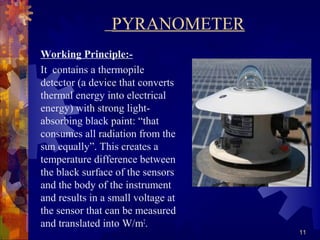
It contains a thermopile
detector (a device that converts
thermal energy into electrical
energy) with strong light-
absorbing black paint: “that
consumes all radiation from the
sun equally”. This creates a
temperature difference between
the black surface of the sensors
and the body of the instrument
and results in a small voltage at
the sensor that can be measured
and translated into W/m2
.
11
12
CONSTRUCTIONS:-CONSTRUCTIONS:-
•The inner and outer domes, their role is to filter out infrared
radiation coming from the atmosphere and the surroundings.
•The detector is a thermopile made with more than 40
thermocouples connected in series. The hot junction of the
thermopile is coated with a highly absorbing material.
•The body of the instrument is a cylindrical piece of brass
painted white to reduce the absorption of solar irradiance.
•The electrical circuit is mounted inside. The body is used as
heat sink for the cold junction of the thermopile.
13
•There's a sun shield which shields the instrument body from
dwelling solar radiation.
•The device also contains a desiccant to remove the humidity
inside the body to protect the circuitry, and a bubble level to
guide the leveling of the absorber surface.
14
CIRCUIT DIAGRAM:-CIRCUIT DIAGRAM:-
15
SPECIFICATION:-SPECIFICATION:-
16
i) ABS plastic case
ii) Silicon photodetector
iii) 470-Ohm, 1/4-Watt, 1%, metal film resistor.
iv) T 1-3/4 LED holder.
v) 2.5 mm stereo plug and cable – 5 feet.
vi) Rubber or soft plastic grommet.
vii) 1 mm (0.039") thick x 3/8" diameter Teflon disk.
viii) Small "bullseye" bubble level.
ix) Long piece of 1/4" (nominal inside diameter) thick-
walled grey PVC plumbing pipe.
x) Small cable tie.
17
ADVANTAGES
 Nearly constant spectral response on the whole solar
spectral range.
 Highly used.
 Used for Meteorological, Scientific , and climatic
observations.
 Very small temperature coefficient.
 More Accurate measurements of performance ratio.
18
DISADVANTAGES
With advantages, plenty of bugs also came as an invitee,
henceforth, there are:-
The response time is a disadvantage, in the order of
seconds
Devices are very much expensive.
The Device are not of Rugged Constructions and
imperilled; therefore it must be handled with care.
Yearly(Annually) Periodic Recalibration have to be
done.
Low Intensity signal must be amplified.
APPLICATIONS
The few applications according to Devices are:-
a)a) Reliable measurements---Reliable measurements---
Conducting reliable and accurate solar radiation
measurements using two components: a suitable set of
pyranometer, and an adequate data logger.
19
20
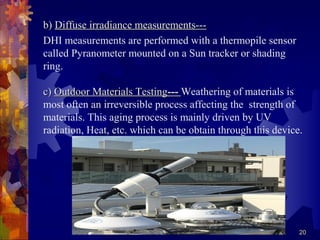
b)b) Diffuse irradiance measurements---Diffuse irradiance measurements---
DHI measurements are performed with a thermopile sensor
called Pyranometer mounted on a Sun tracker or shading
ring.
c)c) Outdoor Materials TestingOutdoor Materials Testing------ Weathering of materials is
most often an irreversible process affecting the strength of
materials. This aging process is mainly driven by UV
radiation, Heat, etc. which can be obtain through this device.
FUTURE ASPECTS
In future if further improvisation could be done within the
systematic development then Automatic-Switching system in
dawn, nightfall and clouds could also be provided.
Moreover, Solar standard solution Technology improvements
can be seen as:-
High precision shadowing control algorithm for solar
tracking.
Switching system for optimizing inverter efficiency.
Performance/efficiency oriented supervision system.
21
22
LAN 2
Local
Automation
Solar Tracker
Inverters
MV an LV
Swicthgears
DCS
Transformers
OPERATOR
WORKPLACE
Remote Office
Internet
Remote Access
LAN 1
eMail
And in Future the Photovoltaic plant automation
Somehow Architecture would Look Like this:
23
CONCLUSIONS
The device that had been introduced, according to its nature
and behaviour, justified a single point of reason had that it
can help in achieving our concerns relating to Solar
Radiation problems thus, giving a lesson about the
Importance of its applications.
The pyranometer detects almost 100% of the light-spectra
range and thus, comprises the uv-radiation, vis-(visible
radiation, and the part of the-(Infrared-radiation) light.
Understanding details of heat flow pathways within the
instrument and how its changes in the environment.
24
REFERENCES
[1] Kinsell Coulson: Handbook of Solar and Terrestrial
Radiation Methods and Measurements. Printed in India by
Magic International (P) Ltd., Greater Noida and Published by
Oxford University Press in 2009.
[2] Md. Iqbal: Handbook of Introduction to Solar Radiation.
Printed in India by B.B. Press, Sec:-67, Noida and published by
Kalyani Publishers in 2014.
25
[3] Eko Instruments
https://eko-eu.com/products/solar-energy/pyranometers
[4] Kipp Zonen Technologies
http://www.kippzonen.com/ProductGroup/3/Pyranometers
[5] Wikipedia
https://en.wikipedia.org/wiki/Pyranometer
26
THANK YOU FOR YOUR
PATIENCE AND TIME!!!
QUESTIONS ???
27

Solar Radiation Transducer

  • 1.
    1 SOLAR RADIATION MEASURING TRANSDUCERS PRESENTEDBY:- Rivu Nandi(15) & Vishal Kr. Singh(02) B.Tech(E.E.), 3rd Sem. Supreme Knowledge Foundation Group Of Institutions.
  • 2.
    TOPICS INCLUDED INTHIS PRESENTATION 1. INTRODUCTION 2. OBJECTIVES 3. IRRADIANCE 4. CLASSIFICATION 5. DEVICE 6. ADVANTAGES & DISADVANTAGES 7. APPLICATIONS 8. FUTURE ASPECTS 9. CONCLUSION 10. REFERENCE 2
  • 3.
    INTRODUCTION 3 A transducer isan electronic device that is used to convert one form of physical quantity into its corresponding electrical signals. In most of the electrical systems, the input signal will not be an electrical signal, but a non-electrical signal.
  • 4.
    4 Hence, in theLate 21st Century, Radiations has become one of the most vital kind of issue. And, Moreover, The word ‘radiation’ arises from the phenomenon of waves radiating (i.e., traveling outward in all directions) from a source. Two main types of Radiations are:- i) Nuclear Radiations ii) Solar Radiation
  • 5.
    6 Solar Radiation Solar radiationis the energy emitted by the sun, which spreads in all directions through space by electromagnetic waves. That energy is the engine that determines the dynamics of atmospheric processes and accounts for almost all of the energy available to the Earth. 4
  • 6.
    OBJ:- Why Transducersand Solar Radiation? Determining the solar radiation and its interaction with the atmosphere and the Earth's surface is important, since solar radiation accounts for almost all of the energy available to the Earth. 6
  • 7.
    7 Unfortunately, too littleis known about the spatial and temporal distribution of incoming solar radiation. Thereby, using a Transducer which can measure the Solar Radiation, with a precise description of distribution will prove usefulness to many fields of study that rely on atmospheric energy input, such as agricultural, architectural, and engineering-planning. For example, analysis of the solar radiation distribution in India—a state with a relatively high loading of input radiation and relatively high spatial and temporal variability—is both important and relevant.
  • 8.
    IRRADIANCE Radiation interactions withthe Earth’s atmosphere with solar radiation results in three components of interest to solar energy conversion technologies :-• Direct normal irradiance (DNI)--- Solar radiation available from the solar disk due to a small divergence angle(5 deg.), i.e., the rays of light from the sun are considered parallel to the earth’s surface are called Direct Normal Irradiance. For e.g.:- PYRHELIOMETER. • Diffuse horizontal irradiance (DHI)--- Scattered solar radiation from the sky dome (not including DNI), i.e., the sky radiation in the hemisphere above the local horizontal representing all radiation from the sky dome is called Diffuse horizontal irradiance . For e.g.:- PYRANOMETER. 8
  • 9.
    9 • Global horizontalirradiance (GHI)--- Geometric sum of the DNI and DHI (total hemispheric irradiance) is known as Global horizontal irradiance. For e.g.:- PYRANOMETER
  • 10.
    CLASSIFICATION Global irradiance isthe amount of radiant energy (electromagnetic radiation from the sun) on a flat surface. The irradiance is measured in (W/m2 ). And the device used to measure this irradiance from all directions is called pyranometer. There are two types of pyranometer: thermopile pyranometer and semiconductor pyranometer. i) A Thermopile Pyranometer ---A Thermopile Pyranometer --- It is a pyranometer that measures the total amount of radiation on a surface. ii) A Semiconductor Pyranometer---A Semiconductor Pyranometer--- It is a pyranometer that measures the total amount of spectral radiation on a surface upto which it sees; means its’ spectral sensitivity is limited. 10
  • 11.
    PYRANOMETER Working Principle:- It containsa thermopile detector (a device that converts thermal energy into electrical energy) with strong light- absorbing black paint: “that consumes all radiation from the sun equally”. This creates a temperature difference between the black surface of the sensors and the body of the instrument and results in a small voltage at the sensor that can be measured and translated into W/m2 . 11
  • 12.
    12 CONSTRUCTIONS:-CONSTRUCTIONS:- •The inner andouter domes, their role is to filter out infrared radiation coming from the atmosphere and the surroundings. •The detector is a thermopile made with more than 40 thermocouples connected in series. The hot junction of the thermopile is coated with a highly absorbing material. •The body of the instrument is a cylindrical piece of brass painted white to reduce the absorption of solar irradiance. •The electrical circuit is mounted inside. The body is used as heat sink for the cold junction of the thermopile.
  • 13.
    13 •There's a sunshield which shields the instrument body from dwelling solar radiation. •The device also contains a desiccant to remove the humidity inside the body to protect the circuitry, and a bubble level to guide the leveling of the absorber surface.
  • 14.
  • 15.
  • 16.
    16 i) ABS plasticcase ii) Silicon photodetector iii) 470-Ohm, 1/4-Watt, 1%, metal film resistor. iv) T 1-3/4 LED holder. v) 2.5 mm stereo plug and cable – 5 feet. vi) Rubber or soft plastic grommet. vii) 1 mm (0.039") thick x 3/8" diameter Teflon disk. viii) Small "bullseye" bubble level. ix) Long piece of 1/4" (nominal inside diameter) thick- walled grey PVC plumbing pipe. x) Small cable tie.
  • 17.
    17 ADVANTAGES  Nearly constantspectral response on the whole solar spectral range.  Highly used.  Used for Meteorological, Scientific , and climatic observations.  Very small temperature coefficient.  More Accurate measurements of performance ratio.
  • 18.
    18 DISADVANTAGES With advantages, plentyof bugs also came as an invitee, henceforth, there are:- The response time is a disadvantage, in the order of seconds Devices are very much expensive. The Device are not of Rugged Constructions and imperilled; therefore it must be handled with care. Yearly(Annually) Periodic Recalibration have to be done. Low Intensity signal must be amplified.
  • 19.
    APPLICATIONS The few applicationsaccording to Devices are:- a)a) Reliable measurements---Reliable measurements--- Conducting reliable and accurate solar radiation measurements using two components: a suitable set of pyranometer, and an adequate data logger. 19
  • 20.
    20 b)b) Diffuse irradiancemeasurements---Diffuse irradiance measurements--- DHI measurements are performed with a thermopile sensor called Pyranometer mounted on a Sun tracker or shading ring. c)c) Outdoor Materials TestingOutdoor Materials Testing------ Weathering of materials is most often an irreversible process affecting the strength of materials. This aging process is mainly driven by UV radiation, Heat, etc. which can be obtain through this device.
  • 21.
    FUTURE ASPECTS In futureif further improvisation could be done within the systematic development then Automatic-Switching system in dawn, nightfall and clouds could also be provided. Moreover, Solar standard solution Technology improvements can be seen as:- High precision shadowing control algorithm for solar tracking. Switching system for optimizing inverter efficiency. Performance/efficiency oriented supervision system. 21
  • 22.
    22 LAN 2 Local Automation Solar Tracker Inverters MVan LV Swicthgears DCS Transformers OPERATOR WORKPLACE Remote Office Internet Remote Access LAN 1 eMail And in Future the Photovoltaic plant automation Somehow Architecture would Look Like this:
  • 23.
    23 CONCLUSIONS The device thathad been introduced, according to its nature and behaviour, justified a single point of reason had that it can help in achieving our concerns relating to Solar Radiation problems thus, giving a lesson about the Importance of its applications. The pyranometer detects almost 100% of the light-spectra range and thus, comprises the uv-radiation, vis-(visible radiation, and the part of the-(Infrared-radiation) light. Understanding details of heat flow pathways within the instrument and how its changes in the environment.
  • 24.
    24 REFERENCES [1] Kinsell Coulson:Handbook of Solar and Terrestrial Radiation Methods and Measurements. Printed in India by Magic International (P) Ltd., Greater Noida and Published by Oxford University Press in 2009. [2] Md. Iqbal: Handbook of Introduction to Solar Radiation. Printed in India by B.B. Press, Sec:-67, Noida and published by Kalyani Publishers in 2014.
  • 25.
    25 [3] Eko Instruments https://eko-eu.com/products/solar-energy/pyranometers [4]Kipp Zonen Technologies http://www.kippzonen.com/ProductGroup/3/Pyranometers [5] Wikipedia https://en.wikipedia.org/wiki/Pyranometer
  • 26.
    26 THANK YOU FORYOUR PATIENCE AND TIME!!!
  • 27.