

Solar Radiation Estimation
based on Digital Image
Processing
HARSH VARDHAN MALL
16EC65R22
Solar Radiation Estimation
 Quantifying the total solar radiation incident in the solar field
 Forecasting cloudy situations.
Why Solar Radiation Estimation?
 Expansion in solar energy applications
 Information of atmospheric conditions is the major
requirement to improve system performance
 Information is used to adapt solar plant's strategic operation
to the meteorological conditions
Components of Solar Radiation
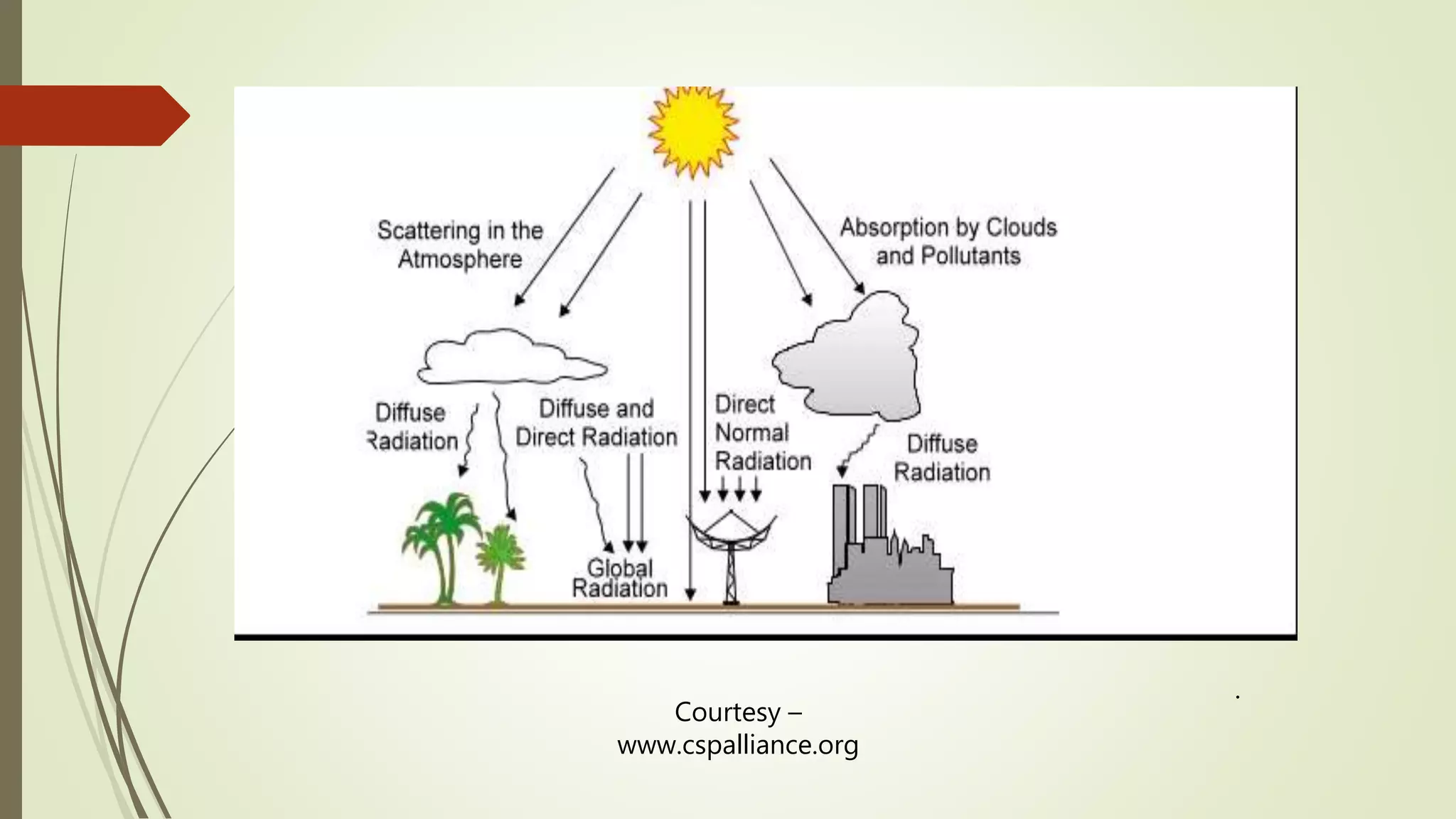
 3 components - Beam, Diffuse and Global Solar Radiation
 Beam Radiation – Solar radiation travelling in a straight line
directly to the surface of the earth
 Diffuse Radiation – Solar radiation reaching the surface after
being scattered by atoms and molecules in atmosphere
 Global Radiation – Total radiation reaching the surface. It
includes both Beam and Diffuse radiation
.
Courtesy –
www.cspalliance.org
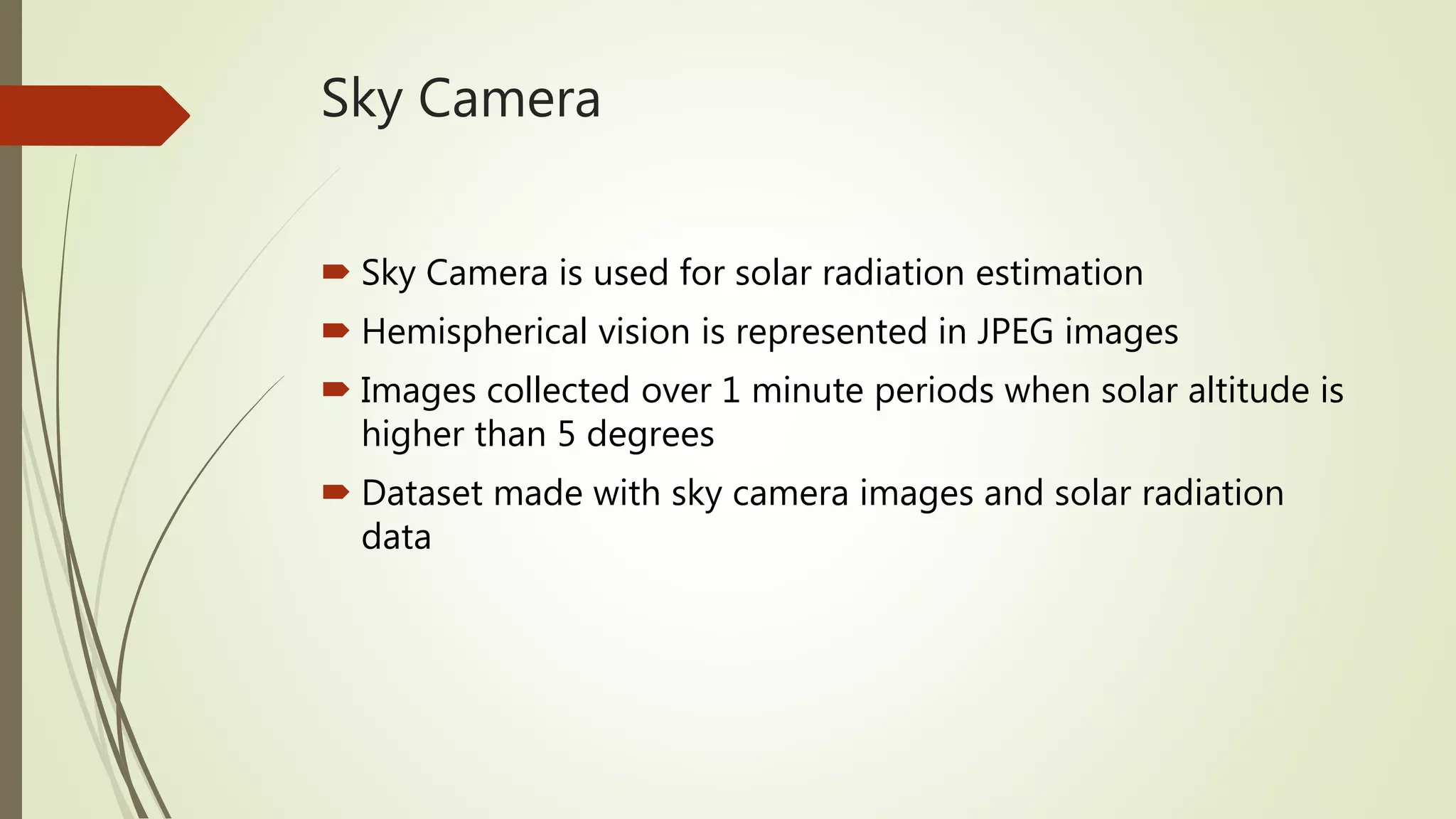
Sky Camera
 Sky Camera is used for solar radiation estimation
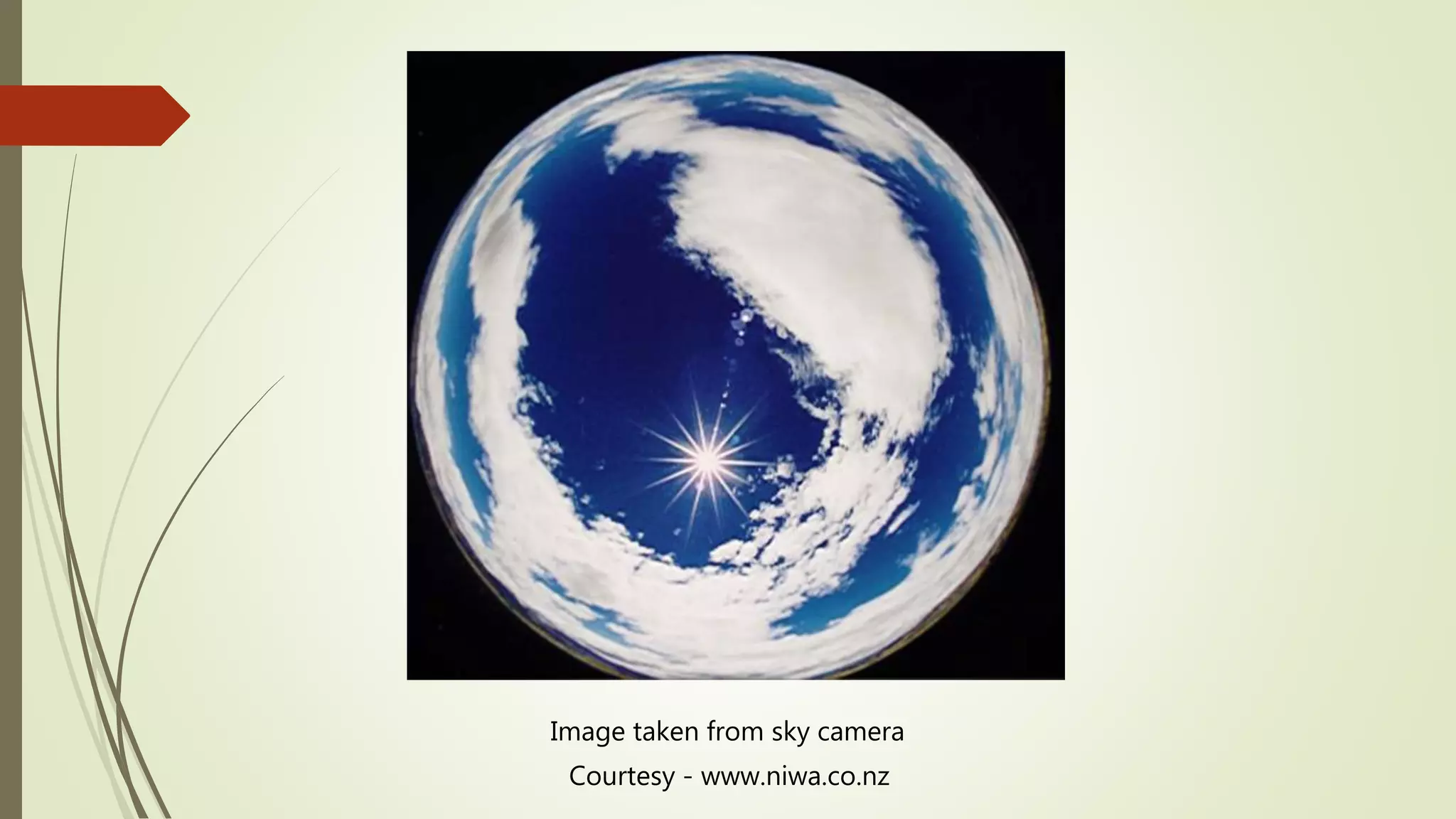
 Hemispherical vision is represented in JPEG images
 Images collected over 1 minute periods when solar altitude is
higher than 5 degrees
 Dataset made with sky camera images and solar radiation
data
Image taken from sky camera
Courtesy - www.niwa.co.nz
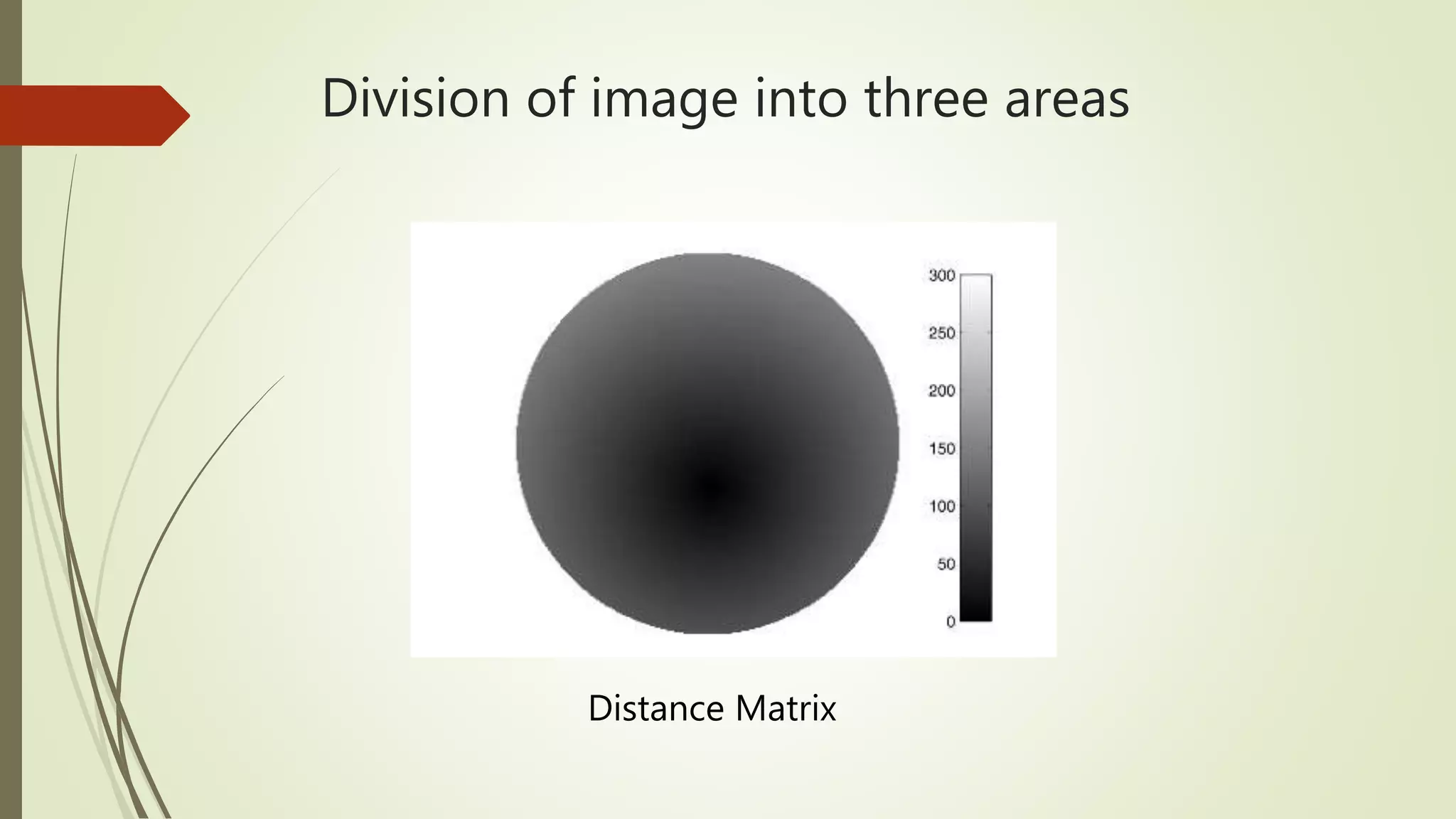
Division of image into three areas
Distance Matrix
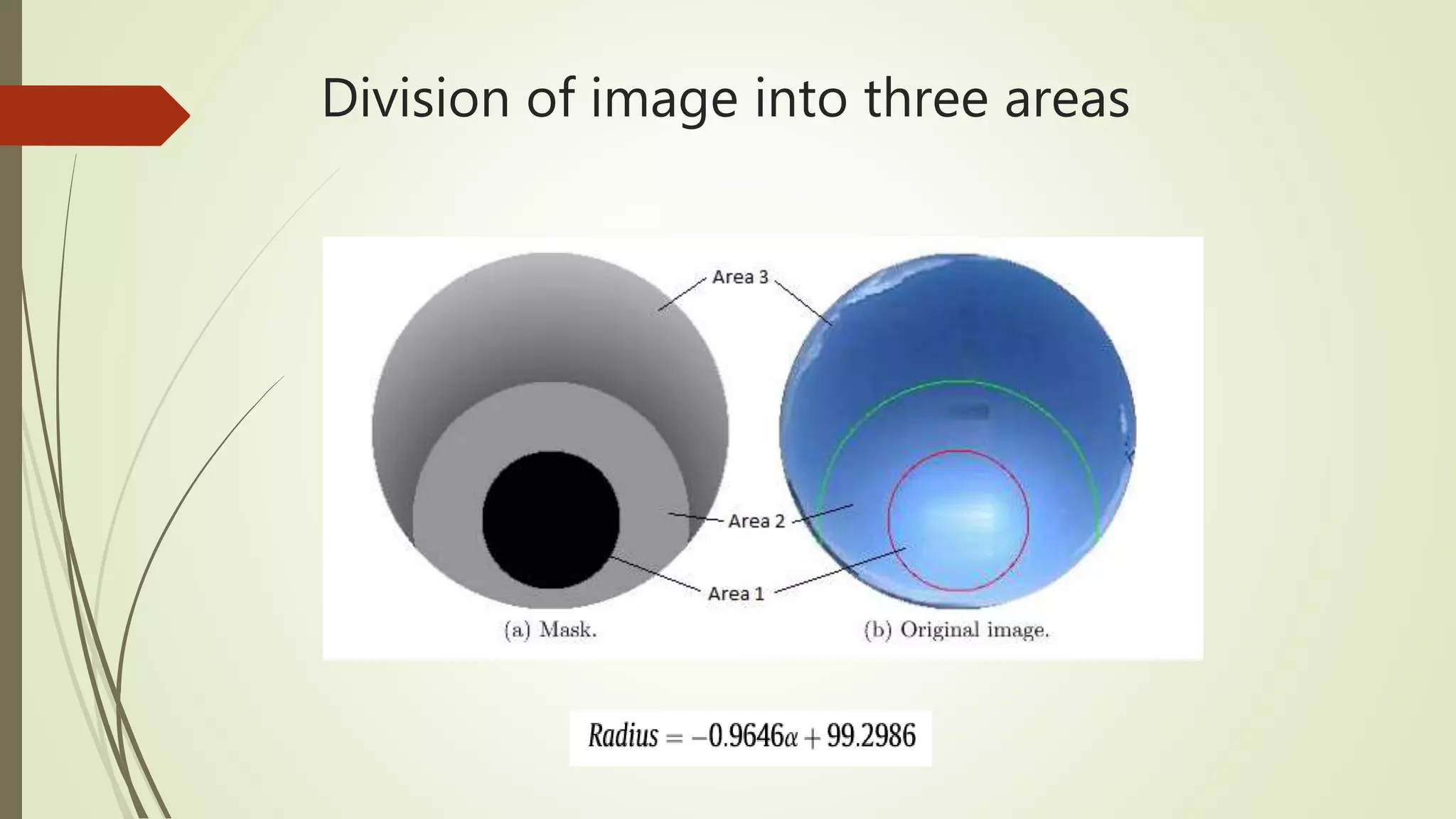
Division of image into three areas
 Area around the sun is more saturated and dilutes as we
move away from "Sun pixel"
 This area varies according to the time of the day
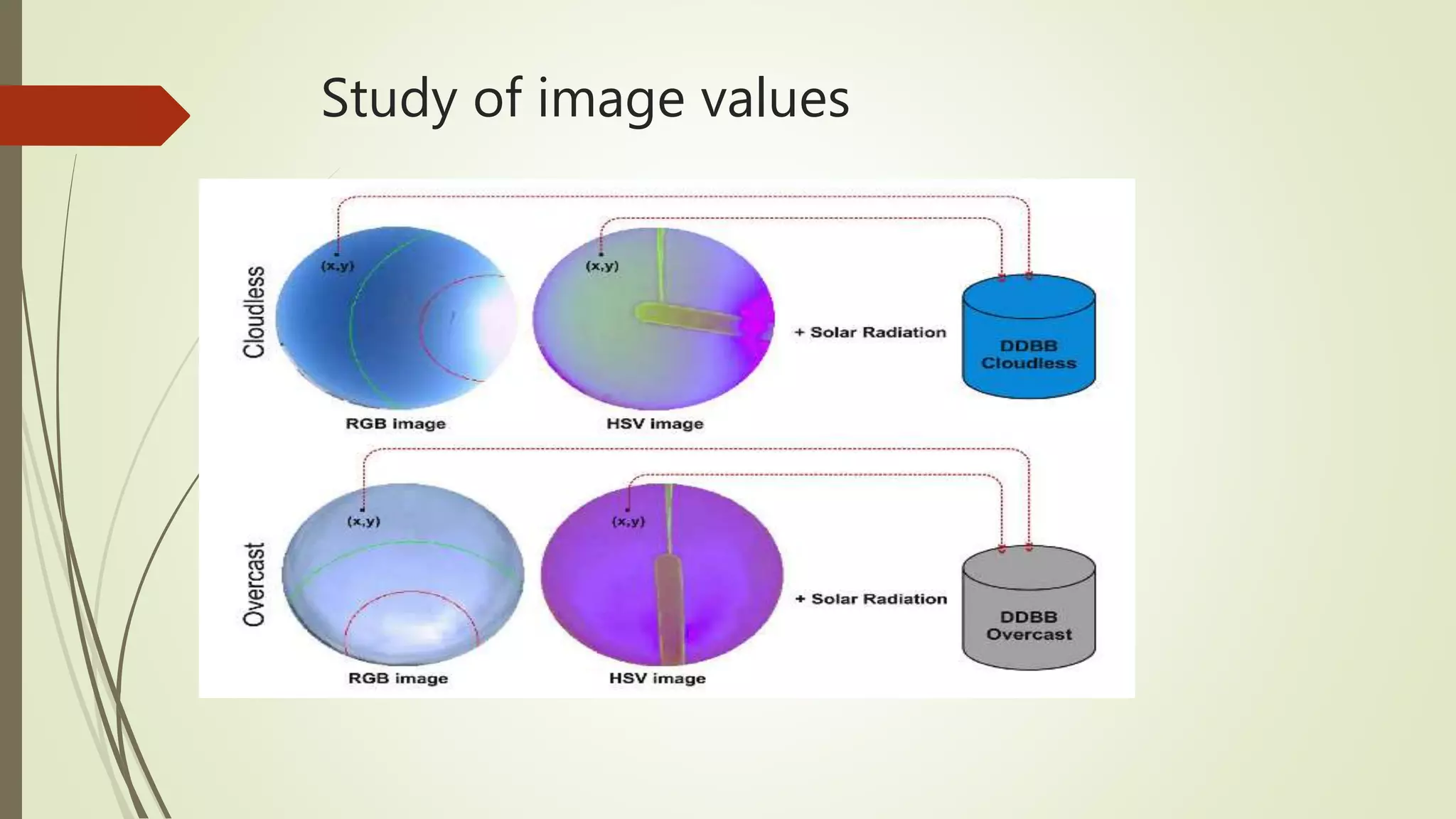
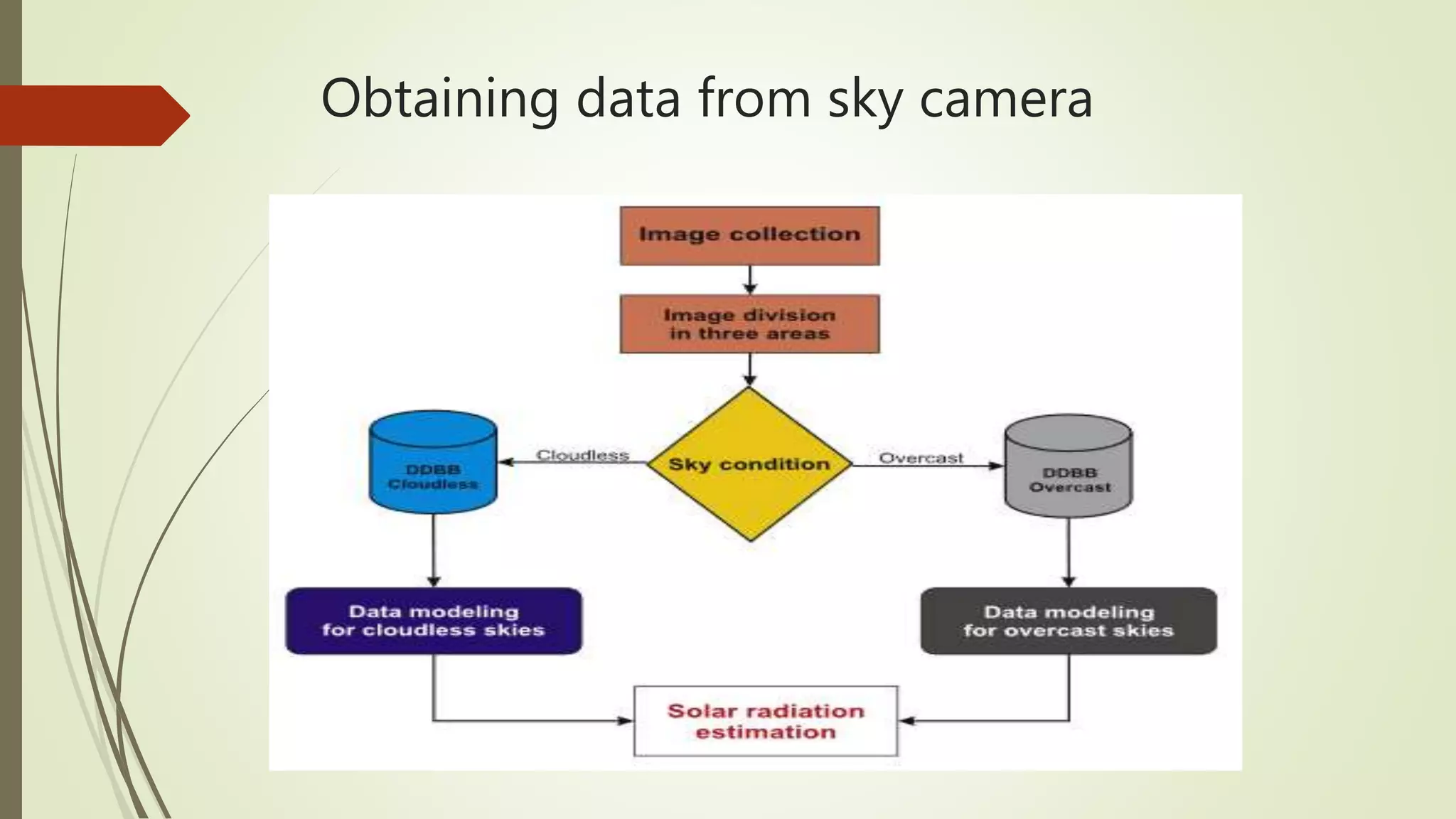
 After image splitting, pixel values are studied for cloudless
and overcast situations
 Different databases were created for both situations
 Data of 4 clear and 4 cloud covered days (for each season)
was collected
Study of Image values
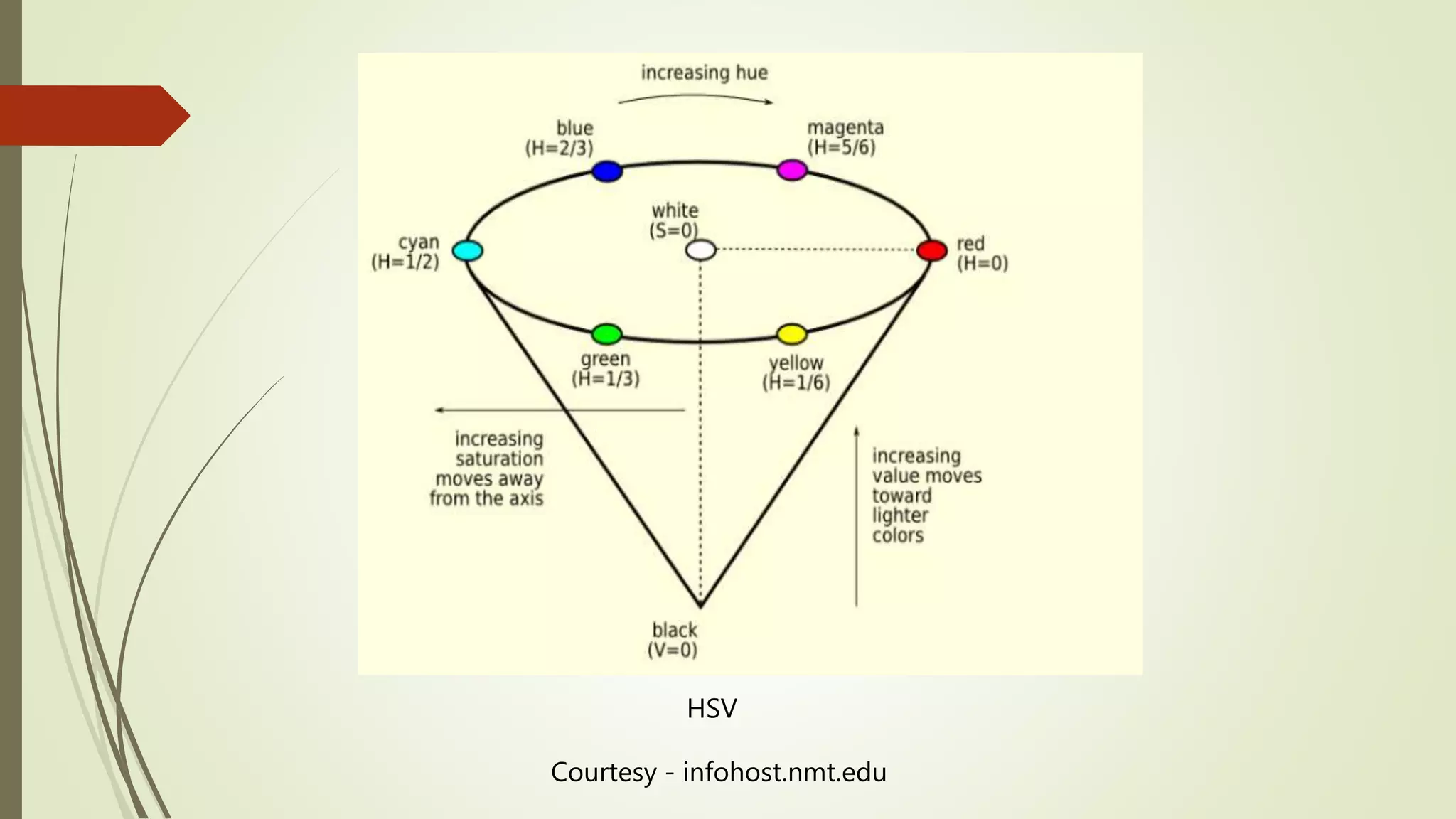
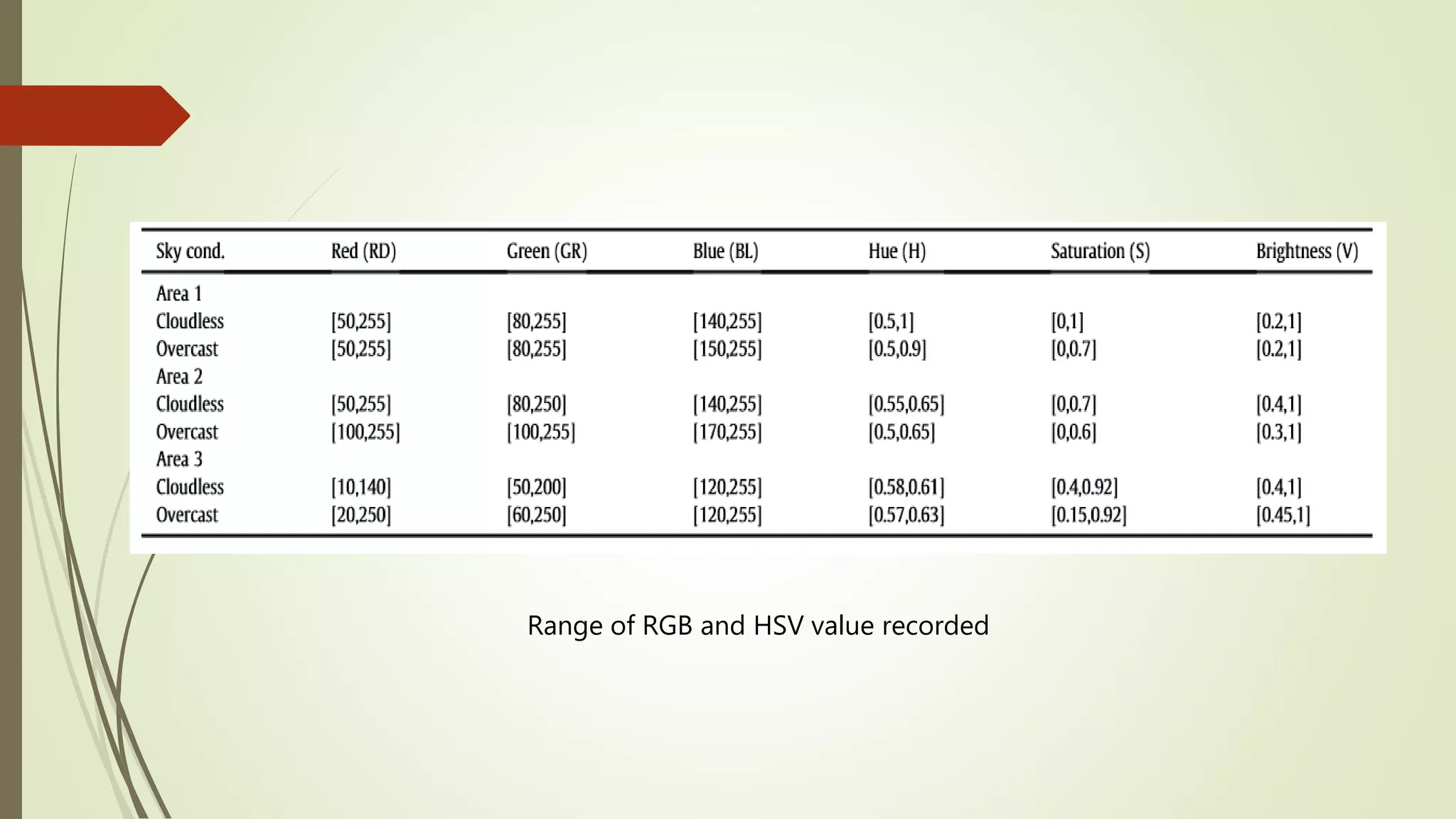
 Digital values of RGB(red, green, blue) and HSV(hue,
saturation, value) are collected for each pixel
 Beam, Diffuse and Global solar irradiance values are also
collected for each pixel
 These values are stored at the databases
HSV
Courtesy - infohost.nmt.edu
Study of image values
Obtaining data from sky camera
Range of RGB and HSV value recorded
Channel values based on solar altitude
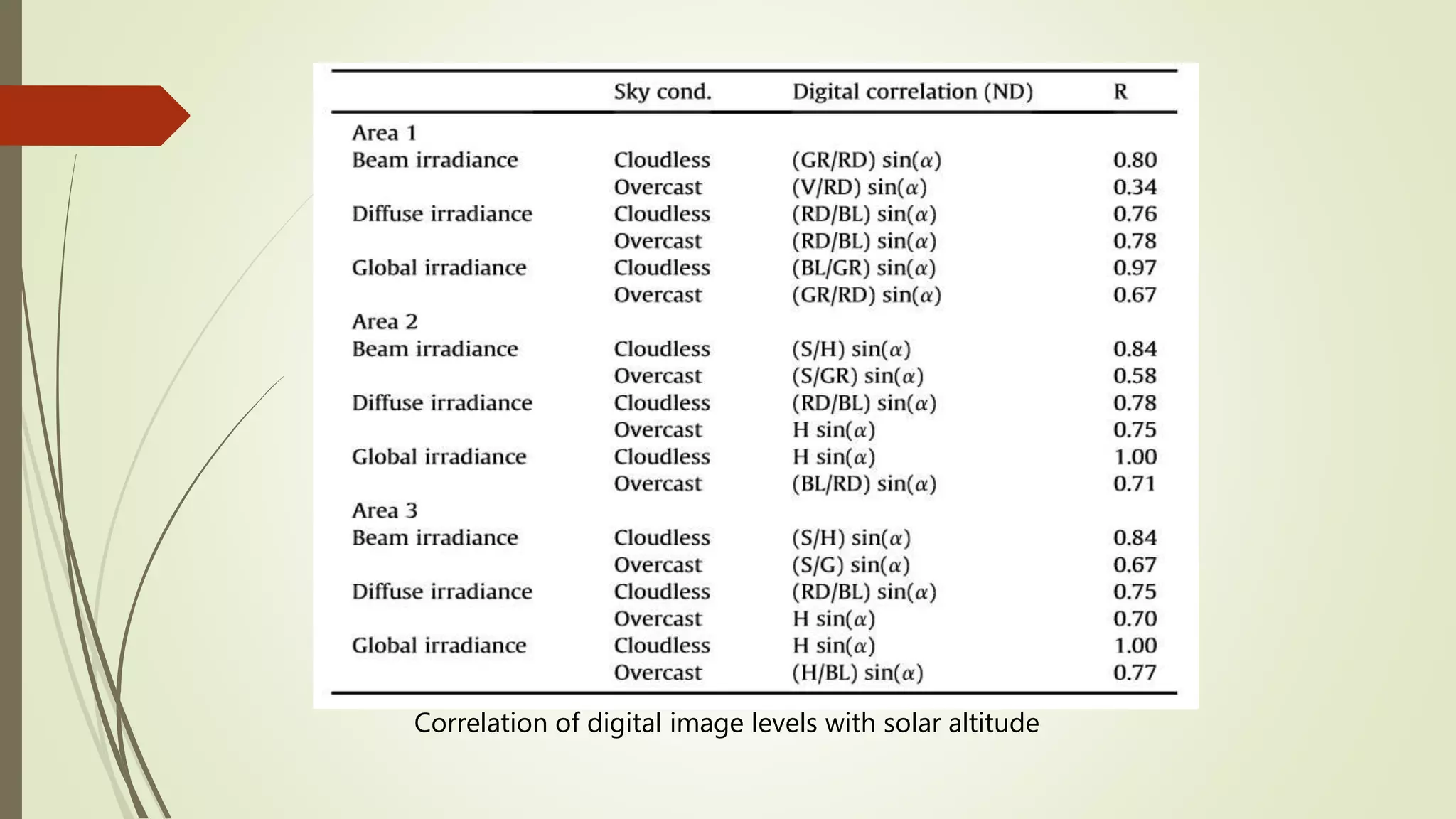
 Correlation between different image and solar altitude was
analyzed.
 It is done for each type of sky condition and each area
Correlation of digital image levels with solar altitude
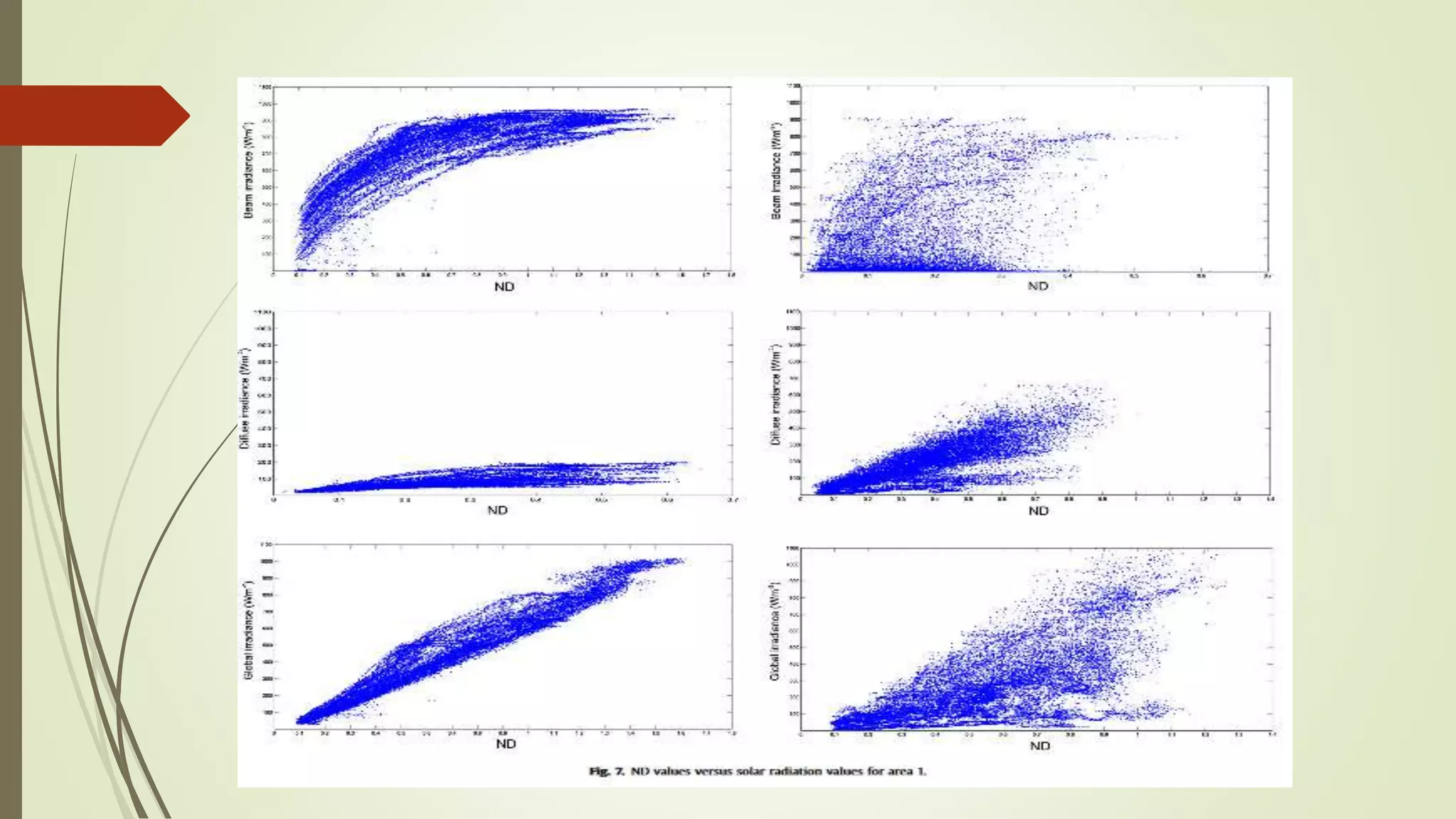
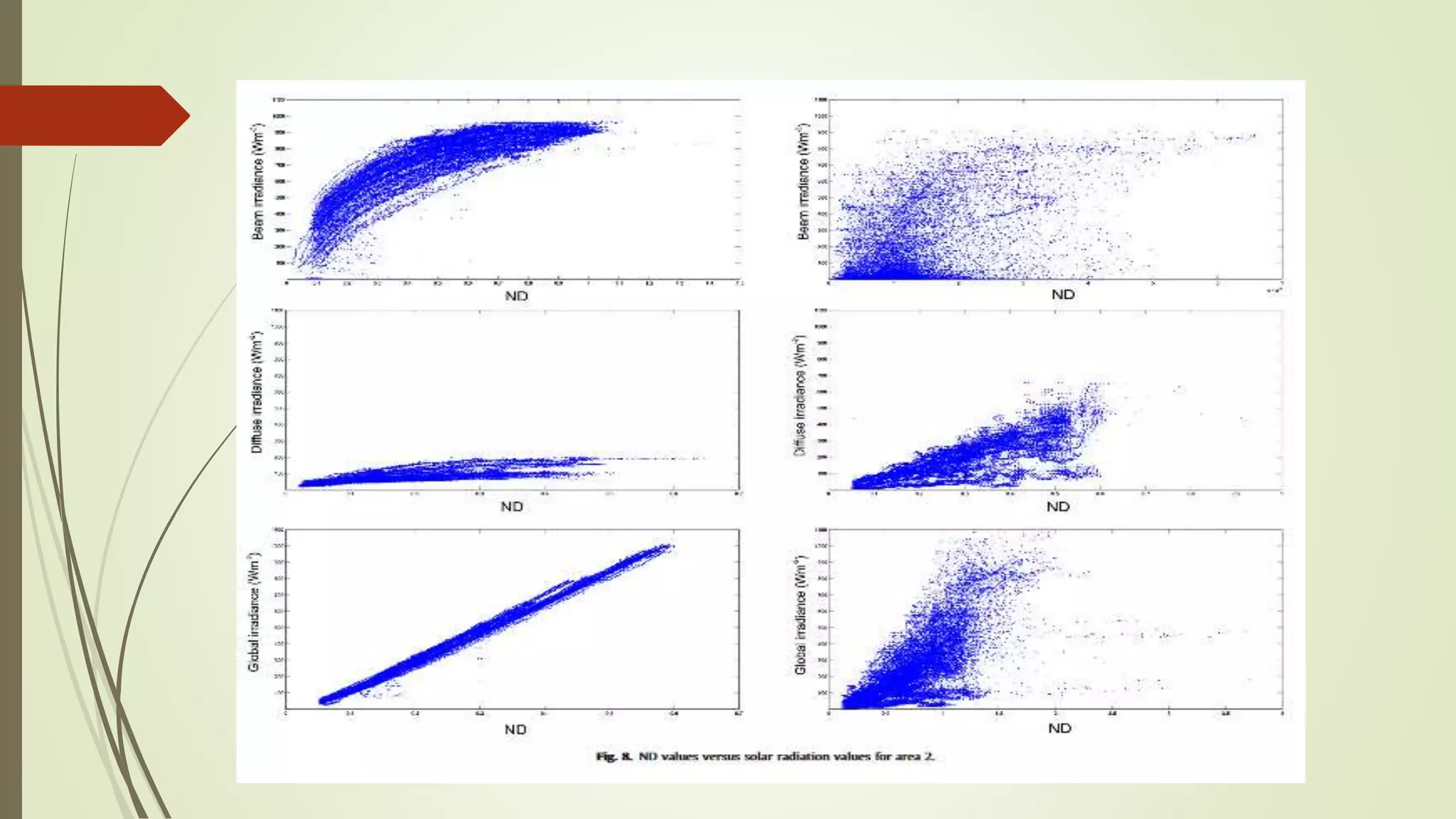
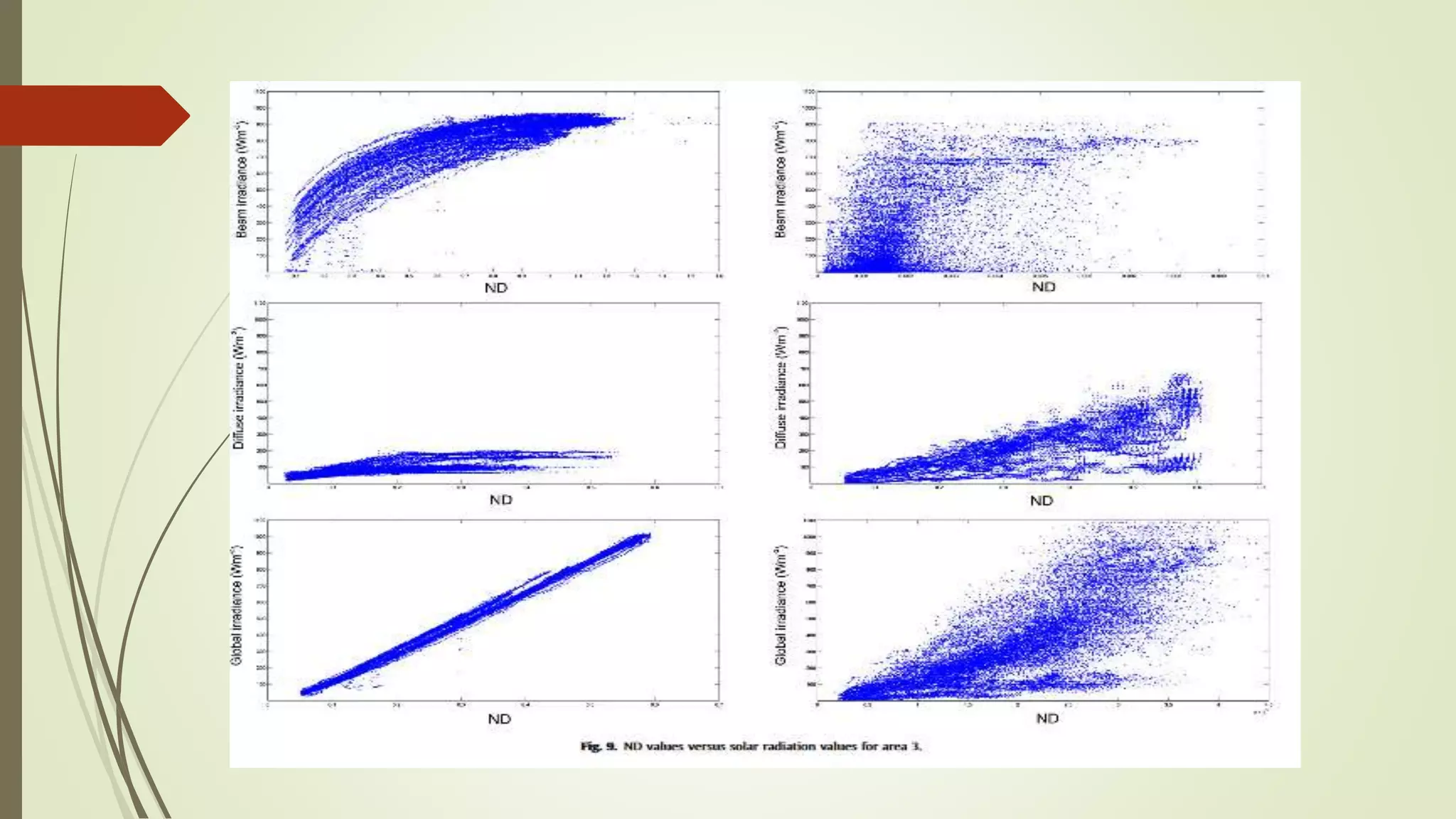
Plotting Solar Irradiance
versus ND values
For Beam, Diffuse and Global Solar Radiation Values
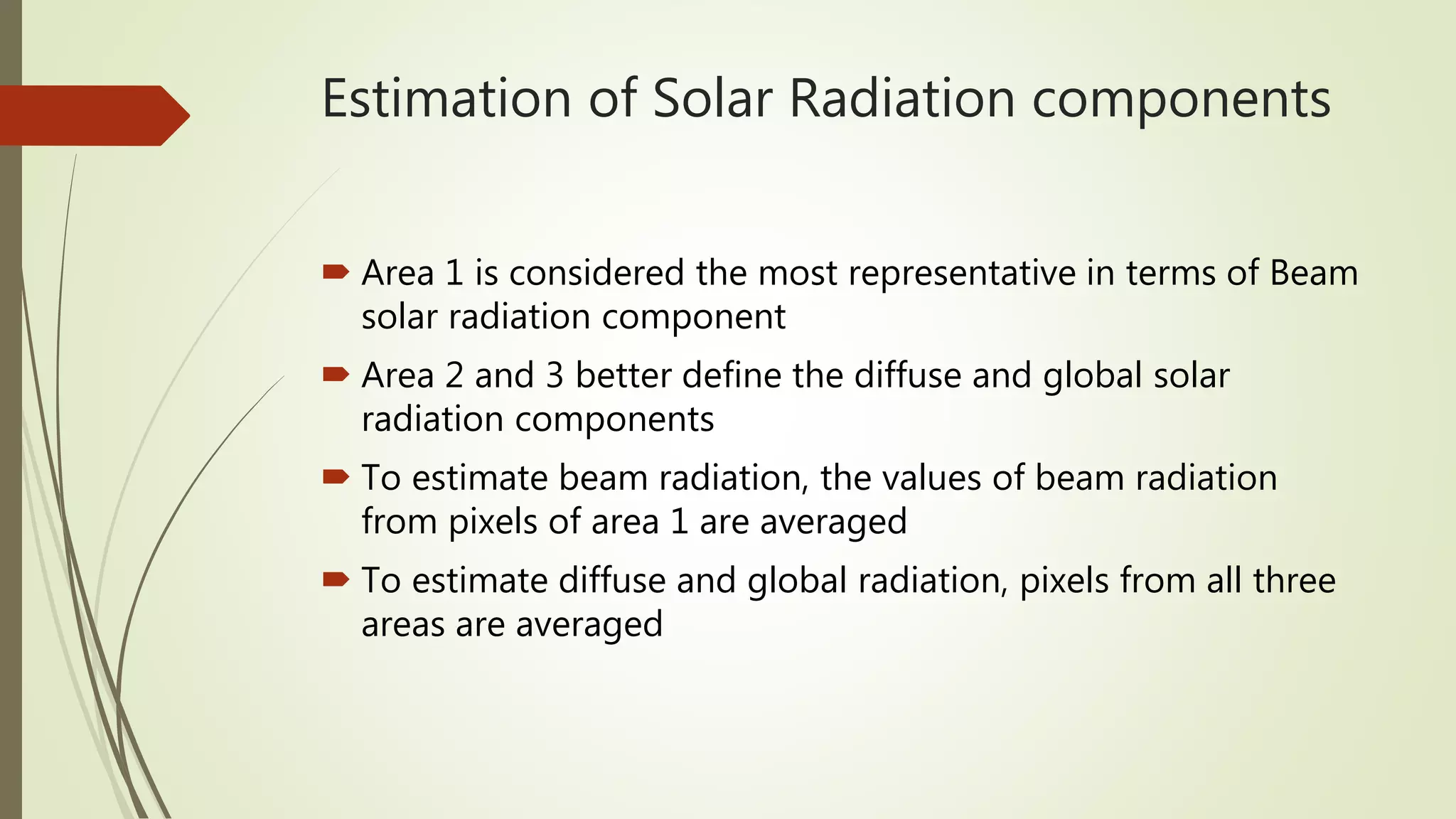
Estimation of Solar Radiation components
 Area 1 is considered the most representative in terms of Beam
solar radiation component
 Area 2 and 3 better define the diffuse and global solar
radiation components
 To estimate beam radiation, the values of beam radiation
from pixels of area 1 are averaged
 To estimate diffuse and global radiation, pixels from all three
areas are averaged
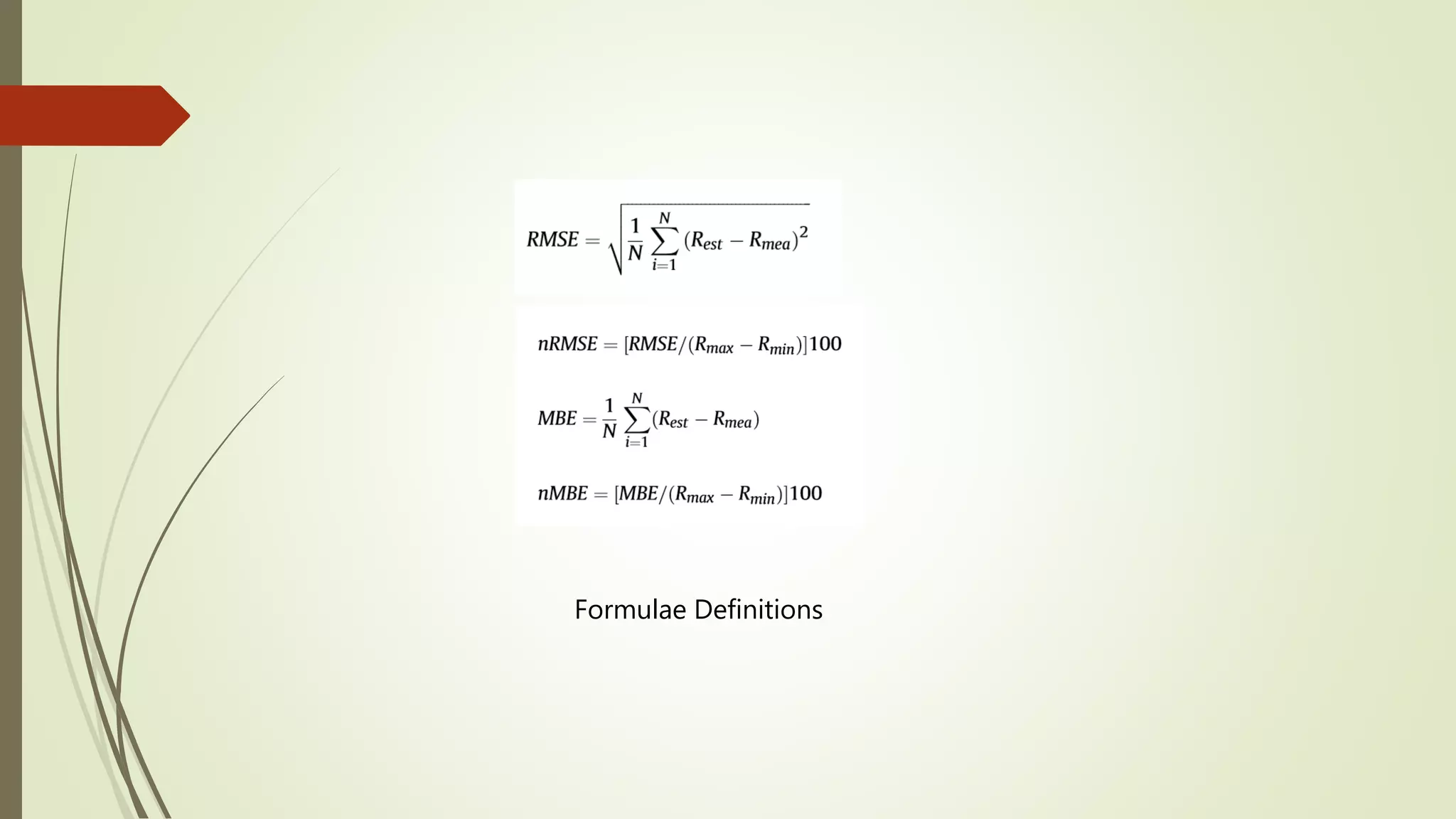
Errors
 RMSE (Root Mean Square Error)
 Normalized RMSE (nRMSE)
 MBE (Mean Bias Error)
 Normalizes MBE (nMBE)
Formulae Definitions
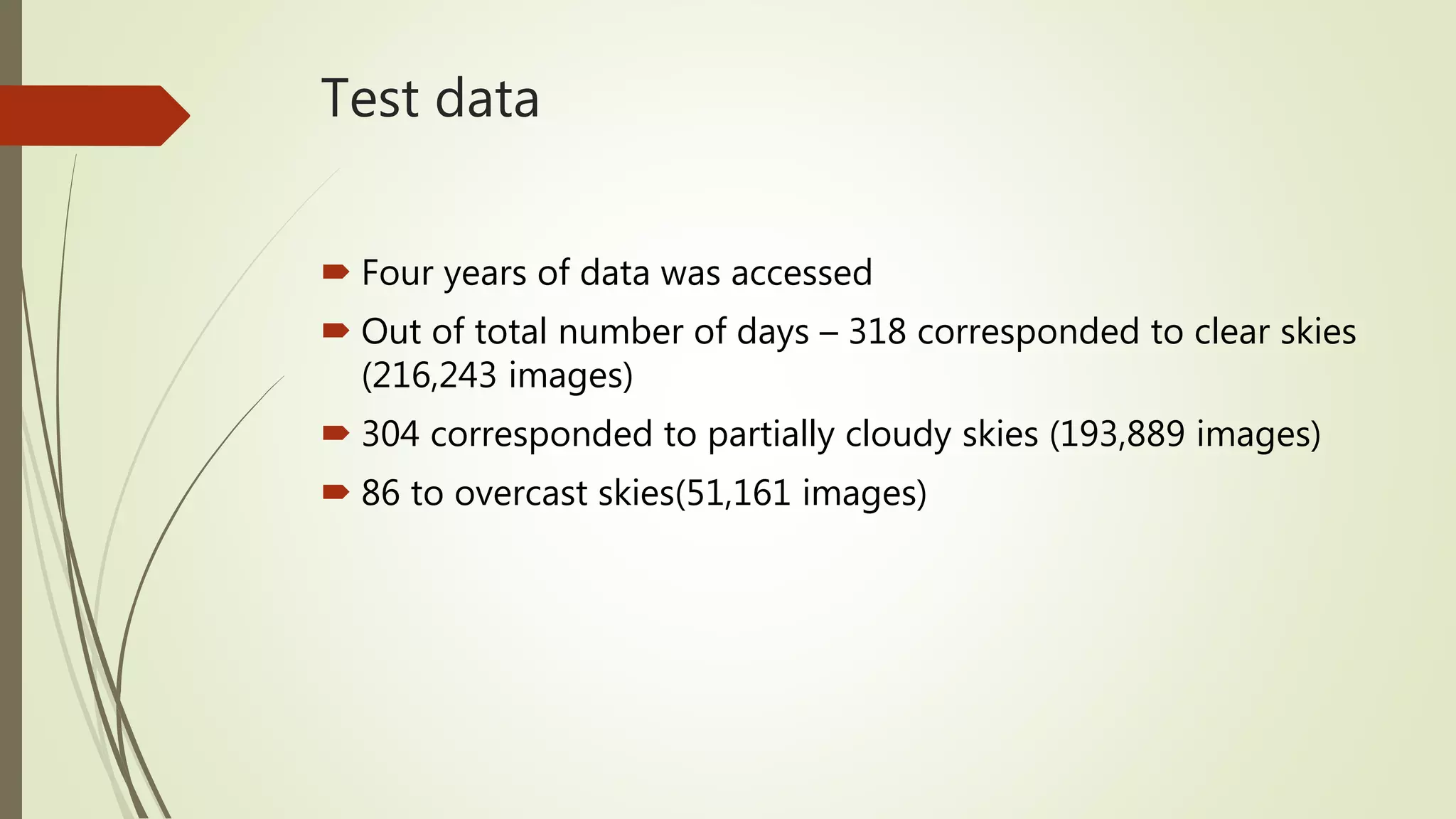
Test data
 Four years of data was accessed
 Out of total number of days – 318 corresponded to clear skies
(216,243 images)
 304 corresponded to partially cloudy skies (193,889 images)
 86 to overcast skies(51,161 images)
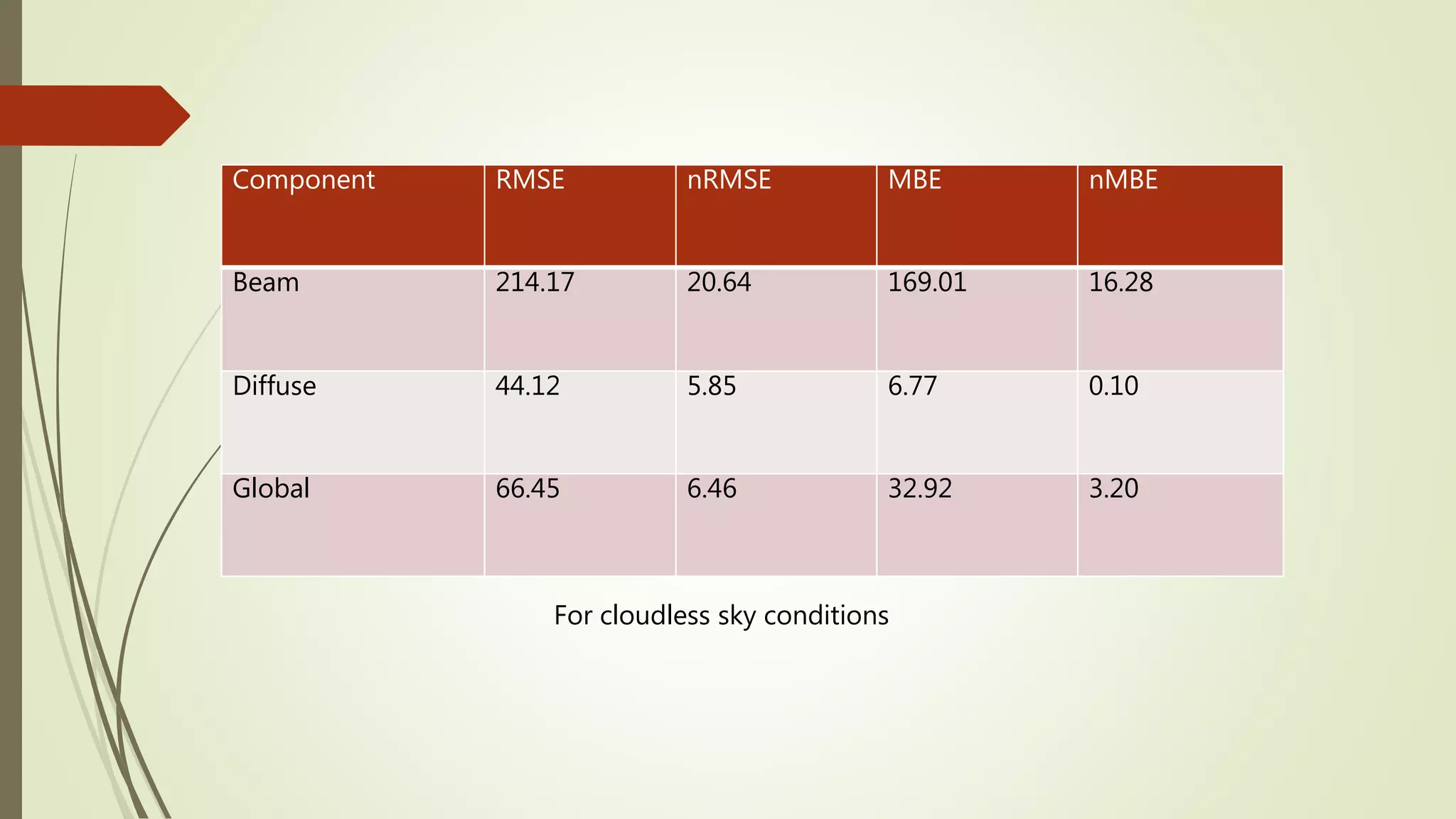
Component RMSE nRMSE MBE nMBE
Beam 214.17 20.64 169.01 16.28
Diffuse 44.12 5.85 6.77 0.10
Global 66.45 6.46 32.92 3.20
For cloudless sky conditions
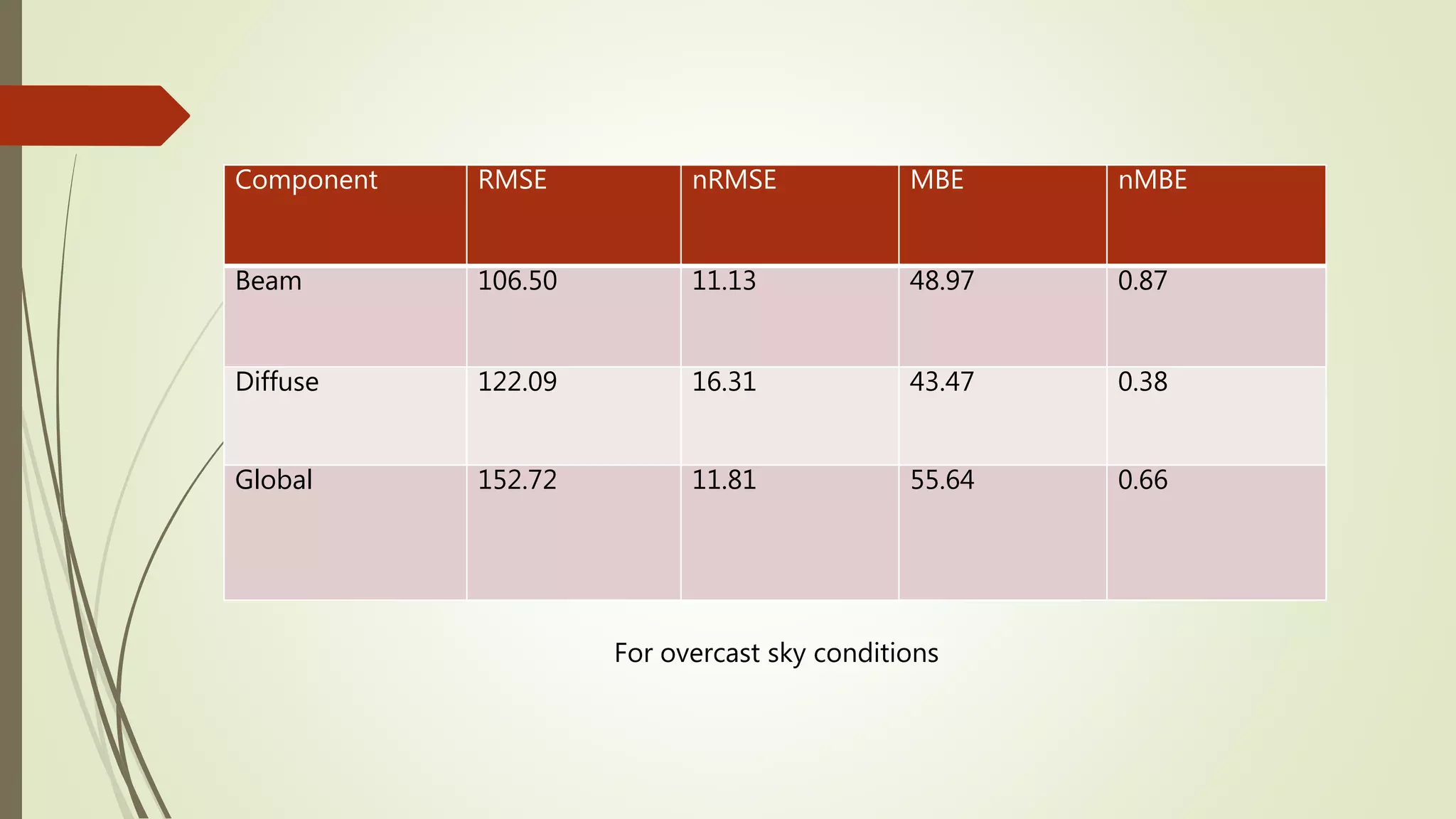
Component RMSE nRMSE MBE nMBE
Beam 106.50 11.13 48.97 0.87
Diffuse 122.09 16.31 43.47 0.38
Global 152.72 11.81 55.64 0.66
For overcast sky conditions
References
 J. Alonso-Montesinos, F.J. Batlles "The use of a sky camera for solar
radiation estimation based on digital image processing" Energy
2015;90: Page 377-386
 Escrig H, Batlles FJ, Alonso J, Baena FM, Bosch JL, Salbidegoitia IB, et al.
"Cloud detection, classification and motion estimation using
geostationary satellite imagery for cloud cover forecast." Energy 2013;55
Page 853-859
 Rusen SE, Hammer A, Akinoglu BG. "Estimation of daily global solar
irradiation by coupling ground measurements of bright sunshine hours to
satellite imagery." Energy 2013;58 Page 417-425

Solar Radiation Estimation based on Digital Image Processing

  • 1.
    Solar Radiation Estimation basedon Digital Image Processing HARSH VARDHAN MALL 16EC65R22
  • 2.
    Solar Radiation Estimation Quantifying the total solar radiation incident in the solar field  Forecasting cloudy situations.
  • 3.
    Why Solar RadiationEstimation?  Expansion in solar energy applications  Information of atmospheric conditions is the major requirement to improve system performance  Information is used to adapt solar plant's strategic operation to the meteorological conditions
  • 4.
    Components of SolarRadiation  3 components - Beam, Diffuse and Global Solar Radiation  Beam Radiation – Solar radiation travelling in a straight line directly to the surface of the earth  Diffuse Radiation – Solar radiation reaching the surface after being scattered by atoms and molecules in atmosphere  Global Radiation – Total radiation reaching the surface. It includes both Beam and Diffuse radiation
  • 5.
  • 6.
    Sky Camera  SkyCamera is used for solar radiation estimation  Hemispherical vision is represented in JPEG images  Images collected over 1 minute periods when solar altitude is higher than 5 degrees  Dataset made with sky camera images and solar radiation data
  • 7.
    Image taken fromsky camera Courtesy - www.niwa.co.nz
  • 8.
    Division of imageinto three areas Distance Matrix
  • 9.
    Division of imageinto three areas
  • 10.
    Division of imageinto three areas  Area around the sun is more saturated and dilutes as we move away from "Sun pixel"  This area varies according to the time of the day  After image splitting, pixel values are studied for cloudless and overcast situations  Different databases were created for both situations  Data of 4 clear and 4 cloud covered days (for each season) was collected
  • 11.
    Study of Imagevalues  Digital values of RGB(red, green, blue) and HSV(hue, saturation, value) are collected for each pixel  Beam, Diffuse and Global solar irradiance values are also collected for each pixel  These values are stored at the databases
  • 12.
  • 13.
  • 14.
  • 15.
    Range of RGBand HSV value recorded
  • 16.
    Channel values basedon solar altitude  Correlation between different image and solar altitude was analyzed.  It is done for each type of sky condition and each area
  • 17.
    Correlation of digitalimage levels with solar altitude
  • 18.
    Plotting Solar Irradiance versusND values For Beam, Diffuse and Global Solar Radiation Values
  • 22.
    Estimation of SolarRadiation components  Area 1 is considered the most representative in terms of Beam solar radiation component  Area 2 and 3 better define the diffuse and global solar radiation components  To estimate beam radiation, the values of beam radiation from pixels of area 1 are averaged  To estimate diffuse and global radiation, pixels from all three areas are averaged
  • 23.
    Errors  RMSE (RootMean Square Error)  Normalized RMSE (nRMSE)  MBE (Mean Bias Error)  Normalizes MBE (nMBE)
  • 24.
  • 25.
    Test data  Fouryears of data was accessed  Out of total number of days – 318 corresponded to clear skies (216,243 images)  304 corresponded to partially cloudy skies (193,889 images)  86 to overcast skies(51,161 images)
  • 26.
    Component RMSE nRMSEMBE nMBE Beam 214.17 20.64 169.01 16.28 Diffuse 44.12 5.85 6.77 0.10 Global 66.45 6.46 32.92 3.20 For cloudless sky conditions
  • 27.
    Component RMSE nRMSEMBE nMBE Beam 106.50 11.13 48.97 0.87 Diffuse 122.09 16.31 43.47 0.38 Global 152.72 11.81 55.64 0.66 For overcast sky conditions
  • 28.
    References  J. Alonso-Montesinos,F.J. Batlles "The use of a sky camera for solar radiation estimation based on digital image processing" Energy 2015;90: Page 377-386  Escrig H, Batlles FJ, Alonso J, Baena FM, Bosch JL, Salbidegoitia IB, et al. "Cloud detection, classification and motion estimation using geostationary satellite imagery for cloud cover forecast." Energy 2013;55 Page 853-859  Rusen SE, Hammer A, Akinoglu BG. "Estimation of daily global solar irradiation by coupling ground measurements of bright sunshine hours to satellite imagery." Energy 2013;58 Page 417-425