A Project Plan
On
SOLAR POWERED “FIELD UTILITY VEHICLE”
Submitted to
Amity University, Uttar Pradesh
In partial fulfillment of requirements for the award of degree of
Bachelor of Technology
In
Mechanical & Automation
Engineering
by
Abhishek Thakur
Akshay Mistri
Anirudh Pratap Singh
Sarthak Anand
Under the guidance of
Mr. P. N. Vishwakarma
DEPARTMENT OF MAE
AMITY SCHOOL OF ENGINEERING & TECHNOLOGY
AMITY UNIVERSITY, NOIDA (U.P.)
MAY, 2015
CONTENTS
CHAPTER - 1
INTRODUCTION……………………………………………………..…1-2
1.1 Purpose of Plan………………………………….………...1
1.2 Background Info/Alternatives…………………………….1
1.3 Goals and Objectives………………………………………1
1.4 Project Division…………………………………………….1-5
1.4.1 Chassis and Roll cage……1-2
1.4.2 Suspension system………..3
1.4.3 Braking system…………...4
1.4.4 Transmission system…..…4-5
1.5 Projected Budget………………………………………….5-6
1.6 Project Constraints……………………………………….6
1.7 Roles & Responsibilities………………………………….6
CHAPTER – 2
LITERATURE REVIEW……………………………..………………..7 - 17
2.1 Motor Torque & Speed……………………………..7 – 10
2.2 Braking System……………………..……………….10 – 12
2.3 Suspension Design……………………………….….12 – 14
2.4 Body Design & Roll Cage……………………….….14 – 17
CHAPTER – 3
CHASSIS AND BODY STRUCTURE………………………………….18-27
3.1 Basic Assumptions……………..……………18
3.2 Material used………………………………..18-19
3.3 Design & Analysis of chassis……….……....20-23
3.4 Design & Analysis of body…………………23-25
3.5 G-Force………………………………………25-26
3.6 Final Model………………………………….26-27
CHAPTER – 4
SUSPENSION SYSTEM…………………………………...………….28-32
4.1 Types of suspension used……………………28
4.2 Calculations involved…………………..……28
4.3 Analysis and calculations……………………28-29
4.4 Mounting the suspension on chassis……….29-32
4.4.1 McPherson strut mountings…..29-31
4.4.2 Leaf Spring mountings………..32
CHAPTER – 5
BRAKING SYSTEM……………………………………………………32-35
5.1 Braking calculations………………………32-34
5.2 Brake System used…………………………34-35
5.3 Parking Brake………………………………35
CHAPTER – 6
TRANSMISSION SYSTEM…………………………………………...36
Basic Assumptions………………..36
6.1 Torque & RPM calculations…36-38
6.2 Motor specification…………...38-39
6.3 Actual Transmission system…39
6.4 Transmission calculations……40
6.5 Battery Analysis………………40-41
CONCLUSION…………………………………………………………...41
REFERENCES……………………………………………………………42
1 | P a g e
CHAPTER – 1
INTRODUCTION
1.1 Purpose of project: The purpose of project is to build suspension, braking systems &
transmission system for a two seater, solar powered car with top speed of 35 km/hr.
1.2 Background Information/Alternatives Available: There are various solar cars built till
now which are performing very well. Also solar power is a good alternative of fuel, which is
available in abundance. E-rickshaw running on roads have also been considered for their motor
and electric circuitry.
1.3 Goals and Objectives:
 To fabricate a robust chassis for the vehicle.
 To fabricate the body structure with solar panel placement.
 To attach the suspension, wheels and steering system to the chassis.
 To attach the drum and disc brakes to chassis.
 To attach the seats on the chassis.
 To fabricate the transmission system connecting the motor shaft to the front axle.
 To fabricate the flooring of the vehicle, attach the solar panels and paint the vehicle.
1.4 Project division: Whole project is divided into four main systems which when assembled
together, create the working model of the vehicle. These systems are:
1. Chassis and Roll cage
2. Suspension system
3.Braking system
4.Transmission system
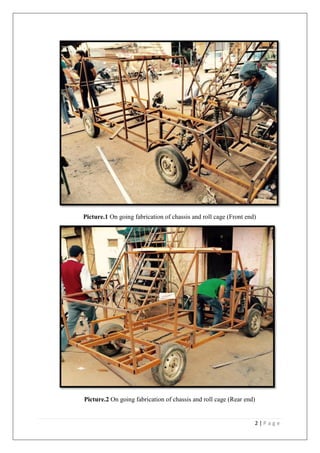
1.4.1 Chassis and Roll cage: First of all, a market survey was done to buy mild steel
pipes required for the fabrication of the same. Chassis has been kept as light in
weight as possible as well as it maintains its robustness. Keeping all the attachments
in mind such as the suspensions, anti-sway bar, wheels, steering, transmission
system the chassis and the roll cage has been designed and fabricated. Chassis and
roll cage has been made using mig-welding (Copper as filler material) which
provides a strong welded joint.
2 | P a g e
Picture.1 On going fabrication of chassis and roll cage (Front end)
Picture.2 On going fabrication of chassis and roll cage (Rear end)
3 | P a g e
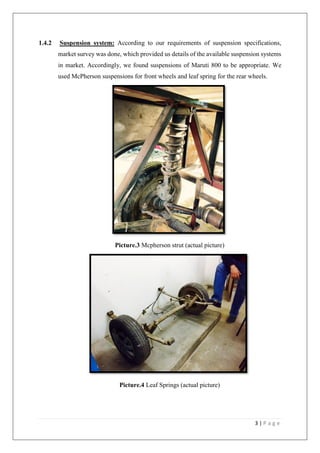
1.4.2 Suspension system: According to our requirements of suspension specifications,
market survey was done, which provided us details of the available suspension systems
in market. Accordingly, we found suspensions of Maruti 800 to be appropriate. We
used McPherson suspensions for front wheels and leaf spring for the rear wheels.
Picture.3 Mcpherson strut (actual picture)
Picture.4 Leaf Springs (actual picture)
4 | P a g e
1.4.2 Braking system: According to the braking requirements market survey was done
which provided us to buy the braking systems of Maruti 800. It has two drum
brakes at rear wheels and two disc brakes at front wheels.
Picture.5 Disc Brakes (actual picture)
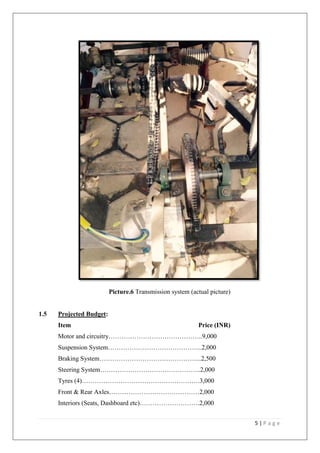
1.4.4 Transmission system: For this system we observed and analysed the E-rickshaw
transmission and motor. Motor of 1 Kilo-Watt was found appropriate according
to the weight of our vehicle. Then transmission system was designed according
to the motor torque specifications using a spur gear and chain drive system.
Picture.6 Meshing of gears on motor and flywheel (actual picture)
5 | P a g e
Picture.6 Transmission system (actual picture)
1.5 Projected Budget:
Item Price (INR)
Motor and circuitry……………………………………..9,000
Suspension System……………………………………..2,000
Braking System………………………………………...2,500
Steering System………………………………………..2,000
Tyres (4)……………………………………………….3,000
Front & Rear Axles……………………………………2,000
Interiors (Seats, Dashboard etc)……………………….2,000
6 | P a g e
Solar panels…………………………………………..11,500
Batteries and charger……………………………….....9,000
Material (body & chassis)………………………….....5000
Electrical wires………………………………………..1000
Welding Labour………………………………………12,000
Mechanic Charges…………………………………….5,000
Transmission parts…………………………………….3000
Brake oil, Paint, Grease, Brush, Rollers………………1,000
Transport and miscellaneous charges…………………8000
Total…………………………………………………78,000
1.6 Project Constraints:
• Effective manufacture of a mechanism to transmit power from motor to front
wheels.
• Design and manufacture of knuckles to lock suspension to the chassis.
• Managing the solar panels on the vehicle body.
1.7 Project Roles and Responsibilities
Role Responsibilities Participant(s)
Designer,
Analysis
Torque calculations, Motor
calculations, Drive System
Akshay Mistri
Designer
Body design Abhishek Thakur
Designer
Suspension system Anirudh Pratap Singh
Designer
Braking system, Hand-brake Sarthak Anand
7 | P a g e
CHAPTER- 2
LITERATURE REVIEW
Various sub topics have been studied using books, web articles and term papers to analyse
them theoretically.
2.1 Motor Torque and Speed calculations
2.2 Braking system and analysis
2.3 Suspension design and analysis
2.4 Aerodynamic body design and analysis
2.1 Motor Torque and Speed calculations
S.No Name of the research
paper
Author Year of
Publish
Research$Findings
1 Drive Wheel Motor
Calculations
MAE
laboratory,
University
of Florida
2003 • Motor torque
requirements
• Total tractive effort
• Concrete Surface
Friction
When selecting drive wheel motors for mobile vehicles, a number of factors must be taken into
account to determine the maximum torque required. The following example presents one
method of computing this torque.
Example vehicle design criteria:
▪ Gross vehicle weight (GVW): 35 lb
▪ Weight on each drive wheel (WW): 10 lb
▪ Radius of wheel/tire (𝑅 𝑊): 4 in
▪ Desired top speed (𝑉𝑚 𝑎𝑥): 1.5 ft/sec
▪ Desired acceleration time (𝑡 𝑎): 1 sec
▪ Maximum incline angle (α): 2 degree
▪ Worst working surface: concrete (good)
To choose motors capable of producing enough torque to propel the example vehicle, it is
necessary to determine the total tractive effort (TTE) requirement for the vehicle:
8 | P a g e
TTE [lb] = RR [lb] + GR [lb] + FA [lb]
Where:
TTE = total tractive effort [lb]
RR = force necessary to overcome rolling resistance [lb]
GR = force required to climb a grade [lb]
FA = force required to accelerate to final velocity [lb]
The components of this equation will be determined in the following steps.
Step One: Determine Rolling Resistance
Rolling Resistance (RR) is the force necessary to propel a vehicle over a particular surface.
The worst possible surface type to be encountered by the vehicle should be factored into the
equation.
RR [lb] = GVW [lb] x Crr [-]
Where:
RR = rolling resistance [lb]
GVW = gross vehicle weight [lb]
Crr = surface friction
Step Two: Determine Grade Resistance
Grade Resistance (GR) is the amount of force necessary to move a vehicle up a slope or
“grade”. This calculation must be made using the maximum angle or grade the vehicle will be
expected to climb in normal operation.
To convert incline angle, α, to grade resistance:
GR [lb] = GVW [lb] x sin (α)
Where:
GR = grade resistance [lb]
GVW = gross vehicle weight [lb]
α = maximum incline angle [degrees]
Step Three: Determine Acceleration Force
Acceleration Force (FA) is the force necessary to accelerate from a stop to maximum speed
in a desired time.
FA [lb] = GVW [lb] x 𝐕 𝐦𝐚𝐱 [ft/s] / (32.2 [ft/𝒔 𝟐
] x 𝐭 𝐚 [s])
9 | P a g e
Where:
FA = acceleration force [lb]
GVW = gross vehicle weight [lb]
Vmax = maximum speed [ft/s]
ta = time required to achieve maximum speed [s]
Step Four: Determine Total Tractive Effort
The Total Tractive Effort (TTE) is the sum of the forces calculated in steps 1, 2, and 3. (On
higher speed vehicles friction in drive components may warrant the addition of 10%-15% to
the total tractive effort to ensure acceptable vehicle performance.)
TTE [lb] = RR [lb] + GR [lb] + FA [lb]
Step Five: Determine Wheel Motor Torque
To verify the vehicle will perform as designed in regards to tractive effort and acceleration, it
is necessary to calculate the required wheel torque (Tw) based on the tractive effort.
Tw [lb-in] = TTE [lb] x 𝑹 𝑾 [in] x RF [-]
Where:
Tw = wheel torque [lb-in]
TTE = total tractive effort [lb]
RW = radius of the wheel/tire [in]
RF = “resistance” factor [-] (1.1 - 1.15)
The “resistance factor” accounts for the frictional losses between the caster wheels and their
axles and the drag on the motor bearings. Typical values range between 1.1 and 1.15 (or 10 to
15%).
Step Six: Reality Check
The final step is to verify the vehicle can transmit the required torque from the drive wheel(s)
to the ground. The maximum tractive torque (MTT) a wheel can transmit is equal to the normal
load times the friction coefficient between the wheel and the ground times the radius of the
drive wheel.
MTT = 𝑾 𝑾 [lb] x μ [-] x 𝑹 𝑾
Where:
𝑊 𝑊 = weight (normal load) on drive wheel [lb]
10 | P a g e
μ = friction coefficient between the wheel and the ground (~0.4 for plastic on concrete) [-]
𝑅 𝑊 = radius of drive wheel/tire [in]
Interpreting Results: Total Tractive Effort is the net horizontal force applied by the drive
wheels to the ground. If the design has two drive wheels, the force applied per drive wheel (for
straight travel) is half of the calculated TTE.
The Wheel Torque calculated in Step Five is the total wheel torque. This quantity does not
change with the number of drive wheels. The sum of the individual drive motor torques (see
Motor Specifications) must be greater than or equal to the computed Wheel Torque.
The Maximum Tractive Torque represents the maximum amount of torque that can be applied
before slipping occurs for each drive wheel. The total wheel torque calculated in Step Five
must be less than the sum of the Maximum Tractive Torques for all drive wheels or slipping
will occur.
Estimating Parameters
For these calculations to be meaningful, appropriate parameters should be chosen. Typical
ranges for robot designs are provided below. Note an appropriate acceleration time must be
chosen such that the required Tw < MTT × number of drive wheels.
Picture.7 Maximum Tractive Torque curve
11 | P a g e
2.2 Braking System calculation and analysis
S. No Name of the research
paper
Author Year of
Publish
Research Findings
1 SAE Road Show,
Brake Systems
SAE
International
2005 • Minimum stopping
distance
• Braking torque
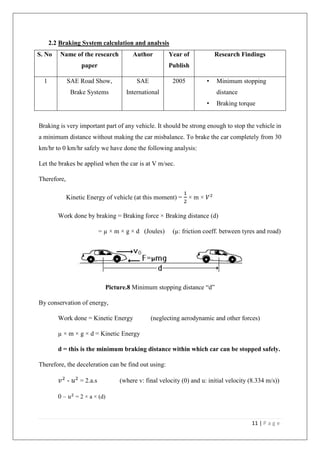
Braking is very important part of any vehicle. It should be strong enough to stop the vehicle in
a minimum distance without making the car misbalance. To brake the car completely from 30
km/hr to 0 km/hr safely we have done the following analysis:
Let the brakes be applied when the car is at V m/sec.
Therefore,
Kinetic Energy of vehicle (at this moment) =
1
2
× m × 𝑉2
Work done by braking = Braking force × Braking distance (d)
= µ × m × g × d (Joules) (µ: friction coeff. between tyres and road)
Picture.8 Minimum stopping distance “d”
By conservation of energy,
Work done = Kinetic Energy (neglecting aerodynamic and other forces)
µ × m × g × d = Kinetic Energy
d = this is the minimum braking distance within which car can be stopped safely.
Therefore, the deceleration can be find out using:
𝑣2
- 𝑢2
= 2.a.s (where v: final velocity (0) and u: initial velocity (8.334 m/s))
0 – 𝑢2
= 2 × a × (d)
12 | P a g e
a = can be found out (negative shows deceleration)
Therefore, time taken by car to stop can be calculated as follows:
𝑣 = 𝑢 + a.t
0 = u + a × t
t = Time the car will stop to rest from top speed.
Therefore, for finding braking torque required following calculation is done:
Braking force (max) = mass (kg) × deceleration (m/𝑠𝑒𝑐2
)
Braking torque (Max) = Braking force (N) × Effective brake radius (m)
Therefore, Braking torque per wheel (max) = (Braking torque) / 4
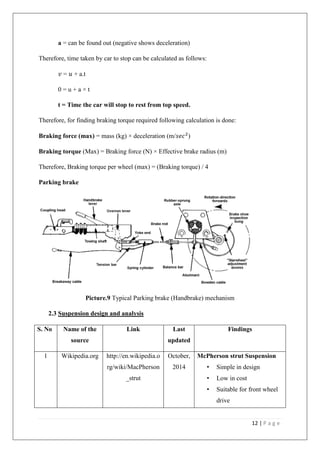
Parking brake
Picture.9 Typical Parking brake (Handbrake) mechanism
2.3 Suspension design and analysis
S. No Name of the
source
Link Last
updated
Findings
1 Wikipedia.org http://en.wikipedia.o
rg/wiki/MacPherson
_strut
October,
2014
McPherson strut Suspension
• Simple in design
• Low in cost
• Suitable for front wheel
drive
13 | P a g e
S. No Name of the
source
Link Last
updated
Findings
2 International
Journal of
Emerging
Technology
and Advanced
Engineering
http://www.ijetae.co
m/files/Volume3Issu
e6/IJETAE_0613_70
.pdf
June,
2013
Leaf Spring suspension
• Holds axle in position,
no separate linkage
required.
• Rigid and suitable for
rear axle
3 Wikipedia.org http://en.wikipedia.o
rg/wiki/Leaf_spring
July,
2014
Leaf spring suspension
Suspension system has been divided into two main categories:
1. Front Axle Suspensions
2. Rear Axle Suspensions
1. Front Axle Suspension: Front axle will be a live axle in our case (powered by motor)
so the suspension has to be designed keeping simplicity and smoothness in mind.
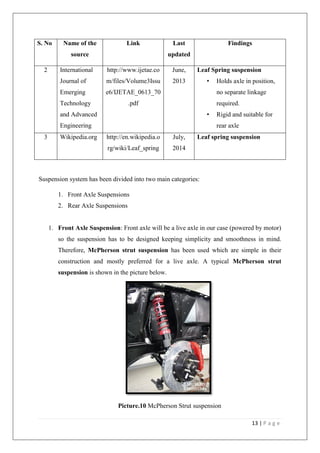
Therefore, McPherson strut suspension has been used which are simple in their
construction and mostly preferred for a live axle. A typical McPherson strut
suspension is shown in the picture below.
Picture.10 McPherson Strut suspension
14 | P a g e
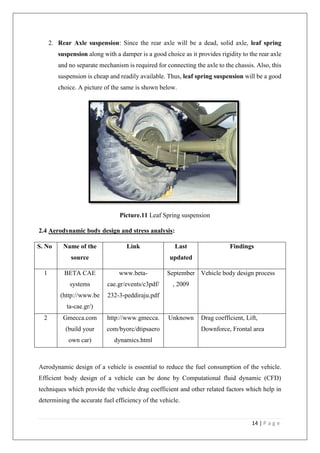
2. Rear Axle suspension: Since the rear axle will be a dead, solid axle, leaf spring
suspension along with a damper is a good choice as it provides rigidity to the rear axle
and no separate mechanism is required for connecting the axle to the chassis. Also, this
suspension is cheap and readily available. Thus, leaf spring suspension will be a good
choice. A picture of the same is shown below.
Picture.11 Leaf Spring suspension
2.4 Aerodynamic body design and stress analysis:
S. No Name of the
source
Link Last
updated
Findings
1 BETA CAE
systems
(http://www.be
ta-cae.gr/)
www.beta-
cae.gr/events/c3pdf/
232-3-peddiraju.pdf
September
, 2009
Vehicle body design process
2 Gmecca.com
(build your
own car)
http://www.gmecca.
com/byorc/dtipsaero
dynamics.html
Unknown Drag coefficient, Lift,
Downforce, Frontal area
Aerodynamic design of a vehicle is essential to reduce the fuel consumption of the vehicle.
Efficient body design of a vehicle can be done by Computational fluid dynamic (CFD)
techniques which provide the vehicle drag coefficient and other related factors which help in
determining the accurate fuel efficiency of the vehicle.
15 | P a g e
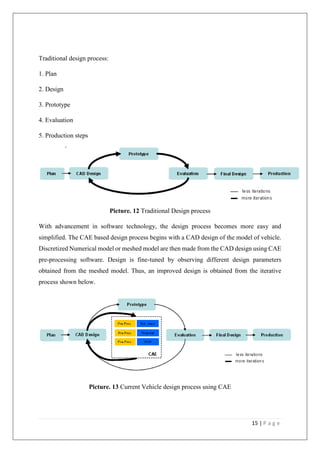
Traditional design process:
1. Plan
2. Design
3. Prototype
4. Evaluation
5. Production steps
Picture. 12 Traditional Design process
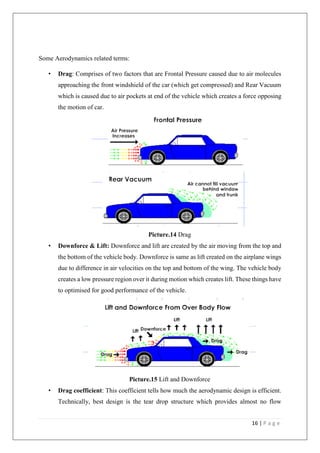
With advancement in software technology, the design process becomes more easy and
simplified. The CAE based design process begins with a CAD design of the model of vehicle.
Discretized Numerical model or meshed model are then made from the CAD design using CAE
pre-processing software. Design is fine-tuned by observing different design parameters
obtained from the meshed model. Thus, an improved design is obtained from the iterative
process shown below.
Picture. 13 Current Vehicle design process using CAE
16 | P a g e
Some Aerodynamics related terms:
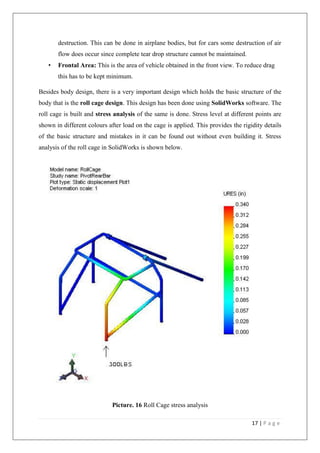
• Drag: Comprises of two factors that are Frontal Pressure caused due to air molecules
approaching the front windshield of the car (which get compressed) and Rear Vacuum
which is caused due to air pockets at end of the vehicle which creates a force opposing
the motion of car.
Picture.14 Drag
• Downforce & Lift: Downforce and lift are created by the air moving from the top and
the bottom of the vehicle body. Downforce is same as lift created on the airplane wings
due to difference in air velocities on the top and bottom of the wing. The vehicle body
creates a low pressure region over it during motion which creates lift. These things have
to optimised for good performance of the vehicle.
Picture.15 Lift and Downforce
• Drag coefficient: This coefficient tells how much the aerodynamic design is efficient.
Technically, best design is the tear drop structure which provides almost no flow
17 | P a g e
destruction. This can be done in airplane bodies, but for cars some destruction of air
flow does occur since complete tear drop structure cannot be maintained.
• Frontal Area: This is the area of vehicle obtained in the front view. To reduce drag
this has to be kept minimum.
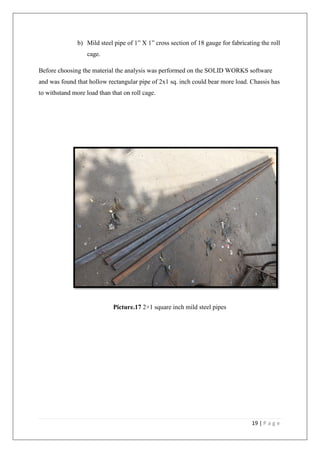
Besides body design, there is a very important design which holds the basic structure of the
body that is the roll cage design. This design has been done using SolidWorks software. The
roll cage is built and stress analysis of the same is done. Stress level at different points are
shown in different colours after load on the cage is applied. This provides the rigidity details
of the basic structure and mistakes in it can be found out without even building it. Stress
analysis of the roll cage in SolidWorks is shown below.
Picture. 16 Roll Cage stress analysis
18 | P a g e
CHAPTER – 3
CHASSIS AND BODY STRUCTURE
3.1 Basic Assumptions of Design of solar car:
1. Accommodation of solar panels- After the market survey and noting down the
specifications the roll cage design was initiated
2. Mountings of all the components of car in chassis.
3. Cost and feasibility of the entire design
4. Material to be used.
5. Machining to be performed.
6. Aerodynamically feasible.
7. Wheel base.
3.2 Material used in design: The material considered while designing the Chassis and Roll
Cage was decided such that it is cost effective and could bear the maximum load. Though the
material for both Chassis and roll cage is the same but their specifications are different.
The material used for Chassis is mild steel also called plain carbon steel .Mild steel
was chosen because of the following reasons-
1. Mild steel is ductile and can be easily machined
2. Generation of heat is less than that of steel machining. So, the tool can have
better life and you can do more machining.
3. Mild steel is easily available
4. No need to change the tool repeatedly and no special tools are required for
machining
5. It has high strength.
6. It is cheaper.
Hollow rectangular cross sectional pipe has been used for both chassis and roll
cage design. Two different cross sectional hollow rectangular pipe has been used
for chassis and roll cage design. They are as follows:
a) Mild steel pipe of 2” X 1” cross section of 16 gauge for fabricating the
chassis.
19 | P a g e
b) Mild steel pipe of 1” X 1” cross section of 18 gauge for fabricating the roll
cage.
Before choosing the material the analysis was performed on the SOLID WORKS software
and was found that hollow rectangular pipe of 2x1 sq. inch could bear more load. Chassis has
to withstand more load than that on roll cage.
Picture.17 2×1 square inch mild steel pipes
20 | P a g e
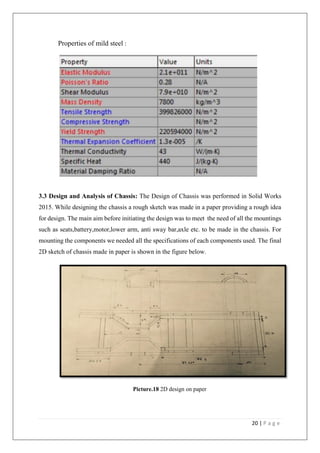
Properties of mild steel :
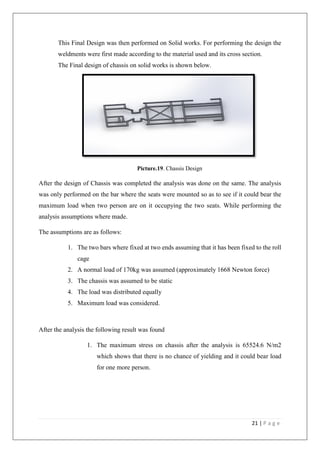
3.3 Design and Analysis of Chassis: The Design of Chassis was performed in Solid Works
2015. While designing the chassis a rough sketch was made in a paper providing a rough idea
for design. The main aim before initiating the design was to meet the need of all the mountings
such as seats,battery,motor,lower arm, anti sway bar,axle etc. to be made in the chassis. For
mounting the components we needed all the specifications of each components used. The final
2D sketch of chassis made in paper is shown in the figure below.
Picture.18 2D design on paper
21 | P a g e
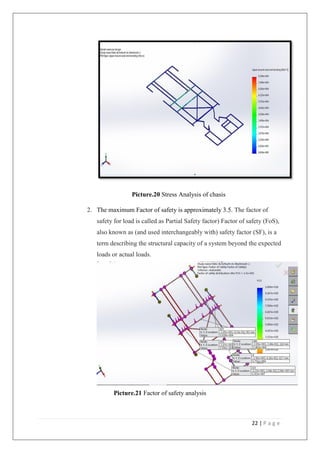
This Final Design was then performed on Solid works. For performing the design the
weldments were first made according to the material used and its cross section.
The Final design of chassis on solid works is shown below.
Picture.19. Chassis Design
After the design of Chassis was completed the analysis was done on the same. The analysis
was only performed on the bar where the seats were mounted so as to see if it could bear the
maximum load when two person are on it occupying the two seats. While performing the
analysis assumptions where made.
The assumptions are as follows:
1. The two bars where fixed at two ends assuming that it has been fixed to the roll
cage
2. A normal load of 170kg was assumed (approximately 1668 Newton force)
3. The chassis was assumed to be static
4. The load was distributed equally
5. Maximum load was considered.
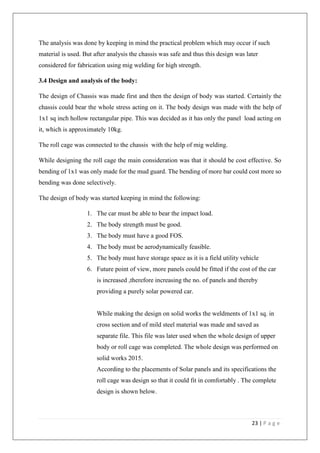
After the analysis the following result was found
1. The maximum stress on chassis after the analysis is 65524.6 N/m2
which shows that there is no chance of yielding and it could bear load
for one more person.
22 | P a g e
Picture.20 Stress Analysis of chasis
2. The maximum Factor of safety is approximately 3.5. The factor of
safety for load is called as Partial Safety factor) Factor of safety (FoS),
also known as (and used interchangeably with) safety factor (SF), is a
term describing the structural capacity of a system beyond the expected
loads or actual loads.
Picture.21 Factor of safety analysis
23 | P a g e
The analysis was done by keeping in mind the practical problem which may occur if such
material is used. But after analysis the chassis was safe and thus this design was later
considered for fabrication using mig welding for high strength.
3.4 Design and analysis of the body:
The design of Chassis was made first and then the design of body was started. Certainly the
chassis could bear the whole stress acting on it. The body design was made with the help of
1x1 sq inch hollow rectangular pipe. This was decided as it has only the panel load acting on
it, which is approximately 10kg.
The roll cage was connected to the chassis with the help of mig welding.
While designing the roll cage the main consideration was that it should be cost effective. So
bending of 1x1 was only made for the mud guard. The bending of more bar could cost more so
bending was done selectively.
The design of body was started keeping in mind the following:
1. The car must be able to bear the impact load.
2. The body strength must be good.
3. The body must have a good FOS.
4. The body must be aerodynamically feasible.
5. The body must have storage space as it is a field utility vehicle
6. Future point of view, more panels could be fitted if the cost of the car
is increased ,therefore increasing the no. of panels and thereby
providing a purely solar powered car.
While making the design on solid works the weldments of 1x1 sq. in
cross section and of mild steel material was made and saved as
separate file. This file was later used when the whole design of upper
body or roll cage was completed. The whole design was performed on
solid works 2015.
According to the placements of Solar panels and its specifications the
roll cage was design so that it could fit in comfortably . The complete
design is shown below.
24 | P a g e
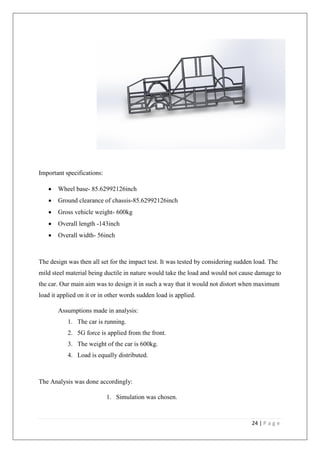
Important specifications:
• Wheel base- 85.62992126inch
• Ground clearance of chassis-85.62992126inch
• Gross vehicle weight- 600kg
• Overall length -143inch
• Overall width- 56inch
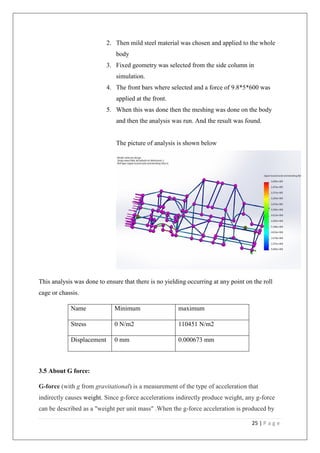
The design was then all set for the impact test. It was tested by considering sudden load. The
mild steel material being ductile in nature would take the load and would not cause damage to
the car. Our main aim was to design it in such a way that it would not distort when maximum
load it applied on it or in other words sudden load is applied.
Assumptions made in analysis:
1. The car is running.
2. 5G force is applied from the front.
3. The weight of the car is 600kg.
4. Load is equally distributed.
The Analysis was done accordingly:
1. Simulation was chosen.
25 | P a g e
2. Then mild steel material was chosen and applied to the whole
body
3. Fixed geometry was selected from the side column in
simulation.
4. The front bars where selected and a force of 9.8*5*600 was
applied at the front.
5. When this was done then the meshing was done on the body
and then the analysis was run. And the result was found.
The picture of analysis is shown below
This analysis was done to ensure that there is no yielding occurring at any point on the roll
cage or chassis.
Name Minimum maximum
Stress 0 N/m2 110451 N/m2
Displacement 0 mm 0.000673 mm
3.5 About G force:
G-force (with g from gravitational) is a measurement of the type of acceleration that
indirectly causes weight. Since g-force accelerations indirectly produce weight, any g-force
can be described as a "weight per unit mass" .When the g-force acceleration is produced by
26 | P a g e
the surface of one object being pushed by the surface of another object, the reaction-force to
this push produces an equal and opposite weight for every unit of an object's mass. The types
of forces involved are transmitted through objects by interior mechanical stresses. The g-
force acceleration (save for certain electromagnetic force influences) is the cause of an
object's acceleration in relation to free-fall.
The term g-force is technically incorrect as it is a measure of acceleration, not force. While
acceleration is a vector quantity, g-force accelerations ("g-forces" for short) are often
expressed as a scalar, with positive g-forces pointing upward (indicating upward
acceleration), and negative g-forces pointing downward. Thus, a g-force is a vector
acceleration. It is an acceleration that must be produced by a mechanical force, and cannot be
produced by simple gravitation. Objects acted upon only by gravitation, experience (or "feel")
no g-force, and are weightless.
G-forces, when multiplied by a mass upon which they act, are associated with a certain type
of mechanical force in the correct sense of the term force, and this force
produces compressive stress and tensile stress. Such forces result in the operational sensation
of weight, but the equation carries a sign change due to the definition of positive weight in
the direction downward, so the direction of weight-force is opposite to the direction of g-
force acceleration:
Weight = mass ∗ ( - g-force)
5G force when applied from the side becomes half of it.
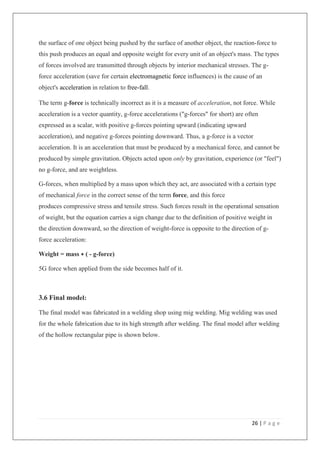
3.6 Final model:
The final model was fabricated in a welding shop using mig welding. Mig welding was used
for the whole fabrication due to its high strength after welding. The final model after welding
of the hollow rectangular pipe is shown below.
27 | P a g e
Picture.22 Vehicle structure design
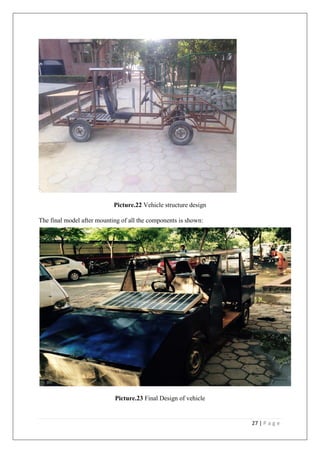
The final model after mounting of all the components is shown:
Picture.23 Final Design of vehicle
28 | P a g e
CHAPTER – 4
SUSPENSION SYSTEM
Suspension system is connected between the chassis and the axles of the vehicle. It provides
comfort to the passenger and enhances the drive quality. It also provides stability to the vehicle
during a turn. Hence, it has to be carefully selected according the vehicle specifications.
4.1 Types of suspension used: Suspension system has been divided into two main
categories:
1. Front Axle Suspensions
2. Rear Axle Suspensions
4.2 Calculations involved: To calculate spring rate: Starting with the basic equation from
physics, relating natural frequency, spring rate, and mass:
f = √
𝐾
𝑀
1
2𝜋
f = Natural frequency (Hz)
K = spring rate (N/m)
M = Mass (kg)
f = 1.5 Hz
The spring rate of a coil spring may be calculated by a simple algebraic equation or it may be
measured in a spring testing machine. The spring constant k can be calculated as follows:
𝑘 =
𝐺𝑑4
8𝑁𝐷3
𝑘 =
80∗10^9∗(.008)4
8∗20∗(.060)3
k = 9481.481 kN/m
29 | P a g e
4.3 Analysis and calculations:
4.4 Mounting the suspensions on the chassis: Mounting the suspensions on chassis was
challenging task since it has to be rigidly attached to the chassis otherwise proper cushion effect
will not occur and may fail the suspensions. This task was completed as follows:
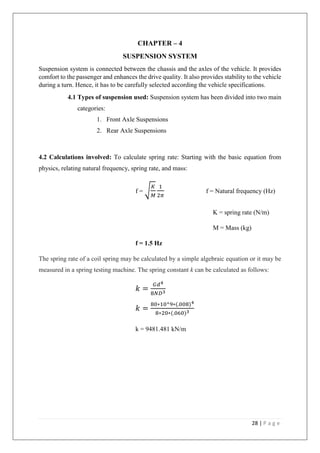
4.4.1 McPherson strut mounting: This was done by fabricating a truss on the chassis
as shown in the picture below.
Specifications Value
Natural frequency 1.5
Speed achieved 2.54 ft/sec
Weight distribution at front 55%
Total weight(kg) 400
Sprung weight 400
Spring length closed (mm) 160
Angle of damper with vertical 25
Motion Ratio 1
Wheel Rate 9.481
Spring compression 52.578
Force in spring(front) 2156
Spring Rate(N/m) 9481.481
Force in spring (rear) 1764
Compression of spring 68.16549367
Required k (N/mm) 9.481481
Spring deflection (mm) 229.4
Energy stored (J) 247.29
Spring stiffness (N/m) 9400
Pitch of lead (mm) 19.47
Shear stress (τ)(Pa) 643 × 103
30 | P a g e
Picture.24 Truss to connect the McPherson strut
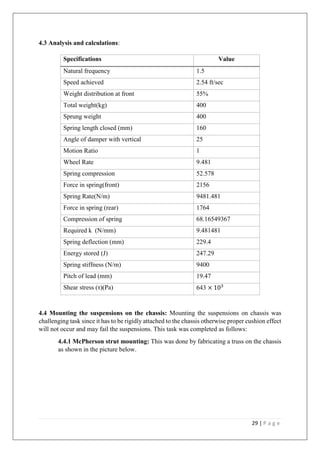
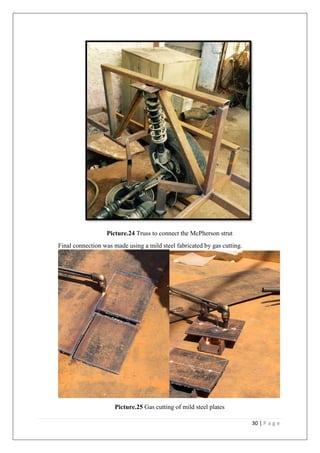
Final connection was made using a mild steel fabricated by gas cutting.
Picture.25 Gas cutting of mild steel plates
31 | P a g e
Picture.26 Final design of mild steel plate
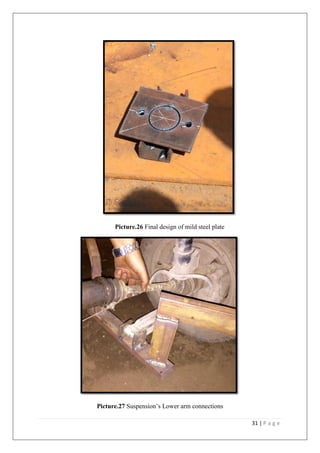
Picture.27 Suspension’s Lower arm connections
32 | P a g e
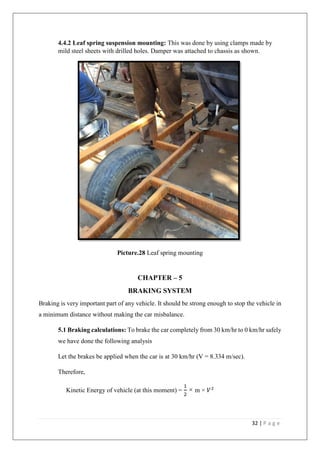
4.4.2 Leaf spring suspension mounting: This was done by using clamps made by
mild steel sheets with drilled holes. Damper was attached to chassis as shown.
Picture.28 Leaf spring mounting
CHAPTER – 5
BRAKING SYSTEM
Braking is very important part of any vehicle. It should be strong enough to stop the vehicle in
a minimum distance without making the car misbalance.
5.1 Braking calculations: To brake the car completely from 30 km/hr to 0 km/hr safely
we have done the following analysis
Let the brakes be applied when the car is at 30 km/hr (V = 8.334 m/sec).
Therefore,
Kinetic Energy of vehicle (at this moment) =
1
2
× m × 𝑉2
33 | P a g e
=
1
2
× 400 × (8.334)2
= 13891.111 Joules
Work done by braking = Braking force × Braking distance (d)
= µ × m × g × d (Joules)
(µ: friction coeff. between tyres and road)
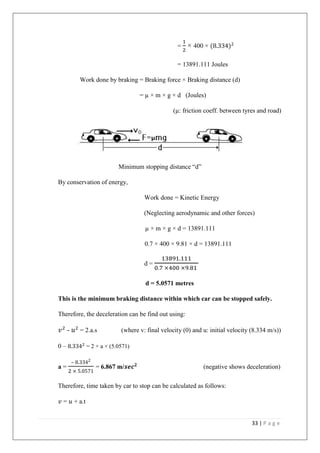
Minimum stopping distance “d”
By conservation of energy,
Work done = Kinetic Energy
(Neglecting aerodynamic and other forces)
µ × m × g × d = 13891.111
0.7 × 400 × 9.81 × d = 13891.111
d =
13891.111
0.7 ×400 ×9.81
d = 5.0571 metres
This is the minimum braking distance within which car can be stopped safely.
Therefore, the deceleration can be find out using:
𝑣2
- 𝑢2
= 2.a.s (where v: final velocity (0) and u: initial velocity (8.334 m/s))
0 – 8.3342
= 2 × a × (5.0571)
a =
– 8.3342
2 × 5.0571
= 6.867 m/𝒔𝒆𝒄 𝟐
(negative shows deceleration)
Therefore, time taken by car to stop can be calculated as follows:
𝑣 = 𝑢 + a.t
34 | P a g e
0 = 8.334 + (-6.867) × t
−8.334
−6.867
= t
t = 1.213 seconds
Therefore, the car will stop to rest in 1.213 seconds from top speed of 30km/hr
safely.
Summing up,
Braking time 1.213 seconds
Minimum Braking distance (d) 5.0571 m
Deceleration achieved 6.867 m/𝑠𝑒𝑐2
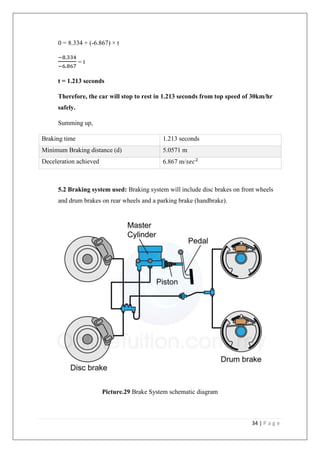
5.2 Braking system used: Braking system will include disc brakes on front wheels
and drum brakes on rear wheels and a parking brake (handbrake).
Picture.29 Brake System schematic diagram
35 | P a g e
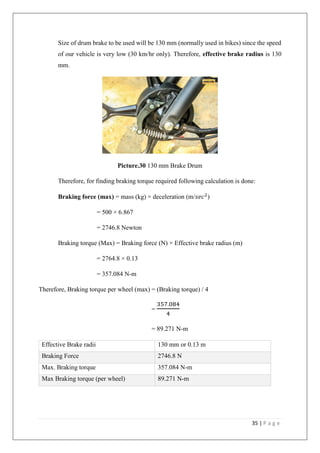
Size of drum brake to be used will be 130 mm (normally used in bikes) since the speed
of our vehicle is very low (30 km/hr only). Therefore, effective brake radius is 130
mm.
Picture.30 130 mm Brake Drum
Therefore, for finding braking torque required following calculation is done:
Braking force (max) = mass (kg) × deceleration (m/𝑠𝑒𝑐2
)
= 500 × 6.867
= 2746.8 Newton
Braking torque (Max) = Braking force (N) × Effective brake radius (m)
= 2764.8 × 0.13
= 357.084 N-m
Therefore, Braking torque per wheel (max) = (Braking torque) / 4
=
357.084
4
= 89.271 N-m
Effective Brake radii 130 mm or 0.13 m
Braking Force 2746.8 N
Max. Braking torque 357.084 N-m
Max Braking torque (per wheel) 89.271 N-m
36 | P a g e
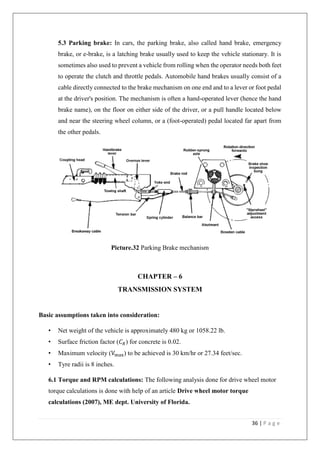
5.3 Parking brake: In cars, the parking brake, also called hand brake, emergency
brake, or e-brake, is a latching brake usually used to keep the vehicle stationary. It is
sometimes also used to prevent a vehicle from rolling when the operator needs both feet
to operate the clutch and throttle pedals. Automobile hand brakes usually consist of a
cable directly connected to the brake mechanism on one end and to a lever or foot pedal
at the driver's position. The mechanism is often a hand-operated lever (hence the hand
brake name), on the floor on either side of the driver, or a pull handle located below
and near the steering wheel column, or a (foot-operated) pedal located far apart from
the other pedals.
Picture.32 Parking Brake mechanism
CHAPTER – 6
TRANSMISSION SYSTEM
Basic assumptions taken into consideration:
• Net weight of the vehicle is approximately 480 kg or 1058.22 lb.
• Surface friction factor (𝐶 𝑅) for concrete is 0.02.
• Maximum velocity (Vmax) to be achieved is 30 km/hr or 27.34 feet/sec.
• Tyre radii is 8 inches.
6.1 Torque and RPM calculations: The following analysis done for drive wheel motor
torque calculations is done with help of an article Drive wheel motor torque
calculations (2007), ME dept. University of Florida.
37 | P a g e
According to it, to choose a motor producing enough torque to propel the vehicle to a
desired speed we need to find the Total Tractive Effort (TTE).
TTE = Rolling Resistance (RR) + Acceleration Force (AF) [Eq. 1]
Steps to find TTE:
1. Determining Rolling Resistance (RR): This is the force required to propel the
vehicle over a flat surface.
RR = Gross vehicle weight (GVW) × Surface friction factor (𝑪 𝑹)
= 1058.22 (lb) × 0.02
= 21.164 lb (or 9.599 kg)
2. Determining Acceleration Force (AF): This is the force required to accelerate the
vehicle from stop to maximum speed in a desired time.
AF =
𝑮𝒓𝒐𝒔𝒔 𝑽𝒆𝒉𝒊𝒄𝒍𝒆 𝑾𝒆𝒊𝒈𝒉𝒕 (𝒍𝒃)× 𝑽 𝒎𝒂𝒙 (
𝒇𝒕
𝒔𝒆𝒄
)
𝟑𝟐.𝟐 (
𝒇𝒕
𝒔𝒆𝒄 𝟐)×𝒕 𝒂 (𝐬𝐞𝐜)
=
1058.22 × 27.34
32.2 × 15
= 59.90 lb (or 27.17 kg)
3. Determining Total Tractive Effort (TTE): Using equation 1,
TTE = RR + AF
= 21.164 + 59.9
= 81.64 lb (or 36.77 kg)
4. Determining Wheel Motor Torque (𝐓 𝐰): Based on total tractive effort, wheel torque
can be found out.
𝐓 𝐰 [lb-inch] = TTE × Radii of wheel (𝑹 𝒘) × Resistance Factor (RF)
= 81.064 (lb) × 8 (inch) × 1.1
= 713.36 lb-inch (or 80.59 Nm)
Tw (per wheel) =
713.36
2
= 356.68 lb-inch (or 40.295 Nm)
5. Reality Check: Final step is to verify that vehicle can transmit the required torque to
the ground without slipping or not. For this, the wheel motor torque, Tw (per wheel)
should be less than the Maximum Tractive Effort (MTE) calculated below.
MTE = Weight on each wheel × coefficient of friction (µ) × Radii of wheel
38 | P a g e
= 220.462 × 0.8 × 8
= 1410.95 lb-inch
Therefore, 𝐓 𝐰 (per wheel) < MTE so the slip will not occur.
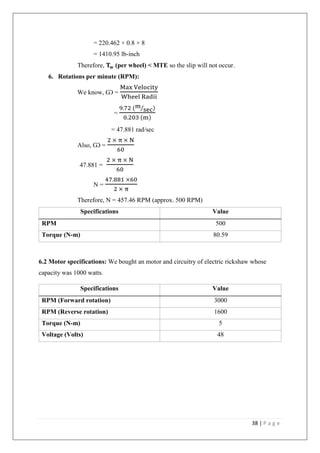
6. Rotations per minute (RPM):
We know, Ѡ =
Max Velocity
Wheel Radii
=
9.72 (m
sec⁄ )
0.203 (m)
= 47.881 rad/sec
Also, Ѡ =
2 × π × N
60
47.881 =
2 × π × N
60
N =
47.881 ×60
2 × π
Therefore, N = 457.46 RPM (approx. 500 RPM)
Specifications Value
RPM 500
Torque (N-m) 80.59
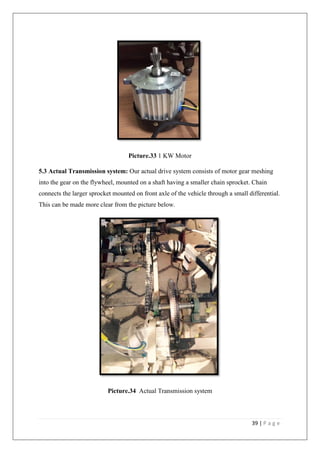
6.2 Motor specifications: We bought an motor and circuitry of electric rickshaw whose
capacity was 1000 watts.
Specifications Value
RPM (Forward rotation) 3000
RPM (Reverse rotation) 1600
Torque (N-m) 5
Voltage (Volts) 48
39 | P a g e
Picture.33 1 KW Motor
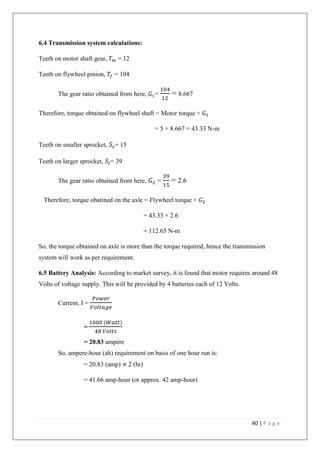
5.3 Actual Transmission system: Our actual drive system consists of motor gear meshing
into the gear on the flywheel, mounted on a shaft having a smaller chain sprocket. Chain
connects the larger sprocket mounted on front axle of the vehicle through a small differential.
This can be made more clear from the picture below.
Picture.34 Actual Transmission system
40 | P a g e
6.4 Transmission system calculations:
Teeth on motor shaft gear, 𝑇 𝑚 = 12
Teeth on flywheel pinion, 𝑇𝑓 = 104
The gear ratio obtained from here, 𝐺1=
104
12
= 8.667
Therefore, torque obtained on flywheel shaft = Motor torque × 𝐺1
= 5 × 8.667 = 43.33 N-m
Teeth on smaller sprocket, 𝑆𝑠= 15
Teeth on larger sprocket, 𝑆𝑙= 39
The gear ratio obtained from here, 𝐺2 =
39
15
= 2.6
Therefore, torque obatined on the axle = Flywheel torque × 𝐺2
= 43.33 × 2.6
= 112.65 N-m
So, the torque obtained on axle is more than the torque required, hence the transmission
system will work as per requirement.
6.5 Battery Analysis: According to market survey, it is found that motor requires around 48
Volts of voltage supply. This will be provided by 4 batteries each of 12 Volts.
Current, I =
𝑃𝑜𝑤𝑒𝑟
𝑉𝑜𝑙𝑡𝑎𝑔𝑒
=
1000 (𝑊𝑎𝑡𝑡)
48 𝑉𝑜𝑙𝑡𝑠
= 20.83 ampere
So, ampere-hour (ah) requirement on basis of one hour run is:
= 20.83 (amp) × 2 (hr)
= 41.66 amp-hour (or approx. 42 amp-hour)
41 | P a g e
Therefore,
Battery Specifications Value
Voltage (Volts) 48 (12 × 4)
Ampere-Hour 42
CONCLUSION
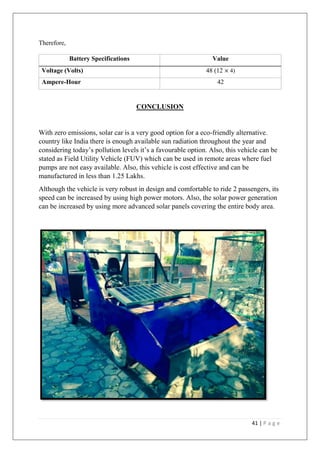
With zero emissions, solar car is a very good option for a eco-friendly alternative.
country like India there is enough available sun radiation throughout the year and
considering today’s pollution levels it’s a favourable option. Also, this vehicle can be
stated as Field Utility Vehicle (FUV) which can be used in remote areas where fuel
pumps are not easy available. Also, this vehicle is cost effective and can be
manufactured in less than 1.25 Lakhs.
Although the vehicle is very robust in design and comfortable to ride 2 passengers, its
speed can be increased by using high power motors. Also, the solar power generation
can be increased by using more advanced solar panels covering the entire body area.
42 | P a g e
REFERENCES
1. Andrew, (2002). Drive Wheel Motor Torque calculations. Department of Mechanical
Engineering, University of Florida.
2. Paul S. Gritt (2005). Brake Analysis. SAE International
www.sae.org/students/presentations/brakes.ppt
3. Engineering Inspirations, Brake Calculations
http://www.engineeringinspiration.co.uk/brakecalcs.html
4. Bhaviskar A. (2013) Design and Analysis of Leaf Spring Suspension, International
Journal of Engineering Technology and Advanced Engineering
http://www.ijetae.com/files/Volume3Issue6/IJETAE_0613_70.pdf
5. Wikipedia.org, McPherson strut suspension
http://en.wikipedia.org/wiki/MacPherson_strut
6. Wikipedia.org, Leaf Spring suspension
http://en.wikipedia.org/wiki/Leaf_spring
7. Gmecca.com, General Aerodynamic Principles and tips
http://www.gmecca.com/byorc/dtipsaerodynamics.html
8. Singh R. (2009) CAE framework for Aerodynamic Design, Beta CAE Systems
http://www.beta-cae.gr/events/c3pdf/232-3-peddiraju.pdf

Solar Powered Field Utility Vehicle

  • 1.
    A Project Plan On SOLARPOWERED “FIELD UTILITY VEHICLE” Submitted to Amity University, Uttar Pradesh In partial fulfillment of requirements for the award of degree of Bachelor of Technology In Mechanical & Automation Engineering by Abhishek Thakur Akshay Mistri Anirudh Pratap Singh Sarthak Anand Under the guidance of Mr. P. N. Vishwakarma DEPARTMENT OF MAE AMITY SCHOOL OF ENGINEERING & TECHNOLOGY AMITY UNIVERSITY, NOIDA (U.P.) MAY, 2015
  • 2.
    CONTENTS CHAPTER - 1 INTRODUCTION……………………………………………………..…1-2 1.1Purpose of Plan………………………………….………...1 1.2 Background Info/Alternatives…………………………….1 1.3 Goals and Objectives………………………………………1 1.4 Project Division…………………………………………….1-5 1.4.1 Chassis and Roll cage……1-2 1.4.2 Suspension system………..3 1.4.3 Braking system…………...4 1.4.4 Transmission system…..…4-5 1.5 Projected Budget………………………………………….5-6 1.6 Project Constraints……………………………………….6 1.7 Roles & Responsibilities………………………………….6 CHAPTER – 2 LITERATURE REVIEW……………………………..………………..7 - 17 2.1 Motor Torque & Speed……………………………..7 – 10 2.2 Braking System……………………..……………….10 – 12 2.3 Suspension Design……………………………….….12 – 14 2.4 Body Design & Roll Cage……………………….….14 – 17 CHAPTER – 3 CHASSIS AND BODY STRUCTURE………………………………….18-27 3.1 Basic Assumptions……………..……………18 3.2 Material used………………………………..18-19 3.3 Design & Analysis of chassis……….……....20-23 3.4 Design & Analysis of body…………………23-25 3.5 G-Force………………………………………25-26 3.6 Final Model………………………………….26-27
  • 3.
    CHAPTER – 4 SUSPENSIONSYSTEM…………………………………...………….28-32 4.1 Types of suspension used……………………28 4.2 Calculations involved…………………..……28 4.3 Analysis and calculations……………………28-29 4.4 Mounting the suspension on chassis……….29-32 4.4.1 McPherson strut mountings…..29-31 4.4.2 Leaf Spring mountings………..32 CHAPTER – 5 BRAKING SYSTEM……………………………………………………32-35 5.1 Braking calculations………………………32-34 5.2 Brake System used…………………………34-35 5.3 Parking Brake………………………………35 CHAPTER – 6 TRANSMISSION SYSTEM…………………………………………...36 Basic Assumptions………………..36 6.1 Torque & RPM calculations…36-38 6.2 Motor specification…………...38-39 6.3 Actual Transmission system…39 6.4 Transmission calculations……40 6.5 Battery Analysis………………40-41 CONCLUSION…………………………………………………………...41 REFERENCES……………………………………………………………42
  • 4.
    1 | Pa g e CHAPTER – 1 INTRODUCTION 1.1 Purpose of project: The purpose of project is to build suspension, braking systems & transmission system for a two seater, solar powered car with top speed of 35 km/hr. 1.2 Background Information/Alternatives Available: There are various solar cars built till now which are performing very well. Also solar power is a good alternative of fuel, which is available in abundance. E-rickshaw running on roads have also been considered for their motor and electric circuitry. 1.3 Goals and Objectives:  To fabricate a robust chassis for the vehicle.  To fabricate the body structure with solar panel placement.  To attach the suspension, wheels and steering system to the chassis.  To attach the drum and disc brakes to chassis.  To attach the seats on the chassis.  To fabricate the transmission system connecting the motor shaft to the front axle.  To fabricate the flooring of the vehicle, attach the solar panels and paint the vehicle. 1.4 Project division: Whole project is divided into four main systems which when assembled together, create the working model of the vehicle. These systems are: 1. Chassis and Roll cage 2. Suspension system 3.Braking system 4.Transmission system 1.4.1 Chassis and Roll cage: First of all, a market survey was done to buy mild steel pipes required for the fabrication of the same. Chassis has been kept as light in weight as possible as well as it maintains its robustness. Keeping all the attachments in mind such as the suspensions, anti-sway bar, wheels, steering, transmission system the chassis and the roll cage has been designed and fabricated. Chassis and roll cage has been made using mig-welding (Copper as filler material) which provides a strong welded joint.
  • 5.
    2 | Pa g e Picture.1 On going fabrication of chassis and roll cage (Front end) Picture.2 On going fabrication of chassis and roll cage (Rear end)
  • 6.
    3 | Pa g e 1.4.2 Suspension system: According to our requirements of suspension specifications, market survey was done, which provided us details of the available suspension systems in market. Accordingly, we found suspensions of Maruti 800 to be appropriate. We used McPherson suspensions for front wheels and leaf spring for the rear wheels. Picture.3 Mcpherson strut (actual picture) Picture.4 Leaf Springs (actual picture)
  • 7.
    4 | Pa g e 1.4.2 Braking system: According to the braking requirements market survey was done which provided us to buy the braking systems of Maruti 800. It has two drum brakes at rear wheels and two disc brakes at front wheels. Picture.5 Disc Brakes (actual picture) 1.4.4 Transmission system: For this system we observed and analysed the E-rickshaw transmission and motor. Motor of 1 Kilo-Watt was found appropriate according to the weight of our vehicle. Then transmission system was designed according to the motor torque specifications using a spur gear and chain drive system. Picture.6 Meshing of gears on motor and flywheel (actual picture)
  • 8.
    5 | Pa g e Picture.6 Transmission system (actual picture) 1.5 Projected Budget: Item Price (INR) Motor and circuitry……………………………………..9,000 Suspension System……………………………………..2,000 Braking System………………………………………...2,500 Steering System………………………………………..2,000 Tyres (4)……………………………………………….3,000 Front & Rear Axles……………………………………2,000 Interiors (Seats, Dashboard etc)……………………….2,000
  • 9.
    6 | Pa g e Solar panels…………………………………………..11,500 Batteries and charger……………………………….....9,000 Material (body & chassis)………………………….....5000 Electrical wires………………………………………..1000 Welding Labour………………………………………12,000 Mechanic Charges…………………………………….5,000 Transmission parts…………………………………….3000 Brake oil, Paint, Grease, Brush, Rollers………………1,000 Transport and miscellaneous charges…………………8000 Total…………………………………………………78,000 1.6 Project Constraints: • Effective manufacture of a mechanism to transmit power from motor to front wheels. • Design and manufacture of knuckles to lock suspension to the chassis. • Managing the solar panels on the vehicle body. 1.7 Project Roles and Responsibilities Role Responsibilities Participant(s) Designer, Analysis Torque calculations, Motor calculations, Drive System Akshay Mistri Designer Body design Abhishek Thakur Designer Suspension system Anirudh Pratap Singh Designer Braking system, Hand-brake Sarthak Anand
  • 10.
    7 | Pa g e CHAPTER- 2 LITERATURE REVIEW Various sub topics have been studied using books, web articles and term papers to analyse them theoretically. 2.1 Motor Torque and Speed calculations 2.2 Braking system and analysis 2.3 Suspension design and analysis 2.4 Aerodynamic body design and analysis 2.1 Motor Torque and Speed calculations S.No Name of the research paper Author Year of Publish Research$Findings 1 Drive Wheel Motor Calculations MAE laboratory, University of Florida 2003 • Motor torque requirements • Total tractive effort • Concrete Surface Friction When selecting drive wheel motors for mobile vehicles, a number of factors must be taken into account to determine the maximum torque required. The following example presents one method of computing this torque. Example vehicle design criteria: ▪ Gross vehicle weight (GVW): 35 lb ▪ Weight on each drive wheel (WW): 10 lb ▪ Radius of wheel/tire (𝑅 𝑊): 4 in ▪ Desired top speed (𝑉𝑚 𝑎𝑥): 1.5 ft/sec ▪ Desired acceleration time (𝑡 𝑎): 1 sec ▪ Maximum incline angle (α): 2 degree ▪ Worst working surface: concrete (good) To choose motors capable of producing enough torque to propel the example vehicle, it is necessary to determine the total tractive effort (TTE) requirement for the vehicle:
  • 11.
    8 | Pa g e TTE [lb] = RR [lb] + GR [lb] + FA [lb] Where: TTE = total tractive effort [lb] RR = force necessary to overcome rolling resistance [lb] GR = force required to climb a grade [lb] FA = force required to accelerate to final velocity [lb] The components of this equation will be determined in the following steps. Step One: Determine Rolling Resistance Rolling Resistance (RR) is the force necessary to propel a vehicle over a particular surface. The worst possible surface type to be encountered by the vehicle should be factored into the equation. RR [lb] = GVW [lb] x Crr [-] Where: RR = rolling resistance [lb] GVW = gross vehicle weight [lb] Crr = surface friction Step Two: Determine Grade Resistance Grade Resistance (GR) is the amount of force necessary to move a vehicle up a slope or “grade”. This calculation must be made using the maximum angle or grade the vehicle will be expected to climb in normal operation. To convert incline angle, α, to grade resistance: GR [lb] = GVW [lb] x sin (α) Where: GR = grade resistance [lb] GVW = gross vehicle weight [lb] α = maximum incline angle [degrees] Step Three: Determine Acceleration Force Acceleration Force (FA) is the force necessary to accelerate from a stop to maximum speed in a desired time. FA [lb] = GVW [lb] x 𝐕 𝐦𝐚𝐱 [ft/s] / (32.2 [ft/𝒔 𝟐 ] x 𝐭 𝐚 [s])
  • 12.
    9 | Pa g e Where: FA = acceleration force [lb] GVW = gross vehicle weight [lb] Vmax = maximum speed [ft/s] ta = time required to achieve maximum speed [s] Step Four: Determine Total Tractive Effort The Total Tractive Effort (TTE) is the sum of the forces calculated in steps 1, 2, and 3. (On higher speed vehicles friction in drive components may warrant the addition of 10%-15% to the total tractive effort to ensure acceptable vehicle performance.) TTE [lb] = RR [lb] + GR [lb] + FA [lb] Step Five: Determine Wheel Motor Torque To verify the vehicle will perform as designed in regards to tractive effort and acceleration, it is necessary to calculate the required wheel torque (Tw) based on the tractive effort. Tw [lb-in] = TTE [lb] x 𝑹 𝑾 [in] x RF [-] Where: Tw = wheel torque [lb-in] TTE = total tractive effort [lb] RW = radius of the wheel/tire [in] RF = “resistance” factor [-] (1.1 - 1.15) The “resistance factor” accounts for the frictional losses between the caster wheels and their axles and the drag on the motor bearings. Typical values range between 1.1 and 1.15 (or 10 to 15%). Step Six: Reality Check The final step is to verify the vehicle can transmit the required torque from the drive wheel(s) to the ground. The maximum tractive torque (MTT) a wheel can transmit is equal to the normal load times the friction coefficient between the wheel and the ground times the radius of the drive wheel. MTT = 𝑾 𝑾 [lb] x μ [-] x 𝑹 𝑾 Where: 𝑊 𝑊 = weight (normal load) on drive wheel [lb]
  • 13.
    10 | Pa g e μ = friction coefficient between the wheel and the ground (~0.4 for plastic on concrete) [-] 𝑅 𝑊 = radius of drive wheel/tire [in] Interpreting Results: Total Tractive Effort is the net horizontal force applied by the drive wheels to the ground. If the design has two drive wheels, the force applied per drive wheel (for straight travel) is half of the calculated TTE. The Wheel Torque calculated in Step Five is the total wheel torque. This quantity does not change with the number of drive wheels. The sum of the individual drive motor torques (see Motor Specifications) must be greater than or equal to the computed Wheel Torque. The Maximum Tractive Torque represents the maximum amount of torque that can be applied before slipping occurs for each drive wheel. The total wheel torque calculated in Step Five must be less than the sum of the Maximum Tractive Torques for all drive wheels or slipping will occur. Estimating Parameters For these calculations to be meaningful, appropriate parameters should be chosen. Typical ranges for robot designs are provided below. Note an appropriate acceleration time must be chosen such that the required Tw < MTT × number of drive wheels. Picture.7 Maximum Tractive Torque curve
  • 14.
    11 | Pa g e 2.2 Braking System calculation and analysis S. No Name of the research paper Author Year of Publish Research Findings 1 SAE Road Show, Brake Systems SAE International 2005 • Minimum stopping distance • Braking torque Braking is very important part of any vehicle. It should be strong enough to stop the vehicle in a minimum distance without making the car misbalance. To brake the car completely from 30 km/hr to 0 km/hr safely we have done the following analysis: Let the brakes be applied when the car is at V m/sec. Therefore, Kinetic Energy of vehicle (at this moment) = 1 2 × m × 𝑉2 Work done by braking = Braking force × Braking distance (d) = µ × m × g × d (Joules) (µ: friction coeff. between tyres and road) Picture.8 Minimum stopping distance “d” By conservation of energy, Work done = Kinetic Energy (neglecting aerodynamic and other forces) µ × m × g × d = Kinetic Energy d = this is the minimum braking distance within which car can be stopped safely. Therefore, the deceleration can be find out using: 𝑣2 - 𝑢2 = 2.a.s (where v: final velocity (0) and u: initial velocity (8.334 m/s)) 0 – 𝑢2 = 2 × a × (d)
  • 15.
    12 | Pa g e a = can be found out (negative shows deceleration) Therefore, time taken by car to stop can be calculated as follows: 𝑣 = 𝑢 + a.t 0 = u + a × t t = Time the car will stop to rest from top speed. Therefore, for finding braking torque required following calculation is done: Braking force (max) = mass (kg) × deceleration (m/𝑠𝑒𝑐2 ) Braking torque (Max) = Braking force (N) × Effective brake radius (m) Therefore, Braking torque per wheel (max) = (Braking torque) / 4 Parking brake Picture.9 Typical Parking brake (Handbrake) mechanism 2.3 Suspension design and analysis S. No Name of the source Link Last updated Findings 1 Wikipedia.org http://en.wikipedia.o rg/wiki/MacPherson _strut October, 2014 McPherson strut Suspension • Simple in design • Low in cost • Suitable for front wheel drive
  • 16.
    13 | Pa g e S. No Name of the source Link Last updated Findings 2 International Journal of Emerging Technology and Advanced Engineering http://www.ijetae.co m/files/Volume3Issu e6/IJETAE_0613_70 .pdf June, 2013 Leaf Spring suspension • Holds axle in position, no separate linkage required. • Rigid and suitable for rear axle 3 Wikipedia.org http://en.wikipedia.o rg/wiki/Leaf_spring July, 2014 Leaf spring suspension Suspension system has been divided into two main categories: 1. Front Axle Suspensions 2. Rear Axle Suspensions 1. Front Axle Suspension: Front axle will be a live axle in our case (powered by motor) so the suspension has to be designed keeping simplicity and smoothness in mind. Therefore, McPherson strut suspension has been used which are simple in their construction and mostly preferred for a live axle. A typical McPherson strut suspension is shown in the picture below. Picture.10 McPherson Strut suspension
  • 17.
    14 | Pa g e 2. Rear Axle suspension: Since the rear axle will be a dead, solid axle, leaf spring suspension along with a damper is a good choice as it provides rigidity to the rear axle and no separate mechanism is required for connecting the axle to the chassis. Also, this suspension is cheap and readily available. Thus, leaf spring suspension will be a good choice. A picture of the same is shown below. Picture.11 Leaf Spring suspension 2.4 Aerodynamic body design and stress analysis: S. No Name of the source Link Last updated Findings 1 BETA CAE systems (http://www.be ta-cae.gr/) www.beta- cae.gr/events/c3pdf/ 232-3-peddiraju.pdf September , 2009 Vehicle body design process 2 Gmecca.com (build your own car) http://www.gmecca. com/byorc/dtipsaero dynamics.html Unknown Drag coefficient, Lift, Downforce, Frontal area Aerodynamic design of a vehicle is essential to reduce the fuel consumption of the vehicle. Efficient body design of a vehicle can be done by Computational fluid dynamic (CFD) techniques which provide the vehicle drag coefficient and other related factors which help in determining the accurate fuel efficiency of the vehicle.
  • 18.
    15 | Pa g e Traditional design process: 1. Plan 2. Design 3. Prototype 4. Evaluation 5. Production steps Picture. 12 Traditional Design process With advancement in software technology, the design process becomes more easy and simplified. The CAE based design process begins with a CAD design of the model of vehicle. Discretized Numerical model or meshed model are then made from the CAD design using CAE pre-processing software. Design is fine-tuned by observing different design parameters obtained from the meshed model. Thus, an improved design is obtained from the iterative process shown below. Picture. 13 Current Vehicle design process using CAE
  • 19.
    16 | Pa g e Some Aerodynamics related terms: • Drag: Comprises of two factors that are Frontal Pressure caused due to air molecules approaching the front windshield of the car (which get compressed) and Rear Vacuum which is caused due to air pockets at end of the vehicle which creates a force opposing the motion of car. Picture.14 Drag • Downforce & Lift: Downforce and lift are created by the air moving from the top and the bottom of the vehicle body. Downforce is same as lift created on the airplane wings due to difference in air velocities on the top and bottom of the wing. The vehicle body creates a low pressure region over it during motion which creates lift. These things have to optimised for good performance of the vehicle. Picture.15 Lift and Downforce • Drag coefficient: This coefficient tells how much the aerodynamic design is efficient. Technically, best design is the tear drop structure which provides almost no flow
  • 20.
    17 | Pa g e destruction. This can be done in airplane bodies, but for cars some destruction of air flow does occur since complete tear drop structure cannot be maintained. • Frontal Area: This is the area of vehicle obtained in the front view. To reduce drag this has to be kept minimum. Besides body design, there is a very important design which holds the basic structure of the body that is the roll cage design. This design has been done using SolidWorks software. The roll cage is built and stress analysis of the same is done. Stress level at different points are shown in different colours after load on the cage is applied. This provides the rigidity details of the basic structure and mistakes in it can be found out without even building it. Stress analysis of the roll cage in SolidWorks is shown below. Picture. 16 Roll Cage stress analysis
  • 21.
    18 | Pa g e CHAPTER – 3 CHASSIS AND BODY STRUCTURE 3.1 Basic Assumptions of Design of solar car: 1. Accommodation of solar panels- After the market survey and noting down the specifications the roll cage design was initiated 2. Mountings of all the components of car in chassis. 3. Cost and feasibility of the entire design 4. Material to be used. 5. Machining to be performed. 6. Aerodynamically feasible. 7. Wheel base. 3.2 Material used in design: The material considered while designing the Chassis and Roll Cage was decided such that it is cost effective and could bear the maximum load. Though the material for both Chassis and roll cage is the same but their specifications are different. The material used for Chassis is mild steel also called plain carbon steel .Mild steel was chosen because of the following reasons- 1. Mild steel is ductile and can be easily machined 2. Generation of heat is less than that of steel machining. So, the tool can have better life and you can do more machining. 3. Mild steel is easily available 4. No need to change the tool repeatedly and no special tools are required for machining 5. It has high strength. 6. It is cheaper. Hollow rectangular cross sectional pipe has been used for both chassis and roll cage design. Two different cross sectional hollow rectangular pipe has been used for chassis and roll cage design. They are as follows: a) Mild steel pipe of 2” X 1” cross section of 16 gauge for fabricating the chassis.
  • 22.
    19 | Pa g e b) Mild steel pipe of 1” X 1” cross section of 18 gauge for fabricating the roll cage. Before choosing the material the analysis was performed on the SOLID WORKS software and was found that hollow rectangular pipe of 2x1 sq. inch could bear more load. Chassis has to withstand more load than that on roll cage. Picture.17 2×1 square inch mild steel pipes
  • 23.
    20 | Pa g e Properties of mild steel : 3.3 Design and Analysis of Chassis: The Design of Chassis was performed in Solid Works 2015. While designing the chassis a rough sketch was made in a paper providing a rough idea for design. The main aim before initiating the design was to meet the need of all the mountings such as seats,battery,motor,lower arm, anti sway bar,axle etc. to be made in the chassis. For mounting the components we needed all the specifications of each components used. The final 2D sketch of chassis made in paper is shown in the figure below. Picture.18 2D design on paper
  • 24.
    21 | Pa g e This Final Design was then performed on Solid works. For performing the design the weldments were first made according to the material used and its cross section. The Final design of chassis on solid works is shown below. Picture.19. Chassis Design After the design of Chassis was completed the analysis was done on the same. The analysis was only performed on the bar where the seats were mounted so as to see if it could bear the maximum load when two person are on it occupying the two seats. While performing the analysis assumptions where made. The assumptions are as follows: 1. The two bars where fixed at two ends assuming that it has been fixed to the roll cage 2. A normal load of 170kg was assumed (approximately 1668 Newton force) 3. The chassis was assumed to be static 4. The load was distributed equally 5. Maximum load was considered. After the analysis the following result was found 1. The maximum stress on chassis after the analysis is 65524.6 N/m2 which shows that there is no chance of yielding and it could bear load for one more person.
  • 25.
    22 | Pa g e Picture.20 Stress Analysis of chasis 2. The maximum Factor of safety is approximately 3.5. The factor of safety for load is called as Partial Safety factor) Factor of safety (FoS), also known as (and used interchangeably with) safety factor (SF), is a term describing the structural capacity of a system beyond the expected loads or actual loads. Picture.21 Factor of safety analysis
  • 26.
    23 | Pa g e The analysis was done by keeping in mind the practical problem which may occur if such material is used. But after analysis the chassis was safe and thus this design was later considered for fabrication using mig welding for high strength. 3.4 Design and analysis of the body: The design of Chassis was made first and then the design of body was started. Certainly the chassis could bear the whole stress acting on it. The body design was made with the help of 1x1 sq inch hollow rectangular pipe. This was decided as it has only the panel load acting on it, which is approximately 10kg. The roll cage was connected to the chassis with the help of mig welding. While designing the roll cage the main consideration was that it should be cost effective. So bending of 1x1 was only made for the mud guard. The bending of more bar could cost more so bending was done selectively. The design of body was started keeping in mind the following: 1. The car must be able to bear the impact load. 2. The body strength must be good. 3. The body must have a good FOS. 4. The body must be aerodynamically feasible. 5. The body must have storage space as it is a field utility vehicle 6. Future point of view, more panels could be fitted if the cost of the car is increased ,therefore increasing the no. of panels and thereby providing a purely solar powered car. While making the design on solid works the weldments of 1x1 sq. in cross section and of mild steel material was made and saved as separate file. This file was later used when the whole design of upper body or roll cage was completed. The whole design was performed on solid works 2015. According to the placements of Solar panels and its specifications the roll cage was design so that it could fit in comfortably . The complete design is shown below.
  • 27.
    24 | Pa g e Important specifications: • Wheel base- 85.62992126inch • Ground clearance of chassis-85.62992126inch • Gross vehicle weight- 600kg • Overall length -143inch • Overall width- 56inch The design was then all set for the impact test. It was tested by considering sudden load. The mild steel material being ductile in nature would take the load and would not cause damage to the car. Our main aim was to design it in such a way that it would not distort when maximum load it applied on it or in other words sudden load is applied. Assumptions made in analysis: 1. The car is running. 2. 5G force is applied from the front. 3. The weight of the car is 600kg. 4. Load is equally distributed. The Analysis was done accordingly: 1. Simulation was chosen.
  • 28.
    25 | Pa g e 2. Then mild steel material was chosen and applied to the whole body 3. Fixed geometry was selected from the side column in simulation. 4. The front bars where selected and a force of 9.8*5*600 was applied at the front. 5. When this was done then the meshing was done on the body and then the analysis was run. And the result was found. The picture of analysis is shown below This analysis was done to ensure that there is no yielding occurring at any point on the roll cage or chassis. Name Minimum maximum Stress 0 N/m2 110451 N/m2 Displacement 0 mm 0.000673 mm 3.5 About G force: G-force (with g from gravitational) is a measurement of the type of acceleration that indirectly causes weight. Since g-force accelerations indirectly produce weight, any g-force can be described as a "weight per unit mass" .When the g-force acceleration is produced by
  • 29.
    26 | Pa g e the surface of one object being pushed by the surface of another object, the reaction-force to this push produces an equal and opposite weight for every unit of an object's mass. The types of forces involved are transmitted through objects by interior mechanical stresses. The g- force acceleration (save for certain electromagnetic force influences) is the cause of an object's acceleration in relation to free-fall. The term g-force is technically incorrect as it is a measure of acceleration, not force. While acceleration is a vector quantity, g-force accelerations ("g-forces" for short) are often expressed as a scalar, with positive g-forces pointing upward (indicating upward acceleration), and negative g-forces pointing downward. Thus, a g-force is a vector acceleration. It is an acceleration that must be produced by a mechanical force, and cannot be produced by simple gravitation. Objects acted upon only by gravitation, experience (or "feel") no g-force, and are weightless. G-forces, when multiplied by a mass upon which they act, are associated with a certain type of mechanical force in the correct sense of the term force, and this force produces compressive stress and tensile stress. Such forces result in the operational sensation of weight, but the equation carries a sign change due to the definition of positive weight in the direction downward, so the direction of weight-force is opposite to the direction of g- force acceleration: Weight = mass ∗ ( - g-force) 5G force when applied from the side becomes half of it. 3.6 Final model: The final model was fabricated in a welding shop using mig welding. Mig welding was used for the whole fabrication due to its high strength after welding. The final model after welding of the hollow rectangular pipe is shown below.
  • 30.
    27 | Pa g e Picture.22 Vehicle structure design The final model after mounting of all the components is shown: Picture.23 Final Design of vehicle
  • 31.
    28 | Pa g e CHAPTER – 4 SUSPENSION SYSTEM Suspension system is connected between the chassis and the axles of the vehicle. It provides comfort to the passenger and enhances the drive quality. It also provides stability to the vehicle during a turn. Hence, it has to be carefully selected according the vehicle specifications. 4.1 Types of suspension used: Suspension system has been divided into two main categories: 1. Front Axle Suspensions 2. Rear Axle Suspensions 4.2 Calculations involved: To calculate spring rate: Starting with the basic equation from physics, relating natural frequency, spring rate, and mass: f = √ 𝐾 𝑀 1 2𝜋 f = Natural frequency (Hz) K = spring rate (N/m) M = Mass (kg) f = 1.5 Hz The spring rate of a coil spring may be calculated by a simple algebraic equation or it may be measured in a spring testing machine. The spring constant k can be calculated as follows: 𝑘 = 𝐺𝑑4 8𝑁𝐷3 𝑘 = 80∗10^9∗(.008)4 8∗20∗(.060)3 k = 9481.481 kN/m
  • 32.
    29 | Pa g e 4.3 Analysis and calculations: 4.4 Mounting the suspensions on the chassis: Mounting the suspensions on chassis was challenging task since it has to be rigidly attached to the chassis otherwise proper cushion effect will not occur and may fail the suspensions. This task was completed as follows: 4.4.1 McPherson strut mounting: This was done by fabricating a truss on the chassis as shown in the picture below. Specifications Value Natural frequency 1.5 Speed achieved 2.54 ft/sec Weight distribution at front 55% Total weight(kg) 400 Sprung weight 400 Spring length closed (mm) 160 Angle of damper with vertical 25 Motion Ratio 1 Wheel Rate 9.481 Spring compression 52.578 Force in spring(front) 2156 Spring Rate(N/m) 9481.481 Force in spring (rear) 1764 Compression of spring 68.16549367 Required k (N/mm) 9.481481 Spring deflection (mm) 229.4 Energy stored (J) 247.29 Spring stiffness (N/m) 9400 Pitch of lead (mm) 19.47 Shear stress (τ)(Pa) 643 × 103
  • 33.
    30 | Pa g e Picture.24 Truss to connect the McPherson strut Final connection was made using a mild steel fabricated by gas cutting. Picture.25 Gas cutting of mild steel plates
  • 34.
    31 | Pa g e Picture.26 Final design of mild steel plate Picture.27 Suspension’s Lower arm connections
  • 35.
    32 | Pa g e 4.4.2 Leaf spring suspension mounting: This was done by using clamps made by mild steel sheets with drilled holes. Damper was attached to chassis as shown. Picture.28 Leaf spring mounting CHAPTER – 5 BRAKING SYSTEM Braking is very important part of any vehicle. It should be strong enough to stop the vehicle in a minimum distance without making the car misbalance. 5.1 Braking calculations: To brake the car completely from 30 km/hr to 0 km/hr safely we have done the following analysis Let the brakes be applied when the car is at 30 km/hr (V = 8.334 m/sec). Therefore, Kinetic Energy of vehicle (at this moment) = 1 2 × m × 𝑉2
  • 36.
    33 | Pa g e = 1 2 × 400 × (8.334)2 = 13891.111 Joules Work done by braking = Braking force × Braking distance (d) = µ × m × g × d (Joules) (µ: friction coeff. between tyres and road) Minimum stopping distance “d” By conservation of energy, Work done = Kinetic Energy (Neglecting aerodynamic and other forces) µ × m × g × d = 13891.111 0.7 × 400 × 9.81 × d = 13891.111 d = 13891.111 0.7 ×400 ×9.81 d = 5.0571 metres This is the minimum braking distance within which car can be stopped safely. Therefore, the deceleration can be find out using: 𝑣2 - 𝑢2 = 2.a.s (where v: final velocity (0) and u: initial velocity (8.334 m/s)) 0 – 8.3342 = 2 × a × (5.0571) a = – 8.3342 2 × 5.0571 = 6.867 m/𝒔𝒆𝒄 𝟐 (negative shows deceleration) Therefore, time taken by car to stop can be calculated as follows: 𝑣 = 𝑢 + a.t
  • 37.
    34 | Pa g e 0 = 8.334 + (-6.867) × t −8.334 −6.867 = t t = 1.213 seconds Therefore, the car will stop to rest in 1.213 seconds from top speed of 30km/hr safely. Summing up, Braking time 1.213 seconds Minimum Braking distance (d) 5.0571 m Deceleration achieved 6.867 m/𝑠𝑒𝑐2 5.2 Braking system used: Braking system will include disc brakes on front wheels and drum brakes on rear wheels and a parking brake (handbrake). Picture.29 Brake System schematic diagram
  • 38.
    35 | Pa g e Size of drum brake to be used will be 130 mm (normally used in bikes) since the speed of our vehicle is very low (30 km/hr only). Therefore, effective brake radius is 130 mm. Picture.30 130 mm Brake Drum Therefore, for finding braking torque required following calculation is done: Braking force (max) = mass (kg) × deceleration (m/𝑠𝑒𝑐2 ) = 500 × 6.867 = 2746.8 Newton Braking torque (Max) = Braking force (N) × Effective brake radius (m) = 2764.8 × 0.13 = 357.084 N-m Therefore, Braking torque per wheel (max) = (Braking torque) / 4 = 357.084 4 = 89.271 N-m Effective Brake radii 130 mm or 0.13 m Braking Force 2746.8 N Max. Braking torque 357.084 N-m Max Braking torque (per wheel) 89.271 N-m
  • 39.
    36 | Pa g e 5.3 Parking brake: In cars, the parking brake, also called hand brake, emergency brake, or e-brake, is a latching brake usually used to keep the vehicle stationary. It is sometimes also used to prevent a vehicle from rolling when the operator needs both feet to operate the clutch and throttle pedals. Automobile hand brakes usually consist of a cable directly connected to the brake mechanism on one end and to a lever or foot pedal at the driver's position. The mechanism is often a hand-operated lever (hence the hand brake name), on the floor on either side of the driver, or a pull handle located below and near the steering wheel column, or a (foot-operated) pedal located far apart from the other pedals. Picture.32 Parking Brake mechanism CHAPTER – 6 TRANSMISSION SYSTEM Basic assumptions taken into consideration: • Net weight of the vehicle is approximately 480 kg or 1058.22 lb. • Surface friction factor (𝐶 𝑅) for concrete is 0.02. • Maximum velocity (Vmax) to be achieved is 30 km/hr or 27.34 feet/sec. • Tyre radii is 8 inches. 6.1 Torque and RPM calculations: The following analysis done for drive wheel motor torque calculations is done with help of an article Drive wheel motor torque calculations (2007), ME dept. University of Florida.
  • 40.
    37 | Pa g e According to it, to choose a motor producing enough torque to propel the vehicle to a desired speed we need to find the Total Tractive Effort (TTE). TTE = Rolling Resistance (RR) + Acceleration Force (AF) [Eq. 1] Steps to find TTE: 1. Determining Rolling Resistance (RR): This is the force required to propel the vehicle over a flat surface. RR = Gross vehicle weight (GVW) × Surface friction factor (𝑪 𝑹) = 1058.22 (lb) × 0.02 = 21.164 lb (or 9.599 kg) 2. Determining Acceleration Force (AF): This is the force required to accelerate the vehicle from stop to maximum speed in a desired time. AF = 𝑮𝒓𝒐𝒔𝒔 𝑽𝒆𝒉𝒊𝒄𝒍𝒆 𝑾𝒆𝒊𝒈𝒉𝒕 (𝒍𝒃)× 𝑽 𝒎𝒂𝒙 ( 𝒇𝒕 𝒔𝒆𝒄 ) 𝟑𝟐.𝟐 ( 𝒇𝒕 𝒔𝒆𝒄 𝟐)×𝒕 𝒂 (𝐬𝐞𝐜) = 1058.22 × 27.34 32.2 × 15 = 59.90 lb (or 27.17 kg) 3. Determining Total Tractive Effort (TTE): Using equation 1, TTE = RR + AF = 21.164 + 59.9 = 81.64 lb (or 36.77 kg) 4. Determining Wheel Motor Torque (𝐓 𝐰): Based on total tractive effort, wheel torque can be found out. 𝐓 𝐰 [lb-inch] = TTE × Radii of wheel (𝑹 𝒘) × Resistance Factor (RF) = 81.064 (lb) × 8 (inch) × 1.1 = 713.36 lb-inch (or 80.59 Nm) Tw (per wheel) = 713.36 2 = 356.68 lb-inch (or 40.295 Nm) 5. Reality Check: Final step is to verify that vehicle can transmit the required torque to the ground without slipping or not. For this, the wheel motor torque, Tw (per wheel) should be less than the Maximum Tractive Effort (MTE) calculated below. MTE = Weight on each wheel × coefficient of friction (µ) × Radii of wheel
  • 41.
    38 | Pa g e = 220.462 × 0.8 × 8 = 1410.95 lb-inch Therefore, 𝐓 𝐰 (per wheel) < MTE so the slip will not occur. 6. Rotations per minute (RPM): We know, Ѡ = Max Velocity Wheel Radii = 9.72 (m sec⁄ ) 0.203 (m) = 47.881 rad/sec Also, Ѡ = 2 × π × N 60 47.881 = 2 × π × N 60 N = 47.881 ×60 2 × π Therefore, N = 457.46 RPM (approx. 500 RPM) Specifications Value RPM 500 Torque (N-m) 80.59 6.2 Motor specifications: We bought an motor and circuitry of electric rickshaw whose capacity was 1000 watts. Specifications Value RPM (Forward rotation) 3000 RPM (Reverse rotation) 1600 Torque (N-m) 5 Voltage (Volts) 48
  • 42.
    39 | Pa g e Picture.33 1 KW Motor 5.3 Actual Transmission system: Our actual drive system consists of motor gear meshing into the gear on the flywheel, mounted on a shaft having a smaller chain sprocket. Chain connects the larger sprocket mounted on front axle of the vehicle through a small differential. This can be made more clear from the picture below. Picture.34 Actual Transmission system
  • 43.
    40 | Pa g e 6.4 Transmission system calculations: Teeth on motor shaft gear, 𝑇 𝑚 = 12 Teeth on flywheel pinion, 𝑇𝑓 = 104 The gear ratio obtained from here, 𝐺1= 104 12 = 8.667 Therefore, torque obtained on flywheel shaft = Motor torque × 𝐺1 = 5 × 8.667 = 43.33 N-m Teeth on smaller sprocket, 𝑆𝑠= 15 Teeth on larger sprocket, 𝑆𝑙= 39 The gear ratio obtained from here, 𝐺2 = 39 15 = 2.6 Therefore, torque obatined on the axle = Flywheel torque × 𝐺2 = 43.33 × 2.6 = 112.65 N-m So, the torque obtained on axle is more than the torque required, hence the transmission system will work as per requirement. 6.5 Battery Analysis: According to market survey, it is found that motor requires around 48 Volts of voltage supply. This will be provided by 4 batteries each of 12 Volts. Current, I = 𝑃𝑜𝑤𝑒𝑟 𝑉𝑜𝑙𝑡𝑎𝑔𝑒 = 1000 (𝑊𝑎𝑡𝑡) 48 𝑉𝑜𝑙𝑡𝑠 = 20.83 ampere So, ampere-hour (ah) requirement on basis of one hour run is: = 20.83 (amp) × 2 (hr) = 41.66 amp-hour (or approx. 42 amp-hour)
  • 44.
    41 | Pa g e Therefore, Battery Specifications Value Voltage (Volts) 48 (12 × 4) Ampere-Hour 42 CONCLUSION With zero emissions, solar car is a very good option for a eco-friendly alternative. country like India there is enough available sun radiation throughout the year and considering today’s pollution levels it’s a favourable option. Also, this vehicle can be stated as Field Utility Vehicle (FUV) which can be used in remote areas where fuel pumps are not easy available. Also, this vehicle is cost effective and can be manufactured in less than 1.25 Lakhs. Although the vehicle is very robust in design and comfortable to ride 2 passengers, its speed can be increased by using high power motors. Also, the solar power generation can be increased by using more advanced solar panels covering the entire body area.
  • 45.
    42 | Pa g e REFERENCES 1. Andrew, (2002). Drive Wheel Motor Torque calculations. Department of Mechanical Engineering, University of Florida. 2. Paul S. Gritt (2005). Brake Analysis. SAE International www.sae.org/students/presentations/brakes.ppt 3. Engineering Inspirations, Brake Calculations http://www.engineeringinspiration.co.uk/brakecalcs.html 4. Bhaviskar A. (2013) Design and Analysis of Leaf Spring Suspension, International Journal of Engineering Technology and Advanced Engineering http://www.ijetae.com/files/Volume3Issue6/IJETAE_0613_70.pdf 5. Wikipedia.org, McPherson strut suspension http://en.wikipedia.org/wiki/MacPherson_strut 6. Wikipedia.org, Leaf Spring suspension http://en.wikipedia.org/wiki/Leaf_spring 7. Gmecca.com, General Aerodynamic Principles and tips http://www.gmecca.com/byorc/dtipsaerodynamics.html 8. Singh R. (2009) CAE framework for Aerodynamic Design, Beta CAE Systems http://www.beta-cae.gr/events/c3pdf/232-3-peddiraju.pdf