VALLIAMMAI ENGINEERING
COLLEGE
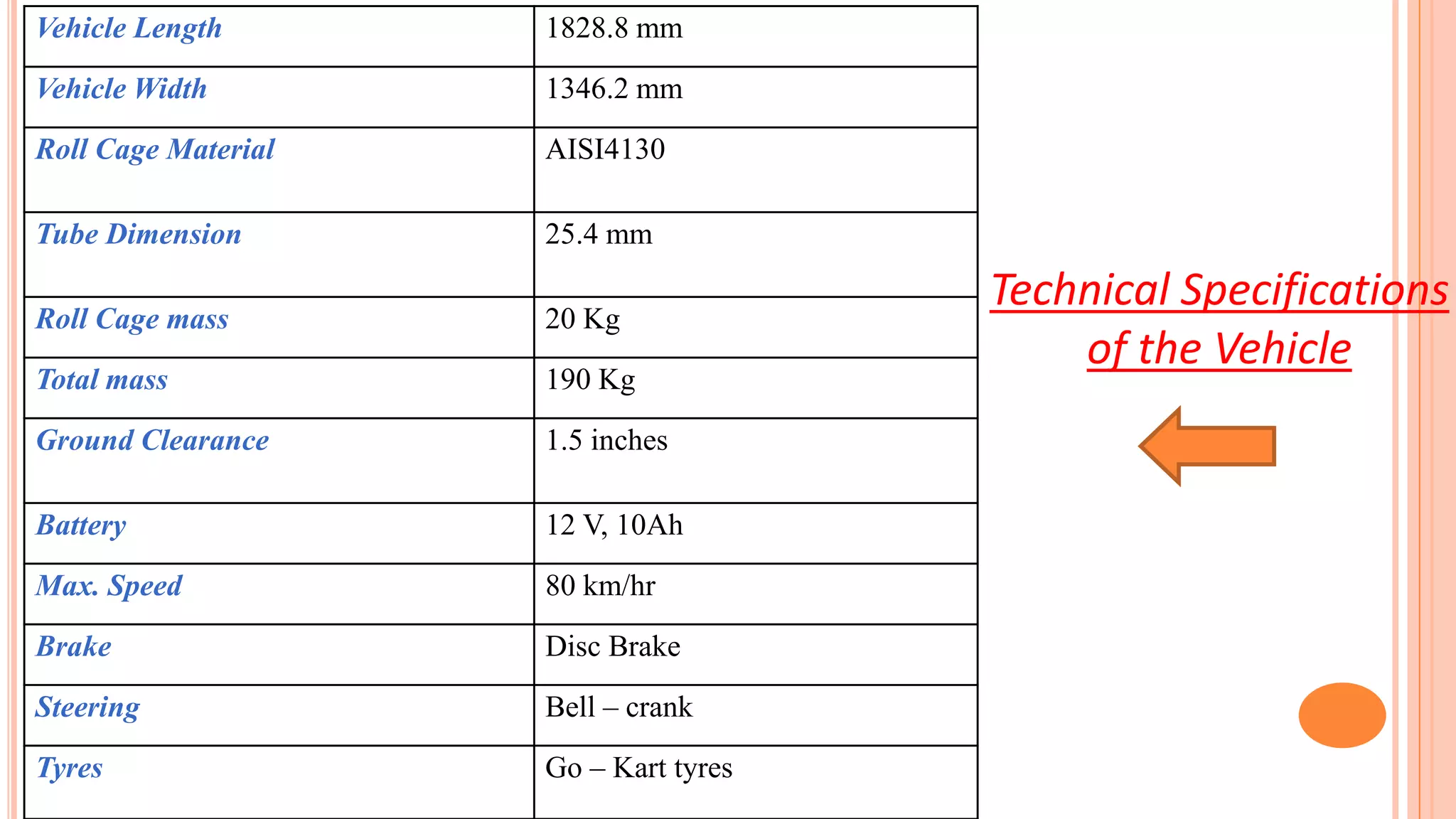
Vehicle Length 1828.8 mm
Vehicle Width 1346.2 mm
Roll Cage Material AISI4130
Tube Dimension 25.4 mm
Roll Cage mass 20 Kg
Total mass 190 Kg
Ground Clearance 1.5 inches
Battery 12 V, 10Ah
Max. Speed 80 km/hr
Brake Disc Brake
Steering Bell – crank
Tyres Go – Kart tyres
Technical Specifications
of the Vehicle
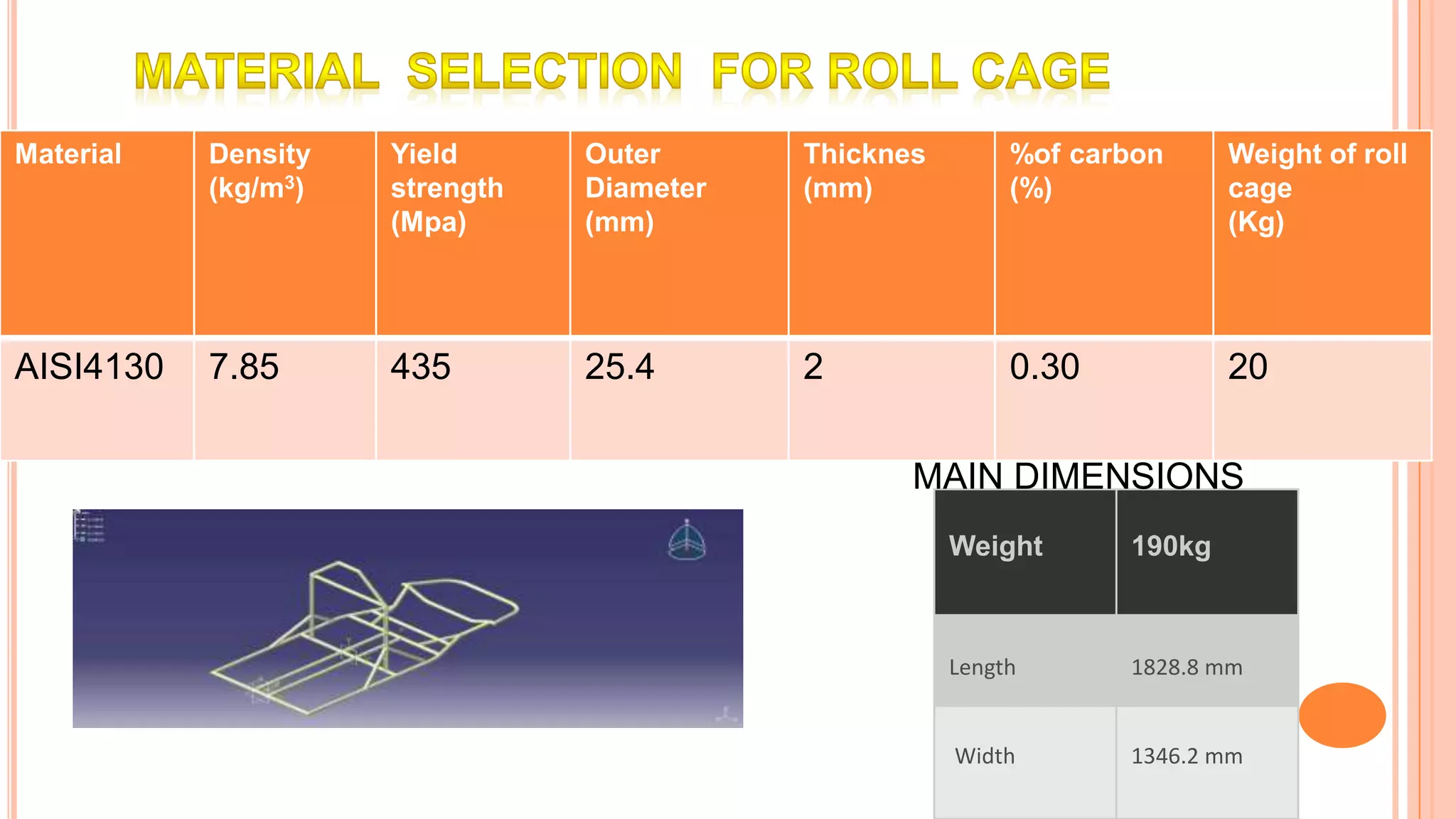
Material Density
(kg/m3)
Yield
strength
(Mpa)
Outer
Diameter
(mm)
Thicknes
(mm)
%of carbon
(%)
Weight of roll
cage
(Kg)
AISI4130 7.85 435 25.4 2 0.30 20
Weight 190kg
Length 1828.8 mm
Width 1346.2 mm
MAIN DIMENSIONS
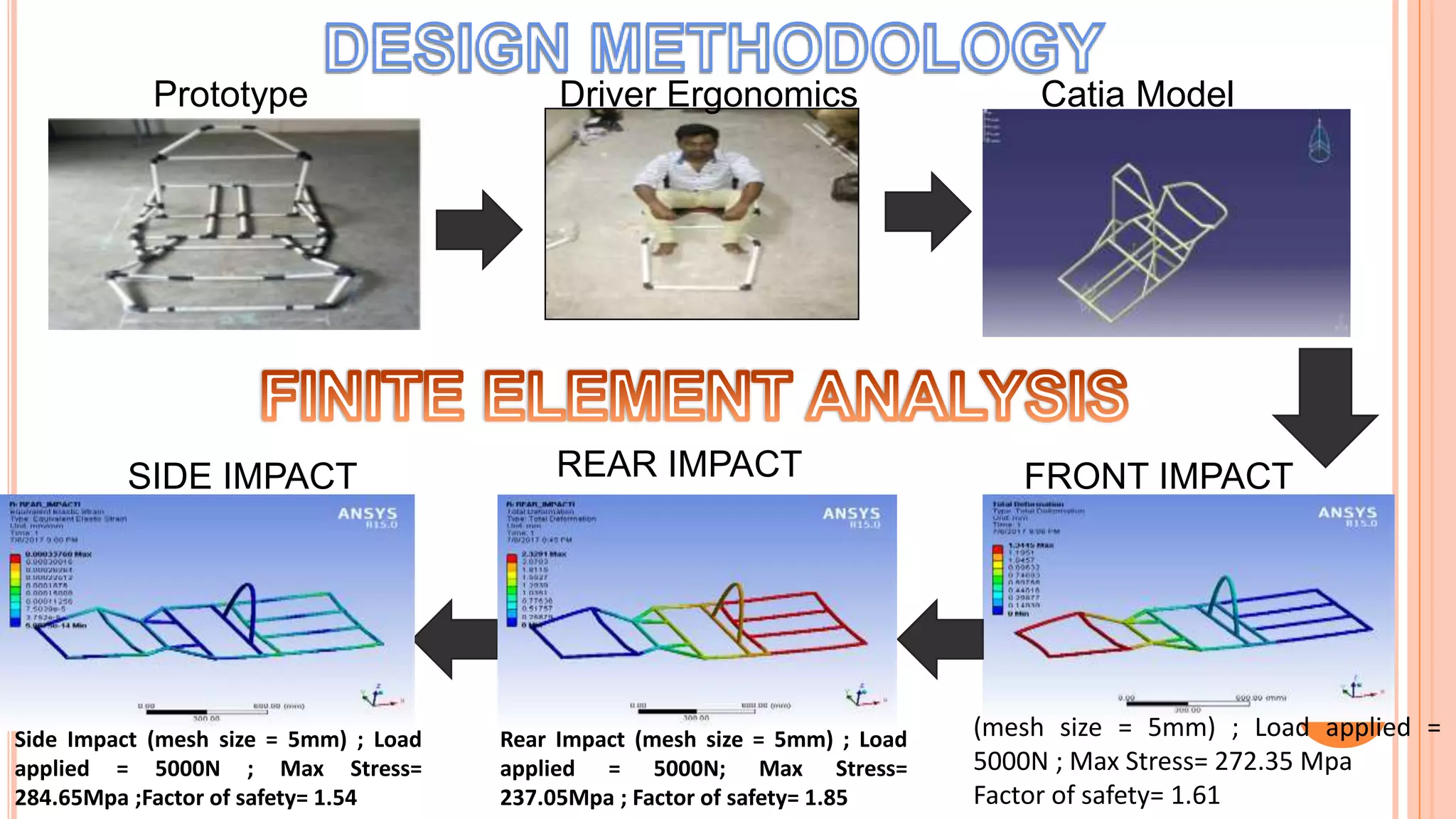
(mesh size = 5mm) ; Load applied =
5000N ; Max Stress= 272.35 Mpa
Factor of safety= 1.61
Rear Impact (mesh size = 5mm) ; Load
applied = 5000N; Max Stress=
237.05Mpa ; Factor of safety= 1.85
Side Impact (mesh size = 5mm) ; Load
applied = 5000N ; Max Stress=
284.65Mpa ;Factor of safety= 1.54
FRONT IMPACTSIDE IMPACT REAR IMPACT
Prototype Driver Ergonomics Catia Model
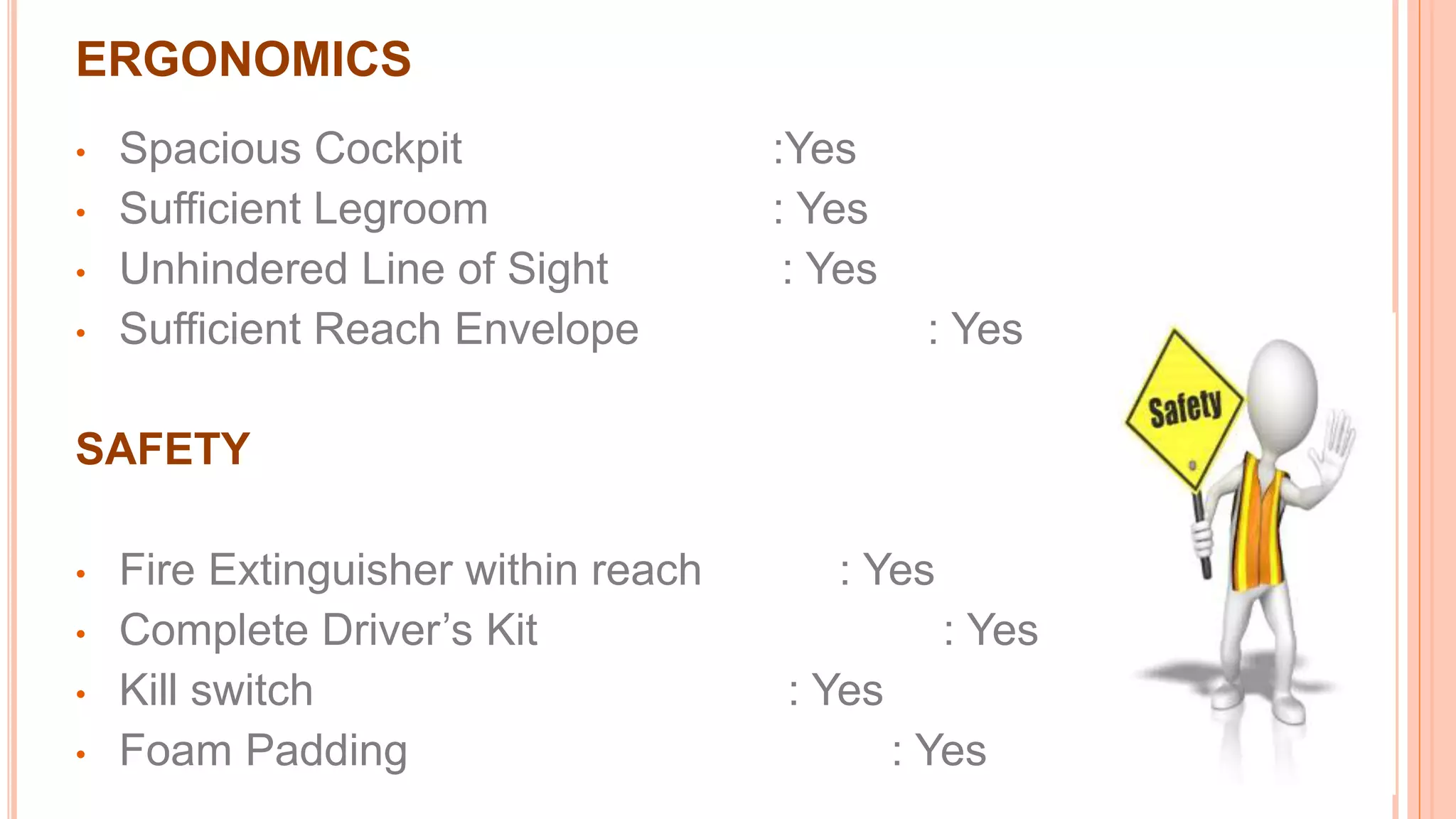
• Spacious Cockpit :Yes
• Sufficient Legroom : Yes
• Unhindered Line of Sight : Yes
• Sufficient Reach Envelope : Yes
SAFETY
• Fire Extinguisher within reach : Yes
• Complete Driver’s Kit : Yes
• Kill switch : Yes
• Foam Padding : Yes
ERGONOMICS
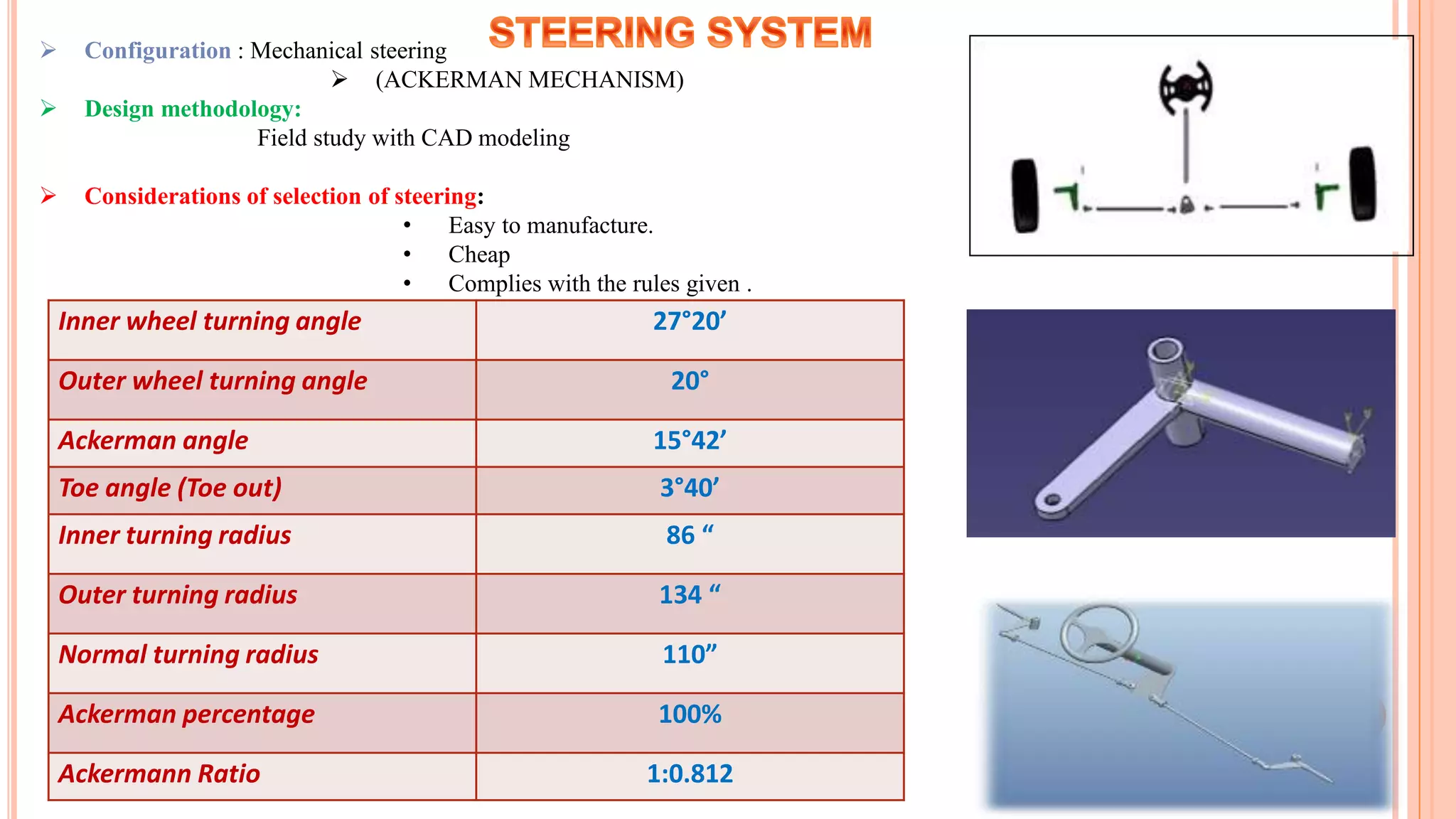
 Configuration : Mechanical steering
 (ACKERMAN MECHANISM)
 Design methodology:
Field study with CAD modeling
 Considerations of selection of steering:
• Easy to manufacture.
• Cheap
• Complies with the rules given .
Inner wheel turning angle 27°20’
Outer wheel turning angle 20°
Ackerman angle 15°42’
Toe angle (Toe out) 3°40’
Inner turning radius 86 “
Outer turning radius 134 “
Normal turning radius 110”
Ackerman percentage 100%
Ackermann Ratio 1:0.812
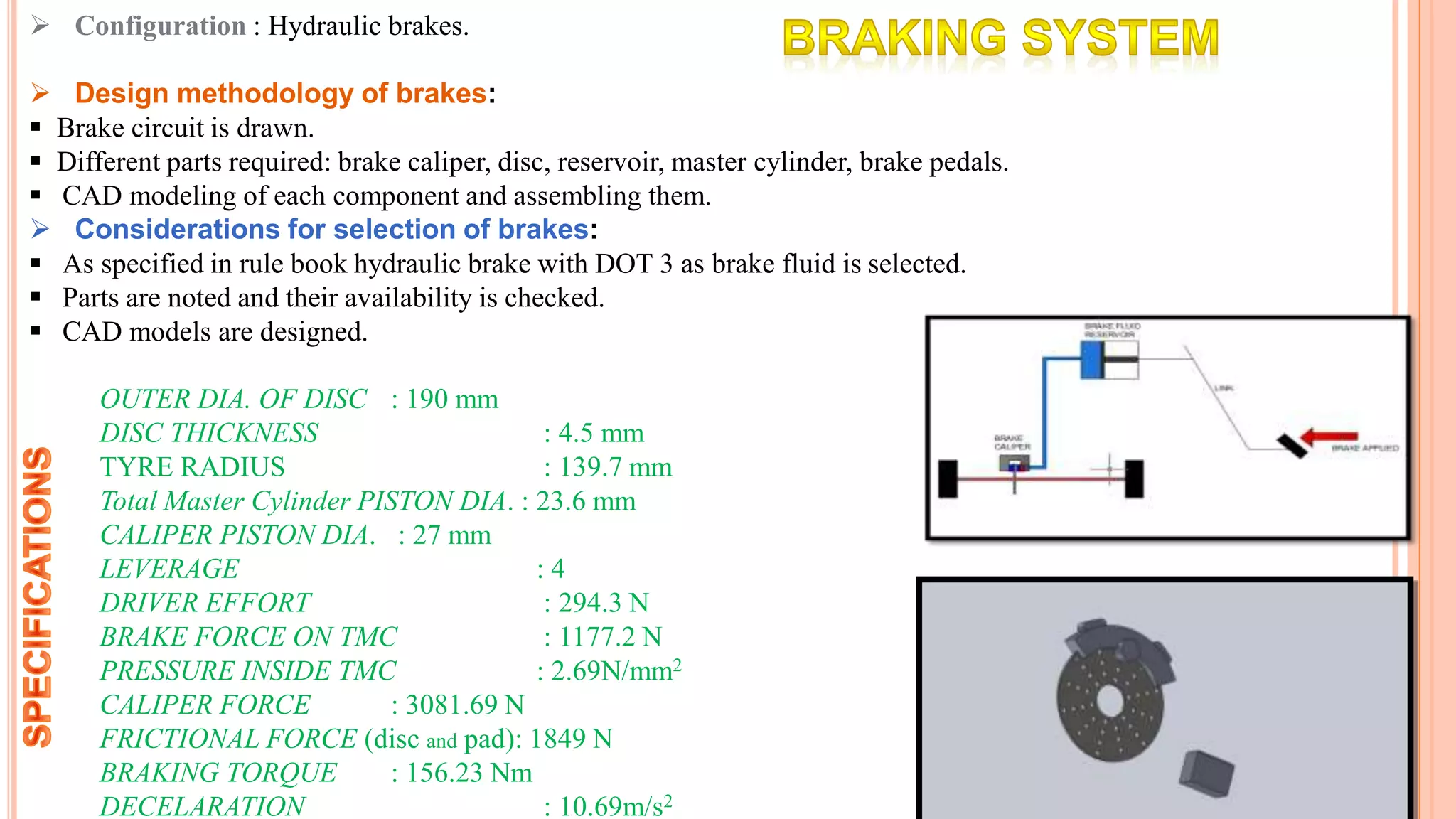
 Configuration : Hydraulic brakes.
 Design methodology of brakes:
 Brake circuit is drawn.
 Different parts required: brake caliper, disc, reservoir, master cylinder, brake pedals.
 CAD modeling of each component and assembling them.
 Considerations for selection of brakes:
 As specified in rule book hydraulic brake with DOT 3 as brake fluid is selected.
 Parts are noted and their availability is checked.
 CAD models are designed.
OUTER DIA. OF DISC : 190 mm
DISC THICKNESS : 4.5 mm
TYRE RADIUS : 139.7 mm
Total Master Cylinder PISTON DIA. : 23.6 mm
CALIPER PISTON DIA. : 27 mm
LEVERAGE : 4
DRIVER EFFORT : 294.3 N
BRAKE FORCE ON TMC : 1177.2 N
PRESSURE INSIDE TMC : 2.69N/mm2
CALIPER FORCE : 3081.69 N
FRICTIONAL FORCE (disc and pad): 1849 N
BRAKING TORQUE : 156.23 Nm
DECELARATION : 10.69m/s2
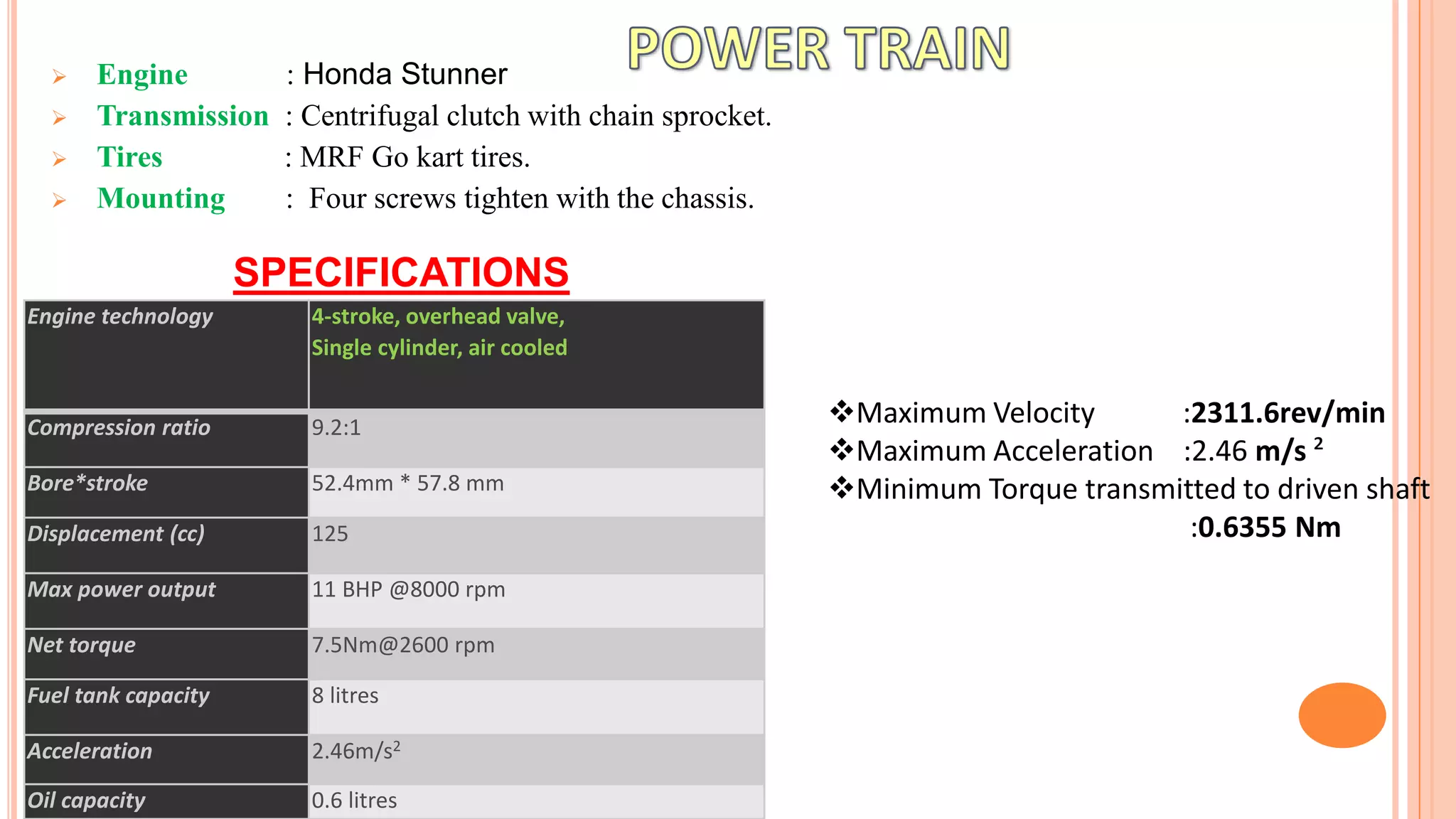
 Engine : Honda Stunner
 Transmission : Centrifugal clutch with chain sprocket.
 Tires : MRF Go kart tires.
 Mounting : Four screws tighten with the chassis.
Engine technology 4-stroke, overhead valve,
Single cylinder, air cooled
Compression ratio 9.2:1
Bore*stroke 52.4mm * 57.8 mm
Displacement (cc) 125
Max power output 11 BHP @8000 rpm
Net torque 7.5Nm@2600 rpm
Fuel tank capacity 8 litres
Acceleration 2.46m/s2
Oil capacity 0.6 litres
SPECIFICATIONS
Maximum Velocity :2311.6rev/min
Maximum Acceleration :2.46 m/s ²
Minimum Torque transmitted to driven shaft
:0.6355 Nm
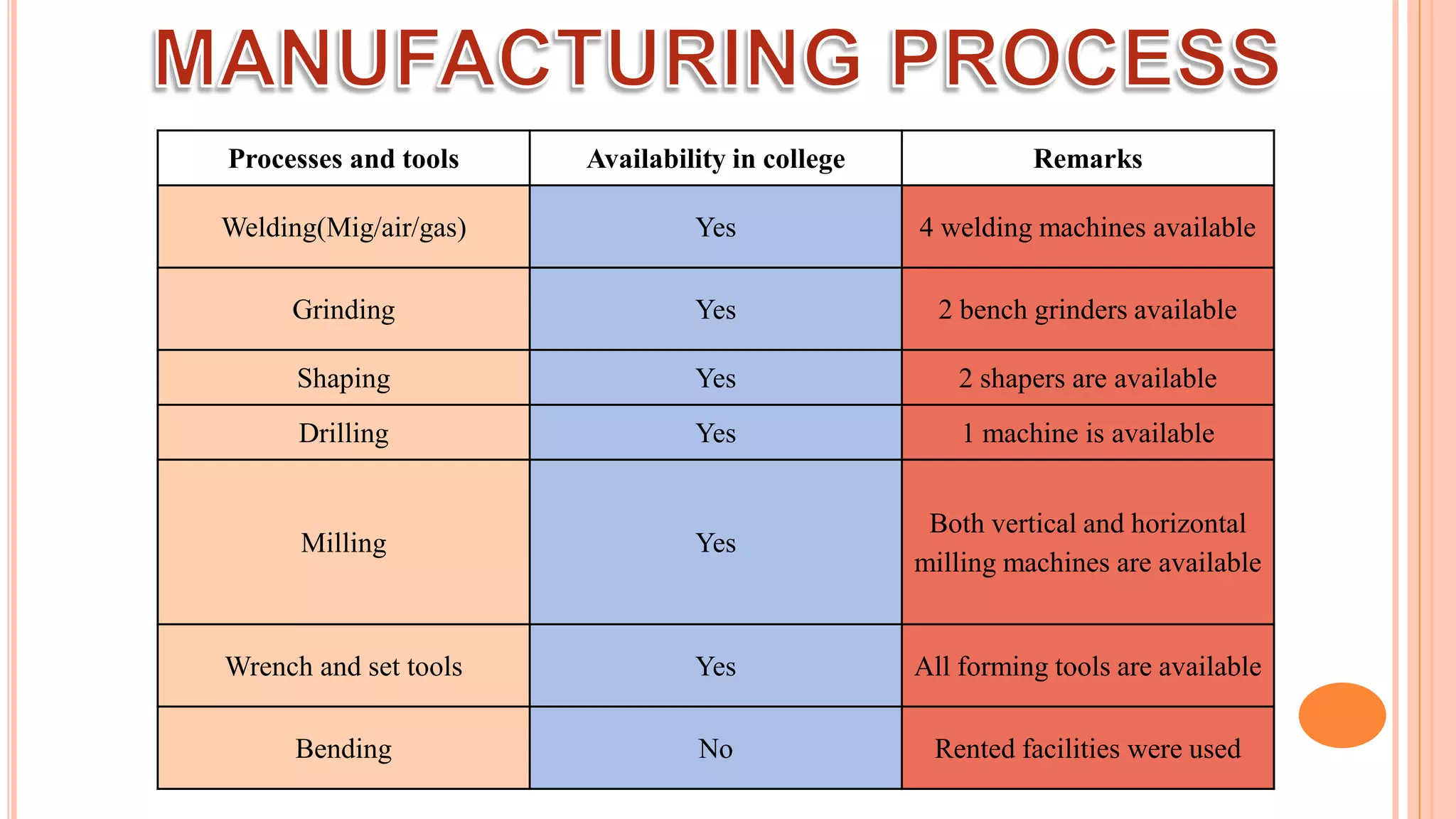
Processes and tools Availability in college Remarks
Welding(Mig/air/gas) Yes 4 welding machines available
Grinding Yes 2 bench grinders available
Shaping Yes 2 shapers are available
Drilling Yes 1 machine is available
Milling Yes
Both vertical and horizontal
milling machines are available
Wrench and set tools Yes All forming tools are available
Bending No Rented facilities were used
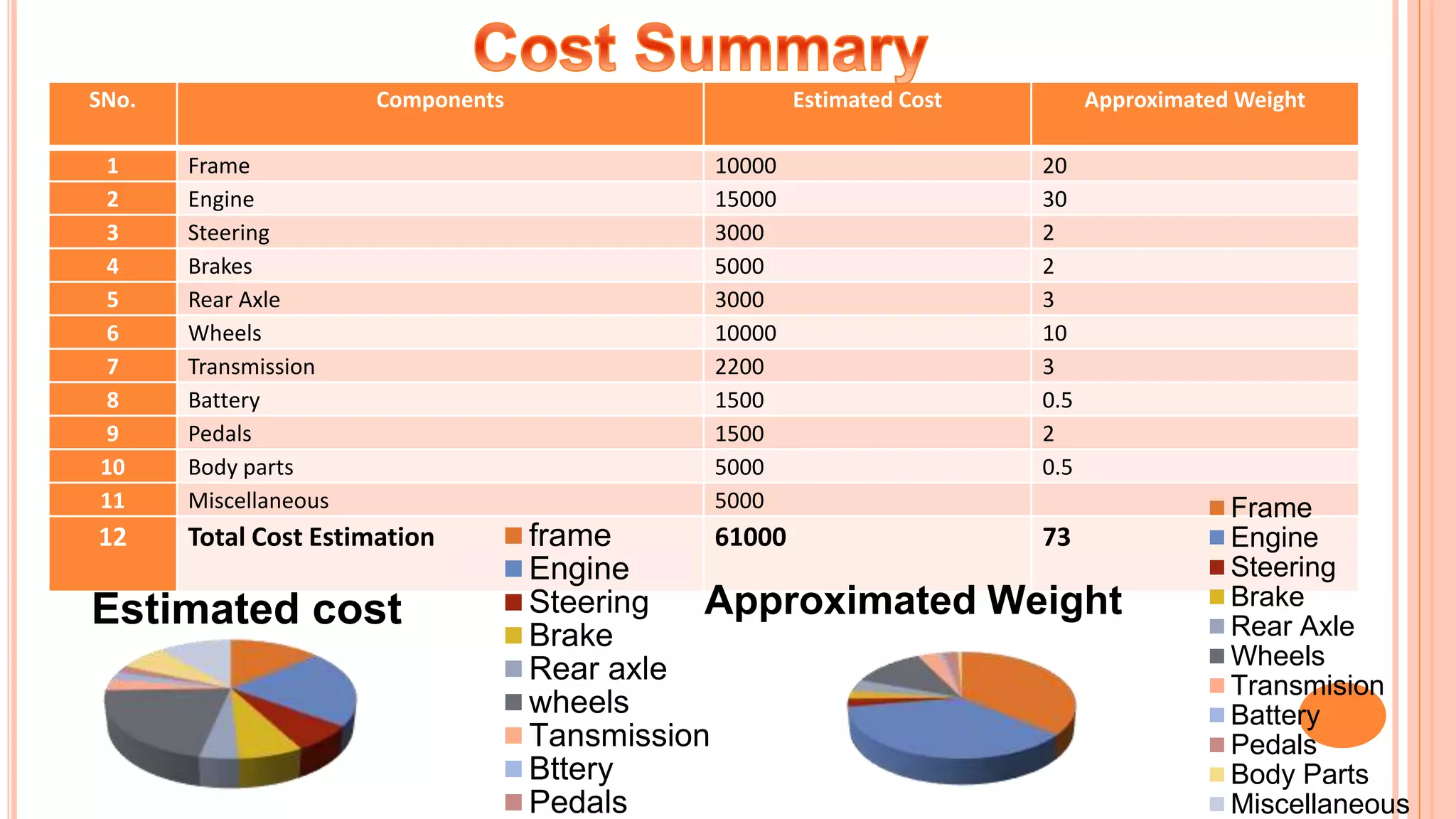
SNo. Components Estimated Cost Approximated Weight
1 Frame 10000 20
2 Engine 15000 30
3 Steering 3000 2
4 Brakes 5000 2
5 Rear Axle 3000 3
6 Wheels 10000 10
7 Transmission 2200 3
8 Battery 1500 0.5
9 Pedals 1500 2
10 Body parts 5000 0.5
11 Miscellaneous 5000
12 Total Cost Estimation 61000 73
Estimated cost
frame
Engine
Steering
Brake
Rear axle
wheels
Tansmission
Bttery
Pedals
Frame
Engine
Steering
Brake
Rear Axle
Wheels
Transmision
Battery
Pedals
Body Parts
Miscellaneous
Approximated Weight
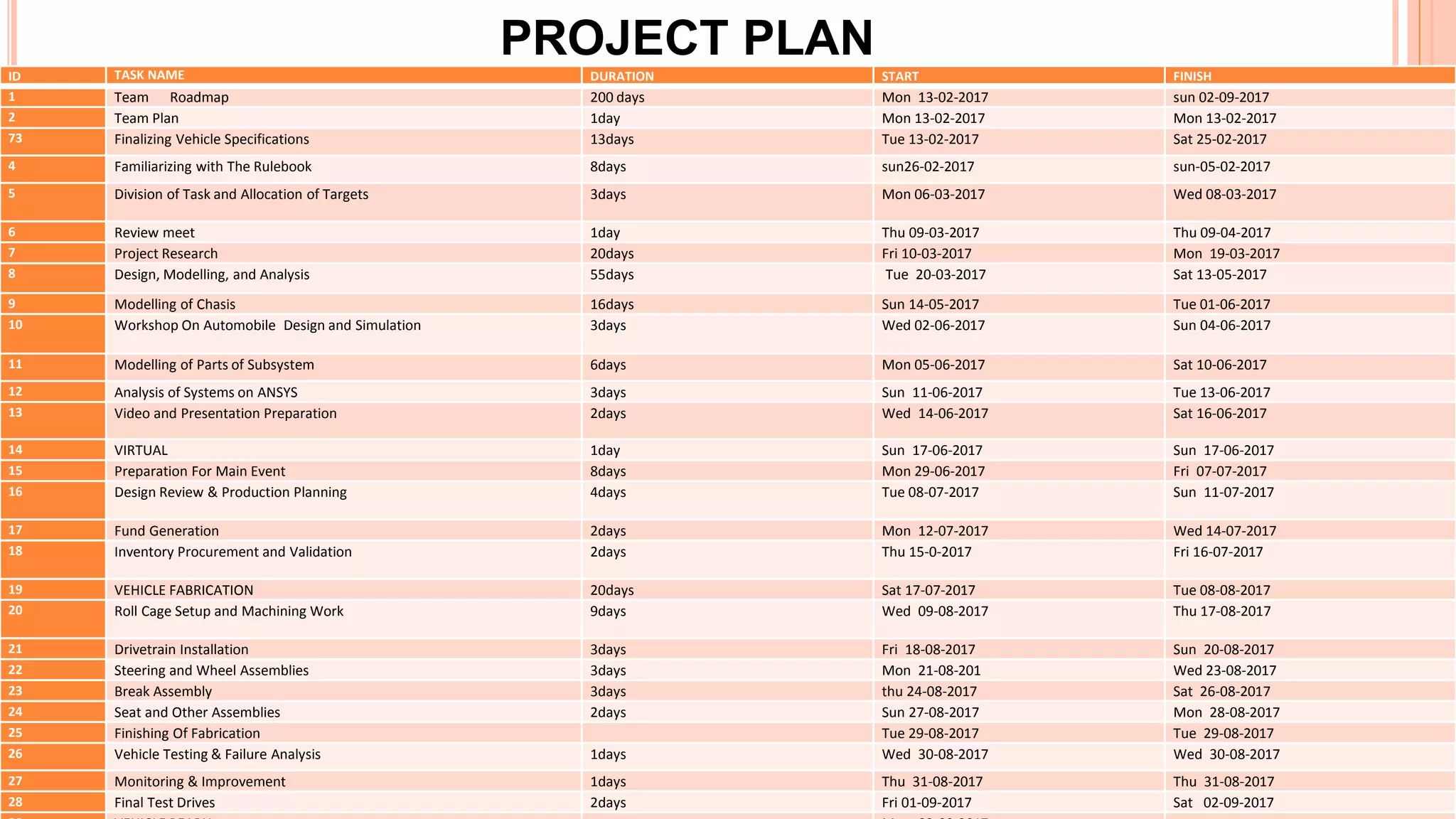
ID TASK NAME DURATION START FINISH
1 Team Roadmap 200 days Mon 13-02-2017 sun 02-09-2017
2 Team Plan 1day Mon 13-02-2017 Mon 13-02-2017
73 Finalizing Vehicle Specifications 13days Tue 13-02-2017 Sat 25-02-2017
4 Familiarizing with The Rulebook 8days sun26-02-2017 sun-05-02-2017
5 Division of Task and Allocation of Targets 3days Mon 06-03-2017 Wed 08-03-2017
6 Review meet 1day Thu 09-03-2017 Thu 09-04-2017
7 Project Research 20days Fri 10-03-2017 Mon 19-03-2017
8 Design, Modelling, and Analysis 55days Tue 20-03-2017 Sat 13-05-2017
9 Modelling of Chasis 16days Sun 14-05-2017 Tue 01-06-2017
10 Workshop On Automobile Design and Simulation 3days Wed 02-06-2017 Sun 04-06-2017
11 Modelling of Parts of Subsystem 6days Mon 05-06-2017 Sat 10-06-2017
12 Analysis of Systems on ANSYS 3days Sun 11-06-2017 Tue 13-06-2017
13 Video and Presentation Preparation 2days Wed 14-06-2017 Sat 16-06-2017
14 VIRTUAL 1day Sun 17-06-2017 Sun 17-06-2017
15 Preparation For Main Event 8days Mon 29-06-2017 Fri 07-07-2017
16 Design Review & Production Planning 4days Tue 08-07-2017 Sun 11-07-2017
17 Fund Generation 2days Mon 12-07-2017 Wed 14-07-2017
18 Inventory Procurement and Validation 2days Thu 15-0-2017 Fri 16-07-2017
19 VEHICLE FABRICATION 20days Sat 17-07-2017 Tue 08-08-2017
20 Roll Cage Setup and Machining Work 9days Wed 09-08-2017 Thu 17-08-2017
21 Drivetrain Installation 3days Fri 18-08-2017 Sun 20-08-2017
22 Steering and Wheel Assemblies 3days Mon 21-08-201 Wed 23-08-2017
23 Break Assembly 3days thu 24-08-2017 Sat 26-08-2017
24 Seat and Other Assemblies 2days Sun 27-08-2017 Mon 28-08-2017
25 Finishing Of Fabrication Tue 29-08-2017 Tue 29-08-2017
26 Vehicle Testing & Failure Analysis 1days Wed 30-08-2017 Wed 30-08-2017
27 Monitoring & Improvement 1days Thu 31-08-2017 Thu 31-08-2017
28 Final Test Drives 2days Fri 01-09-2017 Sat 02-09-2017
PROJECT PLAN
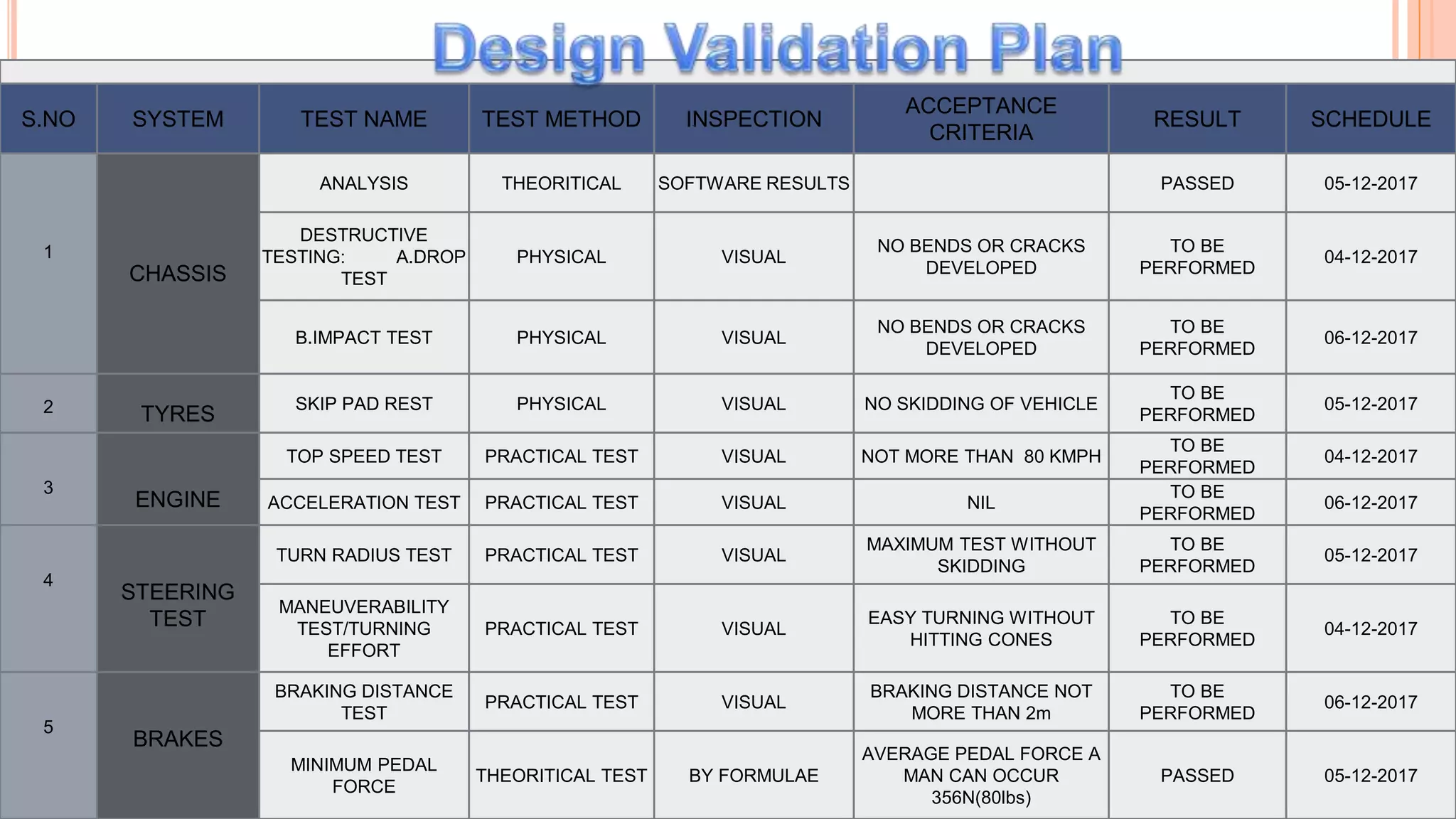
S.NO SYSTEM TEST NAME TEST METHOD INSPECTION
ACCEPTANCE
CRITERIA
RESULT SCHEDULE
1
CHASSIS
ANALYSIS THEORITICAL SOFTWARE RESULTS PASSED 05-12-2017
DESTRUCTIVE
TESTING: A.DROP
TEST
PHYSICAL VISUAL
NO BENDS OR CRACKS
DEVELOPED
TO BE
PERFORMED
04-12-2017
B.IMPACT TEST PHYSICAL VISUAL
NO BENDS OR CRACKS
DEVELOPED
TO BE
PERFORMED
06-12-2017
2 TYRES
SKIP PAD REST PHYSICAL VISUAL NO SKIDDING OF VEHICLE
TO BE
PERFORMED
05-12-2017
3
ENGINE
TOP SPEED TEST PRACTICAL TEST VISUAL NOT MORE THAN 80 KMPH
TO BE
PERFORMED
04-12-2017
ACCELERATION TEST PRACTICAL TEST VISUAL NIL
TO BE
PERFORMED
06-12-2017
4
STEERING
TEST
TURN RADIUS TEST PRACTICAL TEST VISUAL
MAXIMUM TEST WITHOUT
SKIDDING
TO BE
PERFORMED
05-12-2017
MANEUVERABILITY
TEST/TURNING
EFFORT
PRACTICAL TEST VISUAL
EASY TURNING WITHOUT
HITTING CONES
TO BE
PERFORMED
04-12-2017
5
BRAKES
BRAKING DISTANCE
TEST
PRACTICAL TEST VISUAL
BRAKING DISTANCE NOT
MORE THAN 2m
TO BE
PERFORMED
06-12-2017
MINIMUM PEDAL
FORCE
THEORITICAL TEST BY FORMULAE
AVERAGE PEDAL FORCE A
MAN CAN OCCUR
356N(80lbs)
PASSED 05-12-2017
Item /
Functio
n
Potential failure
mode
Potential
effects of
failure
Potentia
l causes
Sev
Occ
Detect
R.P.N.
Recommende
d Actions
Actions
taken
Sev
Occ
Detect
R.P.N.
Brake
Brake oil leakage Braking failure
Improper
sealing
10
6
2
120
Proper sealing
Select the MC
Properly
4
2
2
16
Brake pad wear
Increase in stopping
distance
Over usage
of brakes
7
3
6
126
Recommended
brake pad is used
Recognized
brake pad is
used
2
1
4
8
Steering
Steering failure
Poor connection of
joint
Poor
connection
of joint
9
5
2
90
Proper connection of
rod
Effective and
proper
connection of
rod
4
2
2
16
Bell Crank Breakage Steering failure
Improper
selection of
material to
bear the
force and
improper
welding
10
3
2
60
Analyze the material
before installing
Analyzed the
material
before used
3
2
2
12
Engine
and
power
train
Chain linkage break
Decrease in power
transmission
Improper
fixing of
chain
10
4
2
72
Tightly mount the
chain
Mounted the
chain tightly
and greased
4
2
1
6
Wheels Air leak Dragging of vehicles
Due to
foreign
particle
8
3
4
96
Check the air
regularly and use of
tubeless tyre
Tubeless tyre
are used
3
2
2
12
Electrical
s
Battery malfunction Vehicle collapse
Over
discharge
5
2
9
90
Battery should be
correctly installed
Proper battery
is installed
2
2
1
4
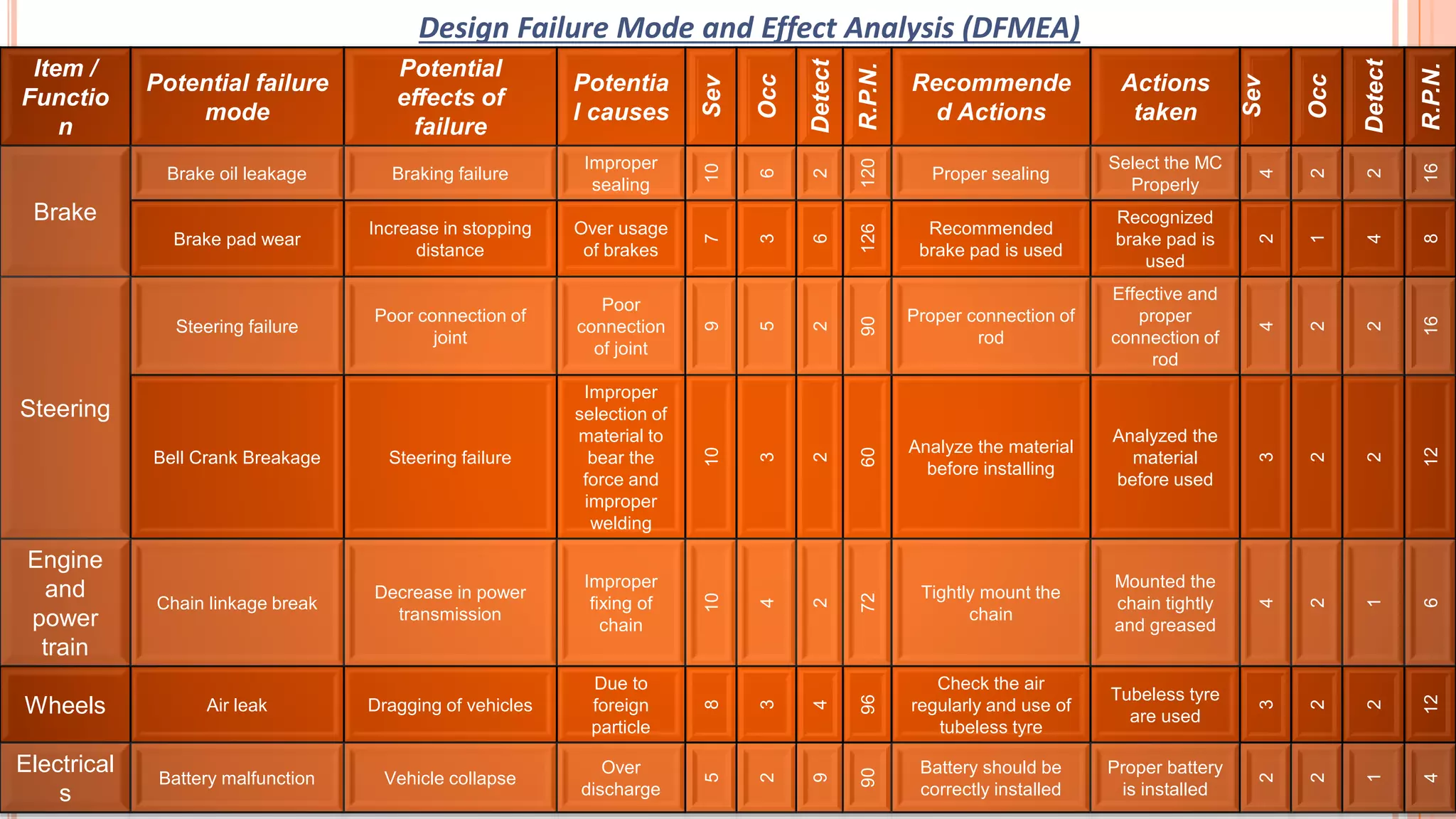
Design Failure Mode and Effect Analysis (DFMEA)
Design presentation of Gokart

Design presentation of Gokart

  • 1.
  • 2.
    Vehicle Length 1828.8mm Vehicle Width 1346.2 mm Roll Cage Material AISI4130 Tube Dimension 25.4 mm Roll Cage mass 20 Kg Total mass 190 Kg Ground Clearance 1.5 inches Battery 12 V, 10Ah Max. Speed 80 km/hr Brake Disc Brake Steering Bell – crank Tyres Go – Kart tyres Technical Specifications of the Vehicle
  • 3.
    Material Density (kg/m3) Yield strength (Mpa) Outer Diameter (mm) Thicknes (mm) %of carbon (%) Weightof roll cage (Kg) AISI4130 7.85 435 25.4 2 0.30 20 Weight 190kg Length 1828.8 mm Width 1346.2 mm MAIN DIMENSIONS
  • 4.
    (mesh size =5mm) ; Load applied = 5000N ; Max Stress= 272.35 Mpa Factor of safety= 1.61 Rear Impact (mesh size = 5mm) ; Load applied = 5000N; Max Stress= 237.05Mpa ; Factor of safety= 1.85 Side Impact (mesh size = 5mm) ; Load applied = 5000N ; Max Stress= 284.65Mpa ;Factor of safety= 1.54 FRONT IMPACTSIDE IMPACT REAR IMPACT Prototype Driver Ergonomics Catia Model
  • 5.
    • Spacious Cockpit:Yes • Sufficient Legroom : Yes • Unhindered Line of Sight : Yes • Sufficient Reach Envelope : Yes SAFETY • Fire Extinguisher within reach : Yes • Complete Driver’s Kit : Yes • Kill switch : Yes • Foam Padding : Yes ERGONOMICS
  • 6.
     Configuration :Mechanical steering  (ACKERMAN MECHANISM)  Design methodology: Field study with CAD modeling  Considerations of selection of steering: • Easy to manufacture. • Cheap • Complies with the rules given . Inner wheel turning angle 27°20’ Outer wheel turning angle 20° Ackerman angle 15°42’ Toe angle (Toe out) 3°40’ Inner turning radius 86 “ Outer turning radius 134 “ Normal turning radius 110” Ackerman percentage 100% Ackermann Ratio 1:0.812
  • 7.
     Configuration :Hydraulic brakes.  Design methodology of brakes:  Brake circuit is drawn.  Different parts required: brake caliper, disc, reservoir, master cylinder, brake pedals.  CAD modeling of each component and assembling them.  Considerations for selection of brakes:  As specified in rule book hydraulic brake with DOT 3 as brake fluid is selected.  Parts are noted and their availability is checked.  CAD models are designed. OUTER DIA. OF DISC : 190 mm DISC THICKNESS : 4.5 mm TYRE RADIUS : 139.7 mm Total Master Cylinder PISTON DIA. : 23.6 mm CALIPER PISTON DIA. : 27 mm LEVERAGE : 4 DRIVER EFFORT : 294.3 N BRAKE FORCE ON TMC : 1177.2 N PRESSURE INSIDE TMC : 2.69N/mm2 CALIPER FORCE : 3081.69 N FRICTIONAL FORCE (disc and pad): 1849 N BRAKING TORQUE : 156.23 Nm DECELARATION : 10.69m/s2
  • 8.
     Engine :Honda Stunner  Transmission : Centrifugal clutch with chain sprocket.  Tires : MRF Go kart tires.  Mounting : Four screws tighten with the chassis. Engine technology 4-stroke, overhead valve, Single cylinder, air cooled Compression ratio 9.2:1 Bore*stroke 52.4mm * 57.8 mm Displacement (cc) 125 Max power output 11 BHP @8000 rpm Net torque 7.5Nm@2600 rpm Fuel tank capacity 8 litres Acceleration 2.46m/s2 Oil capacity 0.6 litres SPECIFICATIONS Maximum Velocity :2311.6rev/min Maximum Acceleration :2.46 m/s ² Minimum Torque transmitted to driven shaft :0.6355 Nm
  • 9.
    Processes and toolsAvailability in college Remarks Welding(Mig/air/gas) Yes 4 welding machines available Grinding Yes 2 bench grinders available Shaping Yes 2 shapers are available Drilling Yes 1 machine is available Milling Yes Both vertical and horizontal milling machines are available Wrench and set tools Yes All forming tools are available Bending No Rented facilities were used
  • 10.
    SNo. Components EstimatedCost Approximated Weight 1 Frame 10000 20 2 Engine 15000 30 3 Steering 3000 2 4 Brakes 5000 2 5 Rear Axle 3000 3 6 Wheels 10000 10 7 Transmission 2200 3 8 Battery 1500 0.5 9 Pedals 1500 2 10 Body parts 5000 0.5 11 Miscellaneous 5000 12 Total Cost Estimation 61000 73 Estimated cost frame Engine Steering Brake Rear axle wheels Tansmission Bttery Pedals Frame Engine Steering Brake Rear Axle Wheels Transmision Battery Pedals Body Parts Miscellaneous Approximated Weight
  • 11.
    ID TASK NAMEDURATION START FINISH 1 Team Roadmap 200 days Mon 13-02-2017 sun 02-09-2017 2 Team Plan 1day Mon 13-02-2017 Mon 13-02-2017 73 Finalizing Vehicle Specifications 13days Tue 13-02-2017 Sat 25-02-2017 4 Familiarizing with The Rulebook 8days sun26-02-2017 sun-05-02-2017 5 Division of Task and Allocation of Targets 3days Mon 06-03-2017 Wed 08-03-2017 6 Review meet 1day Thu 09-03-2017 Thu 09-04-2017 7 Project Research 20days Fri 10-03-2017 Mon 19-03-2017 8 Design, Modelling, and Analysis 55days Tue 20-03-2017 Sat 13-05-2017 9 Modelling of Chasis 16days Sun 14-05-2017 Tue 01-06-2017 10 Workshop On Automobile Design and Simulation 3days Wed 02-06-2017 Sun 04-06-2017 11 Modelling of Parts of Subsystem 6days Mon 05-06-2017 Sat 10-06-2017 12 Analysis of Systems on ANSYS 3days Sun 11-06-2017 Tue 13-06-2017 13 Video and Presentation Preparation 2days Wed 14-06-2017 Sat 16-06-2017 14 VIRTUAL 1day Sun 17-06-2017 Sun 17-06-2017 15 Preparation For Main Event 8days Mon 29-06-2017 Fri 07-07-2017 16 Design Review & Production Planning 4days Tue 08-07-2017 Sun 11-07-2017 17 Fund Generation 2days Mon 12-07-2017 Wed 14-07-2017 18 Inventory Procurement and Validation 2days Thu 15-0-2017 Fri 16-07-2017 19 VEHICLE FABRICATION 20days Sat 17-07-2017 Tue 08-08-2017 20 Roll Cage Setup and Machining Work 9days Wed 09-08-2017 Thu 17-08-2017 21 Drivetrain Installation 3days Fri 18-08-2017 Sun 20-08-2017 22 Steering and Wheel Assemblies 3days Mon 21-08-201 Wed 23-08-2017 23 Break Assembly 3days thu 24-08-2017 Sat 26-08-2017 24 Seat and Other Assemblies 2days Sun 27-08-2017 Mon 28-08-2017 25 Finishing Of Fabrication Tue 29-08-2017 Tue 29-08-2017 26 Vehicle Testing & Failure Analysis 1days Wed 30-08-2017 Wed 30-08-2017 27 Monitoring & Improvement 1days Thu 31-08-2017 Thu 31-08-2017 28 Final Test Drives 2days Fri 01-09-2017 Sat 02-09-2017 PROJECT PLAN
  • 12.
    S.NO SYSTEM TESTNAME TEST METHOD INSPECTION ACCEPTANCE CRITERIA RESULT SCHEDULE 1 CHASSIS ANALYSIS THEORITICAL SOFTWARE RESULTS PASSED 05-12-2017 DESTRUCTIVE TESTING: A.DROP TEST PHYSICAL VISUAL NO BENDS OR CRACKS DEVELOPED TO BE PERFORMED 04-12-2017 B.IMPACT TEST PHYSICAL VISUAL NO BENDS OR CRACKS DEVELOPED TO BE PERFORMED 06-12-2017 2 TYRES SKIP PAD REST PHYSICAL VISUAL NO SKIDDING OF VEHICLE TO BE PERFORMED 05-12-2017 3 ENGINE TOP SPEED TEST PRACTICAL TEST VISUAL NOT MORE THAN 80 KMPH TO BE PERFORMED 04-12-2017 ACCELERATION TEST PRACTICAL TEST VISUAL NIL TO BE PERFORMED 06-12-2017 4 STEERING TEST TURN RADIUS TEST PRACTICAL TEST VISUAL MAXIMUM TEST WITHOUT SKIDDING TO BE PERFORMED 05-12-2017 MANEUVERABILITY TEST/TURNING EFFORT PRACTICAL TEST VISUAL EASY TURNING WITHOUT HITTING CONES TO BE PERFORMED 04-12-2017 5 BRAKES BRAKING DISTANCE TEST PRACTICAL TEST VISUAL BRAKING DISTANCE NOT MORE THAN 2m TO BE PERFORMED 06-12-2017 MINIMUM PEDAL FORCE THEORITICAL TEST BY FORMULAE AVERAGE PEDAL FORCE A MAN CAN OCCUR 356N(80lbs) PASSED 05-12-2017
  • 13.
    Item / Functio n Potential failure mode Potential effectsof failure Potentia l causes Sev Occ Detect R.P.N. Recommende d Actions Actions taken Sev Occ Detect R.P.N. Brake Brake oil leakage Braking failure Improper sealing 10 6 2 120 Proper sealing Select the MC Properly 4 2 2 16 Brake pad wear Increase in stopping distance Over usage of brakes 7 3 6 126 Recommended brake pad is used Recognized brake pad is used 2 1 4 8 Steering Steering failure Poor connection of joint Poor connection of joint 9 5 2 90 Proper connection of rod Effective and proper connection of rod 4 2 2 16 Bell Crank Breakage Steering failure Improper selection of material to bear the force and improper welding 10 3 2 60 Analyze the material before installing Analyzed the material before used 3 2 2 12 Engine and power train Chain linkage break Decrease in power transmission Improper fixing of chain 10 4 2 72 Tightly mount the chain Mounted the chain tightly and greased 4 2 1 6 Wheels Air leak Dragging of vehicles Due to foreign particle 8 3 4 96 Check the air regularly and use of tubeless tyre Tubeless tyre are used 3 2 2 12 Electrical s Battery malfunction Vehicle collapse Over discharge 5 2 9 90 Battery should be correctly installed Proper battery is installed 2 2 1 4 Design Failure Mode and Effect Analysis (DFMEA)