Modeling, Simulation and Control of Semi Active Suspension System for
Automobiles under MATLAB Simulink using PID Controller
K.Dhananjay Rao

*Electrical Engineering Department, Jadavpur University
Kolkata, India, (e-mail: kdhananjayrao@gmail.com)
Abstract: This paper aims to investigate the performance of a quarter car semi-active suspension system
using PID controller under MATLAB Simulink Model. Dynamic system used in this study is a linear
system. A linear system can capture basic performances of vehicle suspension such as body
displacement, body acceleration, wheel displacement, wheel deflection, suspension travels. Performance
of suspension system is determined by the ride comfort and vehicle handling. It can be measured by car
body displacement and wheel deflection performance. Two types of road profiles are used as input for the
system. Results show that the performance of body displacement and wheel displacement can be
improved by using the proposed PID controller.
Keywords: Semi-Active suspension, Quarter car Model, MATLAB Simulink, step and random road
disturbance

1. INTRODUCTION
Vehicle suspensions are mainly classified into three types
i.e., passive, semi active and active suspensions, which
depend on the operation mode to improve vehicle ride
comfort, vehicle safety, road damage minimization and the
overall performance.
Normally, passive suspension is an older conventional
system having non-controlled springs and shock observing
dampers with fixed parameters and no online feedback action
is used- Appleyard et al. (1997) and Sun et al. (2009).Passive
suspension design performance is used for specific operating
conditions .On contrary, active suspensions can have a wide
range of operation condition and can adapt to the system
variations based on online changes of the actuating force.
Therefore, active suspensions have been extensively studied
since 1960s and various approaches have been proposed
Harvat et al. (1997).However active suspensions normally
require large power supply, which is the main drawback that
prevents this technique from being used extensively in
practice. From 1970s, semi-active suspensions have received
much attention since they can achieve desirable performance
than passive suspensions and consume much less power than
active suspensions. Especially some controllable dampers are
available in practice that is electrorhelogical (ER) dampers
and magneto-rheological (MR) dampers. Semi-active
suspensions are more practical than ever in engineering
realization. Semi-active control with MR dampers for
vehicles suspensions have been studied by many researchers-
Yao et al. (2002) and Lai et al. (2002). Many control
strategies such as skyhook, groundhook and hybrid control -
Ahmadian et al. (2000), H -infinity control- Choi et al. (2002)
and model following sliding mode control -Yokoyama et al.
(2001) have been evaluated in terms of their applicability in
practice.
In this paper, the PID controller is considered for
providing the fine control to vehicles suspension system. The
proposed approach has more advantages as compared with
the conventional passive approach- Constantin et al. (2009),
Hanafi et al. (2010) and Kumar et al. (2008).The modelling
and simulation is carried in Simulink environment and further
a sophisticated controller is implemented i.e. PID controller.
Simulink is a versatile interface which can handle various
types of controllers easily –Lai et al. (2002) and Herren et al.
(2008).
The present work tries to analyse the performance of semi-
active suspension control in the application of two degree
freedom vehicle suspension. Dynamic response with road
disturbances is simulated with fixed parameter of the system.
Further implements PID controller and performance
improvement analyses carried out for such system.
2. SYSTEM MODELLING
The mathematical modelling of a two degree of freedom
quarter car body for a semi-active suspension system is being
carried out by using basic laws of mechanics.
Modelling of suspension system has been taking into
account the following observations.
 The suspension system modelled here is considered
two degree of freedom system and assumed to be a
linear or approximately linear system for a quarter
cars.
Proceedings of the Third International Conference on
Advances in Control and Optimization of Dynamical
Systems, Indian Institute of Technology Kanpur, India,
March 13-15, 2014
SaeT1.6
820
 Some minor forces (including flex in the vehicle
body, movement and backlash in various linkages,
joints and gear system) are neglected for reducing
the complexity of the system because effect of these
forces is minimal due to low intensity. Hence these
left out for the system model.
 Tyre material is considered as having damping
property as well as stiffness.
Mathematical Modelling of Semi-active Suspension System
Fig 1. Quarter car semi active suspension model
From fig.1 we have the following equations,
̈ ( ) ( ̇ ̇ ) ( )
̈ ( ) ( ̇ ̇ ) ( ) (1)
̈ ( ) ( ̇ ̇ ) ( ) ( ) (2)
After choosing State variables as,
( ) ( ) ( )
( ) ( ) ( )
( ) ̇ ( )
( ) ̇ ( )
From equation (1), we have
̇ ( ) [ ( ) ( )] [ ( )] ( ) (3)
From equation (2), we have
̇ ( ) [ ( ) ( )] [ ( )] [ ( )] ( ) (4)
Disturbance caused by road roughness,
( ) ̇ ( )
Therefore,
̇ ( ) ( ) ( )
̇ ( ) ( ) ( )
̇ ( )
( ) ( ) ( ) ( )
̇ ( )
( ) ( ) ( ) ( ) ( )
State space equation can be written as form,
̇( ) ( ) ( )
[
̇
̇
̇
̇
]=[ ][ ]+[ ]U +[ ]W
Where,
A=[ ] B=[ ] Bw=[ ]
C= [ ] , D= [0; 0; 0; 0]
3. SIMULATION UNDER MATLAB SIMULINK
In this approach, system needs to be simulated for getting the
dynamic response. The entire suspension is simulated with
the application of MATLAB Simulink. In the last section
mathematical modelling of proposed system is done.
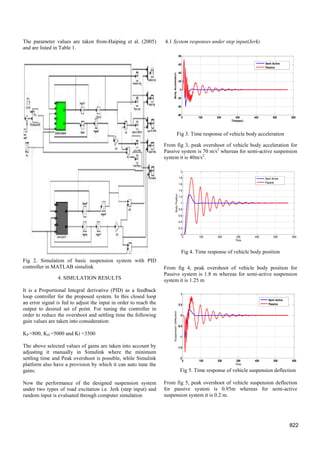
The Simulink library and logic is developed according to the
mathematical equations (1) and (2) and the entire system is
simulated in the Simulink as shown in Fig.2
Table 1. Parameters used in system simulation
S.N. Parameter Symbol Quatities
1 Mass of vehicle body Ms 504.5kg
2 Mass of the tyre and
suspention
Mu 62 kg
3 Coefficient of suspension
spring
Ks 13100
N/m
4 Coefficient of tyre material Kt 252000
N/m
5 Damping coefficient of the
dampers
Cs 400
N-s/m
821
The parameter values are taken from-Haiping et al. (2005)
and are listed in Table 1.
Fig 2. Simulation of basic suspension system with PID
controller in MATLAB simulink
4. SIMULATION RESULTS
It is a Proportional Integral derivative (PID) as a feedback
loop controller for the proposed system. In this closed loop
an error signal is fed to adjust the input in order to reach the
output to desired set of point. For tuning the controller in
order to reduce the overshoot and settling time the following
gain values are taken into consideration:
KP =800, KD =5000 and Ki =3500
The above selected values of gains are taken into account by
adjusting it manually in Simulink where the minimum
settling time and Peak overshoot is possible, while Simulink
platform also have a provision by which it can auto tune the
gains.
Now the performance of the designed suspension system
under two types of road excitation i.e. Jerk (step input) and
random input is evaluated through computer simulation
4.1 System responses under step input(Jerk)
Fig 3. Time response of vehicle body acceleration
From fig 3, peak overshoot of vehicle body acceleration for
Passive system is 70 m/s2
whereas for semi-active suspension
system it is 40m/s2
.
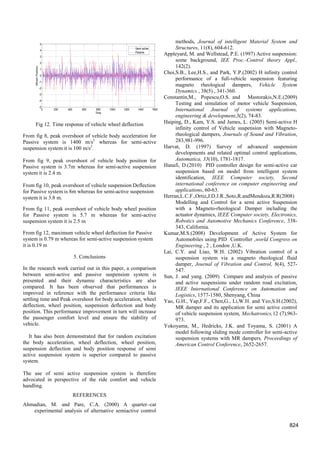
Fig 4. Time response of vehicle body position
From fig 4, peak overshoot of vehicle body position for
Passive system is 1.8 m whereas for semi-active suspension
system it is 1.25 m
Fig 5. Time response of vehicle suspension deflection
From fig 5, peak overshoot of vehicle suspension deflection
for passive system is 0.95m whereas for semi-active
suspension system it is 0.2 m.
0 100 200 300 400 500 600
-60
-40
-20
0
20
40
60
80
Time(sec)
BodyAcceleration
Semi Active
Passive
0 100 200 300 400 500 600
0
0.2
0.4
0.6
0.8
1
1.2
1.4
1.6
1.8
2
Time
BodyPosition
Semi Active
Passive
0 100 200 300 400 500 600
-2
-1.5
-1
-0.5
0
0.5
1
Time
SuspensionDeflection
Semi Active
Passive
822
Fig 6 .Time response of vehicle wheel position
From fig 6, peak overshoot of vehicle body wheel position
for Passive system is 1.78 m whereas for semi-active
suspension system it is 1.19m
Fig 7. Time response of vehicle wheel deflection
From fig 7, peak overshoot of vehicle wheel deflection for
Passive system is 0.79 m whereas for semi-active suspension
system it is 0.19 m
Table 2. Performance Evaluation
Settling Time(Sec)
Passive Semi-active Improvement
Body
Acceleration
300 50 83 %
Wheel
Deflection
250 60 76 %
Wheel
Position
255 65 74.5 %
Suspension
Deflection
300 85 71.66 %
Body Position 300 75 75%
From Table 2,settling time of vehicle body
acceleration,wheel deflection,wheel position ,suspension
deflection and body position for passive system is 300
sec,250sec,255sec,300sec,300sec respectively whereas for
semi-active suspension system it is
50sec,60sec,65sec,85sec,75sec respectively. . It has been
observed that semi-active system performances is improved
in the form of settling time for body acceleration, wheel
deflection, wheel position, suspension deflection and body
position by 83 %,76 %,74.5 %,71.66 and 75% respectively.
4.2 System responses under random input
Fig 8. Time response of vehicle body acceleration
Fig 9. Time response of vehicle body position
Fig 10. Time response of vehicle suspension deflection
Fig 11 .Time response of vehicle wheel position
0 100 200 300 400 500 600
0
0.2
0.4
0.6
0.8
1
1.2
1.4
1.6
1.8
Time
WheelPosition
Semi Active
Passive
0 100 200 300 400 500 600
-1
-0.8
-0.6
-0.4
-0.2
0
0.2
0.4
0.6
0.8
Time
WheelDeflection
Semi Active
Passive
0 200 400 600 800 1000 1200 1400 1600
-1500
-1000
-500
0
500
1000
1500
Time
BodyAcceleration
Semi Active
Passive
0 200 400 600 800 1000 1200 1400 1600
-4
-3
-2
-1
0
1
2
3
4
Time
BodyPosition
Semi Active
Passive
0 200 400 600 800 1000 1200 1400 1600
-8
-6
-4
-2
0
2
4
6
8
10
Time
SuspensionDeflection
Semi Active
Passive
0 200 400 600 800 1000 1200 1400 1600
-6
-4
-2
0
2
4
6
Time
WheelPosition
Semi Active
Passive
823
Fig 12. Time response of vehicle wheel deflection
From fig 8, peak overshoot of vehicle body acceleration for
Passive system is 1400 m/s2
whereas for semi-active
suspension system it is 100 m/s2
.
From fig 9, peak overshoot of vehicle body position for
Passive system is 3.7m whereas for semi-active suspension
system it is 2.4 m.
From fig 10, peak overshoot of vehicle suspension Deflection
for Passive system is 8m whereas for semi-active suspension
system it is 3.8 m.
From fig 11, peak overshoot of vehicle body wheel position
for Passive system is 5.7 m whereas for semi-active
suspension system it is 2.5 m
From fig 12, maximum vehicle wheel deflection for Passive
system is 0.79 m whereas for semi-active suspension system
it is 0.19 m
5. Conclusions
In the research work carried out in this paper, a comparison
between semi-active and passive suspension system is
presented and their dynamic characteristics are also
compared. It has been observed that performances is
improved in reference with the performance criteria like
settling time and Peak overshoot for body acceleration, wheel
deflection, wheel position, suspension deflection and body
position. This performance improvement in turn will increase
the passenger comfort level and ensure the stability of
vehicle.
It has also been demonstrated that for random excitation
the body acceleration, wheel deflection, wheel position,
suspension deflection and body position response of semi
active suspension system is superior compared to passive
system.
The use of semi active suspension system is therefore
advocated in perspective of the ride comfort and vehicle
handling.
REFERENCES
Ahmadian, M. and Pare, C.A. (2000) A quarter–car
experimental analysis of alternative semiactive control
methods, Journal of intelligent Material System and
Structures, 11(8), 604-612.
Appleyard, M. and Wellstead, P.E. (1997) Active suspension:
some background, IEE Proc.-Control theory Appl.,
142(2).
Choi,S.B., Lee,H.S., and Park, Y.P.(2002) H infinity control
performance of a full-vehicle suspension featuring
magneto rheological dampers, Vehicle System
Dynamics , 38(5) , 341-360.
Constantin,M., Popescu,O.S. and Mastorakis,N.E.(2009)
Testing and simulation of motor vehicle Suspension,
International Journal of systems applications,
engineering & development,3(2), 74-83.
Haiping, D., Kam, Y.S. and James, L. (2005) Semi-active H
infinity control of Vehicle suspension with Magneto-
rheological dampers, Journals of Sound and Vibration,
283,981-996.
Harvat, D. (1997) Survey of advanced suspension
developments and related optimal control applications,
Automatica, 33(10), 1781-1817.
Hanafi, D.(2010) PID controller design for semi-active car
suspension based on model from intelligent system
identification, IEEE Computer society, Second
international conference on computer engineering and
applications, 60-63.
Herran,L.C.F.,Ortiz,J.D.J.R.,Soto,R.andMendoza,R.R(2008)
Modelling and Control for a semi active Suspension
with a Magneto-rheological Damper including the
actuator dynamics, IEEE Computer society, Electronics,
Robotics and Automotive Mechanics Conference, 338-
343, California.
Kumar,M.S.(2008) Development of Active System for
Automobiles using PID Controller ,world Congress on
Engineering , 2 , London ,U.K.
Lai, C.Y. and Liao, W.H. (2002) Vibration control of a
suspension system via a magneto rheological fluid
damper, Journal of Vibration and Control, 8(4), 527-
547.
Sun, J. and yang. (2009) Compare and analysis of passive
and active suspensions under random road excitation,
IEEE International Conference on Automation and
Logistics, 1577-1580, Shenyang, China
Yao, G.H., Yap,F.F., Chen,G., Li,W.H. and Yeo,S.H.(2002),
MR damper and its application for semi active control
of vehicle suspension system, Mechatronics,12 (7),963-
973.
Yokoyama, M., Hedricks, J.K. and Toyama, S. (2001) A
model following sliding mode controller for semi-active
suspension systems with MR dampers, Proceedings of
American Control Conference, 2652-2657.
0 200 400 600 800 1000 1200 1400 1600
-5
-4
-3
-2
-1
0
1
2
3
4
5
Time
WheelPosition
Semi active
Passive
824

Suspension system

  • 1.
    Modeling, Simulation andControl of Semi Active Suspension System for Automobiles under MATLAB Simulink using PID Controller K.Dhananjay Rao  *Electrical Engineering Department, Jadavpur University Kolkata, India, (e-mail: kdhananjayrao@gmail.com) Abstract: This paper aims to investigate the performance of a quarter car semi-active suspension system using PID controller under MATLAB Simulink Model. Dynamic system used in this study is a linear system. A linear system can capture basic performances of vehicle suspension such as body displacement, body acceleration, wheel displacement, wheel deflection, suspension travels. Performance of suspension system is determined by the ride comfort and vehicle handling. It can be measured by car body displacement and wheel deflection performance. Two types of road profiles are used as input for the system. Results show that the performance of body displacement and wheel displacement can be improved by using the proposed PID controller. Keywords: Semi-Active suspension, Quarter car Model, MATLAB Simulink, step and random road disturbance  1. INTRODUCTION Vehicle suspensions are mainly classified into three types i.e., passive, semi active and active suspensions, which depend on the operation mode to improve vehicle ride comfort, vehicle safety, road damage minimization and the overall performance. Normally, passive suspension is an older conventional system having non-controlled springs and shock observing dampers with fixed parameters and no online feedback action is used- Appleyard et al. (1997) and Sun et al. (2009).Passive suspension design performance is used for specific operating conditions .On contrary, active suspensions can have a wide range of operation condition and can adapt to the system variations based on online changes of the actuating force. Therefore, active suspensions have been extensively studied since 1960s and various approaches have been proposed Harvat et al. (1997).However active suspensions normally require large power supply, which is the main drawback that prevents this technique from being used extensively in practice. From 1970s, semi-active suspensions have received much attention since they can achieve desirable performance than passive suspensions and consume much less power than active suspensions. Especially some controllable dampers are available in practice that is electrorhelogical (ER) dampers and magneto-rheological (MR) dampers. Semi-active suspensions are more practical than ever in engineering realization. Semi-active control with MR dampers for vehicles suspensions have been studied by many researchers- Yao et al. (2002) and Lai et al. (2002). Many control strategies such as skyhook, groundhook and hybrid control - Ahmadian et al. (2000), H -infinity control- Choi et al. (2002) and model following sliding mode control -Yokoyama et al. (2001) have been evaluated in terms of their applicability in practice. In this paper, the PID controller is considered for providing the fine control to vehicles suspension system. The proposed approach has more advantages as compared with the conventional passive approach- Constantin et al. (2009), Hanafi et al. (2010) and Kumar et al. (2008).The modelling and simulation is carried in Simulink environment and further a sophisticated controller is implemented i.e. PID controller. Simulink is a versatile interface which can handle various types of controllers easily –Lai et al. (2002) and Herren et al. (2008). The present work tries to analyse the performance of semi- active suspension control in the application of two degree freedom vehicle suspension. Dynamic response with road disturbances is simulated with fixed parameter of the system. Further implements PID controller and performance improvement analyses carried out for such system. 2. SYSTEM MODELLING The mathematical modelling of a two degree of freedom quarter car body for a semi-active suspension system is being carried out by using basic laws of mechanics. Modelling of suspension system has been taking into account the following observations.  The suspension system modelled here is considered two degree of freedom system and assumed to be a linear or approximately linear system for a quarter cars. Proceedings of the Third International Conference on Advances in Control and Optimization of Dynamical Systems, Indian Institute of Technology Kanpur, India, March 13-15, 2014 SaeT1.6 820
  • 2.
     Some minorforces (including flex in the vehicle body, movement and backlash in various linkages, joints and gear system) are neglected for reducing the complexity of the system because effect of these forces is minimal due to low intensity. Hence these left out for the system model.  Tyre material is considered as having damping property as well as stiffness. Mathematical Modelling of Semi-active Suspension System Fig 1. Quarter car semi active suspension model From fig.1 we have the following equations, ̈ ( ) ( ̇ ̇ ) ( ) ̈ ( ) ( ̇ ̇ ) ( ) (1) ̈ ( ) ( ̇ ̇ ) ( ) ( ) (2) After choosing State variables as, ( ) ( ) ( ) ( ) ( ) ( ) ( ) ̇ ( ) ( ) ̇ ( ) From equation (1), we have ̇ ( ) [ ( ) ( )] [ ( )] ( ) (3) From equation (2), we have ̇ ( ) [ ( ) ( )] [ ( )] [ ( )] ( ) (4) Disturbance caused by road roughness, ( ) ̇ ( ) Therefore, ̇ ( ) ( ) ( ) ̇ ( ) ( ) ( ) ̇ ( ) ( ) ( ) ( ) ( ) ̇ ( ) ( ) ( ) ( ) ( ) ( ) State space equation can be written as form, ̇( ) ( ) ( ) [ ̇ ̇ ̇ ̇ ]=[ ][ ]+[ ]U +[ ]W Where, A=[ ] B=[ ] Bw=[ ] C= [ ] , D= [0; 0; 0; 0] 3. SIMULATION UNDER MATLAB SIMULINK In this approach, system needs to be simulated for getting the dynamic response. The entire suspension is simulated with the application of MATLAB Simulink. In the last section mathematical modelling of proposed system is done. The Simulink library and logic is developed according to the mathematical equations (1) and (2) and the entire system is simulated in the Simulink as shown in Fig.2 Table 1. Parameters used in system simulation S.N. Parameter Symbol Quatities 1 Mass of vehicle body Ms 504.5kg 2 Mass of the tyre and suspention Mu 62 kg 3 Coefficient of suspension spring Ks 13100 N/m 4 Coefficient of tyre material Kt 252000 N/m 5 Damping coefficient of the dampers Cs 400 N-s/m 821
  • 3.
    The parameter valuesare taken from-Haiping et al. (2005) and are listed in Table 1. Fig 2. Simulation of basic suspension system with PID controller in MATLAB simulink 4. SIMULATION RESULTS It is a Proportional Integral derivative (PID) as a feedback loop controller for the proposed system. In this closed loop an error signal is fed to adjust the input in order to reach the output to desired set of point. For tuning the controller in order to reduce the overshoot and settling time the following gain values are taken into consideration: KP =800, KD =5000 and Ki =3500 The above selected values of gains are taken into account by adjusting it manually in Simulink where the minimum settling time and Peak overshoot is possible, while Simulink platform also have a provision by which it can auto tune the gains. Now the performance of the designed suspension system under two types of road excitation i.e. Jerk (step input) and random input is evaluated through computer simulation 4.1 System responses under step input(Jerk) Fig 3. Time response of vehicle body acceleration From fig 3, peak overshoot of vehicle body acceleration for Passive system is 70 m/s2 whereas for semi-active suspension system it is 40m/s2 . Fig 4. Time response of vehicle body position From fig 4, peak overshoot of vehicle body position for Passive system is 1.8 m whereas for semi-active suspension system it is 1.25 m Fig 5. Time response of vehicle suspension deflection From fig 5, peak overshoot of vehicle suspension deflection for passive system is 0.95m whereas for semi-active suspension system it is 0.2 m. 0 100 200 300 400 500 600 -60 -40 -20 0 20 40 60 80 Time(sec) BodyAcceleration Semi Active Passive 0 100 200 300 400 500 600 0 0.2 0.4 0.6 0.8 1 1.2 1.4 1.6 1.8 2 Time BodyPosition Semi Active Passive 0 100 200 300 400 500 600 -2 -1.5 -1 -0.5 0 0.5 1 Time SuspensionDeflection Semi Active Passive 822
  • 4.
    Fig 6 .Timeresponse of vehicle wheel position From fig 6, peak overshoot of vehicle body wheel position for Passive system is 1.78 m whereas for semi-active suspension system it is 1.19m Fig 7. Time response of vehicle wheel deflection From fig 7, peak overshoot of vehicle wheel deflection for Passive system is 0.79 m whereas for semi-active suspension system it is 0.19 m Table 2. Performance Evaluation Settling Time(Sec) Passive Semi-active Improvement Body Acceleration 300 50 83 % Wheel Deflection 250 60 76 % Wheel Position 255 65 74.5 % Suspension Deflection 300 85 71.66 % Body Position 300 75 75% From Table 2,settling time of vehicle body acceleration,wheel deflection,wheel position ,suspension deflection and body position for passive system is 300 sec,250sec,255sec,300sec,300sec respectively whereas for semi-active suspension system it is 50sec,60sec,65sec,85sec,75sec respectively. . It has been observed that semi-active system performances is improved in the form of settling time for body acceleration, wheel deflection, wheel position, suspension deflection and body position by 83 %,76 %,74.5 %,71.66 and 75% respectively. 4.2 System responses under random input Fig 8. Time response of vehicle body acceleration Fig 9. Time response of vehicle body position Fig 10. Time response of vehicle suspension deflection Fig 11 .Time response of vehicle wheel position 0 100 200 300 400 500 600 0 0.2 0.4 0.6 0.8 1 1.2 1.4 1.6 1.8 Time WheelPosition Semi Active Passive 0 100 200 300 400 500 600 -1 -0.8 -0.6 -0.4 -0.2 0 0.2 0.4 0.6 0.8 Time WheelDeflection Semi Active Passive 0 200 400 600 800 1000 1200 1400 1600 -1500 -1000 -500 0 500 1000 1500 Time BodyAcceleration Semi Active Passive 0 200 400 600 800 1000 1200 1400 1600 -4 -3 -2 -1 0 1 2 3 4 Time BodyPosition Semi Active Passive 0 200 400 600 800 1000 1200 1400 1600 -8 -6 -4 -2 0 2 4 6 8 10 Time SuspensionDeflection Semi Active Passive 0 200 400 600 800 1000 1200 1400 1600 -6 -4 -2 0 2 4 6 Time WheelPosition Semi Active Passive 823
  • 5.
    Fig 12. Timeresponse of vehicle wheel deflection From fig 8, peak overshoot of vehicle body acceleration for Passive system is 1400 m/s2 whereas for semi-active suspension system it is 100 m/s2 . From fig 9, peak overshoot of vehicle body position for Passive system is 3.7m whereas for semi-active suspension system it is 2.4 m. From fig 10, peak overshoot of vehicle suspension Deflection for Passive system is 8m whereas for semi-active suspension system it is 3.8 m. From fig 11, peak overshoot of vehicle body wheel position for Passive system is 5.7 m whereas for semi-active suspension system it is 2.5 m From fig 12, maximum vehicle wheel deflection for Passive system is 0.79 m whereas for semi-active suspension system it is 0.19 m 5. Conclusions In the research work carried out in this paper, a comparison between semi-active and passive suspension system is presented and their dynamic characteristics are also compared. It has been observed that performances is improved in reference with the performance criteria like settling time and Peak overshoot for body acceleration, wheel deflection, wheel position, suspension deflection and body position. This performance improvement in turn will increase the passenger comfort level and ensure the stability of vehicle. It has also been demonstrated that for random excitation the body acceleration, wheel deflection, wheel position, suspension deflection and body position response of semi active suspension system is superior compared to passive system. The use of semi active suspension system is therefore advocated in perspective of the ride comfort and vehicle handling. REFERENCES Ahmadian, M. and Pare, C.A. (2000) A quarter–car experimental analysis of alternative semiactive control methods, Journal of intelligent Material System and Structures, 11(8), 604-612. Appleyard, M. and Wellstead, P.E. (1997) Active suspension: some background, IEE Proc.-Control theory Appl., 142(2). Choi,S.B., Lee,H.S., and Park, Y.P.(2002) H infinity control performance of a full-vehicle suspension featuring magneto rheological dampers, Vehicle System Dynamics , 38(5) , 341-360. Constantin,M., Popescu,O.S. and Mastorakis,N.E.(2009) Testing and simulation of motor vehicle Suspension, International Journal of systems applications, engineering & development,3(2), 74-83. Haiping, D., Kam, Y.S. and James, L. (2005) Semi-active H infinity control of Vehicle suspension with Magneto- rheological dampers, Journals of Sound and Vibration, 283,981-996. Harvat, D. (1997) Survey of advanced suspension developments and related optimal control applications, Automatica, 33(10), 1781-1817. Hanafi, D.(2010) PID controller design for semi-active car suspension based on model from intelligent system identification, IEEE Computer society, Second international conference on computer engineering and applications, 60-63. Herran,L.C.F.,Ortiz,J.D.J.R.,Soto,R.andMendoza,R.R(2008) Modelling and Control for a semi active Suspension with a Magneto-rheological Damper including the actuator dynamics, IEEE Computer society, Electronics, Robotics and Automotive Mechanics Conference, 338- 343, California. Kumar,M.S.(2008) Development of Active System for Automobiles using PID Controller ,world Congress on Engineering , 2 , London ,U.K. Lai, C.Y. and Liao, W.H. (2002) Vibration control of a suspension system via a magneto rheological fluid damper, Journal of Vibration and Control, 8(4), 527- 547. Sun, J. and yang. (2009) Compare and analysis of passive and active suspensions under random road excitation, IEEE International Conference on Automation and Logistics, 1577-1580, Shenyang, China Yao, G.H., Yap,F.F., Chen,G., Li,W.H. and Yeo,S.H.(2002), MR damper and its application for semi active control of vehicle suspension system, Mechatronics,12 (7),963- 973. Yokoyama, M., Hedricks, J.K. and Toyama, S. (2001) A model following sliding mode controller for semi-active suspension systems with MR dampers, Proceedings of American Control Conference, 2652-2657. 0 200 400 600 800 1000 1200 1400 1600 -5 -4 -3 -2 -1 0 1 2 3 4 5 Time WheelPosition Semi active Passive 824