



SOLAR POWER HARNESSING
IN
RAJASTHAN
Enrolment No.:12115026(EE)
IIT Roorkee
(THAR DESERT)
Presented by: Ashfaque
Khan
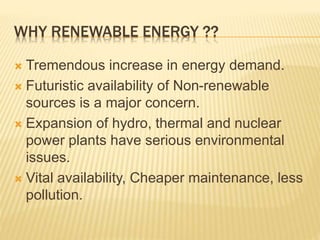
WHY RENEWABLE ENERGY ??
 Tremendous increase in energy demand.
 Futuristic availability of Non-renewable
sources is a major concern.
 Expansion of hydro, thermal and nuclear
power plants have serious environmental
issues.
 Vital availability, Cheaper maintenance, less
pollution.
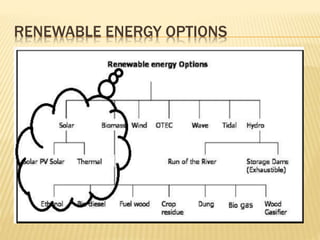
RENEWABLE ENERGY OPTIONS
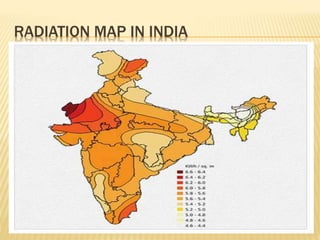
RADIATION MAP IN INDIA
SOLARPOWER
HARNESSING
SUITABILITY OF RAJASTHAN
 Located in the equatorial belt of earth.
 62.11% desert area including Jodhpur,
Jaisalmer, Bikaner, Nagaur, Barmer.
 Equivalent energy potential is about 6,000
million GWh of energy per year.
 Large areas of land are barren and
sparsely populated.
HOW TO
HARNESS ???
TECHNIQUES
 Solar power can be converted into Electrical
and Thermal energy in efficient manner.
 Versatile used techniques
-Photovoltaic (PV): Electricity generation
-CSP system: Thermal power generation.
PHOTOVOLTAIC : ELECTRICITY
 Based on Photoelectric effect .
 Efficiency was limited few years back but
currently more than 40% efficiency is
yielding.
 It is used in Rajasthan and Gujrat to produce
about 1150MW.
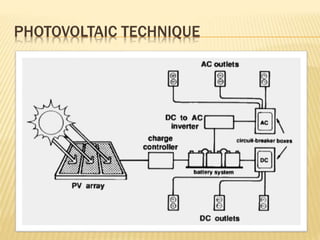
PHOTOVOLTAIC TECHNIQUE
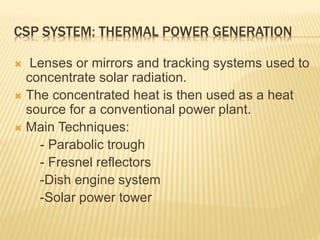
CSP SYSTEM: THERMAL POWER GENERATION
 Lenses or mirrors and tracking systems used to
concentrate solar radiation.
 The concentrated heat is then used as a heat
source for a conventional power plant.
 Main Techniques:
- Parabolic trough
- Fresnel reflectors
-Dish engine system
-Solar power tower
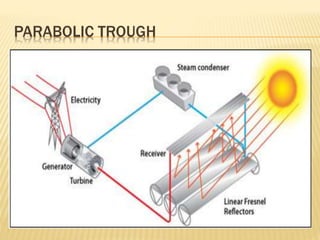
PARABOLIC TROUGH
PRESENT SCENARIO SOLAR
HARNESSING IN RAJASTHAN
JNNSM BIRTH SOLAR SECTOR
 Before 2010 Rajasthan was compelled to
purchase power, power was generated
mainly through conventional sources.
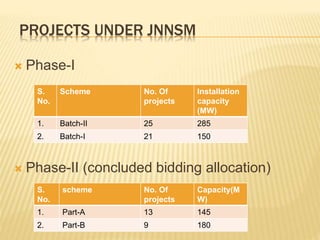
 After JNNSM Rajasthan got 46 projects
(285+150 MW).
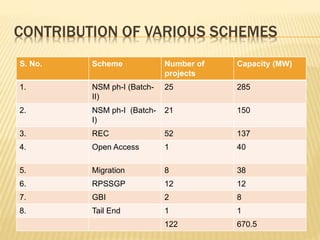
 Some other schemes are also implemented
like REC, Migration.
PROJECTS UNDER JNNSM
 Phase-I
 Phase-II (concluded bidding allocation)
S.
No.
Scheme No. Of
projects
Installation
capacity
(MW)
1. Batch-II 25 285
2. Batch-I 21 150
S.
No.
scheme No. Of
projects
Capacity(M
W)
1. Part-A 13 145
2. Part-B 9 180
CONTRIBUTION OF VARIOUS SCHEMES
S. No. Scheme Number of
projects
Capacity (MW)
1. NSM ph-I (Batch-
II)
25 285
2. NSM ph-I (Batch-
I)
21 150
3. REC 52 137
4. Open Access 1 40
5. Migration 8 38
6. RPSSGP 12 12
7. GBI 2 8
8. Tail End 1 1
122 670.5
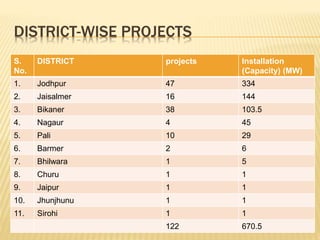
DISTRICT-WISE PROJECTS
S.
No.
DISTRICT projects Installation
(Capacity) (MW)
1. Jodhpur 47 334
2. Jaisalmer 16 144
3. Bikaner 38 103.5
4. Nagaur 4 45
5. Pali 10 29
6. Barmer 2 6
7. Bhilwara 1 5
8. Churu 1 1
9. Jaipur 1 1
10. Jhunjhunu 1 1
11. Sirohi 1 1
122 670.5
DETAILS OF GRID CONNECTED SOLAR POWER
PLANTS
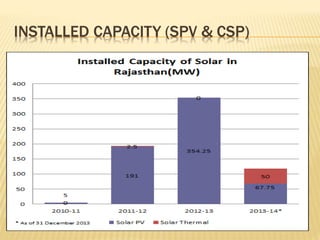
INSTALLED CAPACITY (SPV & CSP)
...
MAJOR PROJECTS
IN THAR
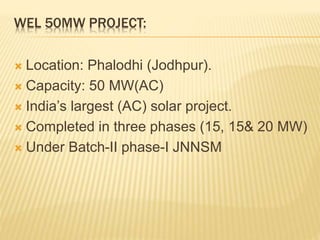
WEL 50MW PROJECT:
 Location: Phalodhi (Jodhpur).
 Capacity: 50 MW(AC)
 India’s largest (AC) solar project.
 Completed in three phases (15, 15& 20 MW)
 Under Batch-II phase-I JNNSM
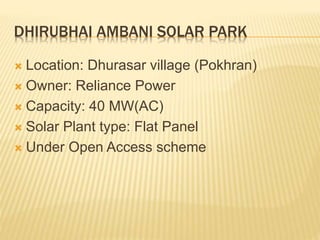
DHIRUBHAI AMBANI SOLAR PARK
 Location: Dhurasar village (Pokhran)
 Owner: Reliance Power
 Capacity: 40 MW(AC)
 Solar Plant type: Flat Panel
 Under Open Access scheme
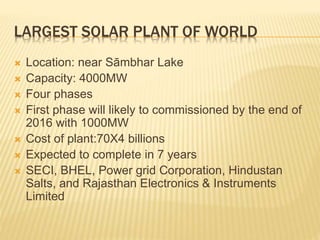
LARGEST SOLAR PLANT OF WORLD
 Location: near Sāmbhar Lake
 Capacity: 4000MW
 Four phases
 First phase will likely to commissioned by the end of
2016 with 1000MW
 Cost of plant:70X4 billions
 Expected to complete in 7 years
 SECI, BHEL, Power grid Corporation, Hindustan
Salts, and Rajasthan Electronics & Instruments
Limited
SOLAR POLICY 2011
 It had a target to allocate 12 GW of solar
power in the state by 2022. As a part of its
first phase, the policy aimed to allocate 50
MW of rooftop Photovoltaic's (PV) of 1 MW
each and 100 MW each of PV
and Concentrated Solar
Project(CSP) projects.
 Productive use of abundant wastelands,
thereby utilizing the non-industrialized desert
area for creation of an industrial hub.
SOLAR POLICY 2011 (COND...)
 Creating favourable conditions to solar
manufacturing capabilities by providing fiscal
incentives.
 Generating large direct and indirect
employment opportunities in solar and allied
industries.
 Create a solar centre of excellence.
APPLICATION OF SOLAR POWER
 Rural electrification
 Agricultural support
 Solar water heaters
CHALLENGES & SOLUTIONS
 Solar Energy possesses tremendous potential in
bridging India’s energy demand-supply gap in the
future.
 There are various challenges for this industry,
including lowering cost of production, increasing
R&D, consumer awareness and financing
infrastructure.
 Cost of solar electricity produced on-grid is Rs.
18.44/unit. This high cost is mainly due to
dependence on imports for silicon and solar wafers
used for the manufacture of solar cells – about 80%
of which comes through imports.
 .
C & S
 It is important to overcome these challenges for
fast growth and mass adoption of the
technology.
 Some of the immediate actions to enable
growth are efficient implementation of REC,
usage of carbon trading as a source of revenue,
immediate implementation of grid powered
energy, development of off-grid usage in various
applications such as cellular towers and
encouraging localized mini grids in areas that
lack connectivity today
HAVE A GOOD DAY !..

Solar power plants in rajasthan

  • 1.
    SOLAR POWER HARNESSING IN RAJASTHAN EnrolmentNo.:12115026(EE) IIT Roorkee (THAR DESERT) Presented by: Ashfaque Khan
  • 2.
    WHY RENEWABLE ENERGY??  Tremendous increase in energy demand.  Futuristic availability of Non-renewable sources is a major concern.  Expansion of hydro, thermal and nuclear power plants have serious environmental issues.  Vital availability, Cheaper maintenance, less pollution.
  • 3.
  • 4.
  • 5.
  • 6.
    SUITABILITY OF RAJASTHAN Located in the equatorial belt of earth.  62.11% desert area including Jodhpur, Jaisalmer, Bikaner, Nagaur, Barmer.  Equivalent energy potential is about 6,000 million GWh of energy per year.  Large areas of land are barren and sparsely populated.
  • 7.
  • 8.
    TECHNIQUES  Solar powercan be converted into Electrical and Thermal energy in efficient manner.  Versatile used techniques -Photovoltaic (PV): Electricity generation -CSP system: Thermal power generation.
  • 9.
    PHOTOVOLTAIC : ELECTRICITY Based on Photoelectric effect .  Efficiency was limited few years back but currently more than 40% efficiency is yielding.  It is used in Rajasthan and Gujrat to produce about 1150MW.
  • 10.
  • 11.
    CSP SYSTEM: THERMALPOWER GENERATION  Lenses or mirrors and tracking systems used to concentrate solar radiation.  The concentrated heat is then used as a heat source for a conventional power plant.  Main Techniques: - Parabolic trough - Fresnel reflectors -Dish engine system -Solar power tower
  • 12.
  • 13.
  • 14.
    JNNSM BIRTH SOLARSECTOR  Before 2010 Rajasthan was compelled to purchase power, power was generated mainly through conventional sources.  After JNNSM Rajasthan got 46 projects (285+150 MW).  Some other schemes are also implemented like REC, Migration.
  • 15.
    PROJECTS UNDER JNNSM Phase-I  Phase-II (concluded bidding allocation) S. No. Scheme No. Of projects Installation capacity (MW) 1. Batch-II 25 285 2. Batch-I 21 150 S. No. scheme No. Of projects Capacity(M W) 1. Part-A 13 145 2. Part-B 9 180
  • 16.
    CONTRIBUTION OF VARIOUSSCHEMES S. No. Scheme Number of projects Capacity (MW) 1. NSM ph-I (Batch- II) 25 285 2. NSM ph-I (Batch- I) 21 150 3. REC 52 137 4. Open Access 1 40 5. Migration 8 38 6. RPSSGP 12 12 7. GBI 2 8 8. Tail End 1 1 122 670.5
  • 17.
    DISTRICT-WISE PROJECTS S. No. DISTRICT projectsInstallation (Capacity) (MW) 1. Jodhpur 47 334 2. Jaisalmer 16 144 3. Bikaner 38 103.5 4. Nagaur 4 45 5. Pali 10 29 6. Barmer 2 6 7. Bhilwara 1 5 8. Churu 1 1 9. Jaipur 1 1 10. Jhunjhunu 1 1 11. Sirohi 1 1 122 670.5
  • 18.
    DETAILS OF GRIDCONNECTED SOLAR POWER PLANTS
  • 19.
  • 20.
  • 21.
    WEL 50MW PROJECT: Location: Phalodhi (Jodhpur).  Capacity: 50 MW(AC)  India’s largest (AC) solar project.  Completed in three phases (15, 15& 20 MW)  Under Batch-II phase-I JNNSM
  • 22.
    DHIRUBHAI AMBANI SOLARPARK  Location: Dhurasar village (Pokhran)  Owner: Reliance Power  Capacity: 40 MW(AC)  Solar Plant type: Flat Panel  Under Open Access scheme
  • 23.
    LARGEST SOLAR PLANTOF WORLD  Location: near Sāmbhar Lake  Capacity: 4000MW  Four phases  First phase will likely to commissioned by the end of 2016 with 1000MW  Cost of plant:70X4 billions  Expected to complete in 7 years  SECI, BHEL, Power grid Corporation, Hindustan Salts, and Rajasthan Electronics & Instruments Limited
  • 24.
    SOLAR POLICY 2011 It had a target to allocate 12 GW of solar power in the state by 2022. As a part of its first phase, the policy aimed to allocate 50 MW of rooftop Photovoltaic's (PV) of 1 MW each and 100 MW each of PV and Concentrated Solar Project(CSP) projects.  Productive use of abundant wastelands, thereby utilizing the non-industrialized desert area for creation of an industrial hub.
  • 25.
    SOLAR POLICY 2011(COND...)  Creating favourable conditions to solar manufacturing capabilities by providing fiscal incentives.  Generating large direct and indirect employment opportunities in solar and allied industries.  Create a solar centre of excellence.
  • 26.
    APPLICATION OF SOLARPOWER  Rural electrification  Agricultural support  Solar water heaters
  • 27.
    CHALLENGES & SOLUTIONS Solar Energy possesses tremendous potential in bridging India’s energy demand-supply gap in the future.  There are various challenges for this industry, including lowering cost of production, increasing R&D, consumer awareness and financing infrastructure.  Cost of solar electricity produced on-grid is Rs. 18.44/unit. This high cost is mainly due to dependence on imports for silicon and solar wafers used for the manufacture of solar cells – about 80% of which comes through imports.  .
  • 28.
    C & S It is important to overcome these challenges for fast growth and mass adoption of the technology.  Some of the immediate actions to enable growth are efficient implementation of REC, usage of carbon trading as a source of revenue, immediate implementation of grid powered energy, development of off-grid usage in various applications such as cellular towers and encouraging localized mini grids in areas that lack connectivity today
  • 29.
    HAVE A GOODDAY !..