Jawaharlal Nehru National Solar
Mission
Ministry of New and Renewable Energy
Government of India
Electronics Manufacturing Conclave
New Delhi
16th January 2013
1
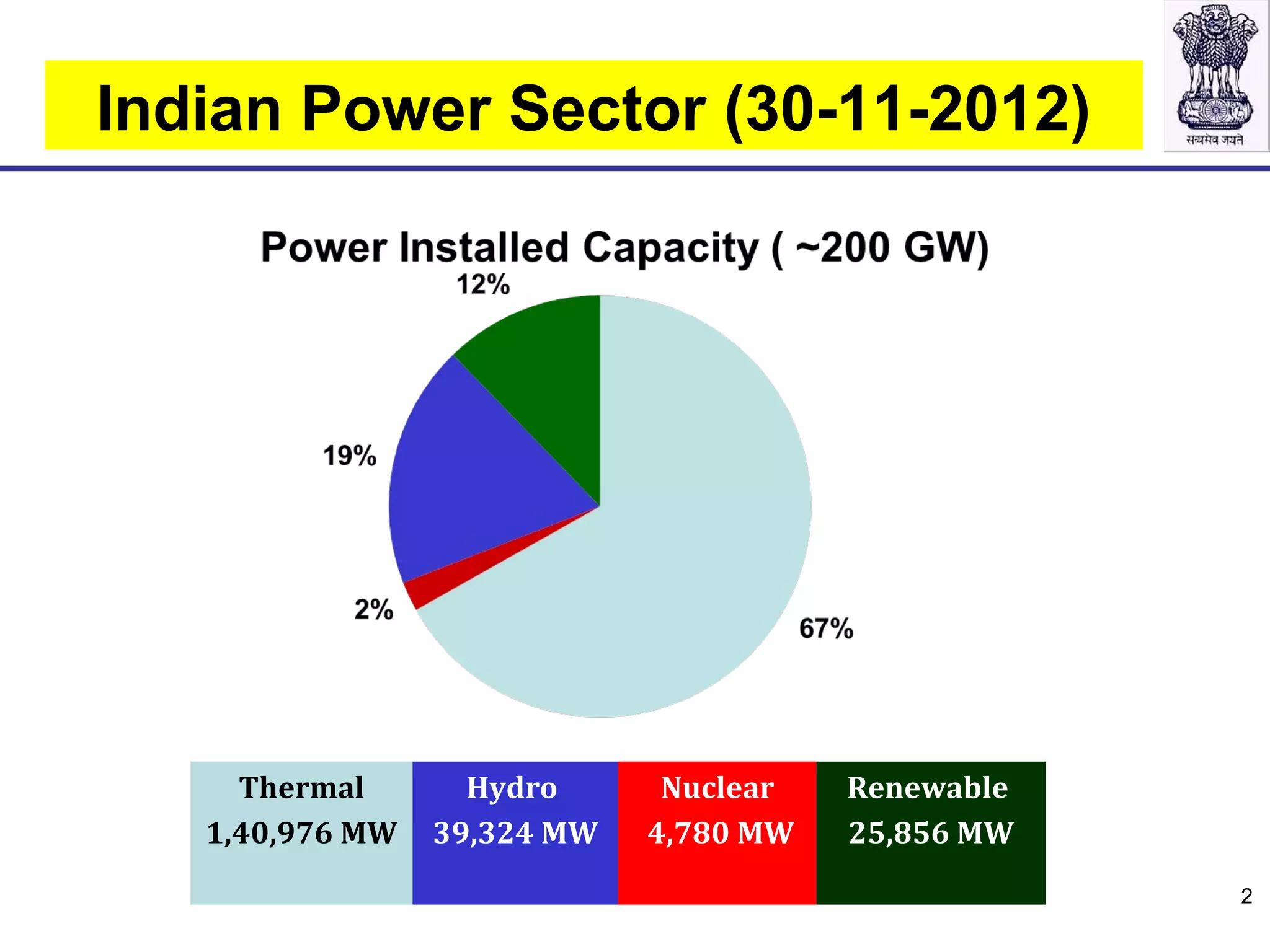
Indian Power Sector (30-11-2012)
Thermal
1,40,976 MW
Hydro
39,324 MW
Nuclear
4,780 MW
Renewable
25,856 MW
2
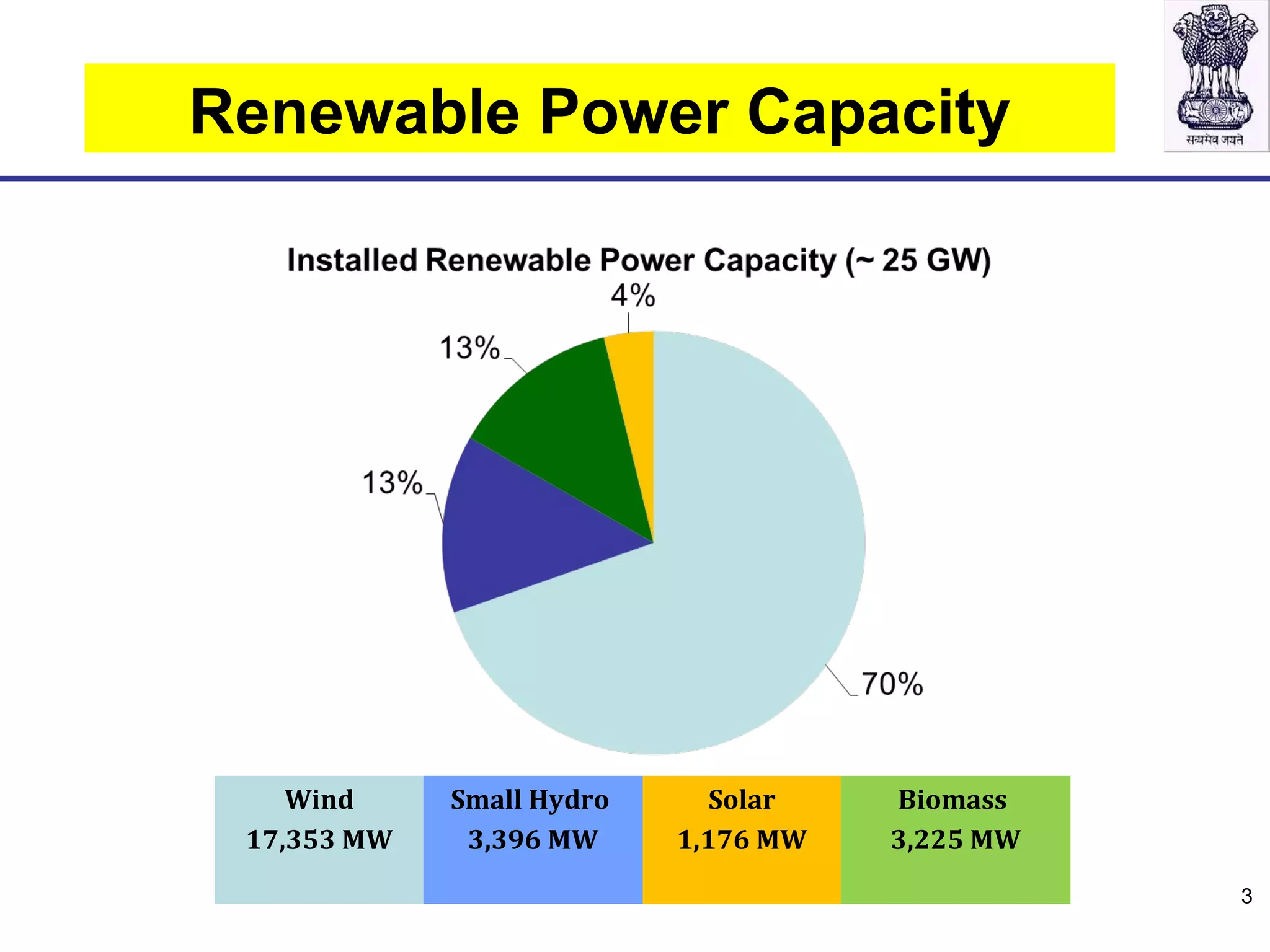
Renewable Power Capacity
Wind
17,353 MW
Small Hydro
3,396 MW
Solar
1,176 MW
Biomass
3,225 MW
3
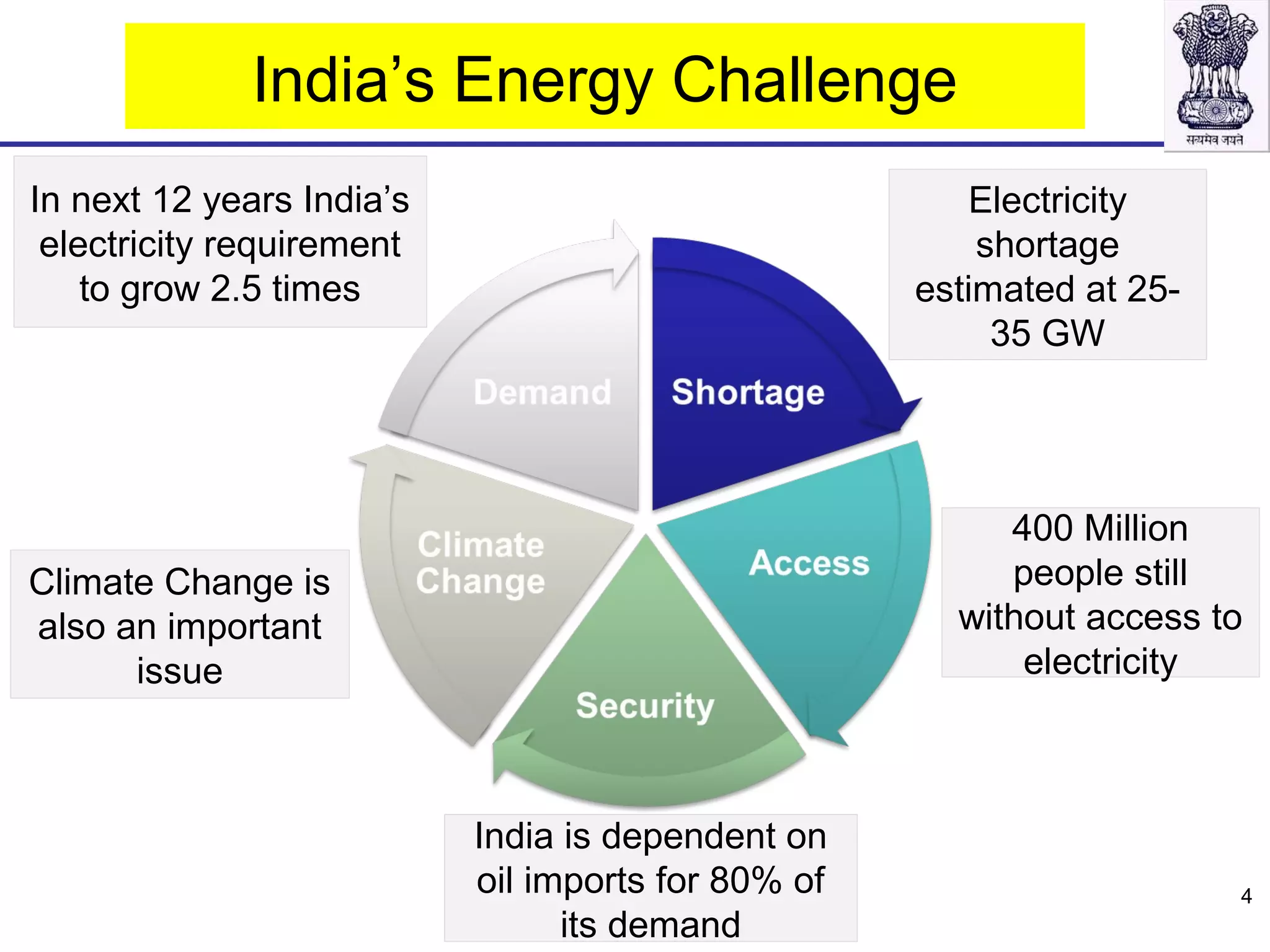
India’s Energy Challenge
In next 12 years India’s
electricity requirement
to grow 2.5 times
Climate Change is
also an important
issue
India is dependent on
oil imports for 80% of
its demand
400 Million
people still
without access to
electricity
Electricity
shortage
estimated at 25-
35 GW
4
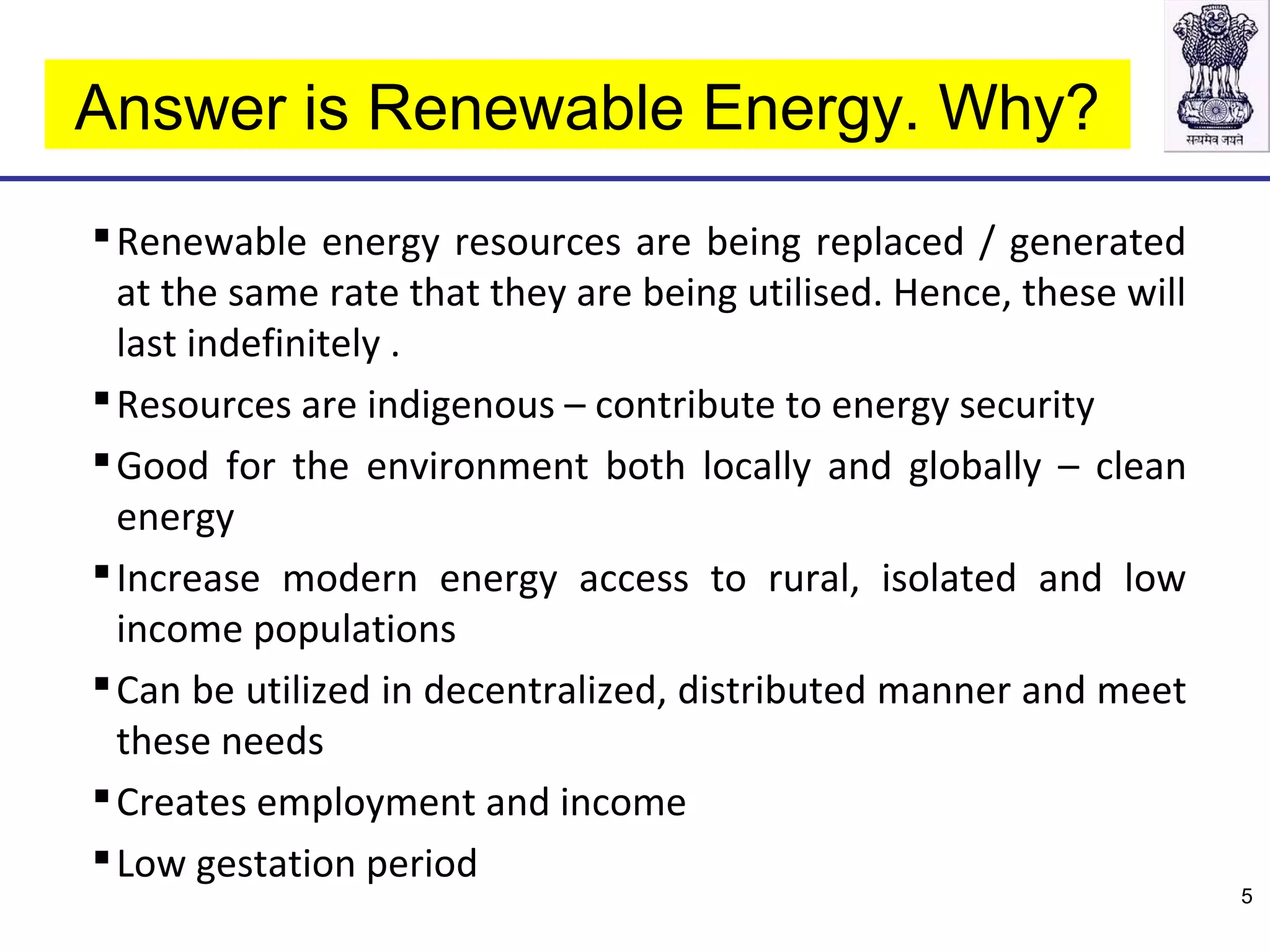
Answer is Renewable Energy. Why?
Renewable energy resources are being replaced / generated
at the same rate that they are being utilised. Hence, these will
last indefinitely .
Resources are indigenous – contribute to energy security
Good for the environment both locally and globally – clean
energy
Increase modern energy access to rural, isolated and low
income populations
Can be utilized in decentralized, distributed manner and meet
these needs
Creates employment and income
Low gestation period
5
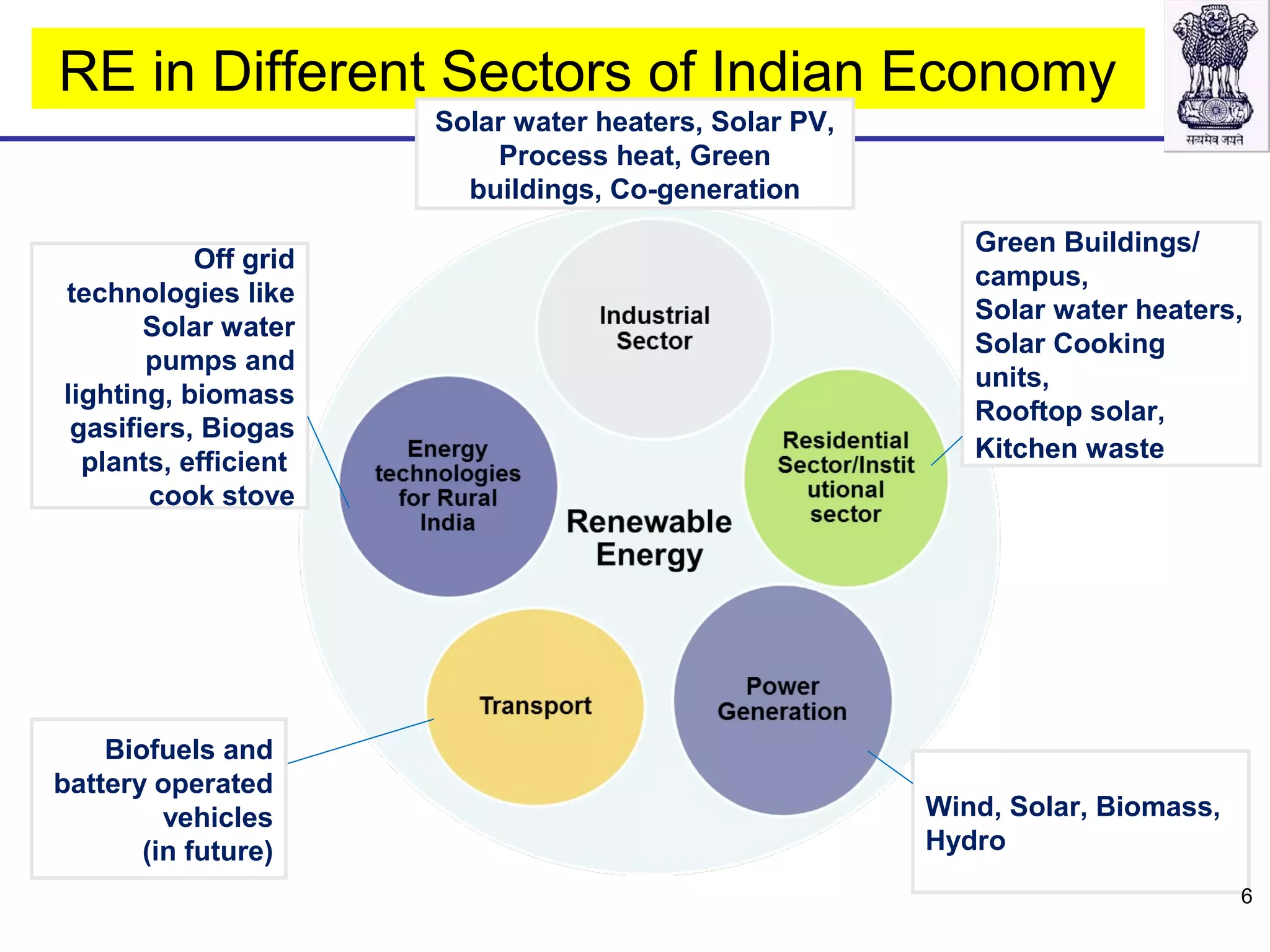
Wind, Solar, Biomass,
Hydro
Green Buildings/
campus,
Solar water heaters,
Solar Cooking
units,
Rooftop solar,
Kitchen waste
Off grid
technologies like
Solar water
pumps and
lighting, biomass
gasifiers, Biogas
plants, efficient
cook stove
Biofuels and
battery operated
vehicles
(in future)
RE in Different Sectors of Indian Economy
Solar water heaters, Solar PV,
Process heat, Green
buildings, Co-generation
6
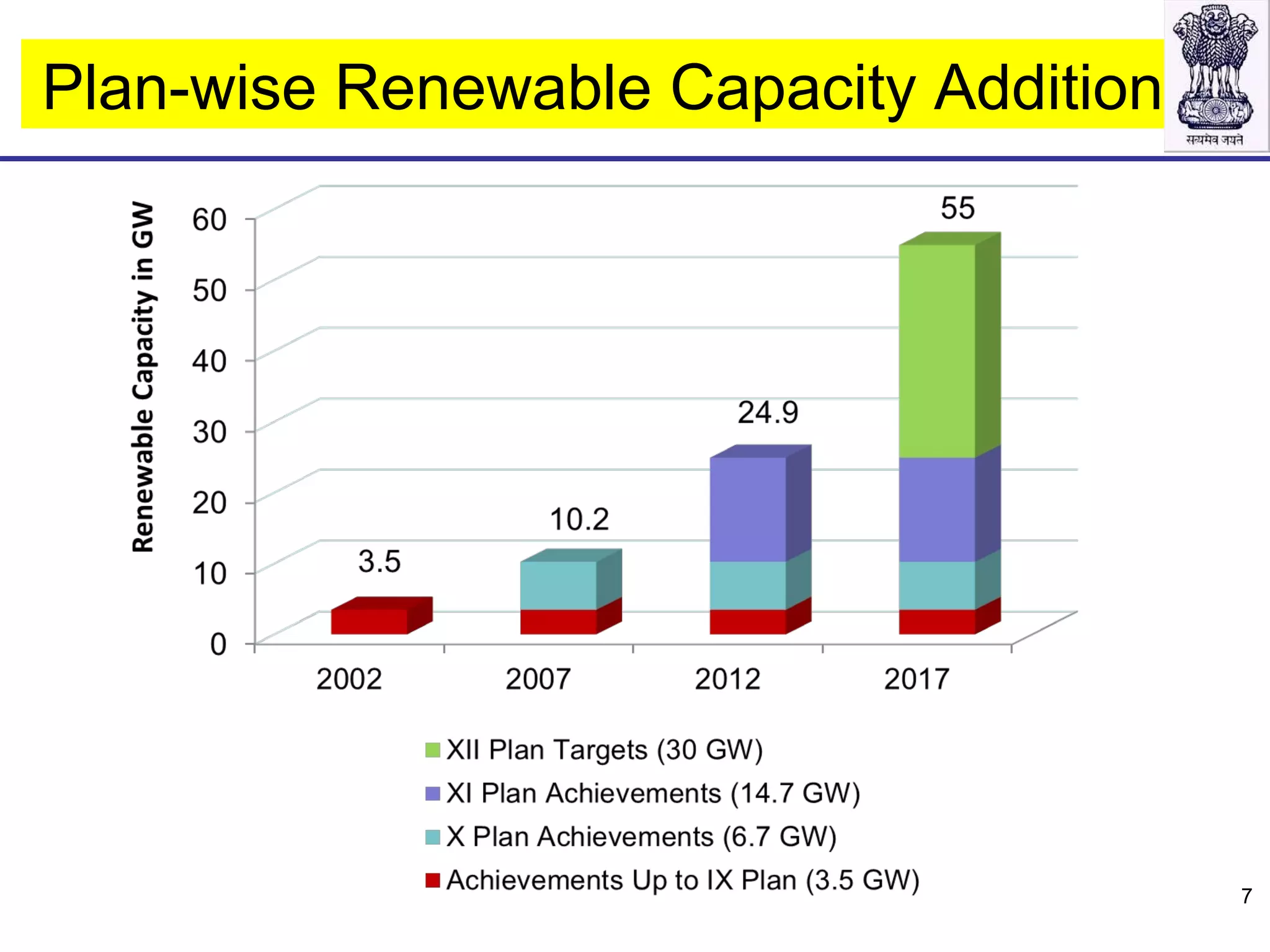
Plan-wise Renewable Capacity Addition
7
8
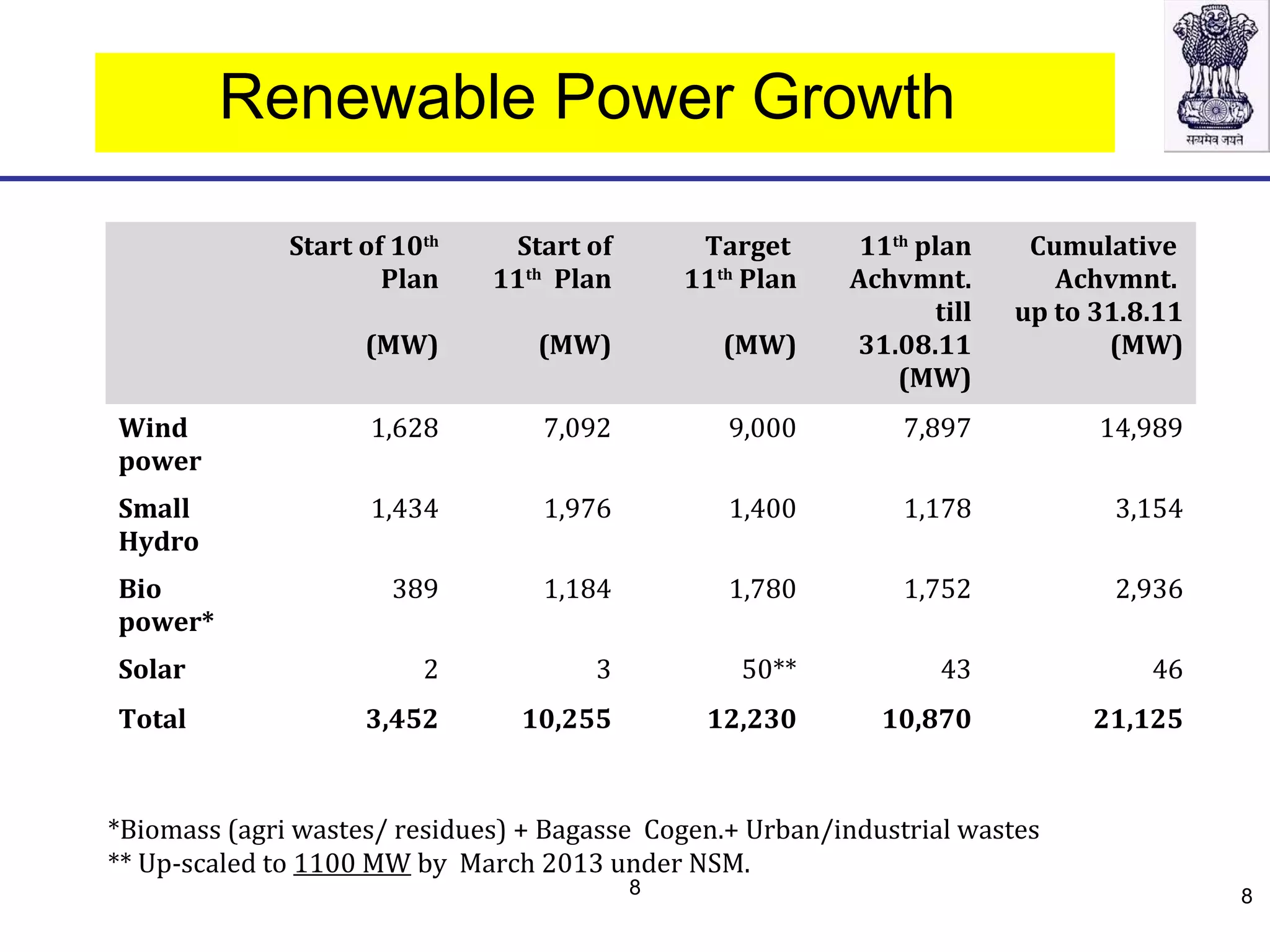
Renewable Power Growth
Start of 10th
Plan
(MW)
Start of
11th
Plan
(MW)
Target
11th
Plan
(MW)
11th
plan
Achvmnt.
till
31.08.11
(MW)
Cumulative
Achvmnt.
up to 31.8.11
(MW)
Wind
power
1,628 7,092 9,000 7,897 14,989
Small
Hydro
1,434 1,976 1,400 1,178 3,154
Bio
power*
389 1,184 1,780 1,752 2,936
Solar 2 3 50** 43 46
Total 3,452 10,255 12,230 10,870 21,125
*Biomass (agri wastes/ residues) + Bagasse Cogen.+ Urban/industrial wastes
** Up-scaled to 1100 MW by March 2013 under NSM.
8
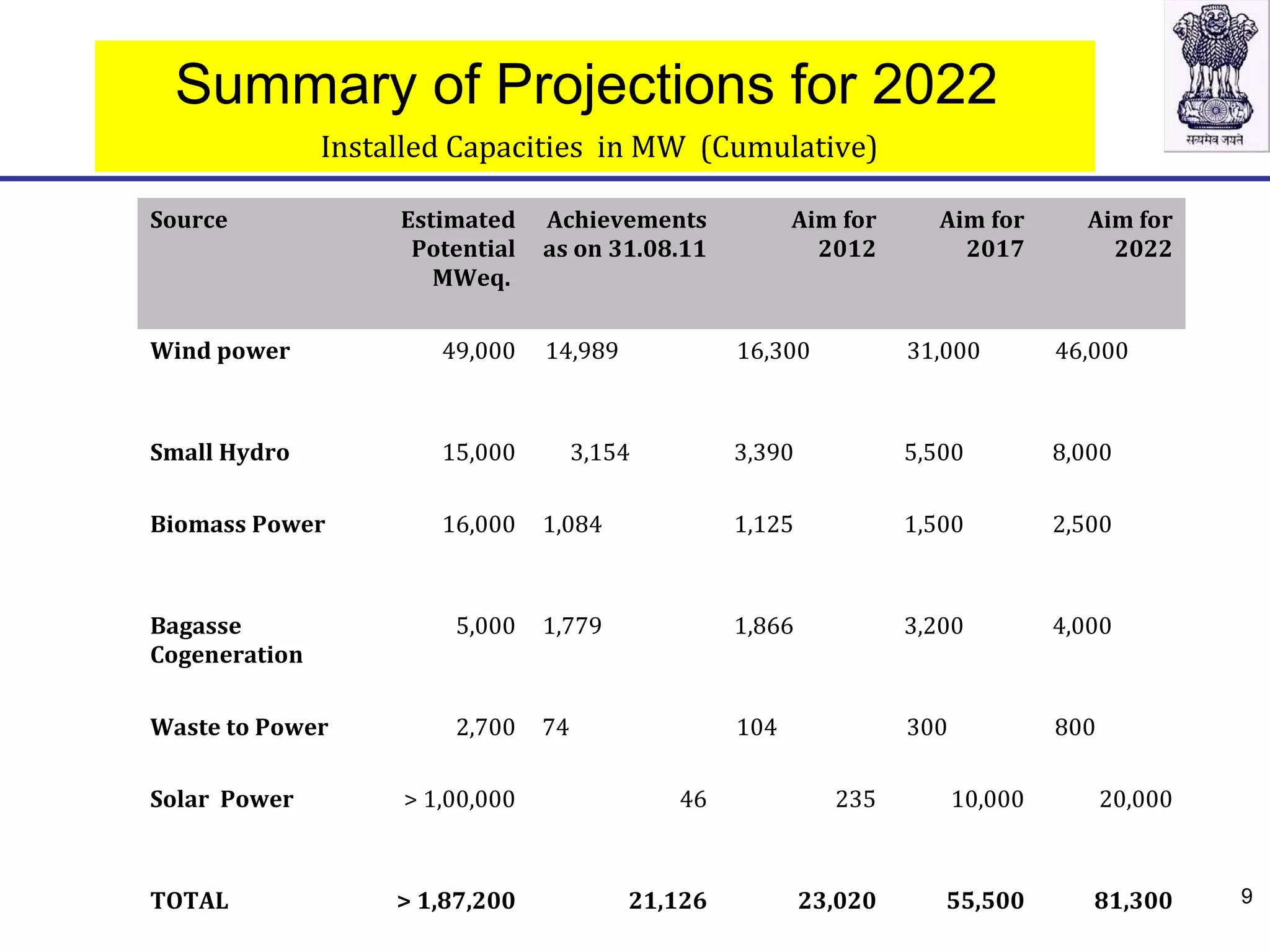
Summary of Projections for 2022
Installed Capacities in MW (Cumulative)
Source Estimated
Potential
MWeq.
Achievements
as on 31.08.11
Aim for
2012
Aim for
2017
Aim for
2022
Wind power 49,000 14,989 16,300 31,000 46,000
Small Hydro 15,000 3,154 3,390 5,500 8,000
Biomass Power 16,000 1,084 1,125 1,500 2,500
Bagasse
Cogeneration
5,000 1,779 1,866 3,200 4,000
Waste to Power 2,700 74 104 300 800
Solar Power > 1,00,000 46 235 10,000 20,000
TOTAL > 1,87,200 21,126 23,020 55,500 81,300 9
10
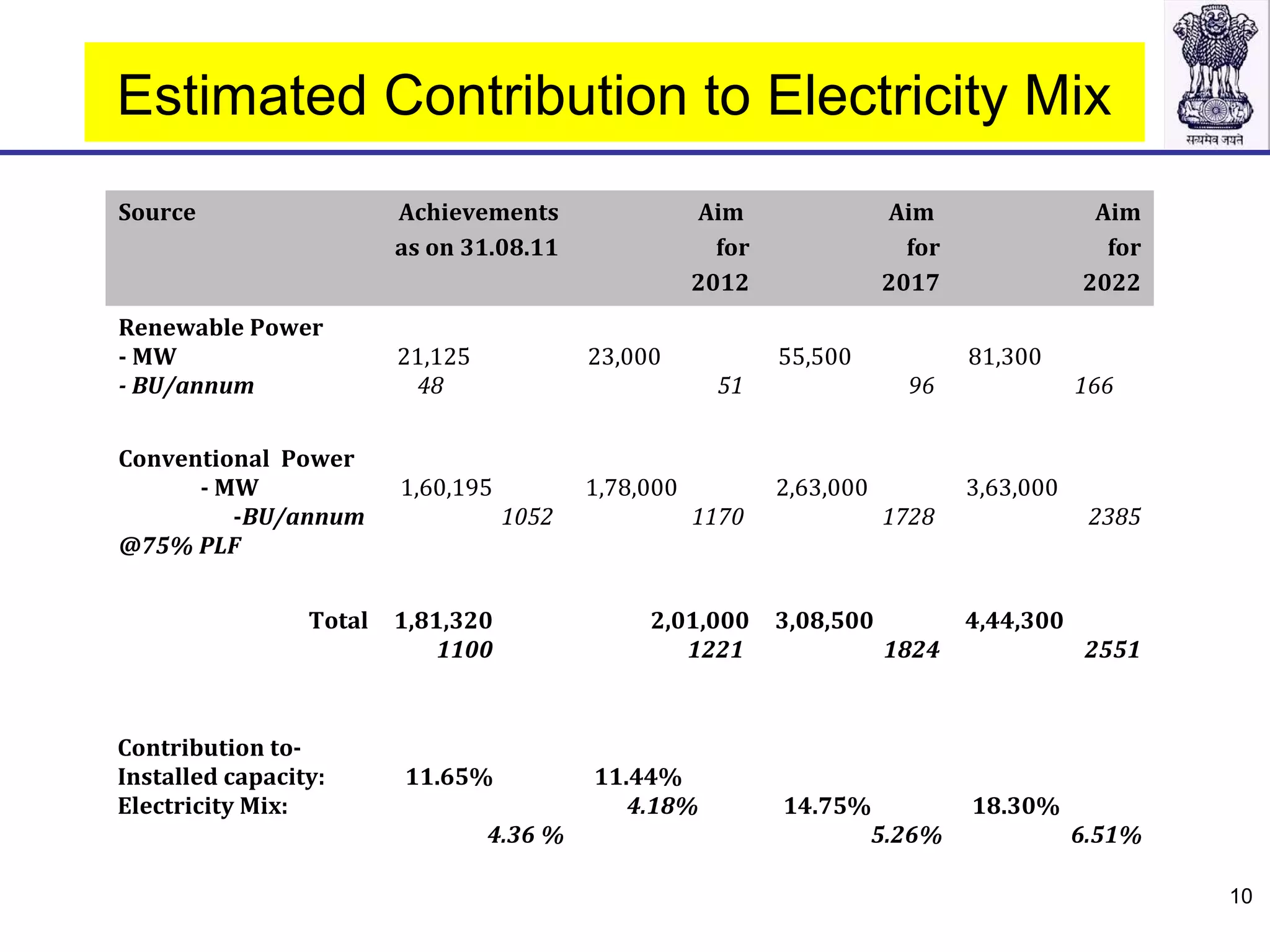
Estimated Contribution to Electricity Mix
Source Achievements
as on 31.08.11
Aim
for
2012
Aim
for
2017
Aim
for
2022
Renewable Power
- MW
- BU/annum
21,125
48
23,000
51
55,500
96
81,300
166
Conventional Power
- MW
-BU/annum
@75% PLF
1,60,195
1052
1,78,000
1170
2,63,000
1728
3,63,000
2385
Total 1,81,320
1100
2,01,000
1221
3,08,500
1824
4,44,300
2551
Contribution to-
Installed capacity:
Electricity Mix:
11.65%
4.36 %
11.44%
4.18% 14.75%
5.26%
18.30%
6.51%
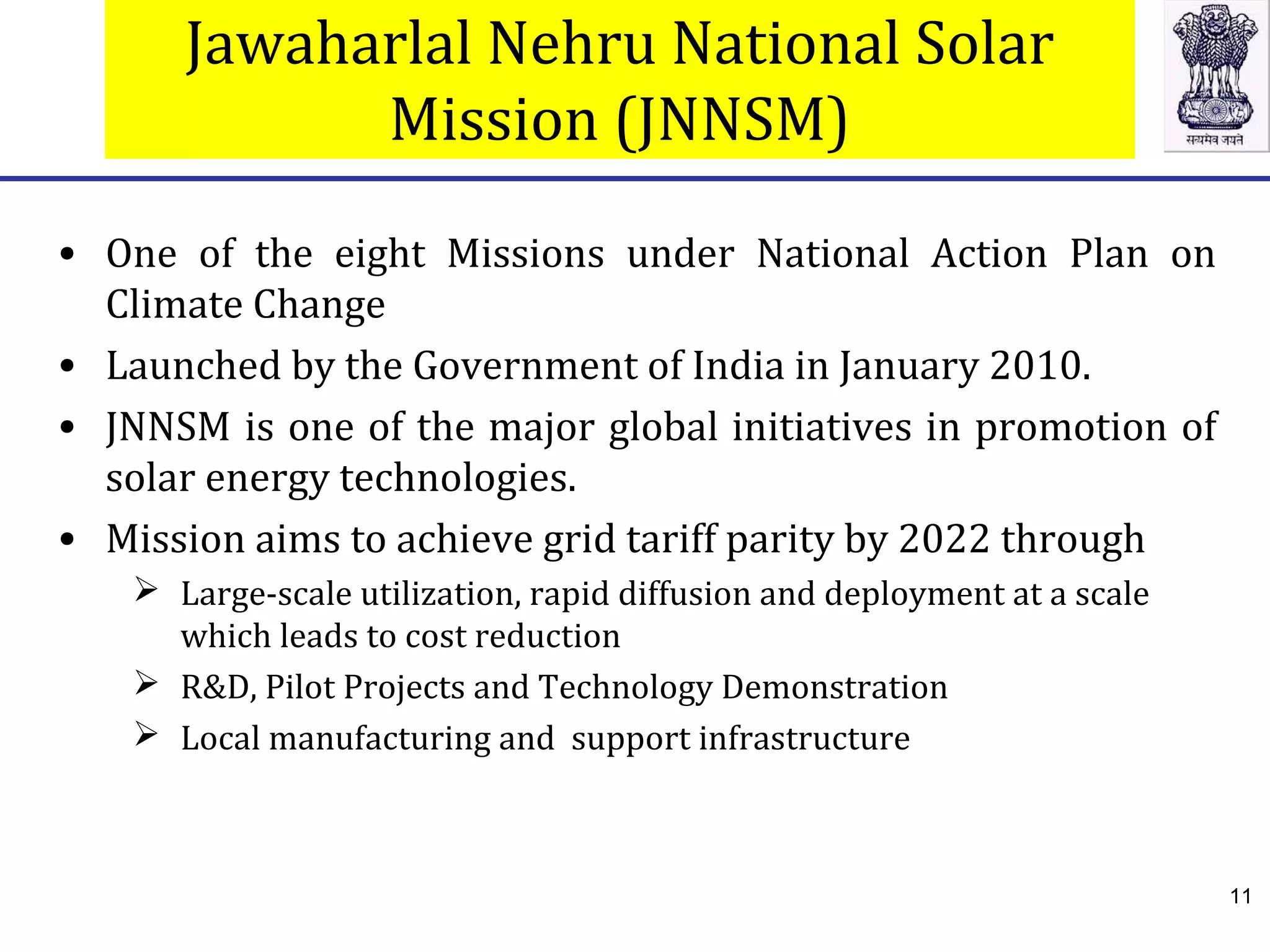
Jawaharlal Nehru National Solar
Mission (JNNSM)
• One of the eight Missions under National Action Plan on
Climate Change
• Launched by the Government of India in January 2010.
• JNNSM is one of the major global initiatives in promotion of
solar energy technologies.
• Mission aims to achieve grid tariff parity by 2022 through
 Large-scale utilization, rapid diffusion and deployment at a scale
which leads to cost reduction
 R&D, Pilot Projects and Technology Demonstration
 Local manufacturing and support infrastructure
11
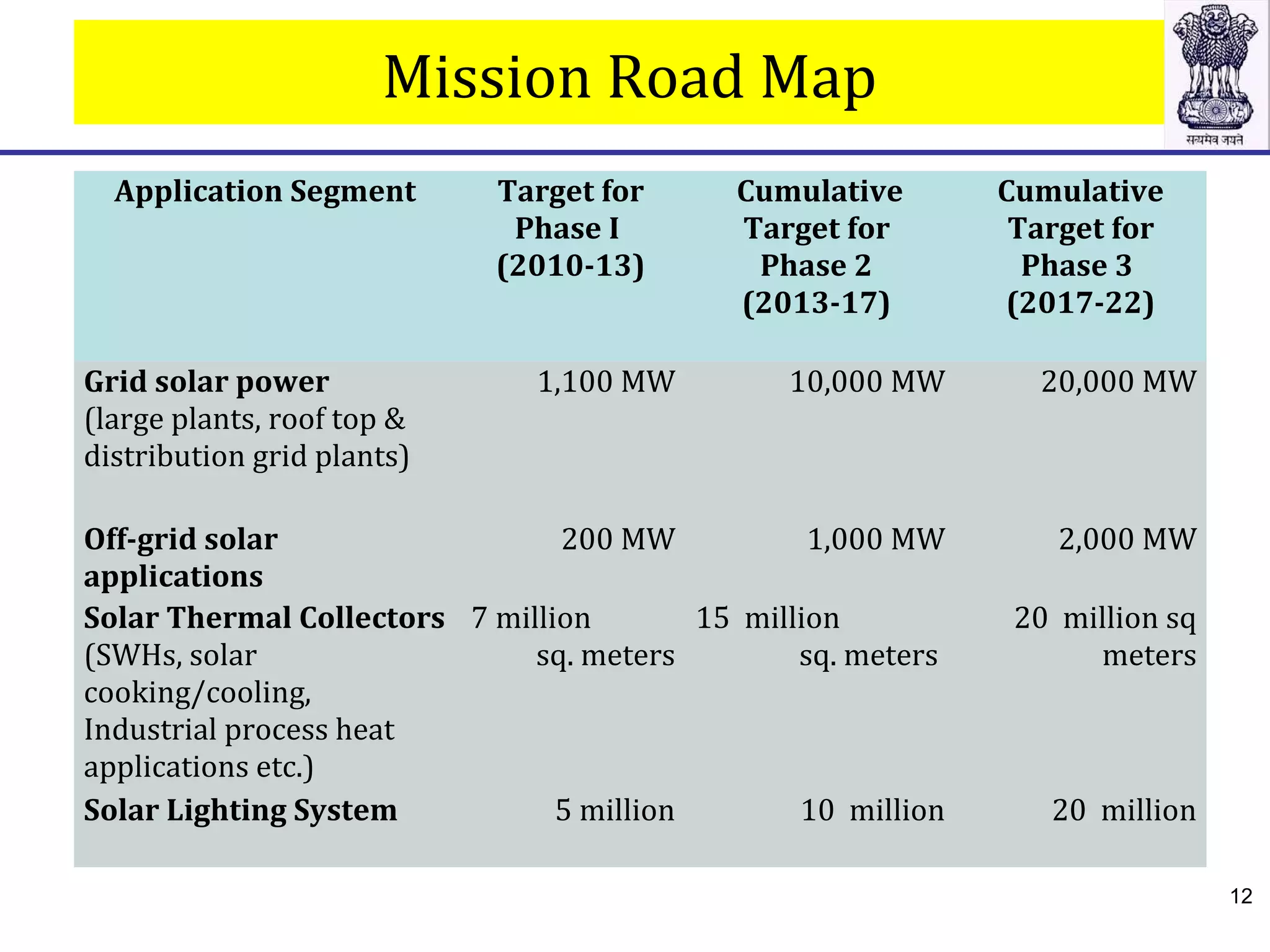
Mission Road Map
Application Segment Target for
Phase I
(2010-13)
Cumulative
Target for
Phase 2
(2013-17)
Cumulative
Target for
Phase 3
(2017-22)
Grid solar power
(large plants, roof top &
distribution grid plants)
1,100 MW 10,000 MW 20,000 MW
Off-grid solar
applications
200 MW 1,000 MW 2,000 MW
Solar Thermal Collectors
(SWHs, solar
cooking/cooling,
Industrial process heat
applications etc.)
7 million
sq. meters
15 million
sq. meters
20 million sq
meters
Solar Lighting System 5 million 10 million 20 million
12
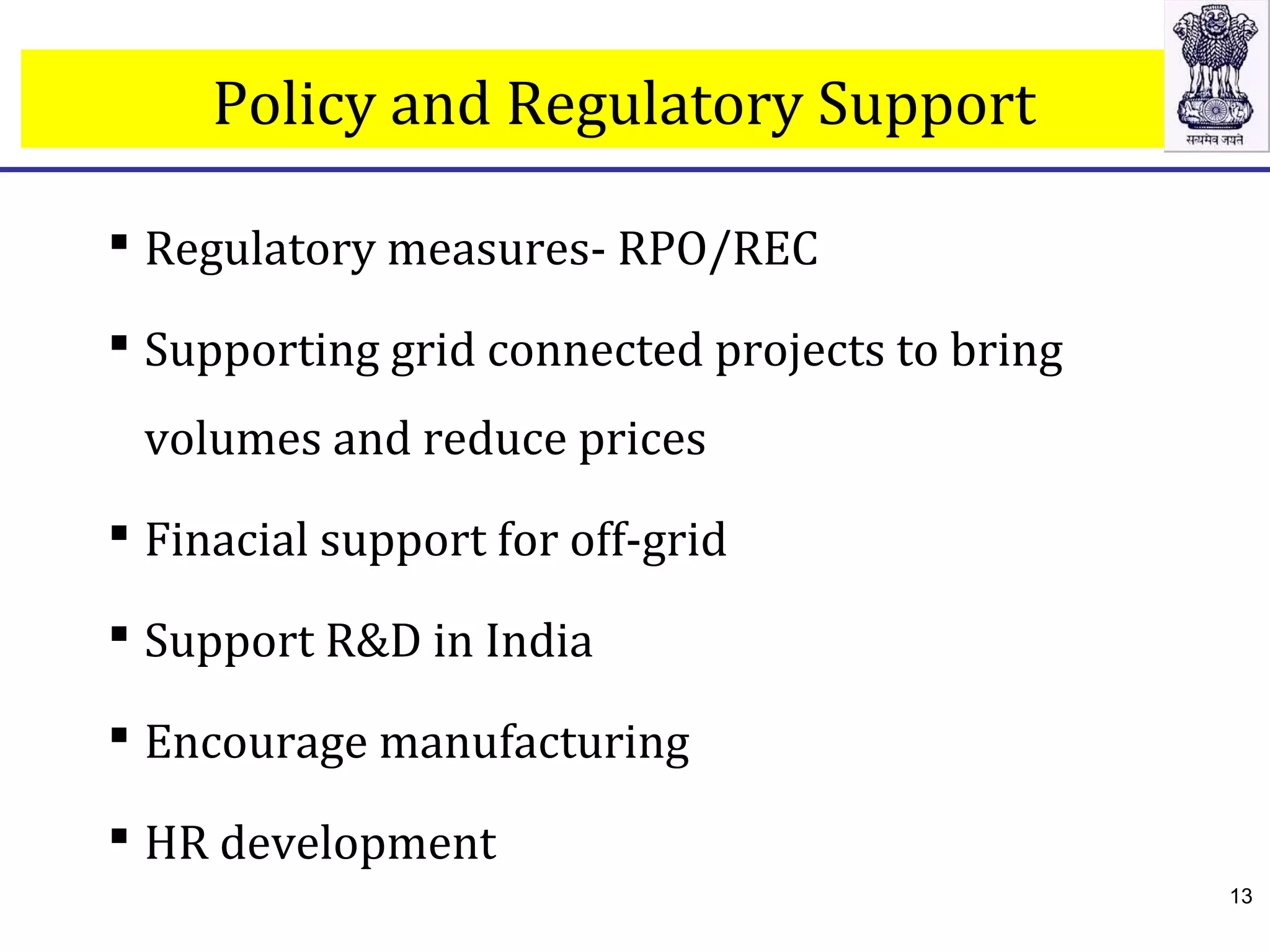
 Regulatory measures- RPO/REC
 Supporting grid connected projects to bring
volumes and reduce prices
 Finacial support for off-grid
 Support R&D in India
 Encourage manufacturing
 HR development
Policy and Regulatory Support
13
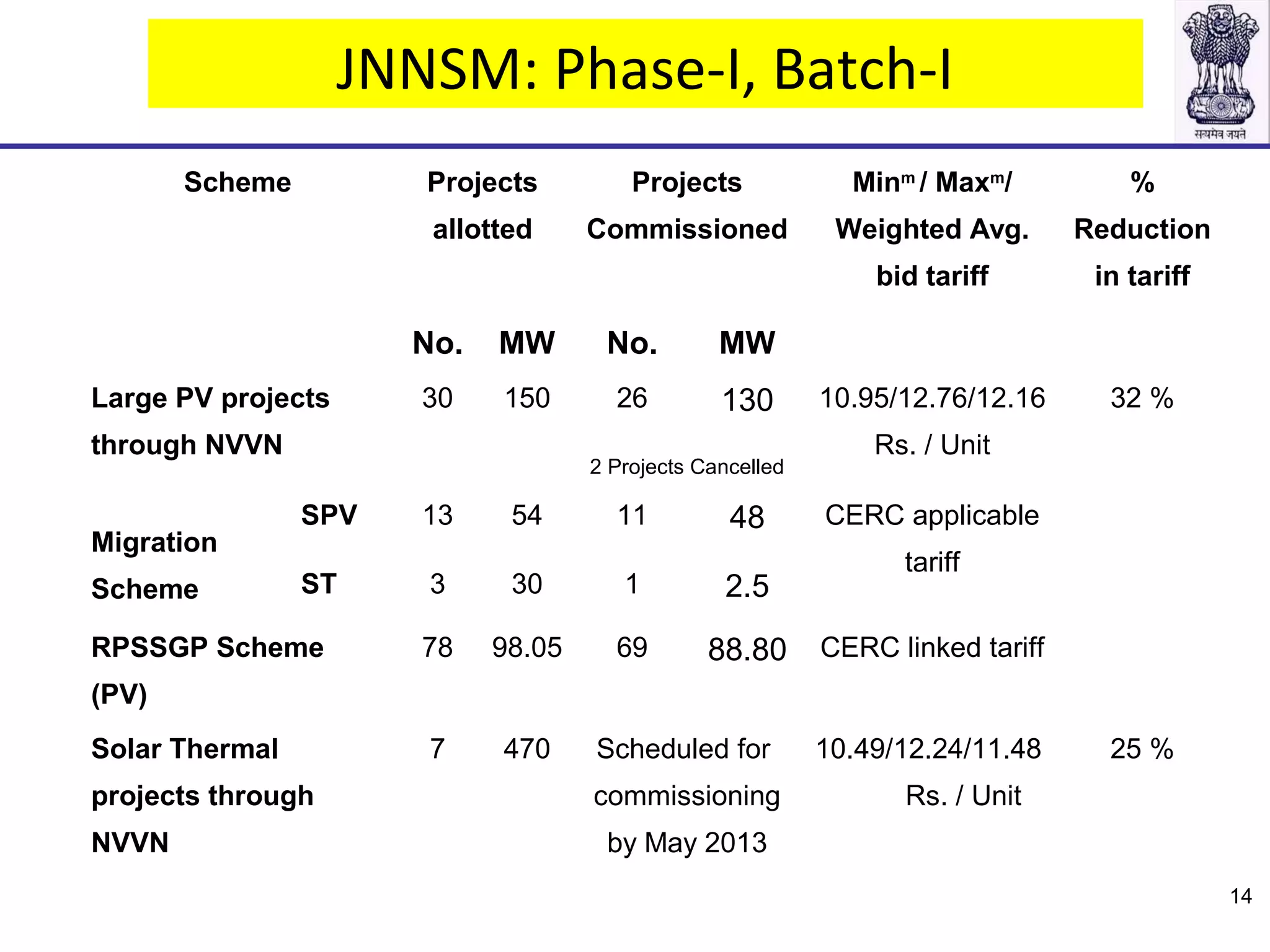
JNNSM: Phase-I, Batch-I
Scheme Projects
allotted
Projects
Commissioned
Minm
/ Maxm
/
Weighted Avg.
bid tariff
%
Reduction
in tariff
No. MW No. MW
Large PV projects
through NVVN
30 150 26 130 10.95/12.76/12.16
Rs. / Unit
32 %
2 Projects Cancelled
Migration
Scheme
SPV 13 54 11 48 CERC applicable
tariff
ST 3 30 1 2.5
RPSSGP Scheme
(PV)
78 98.05 69 88.80 CERC linked tariff
Solar Thermal
projects through
NVVN
7 470 Scheduled for
commissioning
by May 2013
10.49/12.24/11.48
Rs. / Unit
25 %
14
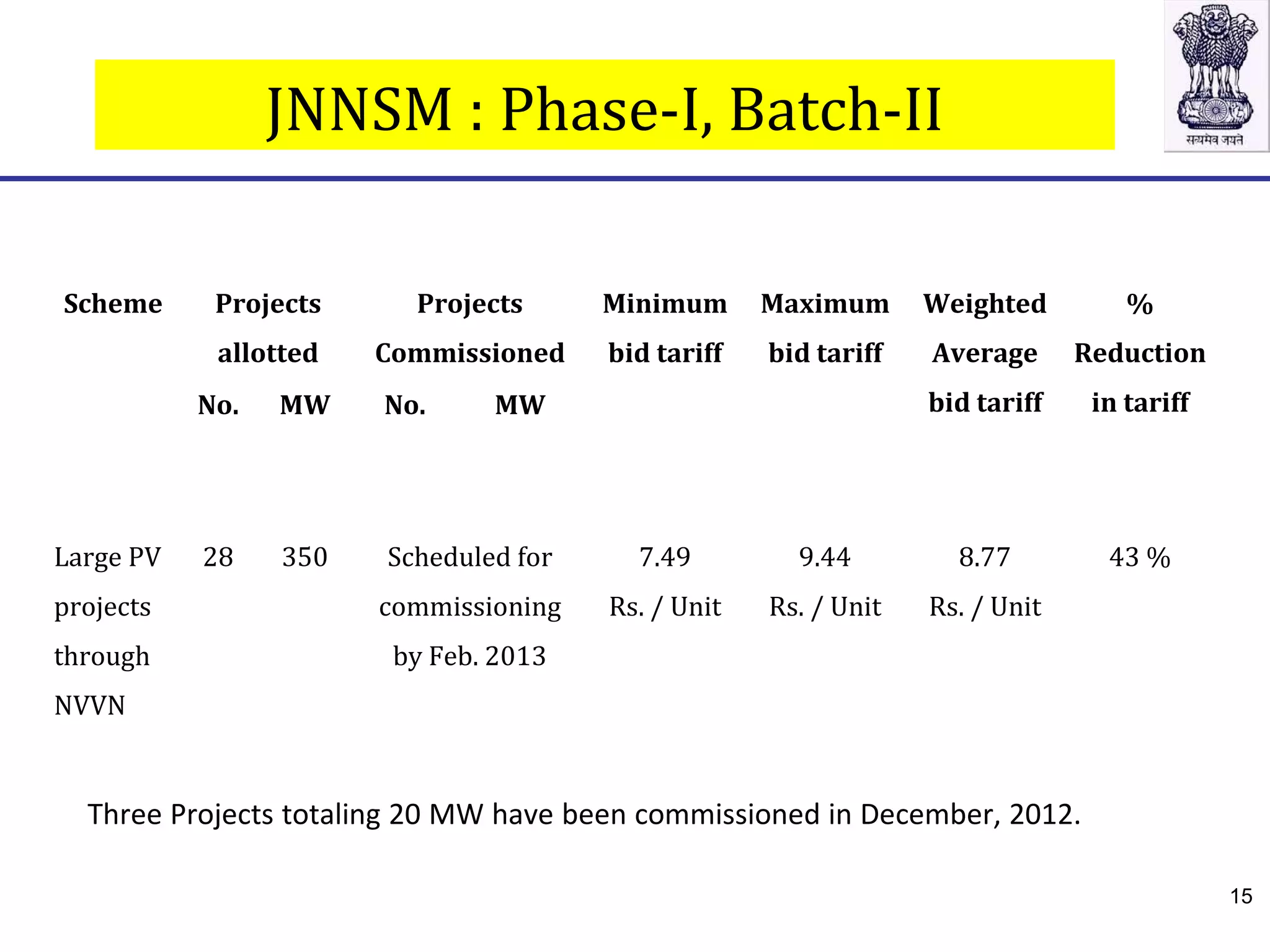
JNNSM : Phase-I, Batch-II
Scheme Projects
allotted
Projects
Commissioned
Minimum
bid tariff
Maximum
bid tariff
Weighted
Average
bid tariff
%
Reduction
in tariffNo. MW No. MW
Large PV
projects
through
NVVN
28 350 Scheduled for
commissioning
by Feb. 2013
7.49
Rs. / Unit
9.44
Rs. / Unit
8.77
Rs. / Unit
43 %
Three Projects totaling 20 MW have been commissioned in December, 2012.
15
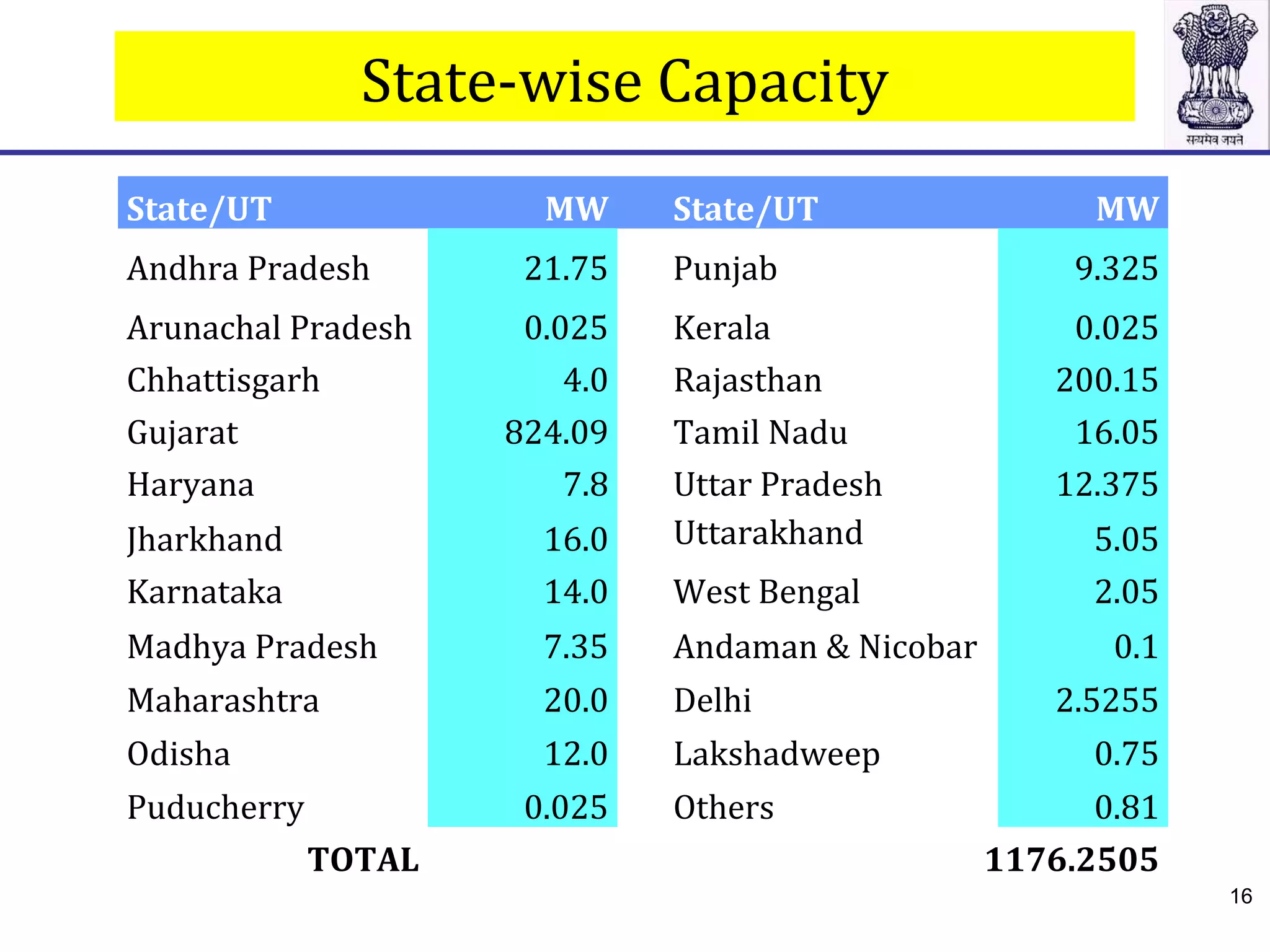
State/UT MW State/UT MW
Andhra Pradesh 21.75 Punjab 9.325
Arunachal Pradesh 0.025 Kerala 0.025
Chhattisgarh 4.0 Rajasthan 200.15
Gujarat 824.09 Tamil Nadu 16.05
Haryana 7.8 Uttar Pradesh 12.375
Jharkhand 16.0 Uttarakhand 5.05
Karnataka 14.0 West Bengal 2.05
Madhya Pradesh 7.35 Andaman & Nicobar 0.1
Maharashtra 20.0 Delhi 2.5255
Odisha 12.0 Lakshadweep 0.75
Puducherry 0.025 Others 0.81
TOTAL 1176.2505
State-wise Capacity
16
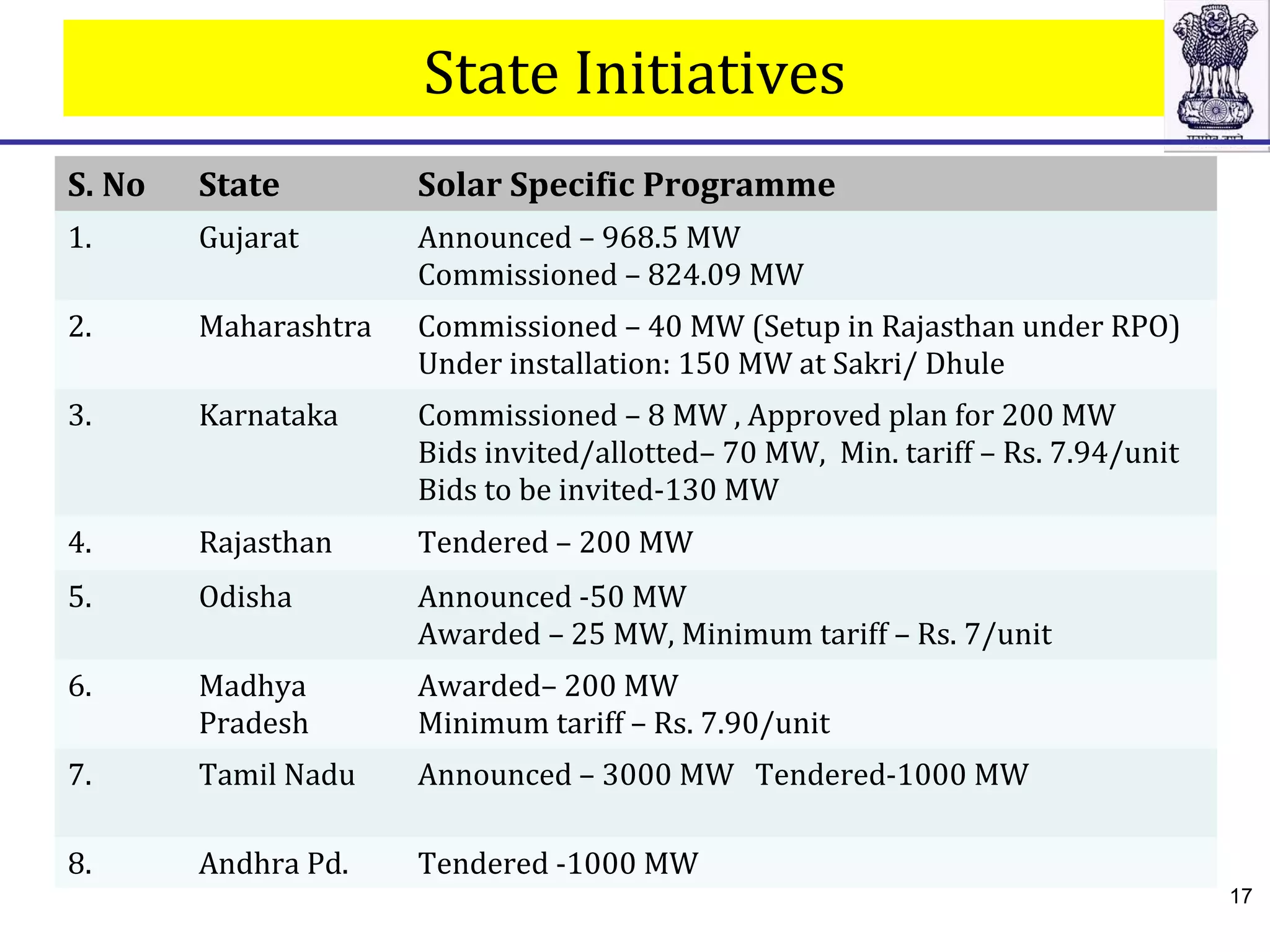
State Initiatives
S. No State Solar Specific Programme
1. Gujarat Announced – 968.5 MW
Commissioned – 824.09 MW
2. Maharashtra Commissioned – 40 MW (Setup in Rajasthan under RPO)
Under installation: 150 MW at Sakri/ Dhule
3. Karnataka Commissioned – 8 MW , Approved plan for 200 MW
Bids invited/allotted– 70 MW, Min. tariff – Rs. 7.94/unit
Bids to be invited-130 MW
4. Rajasthan Tendered – 200 MW
5. Odisha Announced -50 MW
Awarded – 25 MW, Minimum tariff – Rs. 7/unit
6. Madhya
Pradesh
Awarded– 200 MW
Minimum tariff – Rs. 7.90/unit
7. Tamil Nadu Announced – 3000 MW Tendered-1000 MW
8. Andhra Pd. Tendered -1000 MW
17
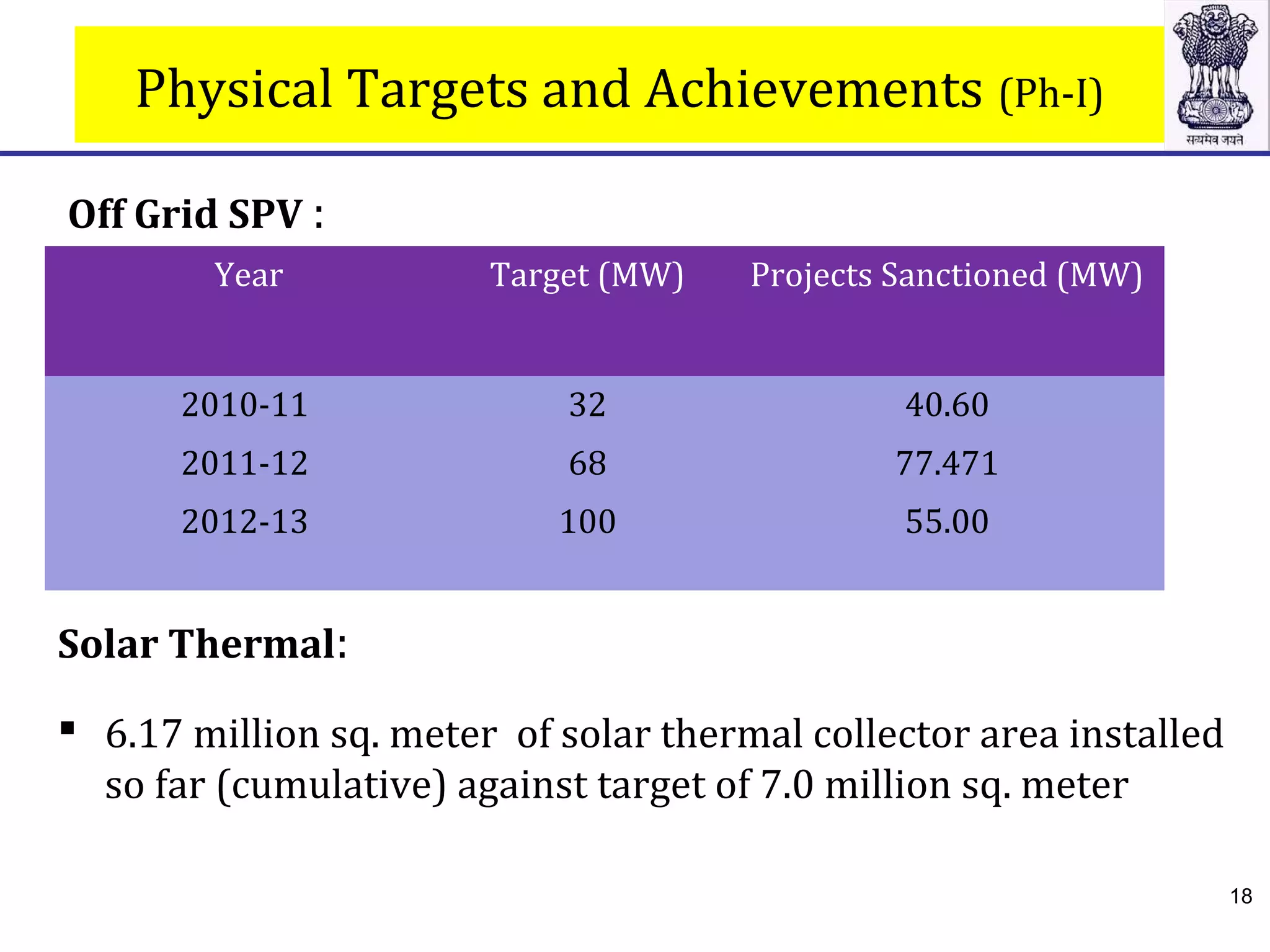
Year Target (MW) Projects Sanctioned (MW)
2010-11 32 40.60
2011-12 68 77.471
2012-13 100 55.00
Physical Targets and Achievements (Ph-I)
Solar Thermal:
 6.17 million sq. meter of solar thermal collector area installed
so far (cumulative) against target of 7.0 million sq. meter
Off Grid SPV :
18
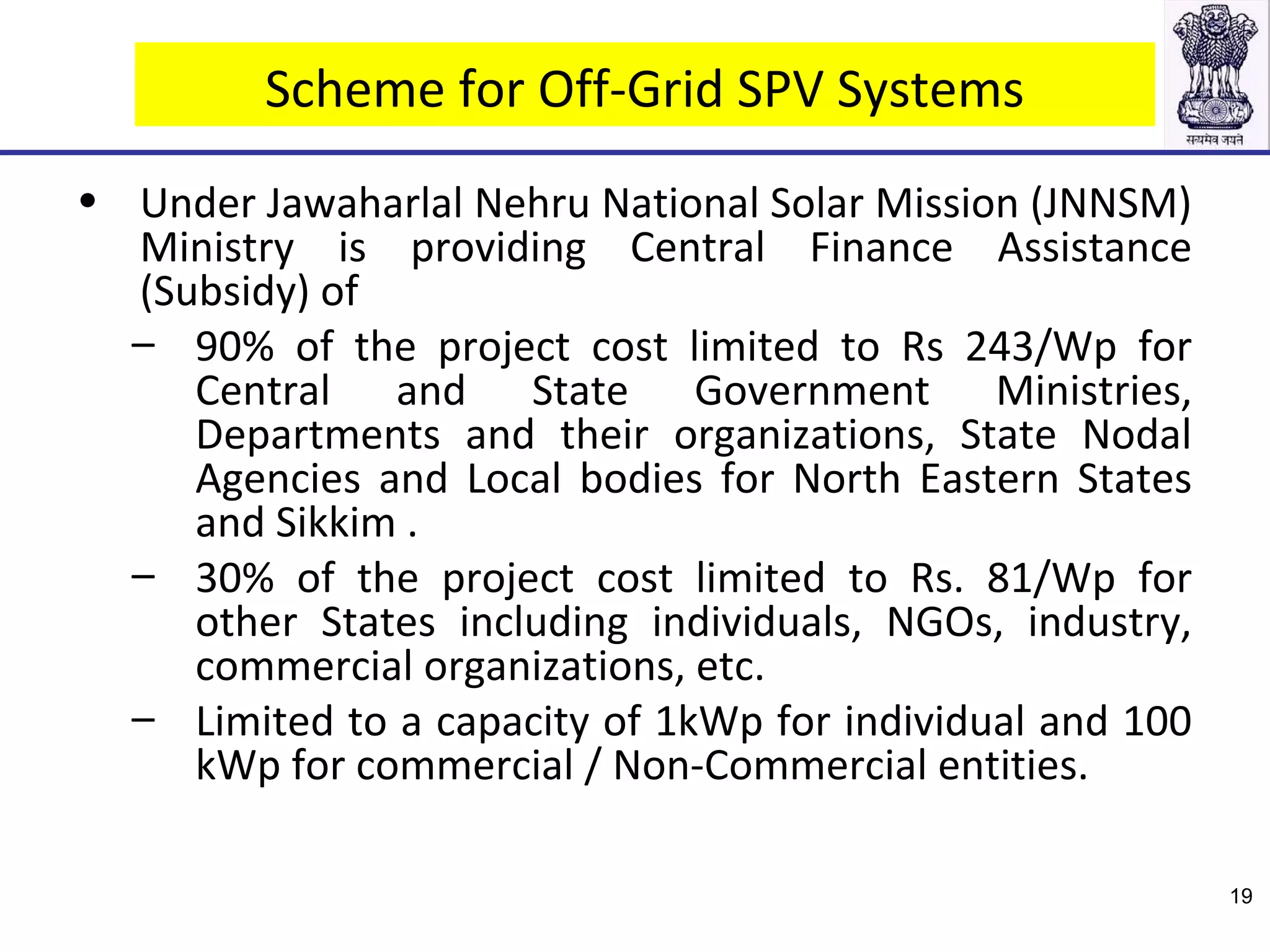
Scheme for Off-Grid SPV Systems
• Under Jawaharlal Nehru National Solar Mission (JNNSM)
Ministry is providing Central Finance Assistance
(Subsidy) of
– 90% of the project cost limited to Rs 243/Wp for
Central and State Government Ministries,
Departments and their organizations, State Nodal
Agencies and Local bodies for North Eastern States
and Sikkim .
– 30% of the project cost limited to Rs. 81/Wp for
other States including individuals, NGOs, industry,
commercial organizations, etc.
– Limited to a capacity of 1kWp for individual and 100
kWp for commercial / Non-Commercial entities.
19
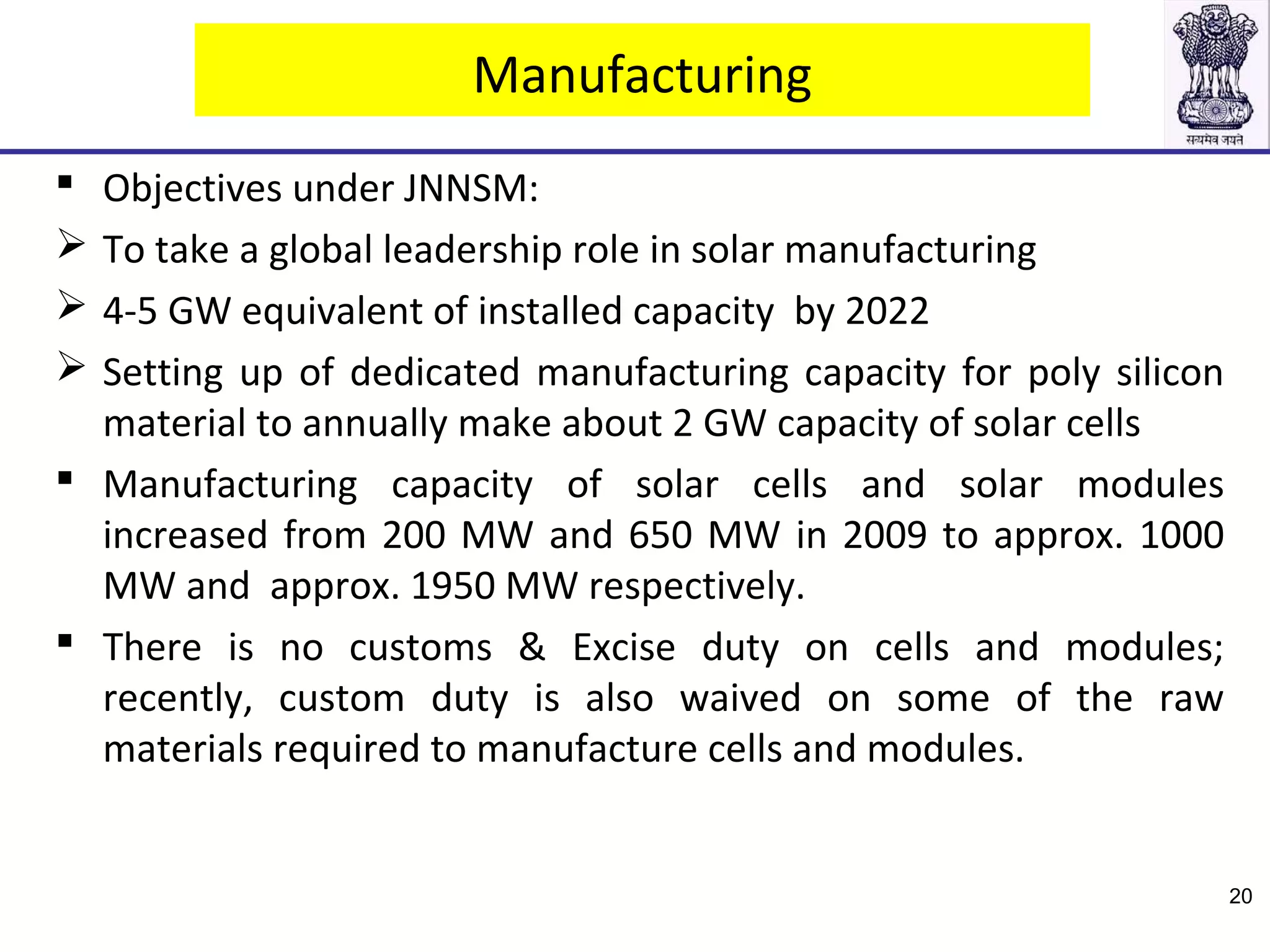
Manufacturing
 Objectives under JNNSM:
 To take a global leadership role in solar manufacturing
 4-5 GW equivalent of installed capacity by 2022
 Setting up of dedicated manufacturing capacity for poly silicon
material to annually make about 2 GW capacity of solar cells
 Manufacturing capacity of solar cells and solar modules
increased from 200 MW and 650 MW in 2009 to approx. 1000
MW and approx. 1950 MW respectively.
 There is no customs & Excise duty on cells and modules;
recently, custom duty is also waived on some of the raw
materials required to manufacture cells and modules.
20
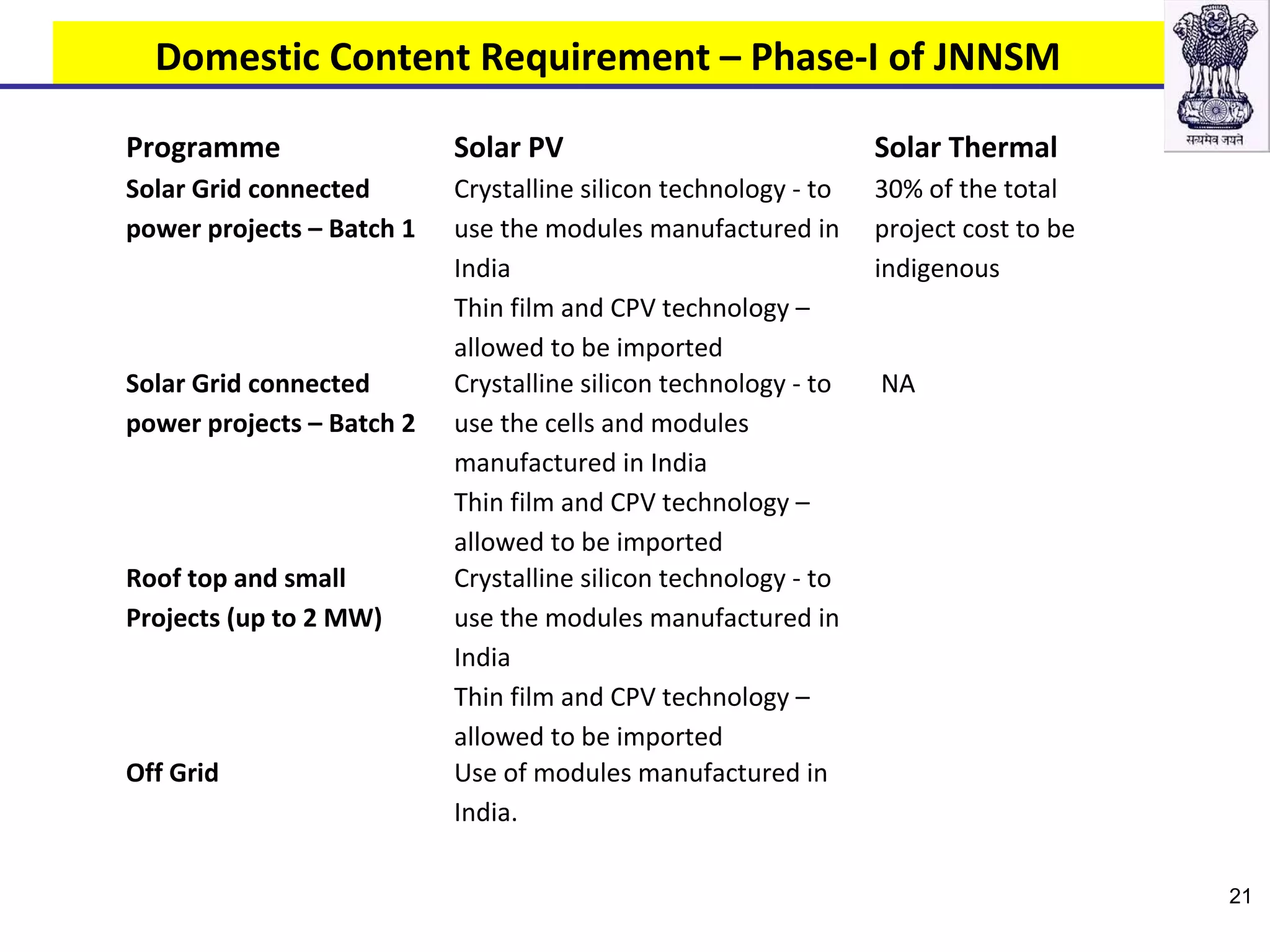
Programme Solar PV Solar Thermal
Solar Grid connected
power projects – Batch 1
Crystalline silicon technology - to
use the modules manufactured in
India
Thin film and CPV technology –
allowed to be imported
30% of the total
project cost to be
indigenous
Solar Grid connected
power projects – Batch 2
Crystalline silicon technology - to
use the cells and modules
manufactured in India
Thin film and CPV technology –
allowed to be imported
NA
Roof top and small
Projects (up to 2 MW)
Crystalline silicon technology - to
use the modules manufactured in
India
Thin film and CPV technology –
allowed to be imported
Off Grid Use of modules manufactured in
India.
Domestic Content Requirement – Phase-I of JNNSM
21
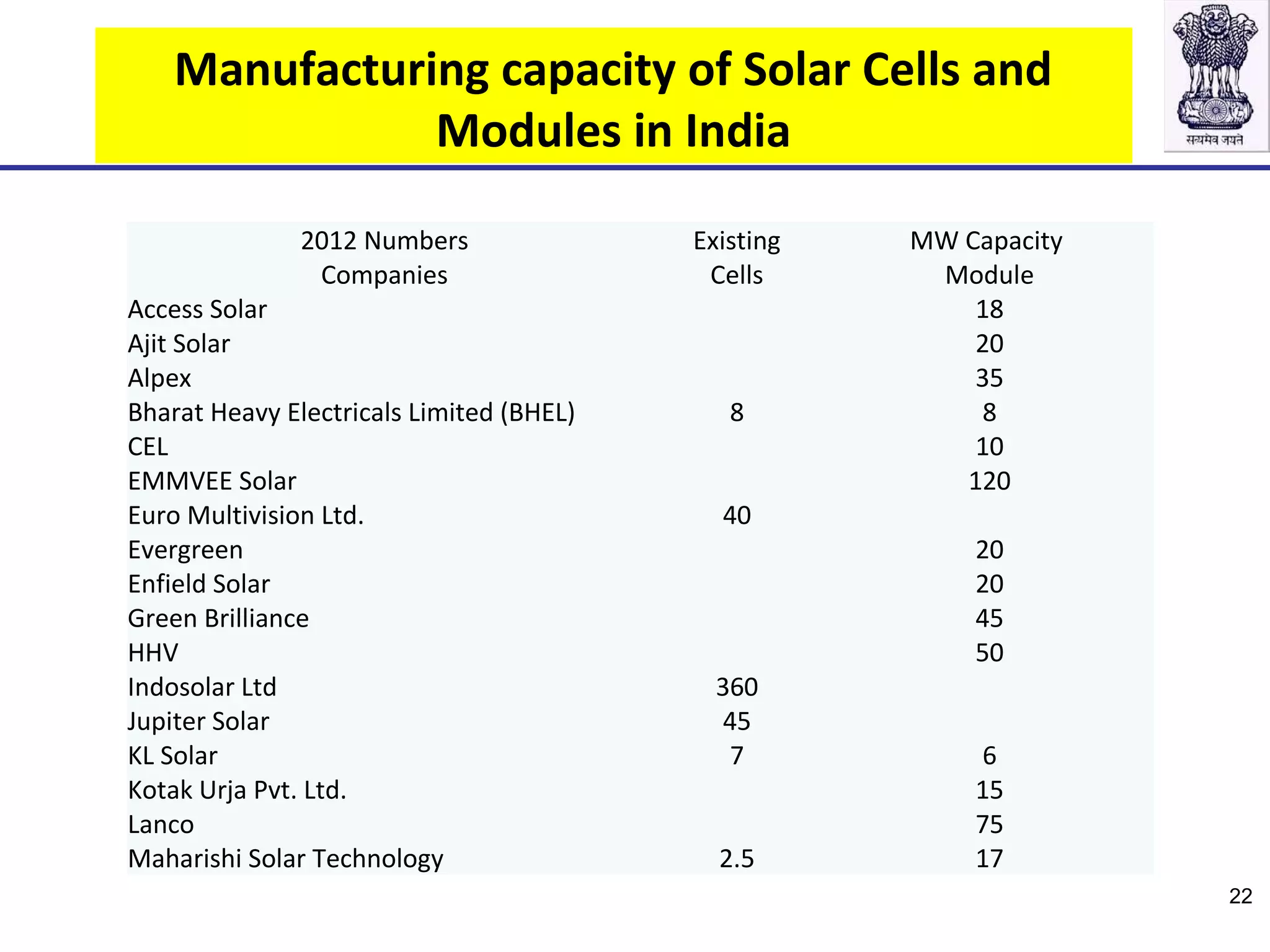
Manufacturing capacity of Solar Cells and
Modules in India
2012 Numbers Existing MW Capacity
Companies Cells Module
Access Solar 18
Ajit Solar 20
Alpex 35
Bharat Heavy Electricals Limited (BHEL) 8 8
CEL 10
EMMVEE Solar 120
Euro Multivision Ltd. 40
Evergreen 20
Enfield Solar 20
Green Brilliance 45
HHV 50
Indosolar Ltd 360
Jupiter Solar 45
KL Solar 7 6
Kotak Urja Pvt. Ltd. 15
Lanco 75
Maharishi Solar Technology 2.5 17
22
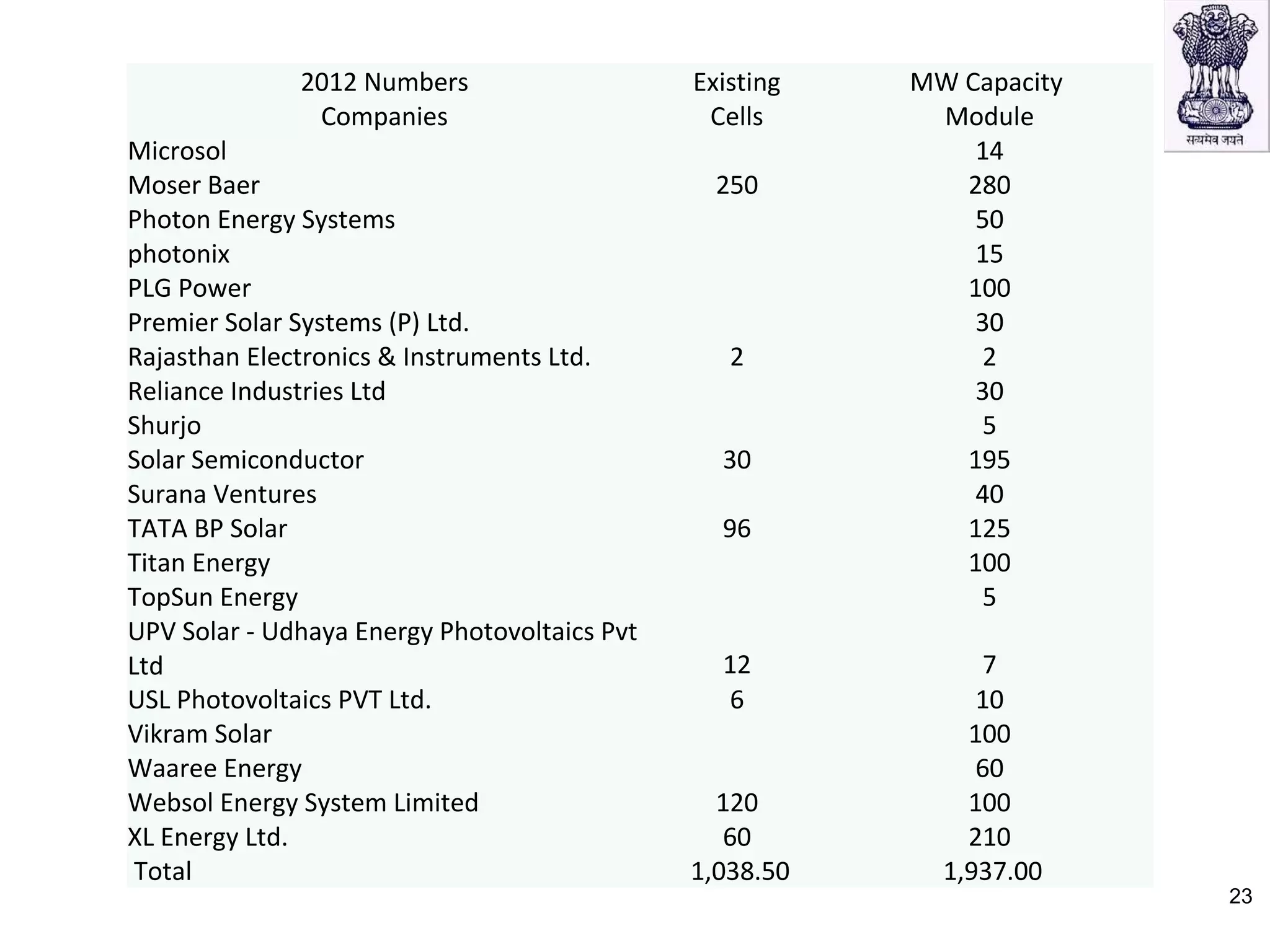
2012 Numbers Existing MW Capacity
Companies Cells Module
Microsol 14
Moser Baer 250 280
Photon Energy Systems 50
photonix 15
PLG Power 100
Premier Solar Systems (P) Ltd. 30
Rajasthan Electronics & Instruments Ltd. 2 2
Reliance Industries Ltd 30
Shurjo 5
Solar Semiconductor 30 195
Surana Ventures 40
TATA BP Solar 96 125
Titan Energy 100
TopSun Energy 5
UPV Solar - Udhaya Energy Photovoltaics Pvt
Ltd 12 7
USL Photovoltaics PVT Ltd. 6 10
Vikram Solar 100
Waaree Energy 60
Websol Energy System Limited 120 100
XL Energy Ltd. 60 210
Total 1,038.50 1,937.00
23
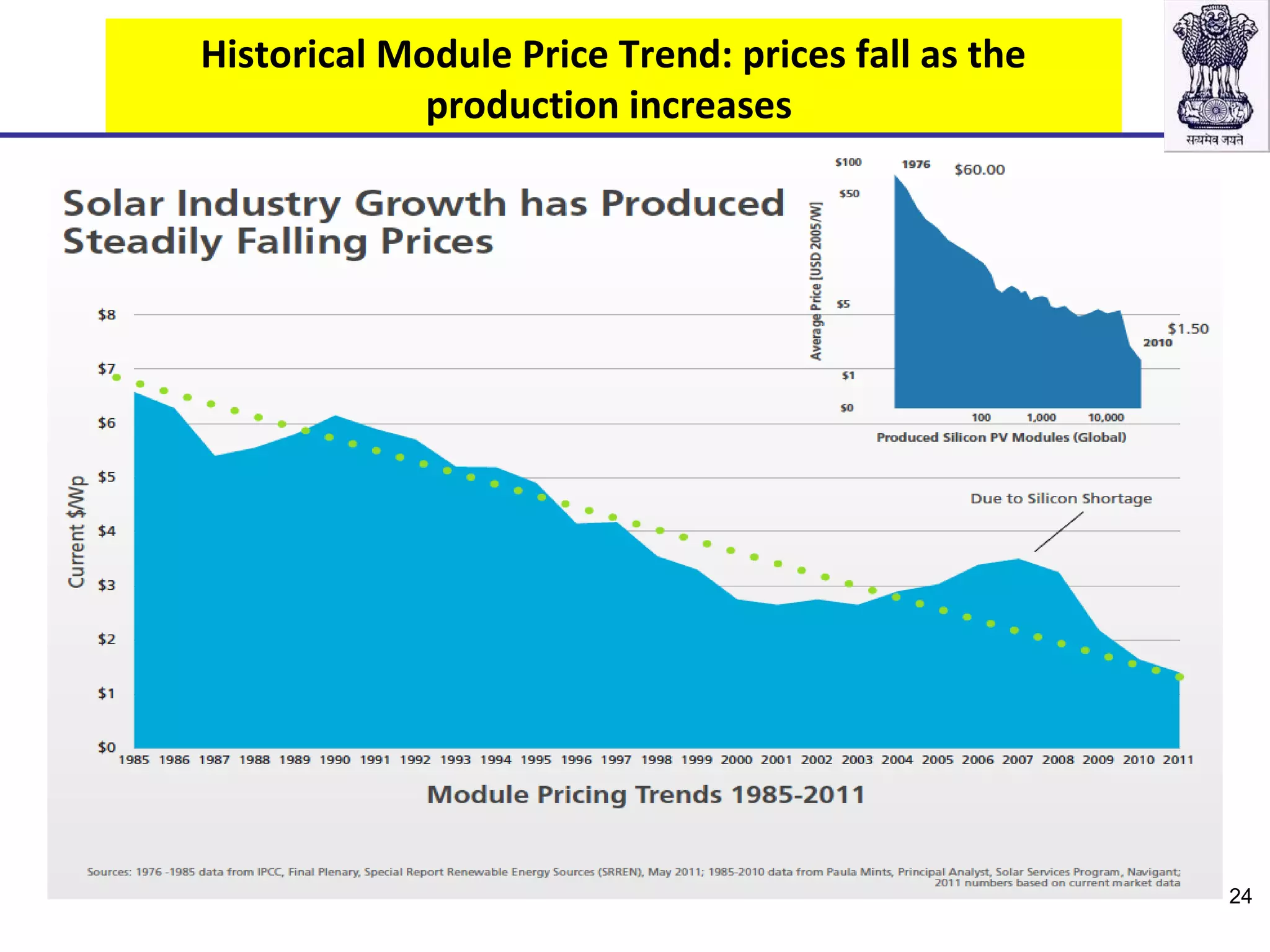
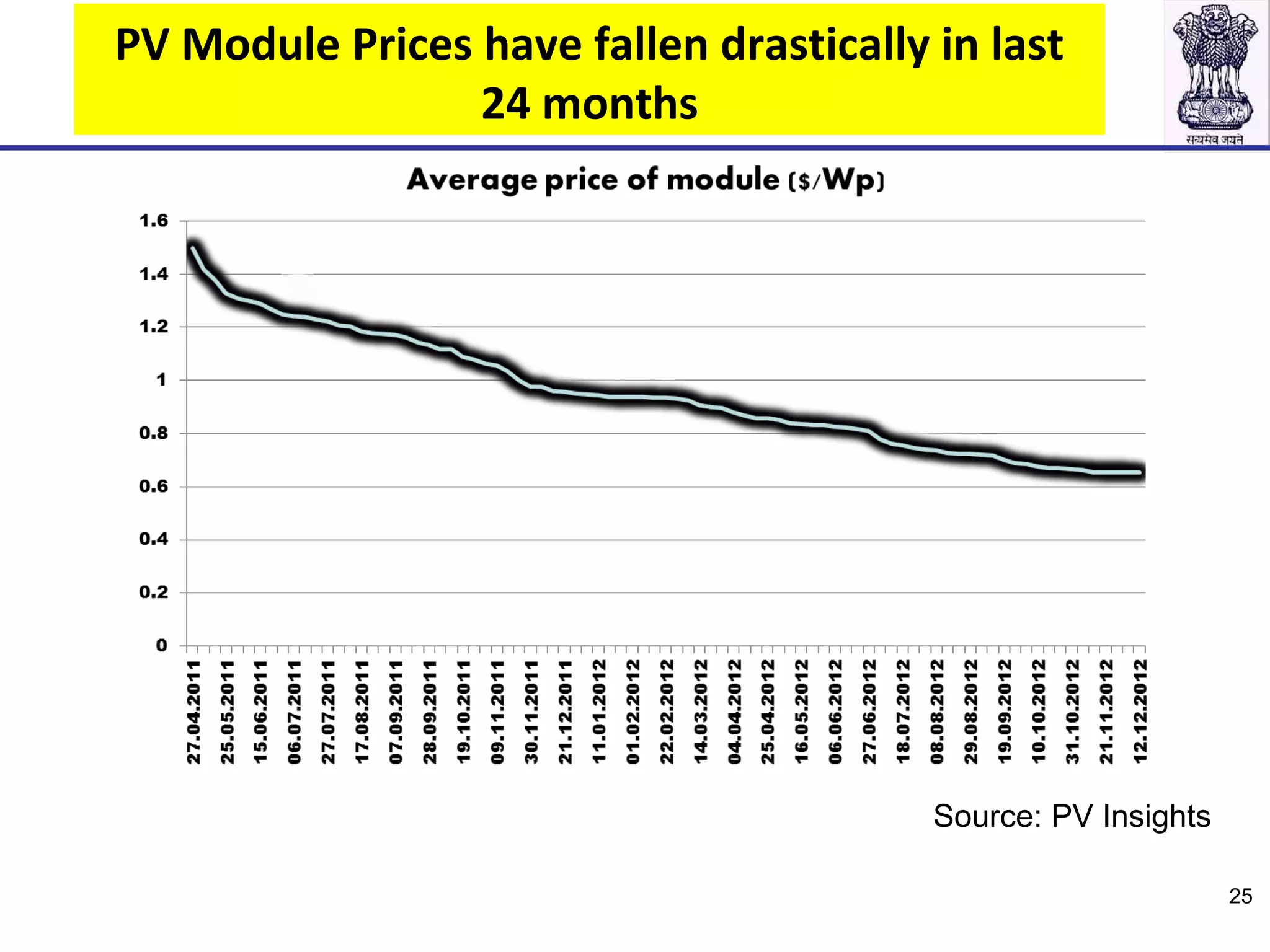
Historical Module Price Trend: prices fall as the
production increases
24
Source: PV Insights
PV Module Prices have fallen drastically in last
24 months
25
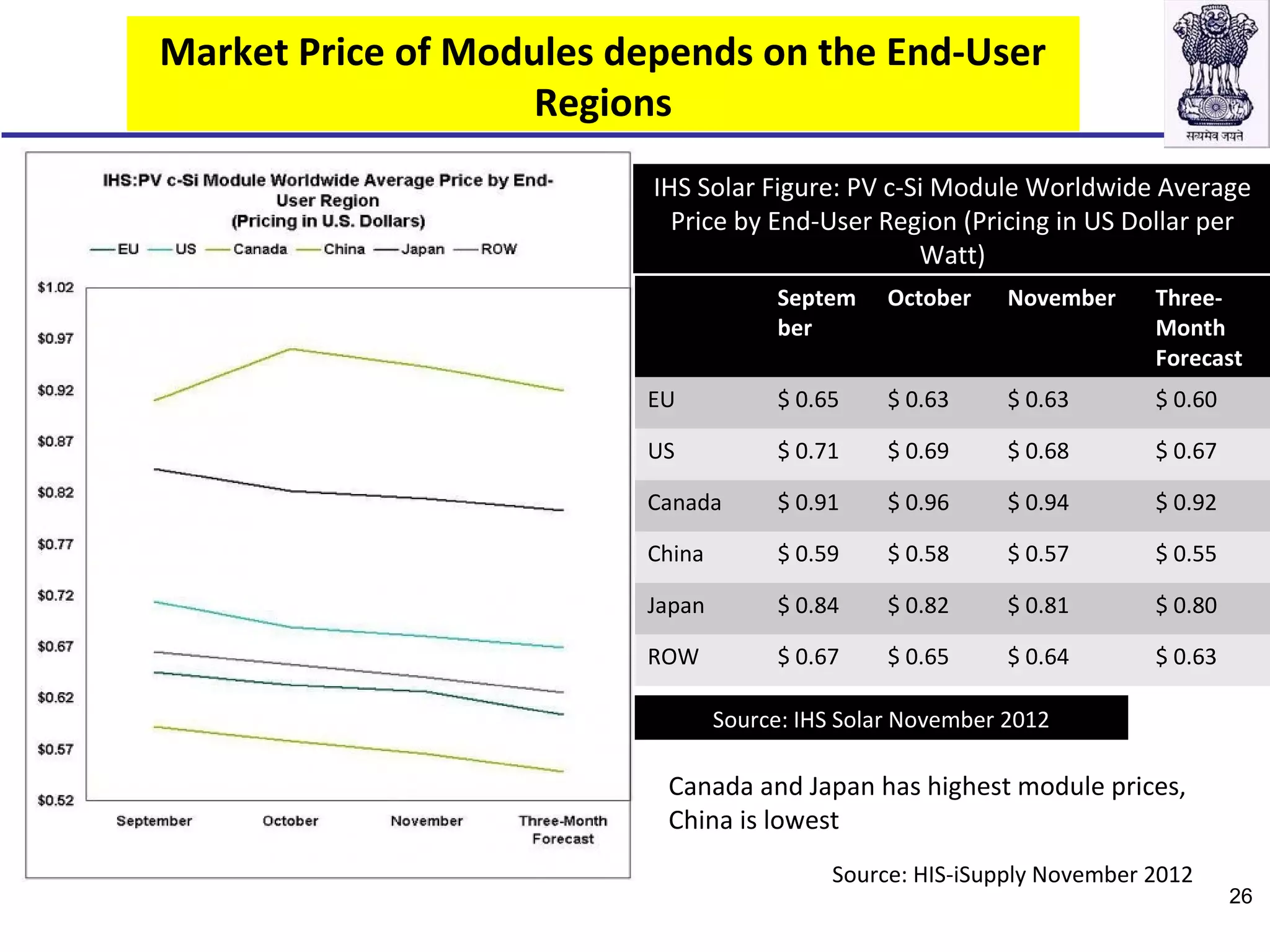
Market Price of Modules depends on the End-User
Regions
Source: HIS-iSupply November 2012
Canada and Japan has highest module prices,
China is lowest
Septem
ber
October November Three-
Month
Forecast
EU $ 0.65 $ 0.63 $ 0.63 $ 0.60
US $ 0.71 $ 0.69 $ 0.68 $ 0.67
Canada $ 0.91 $ 0.96 $ 0.94 $ 0.92
China $ 0.59 $ 0.58 $ 0.57 $ 0.55
Japan $ 0.84 $ 0.82 $ 0.81 $ 0.80
ROW $ 0.67 $ 0.65 $ 0.64 $ 0.63
IHS Solar Figure: PV c-Si Module Worldwide Average
Price by End-User Region (Pricing in US Dollar per
Watt)
Source: IHS Solar November 2012
26
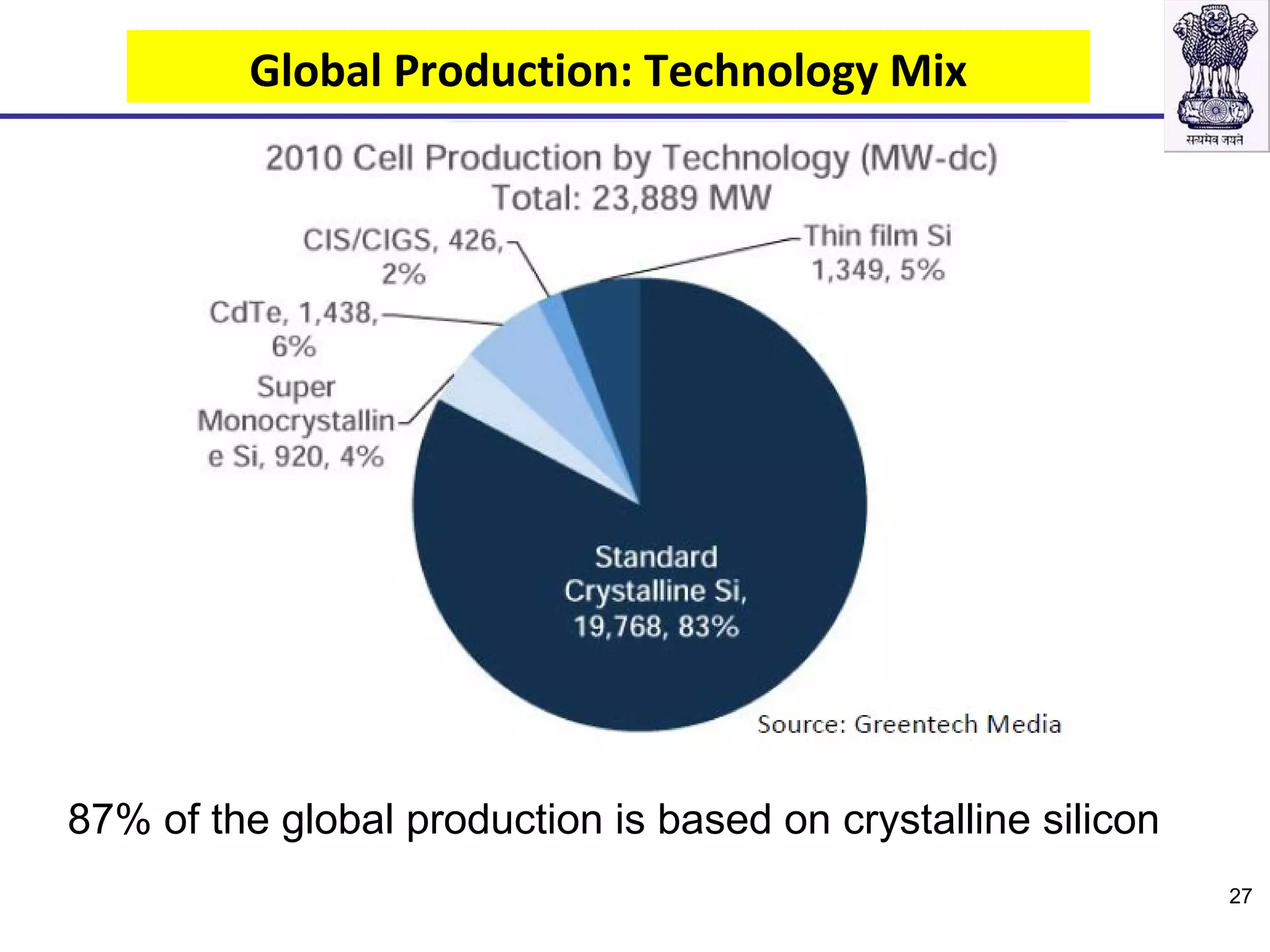
87% of the global production is based on crystalline silicon
Global Production: Technology Mix
27
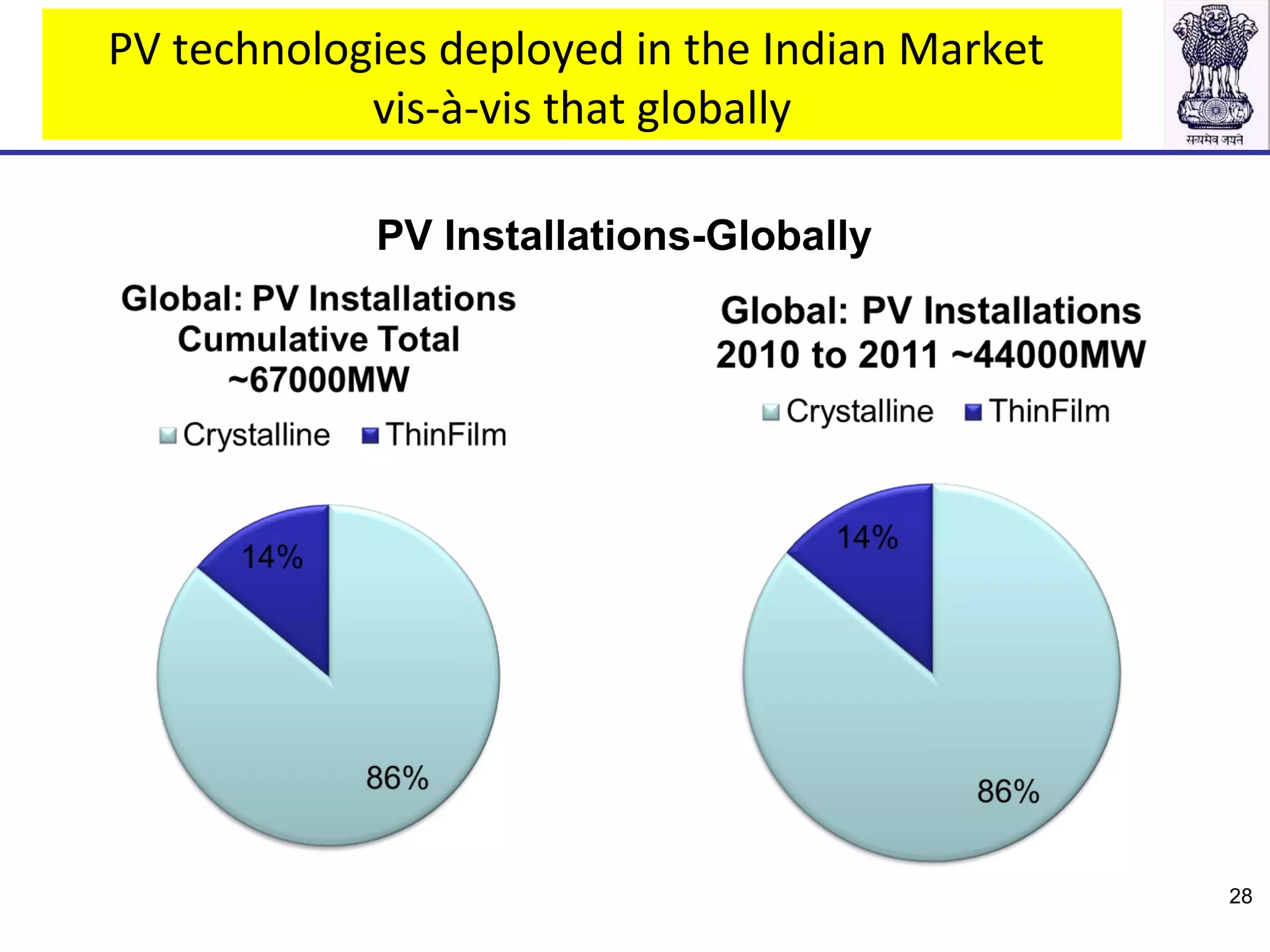
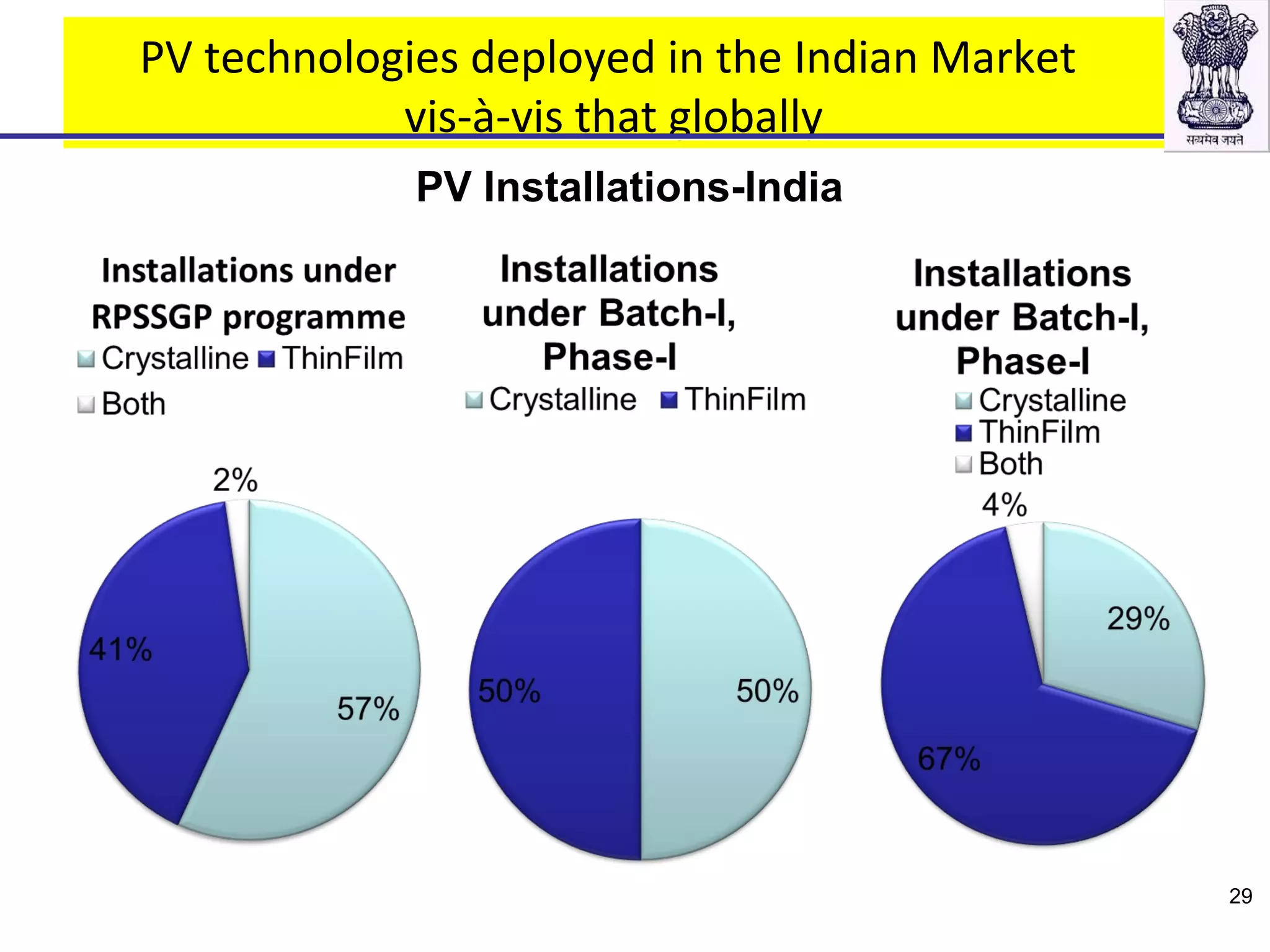
PV technologies deployed in the Indian Market
vis-à-vis that globally
PV Installations-Globally
28
PV technologies deployed in the Indian Market
vis-à-vis that globally
PV Installations-India
29
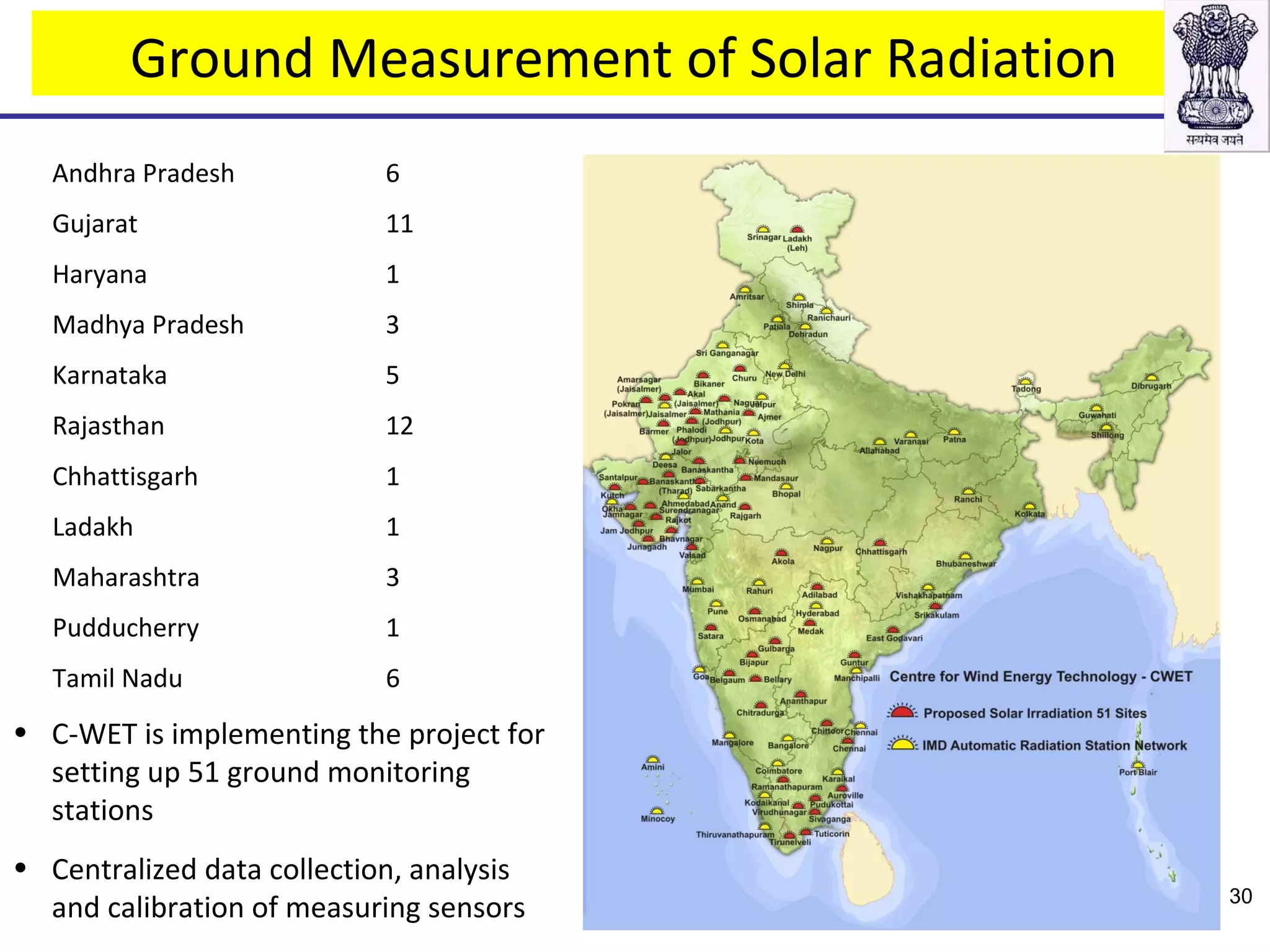
Ground Measurement of Solar Radiation
Andhra Pradesh 6
Gujarat 11
Haryana 1
Madhya Pradesh 3
Karnataka 5
Rajasthan 12
Chhattisgarh 1
Ladakh 1
Maharashtra 3
Pudducherry 1
Tamil Nadu 6
• C-WET is implementing the project for
setting up 51 ground monitoring
stations
• Centralized data collection, analysis
and calibration of measuring sensors 30
Salient Features of Draft Policy (Ph-II)
• 10 GW utility scale solar power capacity (cumulative) by
end of Phase-II (March 2017): 4 GW under central scheme and
6 GW under various State specific schemes.
• Continuation of scheme to support off-grid solar applications to
reach 1000 MW aggregate capacity by 2017.
• Target of 15 million sq. m. solar collectors area (cumulative) by
2017.
31
Grid-connected :Target & Thrust Areas
Cumulative target:
 10,000 MW (by March 2017)
-4,000 MW under Central schemes
-6,000 MW under States initiatives
Thrust areas:
 Development of T&D network
 Developing cluster of Solar Parks to reduce costs
 Grid-connected Roof-top
 Achieving grid parity at the earliest
32
Grid-connected : Plan for Central
Schemes
• Bundling Scheme: (500 MW, PV) Bundle relatively expensive solar
power with power from the unallocated quota of Government of India
(MoP).
Advantages:
 Successful implementation experience during Phase-I of JNNSM.
 Weighted average cost of bundled power is below Rs 5 per unit and
utilities are ready to by power at this rate.
 NVVN as the single off- taker of Solar power.
• Viability Gap Funding : The scheme provides financial support in form
of Grants, one time or deferred, to infrastructure projects with a view
to make commercially viable.
 Bidder would bid for viability gap for funding in Rs. per MW and the
bidder with minimum VGF requirement would be selected.
Cont...
33
Advantages:
Procedural simplicity
With upfront availability of part of capital cost, cost of financing would be lower
Disadvantage:
With upfront payment of VGF, long term performance of the project could be
an issue.
VGF financing plan:
25% at the time of delivery of at least 50% of the major equipment at site . This
would be based on the cost of total procurement.
50% on successful commissioning of the full capacity of the plant.
Balance 25% after one year of operation meeting requirements of generation
as per guidelines.
Target under VGF :
Photovoltaic - 1500 MW
Thermal - 500 MW
Ladakh - 250 MW
Total 2250 MW
Cont...
34
• Solar Parks (250 MW):
 Solar parks would include all required facilities for generation of power
at one location i.e. evacuation and transmission infrastructure, solar
radiation monitoring station, water availability, access roads to the
park, interior road in the park, telecommunication facility, fire station,
Green belt, security, manufacturing facilities, testing and
characterization
 Following items of work will be supported:
 Detailed Project Report- Support up to 50% of the cost, limited to Rs. 5
crore per park is proposed.
 Setting up of Transmission Infrastructure- Support up to 40% of the
cost as per norms of National Clean Energy funds is proposed.
 Civil Infrastructure Development- Support up to 50% of the cost ,
limited to Rs. 10 crore per park is proposed.
 Technical Assistance- Support up to Rs. 1 crore per park is proposed.
 Solar Radiation Monitoring Station- If not installed, will be setup
through MNRE programme based on 100% support.
35
Off-Grid: Targets/Thrust Areas
Target : 800 MW
Thrust areas:
 Energy Access:
 Rural areas in the country mainly lack in distribution infrastructure. The
utilities, not in good financial state, are not in a position to afford major fixed
cost.
 During Phase-II, it envisaged that around 20,000 villages/hamlets/basti/padas
shall be covered through ‘Energy Access’ scheme by way of deployment of
Off-Grid electricity generation projects.
Cont...
36
 Telecom Towers:
 India currently has more than 3.10 lakh telecom towers, 60% of their power
requirements are met by diesel generators which together consume about 2
billion liters of diesel fuels each year and result in 5.3 million tons of CO2
emission.
 Phase-II of JNNSM targets around 25000 solar integrated telecom towers.
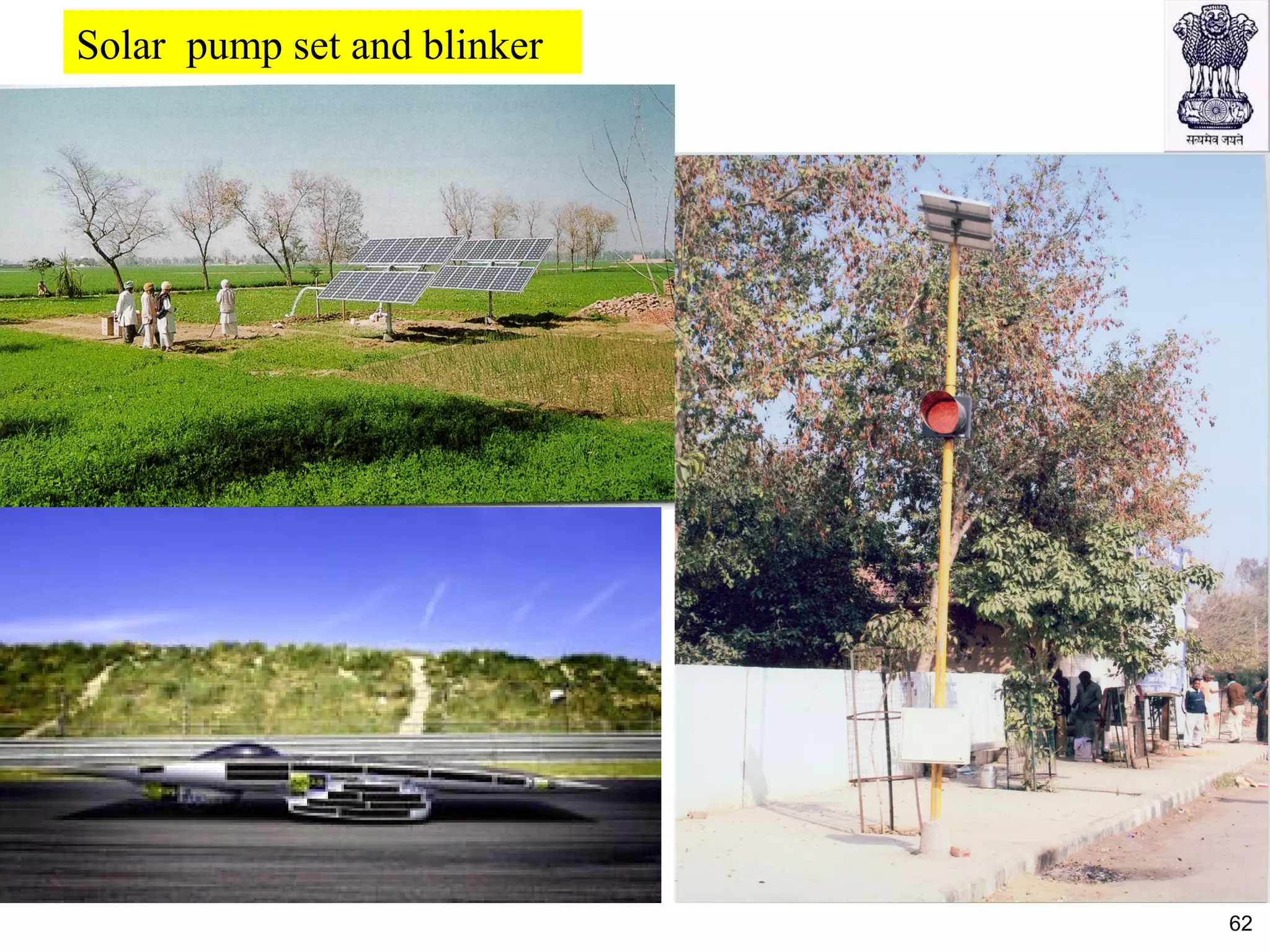
 Water Pumping:
 Solar PV water pumping systems are used for irrigation and drinking water
in India. Solar pumps are constituted by an array of solar panels and are
developed to operate on DC power produced by solar panels.
 Phase-II of JNNSM targets deployment of around 25000 solar pumps.
 Off-Grid lighting System:
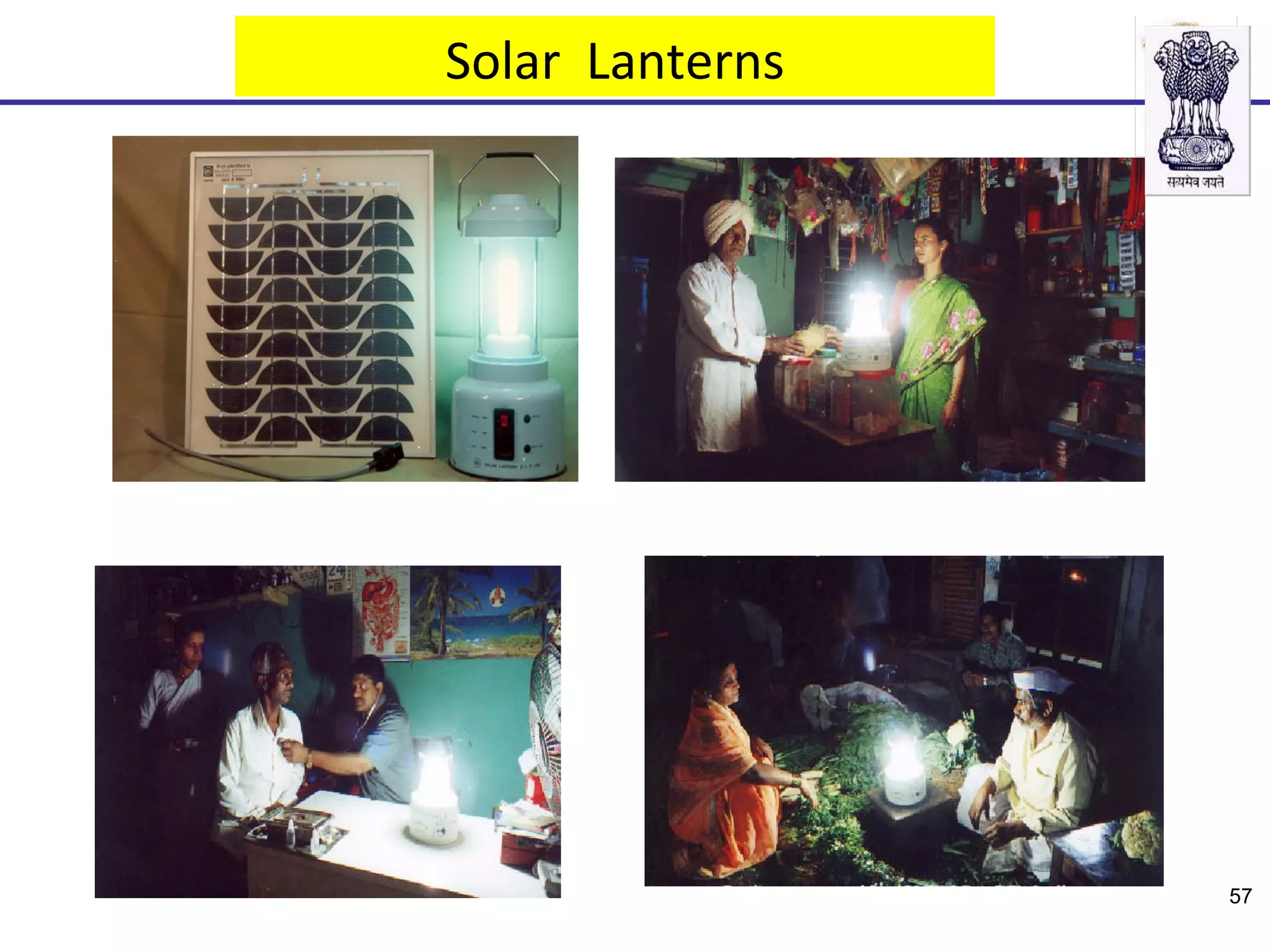
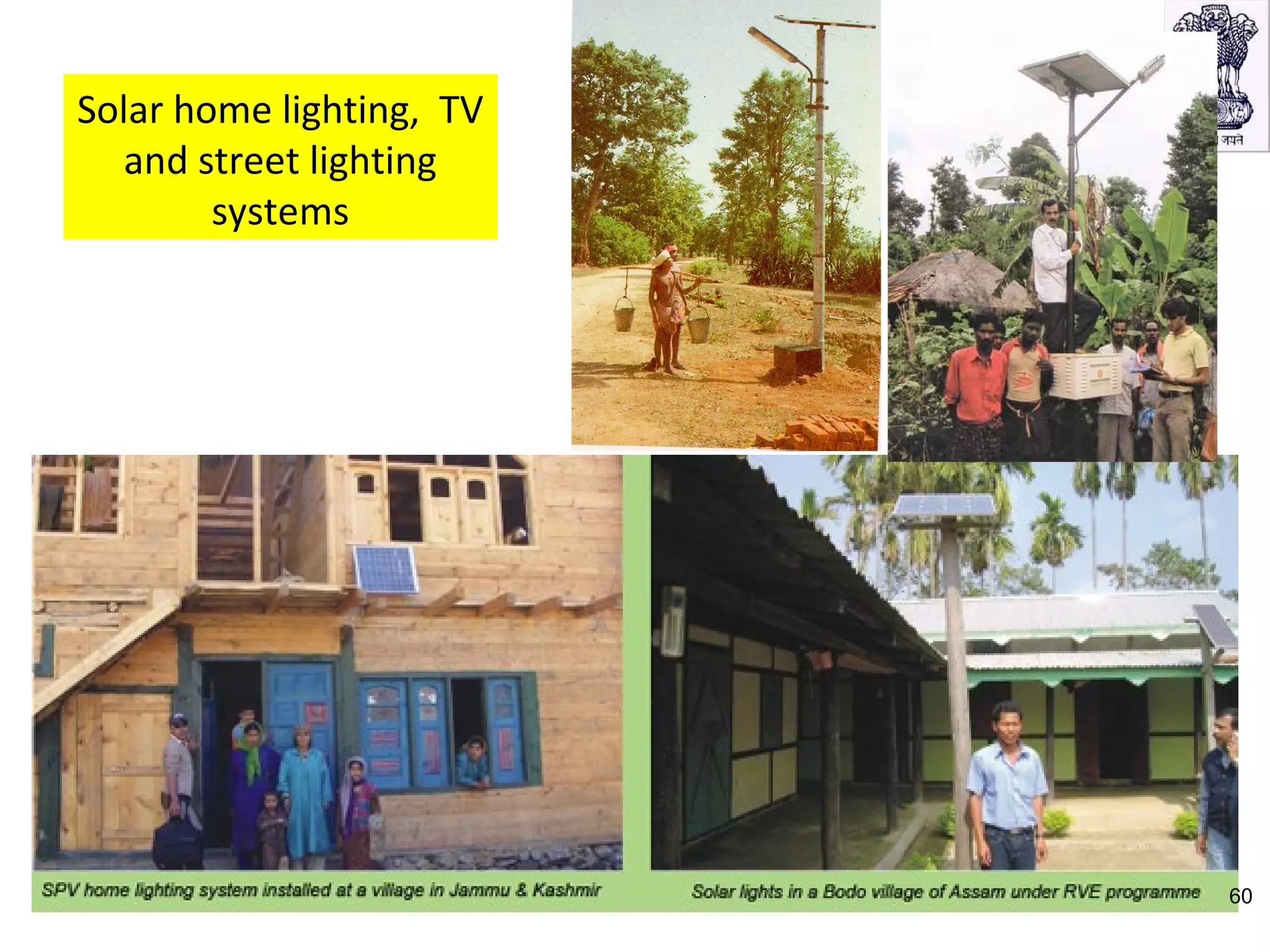
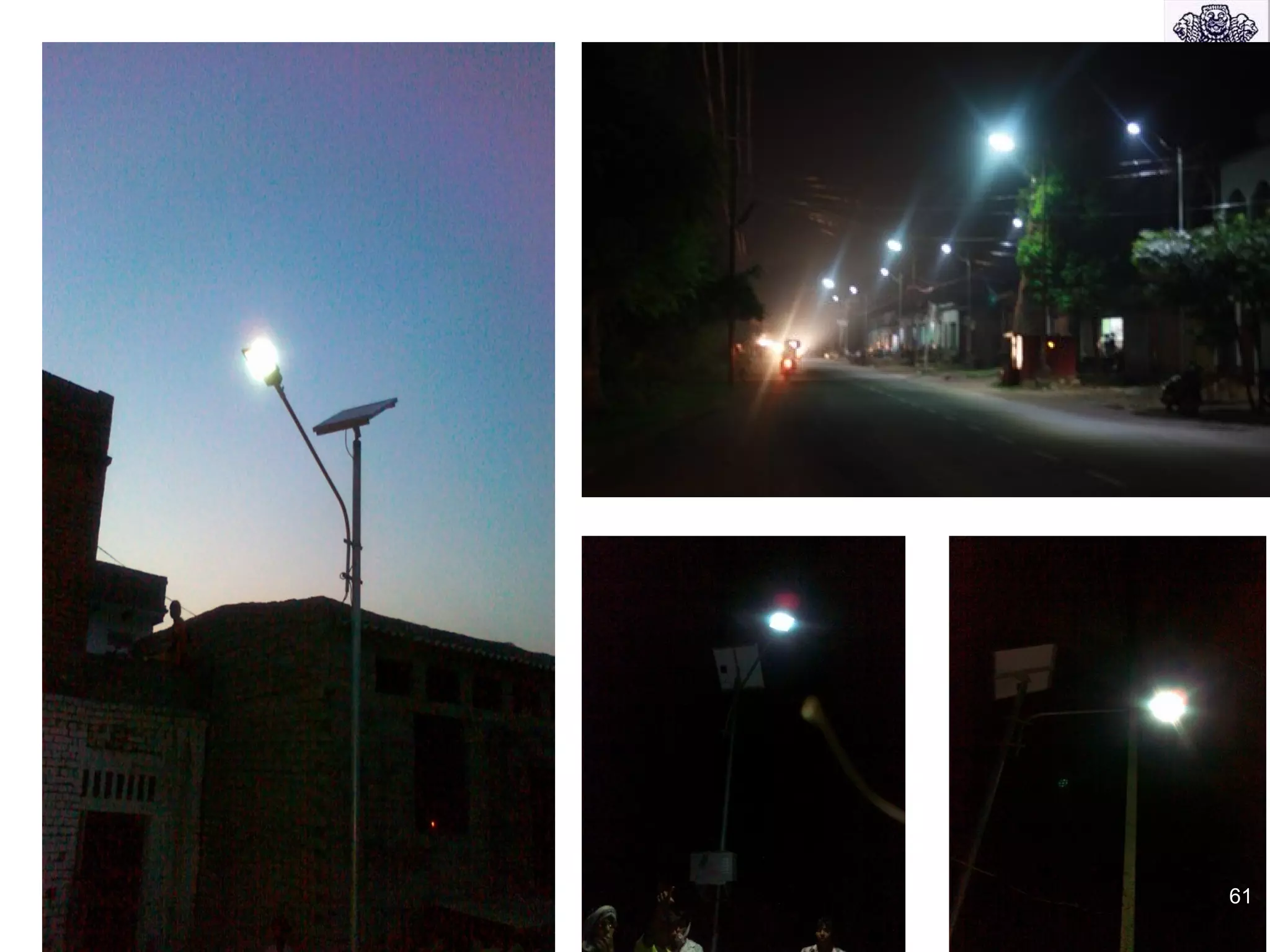
 This will include solar lanterns, home lighting systems with batteries and
solar street lights .
 Phase-II of JNNSM targets deployment of around 10,00,000 Off-Grid
lighting systems.
Cont...
37
 Solar Water Heating Systems:
 In domestic category, hot water is typically required for bathing while
in industrial category it is used pre-heating process.
 Phase-II targets at least 115 to 20 cities where solar water heaters
would become the main source of heating water replacing electric
geysers. Phase-II would target around 8 million Sq. Mt. of collector
area.
 Air Conditioning/Refrigeration:
 Huge amount of fuel oil is being used for cooling through Vapour
Absorption Machine in industries/establishments where power
cuts/electricity tariff are.
38
Options Considered for Domestic
Content Requirement During Phase-II
• Option-1: For all PV projects, cells and modules produced in India shall be
used.
• Option-2: Price preference for domestic manufactured cells/modules.
• Option-3: Percentage of domestic content in cost terms (say 50%) for
both PV and thermal technologies.
• Option-4: Percentage of cells manufactured in India.
• Option-5: some batches with 100% domestic content requirement.
• Option-6: For thermal technologies material equivalent to 50% of supply
cost (excluding land, taxes, erection, financing, soft cost, etc) should be
manufactured in India during Phase-II.
39
ISSUES
Enforcement of RPOs
-Regulatory Measures
-Amendment of Electricity Act
Strengthening of Transmission network for Renewables
- Plan by PGCIL
Unallocated power for bundling
NCEF funds for VGF
Import duty concessions for inputs
Incentives for Manufacturing: M-SIPS
Funding of Solar projects by Banks
40
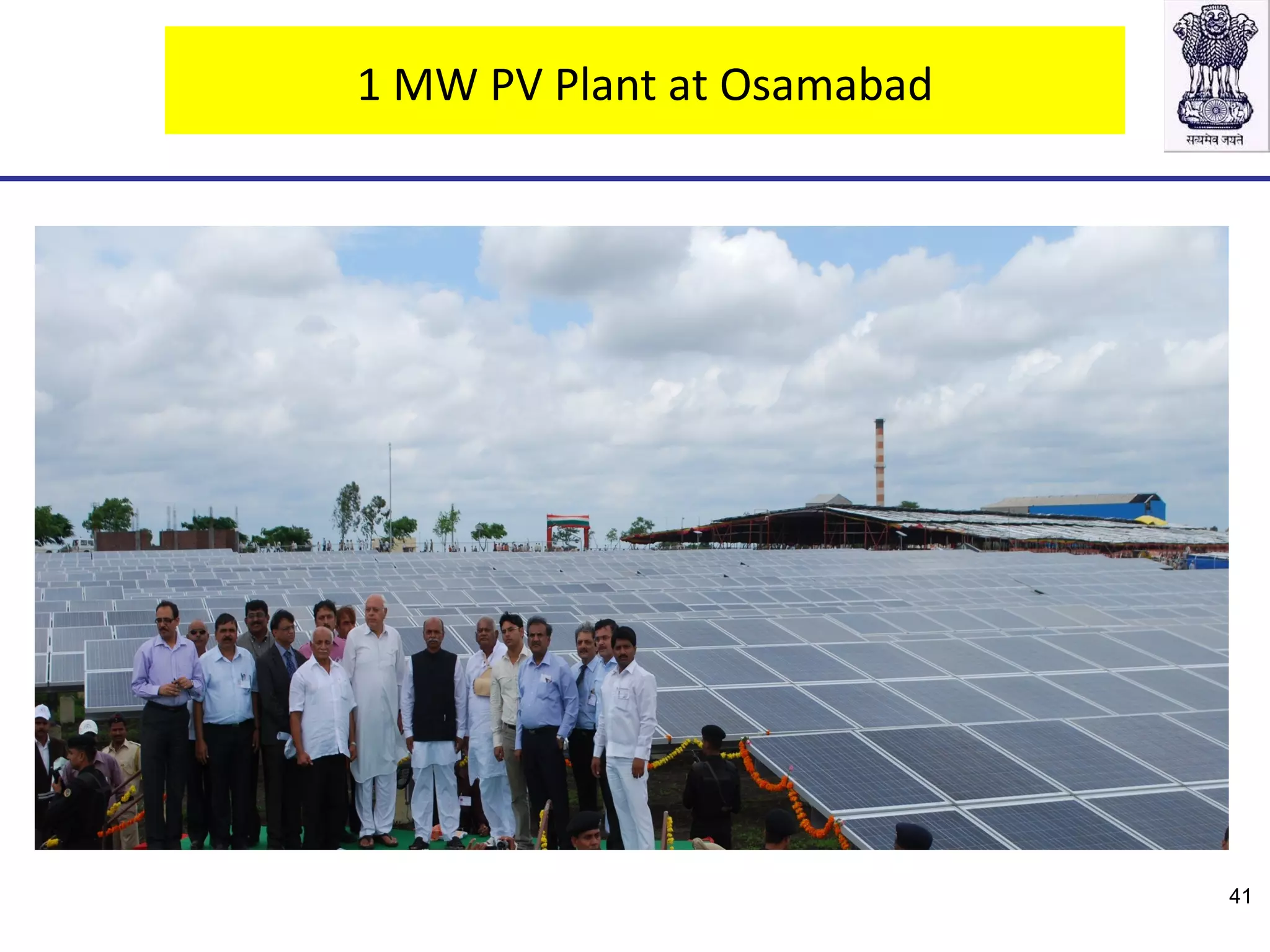
1 MW PV Plant at Osamabad
41
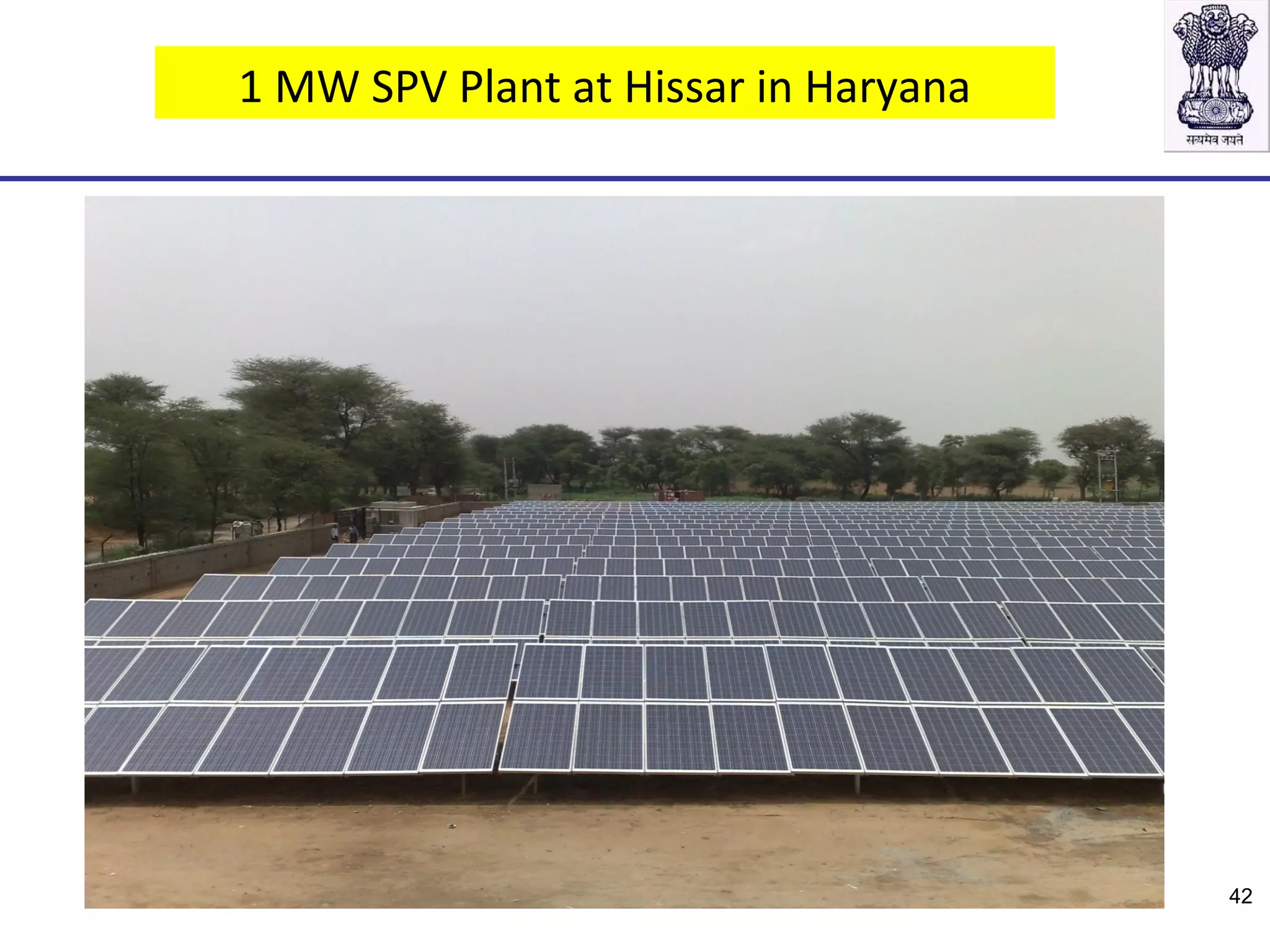
1 MW SPV Plant at Hissar in Haryana
42
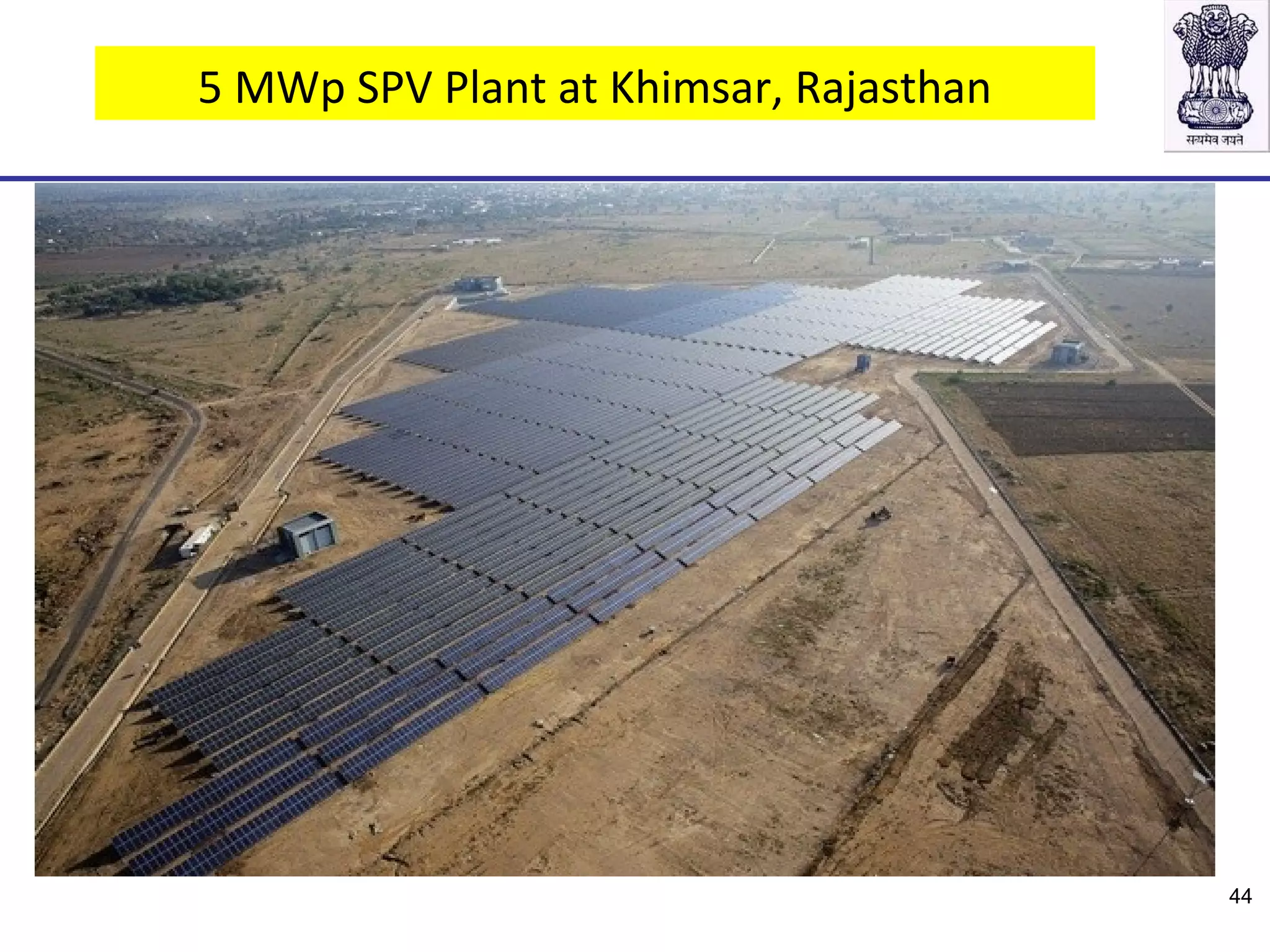
1 MW SPV (Crystalline Silicon) Power Plant at New
Delhi (Solar RPO arrangement)
43
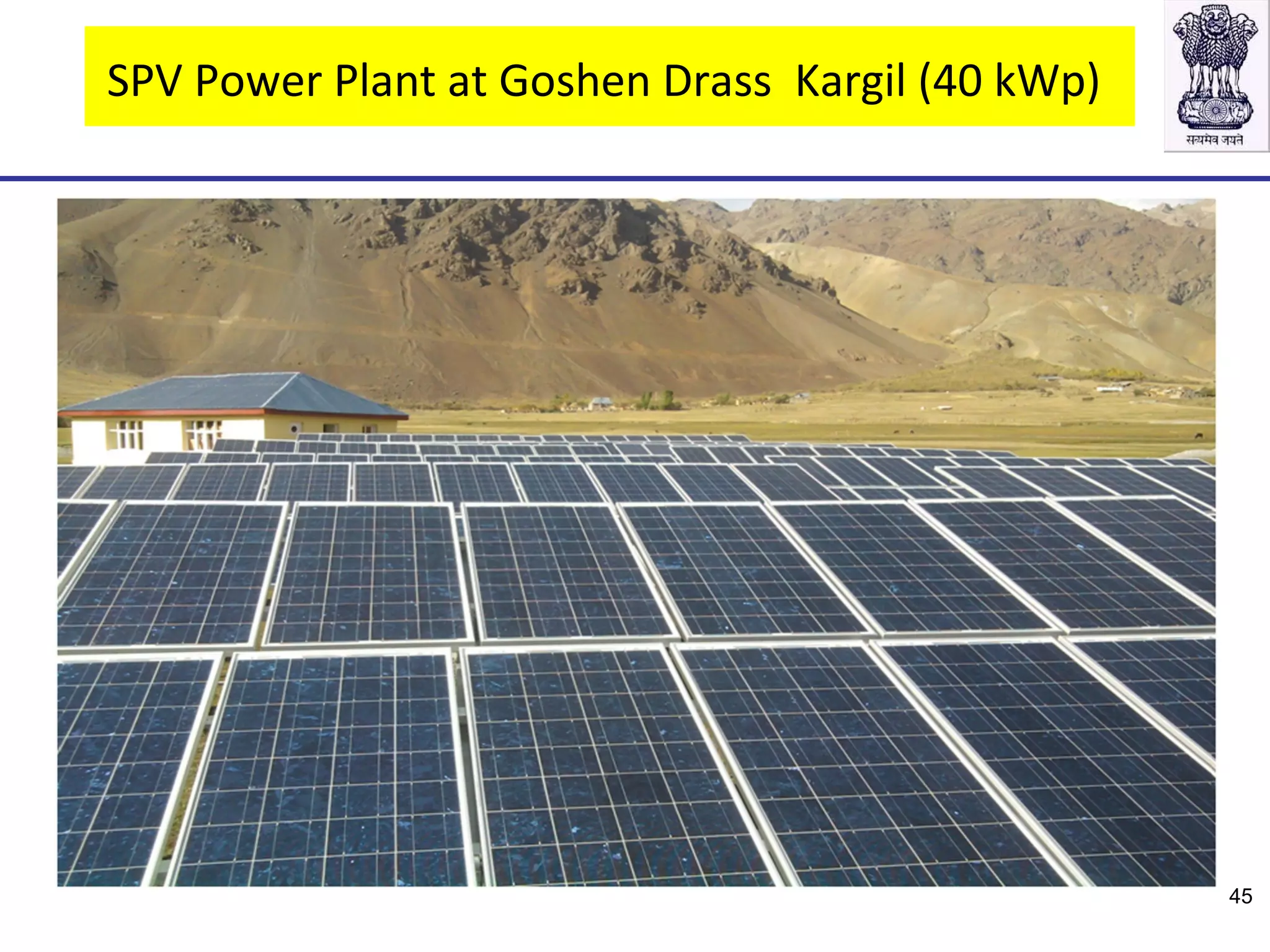
5 MWp SPV Plant at Khimsar, Rajasthan
44
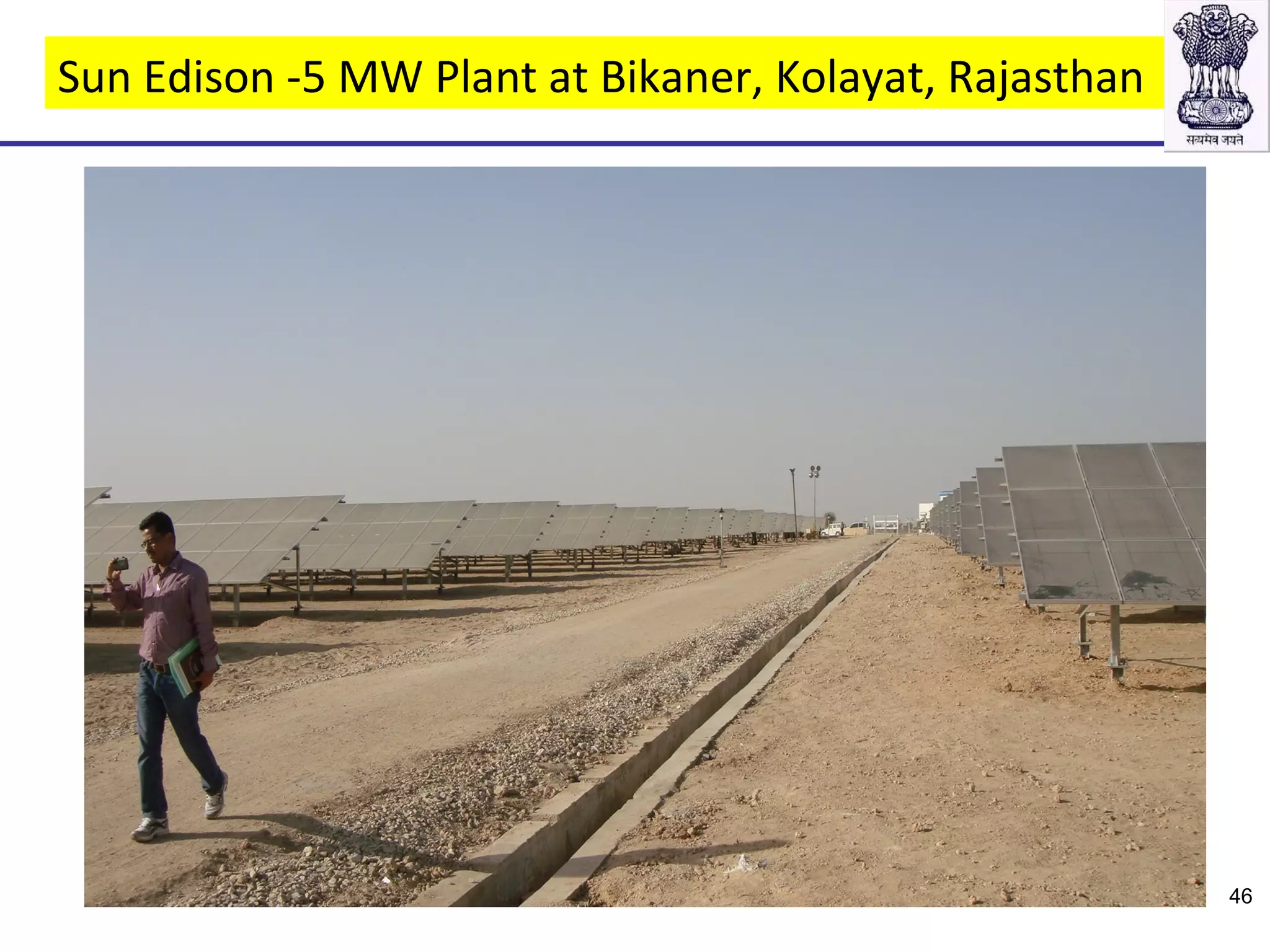
SPV Power Plant at Goshen Drass Kargil (40 kWp)
45
Sun Edison -5 MW Plant at Bikaner, Kolayat, Rajasthan
46
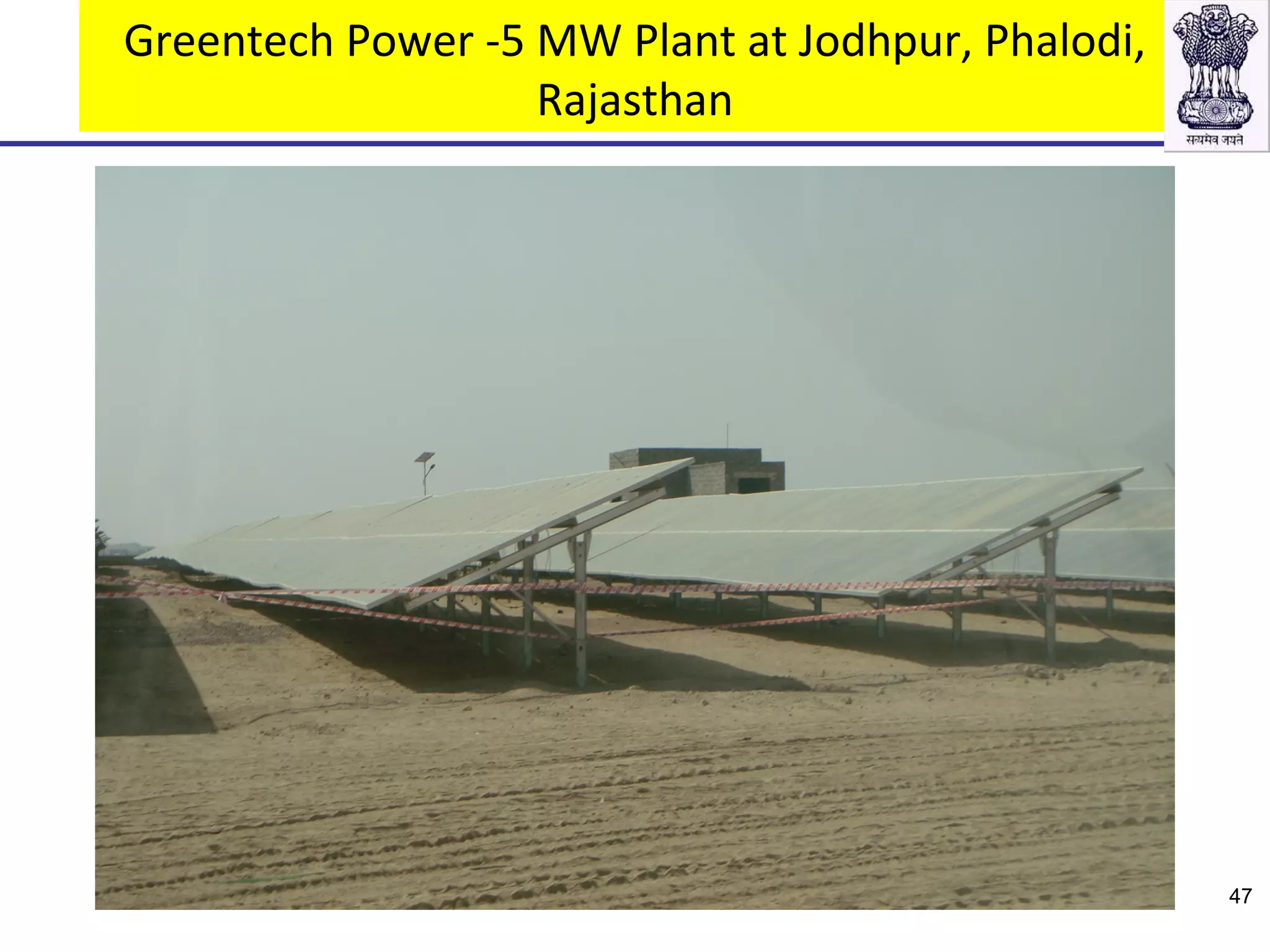
Greentech Power -5 MW Plant at Jodhpur, Phalodi,
Rajasthan
47
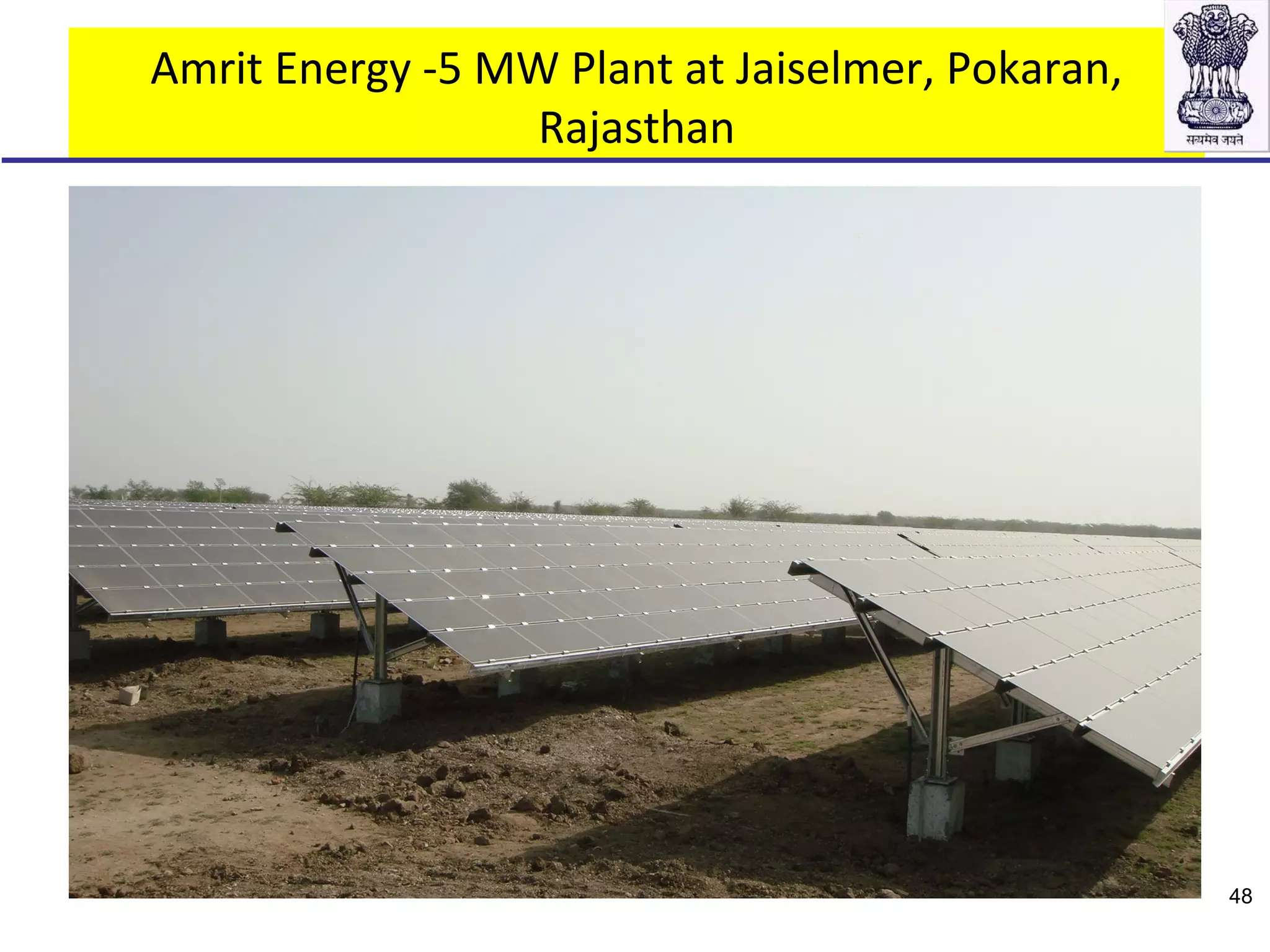
Amrit Energy -5 MW Plant at Jaiselmer, Pokaran,
Rajasthan
48
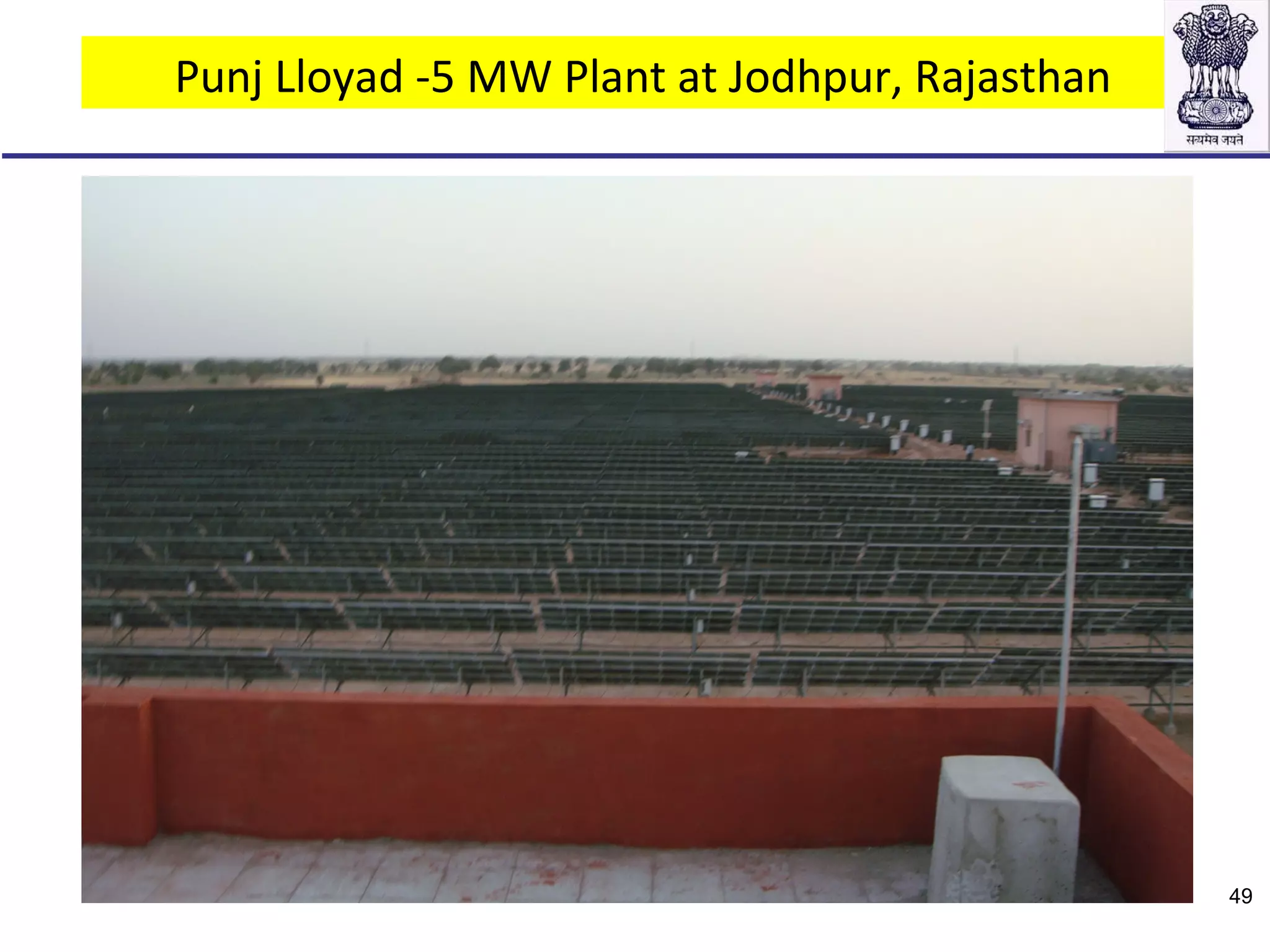
Punj Lloyad -5 MW Plant at Jodhpur, Rajasthan
49
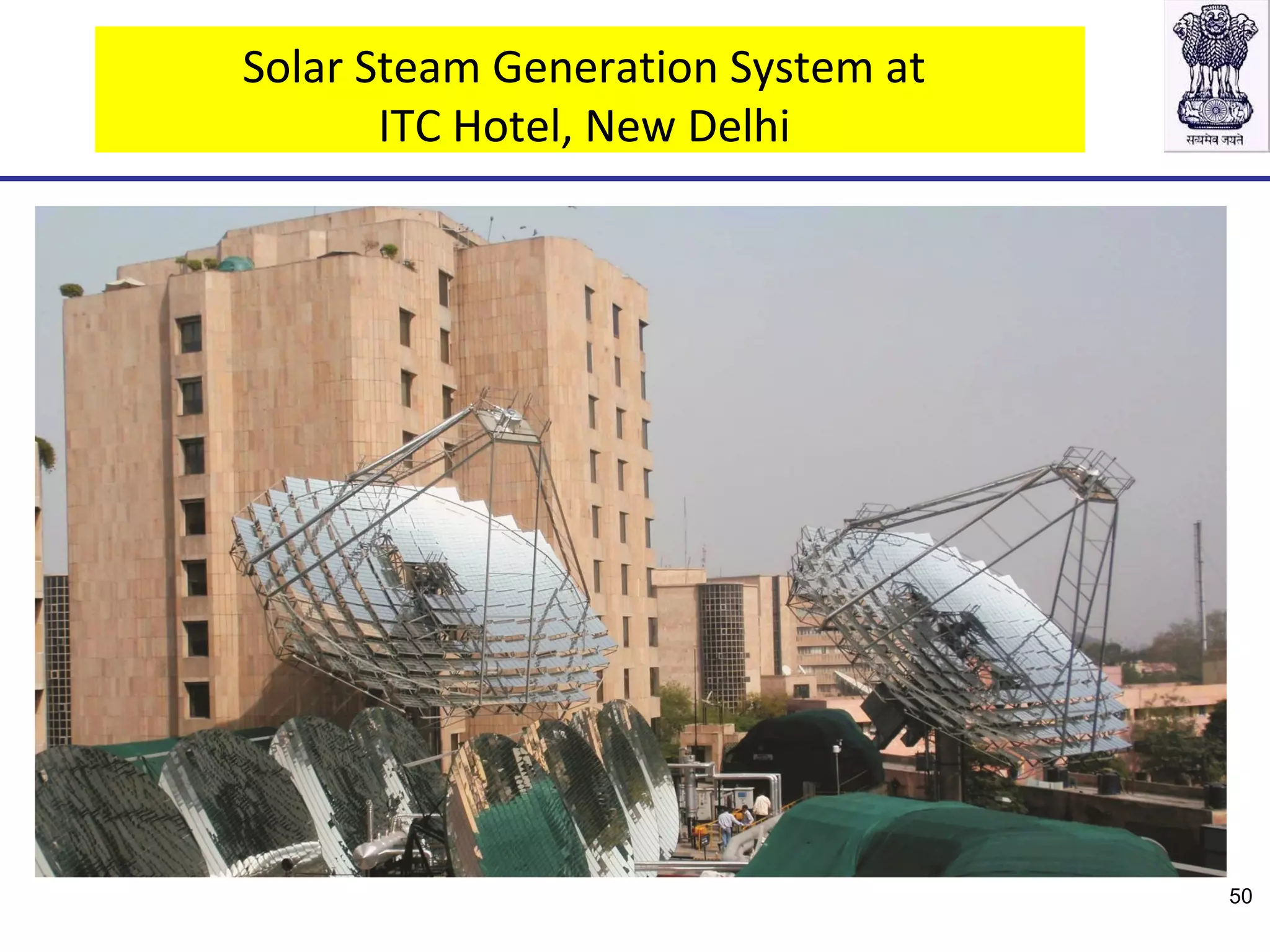
Solar Steam Generation System at
ITC Hotel, New Delhi
50
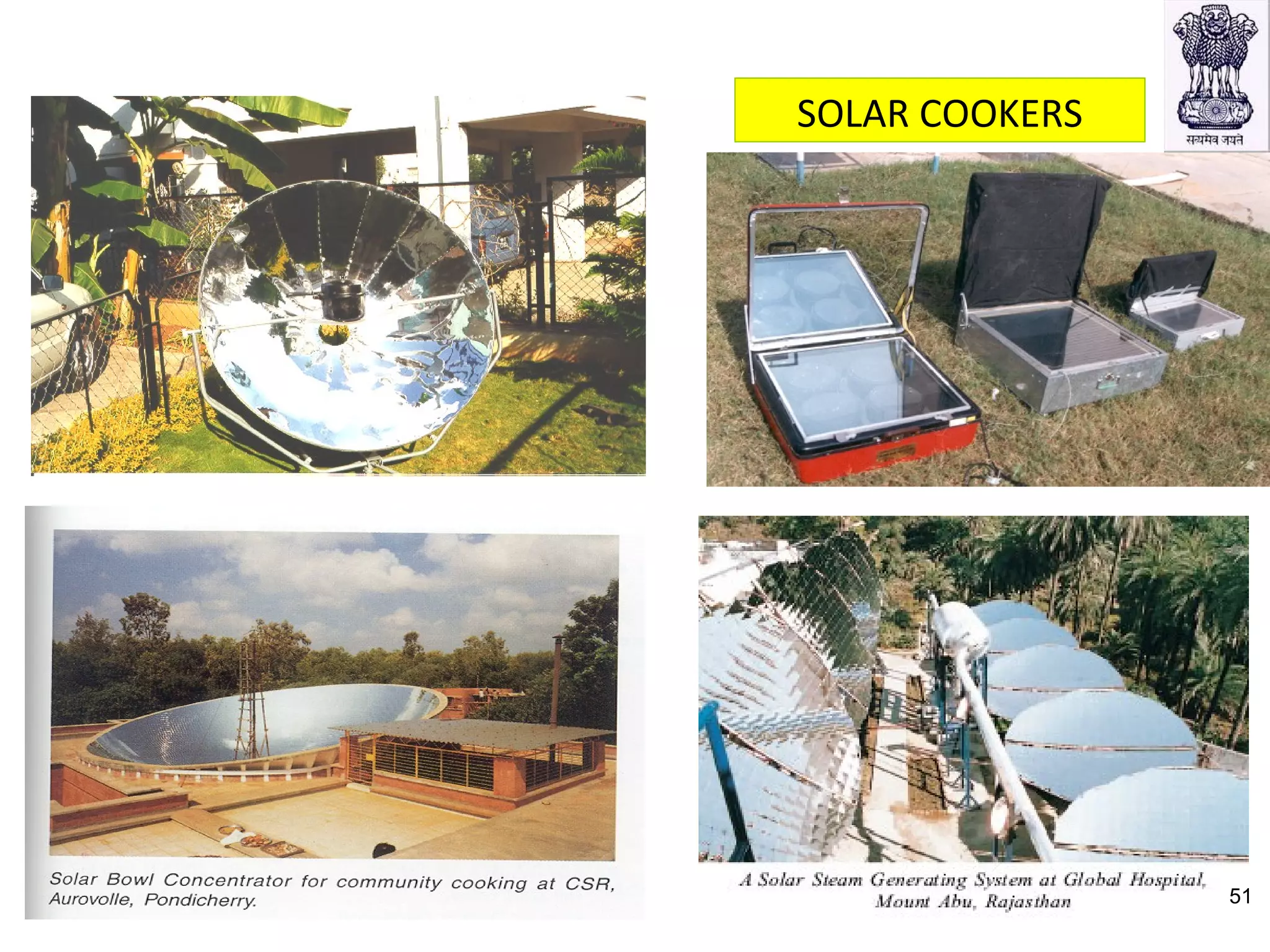
SOLAR COOKERS
51
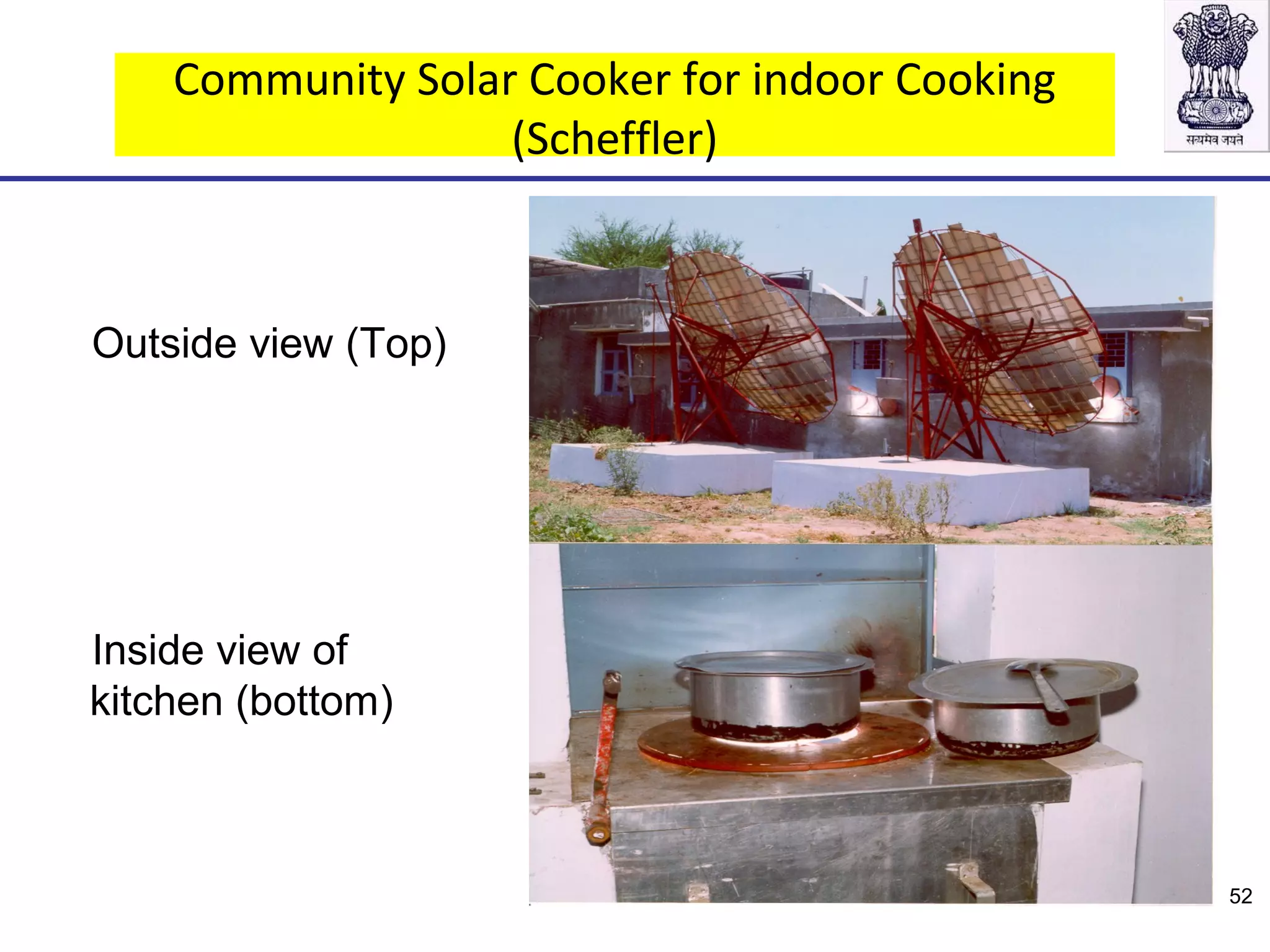
Community Solar Cooker for indoor Cooking
(Scheffler)
Outside view (Top)
Inside view of
kitchen (bottom)
52
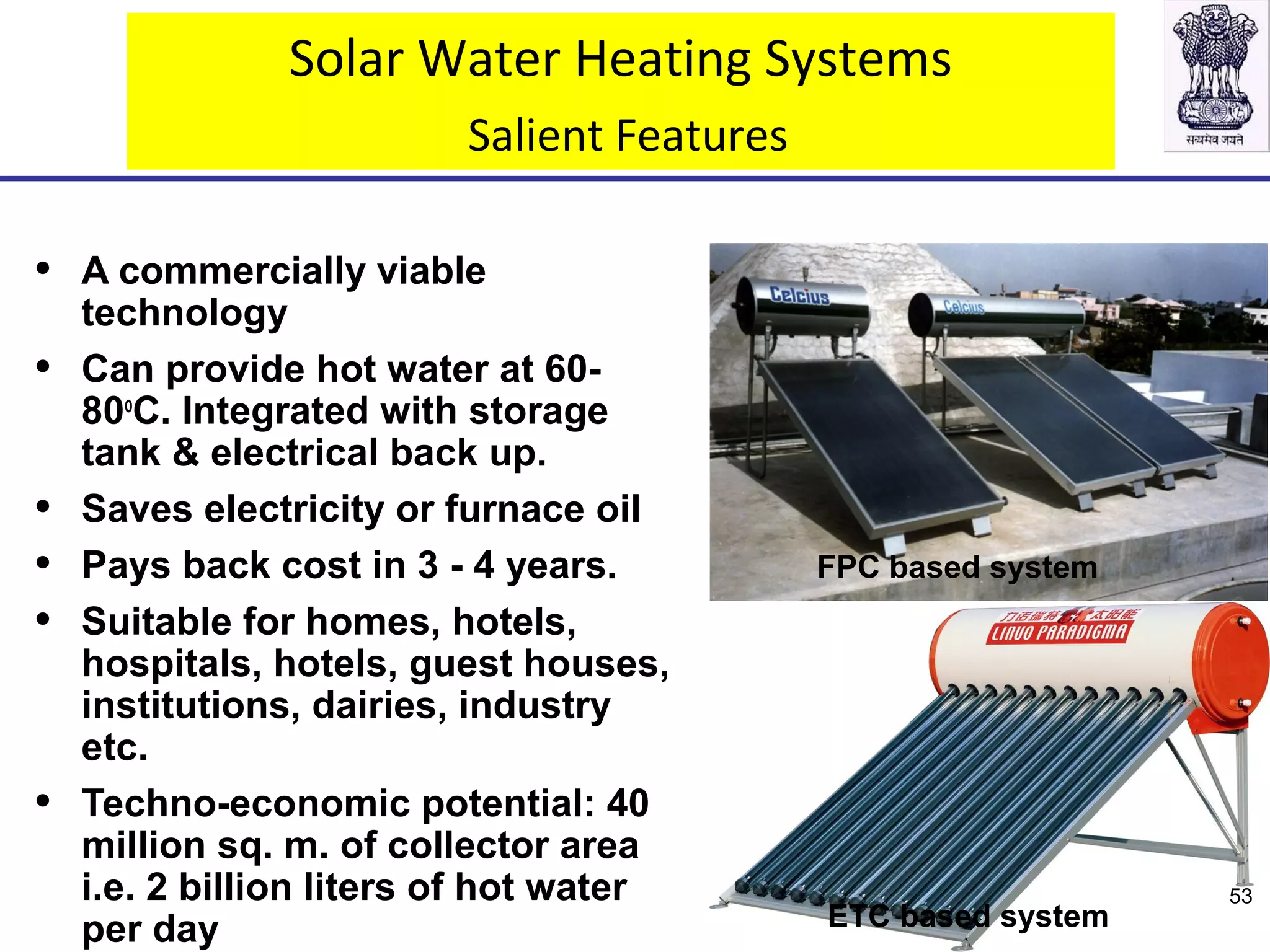
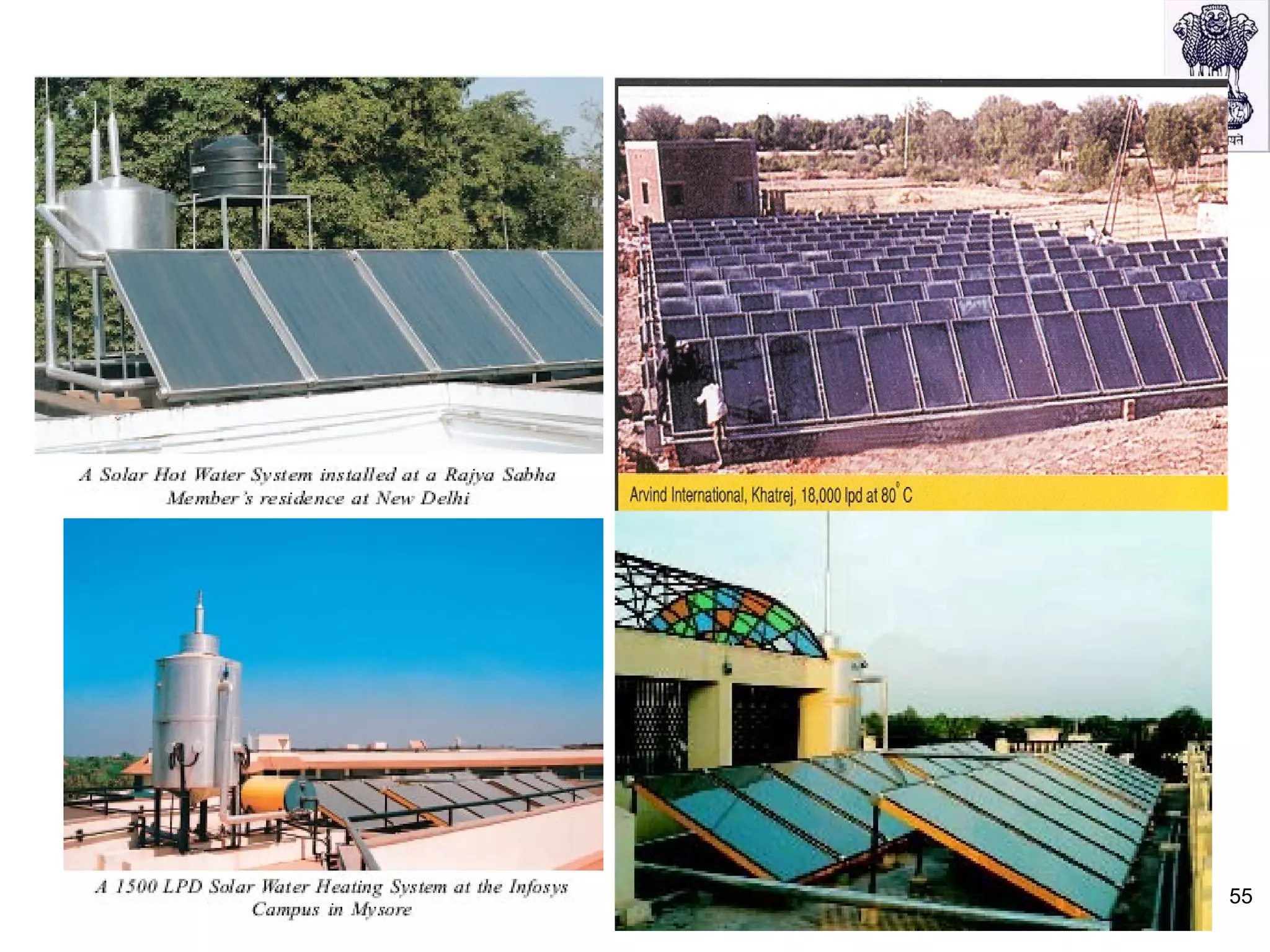
Solar Water Heating Systems
Salient Features
• A commercially viable
technology
• Can provide hot water at 60-
80o
C. Integrated with storage
tank & electrical back up.
• Saves electricity or furnace oil
• Pays back cost in 3 - 4 years.
• Suitable for homes, hotels,
hospitals, hotels, guest houses,
institutions, dairies, industry
etc.
• Techno-economic potential: 40
million sq. m. of collector area
i.e. 2 billion liters of hot water
per day
FPC based system
ETC based system
53
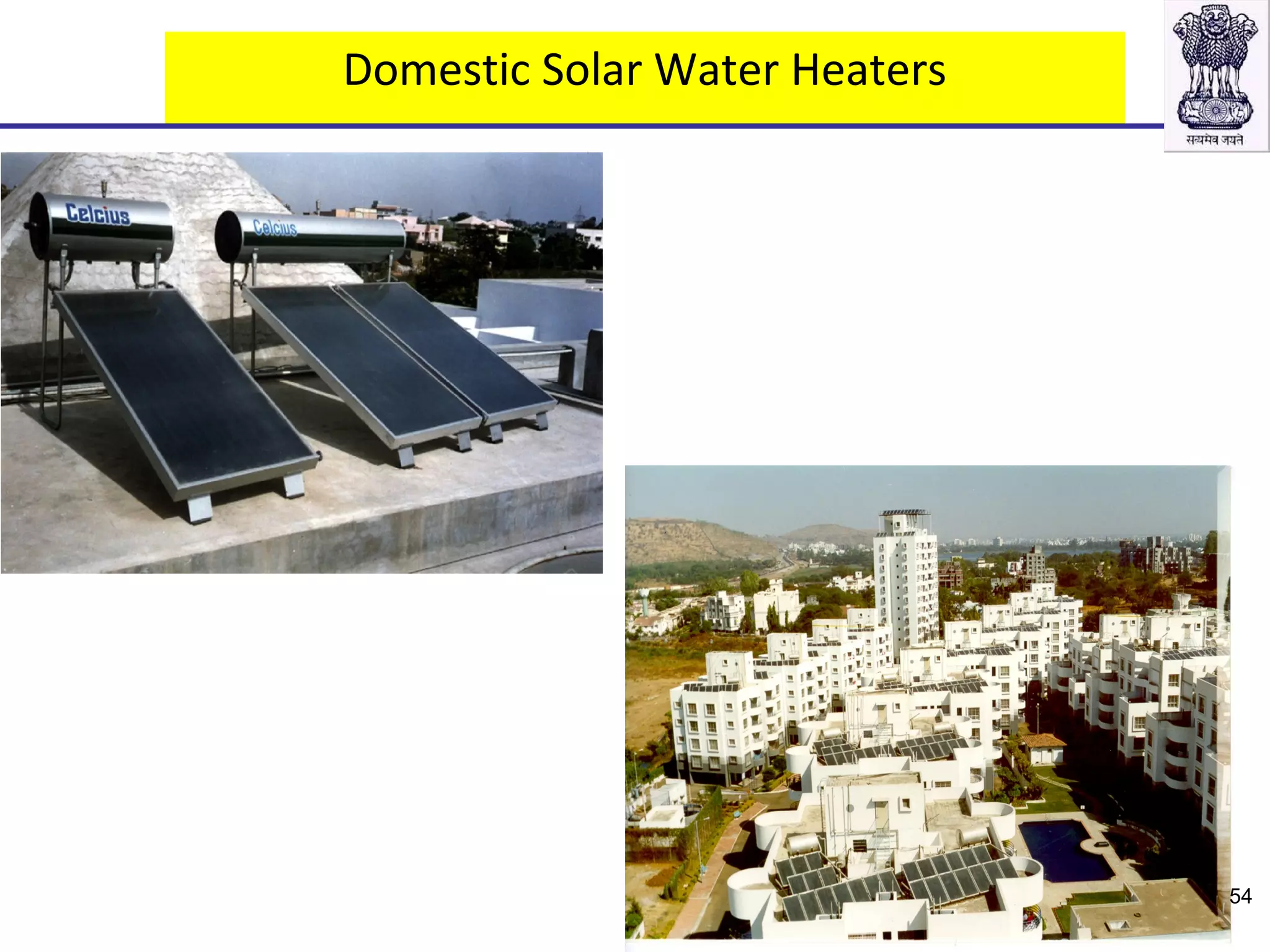
Domestic Solar Water Heaters
54
55
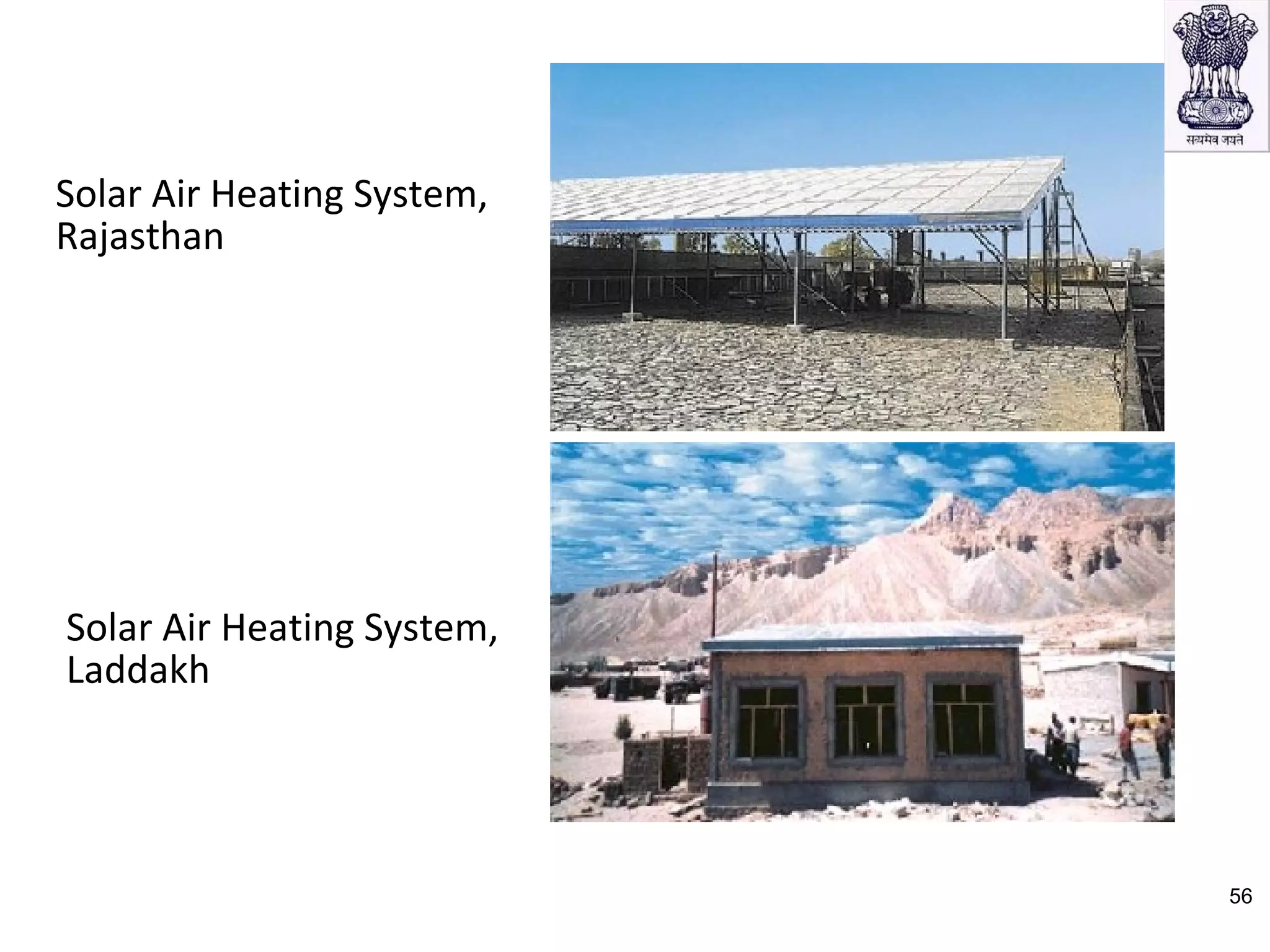
Solar Air Heating System,
Rajasthan
Solar Air Heating System,
Laddakh
56
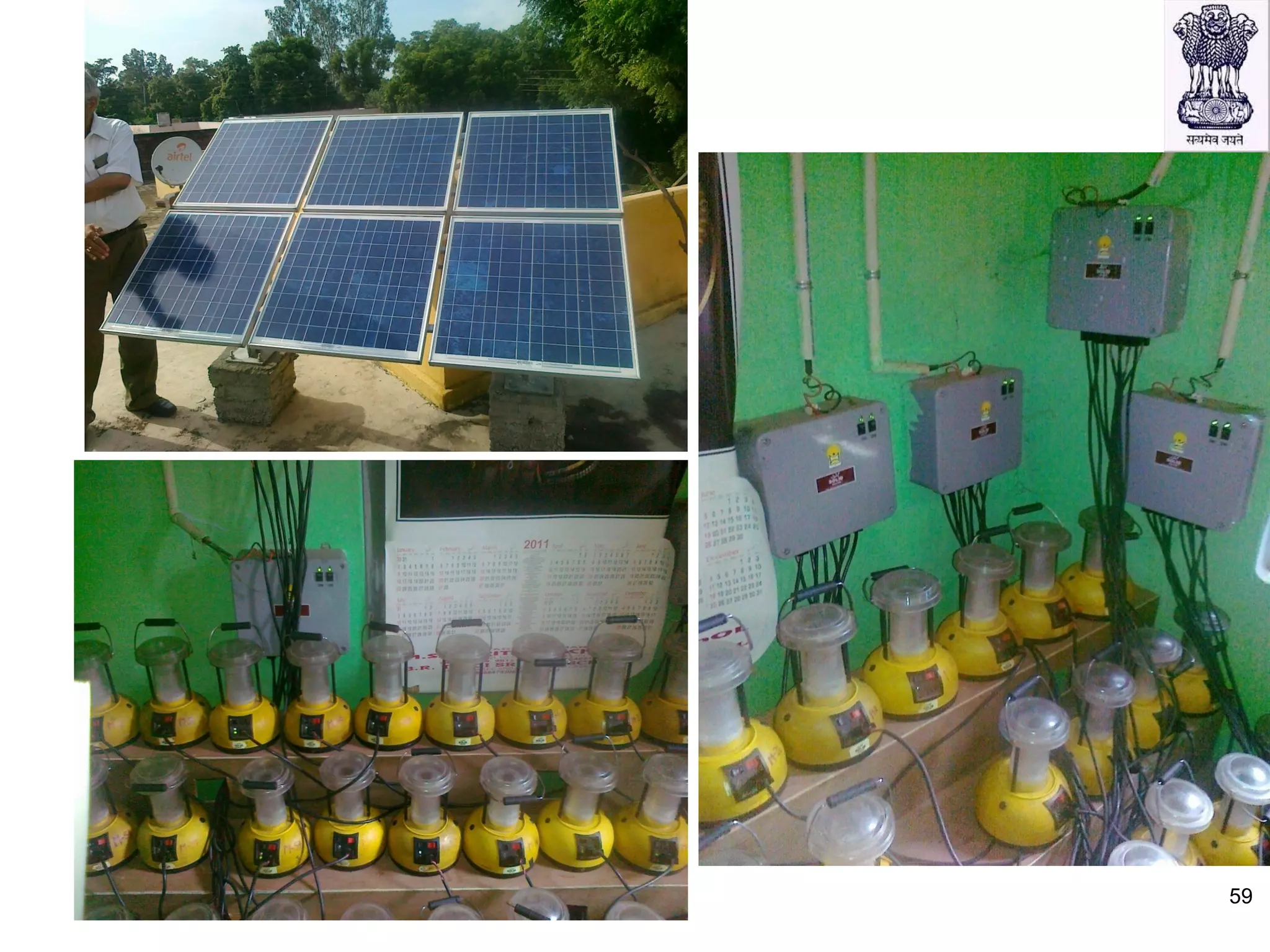
Solar Lanterns
57
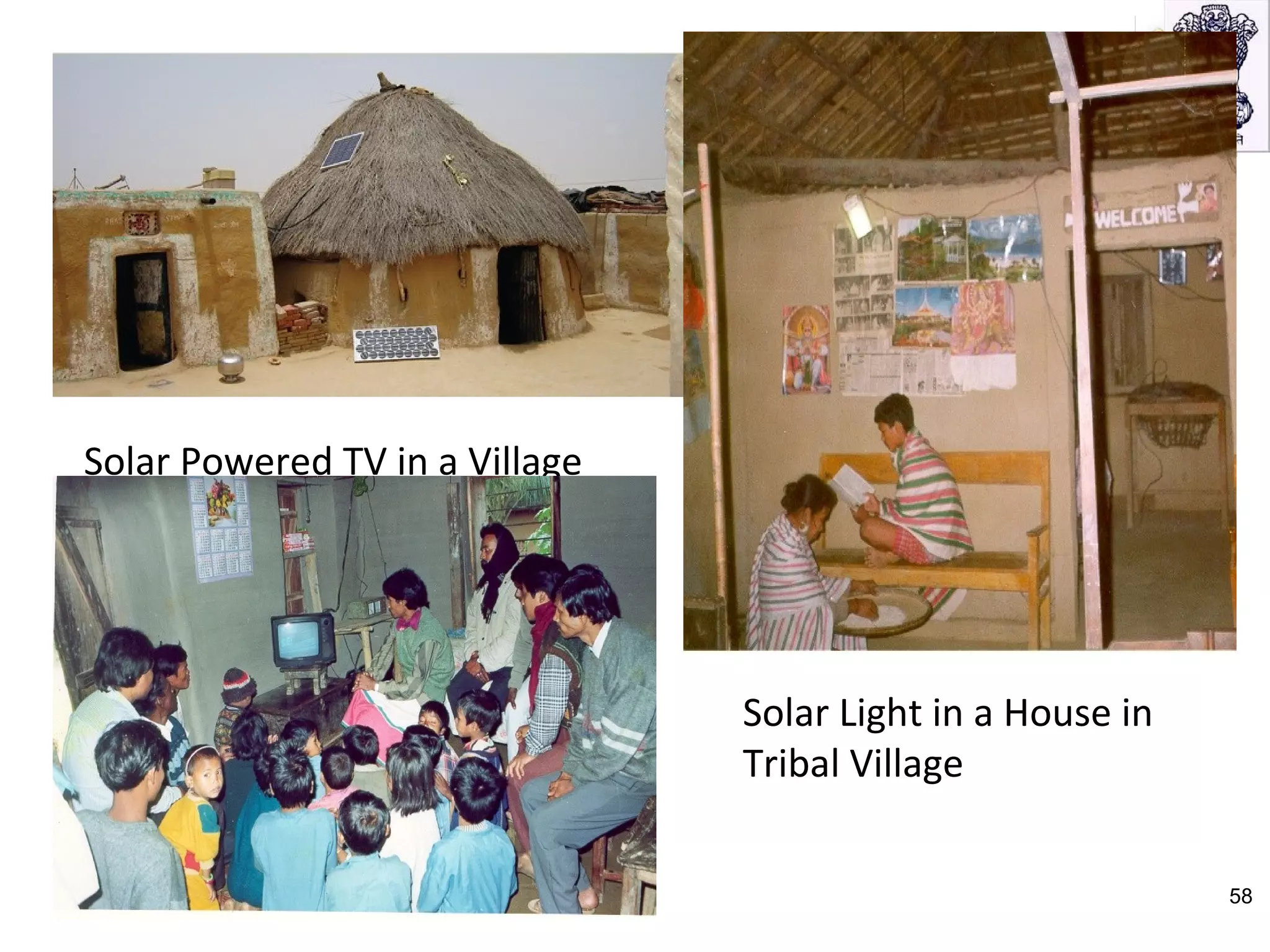
Solar Powered TV in a Village
Solar Light in a House in
Tribal Village
58
59
Solar home lighting, TV
and street lighting
systems
60
61
Solar pump set and blinker
62
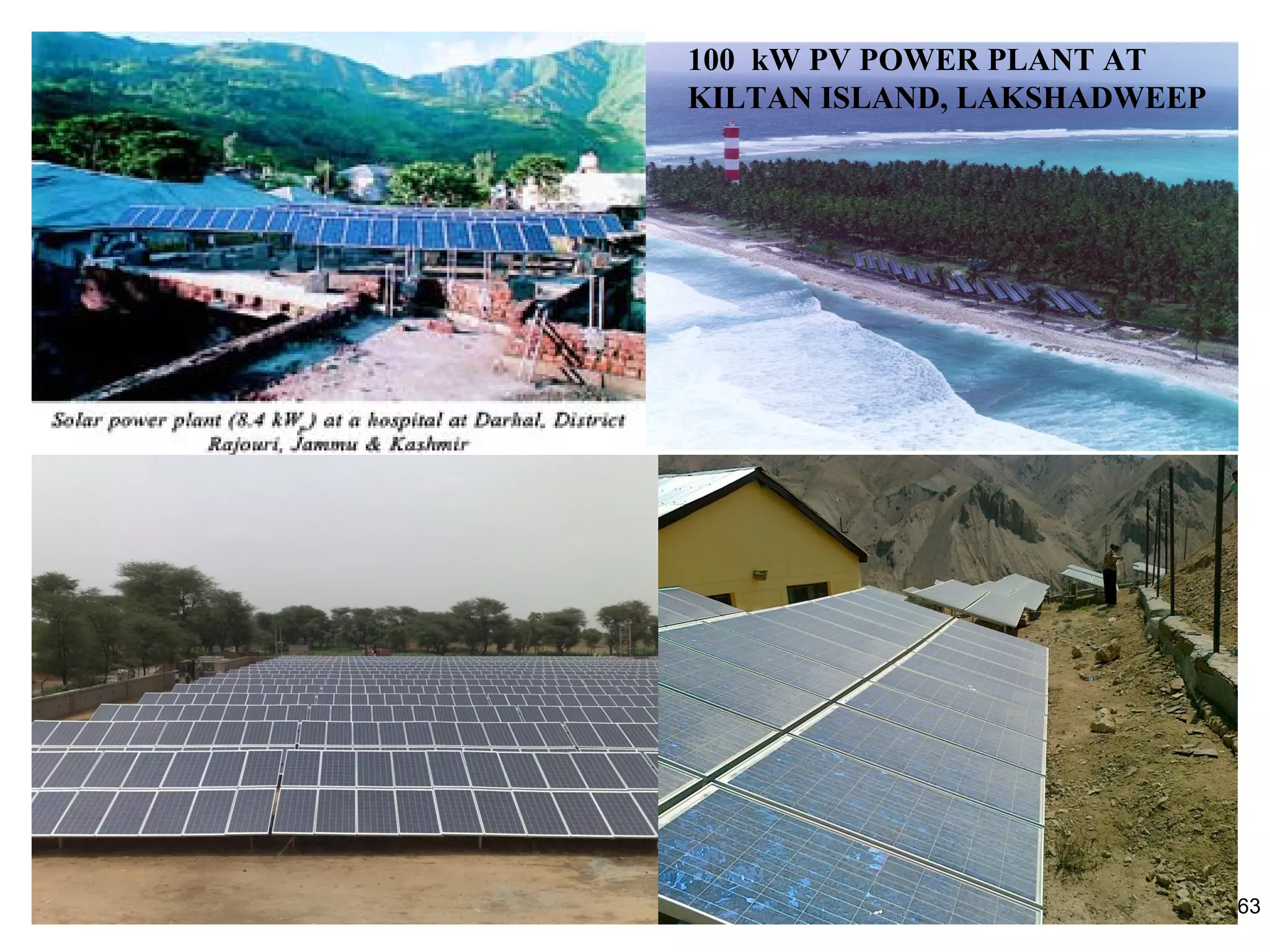
100 kW PV POWER PLANT AT
KILTAN ISLAND, LAKSHADWEEP
63
64

A n srivastava

  • 1.
    Jawaharlal Nehru NationalSolar Mission Ministry of New and Renewable Energy Government of India Electronics Manufacturing Conclave New Delhi 16th January 2013 1
  • 2.
    Indian Power Sector(30-11-2012) Thermal 1,40,976 MW Hydro 39,324 MW Nuclear 4,780 MW Renewable 25,856 MW 2
  • 3.
    Renewable Power Capacity Wind 17,353MW Small Hydro 3,396 MW Solar 1,176 MW Biomass 3,225 MW 3
  • 4.
    India’s Energy Challenge Innext 12 years India’s electricity requirement to grow 2.5 times Climate Change is also an important issue India is dependent on oil imports for 80% of its demand 400 Million people still without access to electricity Electricity shortage estimated at 25- 35 GW 4
  • 5.
    Answer is RenewableEnergy. Why? Renewable energy resources are being replaced / generated at the same rate that they are being utilised. Hence, these will last indefinitely . Resources are indigenous – contribute to energy security Good for the environment both locally and globally – clean energy Increase modern energy access to rural, isolated and low income populations Can be utilized in decentralized, distributed manner and meet these needs Creates employment and income Low gestation period 5
  • 6.
    Wind, Solar, Biomass, Hydro GreenBuildings/ campus, Solar water heaters, Solar Cooking units, Rooftop solar, Kitchen waste Off grid technologies like Solar water pumps and lighting, biomass gasifiers, Biogas plants, efficient cook stove Biofuels and battery operated vehicles (in future) RE in Different Sectors of Indian Economy Solar water heaters, Solar PV, Process heat, Green buildings, Co-generation 6
  • 7.
  • 8.
    8 Renewable Power Growth Startof 10th Plan (MW) Start of 11th Plan (MW) Target 11th Plan (MW) 11th plan Achvmnt. till 31.08.11 (MW) Cumulative Achvmnt. up to 31.8.11 (MW) Wind power 1,628 7,092 9,000 7,897 14,989 Small Hydro 1,434 1,976 1,400 1,178 3,154 Bio power* 389 1,184 1,780 1,752 2,936 Solar 2 3 50** 43 46 Total 3,452 10,255 12,230 10,870 21,125 *Biomass (agri wastes/ residues) + Bagasse Cogen.+ Urban/industrial wastes ** Up-scaled to 1100 MW by March 2013 under NSM. 8
  • 9.
    Summary of Projectionsfor 2022 Installed Capacities in MW (Cumulative) Source Estimated Potential MWeq. Achievements as on 31.08.11 Aim for 2012 Aim for 2017 Aim for 2022 Wind power 49,000 14,989 16,300 31,000 46,000 Small Hydro 15,000 3,154 3,390 5,500 8,000 Biomass Power 16,000 1,084 1,125 1,500 2,500 Bagasse Cogeneration 5,000 1,779 1,866 3,200 4,000 Waste to Power 2,700 74 104 300 800 Solar Power > 1,00,000 46 235 10,000 20,000 TOTAL > 1,87,200 21,126 23,020 55,500 81,300 9
  • 10.
    10 Estimated Contribution toElectricity Mix Source Achievements as on 31.08.11 Aim for 2012 Aim for 2017 Aim for 2022 Renewable Power - MW - BU/annum 21,125 48 23,000 51 55,500 96 81,300 166 Conventional Power - MW -BU/annum @75% PLF 1,60,195 1052 1,78,000 1170 2,63,000 1728 3,63,000 2385 Total 1,81,320 1100 2,01,000 1221 3,08,500 1824 4,44,300 2551 Contribution to- Installed capacity: Electricity Mix: 11.65% 4.36 % 11.44% 4.18% 14.75% 5.26% 18.30% 6.51%
  • 11.
    Jawaharlal Nehru NationalSolar Mission (JNNSM) • One of the eight Missions under National Action Plan on Climate Change • Launched by the Government of India in January 2010. • JNNSM is one of the major global initiatives in promotion of solar energy technologies. • Mission aims to achieve grid tariff parity by 2022 through  Large-scale utilization, rapid diffusion and deployment at a scale which leads to cost reduction  R&D, Pilot Projects and Technology Demonstration  Local manufacturing and support infrastructure 11
  • 12.
    Mission Road Map ApplicationSegment Target for Phase I (2010-13) Cumulative Target for Phase 2 (2013-17) Cumulative Target for Phase 3 (2017-22) Grid solar power (large plants, roof top & distribution grid plants) 1,100 MW 10,000 MW 20,000 MW Off-grid solar applications 200 MW 1,000 MW 2,000 MW Solar Thermal Collectors (SWHs, solar cooking/cooling, Industrial process heat applications etc.) 7 million sq. meters 15 million sq. meters 20 million sq meters Solar Lighting System 5 million 10 million 20 million 12
  • 13.
     Regulatory measures-RPO/REC  Supporting grid connected projects to bring volumes and reduce prices  Finacial support for off-grid  Support R&D in India  Encourage manufacturing  HR development Policy and Regulatory Support 13
  • 14.
    JNNSM: Phase-I, Batch-I SchemeProjects allotted Projects Commissioned Minm / Maxm / Weighted Avg. bid tariff % Reduction in tariff No. MW No. MW Large PV projects through NVVN 30 150 26 130 10.95/12.76/12.16 Rs. / Unit 32 % 2 Projects Cancelled Migration Scheme SPV 13 54 11 48 CERC applicable tariff ST 3 30 1 2.5 RPSSGP Scheme (PV) 78 98.05 69 88.80 CERC linked tariff Solar Thermal projects through NVVN 7 470 Scheduled for commissioning by May 2013 10.49/12.24/11.48 Rs. / Unit 25 % 14
  • 15.
    JNNSM : Phase-I,Batch-II Scheme Projects allotted Projects Commissioned Minimum bid tariff Maximum bid tariff Weighted Average bid tariff % Reduction in tariffNo. MW No. MW Large PV projects through NVVN 28 350 Scheduled for commissioning by Feb. 2013 7.49 Rs. / Unit 9.44 Rs. / Unit 8.77 Rs. / Unit 43 % Three Projects totaling 20 MW have been commissioned in December, 2012. 15
  • 16.
    State/UT MW State/UTMW Andhra Pradesh 21.75 Punjab 9.325 Arunachal Pradesh 0.025 Kerala 0.025 Chhattisgarh 4.0 Rajasthan 200.15 Gujarat 824.09 Tamil Nadu 16.05 Haryana 7.8 Uttar Pradesh 12.375 Jharkhand 16.0 Uttarakhand 5.05 Karnataka 14.0 West Bengal 2.05 Madhya Pradesh 7.35 Andaman & Nicobar 0.1 Maharashtra 20.0 Delhi 2.5255 Odisha 12.0 Lakshadweep 0.75 Puducherry 0.025 Others 0.81 TOTAL 1176.2505 State-wise Capacity 16
  • 17.
    State Initiatives S. NoState Solar Specific Programme 1. Gujarat Announced – 968.5 MW Commissioned – 824.09 MW 2. Maharashtra Commissioned – 40 MW (Setup in Rajasthan under RPO) Under installation: 150 MW at Sakri/ Dhule 3. Karnataka Commissioned – 8 MW , Approved plan for 200 MW Bids invited/allotted– 70 MW, Min. tariff – Rs. 7.94/unit Bids to be invited-130 MW 4. Rajasthan Tendered – 200 MW 5. Odisha Announced -50 MW Awarded – 25 MW, Minimum tariff – Rs. 7/unit 6. Madhya Pradesh Awarded– 200 MW Minimum tariff – Rs. 7.90/unit 7. Tamil Nadu Announced – 3000 MW Tendered-1000 MW 8. Andhra Pd. Tendered -1000 MW 17
  • 18.
    Year Target (MW)Projects Sanctioned (MW) 2010-11 32 40.60 2011-12 68 77.471 2012-13 100 55.00 Physical Targets and Achievements (Ph-I) Solar Thermal:  6.17 million sq. meter of solar thermal collector area installed so far (cumulative) against target of 7.0 million sq. meter Off Grid SPV : 18
  • 19.
    Scheme for Off-GridSPV Systems • Under Jawaharlal Nehru National Solar Mission (JNNSM) Ministry is providing Central Finance Assistance (Subsidy) of – 90% of the project cost limited to Rs 243/Wp for Central and State Government Ministries, Departments and their organizations, State Nodal Agencies and Local bodies for North Eastern States and Sikkim . – 30% of the project cost limited to Rs. 81/Wp for other States including individuals, NGOs, industry, commercial organizations, etc. – Limited to a capacity of 1kWp for individual and 100 kWp for commercial / Non-Commercial entities. 19
  • 20.
    Manufacturing  Objectives underJNNSM:  To take a global leadership role in solar manufacturing  4-5 GW equivalent of installed capacity by 2022  Setting up of dedicated manufacturing capacity for poly silicon material to annually make about 2 GW capacity of solar cells  Manufacturing capacity of solar cells and solar modules increased from 200 MW and 650 MW in 2009 to approx. 1000 MW and approx. 1950 MW respectively.  There is no customs & Excise duty on cells and modules; recently, custom duty is also waived on some of the raw materials required to manufacture cells and modules. 20
  • 21.
    Programme Solar PVSolar Thermal Solar Grid connected power projects – Batch 1 Crystalline silicon technology - to use the modules manufactured in India Thin film and CPV technology – allowed to be imported 30% of the total project cost to be indigenous Solar Grid connected power projects – Batch 2 Crystalline silicon technology - to use the cells and modules manufactured in India Thin film and CPV technology – allowed to be imported NA Roof top and small Projects (up to 2 MW) Crystalline silicon technology - to use the modules manufactured in India Thin film and CPV technology – allowed to be imported Off Grid Use of modules manufactured in India. Domestic Content Requirement – Phase-I of JNNSM 21
  • 22.
    Manufacturing capacity ofSolar Cells and Modules in India 2012 Numbers Existing MW Capacity Companies Cells Module Access Solar 18 Ajit Solar 20 Alpex 35 Bharat Heavy Electricals Limited (BHEL) 8 8 CEL 10 EMMVEE Solar 120 Euro Multivision Ltd. 40 Evergreen 20 Enfield Solar 20 Green Brilliance 45 HHV 50 Indosolar Ltd 360 Jupiter Solar 45 KL Solar 7 6 Kotak Urja Pvt. Ltd. 15 Lanco 75 Maharishi Solar Technology 2.5 17 22
  • 23.
    2012 Numbers ExistingMW Capacity Companies Cells Module Microsol 14 Moser Baer 250 280 Photon Energy Systems 50 photonix 15 PLG Power 100 Premier Solar Systems (P) Ltd. 30 Rajasthan Electronics & Instruments Ltd. 2 2 Reliance Industries Ltd 30 Shurjo 5 Solar Semiconductor 30 195 Surana Ventures 40 TATA BP Solar 96 125 Titan Energy 100 TopSun Energy 5 UPV Solar - Udhaya Energy Photovoltaics Pvt Ltd 12 7 USL Photovoltaics PVT Ltd. 6 10 Vikram Solar 100 Waaree Energy 60 Websol Energy System Limited 120 100 XL Energy Ltd. 60 210 Total 1,038.50 1,937.00 23
  • 24.
    Historical Module PriceTrend: prices fall as the production increases 24
  • 25.
    Source: PV Insights PVModule Prices have fallen drastically in last 24 months 25
  • 26.
    Market Price ofModules depends on the End-User Regions Source: HIS-iSupply November 2012 Canada and Japan has highest module prices, China is lowest Septem ber October November Three- Month Forecast EU $ 0.65 $ 0.63 $ 0.63 $ 0.60 US $ 0.71 $ 0.69 $ 0.68 $ 0.67 Canada $ 0.91 $ 0.96 $ 0.94 $ 0.92 China $ 0.59 $ 0.58 $ 0.57 $ 0.55 Japan $ 0.84 $ 0.82 $ 0.81 $ 0.80 ROW $ 0.67 $ 0.65 $ 0.64 $ 0.63 IHS Solar Figure: PV c-Si Module Worldwide Average Price by End-User Region (Pricing in US Dollar per Watt) Source: IHS Solar November 2012 26
  • 27.
    87% of theglobal production is based on crystalline silicon Global Production: Technology Mix 27
  • 28.
    PV technologies deployedin the Indian Market vis-à-vis that globally PV Installations-Globally 28
  • 29.
    PV technologies deployedin the Indian Market vis-à-vis that globally PV Installations-India 29
  • 30.
    Ground Measurement ofSolar Radiation Andhra Pradesh 6 Gujarat 11 Haryana 1 Madhya Pradesh 3 Karnataka 5 Rajasthan 12 Chhattisgarh 1 Ladakh 1 Maharashtra 3 Pudducherry 1 Tamil Nadu 6 • C-WET is implementing the project for setting up 51 ground monitoring stations • Centralized data collection, analysis and calibration of measuring sensors 30
  • 31.
    Salient Features ofDraft Policy (Ph-II) • 10 GW utility scale solar power capacity (cumulative) by end of Phase-II (March 2017): 4 GW under central scheme and 6 GW under various State specific schemes. • Continuation of scheme to support off-grid solar applications to reach 1000 MW aggregate capacity by 2017. • Target of 15 million sq. m. solar collectors area (cumulative) by 2017. 31
  • 32.
    Grid-connected :Target &Thrust Areas Cumulative target:  10,000 MW (by March 2017) -4,000 MW under Central schemes -6,000 MW under States initiatives Thrust areas:  Development of T&D network  Developing cluster of Solar Parks to reduce costs  Grid-connected Roof-top  Achieving grid parity at the earliest 32
  • 33.
    Grid-connected : Planfor Central Schemes • Bundling Scheme: (500 MW, PV) Bundle relatively expensive solar power with power from the unallocated quota of Government of India (MoP). Advantages:  Successful implementation experience during Phase-I of JNNSM.  Weighted average cost of bundled power is below Rs 5 per unit and utilities are ready to by power at this rate.  NVVN as the single off- taker of Solar power. • Viability Gap Funding : The scheme provides financial support in form of Grants, one time or deferred, to infrastructure projects with a view to make commercially viable.  Bidder would bid for viability gap for funding in Rs. per MW and the bidder with minimum VGF requirement would be selected. Cont... 33
  • 34.
    Advantages: Procedural simplicity With upfrontavailability of part of capital cost, cost of financing would be lower Disadvantage: With upfront payment of VGF, long term performance of the project could be an issue. VGF financing plan: 25% at the time of delivery of at least 50% of the major equipment at site . This would be based on the cost of total procurement. 50% on successful commissioning of the full capacity of the plant. Balance 25% after one year of operation meeting requirements of generation as per guidelines. Target under VGF : Photovoltaic - 1500 MW Thermal - 500 MW Ladakh - 250 MW Total 2250 MW Cont... 34
  • 35.
    • Solar Parks(250 MW):  Solar parks would include all required facilities for generation of power at one location i.e. evacuation and transmission infrastructure, solar radiation monitoring station, water availability, access roads to the park, interior road in the park, telecommunication facility, fire station, Green belt, security, manufacturing facilities, testing and characterization  Following items of work will be supported:  Detailed Project Report- Support up to 50% of the cost, limited to Rs. 5 crore per park is proposed.  Setting up of Transmission Infrastructure- Support up to 40% of the cost as per norms of National Clean Energy funds is proposed.  Civil Infrastructure Development- Support up to 50% of the cost , limited to Rs. 10 crore per park is proposed.  Technical Assistance- Support up to Rs. 1 crore per park is proposed.  Solar Radiation Monitoring Station- If not installed, will be setup through MNRE programme based on 100% support. 35
  • 36.
    Off-Grid: Targets/Thrust Areas Target: 800 MW Thrust areas:  Energy Access:  Rural areas in the country mainly lack in distribution infrastructure. The utilities, not in good financial state, are not in a position to afford major fixed cost.  During Phase-II, it envisaged that around 20,000 villages/hamlets/basti/padas shall be covered through ‘Energy Access’ scheme by way of deployment of Off-Grid electricity generation projects. Cont... 36
  • 37.
     Telecom Towers: India currently has more than 3.10 lakh telecom towers, 60% of their power requirements are met by diesel generators which together consume about 2 billion liters of diesel fuels each year and result in 5.3 million tons of CO2 emission.  Phase-II of JNNSM targets around 25000 solar integrated telecom towers.  Water Pumping:  Solar PV water pumping systems are used for irrigation and drinking water in India. Solar pumps are constituted by an array of solar panels and are developed to operate on DC power produced by solar panels.  Phase-II of JNNSM targets deployment of around 25000 solar pumps.  Off-Grid lighting System:  This will include solar lanterns, home lighting systems with batteries and solar street lights .  Phase-II of JNNSM targets deployment of around 10,00,000 Off-Grid lighting systems. Cont... 37
  • 38.
     Solar WaterHeating Systems:  In domestic category, hot water is typically required for bathing while in industrial category it is used pre-heating process.  Phase-II targets at least 115 to 20 cities where solar water heaters would become the main source of heating water replacing electric geysers. Phase-II would target around 8 million Sq. Mt. of collector area.  Air Conditioning/Refrigeration:  Huge amount of fuel oil is being used for cooling through Vapour Absorption Machine in industries/establishments where power cuts/electricity tariff are. 38
  • 39.
    Options Considered forDomestic Content Requirement During Phase-II • Option-1: For all PV projects, cells and modules produced in India shall be used. • Option-2: Price preference for domestic manufactured cells/modules. • Option-3: Percentage of domestic content in cost terms (say 50%) for both PV and thermal technologies. • Option-4: Percentage of cells manufactured in India. • Option-5: some batches with 100% domestic content requirement. • Option-6: For thermal technologies material equivalent to 50% of supply cost (excluding land, taxes, erection, financing, soft cost, etc) should be manufactured in India during Phase-II. 39
  • 40.
    ISSUES Enforcement of RPOs -RegulatoryMeasures -Amendment of Electricity Act Strengthening of Transmission network for Renewables - Plan by PGCIL Unallocated power for bundling NCEF funds for VGF Import duty concessions for inputs Incentives for Manufacturing: M-SIPS Funding of Solar projects by Banks 40
  • 41.
    1 MW PVPlant at Osamabad 41
  • 42.
    1 MW SPVPlant at Hissar in Haryana 42
  • 43.
    1 MW SPV(Crystalline Silicon) Power Plant at New Delhi (Solar RPO arrangement) 43
  • 44.
    5 MWp SPVPlant at Khimsar, Rajasthan 44
  • 45.
    SPV Power Plantat Goshen Drass Kargil (40 kWp) 45
  • 46.
    Sun Edison -5MW Plant at Bikaner, Kolayat, Rajasthan 46
  • 47.
    Greentech Power -5MW Plant at Jodhpur, Phalodi, Rajasthan 47
  • 48.
    Amrit Energy -5MW Plant at Jaiselmer, Pokaran, Rajasthan 48
  • 49.
    Punj Lloyad -5MW Plant at Jodhpur, Rajasthan 49
  • 50.
    Solar Steam GenerationSystem at ITC Hotel, New Delhi 50
  • 51.
  • 52.
    Community Solar Cookerfor indoor Cooking (Scheffler) Outside view (Top) Inside view of kitchen (bottom) 52
  • 53.
    Solar Water HeatingSystems Salient Features • A commercially viable technology • Can provide hot water at 60- 80o C. Integrated with storage tank & electrical back up. • Saves electricity or furnace oil • Pays back cost in 3 - 4 years. • Suitable for homes, hotels, hospitals, hotels, guest houses, institutions, dairies, industry etc. • Techno-economic potential: 40 million sq. m. of collector area i.e. 2 billion liters of hot water per day FPC based system ETC based system 53
  • 54.
  • 55.
  • 56.
    Solar Air HeatingSystem, Rajasthan Solar Air Heating System, Laddakh 56
  • 57.
  • 58.
    Solar Powered TVin a Village Solar Light in a House in Tribal Village 58
  • 59.
  • 60.
    Solar home lighting,TV and street lighting systems 60
  • 61.
  • 62.
    Solar pump setand blinker 62
  • 63.
    100 kW PVPOWER PLANT AT KILTAN ISLAND, LAKSHADWEEP 63
  • 64.

Editor's Notes

  • #5 A general introduction to Indian Energy Scenario. Self explanatory in nature.   Introduce the viewer to the energy gap prevalent in India, all areas of Shortage, Access, Security, Need for action for Climate Change and also Demand Management
  • #6 One of course, must ask the question These are some of the important reasons One can then ask the question, if it is so good. Why not more? These are 2 fundamental problems – which we will come to later again: It is infirm power – solar when the sun is shining and wind when it blows. Its cost – above thermal power and solar very much more. How do we pay for it. Its initial capital cost – reluctance to install.  
  • #14 A Comprehensive Strategy for Solar Mission has been devised