Prepared By:
Puthawala MohdYamin .S.:180670720017
Soil Structure
Interaction
Structural
Engineering (Sem2)
Design of Masonry
Structures
(3722019)
 Introduction
 Advantages
 Types of interaction
 Degree of influence of SSI
 General method of analysis
 Analysis w.r.t software
 References
 SSI-The process in which the response of the
soil influences the motion of the structure and
the motion of the structure influences the
response of the soil is termed as SSI.
 Traditional Structural Engineering methods
disregard SSI effects.
 SSI effects become prominent and must be
regarded for structures where P-δ effects play a
significant role.
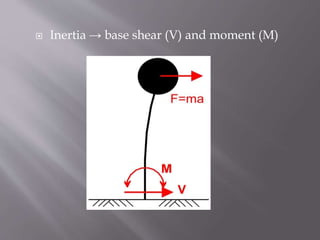
 Inertia → base shear (V) and moment (M)
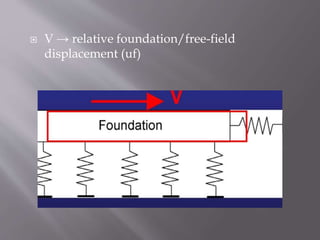
 V → relative foundation/free-field
displacement (uf)
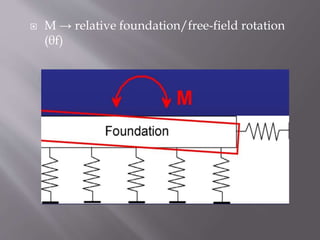
 M → relative foundation/free-field rotation
(θf)
 Considering soil-structure interaction makes a
structure more flexible and thus increases the
natural period of the structure as compared to
the corresponding rigidly supported structure.
 Considering the SSI effect increases the
effective damping ratio of the system
(Superstructure + Foundation + Soil ).
 Inertial soil structure interaction
 Kinematic interaction
 Foundation deformations
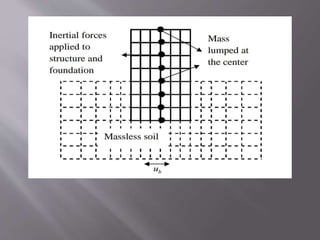
 Inertia from vibration of structure and
foundation Causes foundation translation and
rotation (uf and θf).
 Directly affects system flexibility and mode
shapes.
 Introduces foundation damping.
 Incoherent ground motions → base slab
averaging.
 Ground motion reductions with depth.
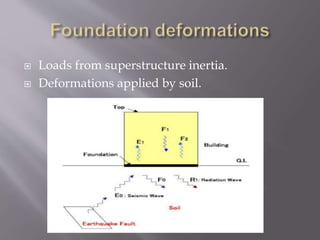
 Loads from superstructure inertia.
 Deformations applied by soil.
 The degree of Influence of SSI on response of
structure depends on the following factors
 Stiffness of soil.
 Dynamic Characteristics of structure itself i.e.
Natural Period and damping factor.
 Stiffness and mass of structure.
 Direct Method
 Sub-Structure Method
 In this soil, structure and foundation is
modeled together using finite element method
(FEM).
 The ground motion is specified as free field
motion and is applied at all boundaries.
 The nodes along the soil-structure interface are
denoted by subscript f (foundation).
 The nodes of the structure are denoted by st .
 The nodes along the interior foundation
medium/soil are denoted by s .
ma+cv+kx=Mg(m,c,k
are vector quantities)
 The good representation of damping matrix is
difficult.
 If the superstructure is modeled as 3D system,
the problem size becomes very large and the
modeling of soil/foundation – structure
interface becomes complex.
 It is computationally more efficient than the direct
method as most of the disadvantages of the direct
method can be removed.
 In this method the effective input motion is
expressed in terms of free-field motions of the soil
layer initially.
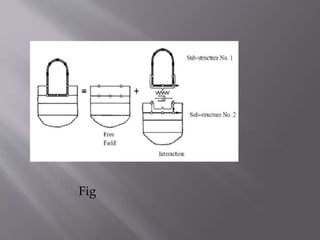
 In continuation to this step, the soil/foundation
medium and the structure are represented as two
independent mathematical models or
substructures as shown in Fig.
Fig
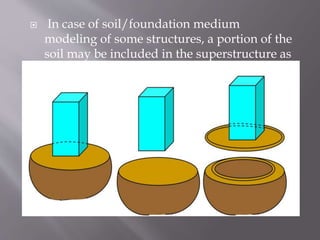
 In case of soil/foundation medium
modeling of some structures, a portion of the
soil may be included in the superstructure as
shown in Fig.
 Three-dimensional finite difference models
were developed with the software FLAC3D.
 This analysis is done in highly compressible
very soft clay.
 This type of soil is present in Mexico City
valley.
3D view of the building
Settlements observed
U/U0 ratio of
settlements
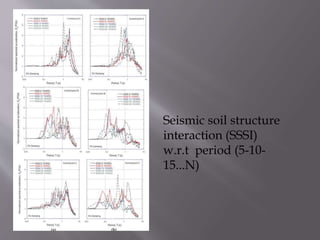
Seismic soil structure
interaction (SSSI)
w.r.t period (5-10-
15...N)
 Regional subsidence effects on seismic soil-
structure interaction in soft clay(Juan M.
Mayoral Ernesto Castañon, Jorge Albarran)
 Chapter 6 seismic soil structure interaction
notes|EduRev
 Resonance effect on structures subjected to
earthquake loads due to soil structure
interaction (Saja Mokhles Al Smadi)
Soil Structure Interaction

Soil Structure Interaction

  • 1.
    Prepared By: Puthawala MohdYamin.S.:180670720017 Soil Structure Interaction Structural Engineering (Sem2) Design of Masonry Structures (3722019)
  • 2.
     Introduction  Advantages Types of interaction  Degree of influence of SSI  General method of analysis  Analysis w.r.t software  References
  • 3.
     SSI-The processin which the response of the soil influences the motion of the structure and the motion of the structure influences the response of the soil is termed as SSI.  Traditional Structural Engineering methods disregard SSI effects.  SSI effects become prominent and must be regarded for structures where P-δ effects play a significant role.
  • 4.
     Inertia →base shear (V) and moment (M)
  • 5.
     V →relative foundation/free-field displacement (uf)
  • 6.
     M →relative foundation/free-field rotation (θf)
  • 7.
     Considering soil-structureinteraction makes a structure more flexible and thus increases the natural period of the structure as compared to the corresponding rigidly supported structure.  Considering the SSI effect increases the effective damping ratio of the system (Superstructure + Foundation + Soil ).
  • 8.
     Inertial soilstructure interaction  Kinematic interaction  Foundation deformations
  • 9.
     Inertia fromvibration of structure and foundation Causes foundation translation and rotation (uf and θf).  Directly affects system flexibility and mode shapes.  Introduces foundation damping.
  • 11.
     Incoherent groundmotions → base slab averaging.  Ground motion reductions with depth.
  • 12.
     Loads fromsuperstructure inertia.  Deformations applied by soil.
  • 13.
     The degreeof Influence of SSI on response of structure depends on the following factors  Stiffness of soil.  Dynamic Characteristics of structure itself i.e. Natural Period and damping factor.  Stiffness and mass of structure.
  • 14.
     Direct Method Sub-Structure Method
  • 15.
     In thissoil, structure and foundation is modeled together using finite element method (FEM).  The ground motion is specified as free field motion and is applied at all boundaries.  The nodes along the soil-structure interface are denoted by subscript f (foundation).  The nodes of the structure are denoted by st .  The nodes along the interior foundation medium/soil are denoted by s .
  • 16.
  • 17.
     The goodrepresentation of damping matrix is difficult.  If the superstructure is modeled as 3D system, the problem size becomes very large and the modeling of soil/foundation – structure interface becomes complex.
  • 18.
     It iscomputationally more efficient than the direct method as most of the disadvantages of the direct method can be removed.  In this method the effective input motion is expressed in terms of free-field motions of the soil layer initially.  In continuation to this step, the soil/foundation medium and the structure are represented as two independent mathematical models or substructures as shown in Fig.
  • 19.
  • 20.
     In caseof soil/foundation medium modeling of some structures, a portion of the soil may be included in the superstructure as shown in Fig.
  • 21.
     Three-dimensional finitedifference models were developed with the software FLAC3D.  This analysis is done in highly compressible very soft clay.  This type of soil is present in Mexico City valley.
  • 22.
    3D view ofthe building Settlements observed
  • 23.
  • 24.
    Seismic soil structure interaction(SSSI) w.r.t period (5-10- 15...N)
  • 25.
     Regional subsidenceeffects on seismic soil- structure interaction in soft clay(Juan M. Mayoral Ernesto Castañon, Jorge Albarran)  Chapter 6 seismic soil structure interaction notes|EduRev  Resonance effect on structures subjected to earthquake loads due to soil structure interaction (Saja Mokhles Al Smadi)