

10 th  B Roll No.-22 Topic-Soil Priyanka Sagar
The thin layer of grainy substance covering the surface of the earth is called soil. 2. Soil is the upper layer of the crust and is closely linked to the land. 3. Landform determine the type of soil. Soil
 
Factors affecting soil formation Climate Vegetation Age of rock Relief and Parent rock
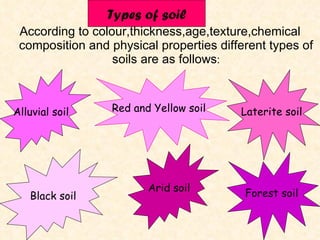
According to colour,thickness,age,texture,chemical composition and physical properties different types of soils are as follows: According to colour,thickness,age,texture,chemical composition and physical properties different types of soils are as follows : Alluvial soil Red and Yellow soil Laterite soil Black soil Arid soil Forest soil Types of soil
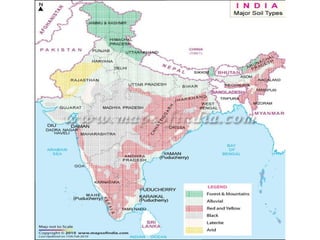
Major soil types
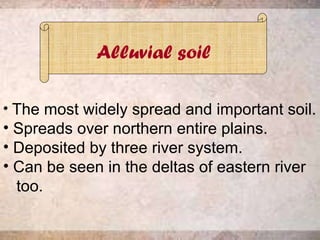
Alluvial soil The most widely spread and important soil. Spreads over northern entire plains. Deposited by three river system. Can be seen in the deltas of eastern river  too.
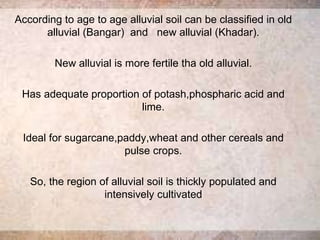
According to age to age alluvial soil can be classified in old alluvial (Bangar)  and  new alluvial (Khadar). New alluvial is more fertile tha old alluvial. Has adequate proportion of potash,phospharic acid and lime. Ideal for sugarcane,paddy,wheat and other cereals and pulse crops. So, the region of alluvial soil is thickly populated and intensively cultivated
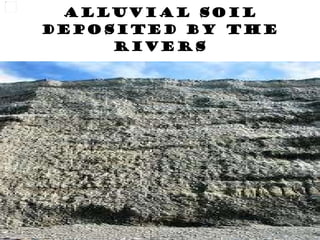
Alluvial Soil deposited by the rivers
The soil is  black  in colour and it is volcanic in origin. Created from igneous rock, and is called ‘ regur soil ’. It is ideal for growing cotton and so called  black cotton soil . Black soil covers part of  Maharashtra,Saurashtra,Malwa, Madhya Pradesh  and  Chattisgarh Black soil
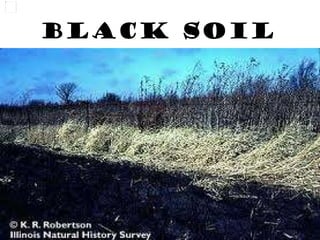
Black Soil
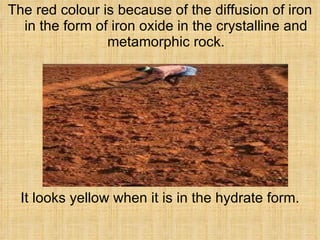
Red and Yellow Soil develops on crystalline igneous rock in the areas of low rainfall in the eastern and southern part of  Deccan Plateau Also found in parts of  Orissa, Chattisgarh,south  of  middle Ganga Plain  and the  eastern piedmont zone of western Ghats Red and Yellow soil
The red colour is because of the diffusion of iron in the form of iron oxide in the crystalline and metamorphic rock. It looks yellow when it is in the hydrate form.
 

soil

  • 1.
  • 2.
    10 th B Roll No.-22 Topic-Soil Priyanka Sagar
  • 3.
    The thin layerof grainy substance covering the surface of the earth is called soil. 2. Soil is the upper layer of the crust and is closely linked to the land. 3. Landform determine the type of soil. Soil
  • 4.
  • 5.
    Factors affecting soilformation Climate Vegetation Age of rock Relief and Parent rock
  • 6.
    According to colour,thickness,age,texture,chemicalcomposition and physical properties different types of soils are as follows: According to colour,thickness,age,texture,chemical composition and physical properties different types of soils are as follows : Alluvial soil Red and Yellow soil Laterite soil Black soil Arid soil Forest soil Types of soil
  • 7.
  • 8.
    Alluvial soil Themost widely spread and important soil. Spreads over northern entire plains. Deposited by three river system. Can be seen in the deltas of eastern river too.
  • 9.
    According to ageto age alluvial soil can be classified in old alluvial (Bangar) and new alluvial (Khadar). New alluvial is more fertile tha old alluvial. Has adequate proportion of potash,phospharic acid and lime. Ideal for sugarcane,paddy,wheat and other cereals and pulse crops. So, the region of alluvial soil is thickly populated and intensively cultivated
  • 10.
  • 11.
    The soil is black in colour and it is volcanic in origin. Created from igneous rock, and is called ‘ regur soil ’. It is ideal for growing cotton and so called black cotton soil . Black soil covers part of Maharashtra,Saurashtra,Malwa, Madhya Pradesh and Chattisgarh Black soil
  • 12.
  • 13.
    Red and YellowSoil develops on crystalline igneous rock in the areas of low rainfall in the eastern and southern part of Deccan Plateau Also found in parts of Orissa, Chattisgarh,south of middle Ganga Plain and the eastern piedmont zone of western Ghats Red and Yellow soil
  • 14.
    The red colouris because of the diffusion of iron in the form of iron oxide in the crystalline and metamorphic rock. It looks yellow when it is in the hydrate form.
  • 15.