Farming:
Conventional and
Sustainable Practices
Prepared by:
Salwa U. Amanoden
MST- General Science
Learning Outcomes!
Describe the components of soil.
Explain the ways we use and abuse soils.
Outline some of the other key sources
for agriculture.
Discuss our principal pests and
pesticides,
List and discuss the environmental
effects of pesticides.
Explain several strategies for soil
conservation.
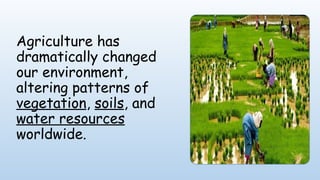
Agriculture has
dramatically changed
our environment,
altering patterns of
vegetation, soils, and
water resources
worldwide.
Soil is both a
finite resource
and depleting
resource.
Over time, soil
is renewable
because it
develops
gradually
through
weathering of
bedrock.
And through
the
accumulation
of organic
matter, such
as decayed
leaves and
plant roots.
But most
farming
techniques
deplete soil.
Such as
plowing and
annual
harvests.
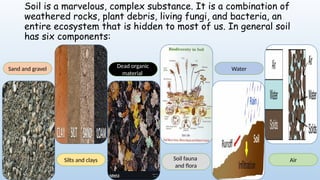
Soil is a marvelous, complex substance. It is a combination of
weathered rocks, plant debris, living fungi, and bacteria, an
entire ecosystem that is hidden to most of us. In general soil
has six components:
Sand and gravel
Soil fauna
and flora
Silts and clays
Dead organic
material
Water
Air
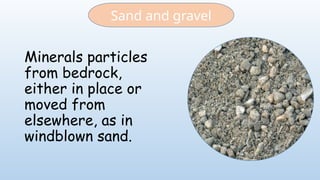
Sand and gravel
Minerals particles
from bedrock,
either in place or
moved from
elsewhere, as in
windblown sand.
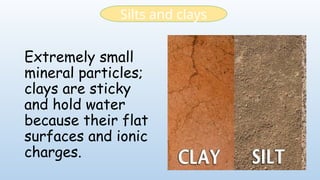
Extremely small
mineral particles;
clays are sticky
and hold water
because their flat
surfaces and ionic
charges.
Silts and clays
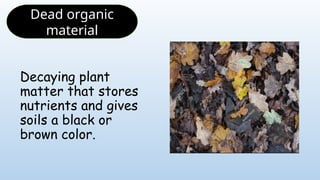
Decaying plant
matter that stores
nutrients and gives
soils a black or
brown color.
Dead organic
material
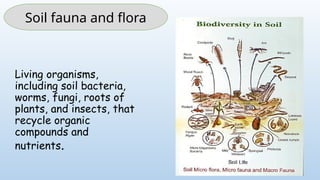
Living organisms,
including soil bacteria,
worms, fungi, roots of
plants, and insects, that
recycle organic
compounds and
nutrients.
Soil fauna and flora
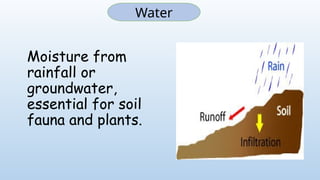
Moisture from
rainfall or
groundwater,
essential for soil
fauna and plants.
Water
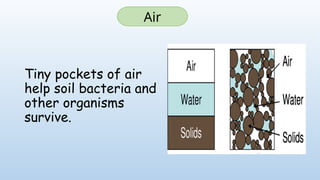
Tiny pockets of air
help soil bacteria and
other organisms
survive.
Air
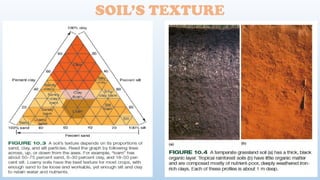
Variations in these components produce almost infinite
variety in the world’s soils.
Abundant clays
-make soil sticky and wet
Abundant organic
material and sand
-make the soil soft and
easy to dig.
Sandy soils
- Drain quickly, often
depriving plants of
moisture.
Silty soils
-silt particles are
larger than clays and
smaller than sand so
they aren’t sticky and
soggy, and they don’t
drain too quickly.
- Ideal for growing
crops.
- They are also light
and blow away easily
when exposed to
wind.
SOIL’S TEXTURE
Healthy Soil fauna can determine fertility
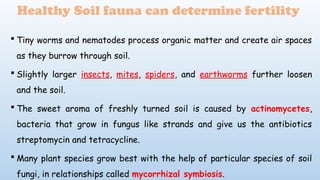
 Tiny worms and nematodes process organic matter and create air spaces
as they burrow through soil.
 Slightly larger insects, mites, spiders, and earthworms further loosen
and the soil.
 The sweet aroma of freshly turned soil is caused by actinomycetes,
bacteria that grow in fungus like strands and give us the antibiotics
streptomycin and tetracycline.
 Many plant species grow best with the help of particular species of soil
fungi, in relationships called mycorrhizal symbiosis.
Healthy Soil fauna can determine fertility
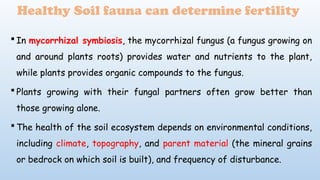
 In mycorrhizal symbiosis, the mycorrhizal fungus (a fungus growing on
and around plants roots) provides water and nutrients to the plant,
while plants provides organic compounds to the fungus.
 Plants growing with their fungal partners often grow better than
those growing alone.
 The health of the soil ecosystem depends on environmental conditions,
including climate, topography, and parent material (the mineral grains
or bedrock on which soil is built), and frequency of disturbance.
Healthy Soil fauna can determine fertility
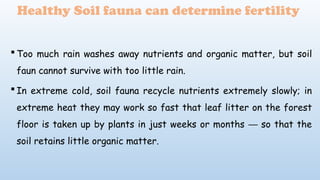
 Too much rain washes away nutrients and organic matter, but soil
faun cannot survive with too little rain.
 In extreme cold, soil fauna recycle nutrients extremely slowly; in
extreme heat they may work so fast that leaf litter on the forest
floor is taken up by plants in just weeks or months so that the
─
soil retains little organic matter.
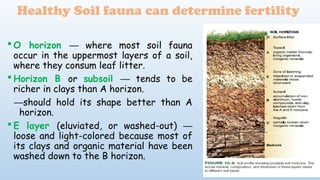
 O horizon where most soil fauna
─
occur in the uppermost layers of a soil,
where they consum leaf litter.
 Horizon B or subsoil tends to be
─
richer in clays than A horizon.
─should hold its shape better than A
horizon.
 E layer (eluviated, or washed-out) ─
loose and light-colored because most of
its clays and organic material have been
washed down to the B horizon.
Healthy Soil fauna can determine fertility
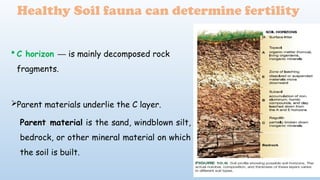
 C horizon is mainly decomposed rock
─
fragments.
Parent materials underlie the C layer.
Parent material is the sand, windblown silt,
bedrock, or other mineral material on which
the soil is built.
Healthy Soil fauna can determine fertility
Your food comes mostly from A horizon
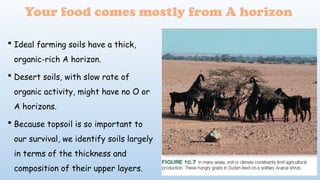
 Ideal farming soils have a thick,
organic-rich A horizon.
 Desert soils, with slow rate of
organic activity, might have no O or
A horizons.
 Because topsoil is so important to
our survival, we identify soils largely
in terms of the thickness and
composition of their upper layers.
Soils vary endlessly in depth, color, and composition.
a) Mollisols (mollic = soft, sol = soil) ─ have a thick, organic-rich A
horizon that developed from the deep, dense roots of prairie grasses
that covered the region (Farm Belt of the United States) until about
150 years ago.
b) Alfisols (alfa = first) have a
─ slightly thinner A horizon than
mollisols do, and slightly less organic matter. Develop in deciduous
forests, where leaf litter is abundant.
Your food comes mostly from A horizon
c) Aridisols (arid = dry) in contrast ardisols of the desert
─
Southwest have little organic matter, and they often contain
accumulations of mineral salts.
Mollisols and Alfisols dominate most of the farming regions of
the United States.
Your food comes mostly from A horizon
 Only about 11 percent of the earth’s land area (1.5 billion ha out of 13.4
billion ha of land area) is currently in crop production.
 In the theory, up to four (4) times as much land could potentially be
converted to cropland, but much of the remaining land is too steep,
soggy, salty, cold, or dry for farming.
 In many developing countries, land continues to be cheaper than other
resources, and forests and grasslands are still being converted to
farmland.
Ways We Use and Abuse Soils
 Other parts of the world, although rich in land area, lack suitable
soil, level land, or climates to sustain good agricultural
productivity.
 In developed countries, 95 percent of recent agricultural growth
in the past century has come from a combination of improved crop
varieties and increased use of fertilizers, pesticides, and
irrigation.
 Conversion of new land to crop fields has contributed relatively
little to increased production.
 Careful management is important for preserving the remaining
farmland.
Ways We Use and Abuse Soils: Arable Land is
Unevenly Distributed
 Agriculture both causes and suffers from soil degradation.
 Every year about 3 million hectares of cropland are made unusable by erosion worldwide.
 4 million hectares are converted to nonagricultural uses, such as urban land, highways,
factories, or reservoirs, according to the International Soil Reference and Information
Center (ISRIC).
 The primary causes of degradation are wind and water.
 Additional causes include chemical deterioration (mainly salt accumulation from salt-laden
irrigation water) and physical deterioration (such as compaction by heavy machinery or
waterlogging.
Ways We Use and Abuse Soils: Soil Losses Reduce
Farm Productivity
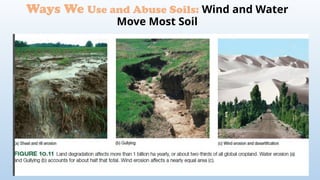
Sheet erosion - A thin layer taken off the land surface.
Rill erosion – when little rivulets of running water gather together and cut
small channels in the soil.
Gully erosion – when rills enlarge to form bigger channels or ravines that are
too large to be removed by normal tillage operations.
Streambank erosion – refers to the washing away of soil from the banks of
established streams, creeks or rivers, often as a result of removing trees and
brush along streambanks and by cattle damage to the banks.
Ways We Use and Abuse Soils: Wind and Water
Move Most Soil
Ways We Use and Abuse Soils: Wind and Water
Move Most Soil
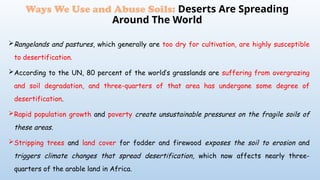
Rangelands and pastures, which generally are too dry for cultivation, are highly susceptible
to desertification.
According to the UN, 80 percent of the world’s grasslands are suffering from overgrazing
and soil degradation, and three-quarters of that area has undergone some degree of
desertification.
Rapid population growth and poverty create unsustainable pressures on the fragile soils of
these areas.
Stripping trees and land cover for fodder and firewood exposes the soil to erosion and
triggers climate changes that spread desertification, which now affects nearly three-
quarters of the arable land in Africa.
Ways We Use and Abuse Soils: Deserts Are Spreading
Around The World
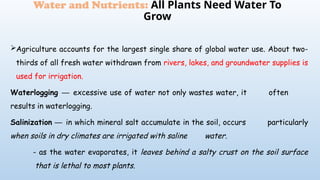
Agriculture accounts for the largest single share of global water use. About two-
thirds of all fresh water withdrawn from rivers, lakes, and groundwater supplies is
used for irrigation.
Waterlogging ─ excessive use of water not only wastes water, it often
results in waterlogging.
Salinization ─ in which mineral salt accumulate in the soil, occurs particularly
when soils in dry climates are irrigated with saline water.
- as the water evaporates, it leaves behind a salty crust on the soil surface
that is lethal to most plants.
Water and Nutrients: All Plants Need Water To
Grow
In addition to water, sunshine, and carbon dioxide, plants need
small amounts of inorganic nutrients for growth.
The major elements required by most plants are nitrogen,
potassium, phosphorus, calcium, magnesium, and sulfur.
Calcium and magnesium often are limited in areas of high rainfall
and must be supplied in the form of lime.
Lack of nitrogen, potassium, and phosphorus even more often
limits plant growth. Adding these elements in fertilizer usually
stimulates growth and greatly increase crop yields.
Water and Nutrients: Plants and Nutrients, But
Not Too Much
Phosphate and nitrates from farm fields and cattle feedlots are a
major cause of aquatic ecosystem pollution.
Nitrate levels in groundwater have risen to dangerous levels in many
areas where intensive farming is practiced.
Manure and green manure (crops grown specifically to add nutrients
to the soil) are important natural sources of soil nutrients.
Nitrogen fixing bacteria living symbiotically in root nodules of
legumes are valuable for making nitrogen available as a plant nutrient.
Interplanting or rotating beans or some other leguminous crop with
such crops as corn and wheat are traditional ways of increasing
nitrogen availability.
Water and Nutrients: Plants and Nutrients, But
Not Too Much
Farming as it is generally practiced in the industrialized countries is
highly energy-intensive.
After crops leave the farm, additional energy is used in food processing,
distribution, storage, and cooking.
It has been estimated that the average food item in the American diet
travels 2, 400 km between the farm that grew it and the person who
consumes it.
The energy required for this complex processing and distribution system
may be five times as much as is used directly in farming.
Water and Nutrients: Farming Is Energy Intensive
Pesticide is a general term for a chemical that kills pests, usually a toxic chemical,
but sometimes we also consider chemicals that drive pests away to be pesticides.
 Some pest-control compounds kill a wide range of living things and are called
biocides.
 Chemicals such as ethylene dibromide that are used to protect stored grain, or to
sterilize soils before planting strawberries, are biocides.
 In addition, there are chemicals aimed at particular groups of pests.
 Herbicides are chemicals that kill plants; insecticides kill insects; and fungicides kill
fungi.
Pests and Pesticides
Using chemicals to control pests may well have been among our earliest
forms of technology.
Sumerians controlled insects and mites with sulfur 5, 000 years ago.
Chinese texts 2, 500 years old describe mercury and arsenic compounds
to control body live and other pests.
Greeks and Romans used oil sprays, ash and sulfur ointments, lime, and
other natural material to protect themselves, their livestock, and their
crops from a variety of pests.
Pests and Pesticides: People Have Always Used Pest
Controls
In addition to these metals and inorganic chemical, people haves
used organic compounds, biological controls, and cultural practices
for a long time.
Alcohol from fermentation and acids in pickling solutions prevent
growth of organisms that would otherwise ruin food.
Spices were valued both for their flavors and because they
deterred spoilage and pest infestations.
Pests and Pesticides: People Have Always Used Pest
Controls
 The era of synthetic organic pesticides began in 1939 when Swiss chemist Paul
Miller discovered the powerful insecticidal properties of dichloro-diphenyl-
trichloroethane (DDT).
DDT is remarkably lethal to a wide variety of insects but relatively nontoxic to
mammals.
By the 1960s, however, evidence began to accumulate that indiscriminate use of DDT
and other long-lasting industrial toxins was having unexpected effects on wildlife.
Peregrine falcons, bald eagles, brown pelicans, and other carnivorous birds were
disappearing from former territories in eastern North America.
Pests and Pesticides: Modern pesticides Provide
Benefits But Also Create Problems
Studies revealed that eggshells were thinning in these species as DDT
and its breakdown products were concentrated through food chains until
it reached endocrine hormone-disrupting levels in top predators.
In 1962 biologist Rachel Carson published Silent Spring, warning that
persistent organic pollutants, such as DDT, pose a threat to wildlife and
perhaps to humans.
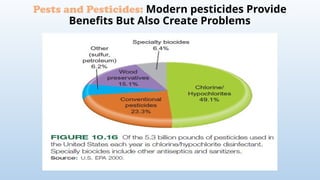
According to EPA, total pesticide use in the United States amounts to
5.3 billion pounds (2.4 million metric tons) per year.
Pests and Pesticides: Modern pesticides Provide
Benefits But Also Create Problems
Pests and Pesticides: Modern pesticides Provide
Benefits But Also Create Problems
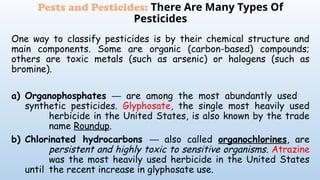
One way to classify pesticides is by their chemical structure and
main components. Some are organic (carbon-based) compounds;
others are toxic metals (such as arsenic) or halogens (such as
bromine).
a) Organophosphates are among the most abundantly used
─
synthetic pesticides. Glyphosate, the single most heavily used
herbicide in the United States, is also known by the trade
name Roundup.
b) Chlorinated hydrocarbons also called
─ organochlorines, are
persistent and highly toxic to sensitive organisms. Atrazine
was the most heavily used herbicide in the United States
until the recent increase in glyphosate use.
Pests and Pesticides: There Are Many Types Of
Pesticides
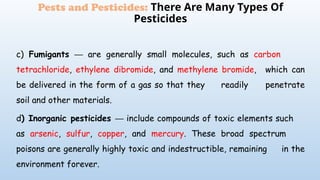
c) Fumigants are generally small molecules, such as
─ carbon
tetrachloride, ethylene dibromide, and methylene bromide, which can
be delivered in the form of a gas so that they readily penetrate
soil and other materials.
d) Inorganic pesticides include compounds of toxic elements such
─
as arsenic, sulfur, copper, and mercury. These broad spectrum
poisons are generally highly toxic and indestructible, remaining in the
environment forever.
Pests and Pesticides: There Are Many Types Of
Pesticides
e) Natural organic pesticides or “
─ botanicals,” generally are
extracted from plants. Some important examples are nicotine
and nicotinoid alkaloids from tobacco, and pyrethrum, a
complex of chemicals extracted from the daisy-like
Chrysanthemum cinerariaefolium.
f) Microbial agents and Biological controls ─ are living organisms
or toxins derived from them that are used in place of pesticides.
A natural soil bacterium, Bacillus thuringiensis is one of the
chief pest-control agents allowed in organic farming. This
bacterium kills caterpillars and beetles by producing toxin that
ruptures the digestive tract lining when eaten.
Pests and Pesticides: There Are Many Types Of
Pesticides
Environmental effects of pesticides
Many pesticides are sprayed broadly and destroy populations of
beneficial insects as well as pests.
The loss of insect diversity has been a growing problem in
agricultural regions: at least a third of the crops we eat rely on
pollinators, such as bees and other invertebrates, to reproduce.
The disappearance of honeybees has received particular attention
in recent years.
Many crops, including squash, tomatoes, peppers, apples, and other
fruit rely on bees for pollination, and it is estimated that the
economic value of bees for pollination is 100 times the value of
their honey.
Pest resurgence, or the rebound of resistant populations, is another
important problem in overuse of pesticides.
As resistant pests evolve, there is an ever-increasing need for
newer, better pesticides this is called the
─ pesticide treadmill.
Glyphosate (Roundup), the dominant herbicide used in the United
States and one of the primary herbicides in Brazil, Australia, and
elsewhere, is no longer effective against a variety of superweeds.
Increasingly farmers are advised to mix tanks of various pesticides
─metachlor, Flexstar, Gramoxone, diuron, and other combinations
are recommended to keep down increasingly aggressive weeds such
as pigweed and rye grass.
Environmental effects of pesticides
Environmental effects of pesticides: POPs
Accumulate in Remote Places
Persistent organic pollutants (POPs)
- Is a collective term for these chemicals, which are stable, easily absorbed into fatty
tissues, and highly toxic.
- Because they persist for years, even decades in some cases, and move freely through
air, water, and soil, they often show up far from the point of original application.
- Because POPs are so long-lasting and so dangerous, 127 countries agreed in 2001 to a
global ban on the worst of them, including aldrin, chlordane, dieldrin, DDT, endrin,
hexachlorobenzene, neptachlor, mirex, toxaphene, polychlorinated biphenyls (PCBs),
dioxins, and furans.
Pesticide effects on human health categories:
(1) Acute effects, including poisoning and illnesses
caused by relatively high doses and accidental
exposures.
(2) Chronic effects suspected to include cancer,
birth defects, immunological problems,
endometriosis, neurological problems, Parkinson’s
disease, and other chronic degenerative disease.
The World Health Organization (WHO) estimates
that 25 million people suffer pesticide poisoning and
at least 20, 000 die each year.
Environmental effects of pesticides: Pesticides
Cause a Variety of Health Problems
 blurred vision
 Nausea
 Headaches
 Conjunctivitis
 Rashes
 Asthma
Also serious chronic
effects:
 Stillbirths
 Miscarriages
 Neurological
problems
To meet demands in North American markets for perfect flowers, table
grapes, and other produce, growers use high levels of pesticides, often
spraying daily with fungicides, insecticides, nematicides, and herbicides.
Working in warm, poorly ventilated greenhouses with little protective
clothing, the workers 70 to 80 percent of whom are women find it hard
─ ─
to avoid pesticide contact.
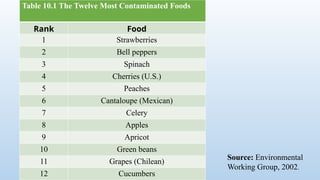
Pesticide use can expose consumers to agricultural chemicals.
Environmental effects of pesticides: Pesticides
Cause a Variety of Health Problems
Source: Environmental
Working Group, 2002.
Table 10.1 The Twelve Most Contaminated Foods
Rank Food
1 Strawberries
2 Bell peppers
3 Spinach
4 Cherries (U.S.)
5 Peaches
6 Cantaloupe (Mexican)
7 Celery
8 Apples
9 Apricot
10 Green beans
11 Grapes (Chilean)
12 Cucumbers
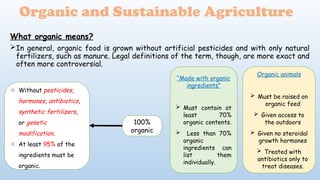
What organic means?
In general, organic food is grown without artificial pesticides and with only natural
fertilizers, such as manure. Legal definitions of the term, though, are more exact and
often more controversial.
Organic and Sustainable Agriculture
100%
organic
o Without pesticides,
hormones, antibiotics,
synthetic fertilizers,
or genetic
modification.
o At least 95% of the
ingredients must be
organic.
“Made with organic
ingredients”
 Must contain at
least 70%
organic contents.
 Less than 70%
organic
ingredients can
list them
individually.
Organic animals
 Must be raised on
organic feed
 Given access to
the outdoors
 Given no steroidal
growth hormones
 Treated with
antibiotics only to
treat diseases.
Organic farming and
sustainable farming use a
multitude of practices to
control pests.
Organic and Sustainable Agriculture: Strategic
Management Can Reduce Pests
Improved management programs can
cut pesticide use by 50 to 90
percent without reducing crop
production or creating new disease.
Some of these techniques are
relatively simple and save money
while maintaining disease control and
yielding crops with just as high
quality and quantity as we get with
current methods.
Crop rotation
Involves growing a different crop in a field each year in a two-to-
six-year cycle.
Mechanical cultivation
Keeps weeds down, but it also increases erosion.
Habitat Diversification
such as restoring windbreaks, hedgerows, and ground cover on
watercourses, provides habitat for insect predators, such as
birds, and also reduces erosion.
Organic and Sustainable Agriculture: Strategic
Management Can Reduce Pests
Biological controls such as predators (wasps, ladybugs, praying
mantises) or pathogens (viruses, bacteria, fungi) can control many
pests more cheaply and safely than broad-spectrum, synthetic
chemical.
Ex. Bacillus thuringiensis or Bt, is a naturally occurring bacterium
that kills the larvae of lepidopteran (butterfly and moth) species but
is generally harmless to mammals.
Organic and Sustainable Agriculture: Useful Organisms
Can Help Us Control Pests
Organic and Sustainable Agriculture: Useful Organisms
Can Help Us Control Pests
Ducks, chickens, and geese, among other species, are used to rid fields of
both insect pests and weeds.
Herbivorous insects have been used to control weeds
The neem tree (Azadirachta indica) is native to India but now grown in many
tropical countries. The leaves, bark, roots, and flowers all contain compounds
that repel insects and can be used to combat a number of crop pests and
diseases.
Another approach is to use hormones that upset development or sex
attractants to bait traps containing toxic pesticides.
Genetic and bioengineering can also help in our war against pests.
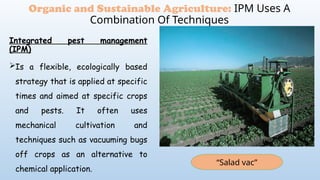
Integrated pest management
(IPM)
Is a flexible, ecologically based
strategy that is applied at specific
times and aimed at specific crops
and pests. It often uses
mechanical cultivation and
techniques such as vacuuming bugs
off crops as an alternative to
chemical application.
Organic and Sustainable Agriculture: IPM Uses A
Combination Of Techniques
“Salad vac”
Successful IPM requires careful monitoring of pest populations to determine
economic thresholds, the point at which potential economic damage justifies
pest-control expenditures, and the precise time, type, and method of
pesticide application.
Trap crops, small areas planted a week or two earlier than the main crop, are
also useful. These plots mature before the rest of the field and attract pests
away from other plants. The trap crop then is sprayed heavily with pesticides
so that no pests are likely to escape. The trap crop is then destroyed, and the
rest of the field should be mostly free of both pests and pesticides.
Organic and Sustainable Agriculture: IPM Uses A
Combination Of Techniques
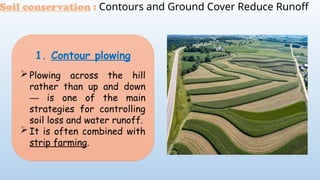
1. Contour plowing
 Plowing across the hill
rather than up and down
is one of the main
─
strategies for controlling
soil loss and water runoff.
 It is often combined with
strip farming.
Soil conservation : Contours and Ground Cover Reduce Runoff
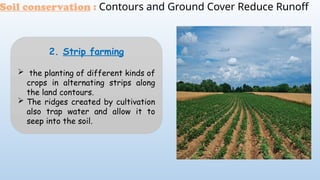
2. Strip farming
 the planting of different kinds of
crops in alternating strips along
the land contours.
 The ridges created by cultivation
also trap water and allow it to
seep into the soil.
Soil conservation : Contours and Ground Cover Reduce Runoff
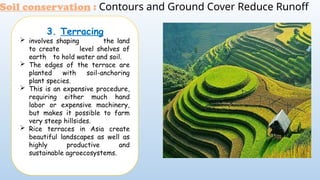
3. Terracing
 involves shaping the land
to create level shelves of
earth to hold water and soil.
 The edges of the terrace are
planted with soil-anchoring
plant species.
 This is an expensive procedure,
requiring either much hand
labor or expensive machinery,
but makes it possible to farm
very steep hillsides.
 Rice terraces in Asia create
beautiful landscapes as well as
highly productive and
sustainable agroecosystems.
Soil conservation : Contours and Ground Cover Reduce Runoff
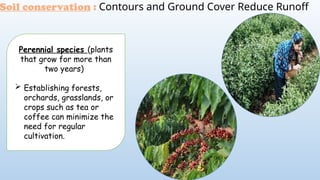
Perennial species (plants
that grow for more than
two years)
 Establishing forests,
orchards, grasslands, or
crops such as tea or
coffee can minimize the
need for regular
cultivation.
Soil conservation : Contours and Ground Cover Reduce Runoff
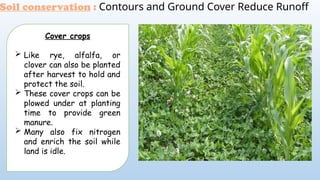
Cover crops
 Like rye, alfalfa, or
clover can also be planted
after harvest to hold and
protect the soil.
 These cover crops can be
plowed under at planting
time to provide green
manure.
 Many also fix nitrogen
and enrich the soil while
land is idle.
Soil conservation : Contours and Ground Cover Reduce Runoff
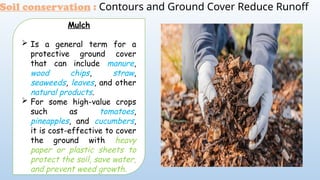
Mulch
 Is a general term for a
protective ground cover
that can include manure,
wood chips, straw,
seaweeds, leaves, and other
natural products.
 For some high-value crops
such as tomatoes,
pineapples, and cucumbers,
it is cost-effective to cover
the ground with heavy
paper or plastic sheets to
protect the soil, save water,
and prevent weed growth.
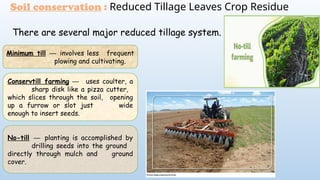
There are several major reduced tillage system.
Soil conservation : Reduced Tillage Leaves Crop Residue
Minimum till ─ involves less frequent
plowing and cultivating.
Conservtill farming ─ uses coulter, a
sharp disk like a pizza cutter,
which slices through the soil, opening
up a furrow or slot just wide
enough to insert seeds.
No-till ─ planting is accomplished by
drilling seeds into the ground
directly through mulch and ground
cover.
 In contrast to the trend toward industrialization and dependence on chemical
fertilizers, pesticides, antibiotics, and artificial growth factors common in
conventional agriculture, some farmers are going back to a more natural,
agroecological farming style.
 Cow are rotated every day between 45 pastures or paddocks to reduce erosion
and maintain healthy grass.
 Even in winter, livestock remain outdoors to avoid the spread of diseases
common in confinement.
 Antibiotics are used only to fight diseases
Soil conservation : Low-input Agriculture Aids Farmers and their land
 Research at Iowa State University has shown that raising animals on pasture
grass rather than grain reduces nitrogen runoff by two-thirds while cutting
erosion by more than half.
 Low-input farms such as these typically don’t turn out the quantity of meat or
milk that their intensive-agriculture neighbors do, but their production costs
are lower and they get higher prices for their crops, so the all-important net
gain is often higher.
Soil conservation : Low-input Agriculture Aids Farmers and their land
Soil conservation : Consumer’s Choices Play an Important Role
Preserving small-scale, family farms also helps preserve rural
culture.
There are the arguments that lead many people to shift at least
part of their diets to local foods.
Locavores (people who eat locally grown, seasonal food) can help
sustain local businesses while they eat.
Community-supported agriculture (CSA)
-CSA farms generally practice organic or low-input agriculture,
and many of them invite members to visit and learn how their
food is grown.
Review Questions!
What is a pest, and what are pesticides? What is the difference between
biocides, herbicides, insecticides, and fungicides?
What is a sustainable agriculture?
What are some strategies for reducing soil erosion?
What is a locavore, and why do some consumers consider them important? In
what ways can local food be better or worse than organic food?
Environmental Science – A Global Concern 12th
Edition
www.google.com (IMAGES)
References!

Different farming techniques in Philippines.pptx

  • 1.
    Farming: Conventional and Sustainable Practices Preparedby: Salwa U. Amanoden MST- General Science
  • 2.
    Learning Outcomes! Describe thecomponents of soil. Explain the ways we use and abuse soils. Outline some of the other key sources for agriculture. Discuss our principal pests and pesticides, List and discuss the environmental effects of pesticides. Explain several strategies for soil conservation.
  • 3.
    Agriculture has dramatically changed ourenvironment, altering patterns of vegetation, soils, and water resources worldwide.
  • 4.
    Soil is botha finite resource and depleting resource. Over time, soil is renewable because it develops gradually through weathering of bedrock. And through the accumulation of organic matter, such as decayed leaves and plant roots. But most farming techniques deplete soil. Such as plowing and annual harvests.
  • 5.
    Soil is amarvelous, complex substance. It is a combination of weathered rocks, plant debris, living fungi, and bacteria, an entire ecosystem that is hidden to most of us. In general soil has six components: Sand and gravel Soil fauna and flora Silts and clays Dead organic material Water Air
  • 6.
    Sand and gravel Mineralsparticles from bedrock, either in place or moved from elsewhere, as in windblown sand.
  • 7.
    Extremely small mineral particles; claysare sticky and hold water because their flat surfaces and ionic charges. Silts and clays
  • 8.
    Decaying plant matter thatstores nutrients and gives soils a black or brown color. Dead organic material
  • 9.
    Living organisms, including soilbacteria, worms, fungi, roots of plants, and insects, that recycle organic compounds and nutrients. Soil fauna and flora
  • 10.
    Moisture from rainfall or groundwater, essentialfor soil fauna and plants. Water
  • 11.
    Tiny pockets ofair help soil bacteria and other organisms survive. Air
  • 12.
    Variations in thesecomponents produce almost infinite variety in the world’s soils. Abundant clays -make soil sticky and wet Abundant organic material and sand -make the soil soft and easy to dig. Sandy soils - Drain quickly, often depriving plants of moisture. Silty soils -silt particles are larger than clays and smaller than sand so they aren’t sticky and soggy, and they don’t drain too quickly. - Ideal for growing crops. - They are also light and blow away easily when exposed to wind.
  • 13.
  • 14.
    Healthy Soil faunacan determine fertility  Tiny worms and nematodes process organic matter and create air spaces as they burrow through soil.  Slightly larger insects, mites, spiders, and earthworms further loosen and the soil.  The sweet aroma of freshly turned soil is caused by actinomycetes, bacteria that grow in fungus like strands and give us the antibiotics streptomycin and tetracycline.  Many plant species grow best with the help of particular species of soil fungi, in relationships called mycorrhizal symbiosis.
  • 15.
    Healthy Soil faunacan determine fertility  In mycorrhizal symbiosis, the mycorrhizal fungus (a fungus growing on and around plants roots) provides water and nutrients to the plant, while plants provides organic compounds to the fungus.  Plants growing with their fungal partners often grow better than those growing alone.  The health of the soil ecosystem depends on environmental conditions, including climate, topography, and parent material (the mineral grains or bedrock on which soil is built), and frequency of disturbance.
  • 16.
    Healthy Soil faunacan determine fertility  Too much rain washes away nutrients and organic matter, but soil faun cannot survive with too little rain.  In extreme cold, soil fauna recycle nutrients extremely slowly; in extreme heat they may work so fast that leaf litter on the forest floor is taken up by plants in just weeks or months so that the ─ soil retains little organic matter.
  • 17.
     O horizonwhere most soil fauna ─ occur in the uppermost layers of a soil, where they consum leaf litter.  Horizon B or subsoil tends to be ─ richer in clays than A horizon. ─should hold its shape better than A horizon.  E layer (eluviated, or washed-out) ─ loose and light-colored because most of its clays and organic material have been washed down to the B horizon. Healthy Soil fauna can determine fertility
  • 18.
     C horizonis mainly decomposed rock ─ fragments. Parent materials underlie the C layer. Parent material is the sand, windblown silt, bedrock, or other mineral material on which the soil is built. Healthy Soil fauna can determine fertility
  • 19.
    Your food comesmostly from A horizon  Ideal farming soils have a thick, organic-rich A horizon.  Desert soils, with slow rate of organic activity, might have no O or A horizons.  Because topsoil is so important to our survival, we identify soils largely in terms of the thickness and composition of their upper layers.
  • 20.
    Soils vary endlesslyin depth, color, and composition. a) Mollisols (mollic = soft, sol = soil) ─ have a thick, organic-rich A horizon that developed from the deep, dense roots of prairie grasses that covered the region (Farm Belt of the United States) until about 150 years ago. b) Alfisols (alfa = first) have a ─ slightly thinner A horizon than mollisols do, and slightly less organic matter. Develop in deciduous forests, where leaf litter is abundant. Your food comes mostly from A horizon
  • 21.
    c) Aridisols (arid= dry) in contrast ardisols of the desert ─ Southwest have little organic matter, and they often contain accumulations of mineral salts. Mollisols and Alfisols dominate most of the farming regions of the United States. Your food comes mostly from A horizon
  • 22.
     Only about11 percent of the earth’s land area (1.5 billion ha out of 13.4 billion ha of land area) is currently in crop production.  In the theory, up to four (4) times as much land could potentially be converted to cropland, but much of the remaining land is too steep, soggy, salty, cold, or dry for farming.  In many developing countries, land continues to be cheaper than other resources, and forests and grasslands are still being converted to farmland. Ways We Use and Abuse Soils
  • 23.
     Other partsof the world, although rich in land area, lack suitable soil, level land, or climates to sustain good agricultural productivity.  In developed countries, 95 percent of recent agricultural growth in the past century has come from a combination of improved crop varieties and increased use of fertilizers, pesticides, and irrigation.  Conversion of new land to crop fields has contributed relatively little to increased production.  Careful management is important for preserving the remaining farmland. Ways We Use and Abuse Soils: Arable Land is Unevenly Distributed
  • 24.
     Agriculture bothcauses and suffers from soil degradation.  Every year about 3 million hectares of cropland are made unusable by erosion worldwide.  4 million hectares are converted to nonagricultural uses, such as urban land, highways, factories, or reservoirs, according to the International Soil Reference and Information Center (ISRIC).  The primary causes of degradation are wind and water.  Additional causes include chemical deterioration (mainly salt accumulation from salt-laden irrigation water) and physical deterioration (such as compaction by heavy machinery or waterlogging. Ways We Use and Abuse Soils: Soil Losses Reduce Farm Productivity
  • 25.
    Sheet erosion -A thin layer taken off the land surface. Rill erosion – when little rivulets of running water gather together and cut small channels in the soil. Gully erosion – when rills enlarge to form bigger channels or ravines that are too large to be removed by normal tillage operations. Streambank erosion – refers to the washing away of soil from the banks of established streams, creeks or rivers, often as a result of removing trees and brush along streambanks and by cattle damage to the banks. Ways We Use and Abuse Soils: Wind and Water Move Most Soil
  • 26.
    Ways We Useand Abuse Soils: Wind and Water Move Most Soil
  • 27.
    Rangelands and pastures,which generally are too dry for cultivation, are highly susceptible to desertification. According to the UN, 80 percent of the world’s grasslands are suffering from overgrazing and soil degradation, and three-quarters of that area has undergone some degree of desertification. Rapid population growth and poverty create unsustainable pressures on the fragile soils of these areas. Stripping trees and land cover for fodder and firewood exposes the soil to erosion and triggers climate changes that spread desertification, which now affects nearly three- quarters of the arable land in Africa. Ways We Use and Abuse Soils: Deserts Are Spreading Around The World
  • 28.
    Agriculture accounts forthe largest single share of global water use. About two- thirds of all fresh water withdrawn from rivers, lakes, and groundwater supplies is used for irrigation. Waterlogging ─ excessive use of water not only wastes water, it often results in waterlogging. Salinization ─ in which mineral salt accumulate in the soil, occurs particularly when soils in dry climates are irrigated with saline water. - as the water evaporates, it leaves behind a salty crust on the soil surface that is lethal to most plants. Water and Nutrients: All Plants Need Water To Grow
  • 29.
    In addition towater, sunshine, and carbon dioxide, plants need small amounts of inorganic nutrients for growth. The major elements required by most plants are nitrogen, potassium, phosphorus, calcium, magnesium, and sulfur. Calcium and magnesium often are limited in areas of high rainfall and must be supplied in the form of lime. Lack of nitrogen, potassium, and phosphorus even more often limits plant growth. Adding these elements in fertilizer usually stimulates growth and greatly increase crop yields. Water and Nutrients: Plants and Nutrients, But Not Too Much
  • 30.
    Phosphate and nitratesfrom farm fields and cattle feedlots are a major cause of aquatic ecosystem pollution. Nitrate levels in groundwater have risen to dangerous levels in many areas where intensive farming is practiced. Manure and green manure (crops grown specifically to add nutrients to the soil) are important natural sources of soil nutrients. Nitrogen fixing bacteria living symbiotically in root nodules of legumes are valuable for making nitrogen available as a plant nutrient. Interplanting or rotating beans or some other leguminous crop with such crops as corn and wheat are traditional ways of increasing nitrogen availability. Water and Nutrients: Plants and Nutrients, But Not Too Much
  • 31.
    Farming as itis generally practiced in the industrialized countries is highly energy-intensive. After crops leave the farm, additional energy is used in food processing, distribution, storage, and cooking. It has been estimated that the average food item in the American diet travels 2, 400 km between the farm that grew it and the person who consumes it. The energy required for this complex processing and distribution system may be five times as much as is used directly in farming. Water and Nutrients: Farming Is Energy Intensive
  • 32.
    Pesticide is ageneral term for a chemical that kills pests, usually a toxic chemical, but sometimes we also consider chemicals that drive pests away to be pesticides.  Some pest-control compounds kill a wide range of living things and are called biocides.  Chemicals such as ethylene dibromide that are used to protect stored grain, or to sterilize soils before planting strawberries, are biocides.  In addition, there are chemicals aimed at particular groups of pests.  Herbicides are chemicals that kill plants; insecticides kill insects; and fungicides kill fungi. Pests and Pesticides
  • 33.
    Using chemicals tocontrol pests may well have been among our earliest forms of technology. Sumerians controlled insects and mites with sulfur 5, 000 years ago. Chinese texts 2, 500 years old describe mercury and arsenic compounds to control body live and other pests. Greeks and Romans used oil sprays, ash and sulfur ointments, lime, and other natural material to protect themselves, their livestock, and their crops from a variety of pests. Pests and Pesticides: People Have Always Used Pest Controls
  • 34.
    In addition tothese metals and inorganic chemical, people haves used organic compounds, biological controls, and cultural practices for a long time. Alcohol from fermentation and acids in pickling solutions prevent growth of organisms that would otherwise ruin food. Spices were valued both for their flavors and because they deterred spoilage and pest infestations. Pests and Pesticides: People Have Always Used Pest Controls
  • 35.
     The eraof synthetic organic pesticides began in 1939 when Swiss chemist Paul Miller discovered the powerful insecticidal properties of dichloro-diphenyl- trichloroethane (DDT). DDT is remarkably lethal to a wide variety of insects but relatively nontoxic to mammals. By the 1960s, however, evidence began to accumulate that indiscriminate use of DDT and other long-lasting industrial toxins was having unexpected effects on wildlife. Peregrine falcons, bald eagles, brown pelicans, and other carnivorous birds were disappearing from former territories in eastern North America. Pests and Pesticides: Modern pesticides Provide Benefits But Also Create Problems
  • 36.
    Studies revealed thateggshells were thinning in these species as DDT and its breakdown products were concentrated through food chains until it reached endocrine hormone-disrupting levels in top predators. In 1962 biologist Rachel Carson published Silent Spring, warning that persistent organic pollutants, such as DDT, pose a threat to wildlife and perhaps to humans. According to EPA, total pesticide use in the United States amounts to 5.3 billion pounds (2.4 million metric tons) per year. Pests and Pesticides: Modern pesticides Provide Benefits But Also Create Problems
  • 37.
    Pests and Pesticides:Modern pesticides Provide Benefits But Also Create Problems
  • 38.
    One way toclassify pesticides is by their chemical structure and main components. Some are organic (carbon-based) compounds; others are toxic metals (such as arsenic) or halogens (such as bromine). a) Organophosphates are among the most abundantly used ─ synthetic pesticides. Glyphosate, the single most heavily used herbicide in the United States, is also known by the trade name Roundup. b) Chlorinated hydrocarbons also called ─ organochlorines, are persistent and highly toxic to sensitive organisms. Atrazine was the most heavily used herbicide in the United States until the recent increase in glyphosate use. Pests and Pesticides: There Are Many Types Of Pesticides
  • 39.
    c) Fumigants aregenerally small molecules, such as ─ carbon tetrachloride, ethylene dibromide, and methylene bromide, which can be delivered in the form of a gas so that they readily penetrate soil and other materials. d) Inorganic pesticides include compounds of toxic elements such ─ as arsenic, sulfur, copper, and mercury. These broad spectrum poisons are generally highly toxic and indestructible, remaining in the environment forever. Pests and Pesticides: There Are Many Types Of Pesticides
  • 40.
    e) Natural organicpesticides or “ ─ botanicals,” generally are extracted from plants. Some important examples are nicotine and nicotinoid alkaloids from tobacco, and pyrethrum, a complex of chemicals extracted from the daisy-like Chrysanthemum cinerariaefolium. f) Microbial agents and Biological controls ─ are living organisms or toxins derived from them that are used in place of pesticides. A natural soil bacterium, Bacillus thuringiensis is one of the chief pest-control agents allowed in organic farming. This bacterium kills caterpillars and beetles by producing toxin that ruptures the digestive tract lining when eaten. Pests and Pesticides: There Are Many Types Of Pesticides
  • 41.
    Environmental effects ofpesticides Many pesticides are sprayed broadly and destroy populations of beneficial insects as well as pests. The loss of insect diversity has been a growing problem in agricultural regions: at least a third of the crops we eat rely on pollinators, such as bees and other invertebrates, to reproduce. The disappearance of honeybees has received particular attention in recent years. Many crops, including squash, tomatoes, peppers, apples, and other fruit rely on bees for pollination, and it is estimated that the economic value of bees for pollination is 100 times the value of their honey.
  • 42.
    Pest resurgence, orthe rebound of resistant populations, is another important problem in overuse of pesticides. As resistant pests evolve, there is an ever-increasing need for newer, better pesticides this is called the ─ pesticide treadmill. Glyphosate (Roundup), the dominant herbicide used in the United States and one of the primary herbicides in Brazil, Australia, and elsewhere, is no longer effective against a variety of superweeds. Increasingly farmers are advised to mix tanks of various pesticides ─metachlor, Flexstar, Gramoxone, diuron, and other combinations are recommended to keep down increasingly aggressive weeds such as pigweed and rye grass. Environmental effects of pesticides
  • 43.
    Environmental effects ofpesticides: POPs Accumulate in Remote Places Persistent organic pollutants (POPs) - Is a collective term for these chemicals, which are stable, easily absorbed into fatty tissues, and highly toxic. - Because they persist for years, even decades in some cases, and move freely through air, water, and soil, they often show up far from the point of original application. - Because POPs are so long-lasting and so dangerous, 127 countries agreed in 2001 to a global ban on the worst of them, including aldrin, chlordane, dieldrin, DDT, endrin, hexachlorobenzene, neptachlor, mirex, toxaphene, polychlorinated biphenyls (PCBs), dioxins, and furans.
  • 44.
    Pesticide effects onhuman health categories: (1) Acute effects, including poisoning and illnesses caused by relatively high doses and accidental exposures. (2) Chronic effects suspected to include cancer, birth defects, immunological problems, endometriosis, neurological problems, Parkinson’s disease, and other chronic degenerative disease. The World Health Organization (WHO) estimates that 25 million people suffer pesticide poisoning and at least 20, 000 die each year. Environmental effects of pesticides: Pesticides Cause a Variety of Health Problems  blurred vision  Nausea  Headaches  Conjunctivitis  Rashes  Asthma Also serious chronic effects:  Stillbirths  Miscarriages  Neurological problems
  • 45.
    To meet demandsin North American markets for perfect flowers, table grapes, and other produce, growers use high levels of pesticides, often spraying daily with fungicides, insecticides, nematicides, and herbicides. Working in warm, poorly ventilated greenhouses with little protective clothing, the workers 70 to 80 percent of whom are women find it hard ─ ─ to avoid pesticide contact. Pesticide use can expose consumers to agricultural chemicals. Environmental effects of pesticides: Pesticides Cause a Variety of Health Problems
  • 46.
    Source: Environmental Working Group,2002. Table 10.1 The Twelve Most Contaminated Foods Rank Food 1 Strawberries 2 Bell peppers 3 Spinach 4 Cherries (U.S.) 5 Peaches 6 Cantaloupe (Mexican) 7 Celery 8 Apples 9 Apricot 10 Green beans 11 Grapes (Chilean) 12 Cucumbers
  • 47.
    What organic means? Ingeneral, organic food is grown without artificial pesticides and with only natural fertilizers, such as manure. Legal definitions of the term, though, are more exact and often more controversial. Organic and Sustainable Agriculture 100% organic o Without pesticides, hormones, antibiotics, synthetic fertilizers, or genetic modification. o At least 95% of the ingredients must be organic. “Made with organic ingredients”  Must contain at least 70% organic contents.  Less than 70% organic ingredients can list them individually. Organic animals  Must be raised on organic feed  Given access to the outdoors  Given no steroidal growth hormones  Treated with antibiotics only to treat diseases.
  • 48.
    Organic farming and sustainablefarming use a multitude of practices to control pests. Organic and Sustainable Agriculture: Strategic Management Can Reduce Pests Improved management programs can cut pesticide use by 50 to 90 percent without reducing crop production or creating new disease. Some of these techniques are relatively simple and save money while maintaining disease control and yielding crops with just as high quality and quantity as we get with current methods.
  • 49.
    Crop rotation Involves growinga different crop in a field each year in a two-to- six-year cycle. Mechanical cultivation Keeps weeds down, but it also increases erosion. Habitat Diversification such as restoring windbreaks, hedgerows, and ground cover on watercourses, provides habitat for insect predators, such as birds, and also reduces erosion. Organic and Sustainable Agriculture: Strategic Management Can Reduce Pests
  • 50.
    Biological controls suchas predators (wasps, ladybugs, praying mantises) or pathogens (viruses, bacteria, fungi) can control many pests more cheaply and safely than broad-spectrum, synthetic chemical. Ex. Bacillus thuringiensis or Bt, is a naturally occurring bacterium that kills the larvae of lepidopteran (butterfly and moth) species but is generally harmless to mammals. Organic and Sustainable Agriculture: Useful Organisms Can Help Us Control Pests
  • 51.
    Organic and SustainableAgriculture: Useful Organisms Can Help Us Control Pests Ducks, chickens, and geese, among other species, are used to rid fields of both insect pests and weeds. Herbivorous insects have been used to control weeds The neem tree (Azadirachta indica) is native to India but now grown in many tropical countries. The leaves, bark, roots, and flowers all contain compounds that repel insects and can be used to combat a number of crop pests and diseases. Another approach is to use hormones that upset development or sex attractants to bait traps containing toxic pesticides. Genetic and bioengineering can also help in our war against pests.
  • 52.
    Integrated pest management (IPM) Isa flexible, ecologically based strategy that is applied at specific times and aimed at specific crops and pests. It often uses mechanical cultivation and techniques such as vacuuming bugs off crops as an alternative to chemical application. Organic and Sustainable Agriculture: IPM Uses A Combination Of Techniques “Salad vac”
  • 53.
    Successful IPM requirescareful monitoring of pest populations to determine economic thresholds, the point at which potential economic damage justifies pest-control expenditures, and the precise time, type, and method of pesticide application. Trap crops, small areas planted a week or two earlier than the main crop, are also useful. These plots mature before the rest of the field and attract pests away from other plants. The trap crop then is sprayed heavily with pesticides so that no pests are likely to escape. The trap crop is then destroyed, and the rest of the field should be mostly free of both pests and pesticides. Organic and Sustainable Agriculture: IPM Uses A Combination Of Techniques
  • 54.
    1. Contour plowing Plowing across the hill rather than up and down is one of the main ─ strategies for controlling soil loss and water runoff.  It is often combined with strip farming. Soil conservation : Contours and Ground Cover Reduce Runoff
  • 55.
    2. Strip farming the planting of different kinds of crops in alternating strips along the land contours.  The ridges created by cultivation also trap water and allow it to seep into the soil. Soil conservation : Contours and Ground Cover Reduce Runoff
  • 56.
    3. Terracing  involvesshaping the land to create level shelves of earth to hold water and soil.  The edges of the terrace are planted with soil-anchoring plant species.  This is an expensive procedure, requiring either much hand labor or expensive machinery, but makes it possible to farm very steep hillsides.  Rice terraces in Asia create beautiful landscapes as well as highly productive and sustainable agroecosystems. Soil conservation : Contours and Ground Cover Reduce Runoff
  • 57.
    Perennial species (plants thatgrow for more than two years)  Establishing forests, orchards, grasslands, or crops such as tea or coffee can minimize the need for regular cultivation. Soil conservation : Contours and Ground Cover Reduce Runoff
  • 58.
    Cover crops  Likerye, alfalfa, or clover can also be planted after harvest to hold and protect the soil.  These cover crops can be plowed under at planting time to provide green manure.  Many also fix nitrogen and enrich the soil while land is idle. Soil conservation : Contours and Ground Cover Reduce Runoff
  • 59.
    Soil conservation :Contours and Ground Cover Reduce Runoff Mulch  Is a general term for a protective ground cover that can include manure, wood chips, straw, seaweeds, leaves, and other natural products.  For some high-value crops such as tomatoes, pineapples, and cucumbers, it is cost-effective to cover the ground with heavy paper or plastic sheets to protect the soil, save water, and prevent weed growth.
  • 60.
    There are severalmajor reduced tillage system. Soil conservation : Reduced Tillage Leaves Crop Residue Minimum till ─ involves less frequent plowing and cultivating. Conservtill farming ─ uses coulter, a sharp disk like a pizza cutter, which slices through the soil, opening up a furrow or slot just wide enough to insert seeds. No-till ─ planting is accomplished by drilling seeds into the ground directly through mulch and ground cover.
  • 61.
     In contrastto the trend toward industrialization and dependence on chemical fertilizers, pesticides, antibiotics, and artificial growth factors common in conventional agriculture, some farmers are going back to a more natural, agroecological farming style.  Cow are rotated every day between 45 pastures or paddocks to reduce erosion and maintain healthy grass.  Even in winter, livestock remain outdoors to avoid the spread of diseases common in confinement.  Antibiotics are used only to fight diseases Soil conservation : Low-input Agriculture Aids Farmers and their land
  • 62.
     Research atIowa State University has shown that raising animals on pasture grass rather than grain reduces nitrogen runoff by two-thirds while cutting erosion by more than half.  Low-input farms such as these typically don’t turn out the quantity of meat or milk that their intensive-agriculture neighbors do, but their production costs are lower and they get higher prices for their crops, so the all-important net gain is often higher. Soil conservation : Low-input Agriculture Aids Farmers and their land
  • 63.
    Soil conservation :Consumer’s Choices Play an Important Role Preserving small-scale, family farms also helps preserve rural culture. There are the arguments that lead many people to shift at least part of their diets to local foods. Locavores (people who eat locally grown, seasonal food) can help sustain local businesses while they eat. Community-supported agriculture (CSA) -CSA farms generally practice organic or low-input agriculture, and many of them invite members to visit and learn how their food is grown.
  • 64.
    Review Questions! What isa pest, and what are pesticides? What is the difference between biocides, herbicides, insecticides, and fungicides? What is a sustainable agriculture? What are some strategies for reducing soil erosion? What is a locavore, and why do some consumers consider them important? In what ways can local food be better or worse than organic food?
  • 65.
    Environmental Science –A Global Concern 12th Edition www.google.com (IMAGES) References!