2020 – 2021
geography PROJECT
SUBMITTED BY : Rahul Yadav
CLASS : X- B
SUBMITTED TO : mr. ranjeet kumar rai sir
CONTENT
• INTRODUCTION
• TYPES OF RESOURCES
• DEVELOPMENT OF RESOURCES
• RESOURCE PLANNING
• LAND RESOURCES
• SOIL AS A RESOURCE
INTRODUCTION
• Natural resources occur naturally within
environments that exist relatively undisturbed
by mankind, in a natural form.
A natural resource is often characterized by
amounts of biodiversity and geodiversity
existent in various ecosystems.
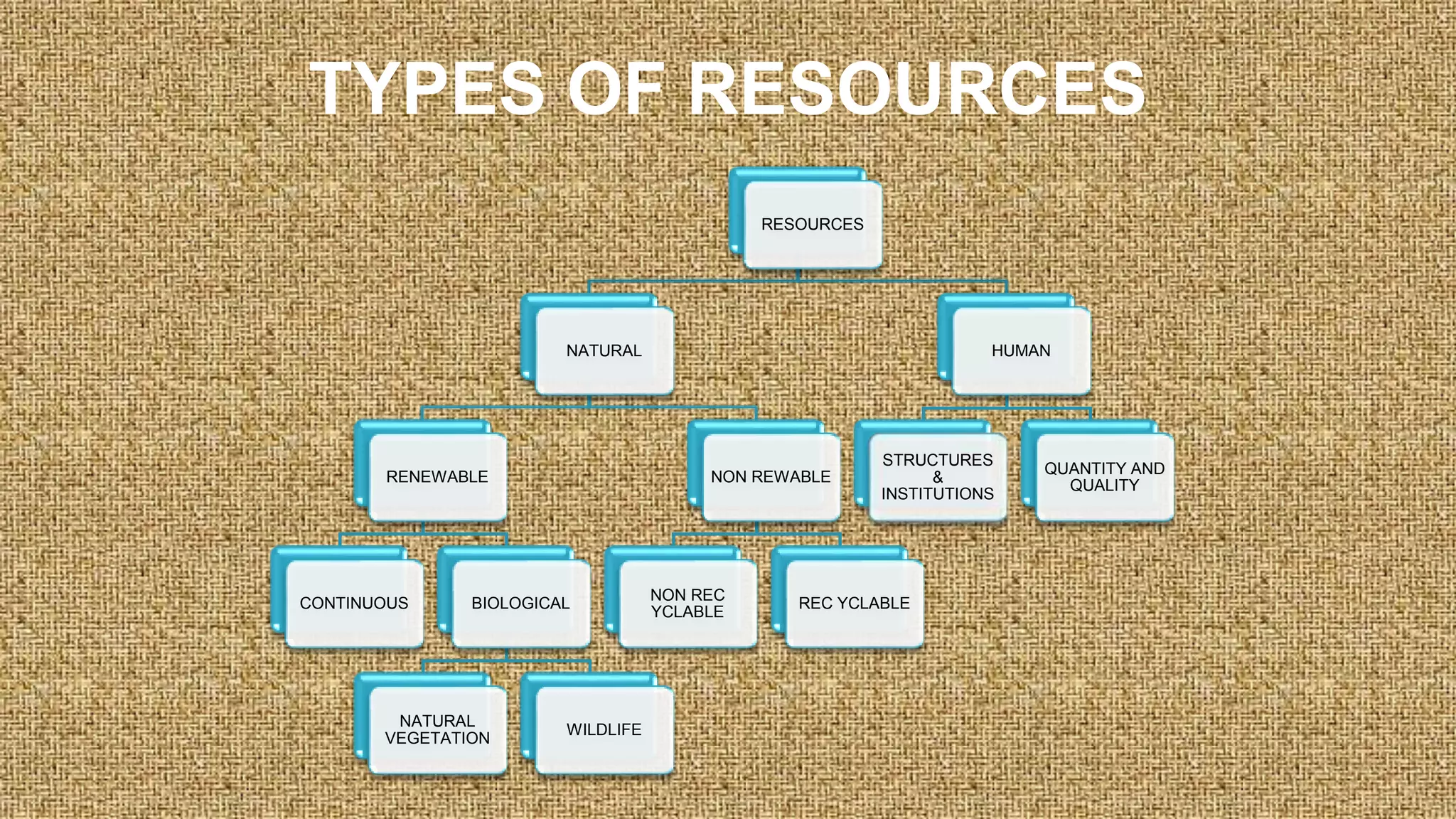
TYPES OF RESOURCES
RESOURCES
NATURAL
RENEWABLE
CONTINUOUS BIOLOGICAL
NATURAL
VEGETATION
WILDLIFE
NON REWABLE
NON REC
YCLABLE
REC YCLABLE
HUMAN
STRUCTURES
&
INSTITUTIONS
QUANTITY AND
QUALITY
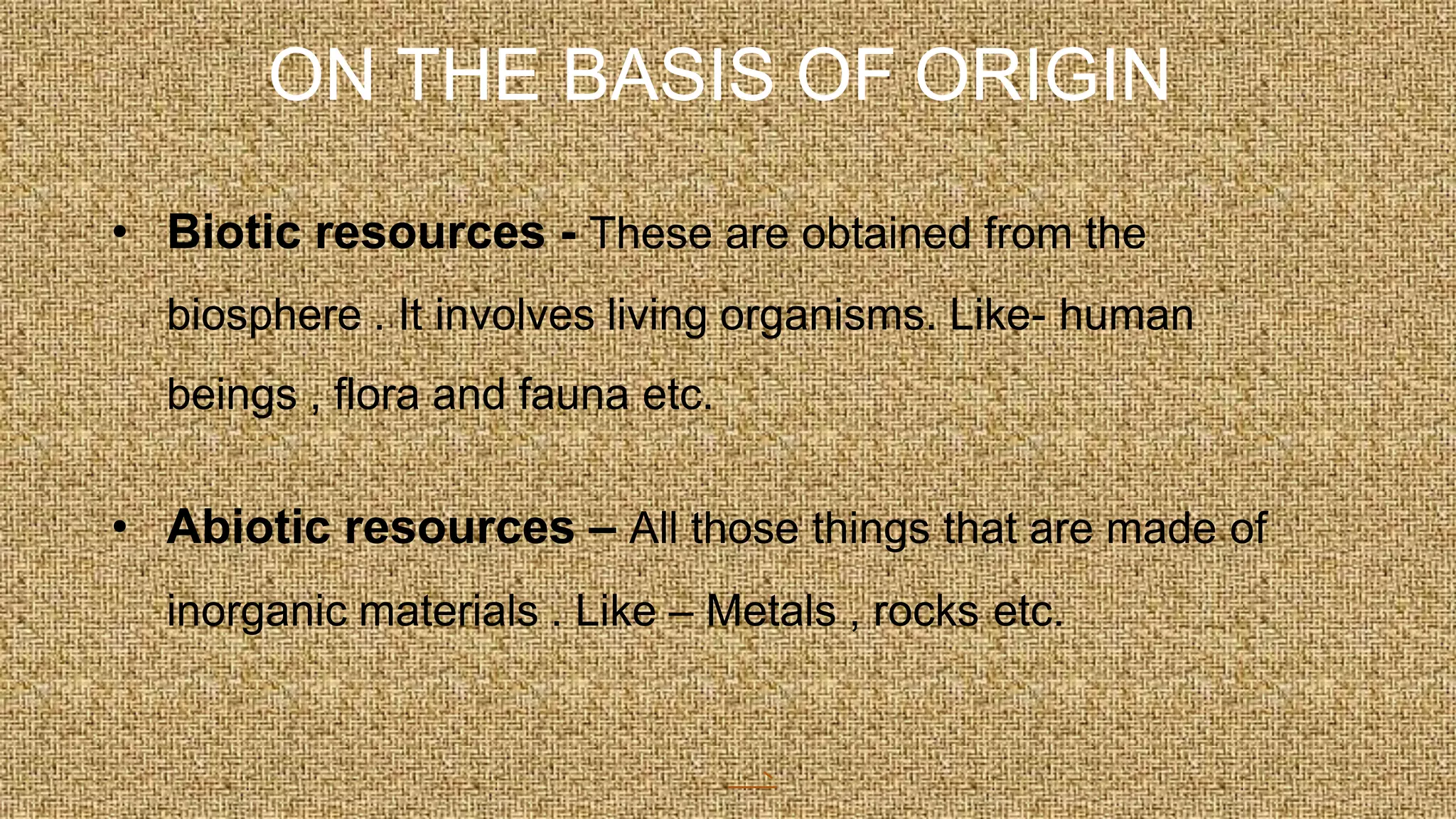
ON THE BASIS OF ORIGIN
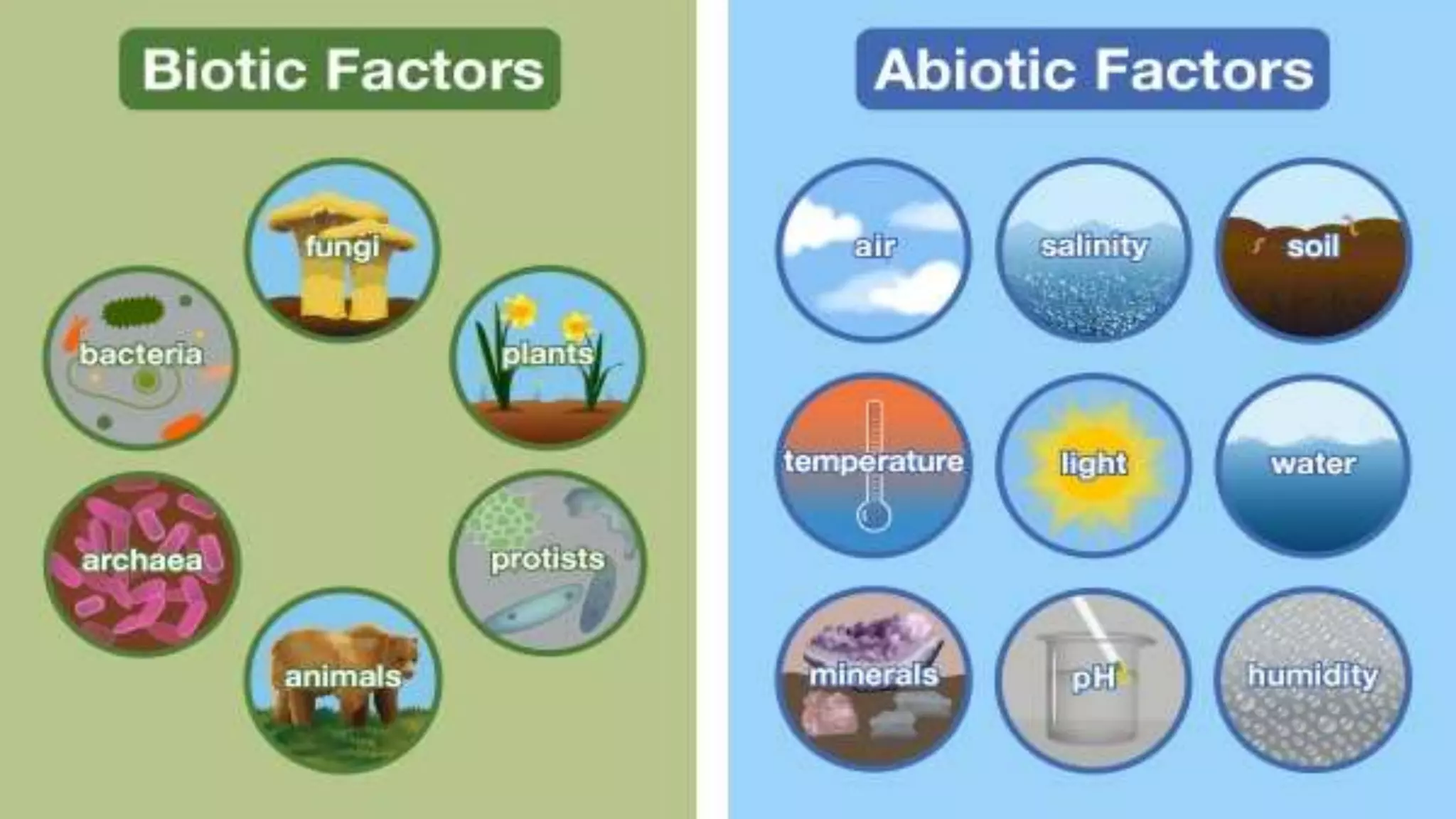
• Biotic resources - These are obtained from the
biosphere . It involves living organisms. Like- human
beings , flora and fauna etc.
• Abiotic resources – All those things that are made of
inorganic materials . Like – Metals , rocks etc.
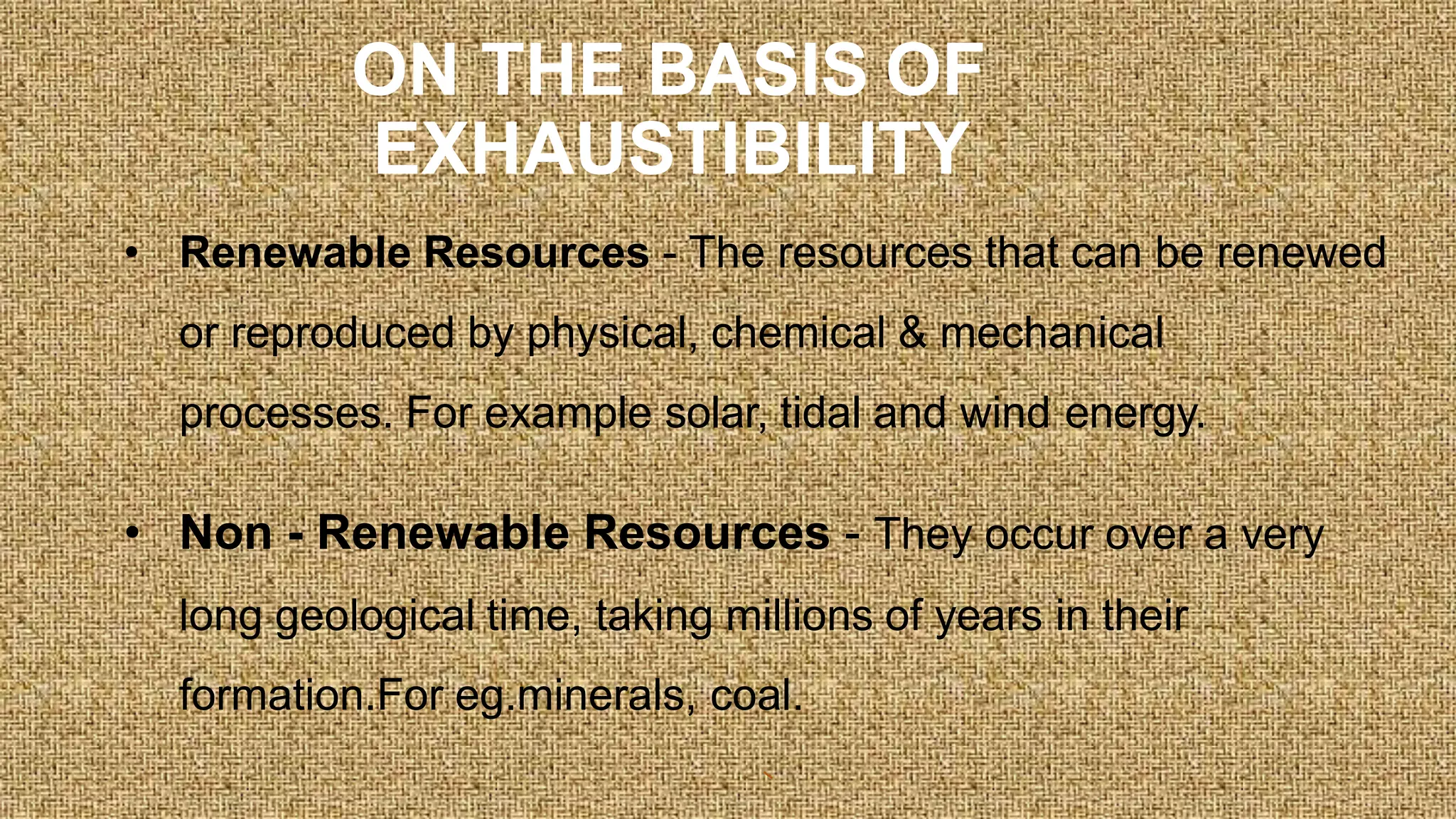
ON THE BASIS OF
EXHAUSTIBILITY
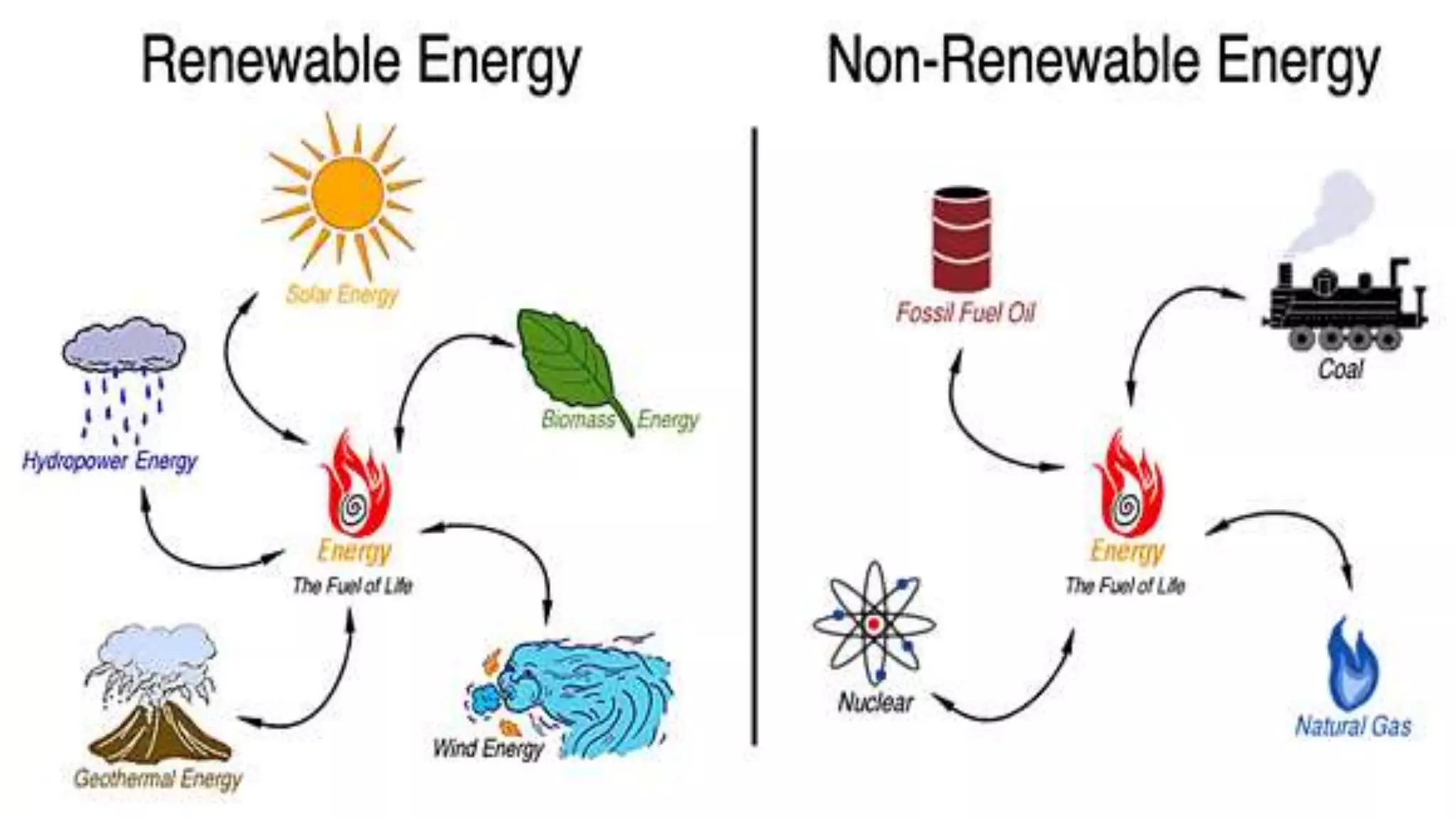
• Renewable Resources - The resources that can be renewed
or reproduced by physical, chemical & mechanical
processes. For example solar, tidal and wind energy.
• Non - Renewable Resources - They occur over a very
long geological time, taking millions of years in their
formation.For eg.minerals, coal.
ON THE BASIS OF OWNERSHIP
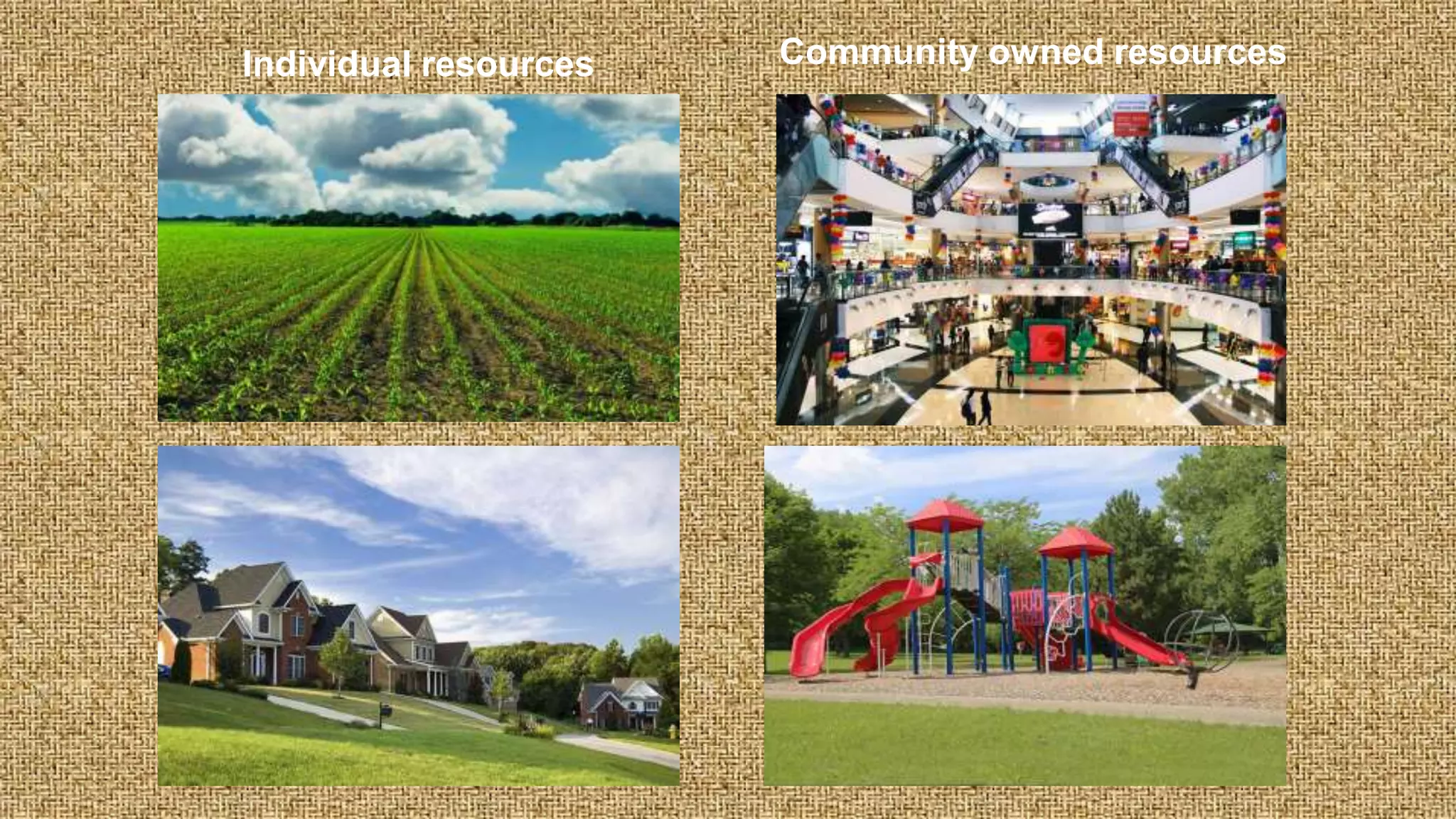
• Individual resources: these are owned by individuals
privately. Like land owned by a farmer allotted to them by
government against the payment of revenue.
• Community owned resources: these include resources
that are accessible to all the members of the community
like the village grazing grounds, burial groundsetc.
Individual resources Community owned resources
• National resources: technically speaking all the resources
belong to the nation because the country has legal powers to
acquire even private property for public good.
• International resources: The oceanic resources beyond
200nautical miles of the Exclusive Economic Zone belong to
open ocean and no individual country can utilize these without
the consensus of international institutions.
NATIONAL RESOURCES AND
INTERNATIONAL RESOURCES
NATIONAL RESOURCES INTERNATIONAL RESOURCES
ON THE BASIS OF STATUS OF
DEVELOPMENT
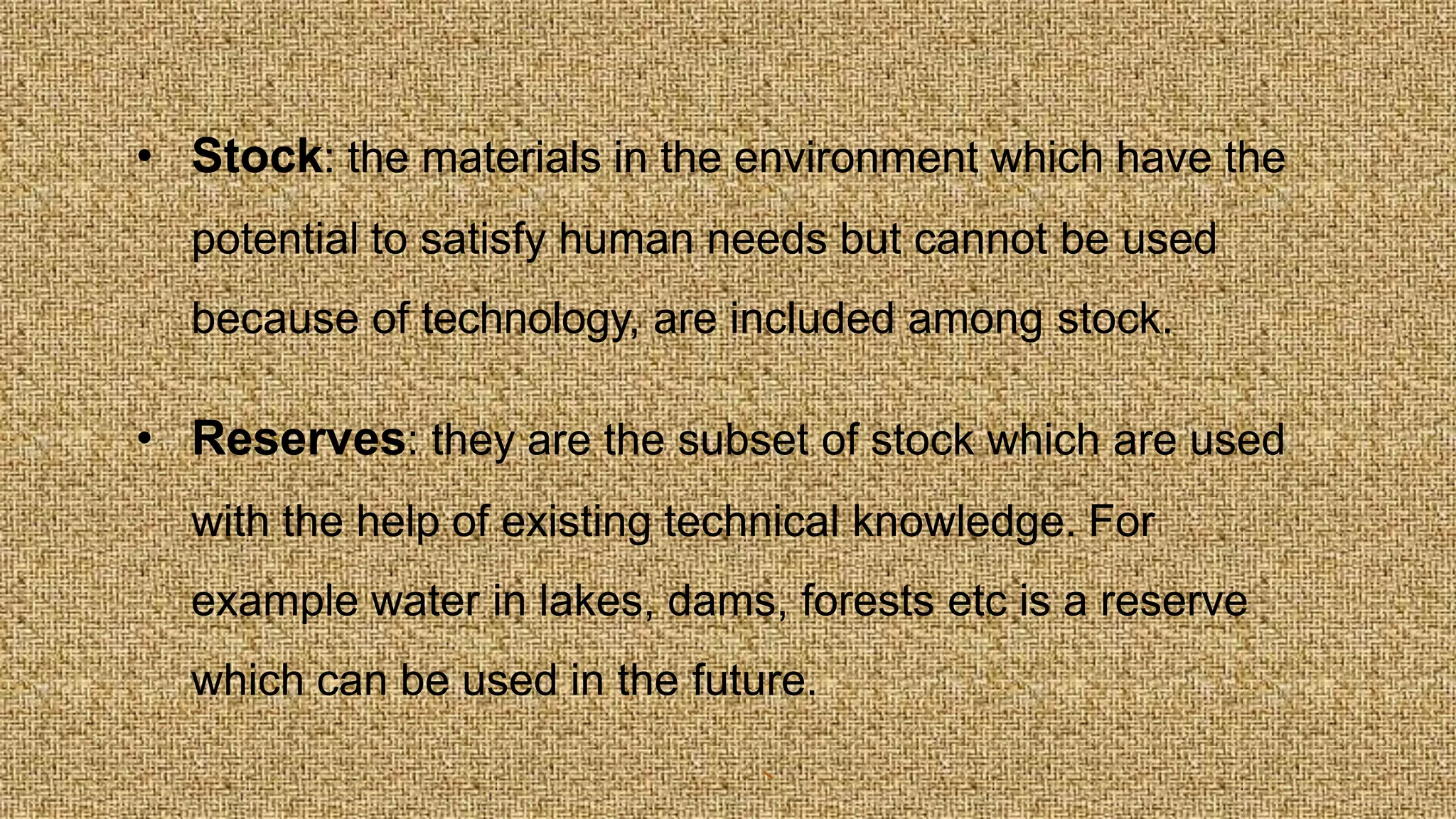
• Potential resources: resources which have not been put to use
but are found in a region are called potential resources. Like
Rajasthan and Gujarat can be utilized for their solar and wind
energies .
• Developed resources: it includes resources which are surveyed
and their quality and quantity have been determined for utilization.
Potential resources Developed resources
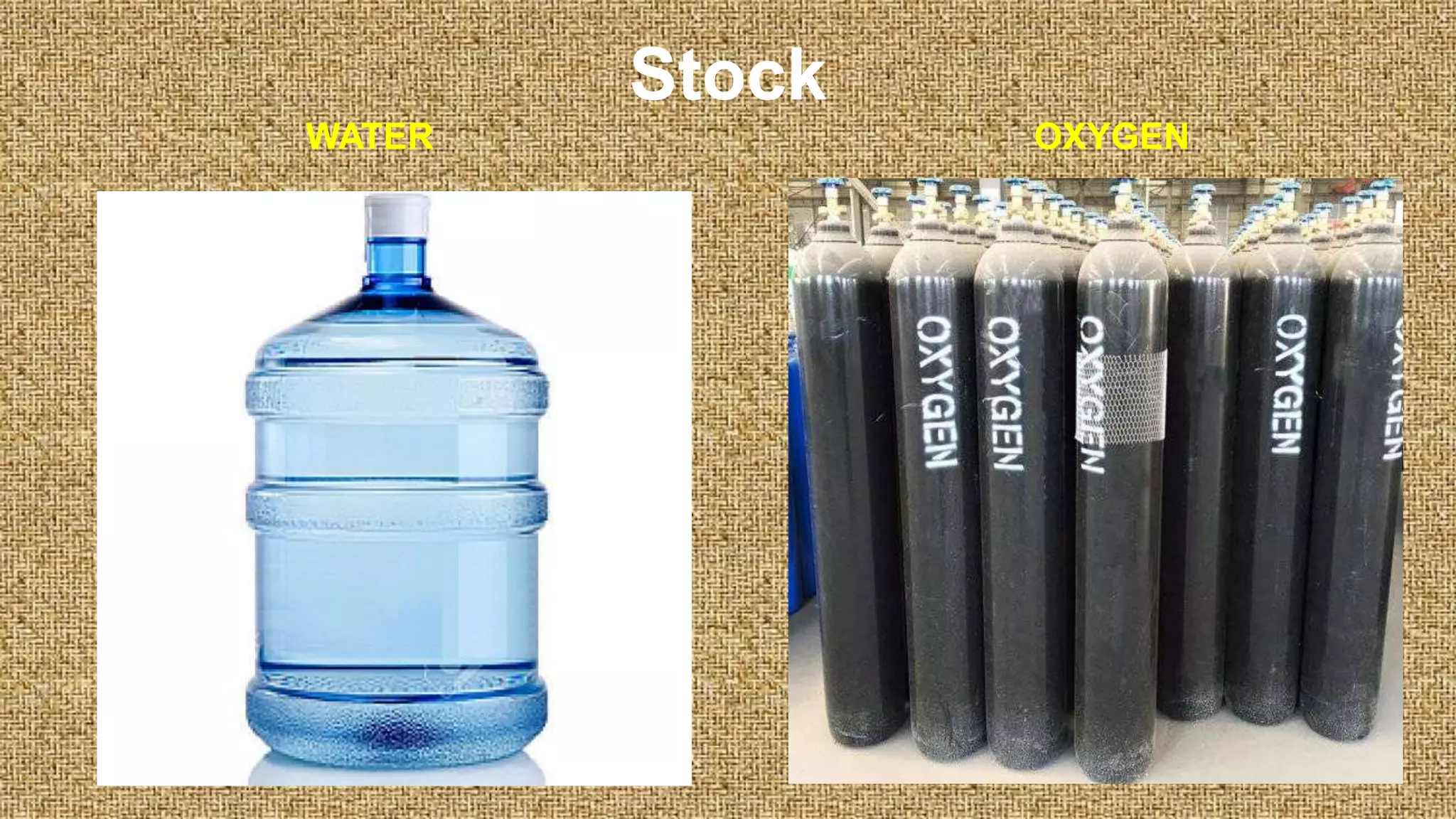
• Stock: the materials in the environment which have the
potential to satisfy human needs but cannot be used
because of technology, are included among stock.
• Reserves: they are the subset of stock which are used
with the help of existing technical knowledge. For
example water in lakes, dams, forests etc is a reserve
which can be used in the future.
Stock
WATER OXYGEN
DEVELOPMENT OF RESOURCES
• It is the process of developing the resources in order to
make them useful for satisfying human wants. Some
resources cannot be used directly. They have to be
processed to make them useful for satisfying our wants.
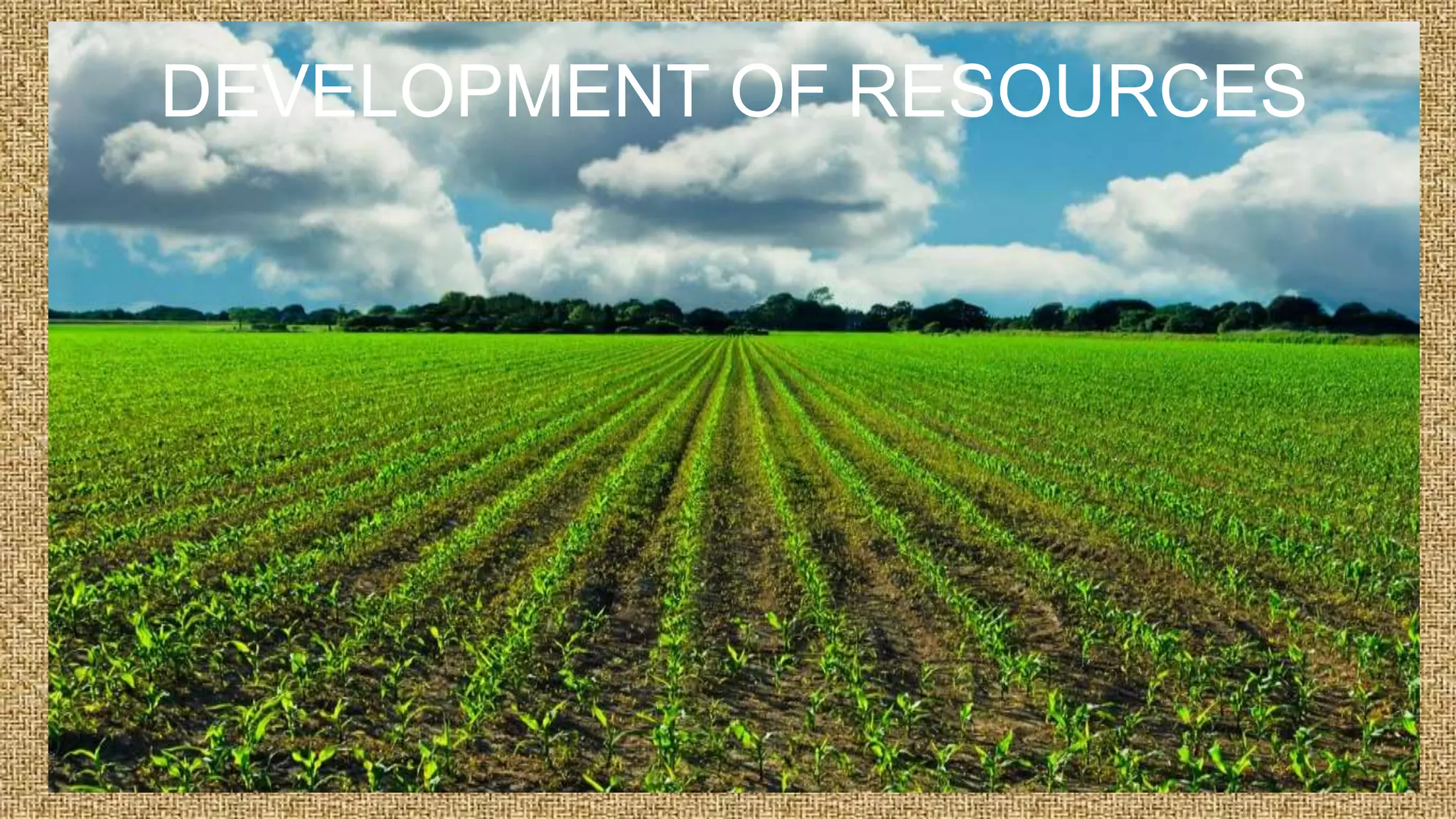
• Ex: Land has to be cleared and ploughed for growing
crops. Water has to be taken to the field to irrigate.
DEVELOPMENT OF RESOURCES
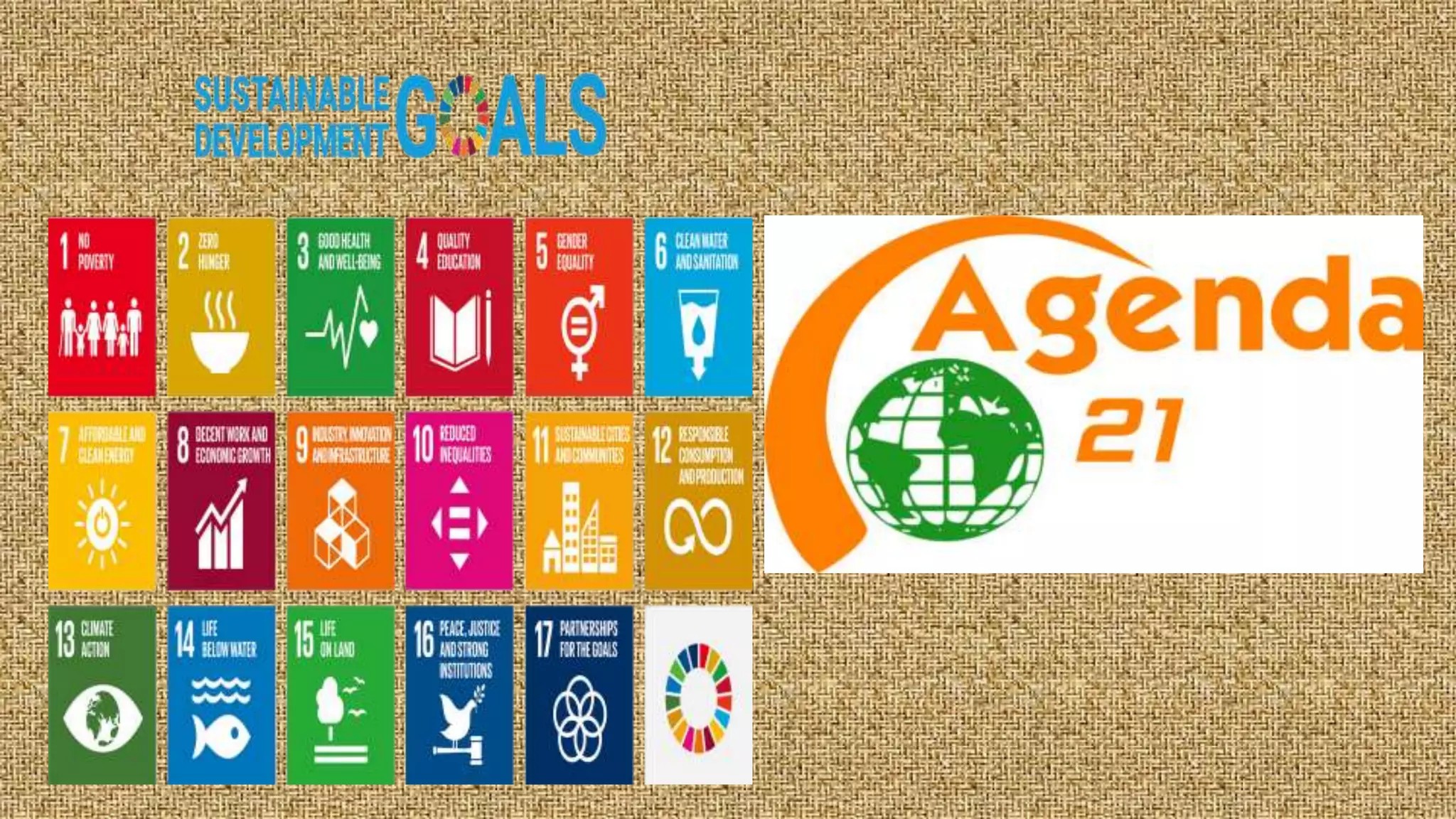
SUSTAINABLE DEVELOPMENT &
AGENDA 21
• Sustainable development – It is the development
which is done without compromising the needs of future
generation or damaging the nature.
• Agenda 21- Aims at achieving global sustainable
development. For diminishing poverty, environmental
damages
RESOURCE PLANNING
• Resource planning in INDIA is done in the following ways :-
• Identification and inventory of resources by surveying and mapping.
• Evolving a planning structure.
• Matching the resource development plans with overall national
development plans.
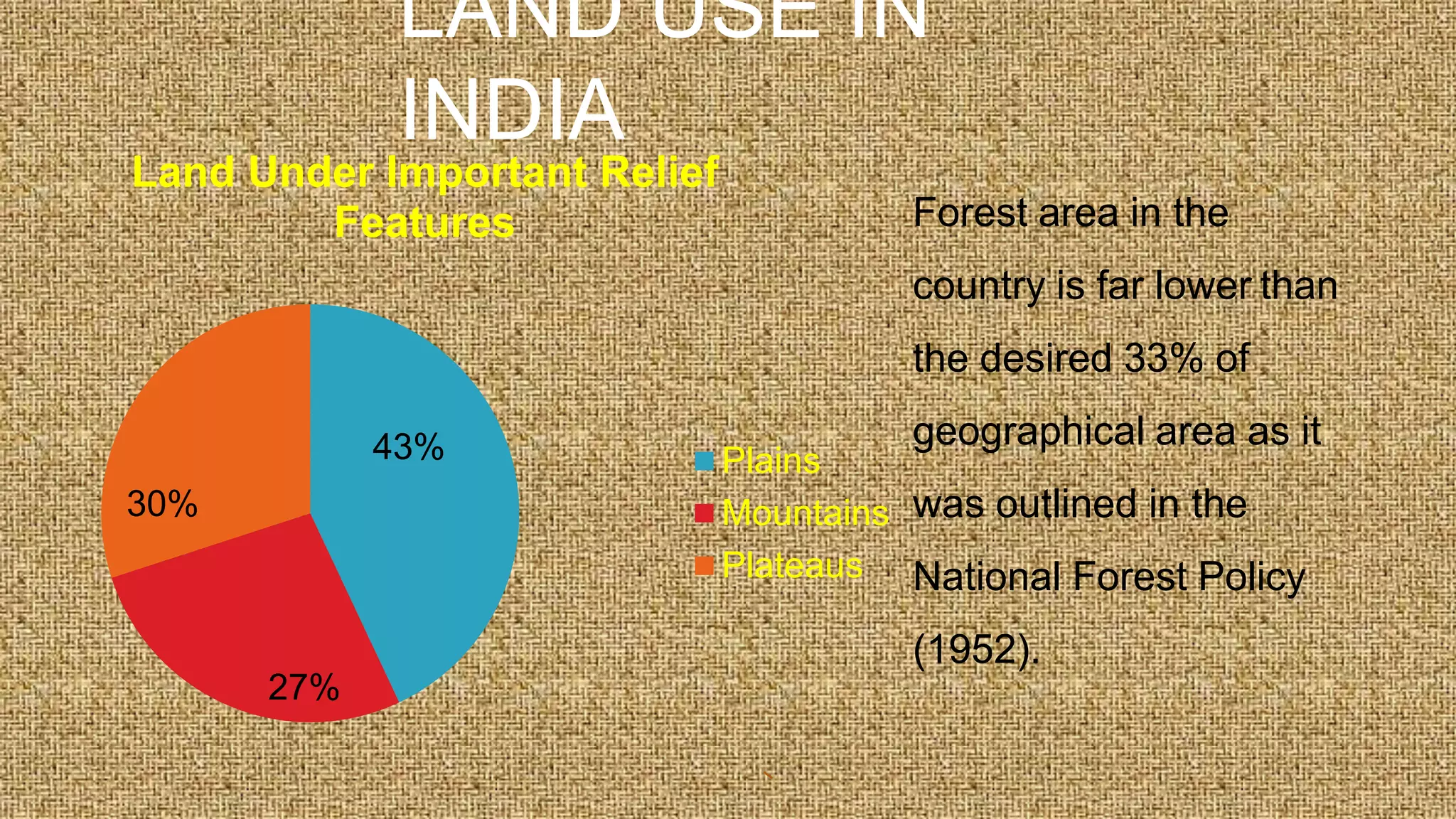
LAND USE IN
INDIA
Forest area in the
country is far lower than
the desired 33% of
geographical area as it
was outlined in the
National Forest Policy
(1952).
43%
27%
30%
Land Under Important Relief
Features
Plains
Mountains
Plateaus
SOIL
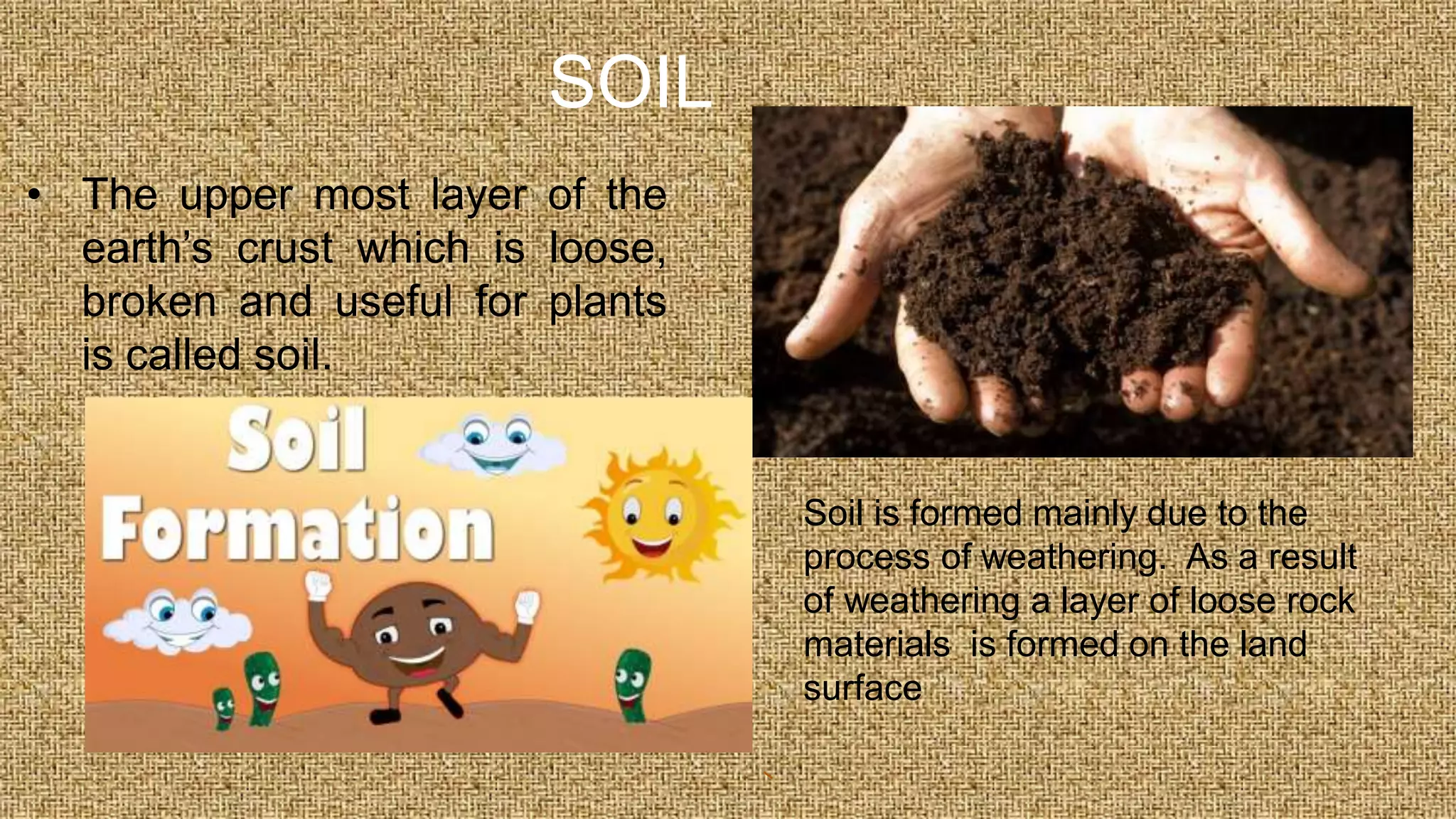
• The upper most layer of the
earth’s crust which is loose,
broken and useful for plants
is called soil.
Soil is formed mainly due to the
process of weathering. As a result
of weathering a layer of loose rock
materials is formed on the land
surface
SOIL AS A RESOURCE
Man depends on the soil directly or indirectly for his food.
Agriculture can be practiced only if soils are available.
Man gets the materials needed for shelter and clothing
directly (or) indirectly from the soil.
Soils are essential for the growth of forests.
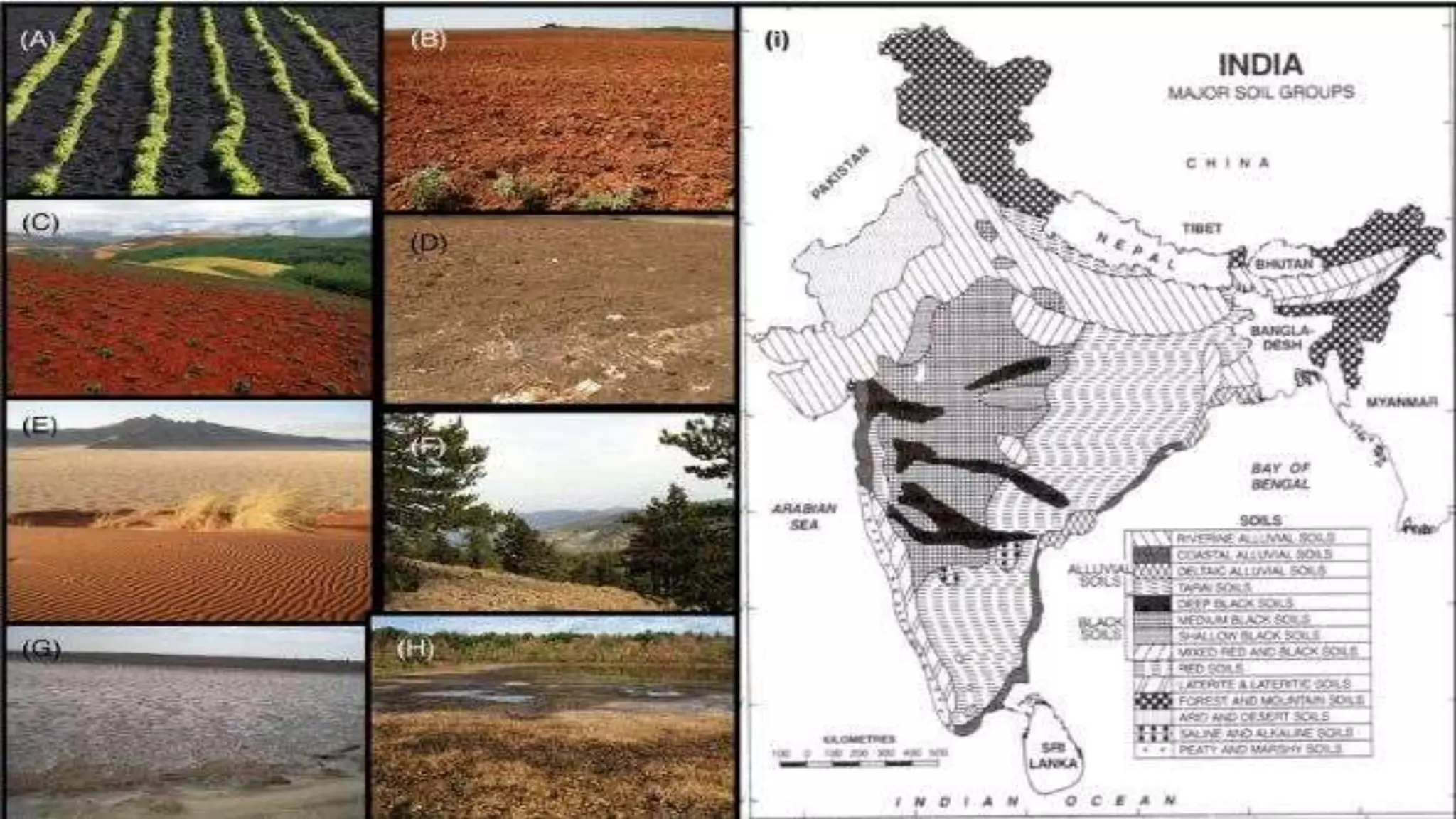
TYPES OF SOILS
• Alluvial soil –Alluvial soil is the most fertile and wide
spread soil found in India. It is formed due to the
deposition of fine silt called alluvium by the rivers.
• Black soil - Black soils are called black cotton soils
because they are black in colour and are very good
for cotton cultivation. It is made up of extremely
fine clayey materials.
• Red soils - It is red in colour because of the presence of iron
in it. It is found in Tamilnadu, Karnataka, Andhra pradesh etc.
• Laterite soils - Laterite soil is formed due to intense leaching
caused by tropical rainfall. Humus content is less because the
micro-organisms get destroyed due to high temperature.
•
• Arid soils- Arid soils are red or brown in colour. They
are sandy and saline. Humus and moisture contents are
very less. They can be cultivated after irrigation.
THANK
YOU

RESOURCES AND DEVELOPMENT PPT

  • 1.
    2020 – 2021 geographyPROJECT SUBMITTED BY : Rahul Yadav CLASS : X- B SUBMITTED TO : mr. ranjeet kumar rai sir
  • 3.
    CONTENT • INTRODUCTION • TYPESOF RESOURCES • DEVELOPMENT OF RESOURCES • RESOURCE PLANNING • LAND RESOURCES • SOIL AS A RESOURCE
  • 4.
    INTRODUCTION • Natural resourcesoccur naturally within environments that exist relatively undisturbed by mankind, in a natural form. A natural resource is often characterized by amounts of biodiversity and geodiversity existent in various ecosystems.
  • 5.
    TYPES OF RESOURCES RESOURCES NATURAL RENEWABLE CONTINUOUSBIOLOGICAL NATURAL VEGETATION WILDLIFE NON REWABLE NON REC YCLABLE REC YCLABLE HUMAN STRUCTURES & INSTITUTIONS QUANTITY AND QUALITY
  • 6.
    ON THE BASISOF ORIGIN • Biotic resources - These are obtained from the biosphere . It involves living organisms. Like- human beings , flora and fauna etc. • Abiotic resources – All those things that are made of inorganic materials . Like – Metals , rocks etc.
  • 8.
    ON THE BASISOF EXHAUSTIBILITY • Renewable Resources - The resources that can be renewed or reproduced by physical, chemical & mechanical processes. For example solar, tidal and wind energy. • Non - Renewable Resources - They occur over a very long geological time, taking millions of years in their formation.For eg.minerals, coal.
  • 10.
    ON THE BASISOF OWNERSHIP • Individual resources: these are owned by individuals privately. Like land owned by a farmer allotted to them by government against the payment of revenue. • Community owned resources: these include resources that are accessible to all the members of the community like the village grazing grounds, burial groundsetc.
  • 11.
  • 12.
    • National resources:technically speaking all the resources belong to the nation because the country has legal powers to acquire even private property for public good. • International resources: The oceanic resources beyond 200nautical miles of the Exclusive Economic Zone belong to open ocean and no individual country can utilize these without the consensus of international institutions. NATIONAL RESOURCES AND INTERNATIONAL RESOURCES
  • 13.
  • 14.
    ON THE BASISOF STATUS OF DEVELOPMENT • Potential resources: resources which have not been put to use but are found in a region are called potential resources. Like Rajasthan and Gujarat can be utilized for their solar and wind energies . • Developed resources: it includes resources which are surveyed and their quality and quantity have been determined for utilization.
  • 15.
  • 16.
    • Stock: thematerials in the environment which have the potential to satisfy human needs but cannot be used because of technology, are included among stock. • Reserves: they are the subset of stock which are used with the help of existing technical knowledge. For example water in lakes, dams, forests etc is a reserve which can be used in the future.
  • 17.
  • 18.
    DEVELOPMENT OF RESOURCES •It is the process of developing the resources in order to make them useful for satisfying human wants. Some resources cannot be used directly. They have to be processed to make them useful for satisfying our wants. • Ex: Land has to be cleared and ploughed for growing crops. Water has to be taken to the field to irrigate.
  • 19.
  • 20.
    SUSTAINABLE DEVELOPMENT & AGENDA21 • Sustainable development – It is the development which is done without compromising the needs of future generation or damaging the nature. • Agenda 21- Aims at achieving global sustainable development. For diminishing poverty, environmental damages
  • 22.
    RESOURCE PLANNING • Resourceplanning in INDIA is done in the following ways :- • Identification and inventory of resources by surveying and mapping. • Evolving a planning structure. • Matching the resource development plans with overall national development plans.
  • 23.
    LAND USE IN INDIA Forestarea in the country is far lower than the desired 33% of geographical area as it was outlined in the National Forest Policy (1952). 43% 27% 30% Land Under Important Relief Features Plains Mountains Plateaus
  • 24.
    SOIL • The uppermost layer of the earth’s crust which is loose, broken and useful for plants is called soil. Soil is formed mainly due to the process of weathering. As a result of weathering a layer of loose rock materials is formed on the land surface
  • 25.
    SOIL AS ARESOURCE Man depends on the soil directly or indirectly for his food. Agriculture can be practiced only if soils are available. Man gets the materials needed for shelter and clothing directly (or) indirectly from the soil. Soils are essential for the growth of forests.
  • 26.
    TYPES OF SOILS •Alluvial soil –Alluvial soil is the most fertile and wide spread soil found in India. It is formed due to the deposition of fine silt called alluvium by the rivers. • Black soil - Black soils are called black cotton soils because they are black in colour and are very good for cotton cultivation. It is made up of extremely fine clayey materials.
  • 27.
    • Red soils- It is red in colour because of the presence of iron in it. It is found in Tamilnadu, Karnataka, Andhra pradesh etc. • Laterite soils - Laterite soil is formed due to intense leaching caused by tropical rainfall. Humus content is less because the micro-organisms get destroyed due to high temperature. •
  • 28.
    • Arid soils-Arid soils are red or brown in colour. They are sandy and saline. Humus and moisture contents are very less. They can be cultivated after irrigation.
  • 30.