SOFTWARE ENGINEERING
Tutorial – 17
By – Anubhav Bansal
Btech CSE – G1
What do you mean by FUNCTION ORIENTED DESIGN? Explain it.
• The design process for software systems often has two levels. At the first
level the focus is on deciding which modules are needed for the system on
the basis of SRS (Software Requirement Specification) and how the
modules should be interconnected.
• Function Oriented Design is an approach to software design where the
design is decomposed into a set of interacting units where each unit has a
clearly defined function.
Function
Oriented
Design
Strategies
• Function Oriented Design Strategies are as
follows:-
• Data Flow Diagram (DFD)
• Data Dictionaries
• Structure Charts
• Pseudo Code
Data Flow Diagram
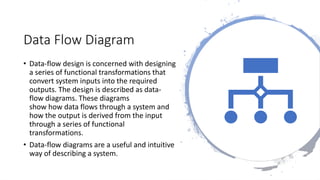
• Data-flow design is concerned with designing
a series of functional transformations that
convert system inputs into the required
outputs. The design is described as data-
flow diagrams. These diagrams
show how data flows through a system and
how the output is derived from the input
through a series of functional
transformations.
• Data-flow diagrams are a useful and intuitive
way of describing a system.
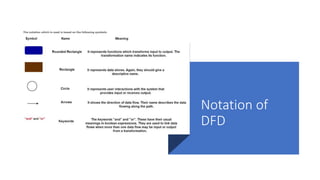
Notation of
DFD
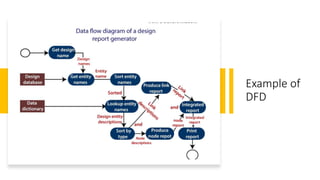
Example of
DFD
Data
Dictionaries
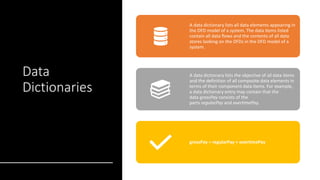
A data dictionary lists all data elements appearing in
the DFD model of a system. The data items listed
contain all data flows and the contents of all data
stores looking on the DFDs in the DFD model of a
system.
A data dictionary lists the objective of all data items
and the definition of all composite data elements in
terms of their component data items. For example,
a data dictionary entry may contain that the
data grossPay consists of the
parts regularPay and overtimePay.
grossPay = regularPay + overtimePay
Advantages of
Data
Dictionaries
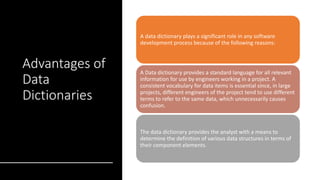
A data dictionary plays a significant role in any software
development process because of the following reasons:
A Data dictionary provides a standard language for all relevant
information for use by engineers working in a project. A
consistent vocabulary for data items is essential since, in large
projects, different engineers of the project tend to use different
terms to refer to the same data, which unnecessarily causes
confusion.
The data dictionary provides the analyst with a means to
determine the definition of various data structures in terms of
their component elements.
Structured Charts
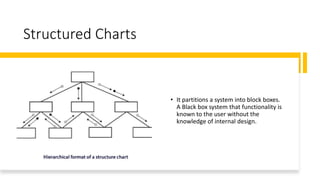
• It partitions a system into block boxes.
A Black box system that functionality is
known to the user without the
knowledge of internal design.
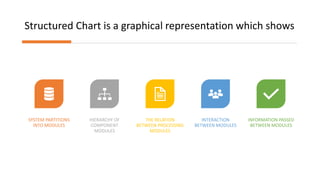
Structured Chart is a graphical representation which shows
SYSTEM PARTITIONS
INTO MODULES
HIERARCHY OF
COMPONENT
MODULES
THE RELATION
BETWEEN PROCESSING
MODULES
INTERACTION
BETWEEN MODULES
INFORMATION PASSED
BETWEEN MODULES
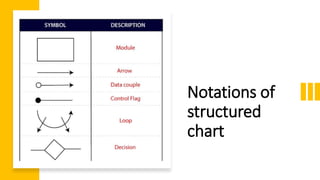
Notations of
structured
chart
Pseudo-code
• Pseudo-code notations can be used in both
the preliminary and detailed design phases.
Using pseudo-code, the designer describes
system characteristics using short, concise,
English Language phases that are structured
by keywords such as If-Then-Else, While-Do,
and End.

SOFTWARE ENGINEERING ppt

  • 1.
    SOFTWARE ENGINEERING Tutorial –17 By – Anubhav Bansal Btech CSE – G1
  • 2.
    What do youmean by FUNCTION ORIENTED DESIGN? Explain it. • The design process for software systems often has two levels. At the first level the focus is on deciding which modules are needed for the system on the basis of SRS (Software Requirement Specification) and how the modules should be interconnected. • Function Oriented Design is an approach to software design where the design is decomposed into a set of interacting units where each unit has a clearly defined function.
  • 3.
    Function Oriented Design Strategies • Function OrientedDesign Strategies are as follows:- • Data Flow Diagram (DFD) • Data Dictionaries • Structure Charts • Pseudo Code
  • 4.
    Data Flow Diagram •Data-flow design is concerned with designing a series of functional transformations that convert system inputs into the required outputs. The design is described as data- flow diagrams. These diagrams show how data flows through a system and how the output is derived from the input through a series of functional transformations. • Data-flow diagrams are a useful and intuitive way of describing a system.
  • 5.
  • 6.
  • 7.
    Data Dictionaries A data dictionarylists all data elements appearing in the DFD model of a system. The data items listed contain all data flows and the contents of all data stores looking on the DFDs in the DFD model of a system. A data dictionary lists the objective of all data items and the definition of all composite data elements in terms of their component data items. For example, a data dictionary entry may contain that the data grossPay consists of the parts regularPay and overtimePay. grossPay = regularPay + overtimePay
  • 8.
    Advantages of Data Dictionaries A datadictionary plays a significant role in any software development process because of the following reasons: A Data dictionary provides a standard language for all relevant information for use by engineers working in a project. A consistent vocabulary for data items is essential since, in large projects, different engineers of the project tend to use different terms to refer to the same data, which unnecessarily causes confusion. The data dictionary provides the analyst with a means to determine the definition of various data structures in terms of their component elements.
  • 9.
    Structured Charts • Itpartitions a system into block boxes. A Black box system that functionality is known to the user without the knowledge of internal design.
  • 10.
    Structured Chart isa graphical representation which shows SYSTEM PARTITIONS INTO MODULES HIERARCHY OF COMPONENT MODULES THE RELATION BETWEEN PROCESSING MODULES INTERACTION BETWEEN MODULES INFORMATION PASSED BETWEEN MODULES
  • 11.
  • 12.
    Pseudo-code • Pseudo-code notationscan be used in both the preliminary and detailed design phases. Using pseudo-code, the designer describes system characteristics using short, concise, English Language phases that are structured by keywords such as If-Then-Else, While-Do, and End.