Visualizing Software
Ecosystems
Prof. Bala Iyer
Twitter: @balaiyer
04/04/14
2
Agenda
 Ecosystem basics
 Examples
 Visualization Methodology
 Lessons
 Future directions
3
Ecosystem
 Loose networks – of suppliers, distributors,
outsourcing firms, makers of related products or
services, technology providers, and a host of other
organizations – that affect, and are affected by the
creation and delivery of a company’s own
offerings. [Marco Iansiti]
 An economic community supported by a
foundation of interacting organizations and
individuals—the organisms of the business world.
The economic community produces goods and
services of value to customers, who are themselves
members of the ecosystem [James Moore]
4
Creating Awesome Users
 Don't make a better [X], make a better
[user of X].
 Kathy Sierra
 Think about how customers experience
the product or service
5
Computer Industry [circa 1980s…]
Source: Bill Gates Testimony - link
Bill Gates, DOJ testimony 2002.
6
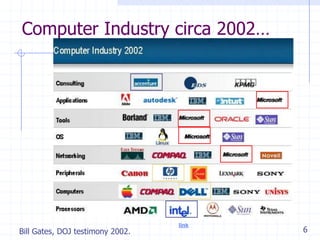
Computer Industry circa 2002…
ony - link
Bill Gates, DOJ testimony 2002.
7
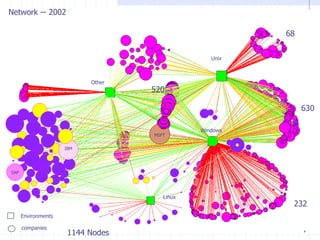
Network -- 2002
Linux
Unix
Windows
Other
IBM
MSFT
SAP
Environments
companies
1144 Nodes
232
68
630
520
8
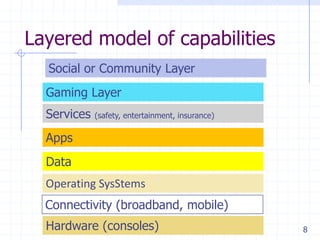
Layered model of capabilities
Hardware (consoles)
Data
Services (safety, entertainment, insurance)
Connectivity (broadband, mobile)
Operating SysStems
Social or Community Layer
Gaming Layer
Apps
9
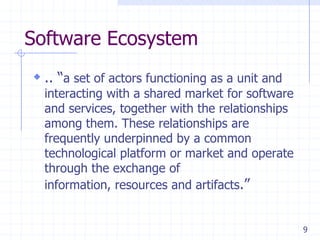
Software Ecosystem
 .. ―a set of actors functioning as a unit and
interacting with a shared market for software
and services, together with the relationships
among them. These relationships are
frequently underpinned by a common
technological platform or market and operate
through the exchange of
information, resources and artifacts.‖
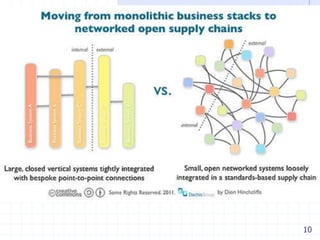
10
11
Networks
 Deliver value to customer segments
using a portfolio of capabilities some of
which are achieved through links or
dependencies.
 People
 Objects
 Systems
 Organizations
12
Roles
 Platform provider
 Component supplier
 Systems integrator
 Orchestrator
13
Industry Platform Definition
 Technology or set of components (or services) that
creates a common foundation,
 That brings together multiple parties beyond a
single firm (―market sides‖) for a common purpose
and generates network effects,
 Where the value can increase exponentially
with (a) more users and (b) more ―complementary‖
products & services built around the platform
Michael Cusumano, Platform Strategy Fundamentals 2014.
14
Examples
 Mobile Payment
 Telematics
 Cloud services
15
Example 1
16
17
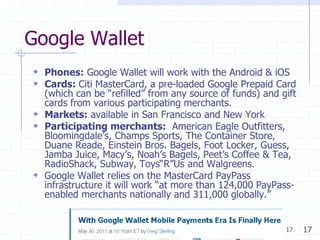
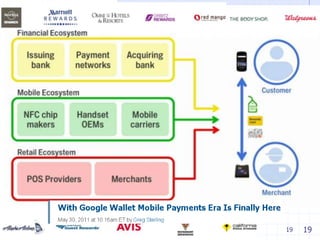
Google Wallet
 Phones: Google Wallet will work with the Android & iOS
 Cards: Citi MasterCard, a pre-loaded Google Prepaid Card
(which can be ―refilled‖ from any source of funds) and gift
cards from various participating merchants.
 Markets: available in San Francisco and New York
 Participating merchants: American Eagle Outfitters,
Bloomingdale’s, Champs Sports, The Container Store,
Duane Reade, Einstein Bros. Bagels, Foot Locker, Guess,
Jamba Juice, Macy’s, Noah’s Bagels, Peet’s Coffee & Tea,
RadioShack, Subway, Toys―R‖Us and Walgreens.
 Google Wallet relies on the MasterCard PayPass
infrastructure it will work ―at more than 124,000 PayPass-
enabled merchants nationally and 311,000 globally.‖
17
18
Google Wallet
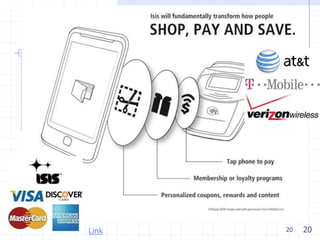
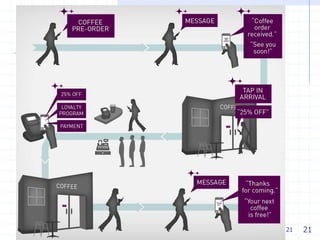
 Google Offers linked to Wallet: Offers are
directly integrated into Google Wallet.
Consumers will be able to send offers they
encounter to Wallet with a single click (if you’re
signed in). Redemption will be accomplished
with a ―SingleTap‖ at the point of sale or via
scanning or keying in a code if the POS system
doesn’t support SingleTap.
 Future uses: Google envisions that ―receipts,
boarding passes and tickets will all be
seamlessly synced to your Google Wallet.‖
18
1919
2020Link
2121
22
M-payment Stakeholders
 Platform provider
 Network Operators
 Banks
 Credit Card Issuers
 Device Manufacturers
 Merchants
 Consumers
22
23
Market
 Forrester Research estimates the size of the opportunity
will grow to $90 billion by 2017, growing at a 48% rate
since 2012.
 Worldwide mobile payment transaction values will
surpass $171.5 billion ... according to Gartner, Inc.
 By 2015, about half of the 863 million phone
handsets sold yearly worldwide will contain the
chips, according to Frost & Sullivan.
 150,000 merchants on Google Wallet
 ―only about 7 percent of retail sales occur
online, compared to $4 trillion that is still spent in person
at stores. "We're going after the 93 percent," Google
VP, Osama Bedier.
23
2424
25
Platforms
25
26
Method used for Ecosystem
generation
 List of platform players created from
virtual currency platforms, experts, and
 Created a list of partners from news
feeds and websites
 Visualized using Pajek
27
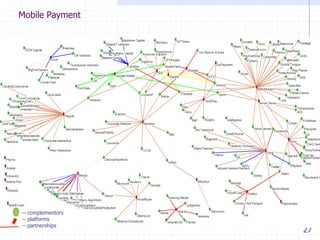
Mobile Payment
-- complementors
-- platforms
-- partnerships
28
Analysis
 237 companies, 25 platforms
 Many approaches to M-payment
 Diversity is good
 Many fragmented platforms
 Carriers and card issuers are working
across platforms
 Still evolving ecosystem
 Many experiments in emerging
economies
29
M-payment Platform Wars
 A few platforms may emerge
 Unique value proposition
 Too expensive to carry multiple systems
 Direct (developers) and Indirect (end
users) Network Effects
 Business models and subsidies
 Emergence of standards like OpenSocial
29
30
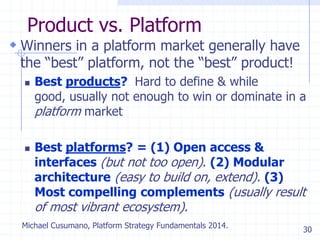
Product vs. Platform
 Winners in a platform market generally have
the ―best‖ platform, not the ―best‖ product!
 Best products? Hard to define & while
good, usually not enough to win or dominate in a
platform market
 Best platforms? = (1) Open access &
interfaces (but not too open). (2) Modular
architecture (easy to build on, extend). (3)
Most compelling complements (usually result
of most vibrant ecosystem).
Michael Cusumano, Platform Strategy Fundamentals 2014.
31
Example #2: Cloud computing
32
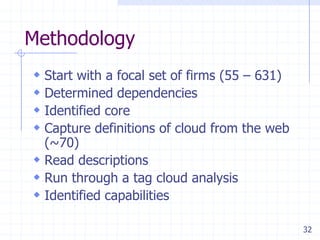
Methodology
 Start with a focal set of firms (55 – 631)
 Determined dependencies
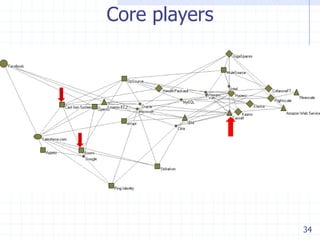
 Identified core
 Capture definitions of cloud from the web
(~70)
 Read descriptions
 Run through a tag cloud analysis
 Identified capabilities
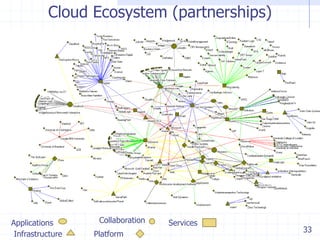
33
Infrastructure Platform
Applications Collaboration Services
Cloud Ecosystem (partnerships)
34
Core players
35
Example #3: Telematics
36
37
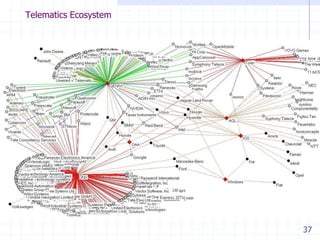
Telematics Ecosystem
38
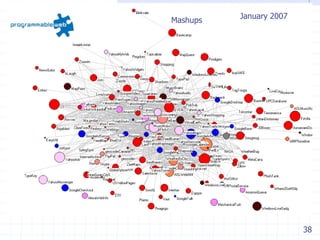
January 2007
Mashups
39
2002
Highest
High
Medium
Low
Higher
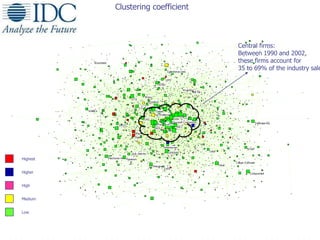
Clustering coefficient
Central firms:
Between 1990 and 2002,
these firms account for
35 to 69% of the industry sale
40
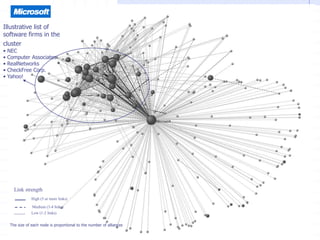
Illustrative list of
software firms in the
cluster
• NEC
• Computer Associates
• RealNetworks
• CheckFree Corp.
• Yahoo!
Link strength
High (5 or more links)
Medium (3-4 links)
Low (1-2 links)
The size of each node is proportional to the number of alliances
41
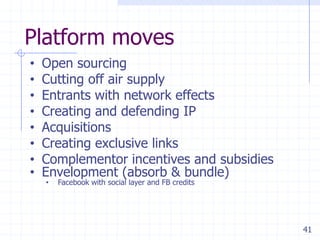
Platform moves
• Open sourcing
• Cutting off air supply
• Entrants with network effects
• Creating and defending IP
• Acquisitions
• Creating exclusive links
• Complementor incentives and subsidies
• Envelopment (absorb & bundle)
• Facebook with social layer and FB credits
42
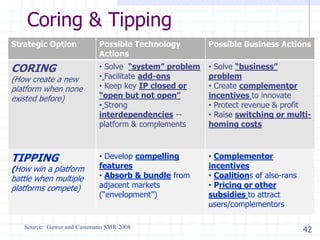
Coring & Tipping
Strategic Option Possible Technology
Actions
Possible Business Actions
CORING
(How create a new
platform when none
existed before)
• Solve “system” problem
• Facilitate add-ons
• Keep key IP closed or
“open but not open”
• Strong
interdependencies --
platform & complements
• Solve “business”
problem
• Create complementor
incentives to innovate
• Protect revenue & profit
• Raise switching or multi-
homing costs
TIPPING
(How win a platform
battle when multiple
platforms compete)
• Develop compelling
features
• Absorb & bundle from
adjacent markets
(―envelopment‖)
• Complementor
incentives
• Coalitions of also-rans
• Pricing or other
subsidies to attract
users/complementors
Source: Gawer and Cusumano SMR 2008
43
Findings
 Chart your ecosystem
 Ford (telematics, healthcare,
entertainment, ..)
 Consider shifts in network
 Own and third-party moves
 Portfolio of proactive and reactive
connections
 Ecosystem moves
44
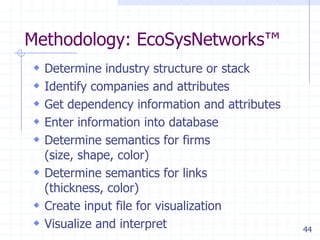
Methodology: EcoSysNetworks™
 Determine industry structure or stack
 Identify companies and attributes
 Get dependency information and attributes
 Enter information into database
 Determine semantics for firms
(size, shape, color)
 Determine semantics for links
(thickness, color)
 Create input file for visualization
 Visualize and interpret
45
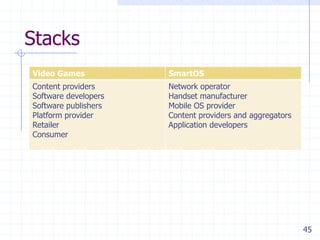
Stacks
Video Games SmartOS
Content providers
Software developers
Software publishers
Platform provider
Retailer
Consumer
Network operator
Handset manufacturer
Mobile OS provider
Content providers and aggregators
Application developers
46
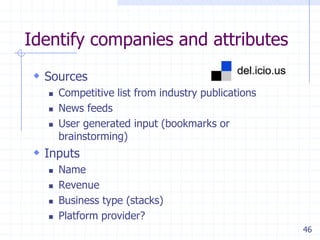
Identify companies and attributes
 Sources
 Competitive list from industry publications
 News feeds
 User generated input (bookmarks or
brainstorming)
 Inputs
 Name
 Revenue
 Business type (stacks)
 Platform provider?
47
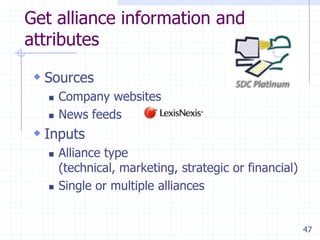
Get alliance information and
attributes
 Sources
 Company websites
 News feeds
 Inputs
 Alliance type
(technical, marketing, strategic or financial)
 Single or multiple alliances
48
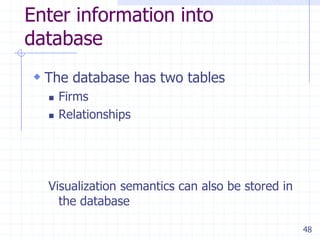
Enter information into
database
 The database has two tables
 Firms
 Relationships
Visualization semantics can also be stored in
the database
49
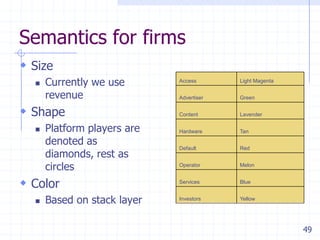
Semantics for firms
 Size
 Currently we use
revenue
 Shape
 Platform players are
denoted as
diamonds, rest as
circles
 Color
 Based on stack layer
Access Light Magenta
Advertiser Green
Content Lavender
Hardware Tan
Default Red
Operator Melon
Services Blue
Investors Yellow
50
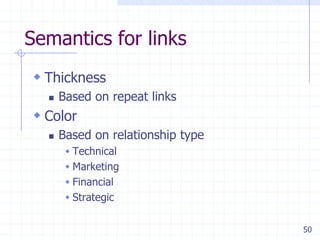
Semantics for links
 Thickness
 Based on repeat links
 Color
 Based on relationship type
 Technical
 Marketing
 Financial
 Strategic
51
Pajek
 Download:
http://pajek.imfm.si/doku.php?id=down
load
 Reference manual
52
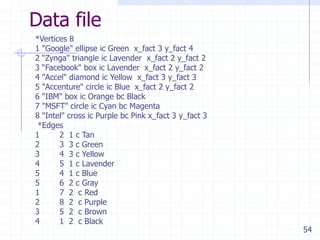
Create input file for
visualization
 We use Pajek for the visualizations
 A sample Pajek input file has two parts
 Vertices
 A vertex record contains vertex
number, name, color, shape, size and the time
it appears on the visualization.
 Edges
 An edge record contains
from, to, thickness, color and the time it
appears in the visualization
53
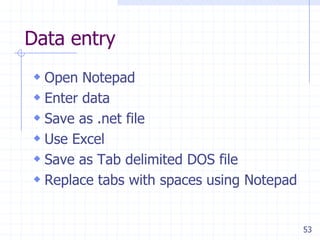
Data entry
 Open Notepad
 Enter data
 Save as .net file
 Use Excel
 Save as Tab delimited DOS file
 Replace tabs with spaces using Notepad
54
*Vertices 8
1 "Google" ellipse ic Green x_fact 3 y_fact 4
2 ―Zynga" triangle ic Lavender x_fact 2 y_fact 2
3 ―Facebook" box ic Lavender x_fact 2 y_fact 2
4 "Accel" diamond ic Yellow x_fact 3 y_fact 3
5 "Accenture" circle ic Blue x_fact 2 y_fact 2
6 "IBM" box ic Orange bc Black
7 "MSFT" circle ic Cyan bc Magenta
8 "Intel" cross ic Purple bc Pink x_fact 3 y_fact 3
*Edges
1 2 1 c Tan
2 3 3 c Green
3 4 3 c Yellow
4 5 1 c Lavender
5 4 1 c Blue
5 6 2 c Gray
1 7 2 c Red
2 8 2 c Purple
3 5 2 c Brown
4 1 2 c Black
Data file
55
56
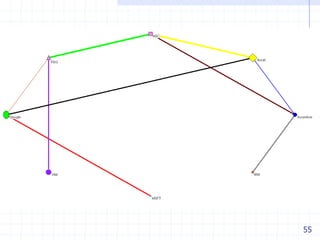
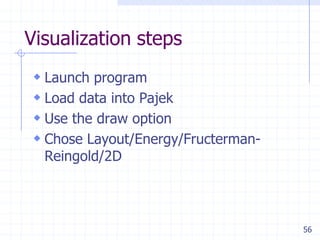
Visualization steps
 Launch program
 Load data into Pajek
 Use the draw option
 Chose Layout/Energy/Fructerman-
Reingold/2D
57
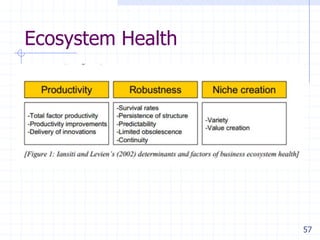
Ecosystem Health
58
Network Measures
59
Degree centrality
 The degree centrality of a node is
defined as the total number of
connections the node has
60
Density
 Density is the number of connections a
node has, divided by the number of
possible connections
61
Betweenness
 It is important to find which units lie on
the shortest paths among pairs of other
units. Such units have control over the
flow of information in the network. Idea
of betweenness centrality measures:
unit is central, if it lies on several
shortest paths among other pairs of
units.
62
Closeness centrality
 Closeness is preferred in network
analysis to mean shortest-path
length, as it gives higher values to more
central vertices, and so is usually
positively associated with other
measures such as degree.
Source: wikipedia
63
Clustering Coefficient
 A node’s clustering coefficient can be
defined as the proportion of alters that
are themselves directly connected
64
Pajek measures
 Network/Create
Vector/Centrality/Degree/, while other two
centralities can be found under Degree
 Network reduction
 Net/Transform/Reduction/Degree
 Core players
 Net/Partitions/Core/Degree
 Operations/Extract Network/Partitions
 Draw-partition
65
Exporting pictures
 Export/2D/bitmap
 Save file
 Import into PowerPoint
66
What did we find in the software sector
(1990-2001)?
 Small worlds
 Degree – 3.1 to 2.8
 Density – decreased from 0.005 to
0.001
 CC – 0.21 to 0.28
 Structure of the network and firm
performance
67
Platform Leadership Process
 Create & communicate a vision of platform evolution
 Build consensus & coalitions among a small group of
influential firms for new initiatives
 Identify and target “system” bottlenecks
 Distribute tools & enabling technologies to help partners
develop complements fitting the vision
 Highlight business opportunities and help leading firms act
as “rabbits” to lead the market
 Facilitate multi-firm initiatives to promote standards,
platform interfaces, and complementary innovations
Michael Cusumano, Platform Strategy Fundamentals 2014.
68
Data sources
 Website
 Lexis/Nexis
 Sort search results by subject (alliances and
partnerships)
 SDC Platinum
 Programmableweb.com
 http://www.programmableweb.com/neoapi.xml
 http://www.programmableweb.com/neomatrix.xml
 Appdata
 www.compete.com ; www.socialmention.com;
www.google.com/trends
69
Future directions
 Decision Environments
 automate data collection
 Visualize
 collaborate
 Shared repositories
 Strong theory and cases
 Better understanding of ecosystem risks
 API-based networks
 Communities to share findings

Understanding Software Ecosystems

  • 1.
    Visualizing Software Ecosystems Prof. BalaIyer Twitter: @balaiyer 04/04/14
  • 2.
    2 Agenda  Ecosystem basics Examples  Visualization Methodology  Lessons  Future directions
  • 3.
    3 Ecosystem  Loose networks– of suppliers, distributors, outsourcing firms, makers of related products or services, technology providers, and a host of other organizations – that affect, and are affected by the creation and delivery of a company’s own offerings. [Marco Iansiti]  An economic community supported by a foundation of interacting organizations and individuals—the organisms of the business world. The economic community produces goods and services of value to customers, who are themselves members of the ecosystem [James Moore]
  • 4.
    4 Creating Awesome Users Don't make a better [X], make a better [user of X].  Kathy Sierra  Think about how customers experience the product or service
  • 5.
    5 Computer Industry [circa1980s…] Source: Bill Gates Testimony - link Bill Gates, DOJ testimony 2002.
  • 6.
    6 Computer Industry circa2002… ony - link Bill Gates, DOJ testimony 2002.
  • 7.
  • 8.
    8 Layered model ofcapabilities Hardware (consoles) Data Services (safety, entertainment, insurance) Connectivity (broadband, mobile) Operating SysStems Social or Community Layer Gaming Layer Apps
  • 9.
    9 Software Ecosystem  ..―a set of actors functioning as a unit and interacting with a shared market for software and services, together with the relationships among them. These relationships are frequently underpinned by a common technological platform or market and operate through the exchange of information, resources and artifacts.‖
  • 10.
  • 11.
    11 Networks  Deliver valueto customer segments using a portfolio of capabilities some of which are achieved through links or dependencies.  People  Objects  Systems  Organizations
  • 12.
    12 Roles  Platform provider Component supplier  Systems integrator  Orchestrator
  • 13.
    13 Industry Platform Definition Technology or set of components (or services) that creates a common foundation,  That brings together multiple parties beyond a single firm (―market sides‖) for a common purpose and generates network effects,  Where the value can increase exponentially with (a) more users and (b) more ―complementary‖ products & services built around the platform Michael Cusumano, Platform Strategy Fundamentals 2014.
  • 14.
    14 Examples  Mobile Payment Telematics  Cloud services
  • 15.
  • 16.
  • 17.
    17 Google Wallet  Phones:Google Wallet will work with the Android & iOS  Cards: Citi MasterCard, a pre-loaded Google Prepaid Card (which can be ―refilled‖ from any source of funds) and gift cards from various participating merchants.  Markets: available in San Francisco and New York  Participating merchants: American Eagle Outfitters, Bloomingdale’s, Champs Sports, The Container Store, Duane Reade, Einstein Bros. Bagels, Foot Locker, Guess, Jamba Juice, Macy’s, Noah’s Bagels, Peet’s Coffee & Tea, RadioShack, Subway, Toys―R‖Us and Walgreens.  Google Wallet relies on the MasterCard PayPass infrastructure it will work ―at more than 124,000 PayPass- enabled merchants nationally and 311,000 globally.‖ 17
  • 18.
    18 Google Wallet  GoogleOffers linked to Wallet: Offers are directly integrated into Google Wallet. Consumers will be able to send offers they encounter to Wallet with a single click (if you’re signed in). Redemption will be accomplished with a ―SingleTap‖ at the point of sale or via scanning or keying in a code if the POS system doesn’t support SingleTap.  Future uses: Google envisions that ―receipts, boarding passes and tickets will all be seamlessly synced to your Google Wallet.‖ 18
  • 19.
  • 20.
  • 21.
  • 22.
    22 M-payment Stakeholders  Platformprovider  Network Operators  Banks  Credit Card Issuers  Device Manufacturers  Merchants  Consumers 22
  • 23.
    23 Market  Forrester Researchestimates the size of the opportunity will grow to $90 billion by 2017, growing at a 48% rate since 2012.  Worldwide mobile payment transaction values will surpass $171.5 billion ... according to Gartner, Inc.  By 2015, about half of the 863 million phone handsets sold yearly worldwide will contain the chips, according to Frost & Sullivan.  150,000 merchants on Google Wallet  ―only about 7 percent of retail sales occur online, compared to $4 trillion that is still spent in person at stores. "We're going after the 93 percent," Google VP, Osama Bedier. 23
  • 24.
  • 25.
  • 26.
    26 Method used forEcosystem generation  List of platform players created from virtual currency platforms, experts, and  Created a list of partners from news feeds and websites  Visualized using Pajek
  • 27.
    27 Mobile Payment -- complementors --platforms -- partnerships
  • 28.
    28 Analysis  237 companies,25 platforms  Many approaches to M-payment  Diversity is good  Many fragmented platforms  Carriers and card issuers are working across platforms  Still evolving ecosystem  Many experiments in emerging economies
  • 29.
    29 M-payment Platform Wars A few platforms may emerge  Unique value proposition  Too expensive to carry multiple systems  Direct (developers) and Indirect (end users) Network Effects  Business models and subsidies  Emergence of standards like OpenSocial 29
  • 30.
    30 Product vs. Platform Winners in a platform market generally have the ―best‖ platform, not the ―best‖ product!  Best products? Hard to define & while good, usually not enough to win or dominate in a platform market  Best platforms? = (1) Open access & interfaces (but not too open). (2) Modular architecture (easy to build on, extend). (3) Most compelling complements (usually result of most vibrant ecosystem). Michael Cusumano, Platform Strategy Fundamentals 2014.
  • 31.
  • 32.
    32 Methodology  Start witha focal set of firms (55 – 631)  Determined dependencies  Identified core  Capture definitions of cloud from the web (~70)  Read descriptions  Run through a tag cloud analysis  Identified capabilities
  • 33.
    33 Infrastructure Platform Applications CollaborationServices Cloud Ecosystem (partnerships)
  • 34.
  • 35.
  • 36.
  • 37.
  • 38.
  • 39.
    39 2002 Highest High Medium Low Higher Clustering coefficient Central firms: Between1990 and 2002, these firms account for 35 to 69% of the industry sale
  • 40.
    40 Illustrative list of softwarefirms in the cluster • NEC • Computer Associates • RealNetworks • CheckFree Corp. • Yahoo! Link strength High (5 or more links) Medium (3-4 links) Low (1-2 links) The size of each node is proportional to the number of alliances
  • 41.
    41 Platform moves • Opensourcing • Cutting off air supply • Entrants with network effects • Creating and defending IP • Acquisitions • Creating exclusive links • Complementor incentives and subsidies • Envelopment (absorb & bundle) • Facebook with social layer and FB credits
  • 42.
    42 Coring & Tipping StrategicOption Possible Technology Actions Possible Business Actions CORING (How create a new platform when none existed before) • Solve “system” problem • Facilitate add-ons • Keep key IP closed or “open but not open” • Strong interdependencies -- platform & complements • Solve “business” problem • Create complementor incentives to innovate • Protect revenue & profit • Raise switching or multi- homing costs TIPPING (How win a platform battle when multiple platforms compete) • Develop compelling features • Absorb & bundle from adjacent markets (―envelopment‖) • Complementor incentives • Coalitions of also-rans • Pricing or other subsidies to attract users/complementors Source: Gawer and Cusumano SMR 2008
  • 43.
    43 Findings  Chart yourecosystem  Ford (telematics, healthcare, entertainment, ..)  Consider shifts in network  Own and third-party moves  Portfolio of proactive and reactive connections  Ecosystem moves
  • 44.
    44 Methodology: EcoSysNetworks™  Determineindustry structure or stack  Identify companies and attributes  Get dependency information and attributes  Enter information into database  Determine semantics for firms (size, shape, color)  Determine semantics for links (thickness, color)  Create input file for visualization  Visualize and interpret
  • 45.
    45 Stacks Video Games SmartOS Contentproviders Software developers Software publishers Platform provider Retailer Consumer Network operator Handset manufacturer Mobile OS provider Content providers and aggregators Application developers
  • 46.
    46 Identify companies andattributes  Sources  Competitive list from industry publications  News feeds  User generated input (bookmarks or brainstorming)  Inputs  Name  Revenue  Business type (stacks)  Platform provider?
  • 47.
    47 Get alliance informationand attributes  Sources  Company websites  News feeds  Inputs  Alliance type (technical, marketing, strategic or financial)  Single or multiple alliances
  • 48.
    48 Enter information into database The database has two tables  Firms  Relationships Visualization semantics can also be stored in the database
  • 49.
    49 Semantics for firms Size  Currently we use revenue  Shape  Platform players are denoted as diamonds, rest as circles  Color  Based on stack layer Access Light Magenta Advertiser Green Content Lavender Hardware Tan Default Red Operator Melon Services Blue Investors Yellow
  • 50.
    50 Semantics for links Thickness  Based on repeat links  Color  Based on relationship type  Technical  Marketing  Financial  Strategic
  • 51.
  • 52.
    52 Create input filefor visualization  We use Pajek for the visualizations  A sample Pajek input file has two parts  Vertices  A vertex record contains vertex number, name, color, shape, size and the time it appears on the visualization.  Edges  An edge record contains from, to, thickness, color and the time it appears in the visualization
  • 53.
    53 Data entry  OpenNotepad  Enter data  Save as .net file  Use Excel  Save as Tab delimited DOS file  Replace tabs with spaces using Notepad
  • 54.
    54 *Vertices 8 1 "Google"ellipse ic Green x_fact 3 y_fact 4 2 ―Zynga" triangle ic Lavender x_fact 2 y_fact 2 3 ―Facebook" box ic Lavender x_fact 2 y_fact 2 4 "Accel" diamond ic Yellow x_fact 3 y_fact 3 5 "Accenture" circle ic Blue x_fact 2 y_fact 2 6 "IBM" box ic Orange bc Black 7 "MSFT" circle ic Cyan bc Magenta 8 "Intel" cross ic Purple bc Pink x_fact 3 y_fact 3 *Edges 1 2 1 c Tan 2 3 3 c Green 3 4 3 c Yellow 4 5 1 c Lavender 5 4 1 c Blue 5 6 2 c Gray 1 7 2 c Red 2 8 2 c Purple 3 5 2 c Brown 4 1 2 c Black Data file
  • 55.
  • 56.
    56 Visualization steps  Launchprogram  Load data into Pajek  Use the draw option  Chose Layout/Energy/Fructerman- Reingold/2D
  • 57.
  • 58.
  • 59.
    59 Degree centrality  Thedegree centrality of a node is defined as the total number of connections the node has
  • 60.
    60 Density  Density isthe number of connections a node has, divided by the number of possible connections
  • 61.
    61 Betweenness  It isimportant to find which units lie on the shortest paths among pairs of other units. Such units have control over the flow of information in the network. Idea of betweenness centrality measures: unit is central, if it lies on several shortest paths among other pairs of units.
  • 62.
    62 Closeness centrality  Closenessis preferred in network analysis to mean shortest-path length, as it gives higher values to more central vertices, and so is usually positively associated with other measures such as degree. Source: wikipedia
  • 63.
    63 Clustering Coefficient  Anode’s clustering coefficient can be defined as the proportion of alters that are themselves directly connected
  • 64.
    64 Pajek measures  Network/Create Vector/Centrality/Degree/,while other two centralities can be found under Degree  Network reduction  Net/Transform/Reduction/Degree  Core players  Net/Partitions/Core/Degree  Operations/Extract Network/Partitions  Draw-partition
  • 65.
    65 Exporting pictures  Export/2D/bitmap Save file  Import into PowerPoint
  • 66.
    66 What did wefind in the software sector (1990-2001)?  Small worlds  Degree – 3.1 to 2.8  Density – decreased from 0.005 to 0.001  CC – 0.21 to 0.28  Structure of the network and firm performance
  • 67.
    67 Platform Leadership Process Create & communicate a vision of platform evolution  Build consensus & coalitions among a small group of influential firms for new initiatives  Identify and target “system” bottlenecks  Distribute tools & enabling technologies to help partners develop complements fitting the vision  Highlight business opportunities and help leading firms act as “rabbits” to lead the market  Facilitate multi-firm initiatives to promote standards, platform interfaces, and complementary innovations Michael Cusumano, Platform Strategy Fundamentals 2014.
  • 68.
    68 Data sources  Website Lexis/Nexis  Sort search results by subject (alliances and partnerships)  SDC Platinum  Programmableweb.com  http://www.programmableweb.com/neoapi.xml  http://www.programmableweb.com/neomatrix.xml  Appdata  www.compete.com ; www.socialmention.com; www.google.com/trends
  • 69.
    69 Future directions  DecisionEnvironments  automate data collection  Visualize  collaborate  Shared repositories  Strong theory and cases  Better understanding of ecosystem risks  API-based networks  Communities to share findings