QuESo: a Quality Model for Open Source Software EcosystemsICSOFT-EA 2014 
Oscar Franco-Bedoya 
ohernan@essi.upc.edu 
David Ameller 
dameller@essi.upc.edu 
Dolors Costal 
dolors@essi.upc.edu 
Xavier Franch 
franch@essi.upc.edu
2 
Related work 
Method 
QuESo 
Application 
example 
Discussion 
Future work 
Conclusions 
Outline 
Overview
3 
0 
500.000 
1.000.000 
1.500.000 
2.000.000 
2.500.000 
2007 
2009 
2011 
2013 
2015 
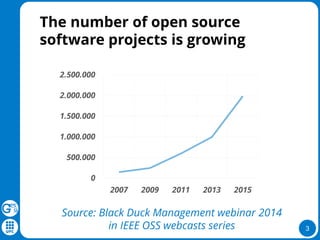
The number of open source 
software projects is growing 
Source: Black Duck Management webinar 2014 
in IEEE OSS webcasts series
4 
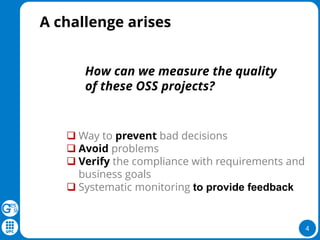
A challenge arises 
How can we measure the quality of these OSS projects? 
Way to preventbad decisions 
Avoidproblems 
Verifythe compliance with requirements and business goals 
Systematic monitoring to provide feedback
5 
The ecosystem metaphor is used to 
understand software relationships 
A systemformed by 
the interactionof 
a community of organisms 
with their environment 
Developers 
Adopters 
Software 
Projects 
Contributors 
Software 
products
6 
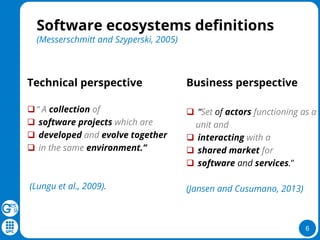
Software ecosystems definitions(Messerschmitt and Szyperski, 2005) 
Business perspective 
“Setof actorsfunctioning as a 
unit and 
interacting with a 
shared market for 
software and services.” 
(Jansen and Cusumano, 2013) 
Technical perspective 
“ Acollection of 
software projects which are 
developedandevolve together 
in the same environment.” 
(Lunguet al., 2009).
7 
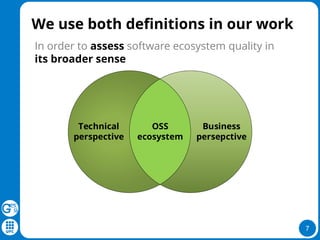
We use both definitions in our work 
In order to assesssoftware ecosystem quality in its broader sense 
TechnicalperspectiveBusinesspersepctiveOSSecosystem
8 
From the challenge: 
How can we measure the quality of these OSS projects? 
To the research goal of this work: 
How can we measure the quality of these OSS ecosystems?
9 
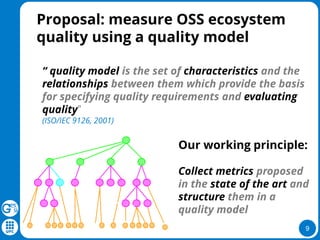
Proposal: measure OSS ecosystem quality using a quality model 
“ quality model is the set of characteristicsand the relationshipsbetween them which provide the basis for specifying quality requirements and evaluating quality” 
(ISO/IEC 9126, 2001) 
Our working principle: 
Collect metrics proposed in the state of the art and structurethem in a quality model
10 
Overview 
Related work 
Method 
QuESo 
Application 
example 
Discussion 
Future work 
Conclusions 
Outline
11 
Related Work
12 
Overview 
Related work 
Method 
QuESo 
Application 
example 
Discussion 
Future work 
Conclusions 
Outline
13 
Gathering measures 
Systematic 
literature 
review 
1 
Constructing Model 
Bottom up 
Top down 
2 
The methodology have two steps
14 
Gathering measures from the available literature. 
Systematic literature review 
(Kitchenham and Charters, 2007). 
Measure inclusion criteria: 
(Hartighet al., 2013; Neuet al., 2011) 
User-friendlyand 
operationalizable. 
Non-redundant 
68 measures! 
BookManual searchSecondary studiesDigital libraries351116Papers with measures of OSS ecosystems17
15 
Method for quality model construction. RadulovicandGarcia-Castro(2011) 
Sub-characteristics 
Relationships 
Quality measures 
Derived measures 
Basic measures 
Align quality sub- characteristics with a quality model 
QuESo 
SLR measures 
QualOSS 
ISO Quality model
16 
Overview 
Related work 
Method 
QuESo 
Application 
example 
Discussion 
Future work 
Conclusions 
Outline
17 
Quality characteristics in QuESo have 
been organized into three dimensions 
QuESo Community 
quality 
Ecosystem 
network 
quality 
Platform 
quality 
Software platform in 
which the projects 
of the ecosystem 
are built. 
OSS communities 
that grow inside the 
ecosystem and 
ecosystem’s projects 
OSS ecosystem as a 
network of interrelated 
elements 
# 
11 
54 
8 
20
18 
Maintenance capacity :Ability to provide 
the resources necessary for maintaining 
community products 
Dimension 
Characteristic 
Sub-characteristic 
From QualOSS 
Measure 
QuESo 
Maintenance 
capacity 
Community 
quality 
Size 
Activeness 
number 
authors 
Gnome: 3.500 
1997-2012 
number of 
commits 
Gnome: 
480.000 
1997-2007
19 
Network health: How well members are connected and their impact 
Ability of the nodes to establish connections between them 
Capacity of the ecosystem nodes to be classified around its projects. 
QuESoEcosystemnetwork qualityNetwork healthClusteringInterrelatednessnumber community projectsGnome: 1.200 1997-2012Contributor activity graphGnome:499 projects / 15.000 changes1998-2011
20 
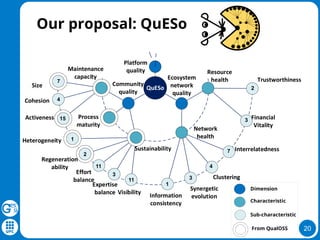
Our proposal: QuESo 
QuESo 
Maintenance 
capacity 
Sustainability 
Process 
maturity 
Community 
quality 
Size 
Cohesion 
Activeness 
Heterogeneity 
Regeneration 
ability 
Effort 
balance 
Expertise 
balance Visibility 
Ecosystem 
network 
quality 
Resource 
health 
Network 
health 
Information 
consistency 
Financial 
Vitality 
Clustering 
Trustworthiness 
Interrelatedness 
Synergetic 
evolution 
Platform 
quality 
Dimension 
Characteristic 
Sub-characteristic 
From QualOSS 
4 
7 
15 
1 
2 
11 
3 
11 
2 
3 
7 
4 
3 
1
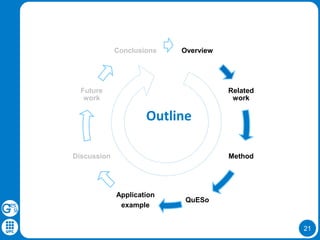
21 
Overview 
Related work 
Method 
QuESo 
Application 
example 
Discussion 
Future work 
Conclusions 
Outline
22 
Using QuESOfor risk analysisKenett, R et al. (2014) 
Managing Risk and Costs in OSS Adoption
23 
Software ecosystem model
24 
Relations between measures and quality characteristics 
QuESo 
measures 
QuESo 
characteristics 
Mail per day 
Activeness
25 
SALMonOSS: AssessingOpen Source Communities’ Health(Oriol , Franco-Bedoya, 2014)
26 
: Ecosystem Quality Object 
goals-tasks-resources-softgoals 
: Ecosystem Quality Parameter 
QuESo Quality characteristics & measures 
: Ecosystem Measure Directive 
Measures metrics process 
: Ecosystem Quality Objectives 
Logic expressions 
: Ecosystem Quality Evaluation Event 
Logic expressions 
: Ecosystem Action Garantees 
actions for OSS Actors 
Has 
Define 
Trigger 
EQLA: Ecosystem Quality Level 
Agreement
27 
Overview 
Related work 
Method 
QuESo 
Application 
example 
Discussion 
Future work 
Conclusions 
Outline
28 
Discussion 
Some observations 
Completeness:To remarkthat QuESo model may not be complete 
Quantitative vs. qualitative: QuESo measures are mostly quantitative. 
Unbalanced distribution of measures:more research needed 
Measure names:room for improvement
29 
Overview 
Related work 
Method 
QuESo 
Application 
example 
Discussion 
Futurework 
Conclusions 
Outline
30 
Futurework: Perform a complete quality assessment 
Define 
Quality assessment process 
How are the valuesof each measure interpreted? 
Good and bad values? 
How can the measures be merged to 
provide the assessment for a particular 
sub-characteristic of the quality model? 
What are the principles to perform the assessment with missing, incorrect, 
and/or inconsistent measure data?
31 
Overview 
Related work 
Method 
QuESo 
Application 
example 
Discussion 
Futurework 
Conclusions 
Outline
32 
Conclusions 
We have presented QuESo, a quality model for assessing the quality of OSS ecosystems. 
This quality model has been constructed following bottom-up – Top down strategies. 
QuESo coversthe platform, the community, and the ecosystem network dimensions. 
This quality model can be used as a starting pointfor the quality assessment of an OSS ecosystem
Thanks for your attention 
Comments and Questions
34 
Bibliography 
Lungu,M.,Lanza,M.,Gˆırba,T.,andRobbes,R.(2010).TheSmallProjectObservatory:Visualizingsoftwareecosystems. ScienceofComputerProgramming,75(4):264–275.Lungu,M.,Malnati,J. 
Jansen,S.andCusumano,M.(2013).SoftwareEcosystems:AnalyzingandManagingBusinessNetworksinthe 
SoftwareIndustry,chapterDefiningsoftwareecosystems:asurveyofsoftwareplatformsandbusinessnetwork 
governance,pages13–28.Volume1of(Jansenetal.,2013). 
ISO/IEC9126(2001).Productquality–Part1:Qualitymodel. 
ISO/IEC25010:2011Systemsandsoftwareengineering--SystemsandsoftwareQualityRequirementsandEvaluation(SQuaRE) --Systemandsoftwarequalitymodels. 
Soto,M.andCiolkowski,M.(2009).TheQualOSSopensourceassessmentmodelmeasuringtheperformance 
ofopensourcecommunities.InProceedingsofthe3rdESEM,pages498–501. 
Jansen,S.,Brinkkemper,S.,andMichaelCusumano(2013).SoftwareEcosystems:AnalyzingandManagingBusinessNetworksintheSoftwareIndustry,volume1.EdwardElgarPublishing. 
Kitchenham,B.andCharters,S.(2007).GuidelinesforperformingSystematicLiteraturereviewsinSoftware 
EngineeringVersion2.3.Technicalreport,KeeleUniversityEBSE. 
Hartigh,E.,Visscher,W.,Tol,M.,andSalas,A.J.(2013).SoftwareEcosystems:AnalyzingandManagingBusiness 
NetworksintheSoftwareIndustry,chapterMeasuringthehealthofabusinessecosystem,pages221–245.Volume1of(Jansenetal.,2013). 
Radulovic,F.andGarcia-Castro,R.(2011).ExtendingSoftwareQualityModels-ASampleInTheDomain 
ofSemanticTechnologies.InProceedingsofthe23rdSEKE,pages25–30. 
Kenett,R,Franch,X.,Susi,A.,Galanis,N.(2014).AdoptionofFreeLibreOpenSourceSoftware(FLOSS):ARiskManagementPerspective.InProceedingsofthe38thCOMPSAC. 
Oriol,M.Franco-Bedoya,O.Franch,X.,Marco,J.AssessingOpenSourceCommunities’HealthusingServiceOrientedComputingConcepts.Inproceedingsofthe8thRCIS. 
Messerschmitt,D.G.,Szyperski,C.:Softwareecosystem:understandinganindispensabletechnologyandindustry.TheMITPress, Cambridge(2005)
35 
Backup
36 
Backup
37 
Backup
38

QuESo: a Quality Model for Open Source Software Ecosystems

  • 1.
    QuESo: a QualityModel for Open Source Software EcosystemsICSOFT-EA 2014 Oscar Franco-Bedoya ohernan@essi.upc.edu David Ameller dameller@essi.upc.edu Dolors Costal dolors@essi.upc.edu Xavier Franch franch@essi.upc.edu
  • 2.
    2 Related work Method QuESo Application example Discussion Future work Conclusions Outline Overview
  • 3.
    3 0 500.000 1.000.000 1.500.000 2.000.000 2.500.000 2007 2009 2011 2013 2015 The number of open source software projects is growing Source: Black Duck Management webinar 2014 in IEEE OSS webcasts series
  • 4.
    4 A challengearises How can we measure the quality of these OSS projects? Way to preventbad decisions Avoidproblems Verifythe compliance with requirements and business goals Systematic monitoring to provide feedback
  • 5.
    5 The ecosystemmetaphor is used to understand software relationships A systemformed by the interactionof a community of organisms with their environment Developers Adopters Software Projects Contributors Software products
  • 6.
    6 Software ecosystemsdefinitions(Messerschmitt and Szyperski, 2005) Business perspective “Setof actorsfunctioning as a unit and interacting with a shared market for software and services.” (Jansen and Cusumano, 2013) Technical perspective “ Acollection of software projects which are developedandevolve together in the same environment.” (Lunguet al., 2009).
  • 7.
    7 We useboth definitions in our work In order to assesssoftware ecosystem quality in its broader sense TechnicalperspectiveBusinesspersepctiveOSSecosystem
  • 8.
    8 From thechallenge: How can we measure the quality of these OSS projects? To the research goal of this work: How can we measure the quality of these OSS ecosystems?
  • 9.
    9 Proposal: measureOSS ecosystem quality using a quality model “ quality model is the set of characteristicsand the relationshipsbetween them which provide the basis for specifying quality requirements and evaluating quality” (ISO/IEC 9126, 2001) Our working principle: Collect metrics proposed in the state of the art and structurethem in a quality model
  • 10.
    10 Overview Relatedwork Method QuESo Application example Discussion Future work Conclusions Outline
  • 11.
  • 12.
    12 Overview Relatedwork Method QuESo Application example Discussion Future work Conclusions Outline
  • 13.
    13 Gathering measures Systematic literature review 1 Constructing Model Bottom up Top down 2 The methodology have two steps
  • 14.
    14 Gathering measuresfrom the available literature. Systematic literature review (Kitchenham and Charters, 2007). Measure inclusion criteria: (Hartighet al., 2013; Neuet al., 2011) User-friendlyand operationalizable. Non-redundant 68 measures! BookManual searchSecondary studiesDigital libraries351116Papers with measures of OSS ecosystems17
  • 15.
    15 Method forquality model construction. RadulovicandGarcia-Castro(2011) Sub-characteristics Relationships Quality measures Derived measures Basic measures Align quality sub- characteristics with a quality model QuESo SLR measures QualOSS ISO Quality model
  • 16.
    16 Overview Relatedwork Method QuESo Application example Discussion Future work Conclusions Outline
  • 17.
    17 Quality characteristicsin QuESo have been organized into three dimensions QuESo Community quality Ecosystem network quality Platform quality Software platform in which the projects of the ecosystem are built. OSS communities that grow inside the ecosystem and ecosystem’s projects OSS ecosystem as a network of interrelated elements # 11 54 8 20
  • 18.
    18 Maintenance capacity:Ability to provide the resources necessary for maintaining community products Dimension Characteristic Sub-characteristic From QualOSS Measure QuESo Maintenance capacity Community quality Size Activeness number authors Gnome: 3.500 1997-2012 number of commits Gnome: 480.000 1997-2007
  • 19.
    19 Network health:How well members are connected and their impact Ability of the nodes to establish connections between them Capacity of the ecosystem nodes to be classified around its projects. QuESoEcosystemnetwork qualityNetwork healthClusteringInterrelatednessnumber community projectsGnome: 1.200 1997-2012Contributor activity graphGnome:499 projects / 15.000 changes1998-2011
  • 20.
    20 Our proposal:QuESo QuESo Maintenance capacity Sustainability Process maturity Community quality Size Cohesion Activeness Heterogeneity Regeneration ability Effort balance Expertise balance Visibility Ecosystem network quality Resource health Network health Information consistency Financial Vitality Clustering Trustworthiness Interrelatedness Synergetic evolution Platform quality Dimension Characteristic Sub-characteristic From QualOSS 4 7 15 1 2 11 3 11 2 3 7 4 3 1
  • 21.
    21 Overview Relatedwork Method QuESo Application example Discussion Future work Conclusions Outline
  • 22.
    22 Using QuESOforrisk analysisKenett, R et al. (2014) Managing Risk and Costs in OSS Adoption
  • 23.
  • 24.
    24 Relations betweenmeasures and quality characteristics QuESo measures QuESo characteristics Mail per day Activeness
  • 25.
    25 SALMonOSS: AssessingOpenSource Communities’ Health(Oriol , Franco-Bedoya, 2014)
  • 26.
    26 : EcosystemQuality Object goals-tasks-resources-softgoals : Ecosystem Quality Parameter QuESo Quality characteristics & measures : Ecosystem Measure Directive Measures metrics process : Ecosystem Quality Objectives Logic expressions : Ecosystem Quality Evaluation Event Logic expressions : Ecosystem Action Garantees actions for OSS Actors Has Define Trigger EQLA: Ecosystem Quality Level Agreement
  • 27.
    27 Overview Relatedwork Method QuESo Application example Discussion Future work Conclusions Outline
  • 28.
    28 Discussion Someobservations Completeness:To remarkthat QuESo model may not be complete Quantitative vs. qualitative: QuESo measures are mostly quantitative. Unbalanced distribution of measures:more research needed Measure names:room for improvement
  • 29.
    29 Overview Relatedwork Method QuESo Application example Discussion Futurework Conclusions Outline
  • 30.
    30 Futurework: Performa complete quality assessment Define Quality assessment process How are the valuesof each measure interpreted? Good and bad values? How can the measures be merged to provide the assessment for a particular sub-characteristic of the quality model? What are the principles to perform the assessment with missing, incorrect, and/or inconsistent measure data?
  • 31.
    31 Overview Relatedwork Method QuESo Application example Discussion Futurework Conclusions Outline
  • 32.
    32 Conclusions Wehave presented QuESo, a quality model for assessing the quality of OSS ecosystems. This quality model has been constructed following bottom-up – Top down strategies. QuESo coversthe platform, the community, and the ecosystem network dimensions. This quality model can be used as a starting pointfor the quality assessment of an OSS ecosystem
  • 33.
    Thanks for yourattention Comments and Questions
  • 34.
    34 Bibliography Lungu,M.,Lanza,M.,Gˆırba,T.,andRobbes,R.(2010).TheSmallProjectObservatory:Visualizingsoftwareecosystems.ScienceofComputerProgramming,75(4):264–275.Lungu,M.,Malnati,J. Jansen,S.andCusumano,M.(2013).SoftwareEcosystems:AnalyzingandManagingBusinessNetworksinthe SoftwareIndustry,chapterDefiningsoftwareecosystems:asurveyofsoftwareplatformsandbusinessnetwork governance,pages13–28.Volume1of(Jansenetal.,2013). ISO/IEC9126(2001).Productquality–Part1:Qualitymodel. ISO/IEC25010:2011Systemsandsoftwareengineering--SystemsandsoftwareQualityRequirementsandEvaluation(SQuaRE) --Systemandsoftwarequalitymodels. Soto,M.andCiolkowski,M.(2009).TheQualOSSopensourceassessmentmodelmeasuringtheperformance ofopensourcecommunities.InProceedingsofthe3rdESEM,pages498–501. Jansen,S.,Brinkkemper,S.,andMichaelCusumano(2013).SoftwareEcosystems:AnalyzingandManagingBusinessNetworksintheSoftwareIndustry,volume1.EdwardElgarPublishing. Kitchenham,B.andCharters,S.(2007).GuidelinesforperformingSystematicLiteraturereviewsinSoftware EngineeringVersion2.3.Technicalreport,KeeleUniversityEBSE. Hartigh,E.,Visscher,W.,Tol,M.,andSalas,A.J.(2013).SoftwareEcosystems:AnalyzingandManagingBusiness NetworksintheSoftwareIndustry,chapterMeasuringthehealthofabusinessecosystem,pages221–245.Volume1of(Jansenetal.,2013). Radulovic,F.andGarcia-Castro,R.(2011).ExtendingSoftwareQualityModels-ASampleInTheDomain ofSemanticTechnologies.InProceedingsofthe23rdSEKE,pages25–30. Kenett,R,Franch,X.,Susi,A.,Galanis,N.(2014).AdoptionofFreeLibreOpenSourceSoftware(FLOSS):ARiskManagementPerspective.InProceedingsofthe38thCOMPSAC. Oriol,M.Franco-Bedoya,O.Franch,X.,Marco,J.AssessingOpenSourceCommunities’HealthusingServiceOrientedComputingConcepts.Inproceedingsofthe8thRCIS. Messerschmitt,D.G.,Szyperski,C.:Softwareecosystem:understandinganindispensabletechnologyandindustry.TheMITPress, Cambridge(2005)
  • 35.
  • 36.
  • 37.
  • 38.