XAMPP Installation
Guide
By : Amira Elsayed Ismail
Agenda
- Xampp installation guide
What is xampp
➔ XAMPP ( or ) is a free and open source cross-
platform web server solution stack package
developed by Apache Friends,
➔ consisting mainly of the Apache HTTP Server,
MariaDB database, and interpreters for scripts
written in the PHP and Perl programming
languages.
➔ XAMPP stands for Cross-Platform (X), Apache
(A), MariaDB (M), PHP (P) and Perl (P).
➔ It is a simple, lightweight Apache distribution
that makes it extremely easy for developers to
create a local web server for testing and
deployment purposes.
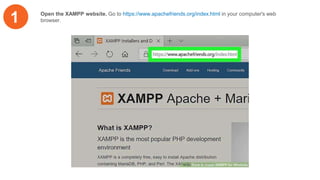
1 Open the XAMPP website. Go to https://www.apachefriends.org/index.html in your computer's web
browser.
2
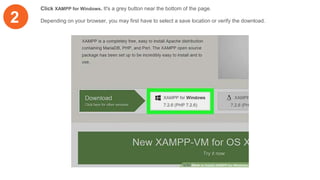
Click XAMPP for Windows. It's a grey button near the bottom of the page.
Depending on your browser, you may first have to select a save location or verify the download.
3
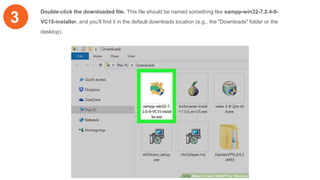
Double-click the downloaded file. This file should be named something like xampp-win32-7.2.4-0-
VC15-installer, and you'll find it in the default downloads location (e.g., the "Downloads" folder or the
desktop).
4
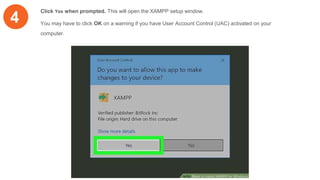
Click Yes when prompted. This will open the XAMPP setup window.
You may have to click OK on a warning if you have User Account Control (UAC) activated on your
computer.
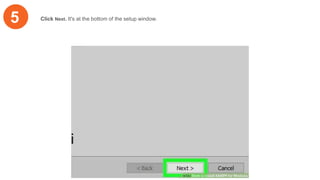
5 Click Next. It's at the bottom of the setup window.
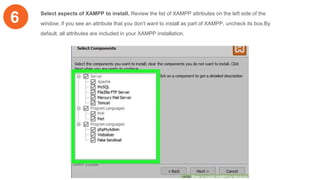
6 Select aspects of XAMPP to install. Review the list of XAMPP attributes on the left side of the
window; if you see an attribute that you don't want to install as part of XAMPP, uncheck its box.By
default, all attributes are included in your XAMPP installation.
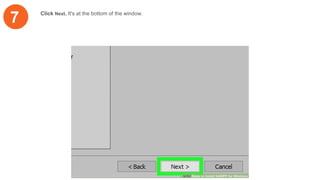
7 Click Next. It's at the bottom of the window.
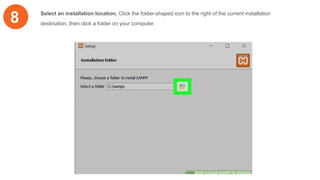
8 Select an installation location. Click the folder-shaped icon to the right of the current installation
destination, then click a folder on your computer.
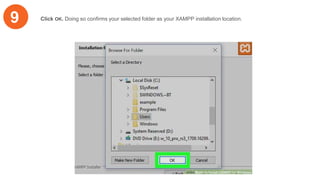
9 Click OK. Doing so confirms your selected folder as your XAMPP installation location.
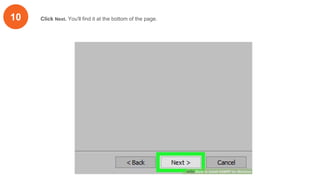
10 Click Next. You'll find it at the bottom of the page.
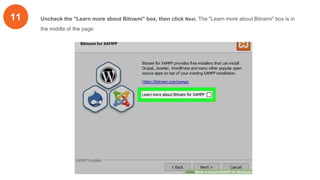
11 Uncheck the "Learn more about Bitnami" box, then click Next. The "Learn more about Bitnami" box is in
the middle of the page.
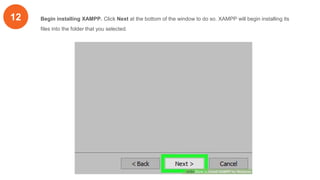
12 Begin installing XAMPP. Click Next at the bottom of the window to do so. XAMPP will begin installing its
files into the folder that you selected.
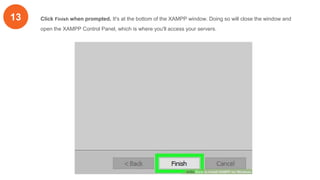
13 Click Finish when prompted. It's at the bottom of the XAMPP window. Doing so will close the window and
open the XAMPP Control Panel, which is where you'll access your servers.
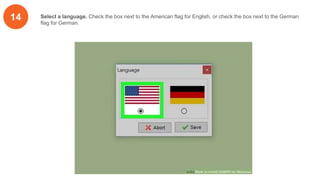
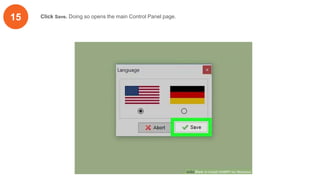
14 Select a language. Check the box next to the American flag for English, or check the box next to the German
flag for German.
15 Click Save. Doing so opens the main Control Panel page.
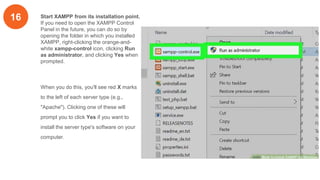
16 Start XAMPP from its installation point.
If you need to open the XAMPP Control
Panel in the future, you can do so by
opening the folder in which you installed
XAMPP, right-clicking the orange-and-
white xampp-control icon, clicking Run
as administrator, and clicking Yes when
prompted.
When you do this, you'll see red X marks
to the left of each server type (e.g.,
"Apache"). Clicking one of these will
prompt you to click Yes if you want to
install the server type's software on your
computer.
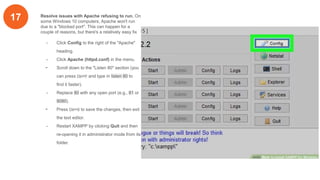
17 Resolve issues with Apache refusing to run. On
some Windows 10 computers, Apache won't run
due to a "blocked port". This can happen for a
couple of reasons, but there's a relatively easy fix
- Click Config to the right of the "Apache"
heading.
- Click Apache (httpd.conf) in the menu.
- Scroll down to the "Listen 80" section (you
can press Ctrl+F and type in listen 80 to
find it faster).
- Replace 80 with any open port (e.g., 81 or
9080).
- Press Ctrl+S to save the changes, then exit
the text editor.
- Restart XAMPP by clicking Quit and then
re-opening it in administrator mode from its
folder.
18 To make sure your server is running
open any browser and write the following
127.0.0.1:[port number]
In the normal case the port number is 80
But if you have changes it in step 17 so
you have to write the number you have
used
19 Also to make sure your server is
running open any browser and write the
following
localhost:[port number]
In the normal case the port number is 80
But if you have changes it in step 17 so
you have to write the number you have
used
Congratulations
You can install
moodle and
wordpress easily
now
Your local server
is up and running
now
You can now
build any php
website and test
it on your local
machine
References
https://www.wikihow.com/Install-XAMPP-for-Windows
Get Help
http://stackoverflow.com/
https://community.apachefriends.org/

Xampp installation guide

  • 1.
    XAMPP Installation Guide By :Amira Elsayed Ismail
  • 2.
  • 3.
    What is xampp ➔XAMPP ( or ) is a free and open source cross- platform web server solution stack package developed by Apache Friends, ➔ consisting mainly of the Apache HTTP Server, MariaDB database, and interpreters for scripts written in the PHP and Perl programming languages. ➔ XAMPP stands for Cross-Platform (X), Apache (A), MariaDB (M), PHP (P) and Perl (P). ➔ It is a simple, lightweight Apache distribution that makes it extremely easy for developers to create a local web server for testing and deployment purposes.
  • 4.
    1 Open theXAMPP website. Go to https://www.apachefriends.org/index.html in your computer's web browser.
  • 5.
    2 Click XAMPP forWindows. It's a grey button near the bottom of the page. Depending on your browser, you may first have to select a save location or verify the download.
  • 6.
    3 Double-click the downloadedfile. This file should be named something like xampp-win32-7.2.4-0- VC15-installer, and you'll find it in the default downloads location (e.g., the "Downloads" folder or the desktop).
  • 7.
    4 Click Yes whenprompted. This will open the XAMPP setup window. You may have to click OK on a warning if you have User Account Control (UAC) activated on your computer.
  • 8.
    5 Click Next.It's at the bottom of the setup window.
  • 9.
    6 Select aspectsof XAMPP to install. Review the list of XAMPP attributes on the left side of the window; if you see an attribute that you don't want to install as part of XAMPP, uncheck its box.By default, all attributes are included in your XAMPP installation.
  • 10.
    7 Click Next.It's at the bottom of the window.
  • 11.
    8 Select aninstallation location. Click the folder-shaped icon to the right of the current installation destination, then click a folder on your computer.
  • 12.
    9 Click OK.Doing so confirms your selected folder as your XAMPP installation location.
  • 13.
    10 Click Next.You'll find it at the bottom of the page.
  • 14.
    11 Uncheck the"Learn more about Bitnami" box, then click Next. The "Learn more about Bitnami" box is in the middle of the page.
  • 15.
    12 Begin installingXAMPP. Click Next at the bottom of the window to do so. XAMPP will begin installing its files into the folder that you selected.
  • 16.
    13 Click Finishwhen prompted. It's at the bottom of the XAMPP window. Doing so will close the window and open the XAMPP Control Panel, which is where you'll access your servers.
  • 17.
    14 Select alanguage. Check the box next to the American flag for English, or check the box next to the German flag for German.
  • 18.
    15 Click Save.Doing so opens the main Control Panel page.
  • 19.
    16 Start XAMPPfrom its installation point. If you need to open the XAMPP Control Panel in the future, you can do so by opening the folder in which you installed XAMPP, right-clicking the orange-and- white xampp-control icon, clicking Run as administrator, and clicking Yes when prompted. When you do this, you'll see red X marks to the left of each server type (e.g., "Apache"). Clicking one of these will prompt you to click Yes if you want to install the server type's software on your computer.
  • 20.
    17 Resolve issueswith Apache refusing to run. On some Windows 10 computers, Apache won't run due to a "blocked port". This can happen for a couple of reasons, but there's a relatively easy fix - Click Config to the right of the "Apache" heading. - Click Apache (httpd.conf) in the menu. - Scroll down to the "Listen 80" section (you can press Ctrl+F and type in listen 80 to find it faster). - Replace 80 with any open port (e.g., 81 or 9080). - Press Ctrl+S to save the changes, then exit the text editor. - Restart XAMPP by clicking Quit and then re-opening it in administrator mode from its folder.
  • 21.
    18 To makesure your server is running open any browser and write the following 127.0.0.1:[port number] In the normal case the port number is 80 But if you have changes it in step 17 so you have to write the number you have used
  • 22.
    19 Also tomake sure your server is running open any browser and write the following localhost:[port number] In the normal case the port number is 80 But if you have changes it in step 17 so you have to write the number you have used
  • 23.
    Congratulations You can install moodleand wordpress easily now Your local server is up and running now You can now build any php website and test it on your local machine
  • 24.