Presenting ActiveWeb making Java Web programming fun...again! Igor Polevoy
About me Developer like you
Have bad aftertaste of many web frameworks
Presented ActiveJDBC to CJUG last year at about the same time
Was suggested to shut up and make a change
Currently a Chief Technologist at ProductiveEdge, Chicago
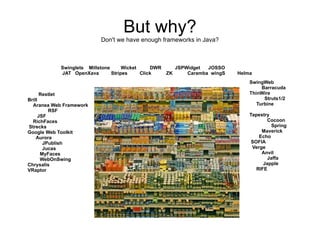
But why? Don't we have enough frameworks in Java? Restlet Brill Aranea Web Framework RSF JSF RichFaces Strecks Google Web Toolkit Aurora JPublish Jucas MyFaces WebOnSwing Chrysalis VRaptor SwingWeb Barracuda ThinWire Struts1/2 Turbine Tapestry Cocoon Spring Maverick Echo SOFIA Verge Anvil Jaffa Japple RIFE Swinglets  Millstone  Wicket  DWR  JSPWidget  JOSSO JAT  OpenXava  Stripes  Click  ZK  Caramba  wingS  Helma
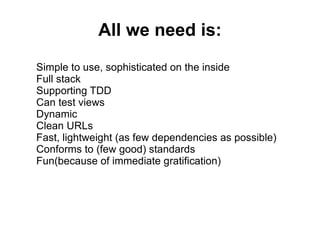
All we need is: Simple to use, sophisticated on the inside
Full stack
Supporting TDD
Can test views
Dynamic
Clean URLs
Fast, lightweight (as few dependencies as possible)
Conforms to (few good) standards
Fun(because of immediate gratification)
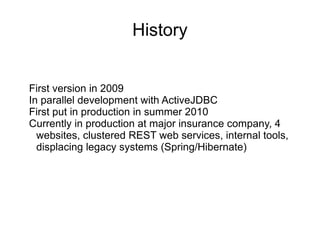
History First version in 2009
In parallel development with ActiveJDBC
First put in production in summer 2010
Currently in production at major insurance company, 4 websites, clustered REST web services, internal tools, displacing legacy systems (Spring/Hibernate)
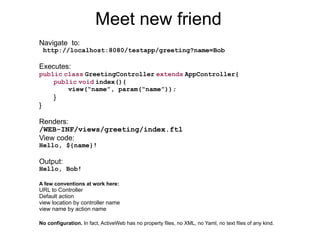
Meet new friend Navigate  to: http://localhost:8080/testapp/greeting?name=Bob Executes: public   class   GreetingController   extends   AppController{ public   void   index(){ view(“name”, param(“name”)); } } Renders: /WEB-INF/views/greeting/index.ftl View code: Hello, ${name}! Output: Hello, Bob! A few conventions at work here:  URL to Controller Default action view location by controller name view name by action name No configuration.  In fact, ActiveWeb has no property files, no XML, no Yaml, no text files of any kind.
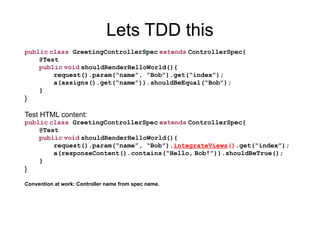
Lets TDD this public   cla ss  G r eetingControllerSpec   extends   ControllerSpec{ @Test public   void   shouldRenderHelloWorld(){ request().param(“name”, “Bob”).get(“index”); a(assigns().get(“name”)).shouldBeEqual(“Bob”); } } Test HTML content: public   class  G reet ingControllerSpec   extends   ControllerSpec{ @Test public   void   shouldRenderHelloWorld(){ request().param(“name”, “Bob”). integrateViews () .get(“index”); a(responseContent().contains(“Hello,   Bob!”)).shouldBeTrue(); } } Convention at work: Controller name from spec name.
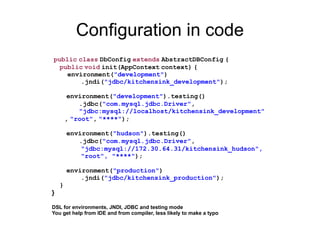
Configuration in code public   class   DbConfig   extends   AbstractDBConfig   { public   void   init(AppContext   context)   { environment( "development" ) .jndi( "jdbc/kitchensink_development" ); environment( "development" ).testing() .jdbc( "com.mysql.jdbc.Driver" ,   "jdbc:mysql://localhost/kitchensink_development"  ,   "root" ,   "****" );   environment( "hudson" ).testing() .jdbc( "com.mysql.jdbc.Driver" ,   "jdbc:mysql://172.30.64.31/kitchensink_hudson",  "root", "****" ); environment( "production" ) .jndi( "jdbc/kitchensink_production" ); } } DSL for environments, JNDI, JDBC and testing mode You get help from IDE and from compiler, less likely to make a typo
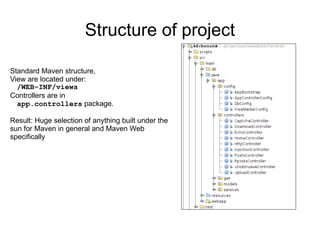
Structure of project Standard Maven structure,  View are located under:  /WEB-INF/views Controllers   are   in   app.controllers   package . Result: Huge selection of anything built under the  sun for Maven in general and Maven Web  specifically
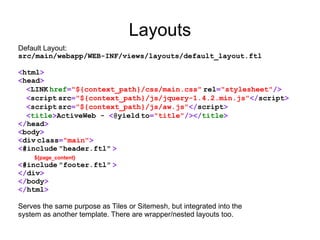
Layouts Default Layout: src/main/webapp/WEB-INF/views/layouts/default_layout.ftl < html > < head > < LINK   href = &quot;${context_path}/css/main.css&quot;   rel = &quot;stylesheet&quot; /> < script   src = &quot;${context_path}/js/jquery-1.4.2.min.js&quot; </ script > < script   src = &quot;${context_path}/js/aw.js&quot; </ script > < title > ActiveWeb -  < @yield   to = &quot;title&quot; /></ title > </ head > < body > < div   class = &quot;main&quot; > < #include   &quot;header.ftl&quot;   > ${page_content}  < #include   &quot;footer.ftl&quot;   > </ div > </ body > </ html > Serves the same purpose as Tiles or Sitemesh, but integrated into the  system as another template. There are wrapper/nested layouts too.
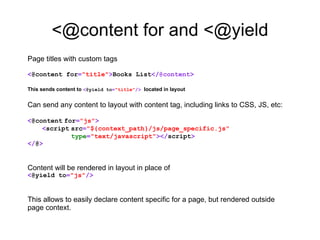
<@content for and <@yield Page titles with custom tags < @content   for = &quot;title&quot; > Books List </@content> This sends content to  < @yield   to = &quot;title&quot; />  located in layout Can send any content to layout with content tag, including links to CSS, JS, etc: < @content   for = &quot;js&quot; > < script   src = &quot;${context_path}/js/page_specific.js&quot;   type = &quot;text/javascript&quot; ></ script > </ @ > Content will be rendered in layout in place of  < @yield   to = &quot;js&quot; /> This allows to easily declare content specific for a page, but rendered outside  page context.
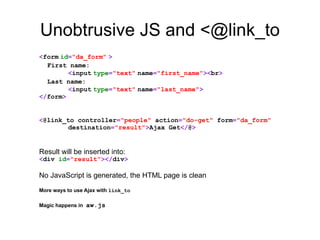
Unobtrusive JS and <@link_to < form   id = &quot;da_form&quot;   > First name:  < input   type = &quot;text&quot;   name = &quot;first_name&quot; >< br > Last name:  < input   type = &quot;text&quot;   name = &quot;last_name&quot; >   </ form > < @link_to   controller = &quot;people&quot;   action = &quot;do-get&quot;   form = &quot;da_form&quot;   destination = &quot;result&quot; > Ajax Get </ @ > Result will be inserted into: < div   id = &quot;result&quot; ></ div > No JavaScript is generated, the HTML page is clean More ways to use Ajax with  link_to Magic happens in   aw.js
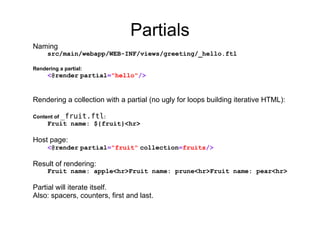
Partials Naming src/main/webapp/WEB-INF/views/greeting/_hello.ftl Rendering a partial: < @render   partial = &quot;hello&quot; /> Rendering a collection with a partial (no ugly for loops building iterative HTML): Content of  _fruit.ftl :  Fruit name: ${fruit}<hr> Host page: < @render   partial = &quot;fruit&quot;   collection = fruits /> Result of rendering: Fruit name: apple<hr>Fruit name: prune<hr>Fruit name: pear<hr> Partial will iterate itself. Also: spacers, counters, first and last.

ActiveWeb: Chicago Java User Group Presentation

  • 1.
    Presenting ActiveWeb makingJava Web programming fun...again! Igor Polevoy
  • 2.
  • 3.
    Have bad aftertasteof many web frameworks
  • 4.
    Presented ActiveJDBC toCJUG last year at about the same time
  • 5.
    Was suggested toshut up and make a change
  • 6.
    Currently a ChiefTechnologist at ProductiveEdge, Chicago
  • 7.
    But why? Don'twe have enough frameworks in Java? Restlet Brill Aranea Web Framework RSF JSF RichFaces Strecks Google Web Toolkit Aurora JPublish Jucas MyFaces WebOnSwing Chrysalis VRaptor SwingWeb Barracuda ThinWire Struts1/2 Turbine Tapestry Cocoon Spring Maverick Echo SOFIA Verge Anvil Jaffa Japple RIFE Swinglets Millstone Wicket DWR JSPWidget JOSSO JAT OpenXava Stripes Click ZK Caramba wingS Helma
  • 8.
    All we needis: Simple to use, sophisticated on the inside
  • 9.
  • 10.
  • 11.
  • 12.
  • 13.
  • 14.
    Fast, lightweight (asfew dependencies as possible)
  • 15.
    Conforms to (fewgood) standards
  • 16.
  • 17.
  • 18.
    In parallel developmentwith ActiveJDBC
  • 19.
    First put inproduction in summer 2010
  • 20.
    Currently in productionat major insurance company, 4 websites, clustered REST web services, internal tools, displacing legacy systems (Spring/Hibernate)
  • 21.
    Meet new friendNavigate to: http://localhost:8080/testapp/greeting?name=Bob Executes: public class GreetingController extends AppController{ public void index(){ view(“name”, param(“name”)); } } Renders: /WEB-INF/views/greeting/index.ftl View code: Hello, ${name}! Output: Hello, Bob! A few conventions at work here: URL to Controller Default action view location by controller name view name by action name No configuration. In fact, ActiveWeb has no property files, no XML, no Yaml, no text files of any kind.
  • 22.
    Lets TDD thispublic cla ss G r eetingControllerSpec extends ControllerSpec{ @Test public void shouldRenderHelloWorld(){ request().param(“name”, “Bob”).get(“index”); a(assigns().get(“name”)).shouldBeEqual(“Bob”); } } Test HTML content: public class G reet ingControllerSpec extends ControllerSpec{ @Test public void shouldRenderHelloWorld(){ request().param(“name”, “Bob”). integrateViews () .get(“index”); a(responseContent().contains(“Hello, Bob!”)).shouldBeTrue(); } } Convention at work: Controller name from spec name.
  • 23.
    Configuration in codepublic class DbConfig extends AbstractDBConfig { public void init(AppContext context) { environment( &quot;development&quot; ) .jndi( &quot;jdbc/kitchensink_development&quot; ); environment( &quot;development&quot; ).testing() .jdbc( &quot;com.mysql.jdbc.Driver&quot; , &quot;jdbc:mysql://localhost/kitchensink_development&quot; , &quot;root&quot; , &quot;****&quot; ); environment( &quot;hudson&quot; ).testing() .jdbc( &quot;com.mysql.jdbc.Driver&quot; , &quot;jdbc:mysql://172.30.64.31/kitchensink_hudson&quot;, &quot;root&quot;, &quot;****&quot; ); environment( &quot;production&quot; ) .jndi( &quot;jdbc/kitchensink_production&quot; ); } } DSL for environments, JNDI, JDBC and testing mode You get help from IDE and from compiler, less likely to make a typo
  • 24.
    Structure of projectStandard Maven structure, View are located under: /WEB-INF/views Controllers are in app.controllers package . Result: Huge selection of anything built under the sun for Maven in general and Maven Web specifically
  • 25.
    Layouts Default Layout:src/main/webapp/WEB-INF/views/layouts/default_layout.ftl < html > < head > < LINK href = &quot;${context_path}/css/main.css&quot; rel = &quot;stylesheet&quot; /> < script src = &quot;${context_path}/js/jquery-1.4.2.min.js&quot; </ script > < script src = &quot;${context_path}/js/aw.js&quot; </ script > < title > ActiveWeb - < @yield to = &quot;title&quot; /></ title > </ head > < body > < div class = &quot;main&quot; > < #include &quot;header.ftl&quot; > ${page_content} < #include &quot;footer.ftl&quot; > </ div > </ body > </ html > Serves the same purpose as Tiles or Sitemesh, but integrated into the system as another template. There are wrapper/nested layouts too.
  • 26.
    <@content for and<@yield Page titles with custom tags < @content for = &quot;title&quot; > Books List </@content> This sends content to < @yield to = &quot;title&quot; /> located in layout Can send any content to layout with content tag, including links to CSS, JS, etc: < @content for = &quot;js&quot; > < script src = &quot;${context_path}/js/page_specific.js&quot; type = &quot;text/javascript&quot; ></ script > </ @ > Content will be rendered in layout in place of < @yield to = &quot;js&quot; /> This allows to easily declare content specific for a page, but rendered outside page context.
  • 27.
    Unobtrusive JS and<@link_to < form id = &quot;da_form&quot; > First name: < input type = &quot;text&quot; name = &quot;first_name&quot; >< br > Last name: < input type = &quot;text&quot; name = &quot;last_name&quot; > </ form > < @link_to controller = &quot;people&quot; action = &quot;do-get&quot; form = &quot;da_form&quot; destination = &quot;result&quot; > Ajax Get </ @ > Result will be inserted into: < div id = &quot;result&quot; ></ div > No JavaScript is generated, the HTML page is clean More ways to use Ajax with link_to Magic happens in aw.js
  • 28.
    Partials Naming src/main/webapp/WEB-INF/views/greeting/_hello.ftlRendering a partial: < @render partial = &quot;hello&quot; /> Rendering a collection with a partial (no ugly for loops building iterative HTML): Content of _fruit.ftl : Fruit name: ${fruit}<hr> Host page: < @render partial = &quot;fruit&quot; collection = fruits /> Result of rendering: Fruit name: apple<hr>Fruit name: prune<hr>Fruit name: pear<hr> Partial will iterate itself. Also: spacers, counters, first and last.