Pragmatic
Real-World Scala

             Jonas Bonér
       Scalable Solutions
“If I were to pick a language
to use today other than Java,
it would be Scala”
                 James Gosling
Chat app in Lift
   Build a multi-user, comet-based chat app
   About 30 lines of code
   Three slides worth
   Slides By David Pollak, creator of Lift
Define Messages
case class Add(who: Actor)
case class Remove(who: Actor)
case class Messages(msgs: List[String])
Chat Server
object ChatServer extends Actor {
  private var listeners: List[Actor] = Nil
  private var msgs: List[String] = Nil
  def act = loop {
    react {
      case s: String =>
        msgs = s :: msgs
        listeners.foreach(l => l ! Messages(msgs))
      case Add(who) =>
        listeners = who :: listeners
        who ! Messages(msgs)
      case Remove(who) => listeners -= who
    }
  }
  this.start
}
Chat Comet Component
class Chat extends CometActor {
  private var msgs: List[String] = Nil
  def render =
    <div>
      <ul>{ msgs.reverse.map(m => <li>{ m }</li>) }</ul>
      { ajaxText("", s => { ChatServer ! s; Noop }) }
    </div>
  override def localSetup = ChatServer ! Add(this)
  override def localShutdown = ChatServer ! Remove(this)
  override def lowPriority = {
    case Messages(m) => msgs = m; reRender(false)
  }
}
Demo
Scalable language
Unique and elegant blend of


OO FP           +
Pragmatic     Since   2003
                 Sponsored by EPFL
Martin Odersky
      Seamless Java interoperability
Friendly and supportive      Production
community                    ready

Runs on the   JVM         Statically typed
Unique and elegant blend of


       is...
Expressive &
       light-weight
val phonebook = Map(
  “Jonas” -> “123456”,
  “Sara” -> “654321”)
phonebook += (“Jacob” -> “987654”)
println(phonebook(“Jonas”))
High-level
            Java version
boolean hasUpperCase = false;
for (int i = 0; i < name.length(); i++) {
  if (Character.isUpperCase(name.charAt(i)))
  {
    hasUpperCase = true;
    break;
  }
}
High-level
             Scala version

val hasUpperCase = name.exists(_.isUpperCase)
Concise
// Java
public class Person {
 private String name;
 private int age;
 public Person(String name,
                int age) {
   this.name = name;
   this.age = age;                    // Scala
 }
 public String getName() {            class Person(
   return name;                         var name: String,
 }
 public int getAge() {                  var age: Int)
   return age;
 }
 public void setName(String name) {
   this.name = name;
 }
 public void setAge(age: int) {
   this.age = age;
 }
}
Pure OO
1 + 2
1.+(2)

123.toString()
Extensible
val service = actor {
  loop {
    receive {
      case Add(x,y) => reply(x+y)
      case Sub(x,y) => reply(x-y)
    }
  }
}
service ! Add(4, 2)    6
Pragmatic
def users =
  <users>
    <user role=”customer”>
      <name>{ user.name }</name>
      <password>{ user.password }</password>
      <email>{ user.email }</email>
    </user>
    ...
  </users>
Pragmatic
users match {
  case <users>{users @ _*}</users> =>
    for (user <- users)
      println(“User “ + (user  “name”).text)
}
Great for DSLs
     Apache Camel
“direct:a“ ==> {
  loadbalance roundrobin {
    to (“mock:a“)
    to (“mock:b“)
    to (“mock:c“)
  }
}
deep
 Scala is
But you don’t need to go very deep
to still have fun and be productive
Java
Tastier Java
Different beast
Composition
Composition

in   large
2
building blocks
Traits
   &   &

  Self-type
annotations
Trait
trait Dad {
  private var children: List[Child] = Nil

    def addChild(child: Child) =
      children = child :: children

    def getChildren = children.clone
}
Base

class Man(val name: String) extends Human
Plumbing
Static mixin composition

class Man(val name: String) extends Human with Dad
Static mixin composition
          usage
class Man(val name: String) extends Human with Dad


val jonas = new Man(“Jonas”)
jonas.addChild(new Child(“Jacob”))
Dynamic mixin composition


val jonas = new Man(“Jonas”) with Dad
Dynamic mixin composition
         usage
val jonas = new Man(“Jonas”) with Dad


jonas.addChild(new Child(“Jacob”))
3   different type of traits
1
Rich interface
trait RichIterable[A] {
  def iterator: Iterator[A] // contract method

    def foreach(f: A => Unit) = {
      val iter = iterator
      while (iter.hasNext) f(iter.next)
    }

    def foldLeft[B](seed: B)(f: (B, A) => B) = {
       var result = seed
       foreach(e => result = f(result, e))
       result
     }
}
Rich interface
val richSet =
    new java.util.HashSet[Int]
    with RichIterable[Int]

richSet.add(1)
richSet.add(2)

richSet.foldLeft(0)((x, y) => x + y)
    3
2
Stackable modifications
trait IgnoreCaseSet
  extends java.util.Set[String] {

    abstract override def add(e: String) = {
      super.add(e.toLowerCase)
    }
    abstract override def contains(e: String) = {
      super.contains(e.toLowerCase)
    }
    abstract override def remove(e: String) = {
      super.remove(e.toLowerCase)
    }
}
Stackable modifications
val set =
    new java.util.HashSet[String]
    with IgnoreCaseSet

set.add(“HI THERE“)      // uppercase

set.contains(“hi there“) // lowercase
     true
Add another trait interceptor
trait LoggableSet
  extends java.util.Set[String] {

    abstract override def add(e: String) = {
      println(“Add :“ + e)
      super.add(e)
    }

    abstract override def remove(e: String) = {
      println(“Remove :“ + e)
      super.remove(e)
    }
}
Run the stack of interceptors
  val set =
    new java.util.HashSet[String]
    with IgnoreCaseSet
    with LoggableSet

  set.add(“HI THERE“)
     “Add: HI THERE”


      Prints in uppercase
Change the order
val set =
  new java.util.HashSet[String]
  with LoggableSet
  with IgnoreCaseSet

set.add(“HI THERE“)
   “Add: hi there”


     Prints in lowercase
3
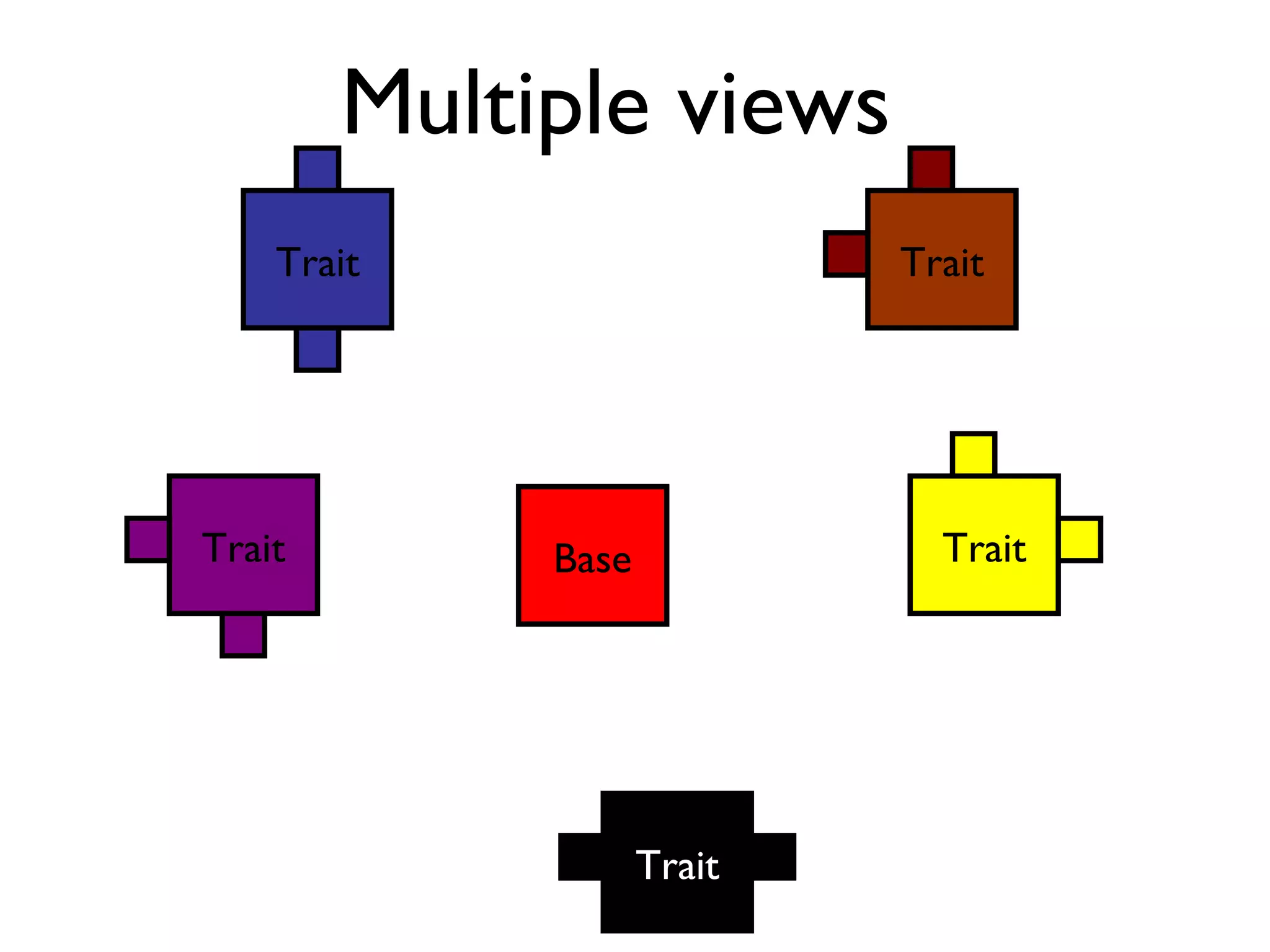
Multiple views
    Trait                   Trait


Trait        Base             Trait


                    Trait
Multiple views
    Trait                   Trait


Trait        Base             Trait


                    Trait
Traits
 Multiple
personalities
Traits


          Multiple
         facets
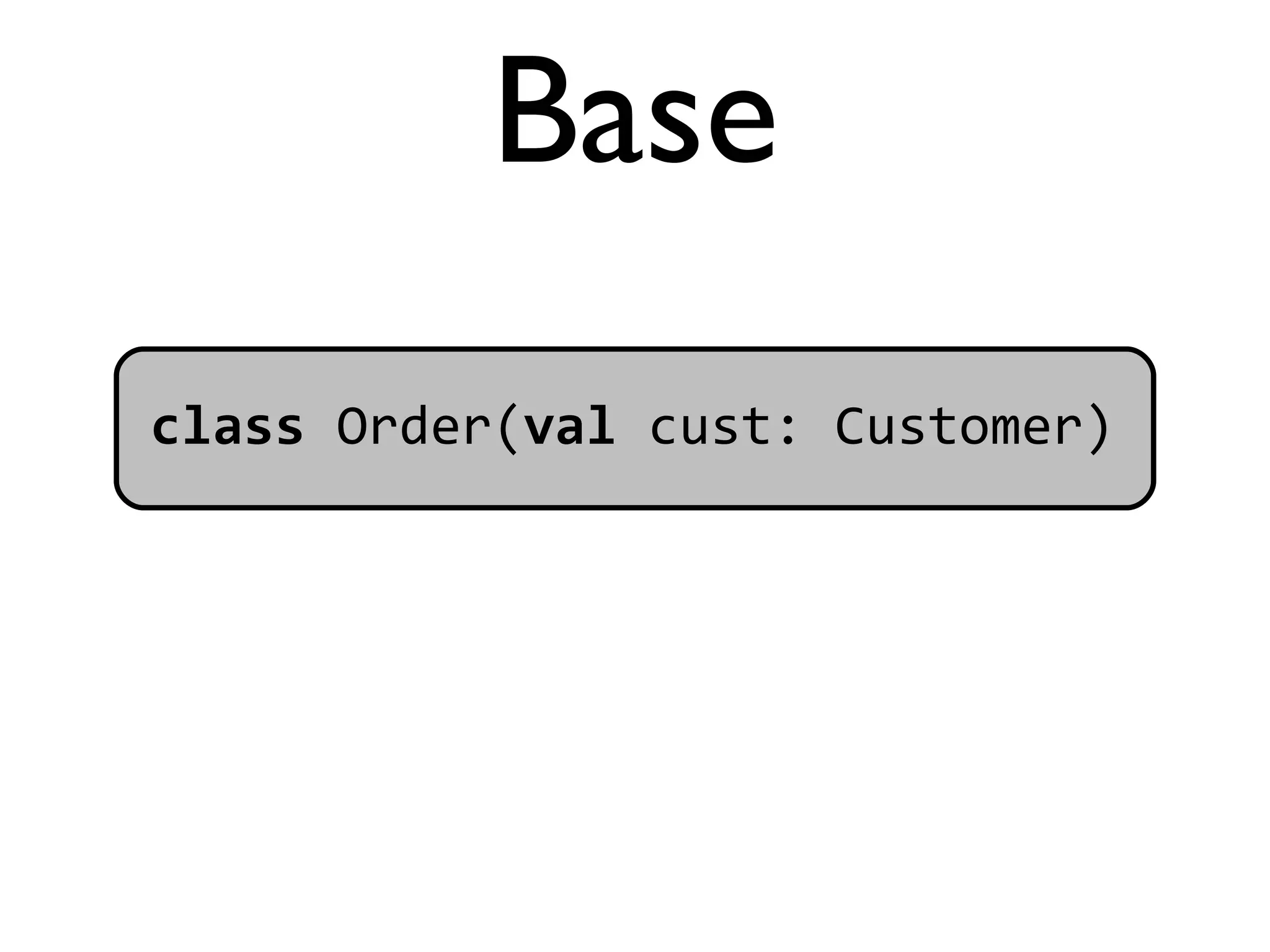
Base
class Order(val cust: Customer)
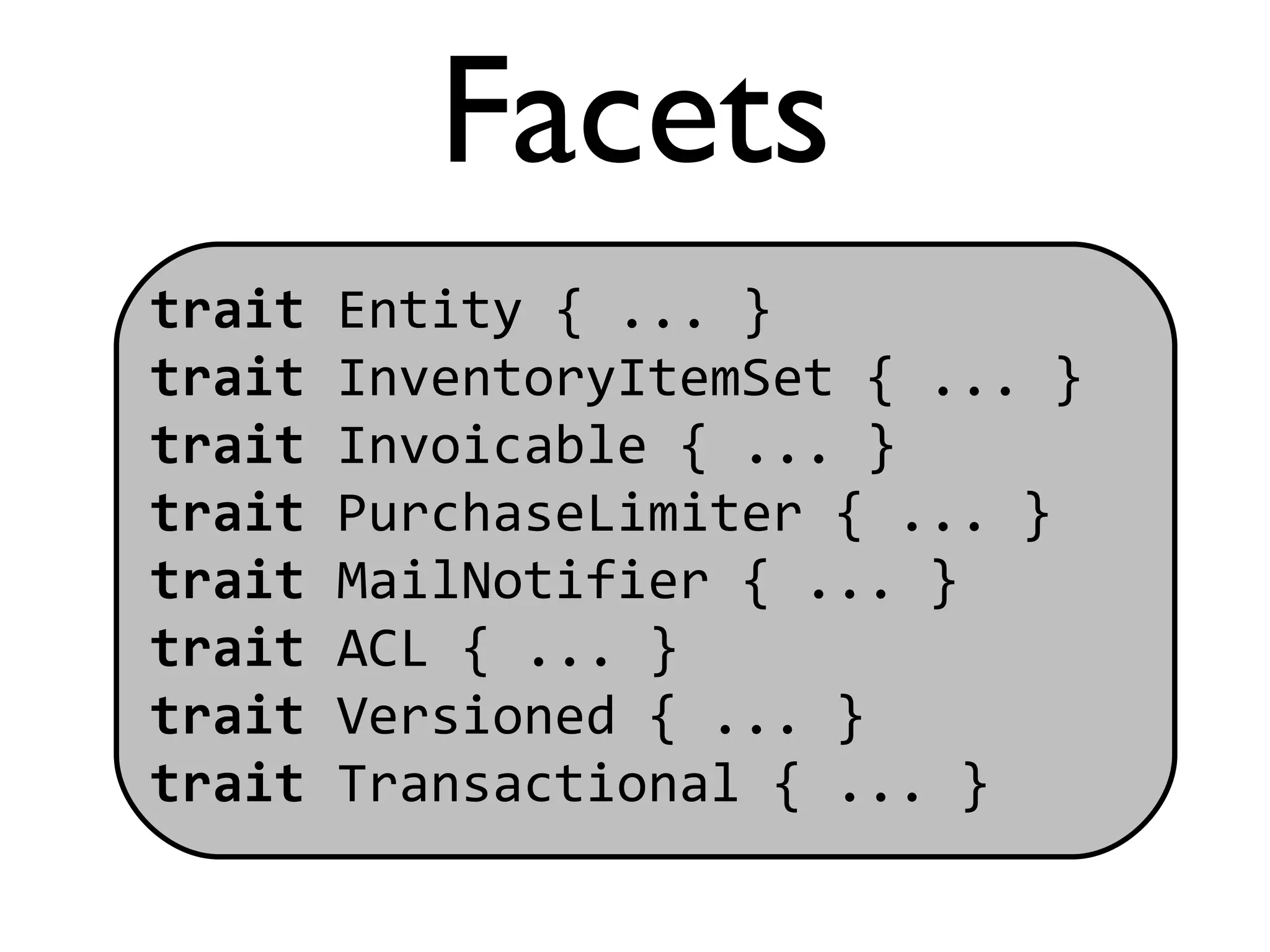
Facets
trait   Entity { ... }
trait   InventoryItemSet { ... }
trait   Invoicable { ... }
trait   PurchaseLimiter { ... }
trait   MailNotifier { ... }
trait   ACL { ... }
trait   Versioned { ... }
trait   Transactional { ... }
Composition
val order = new Order(customer)
    with Entity
    with InventoryItemSet
    with Invoicable
    with PurchaseLimiter
    with MailNotifier
    with ACL
    with Versioned
    with Transactional
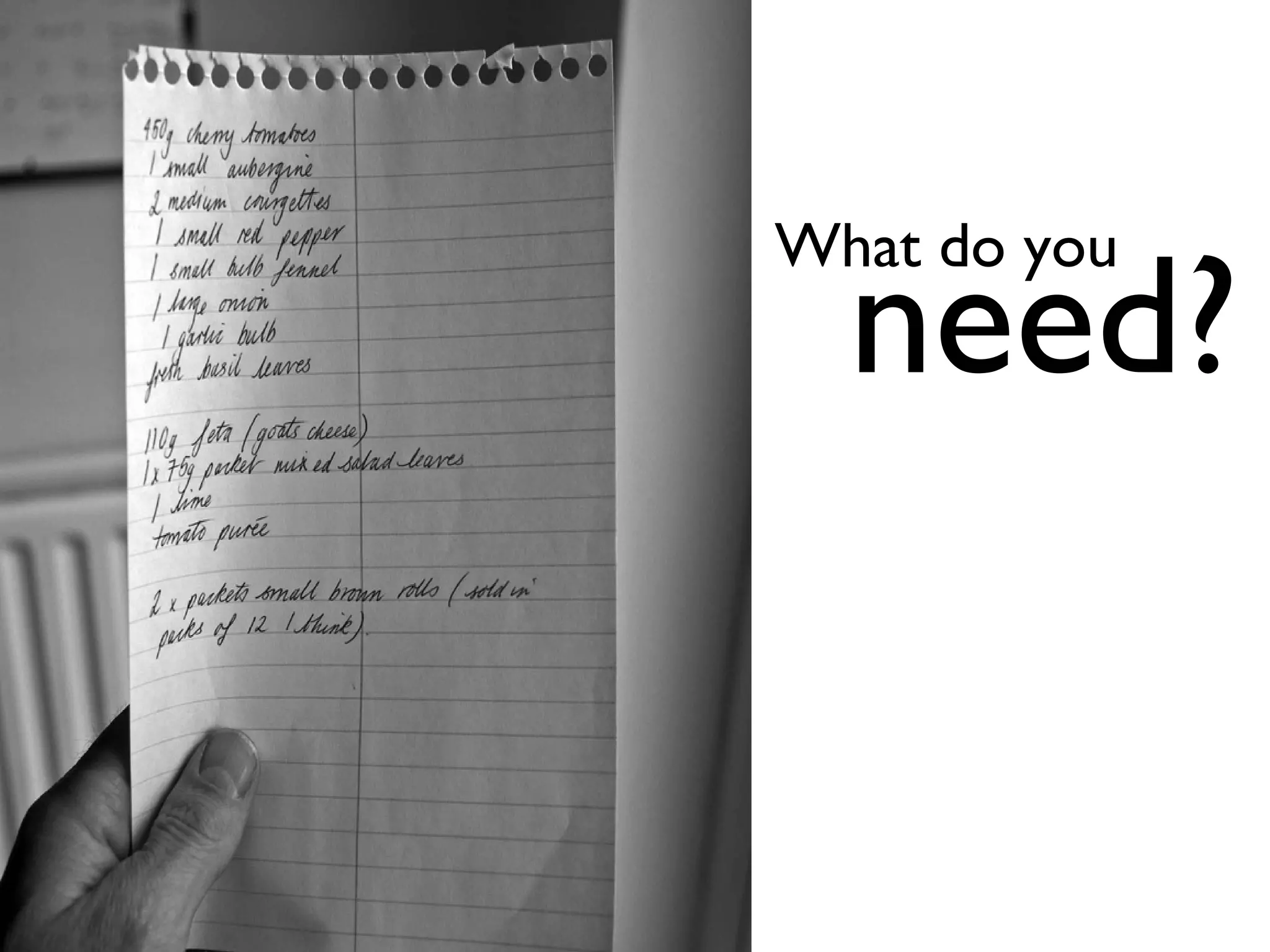
What do you
  need?
DI
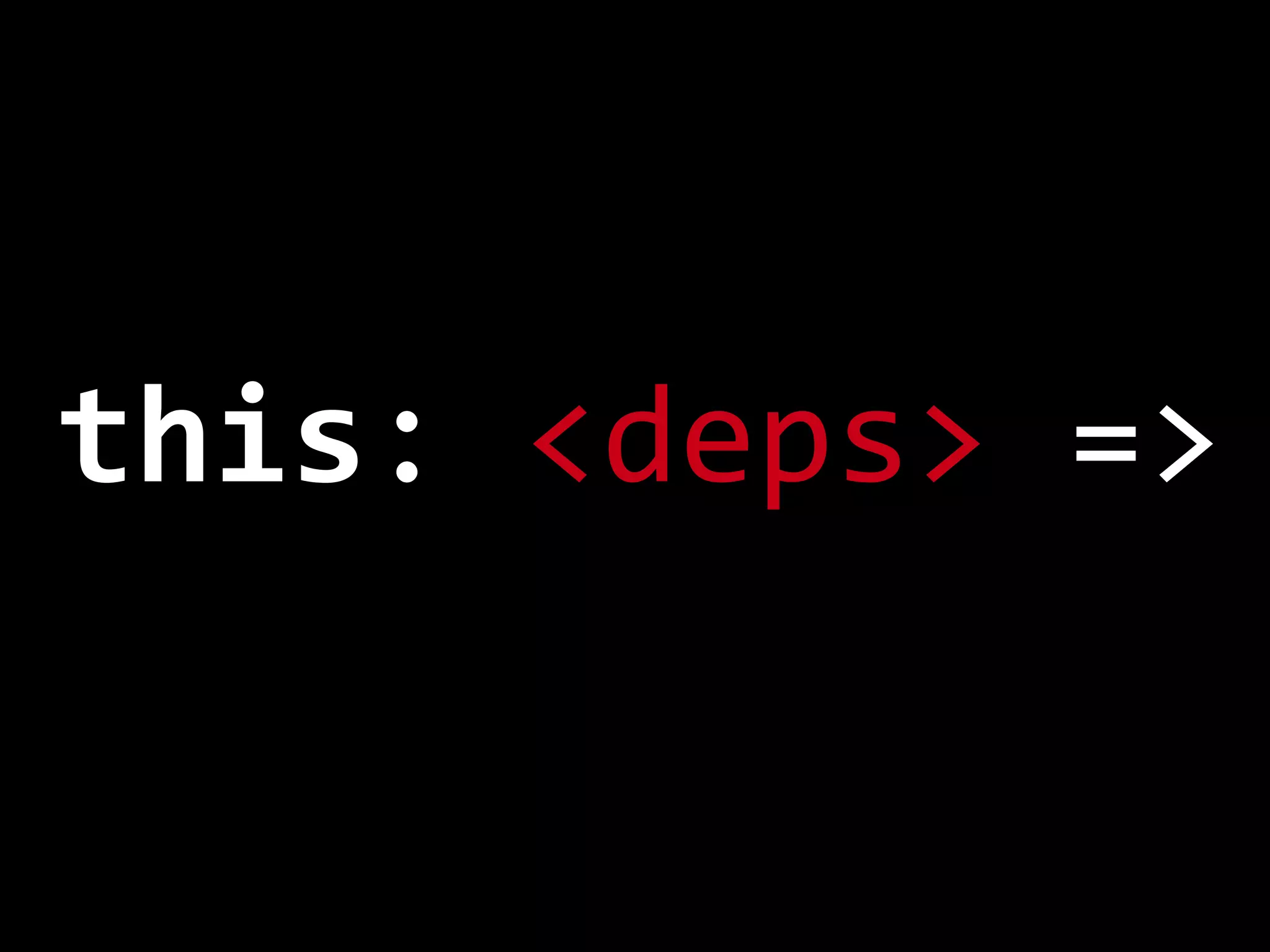
this: <deps> =>
this: <deps> =>
Dependency declaration
trait UserService {
  this: UserRepository =>
  ...
  // provided with composition
  userRepository.merge(user)
}

…using self-type annotation
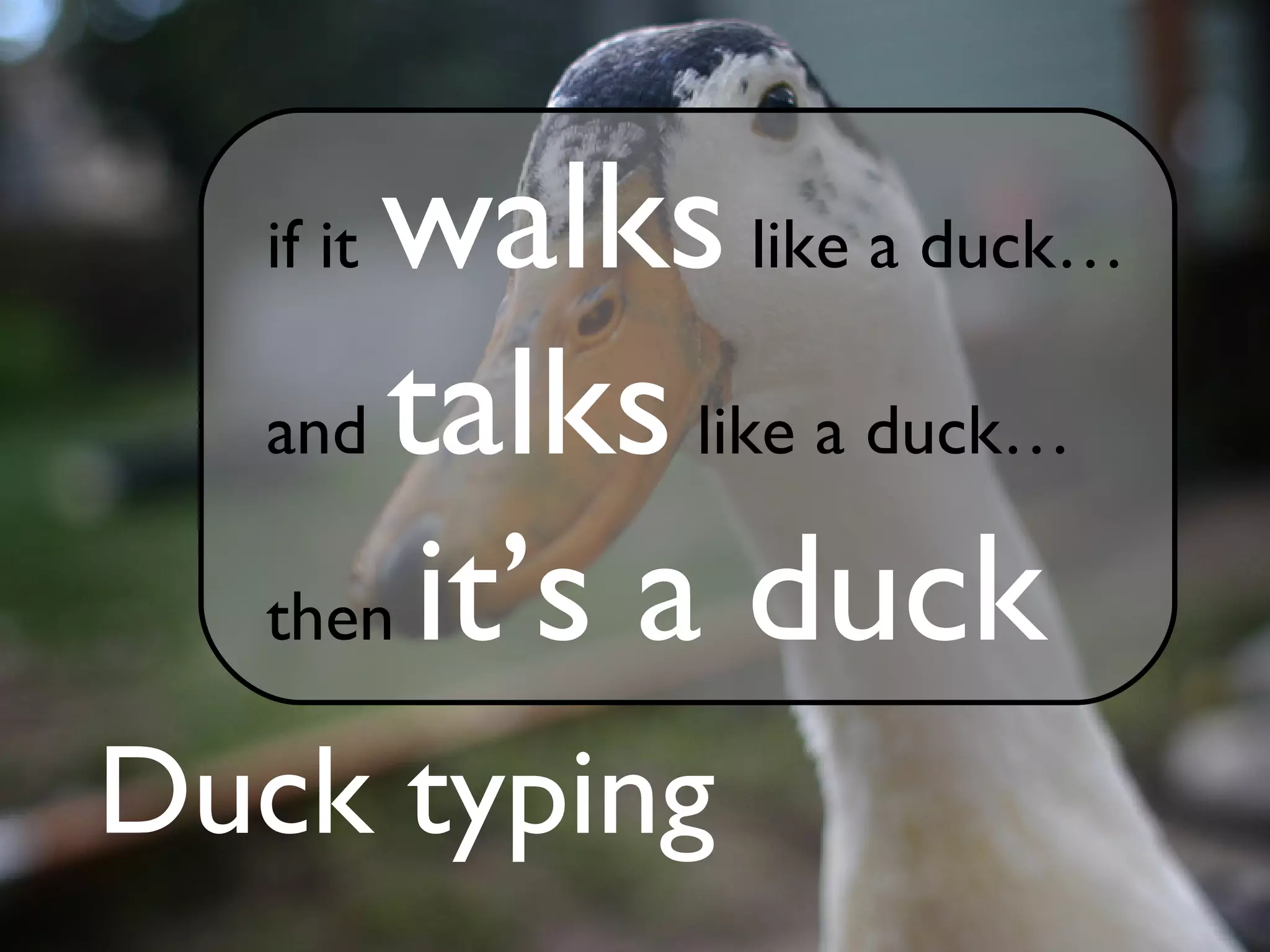
Duck typing
walks like a duck…
   if it

   and talks like a duck…

   then it’s a duck

Duck typing
Structural Typing:
      Duck-typing done right
def authorize(target: { def getACL: ACL }) = {

    val acl = target.getACL
    ... //authorize
}


          Statically enforced
Composition

   in small
“It's Time to Get Good at
 Functional Programming”
                   Dr Dobb’s Journal
                Issue December 2008
What’s
all the

buzz
about?
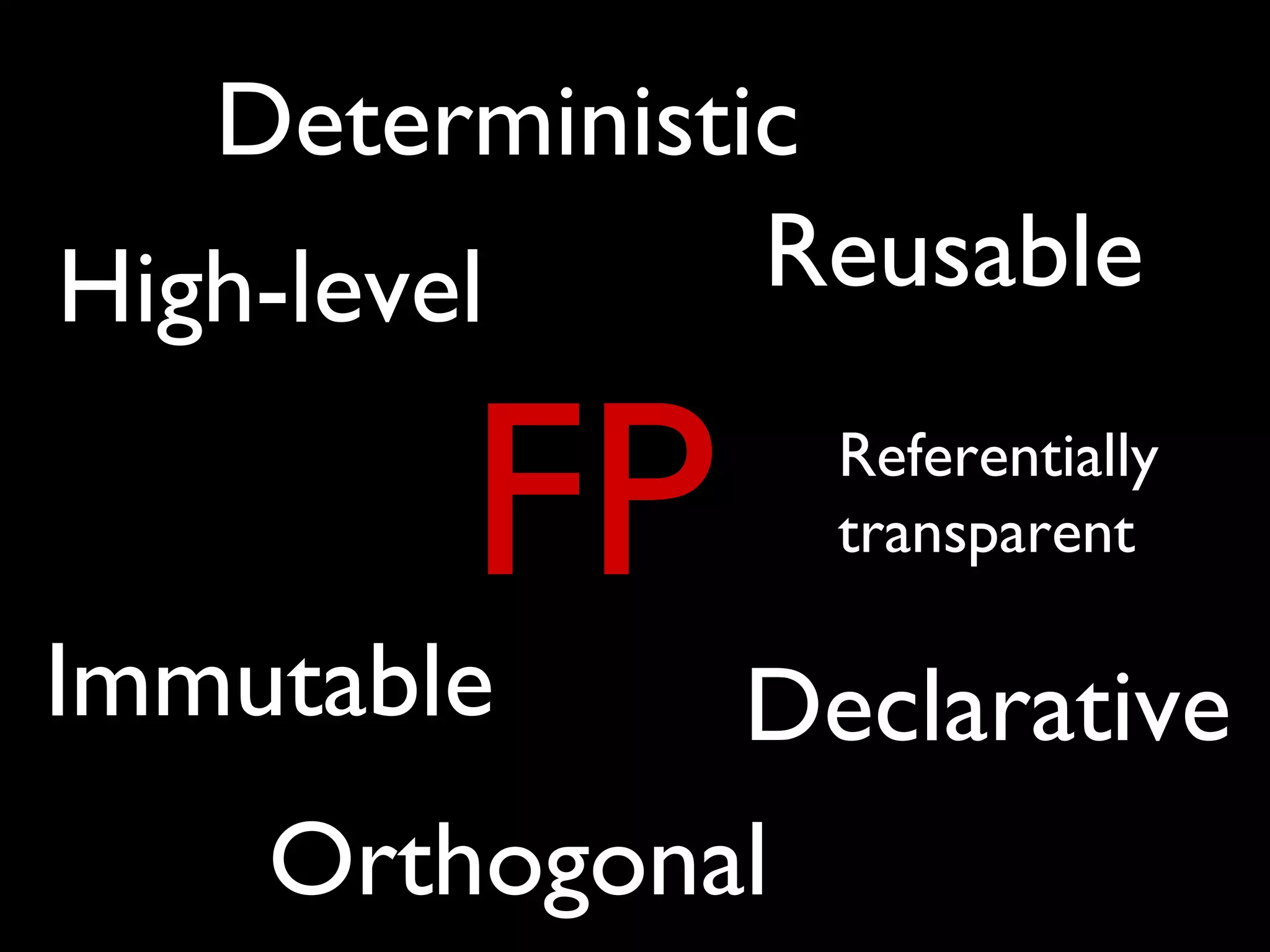
Deterministic
High-level     Reusable

        FP      Referentially
                transparent

Immutable    Declarative
    Orthogonal
Lego
FP is like
Small reusable pieces

with   input
and    output
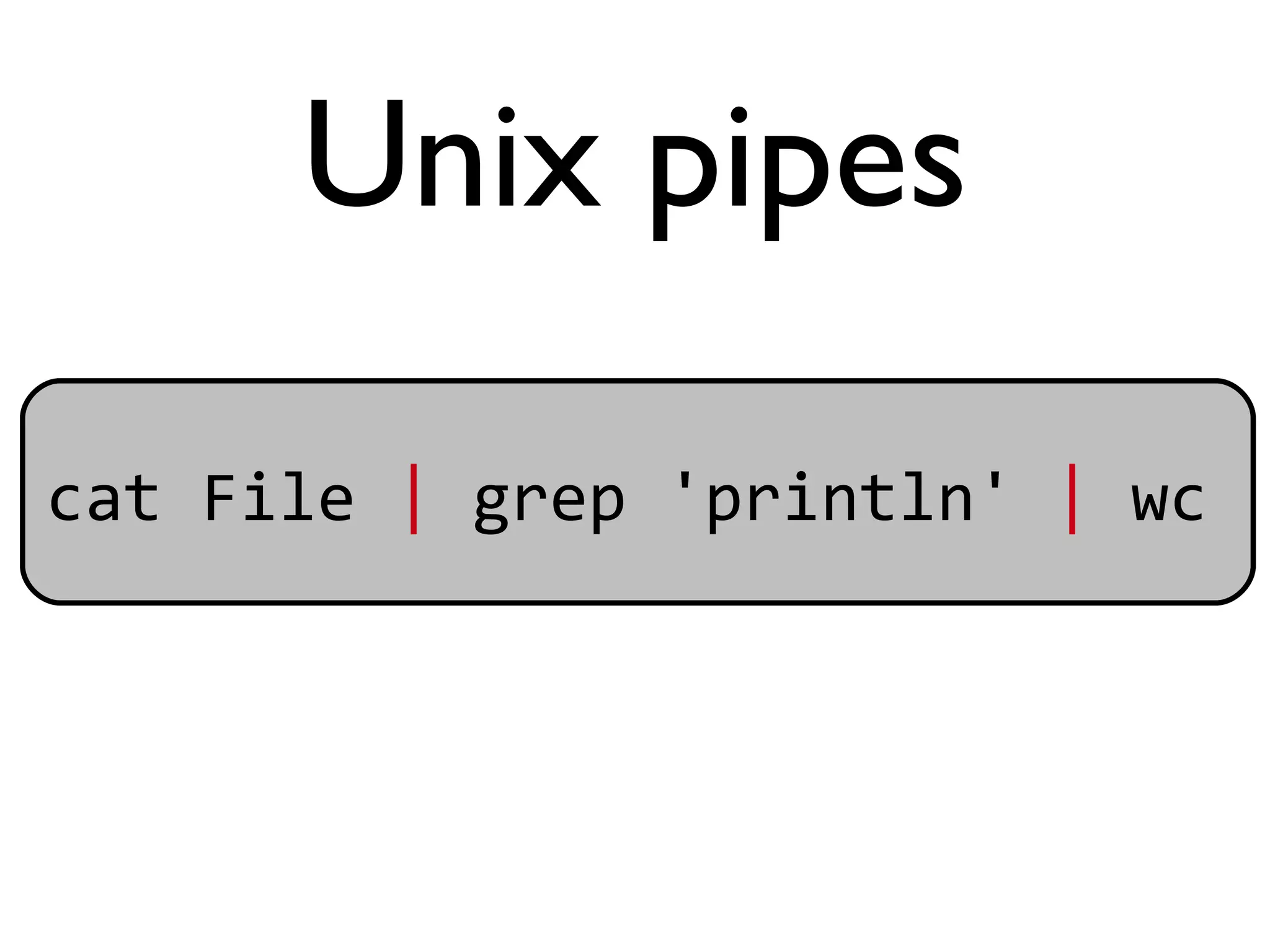
Unix pipes

cat File | grep 'println' | wc
Functions

(x: Int) => x + 1
Functions as values
  val inc = (x: Int) => x + 1


  inc(1)   2
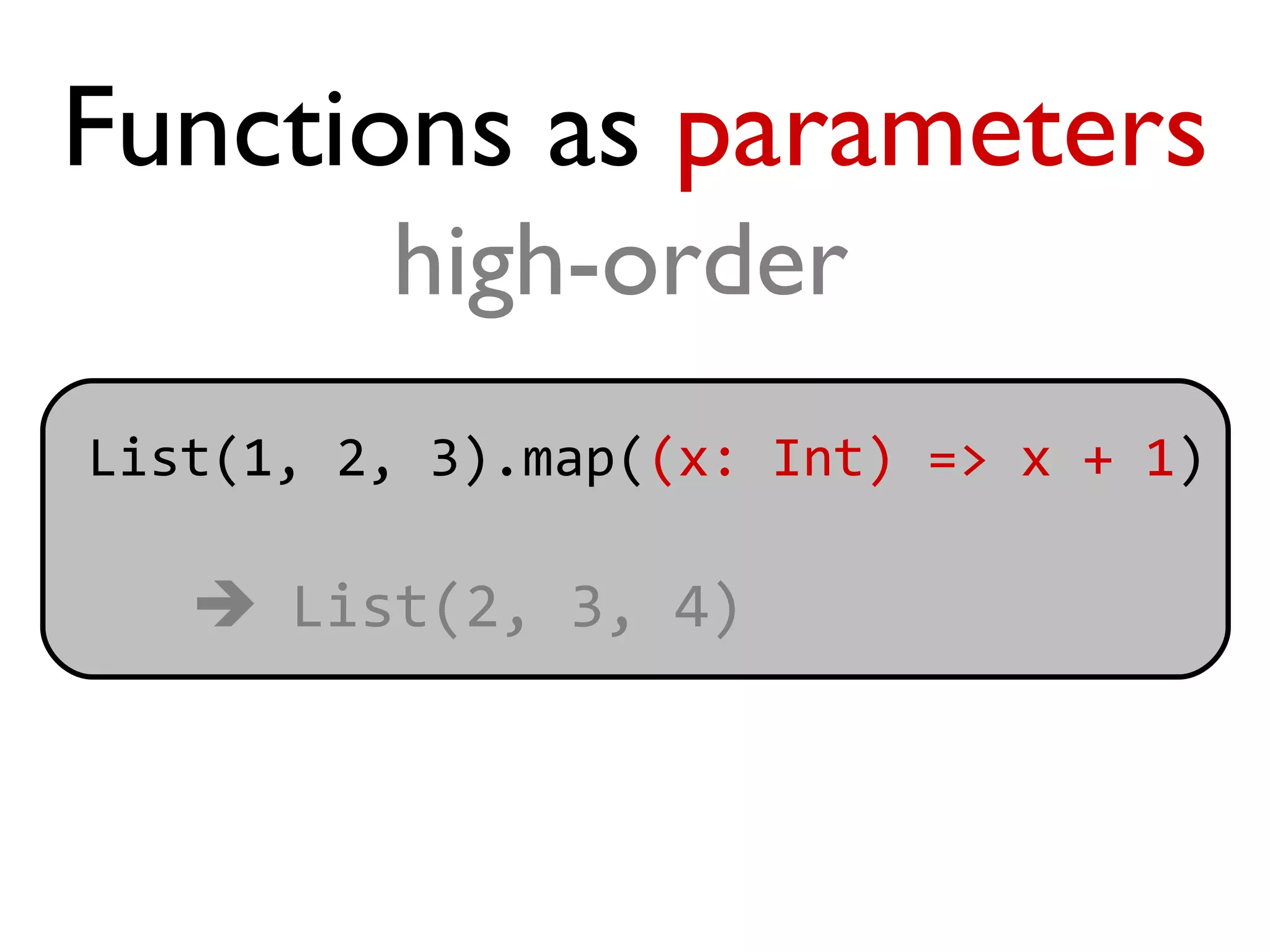
Functions as parameters
         high-order
List(1, 2, 3).map((x: Int) => x + 1)

    List(2, 3, 4)
Functions as parameters
          with sugar
List(1, 2, 3).map((x: Int) => x + 1)


List(1, 2, 3).map(x => x + 1)


List(1, 2, 3).map(_ + 1)
Functions as closures

val addMore = (x: Int) => x + more
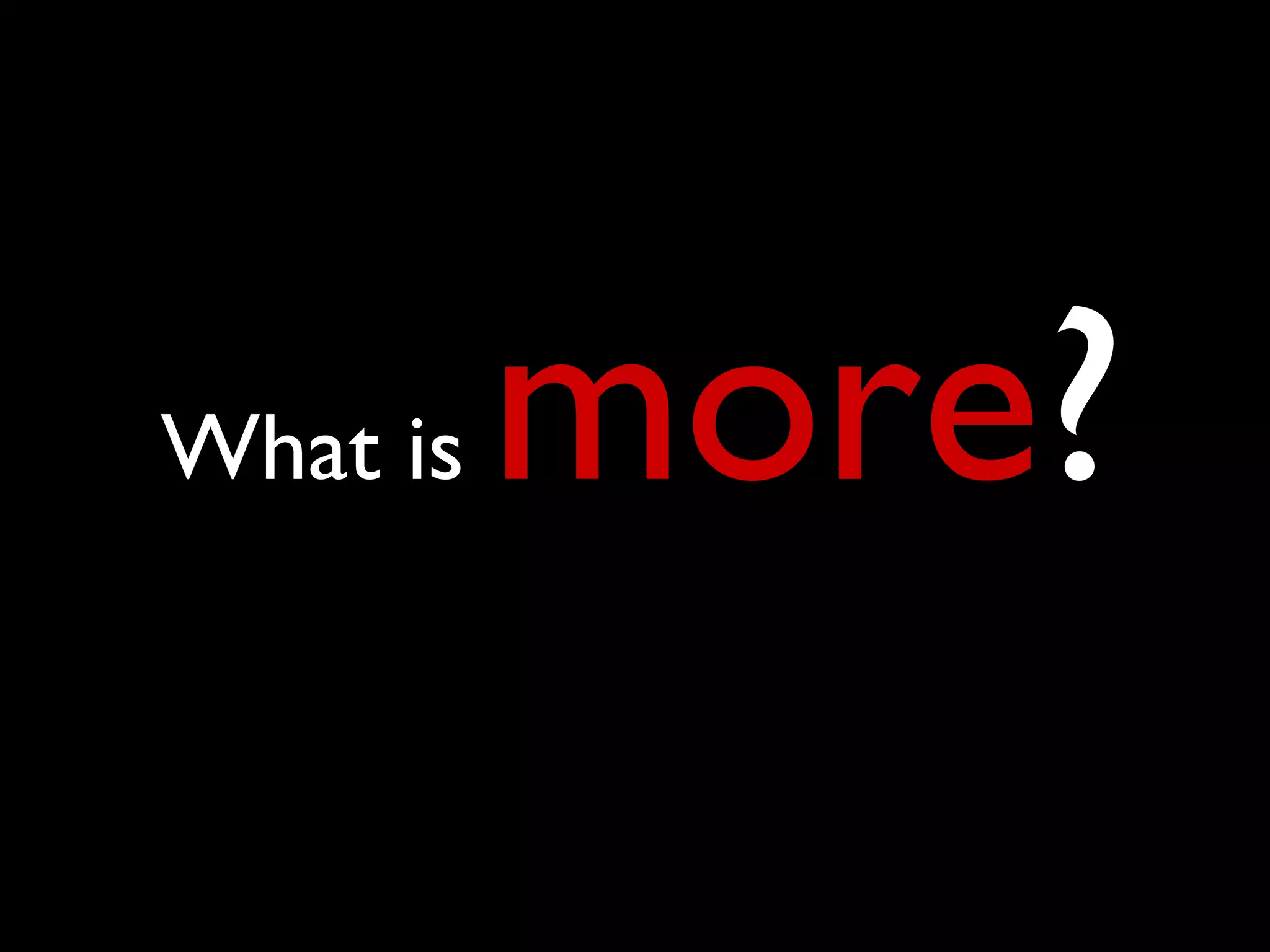
What is   more?
Some value outside
the function’s lexical scope
 var more = 7
 val addMore = (x: Int) => x + more


 addMore(3)  10
 more = 8
 addMore(3)  11
Functional
Data Structures
Immutable
The almighty


List
Lists
Grow at the front
Insert at front  O(1)
Insert at end  O(n)
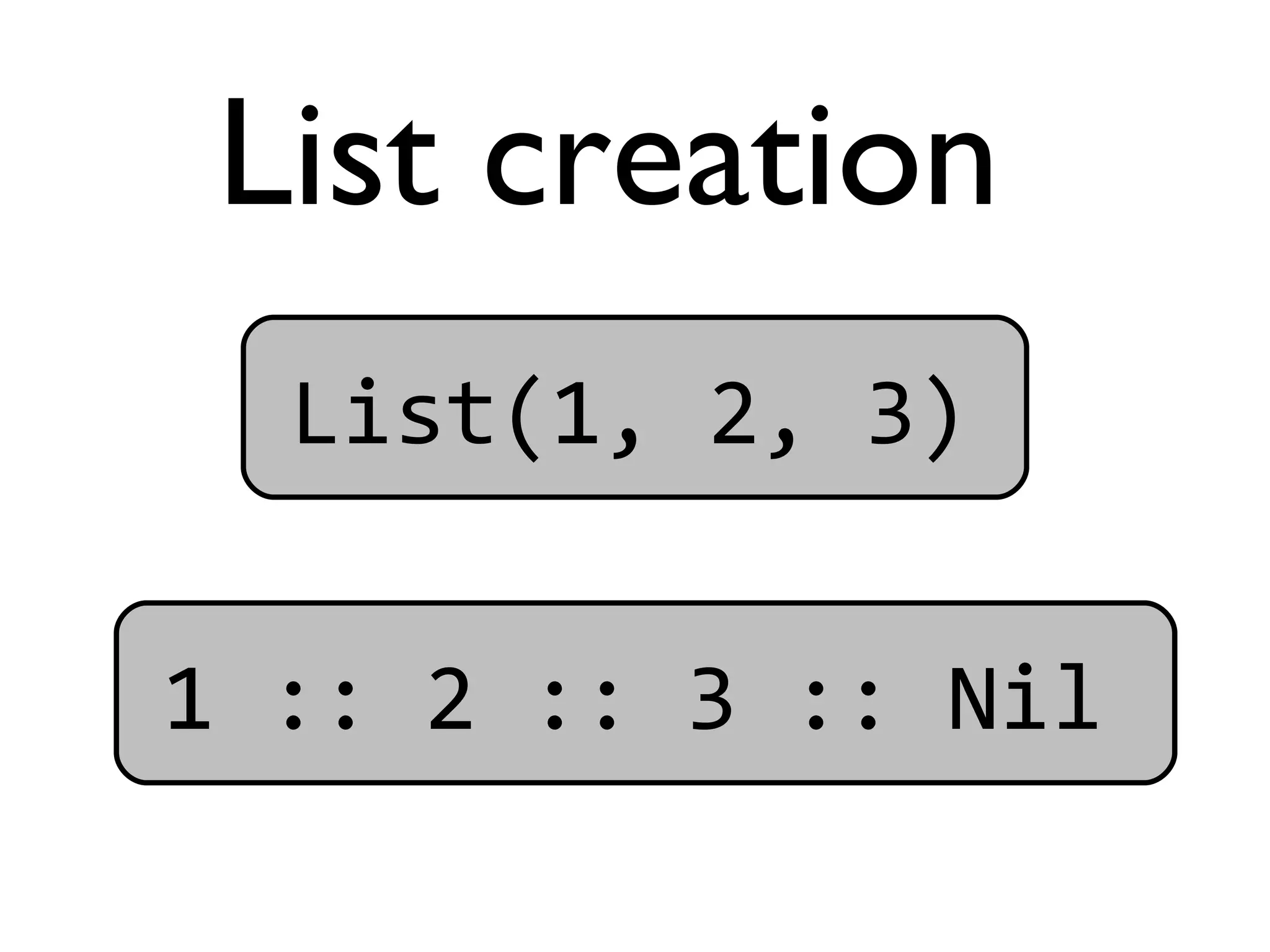
List creation
  List(1, 2, 3)


1 :: 2 :: 3 :: Nil
Basics
val list = List(1, 2, 3)
list.head     1
list.tail     List(2, 3)
list.isEmpty  false
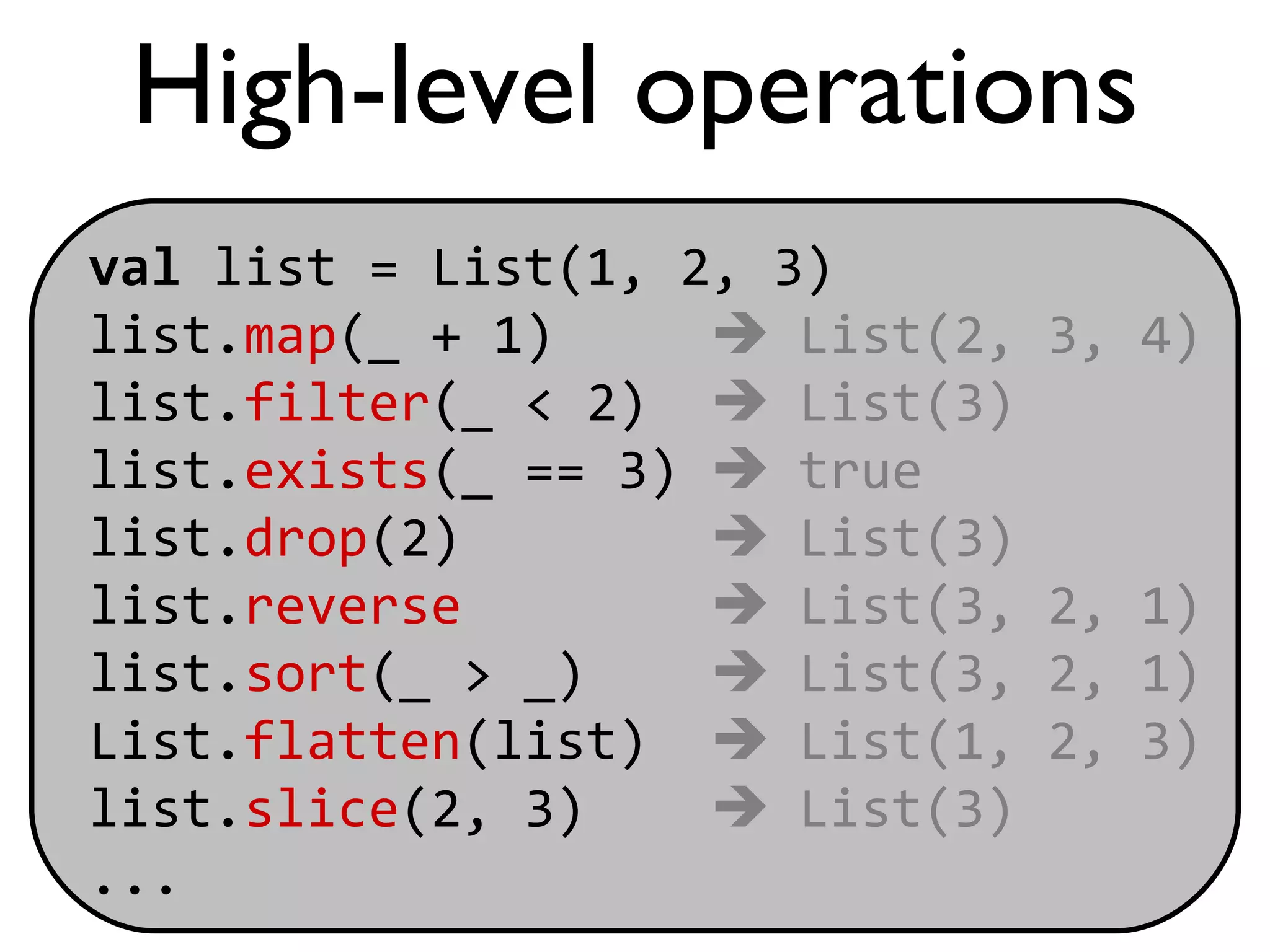
High-level operations
val list = List(1, 2, 3)
list.map(_ + 1)      List(2,   3, 4)
list.filter(_ < 2)  List(3)
list.exists(_ == 3)  true
list.drop(2)         List(3)
list.reverse         List(3,   2, 1)
list.sort(_ > _)     List(3,   2, 1)
List.flatten(list)  List(1,    2, 3)
list.slice(2, 3)     List(3)
...
115
functions defined on   List
Tuples
def getNameAndAge: Tuple2[String, Int] = {
  val name = ...
  val age = ...
  (name, age)
}


val (name, age) = getNameAndAge
println(“Name: “ + name)
println(“Age: “ + age)
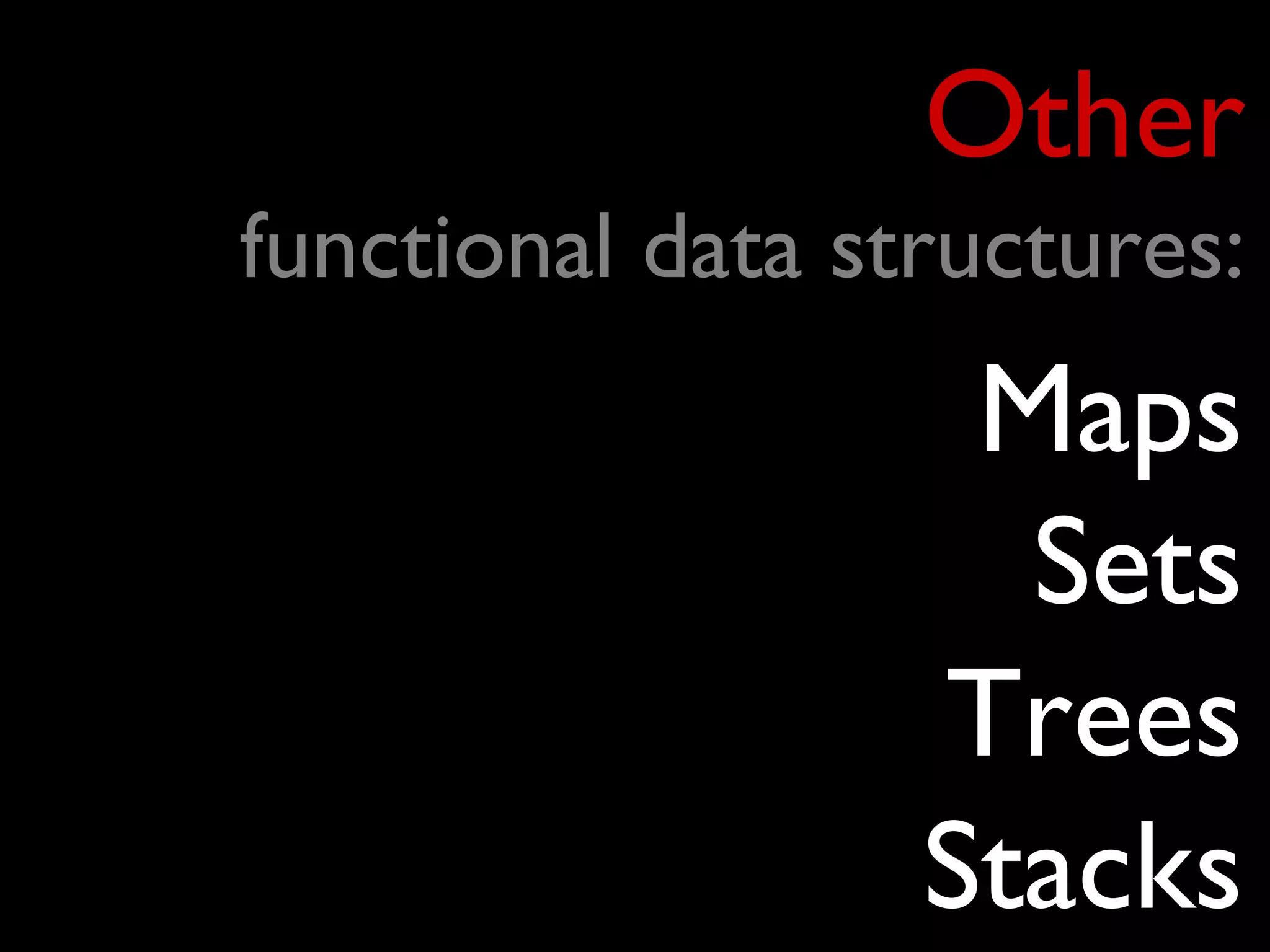
Other
functional data structures:
                   Maps
                    Sets
                  Trees
                  Stacks
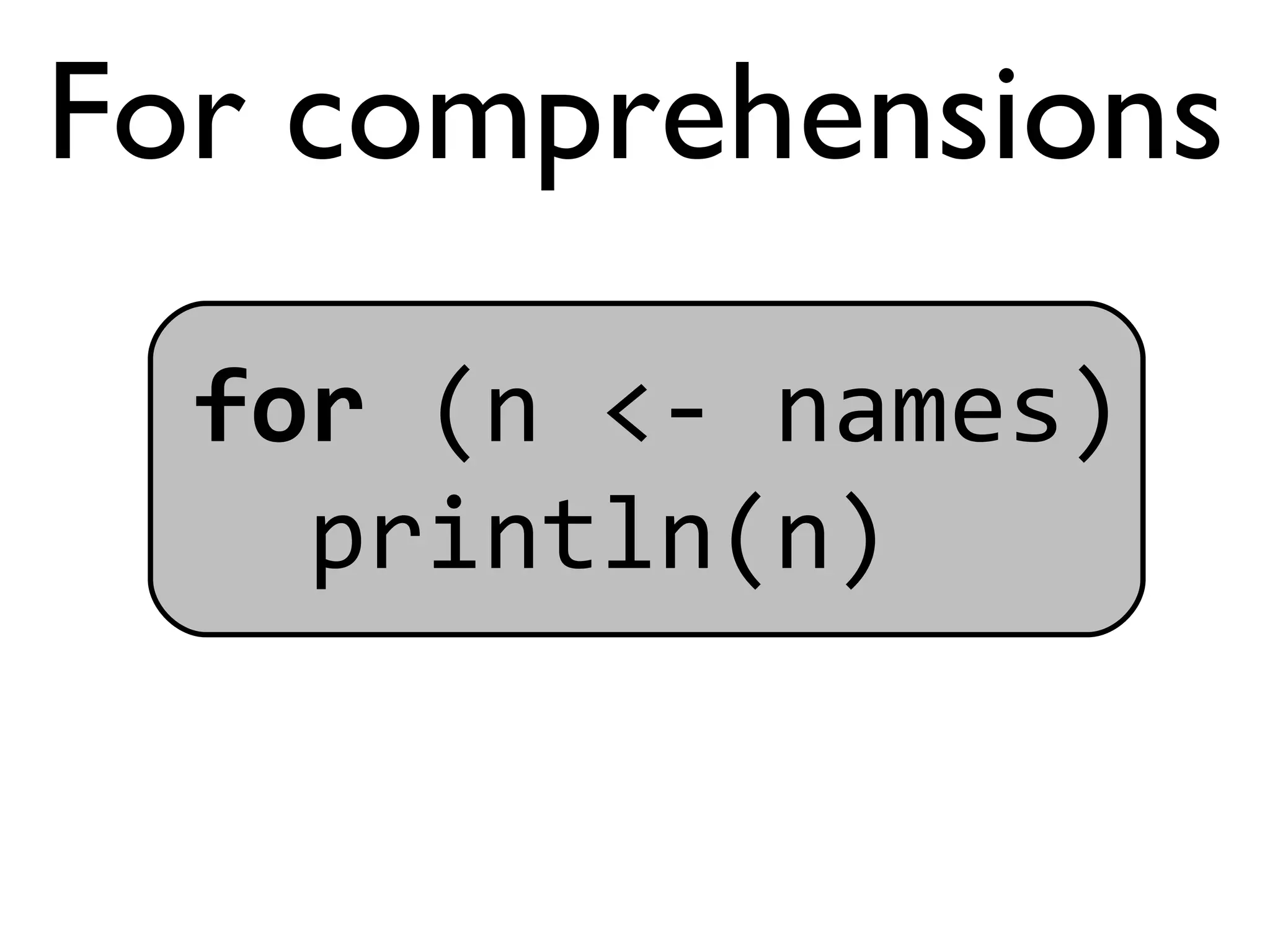
For comprehensions

  for (n <- names)
    println(n)
Like SQL queries
for {
  att <- attendees
  if att.name == “Fred”
  lang <- att.spokenLanguages
  if lang == “Danish”
} println(att)

Find all attendees named Fred that speaks Danish
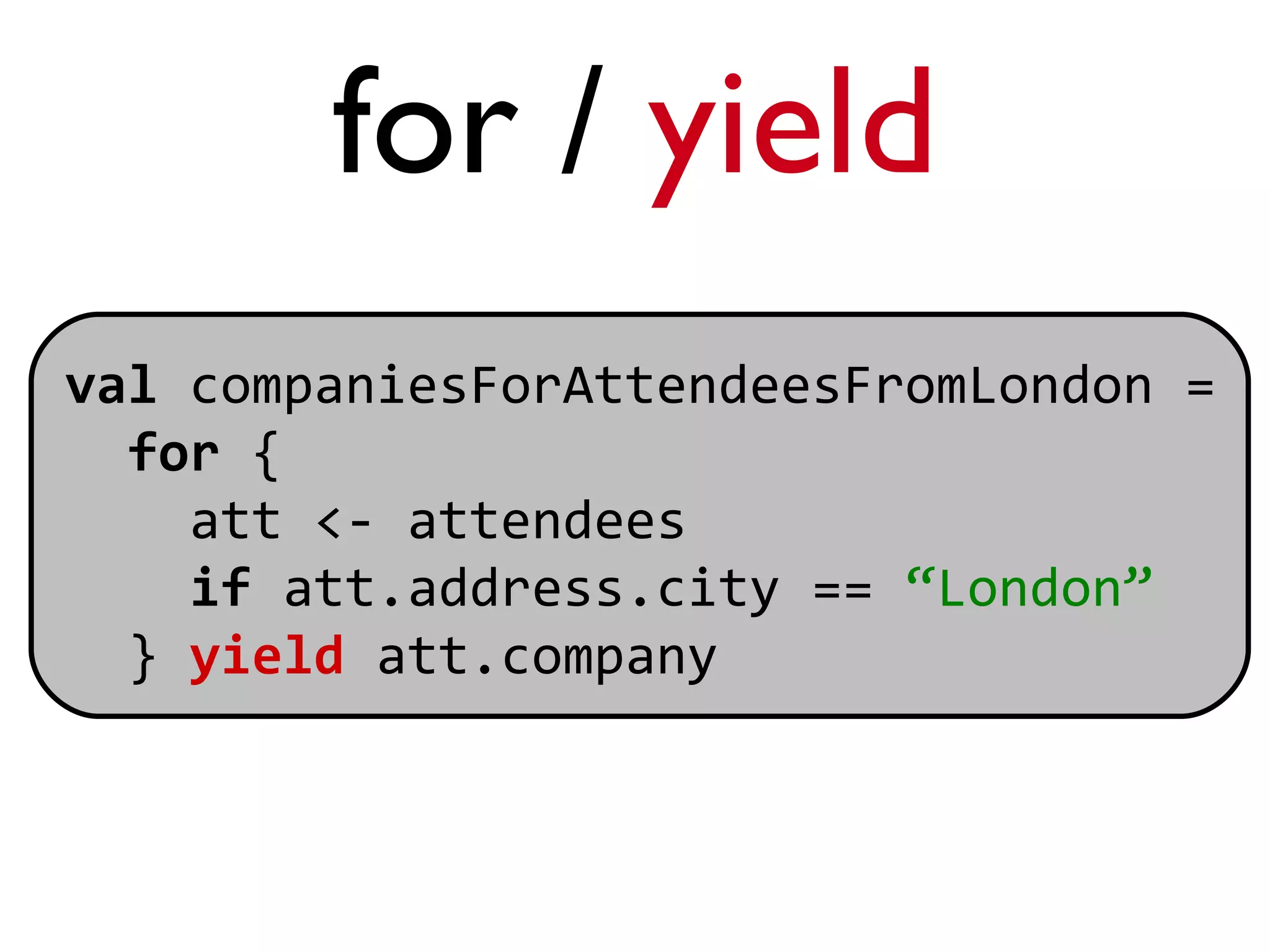
for / yield
val companiesForAttendeesFromLondon =
  for {
    att <- attendees
    if att.address.city == “London”
  } yield att.company
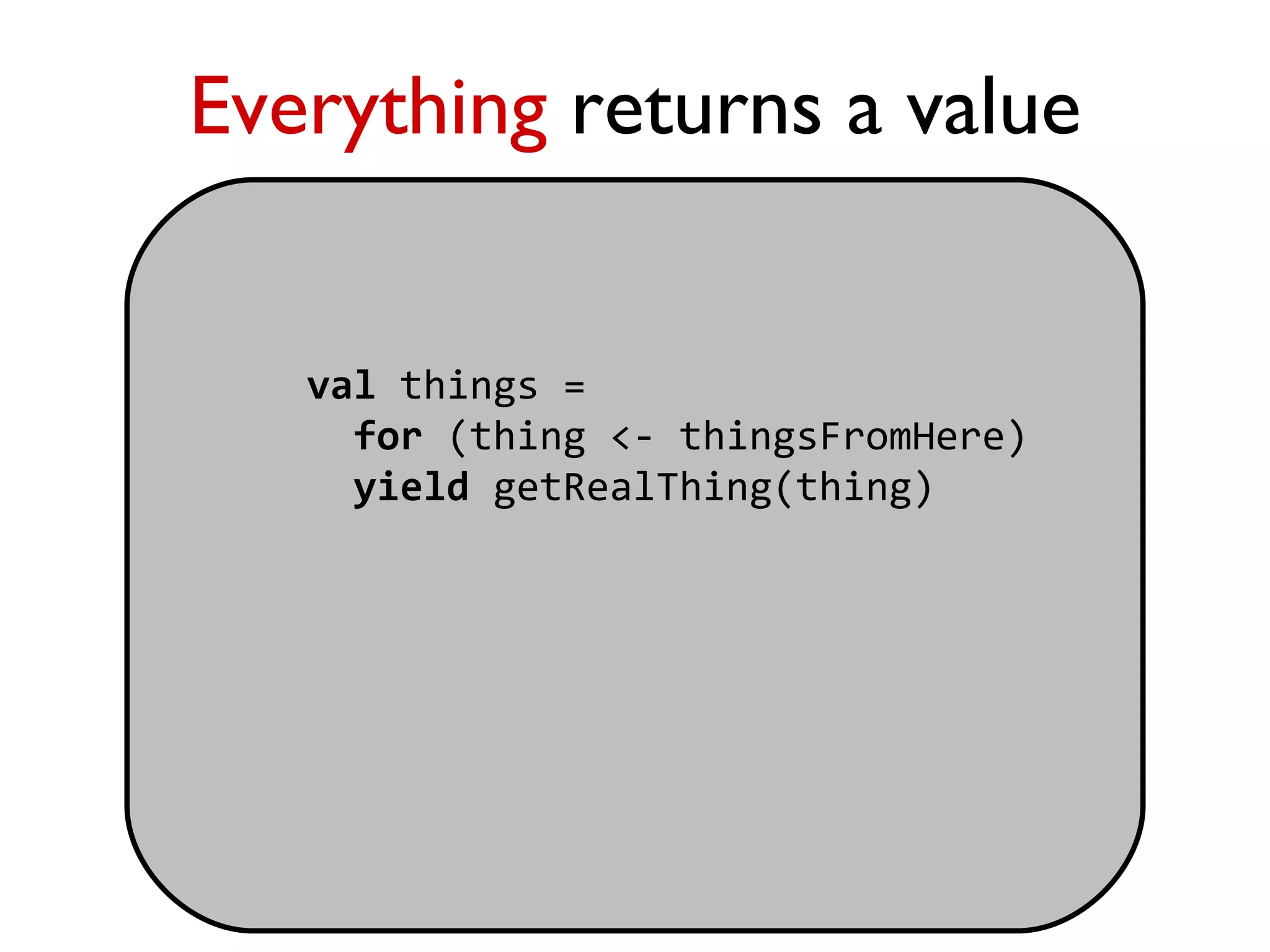
Everything returns a value


    for (thing <- thingsFromHere)
    yield getRealThing(thing)
Everything returns a value


   val things =
     for (thing <- thingsFromHere)
     yield getRealThing(thing)
Everything returns a value


   if (fromHere) {
     for (thing <- thingsFromHere)
     yield getRealThing(thing)
   } else {
     for (thing <- thingsFromThere)
     yield thing
   }
Everything returns a value

 val things =
   if (fromHere) {
     for (thing <- thingsFromHere)
     yield getRealThing(thing)
   } else {
     for (thing <- thingsFromThere)
     yield thing
   }
Everything returns a value

  try {
    if (fromHere) {
      for (thing <- thingsFromHere)
      yield getRealThing(thing)
    } else {
      for (thing <- thingsFromThere)
      yield thing
    }
  } catch {
    case e => error(e); Nil
  }
Everything returns a value
val things =
  try {
    if (fromHere) {
      for (thing <- thingsFromHere)
      yield getRealThing(thing)
    } else {
      for (thing <- thingsFromThere)
      yield thing
    }
  } catch {
    case e => error(e); Nil
  }
Everything returns a value
def getThingsFromSomewhere(
  fromHere: Boolean): List[Thing] = {
  try {
    if (fromHere) {
      for (thing <- thingsFromHere)
      yield getRealThing(thing)
    } else {
      for (thing <- thingsFromThere)
      yield thing
    }
  } catch {
    case e => error(e); Nil
  }
}
Pattern
matching
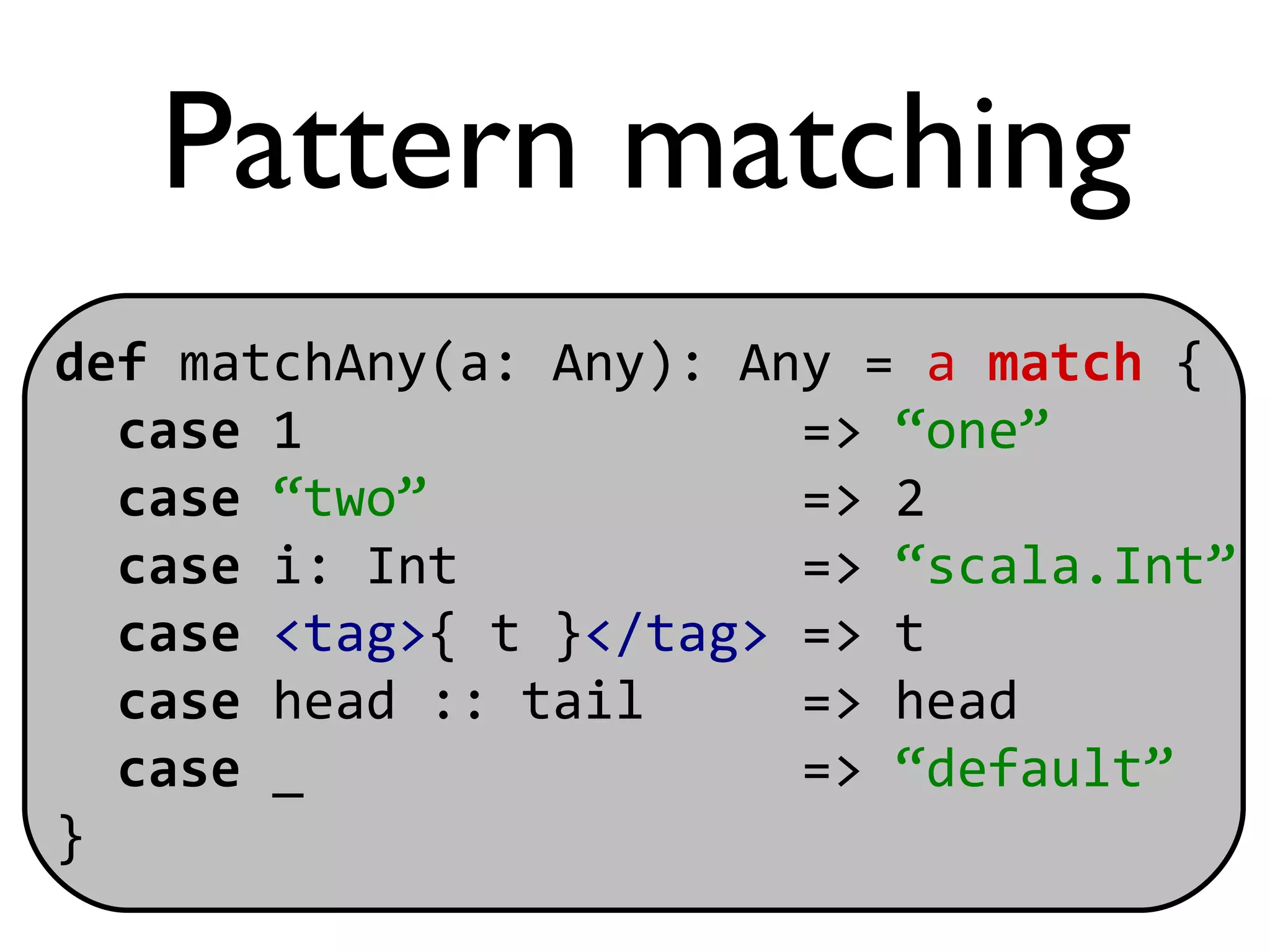
Pattern matching
def matchAny(a: Any): Any = a match {
  case 1                => “one”
  case “two”            => 2
  case i: Int           => “scala.Int”
  case <tag>{ t }</tag> => t
  case head :: tail     => head
  case _                => “default”
}
Tools
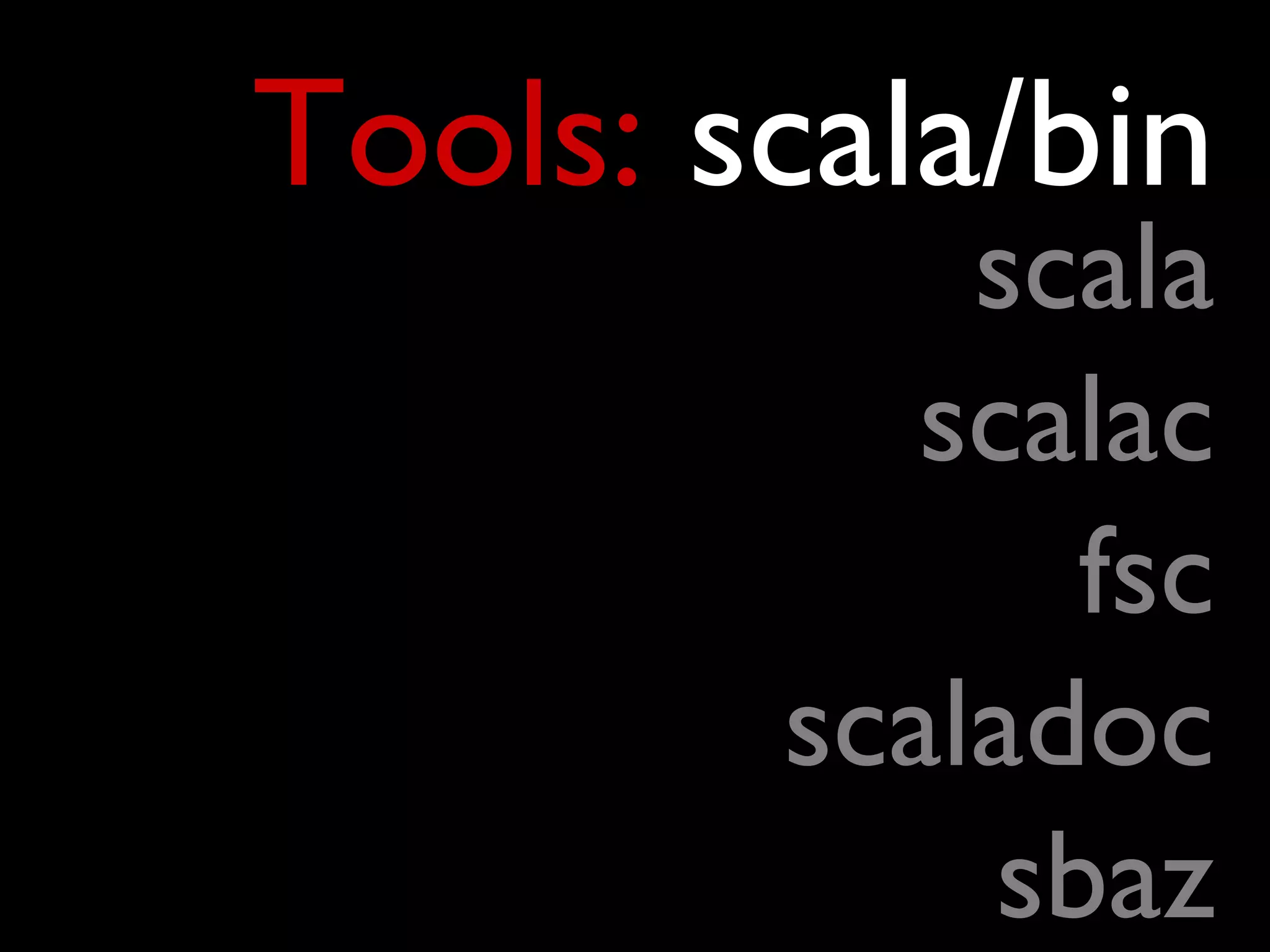
Tools: scala/bin
            scala
           scalac
               fsc
        scaladoc
             sbaz
Tools: IDEs
        Eclipse
    NetBeans
 IntelliJ IDEA
         Emacs
           JEdit
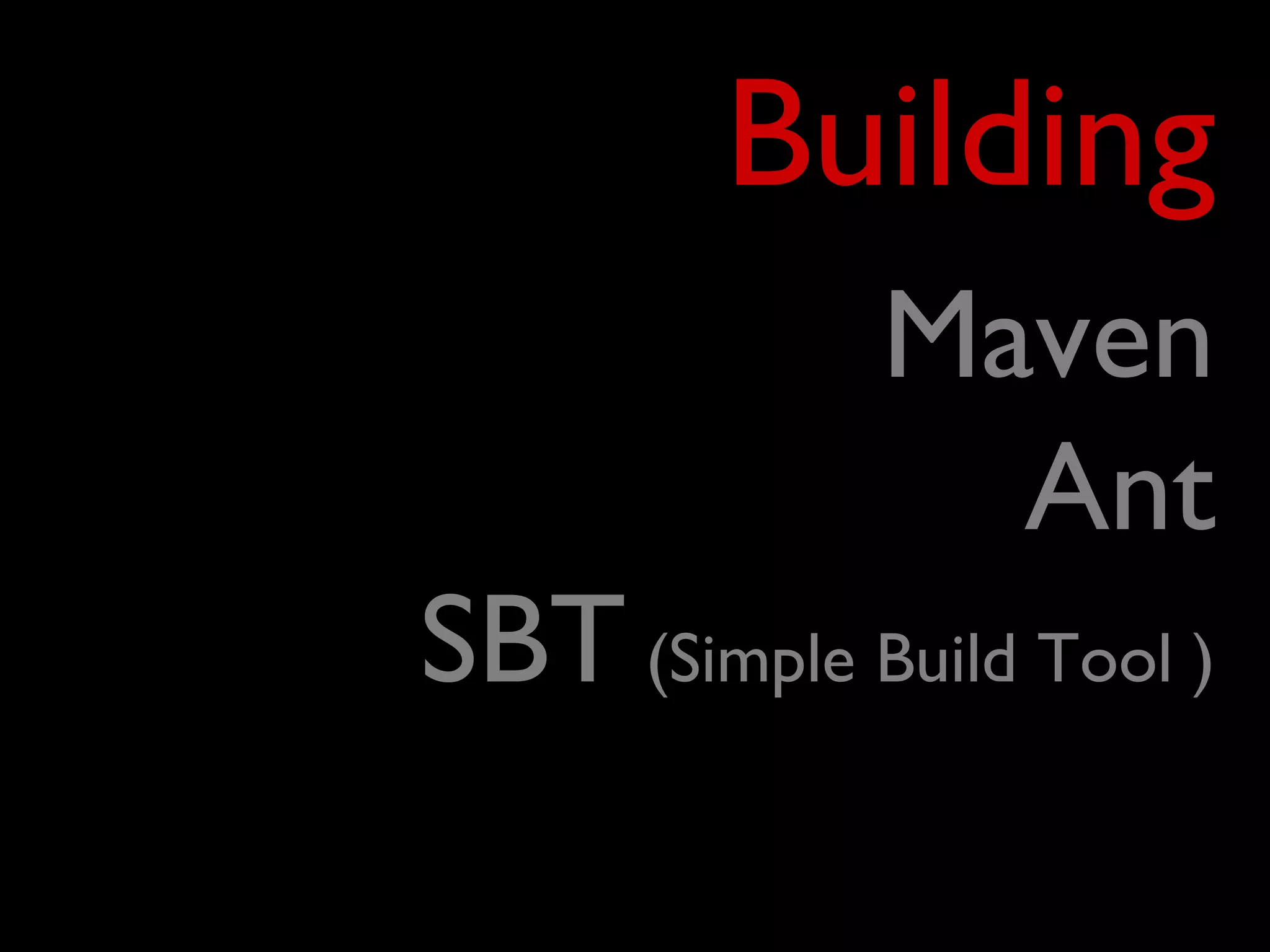
Building
             Maven
               Ant
SBT (Simple Build Tool )
Tools: Testing
          Specs
    ScalaCheck
      ScalaTest
          SUnit
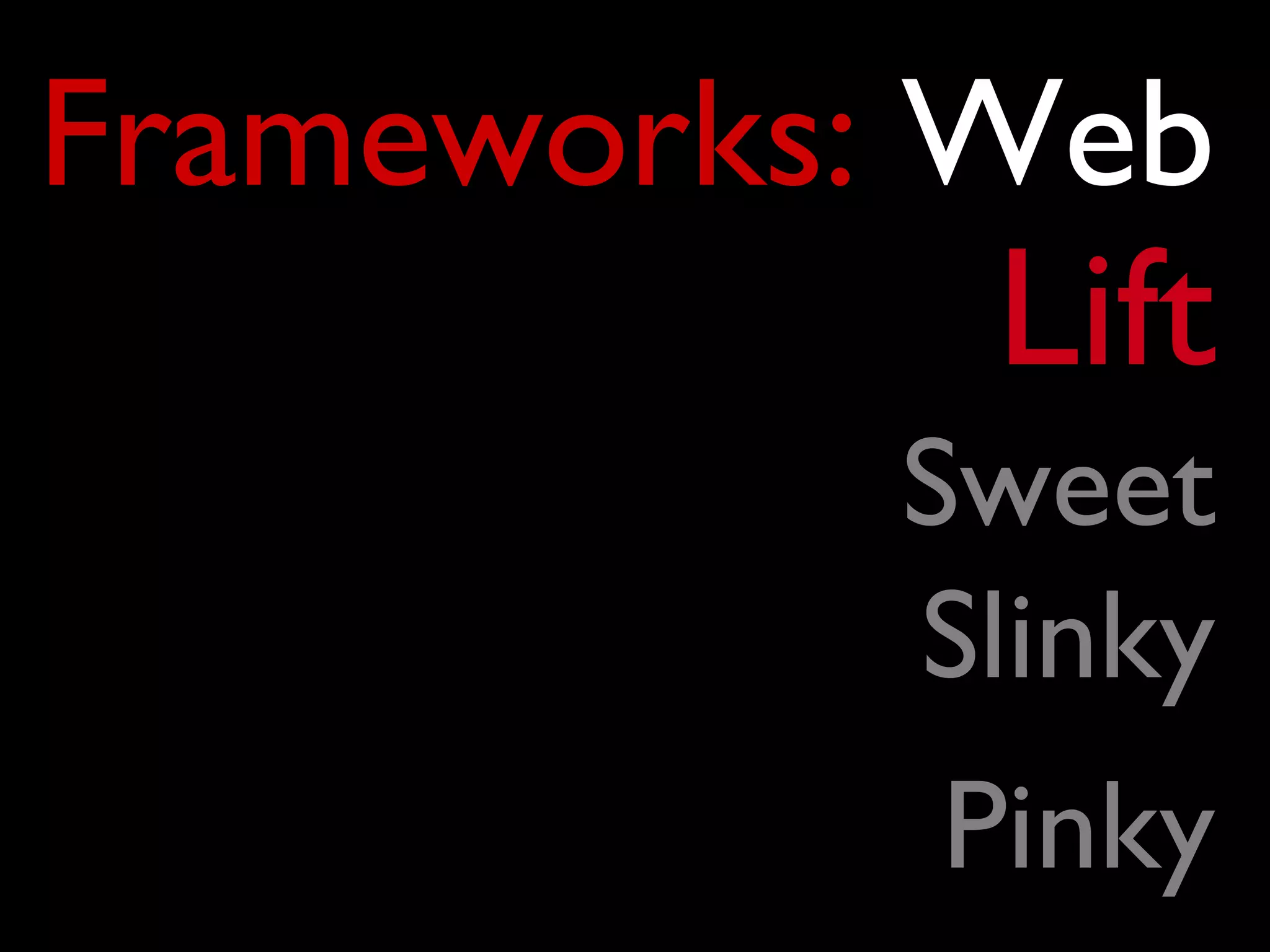
Frameworks: Web
            Lift
           Sweet
           Slinky
            Pinky
Learn more
jonas@jonasboner.com
  http://jonasboner.com
     http://scala-lang.org
Professional help
Consulting Training Mentoring

    http://scalablesolutions.se
Pragmatic
Real-World Scala

              Jonas Bonér
       Scalable Solutions


        Copyright 2009 Scalable Solutions

pragmaticrealworldscalajfokus2009-1233251076441384-2.pdf

  • 1.
    Pragmatic Real-World Scala Jonas Bonér Scalable Solutions
  • 2.
    “If I wereto pick a language to use today other than Java, it would be Scala” James Gosling
  • 3.
    Chat app inLift  Build a multi-user, comet-based chat app  About 30 lines of code  Three slides worth  Slides By David Pollak, creator of Lift
  • 4.
    Define Messages case classAdd(who: Actor) case class Remove(who: Actor) case class Messages(msgs: List[String])
  • 5.
    Chat Server object ChatServerextends Actor { private var listeners: List[Actor] = Nil private var msgs: List[String] = Nil def act = loop { react { case s: String => msgs = s :: msgs listeners.foreach(l => l ! Messages(msgs)) case Add(who) => listeners = who :: listeners who ! Messages(msgs) case Remove(who) => listeners -= who } } this.start }
  • 6.
    Chat Comet Component classChat extends CometActor { private var msgs: List[String] = Nil def render = <div> <ul>{ msgs.reverse.map(m => <li>{ m }</li>) }</ul> { ajaxText("", s => { ChatServer ! s; Noop }) } </div> override def localSetup = ChatServer ! Add(this) override def localShutdown = ChatServer ! Remove(this) override def lowPriority = { case Messages(m) => msgs = m; reRender(false) } }
  • 7.
  • 8.
  • 9.
    Unique and elegantblend of OO FP +
  • 10.
    Pragmatic Since 2003 Sponsored by EPFL Martin Odersky Seamless Java interoperability Friendly and supportive Production community ready Runs on the JVM Statically typed
  • 11.
    Unique and elegantblend of is...
  • 12.
    Expressive & light-weight val phonebook = Map( “Jonas” -> “123456”, “Sara” -> “654321”) phonebook += (“Jacob” -> “987654”) println(phonebook(“Jonas”))
  • 13.
    High-level Java version boolean hasUpperCase = false; for (int i = 0; i < name.length(); i++) { if (Character.isUpperCase(name.charAt(i))) { hasUpperCase = true; break; } }
  • 14.
    High-level Scala version val hasUpperCase = name.exists(_.isUpperCase)
  • 15.
    Concise // Java public classPerson { private String name; private int age; public Person(String name, int age) { this.name = name; this.age = age; // Scala } public String getName() { class Person( return name; var name: String, } public int getAge() { var age: Int) return age; } public void setName(String name) { this.name = name; } public void setAge(age: int) { this.age = age; } }
  • 16.
    Pure OO 1 +2 1.+(2) 123.toString()
  • 17.
    Extensible val service =actor { loop { receive { case Add(x,y) => reply(x+y) case Sub(x,y) => reply(x-y) } } } service ! Add(4, 2)  6
  • 18.
    Pragmatic def users = <users> <user role=”customer”> <name>{ user.name }</name> <password>{ user.password }</password> <email>{ user.email }</email> </user> ... </users>
  • 19.
    Pragmatic users match { case <users>{users @ _*}</users> => for (user <- users) println(“User “ + (user “name”).text) }
  • 20.
    Great for DSLs Apache Camel “direct:a“ ==> { loadbalance roundrobin { to (“mock:a“) to (“mock:b“) to (“mock:c“) } }
  • 21.
  • 22.
    But you don’tneed to go very deep to still have fun and be productive
  • 23.
  • 24.
  • 25.
  • 26.
  • 27.
  • 28.
  • 29.
    Traits & & Self-type annotations
  • 30.
    Trait trait Dad { private var children: List[Child] = Nil def addChild(child: Child) = children = child :: children def getChildren = children.clone }
  • 31.
    Base class Man(val name:String) extends Human
  • 32.
  • 33.
    Static mixin composition classMan(val name: String) extends Human with Dad
  • 34.
    Static mixin composition usage class Man(val name: String) extends Human with Dad val jonas = new Man(“Jonas”) jonas.addChild(new Child(“Jacob”))
  • 35.
    Dynamic mixin composition valjonas = new Man(“Jonas”) with Dad
  • 36.
    Dynamic mixin composition usage val jonas = new Man(“Jonas”) with Dad jonas.addChild(new Child(“Jacob”))
  • 37.
    3 different type of traits
  • 38.
  • 39.
    Rich interface trait RichIterable[A]{ def iterator: Iterator[A] // contract method def foreach(f: A => Unit) = { val iter = iterator while (iter.hasNext) f(iter.next) } def foldLeft[B](seed: B)(f: (B, A) => B) = { var result = seed foreach(e => result = f(result, e)) result } }
  • 40.
    Rich interface val richSet= new java.util.HashSet[Int] with RichIterable[Int] richSet.add(1) richSet.add(2) richSet.foldLeft(0)((x, y) => x + y)  3
  • 41.
  • 42.
    Stackable modifications trait IgnoreCaseSet extends java.util.Set[String] { abstract override def add(e: String) = { super.add(e.toLowerCase) } abstract override def contains(e: String) = { super.contains(e.toLowerCase) } abstract override def remove(e: String) = { super.remove(e.toLowerCase) } }
  • 43.
    Stackable modifications val set= new java.util.HashSet[String] with IgnoreCaseSet set.add(“HI THERE“) // uppercase set.contains(“hi there“) // lowercase  true
  • 44.
    Add another traitinterceptor trait LoggableSet extends java.util.Set[String] { abstract override def add(e: String) = { println(“Add :“ + e) super.add(e) } abstract override def remove(e: String) = { println(“Remove :“ + e) super.remove(e) } }
  • 45.
    Run the stackof interceptors val set = new java.util.HashSet[String] with IgnoreCaseSet with LoggableSet set.add(“HI THERE“)  “Add: HI THERE” Prints in uppercase
  • 46.
    Change the order valset = new java.util.HashSet[String] with LoggableSet with IgnoreCaseSet set.add(“HI THERE“)  “Add: hi there” Prints in lowercase
  • 47.
  • 48.
    Multiple views Trait Trait Trait Base Trait Trait
  • 49.
    Multiple views Trait Trait Trait Base Trait Trait
  • 50.
  • 51.
    Traits Multiple facets
  • 52.
  • 53.
    Facets trait Entity { ... } trait InventoryItemSet { ... } trait Invoicable { ... } trait PurchaseLimiter { ... } trait MailNotifier { ... } trait ACL { ... } trait Versioned { ... } trait Transactional { ... }
  • 54.
    Composition val order =new Order(customer) with Entity with InventoryItemSet with Invoicable with PurchaseLimiter with MailNotifier with ACL with Versioned with Transactional
  • 55.
  • 56.
  • 57.
  • 58.
  • 59.
    Dependency declaration trait UserService{ this: UserRepository => ... // provided with composition userRepository.merge(user) } …using self-type annotation
  • 61.
  • 62.
    walks like aduck… if it and talks like a duck… then it’s a duck Duck typing
  • 63.
    Structural Typing: Duck-typing done right def authorize(target: { def getACL: ACL }) = { val acl = target.getACL ... //authorize } Statically enforced
  • 64.
    Composition in small
  • 65.
    “It's Time toGet Good at Functional Programming” Dr Dobb’s Journal Issue December 2008
  • 66.
  • 67.
    Deterministic High-level Reusable FP Referentially transparent Immutable Declarative Orthogonal
  • 68.
  • 69.
    Small reusable pieces with input and output
  • 70.
    Unix pipes cat File| grep 'println' | wc
  • 71.
  • 72.
    Functions as values val inc = (x: Int) => x + 1 inc(1) 2
  • 73.
    Functions as parameters high-order List(1, 2, 3).map((x: Int) => x + 1)  List(2, 3, 4)
  • 74.
    Functions as parameters with sugar List(1, 2, 3).map((x: Int) => x + 1) List(1, 2, 3).map(x => x + 1) List(1, 2, 3).map(_ + 1)
  • 75.
    Functions as closures valaddMore = (x: Int) => x + more
  • 76.
    What is more?
  • 77.
    Some value outside thefunction’s lexical scope var more = 7 val addMore = (x: Int) => x + more addMore(3)  10 more = 8 addMore(3)  11
  • 78.
  • 79.
  • 80.
  • 81.
    Lists Grow at thefront Insert at front  O(1) Insert at end  O(n)
  • 82.
    List creation List(1, 2, 3) 1 :: 2 :: 3 :: Nil
  • 83.
    Basics val list =List(1, 2, 3) list.head  1 list.tail  List(2, 3) list.isEmpty  false
  • 84.
    High-level operations val list= List(1, 2, 3) list.map(_ + 1)  List(2, 3, 4) list.filter(_ < 2)  List(3) list.exists(_ == 3)  true list.drop(2)  List(3) list.reverse  List(3, 2, 1) list.sort(_ > _)  List(3, 2, 1) List.flatten(list)  List(1, 2, 3) list.slice(2, 3)  List(3) ...
  • 85.
  • 86.
    Tuples def getNameAndAge: Tuple2[String,Int] = { val name = ... val age = ... (name, age) } val (name, age) = getNameAndAge println(“Name: “ + name) println(“Age: “ + age)
  • 87.
    Other functional data structures: Maps Sets Trees Stacks
  • 88.
    For comprehensions for (n <- names) println(n)
  • 89.
    Like SQL queries for{ att <- attendees if att.name == “Fred” lang <- att.spokenLanguages if lang == “Danish” } println(att) Find all attendees named Fred that speaks Danish
  • 90.
    for / yield valcompaniesForAttendeesFromLondon = for { att <- attendees if att.address.city == “London” } yield att.company
  • 91.
    Everything returns avalue for (thing <- thingsFromHere) yield getRealThing(thing)
  • 92.
    Everything returns avalue val things = for (thing <- thingsFromHere) yield getRealThing(thing)
  • 93.
    Everything returns avalue if (fromHere) { for (thing <- thingsFromHere) yield getRealThing(thing) } else { for (thing <- thingsFromThere) yield thing }
  • 94.
    Everything returns avalue val things = if (fromHere) { for (thing <- thingsFromHere) yield getRealThing(thing) } else { for (thing <- thingsFromThere) yield thing }
  • 95.
    Everything returns avalue try { if (fromHere) { for (thing <- thingsFromHere) yield getRealThing(thing) } else { for (thing <- thingsFromThere) yield thing } } catch { case e => error(e); Nil }
  • 96.
    Everything returns avalue val things = try { if (fromHere) { for (thing <- thingsFromHere) yield getRealThing(thing) } else { for (thing <- thingsFromThere) yield thing } } catch { case e => error(e); Nil }
  • 97.
    Everything returns avalue def getThingsFromSomewhere( fromHere: Boolean): List[Thing] = { try { if (fromHere) { for (thing <- thingsFromHere) yield getRealThing(thing) } else { for (thing <- thingsFromThere) yield thing } } catch { case e => error(e); Nil } }
  • 98.
  • 99.
    Pattern matching def matchAny(a:Any): Any = a match { case 1 => “one” case “two” => 2 case i: Int => “scala.Int” case <tag>{ t }</tag> => t case head :: tail => head case _ => “default” }
  • 100.
  • 101.
    Tools: scala/bin scala scalac fsc scaladoc sbaz
  • 102.
    Tools: IDEs Eclipse NetBeans IntelliJ IDEA Emacs JEdit
  • 103.
    Building Maven Ant SBT (Simple Build Tool )
  • 104.
    Tools: Testing Specs ScalaCheck ScalaTest SUnit
  • 105.
    Frameworks: Web Lift Sweet Slinky Pinky
  • 106.
    Learn more jonas@jonasboner.com http://jonasboner.com http://scala-lang.org
  • 107.
    Professional help Consulting TrainingMentoring http://scalablesolutions.se
  • 108.
    Pragmatic Real-World Scala Jonas Bonér Scalable Solutions Copyright 2009 Scalable Solutions