Copyright @ Deutscher Outsourcing Verband e.V. &
The Outsourcing Journal - All rights reserved. Copying and distribution with-
out prior written agreement prohibited.
OUTSOURCING
JOURNAL SHARED KNOWLEDGE FOR
DACH AND GLOBAL MARKETS
THE FUTURE
OF GLOBAL
BUSINESS
OPERATIONS
THE FUTURE OF
CLOUD SERVICES:
WHY SHOULD MY
BUSINESS USE THE
CLOUD?
ADAPTING TO THE
21ST CENTURY BPO
MARKET: BETTER
SERVICE, LEANER
MARGINS
SERVICE
DELIVERY
MODEL FOR
GERMANY
SPECIALEDITION - ITO&BPOGERMANYFORUM2014
THEFUTURE
EDITION
www.outsourcing-journal.org Q4 - 2014 - Deutsch / English
THE NEW EDUCATION PRO-
GRAM FOR DACH BY GERMAN
OUTSOURCING ASSOCIATION
Publisher Featured Event Featured Initiative in Germany
Page 59The Outsourcing Journal “ITO&BPO GERMANY FORUM ISSUE Q4/14” All rights reserved.
9 Ways to
Fail Your
IT-Project
By Olga Yatsyna, Public Relations &
Marketing Manager, Softengi LLC,
Ukraine
Aboutnine steps to become an enemy of your
ITcontractorandbringyourITproject
tofailure.
Page 60 The Outsourcing Journal “ITO&BPO GERMANY FORUM ISSUE Q4/14” All rights reserved.
IT-PROJECTS
T
he customer, who works
with an IT company, or
business department,
working with its internal IT de-
partment, originally are on the
same side of the fence. Busi-
ness wants to improve its ef-
ficiency or performance and
reduce costs through IT. The IT
industry representatives want
to pass the project, which will
be a nice addition to their “our
cases” page, and get the mon-
ey. All of them seem to be in
the same boat and should be
happy.
The problems in this perfect
world begin when the two
sides find themselves on oppo-
site sides of the barricades, be-
cause at some point something
has not been taken into ac-
count. The customer becomes
unhappy with the poor per-
formance of the executor. The
outsourcing provider believes
that it is the mistake made by
the customer. Former partners
acquire different interests, and
the project turns into a great
sadness.
In the following we have gath-
ered nine typical problems en-
countered when implement-
ing IT projects, and nine ways
to address them based on the
experience of Softengi project
managers.
1.“Wow, so cheap!
Probably you, guys,
are the most honest”
Too low price at the initial stage
should at least alert the cus-
tomer. Too high price - too. As a
general rule, if the cost of work
is too low – the contractor did
not consider something in the
price assessment.
Solution: the price must be
justified. Pricing should be
transparent to the customer.
Remember that price is impor-
tant when you choose an out-
sourcing provider, but should
not be the determining factor.
You can select two or three IT
providers based on references
and good portfolio, and use
then the price factor for the fi-
nal selection.
2.“We want warm
green. Warmer. The
warmest”
During the development the
customer and the contractor
often “get stuck” in details. Go-
ing too much into details slows
down the development, chews
up budget and time. This leads
to the fact that the team mills
about, time is running out, the
budget is used.
Solution: perhaps the warmth
of the button is not so vitally
important for the user? It often
turns out that the detail stop-
ping the project as a result will
be not even visible for the user.
A tip from our creative PMs: do
the project as an artist paints a
picture - rough strokes, draw-
ing first the background and
basic elements, and painting in
the details later.
3.“Do as you wish
and then we will
see”
Insufficient interaction of IT-
employees with business repre-
sentatives. The customer “buys
off”withthemoney,leavingeve-
rything at the whim of the out-
sourcing provider, and when the
system is ready – sends tons of
comments. IT-guys and business
seem to be moving in the same
orbit with the same goals, but
do not meet each other. At the
same time inside there is a pro-
ject with its goals and objectives
known only by the business, and
the business shall direct it.
Solution: get involved in the
project, but do not become a
member of the IT team. The in-
teraction of customers and ser-
vice provider is one of three key
success factors, according to the
CHAOS Manifesto report by The
Page 61The Outsourcing Journal “ITO&BPO GERMANY FORUM ISSUE Q4/14” All rights reserved.
IT-PROJECTS
Standish Group.
4.“Here is some SAP
data, integrate them
somewhere”
Insufficiently clear statement of
requirements in the specifica-
tion. Another extreme situation
– too detailed development of
specification. It takes too much
time and money of the custom-
er.
Solution: no fanaticism. The
specification should be broad
enough to ensure that the IT
company could think out the
missing details and get started.
Here customer involvement is
also important. It is also possible
to hire/involve analyst for speci-
fication development.
5.“I was thinking a
bit and now changed
my mind”
Constant changes of specifica-
tion. IT company implements
the customer’s vision in the pro-
ject, but in the process the cus-
tomer understands that every-
thing so beautifully described in
the specification will not satisfy
him. Or something is not consid-
ered. “And this is normal,” - said
all together our PMs.
If an IT company in advance does
not foresee changes of the spec-
ification in the process of work,
the customer will not be happy
because what he gets is not
what he wants. Moreover, if one
changes specification or works
separately from it, the project
team will be demotivated and
will reply“it is impossible”to any
request from the customer to
change already developed func-
tions.
Solution: to find out in advance
if an IT company is ready to work
by a flexible methodology allow-
ing changing the requirements
at any stage of work.
6.“It was me who
ordered this?”
Long period between the start
of work and the first/each subse-
quent delivery of the product. IT
company accepts specification,
develops something and comes
back after three or four months.
Thus so called “dead zones” oc-
cur between the start of the pro-
ject and the first delivery when
the customer has no idea what is
happening on the project. In this
case, he can only trust and wait
till the first product delivery, re-
ceiving then first problems with
the first delivery. Because it can
well-developed, but it is not any-
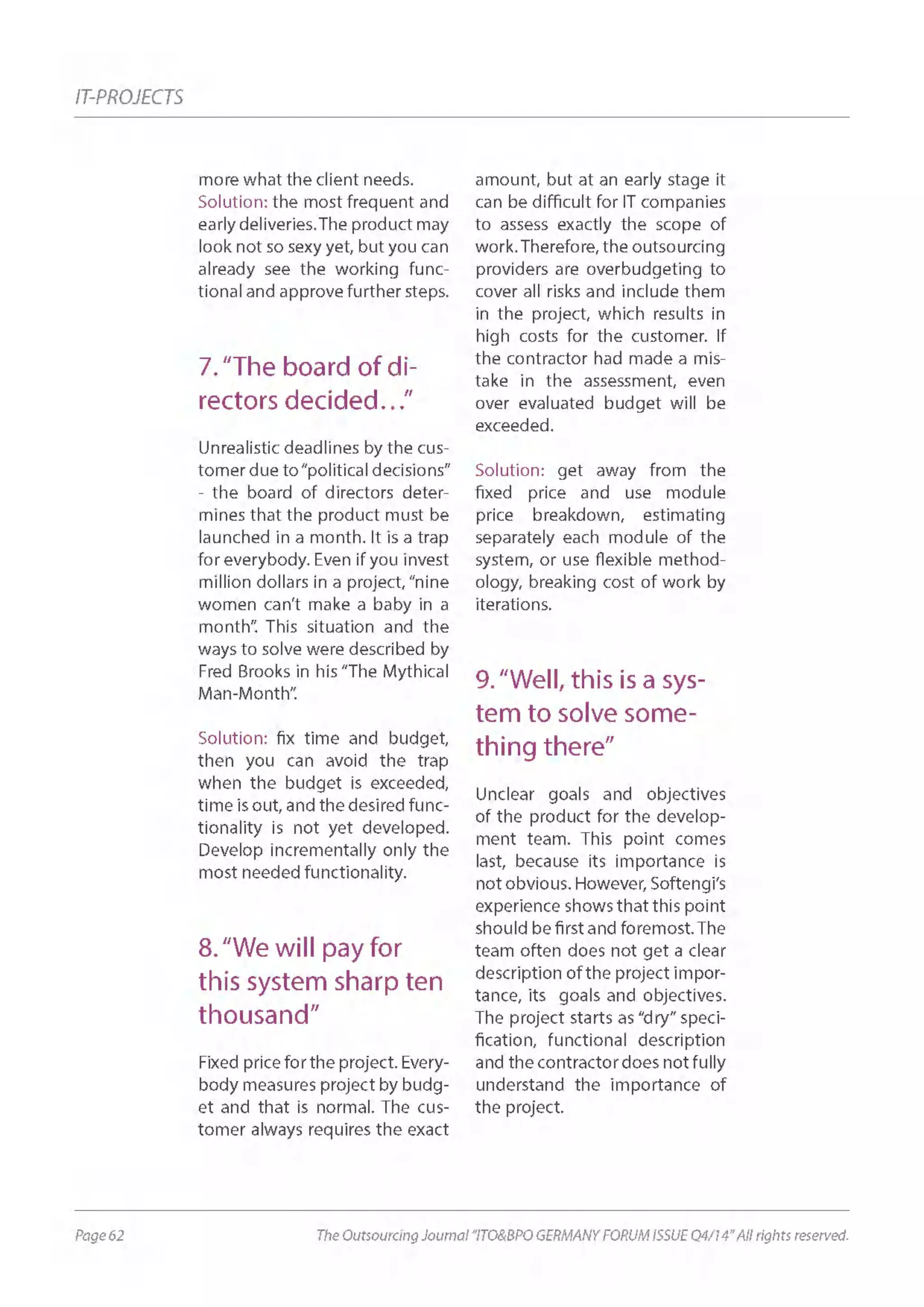
“The interaction of
customers and ser-
vice provider is one
of three key success
factors,...”
Page 62 The Outsourcing Journal “ITO&BPO GERMANY FORUM ISSUE Q4/14” All rights reserved.
IT-PROJECTS
more what the client needs.
Solution: the most frequent and
early deliveries.The product may
look not so sexy yet, but you can
already see the working func-
tional and approve further steps.
7.“The board of di-
rectors decided…”
Unrealistic deadlines by the cus-
tomer due to“political decisions”
- the board of directors deter-
mines that the product must be
launched in a month. It is a trap
for everybody. Even if you invest
million dollars in a project, “nine
women can’t make a baby in a
month”. This situation and the
ways to solve were described by
Fred Brooks in his “The Mythical
Man-Month”.
Solution: fix time and budget,
then you can avoid the trap
when the budget is exceeded,
time is out, and the desired func-
tionality is not yet developed.
Develop incrementally only the
most needed functionality.
8.“We will pay for
this system sharp ten
thousand”
Fixed price for the project. Every-
body measures project by budg-
et and that is normal. The cus-
tomer always requires the exact
amount, but at an early stage it
can be difficult for IT companies
to assess exactly the scope of
work. Therefore, the outsourcing
providers are overbudgeting to
cover all risks and include them
in the project, which results in
high costs for the customer. If
the contractor had made a mis-
take in the assessment, even
over evaluated budget will be
exceeded.
Solution: get away from the
fixed price and use module
price breakdown, estimating
separately each module of the
system, or use flexible method-
ology, breaking cost of work by
iterations.
9.“Well, this is a sys-
tem to solve some-
thing there”
Unclear goals and objectives
of the product for the develop-
ment team. This point comes
last, because its importance is
not obvious. However, Softengi’s
experience shows that this point
should be first and foremost.The
team often does not get a clear
description of the project impor-
tance, its goals and objectives.
The project starts as “dry” speci-
fication, functional description
and the contractor does not fully
understand the importance of
the project.
IT-PROJECTS
Solution: get involved in the
project at least at the initial
stage and explain the team the
importance of the system for
the society/company.
It is not necessary to see an
outsourcing provider or your
IT department as chairwarmers
dreaming only to exceed the
budget. With properly aligned
relationship, the outsourcing
companywillbecomeapartner
interested in a positive result,
no less than you. The custom-
er from his side should always
be involved in the project, un-
derstand what he eventually
wants to get, not afraid to ask
questions, and sometimes still,
listening to the advice of pro-
fessionals.
The author: Olga Yatsyna is a public relations and Internet
marketing professional, specializing in IT field. After holding
a degree in translation, she has been working as a journalist
and translator in online European magazine and a contribu-
tor in IT-related media. Currently she is working as Public Re-
lations & Marketing Manager at Softengi software develop-
ment company www.softengi.com
ITO
&BPOG
ERMANY
FORUM2
014
SPONSOR
2014
Advertisement

Softengi's 9 Ways To Fail Your IT Project In The Outsourcing Journal Special Edition - IT&BPO Germany Forum 2014

  • 1.
    Copyright @ DeutscherOutsourcing Verband e.V. & The Outsourcing Journal - All rights reserved. Copying and distribution with- out prior written agreement prohibited. OUTSOURCING JOURNAL SHARED KNOWLEDGE FOR DACH AND GLOBAL MARKETS THE FUTURE OF GLOBAL BUSINESS OPERATIONS THE FUTURE OF CLOUD SERVICES: WHY SHOULD MY BUSINESS USE THE CLOUD? ADAPTING TO THE 21ST CENTURY BPO MARKET: BETTER SERVICE, LEANER MARGINS SERVICE DELIVERY MODEL FOR GERMANY SPECIALEDITION - ITO&BPOGERMANYFORUM2014 THEFUTURE EDITION www.outsourcing-journal.org Q4 - 2014 - Deutsch / English THE NEW EDUCATION PRO- GRAM FOR DACH BY GERMAN OUTSOURCING ASSOCIATION Publisher Featured Event Featured Initiative in Germany
  • 2.
    Page 59The OutsourcingJournal “ITO&BPO GERMANY FORUM ISSUE Q4/14” All rights reserved. 9 Ways to Fail Your IT-Project By Olga Yatsyna, Public Relations & Marketing Manager, Softengi LLC, Ukraine Aboutnine steps to become an enemy of your ITcontractorandbringyourITproject tofailure.
  • 3.
    Page 60 TheOutsourcing Journal “ITO&BPO GERMANY FORUM ISSUE Q4/14” All rights reserved. IT-PROJECTS T he customer, who works with an IT company, or business department, working with its internal IT de- partment, originally are on the same side of the fence. Busi- ness wants to improve its ef- ficiency or performance and reduce costs through IT. The IT industry representatives want to pass the project, which will be a nice addition to their “our cases” page, and get the mon- ey. All of them seem to be in the same boat and should be happy. The problems in this perfect world begin when the two sides find themselves on oppo- site sides of the barricades, be- cause at some point something has not been taken into ac- count. The customer becomes unhappy with the poor per- formance of the executor. The outsourcing provider believes that it is the mistake made by the customer. Former partners acquire different interests, and the project turns into a great sadness. In the following we have gath- ered nine typical problems en- countered when implement- ing IT projects, and nine ways to address them based on the experience of Softengi project managers. 1.“Wow, so cheap! Probably you, guys, are the most honest” Too low price at the initial stage should at least alert the cus- tomer. Too high price - too. As a general rule, if the cost of work is too low – the contractor did not consider something in the price assessment. Solution: the price must be justified. Pricing should be transparent to the customer. Remember that price is impor- tant when you choose an out- sourcing provider, but should not be the determining factor. You can select two or three IT providers based on references and good portfolio, and use then the price factor for the fi- nal selection. 2.“We want warm green. Warmer. The warmest” During the development the customer and the contractor often “get stuck” in details. Go- ing too much into details slows down the development, chews up budget and time. This leads to the fact that the team mills about, time is running out, the budget is used. Solution: perhaps the warmth of the button is not so vitally important for the user? It often turns out that the detail stop- ping the project as a result will be not even visible for the user. A tip from our creative PMs: do the project as an artist paints a picture - rough strokes, draw- ing first the background and basic elements, and painting in the details later. 3.“Do as you wish and then we will see” Insufficient interaction of IT- employees with business repre- sentatives. The customer “buys off”withthemoney,leavingeve- rything at the whim of the out- sourcing provider, and when the system is ready – sends tons of comments. IT-guys and business seem to be moving in the same orbit with the same goals, but do not meet each other. At the same time inside there is a pro- ject with its goals and objectives known only by the business, and the business shall direct it. Solution: get involved in the project, but do not become a member of the IT team. The in- teraction of customers and ser- vice provider is one of three key success factors, according to the CHAOS Manifesto report by The
  • 4.
    Page 61The OutsourcingJournal “ITO&BPO GERMANY FORUM ISSUE Q4/14” All rights reserved. IT-PROJECTS Standish Group. 4.“Here is some SAP data, integrate them somewhere” Insufficiently clear statement of requirements in the specifica- tion. Another extreme situation – too detailed development of specification. It takes too much time and money of the custom- er. Solution: no fanaticism. The specification should be broad enough to ensure that the IT company could think out the missing details and get started. Here customer involvement is also important. It is also possible to hire/involve analyst for speci- fication development. 5.“I was thinking a bit and now changed my mind” Constant changes of specifica- tion. IT company implements the customer’s vision in the pro- ject, but in the process the cus- tomer understands that every- thing so beautifully described in the specification will not satisfy him. Or something is not consid- ered. “And this is normal,” - said all together our PMs. If an IT company in advance does not foresee changes of the spec- ification in the process of work, the customer will not be happy because what he gets is not what he wants. Moreover, if one changes specification or works separately from it, the project team will be demotivated and will reply“it is impossible”to any request from the customer to change already developed func- tions. Solution: to find out in advance if an IT company is ready to work by a flexible methodology allow- ing changing the requirements at any stage of work. 6.“It was me who ordered this?” Long period between the start of work and the first/each subse- quent delivery of the product. IT company accepts specification, develops something and comes back after three or four months. Thus so called “dead zones” oc- cur between the start of the pro- ject and the first delivery when the customer has no idea what is happening on the project. In this case, he can only trust and wait till the first product delivery, re- ceiving then first problems with the first delivery. Because it can well-developed, but it is not any- “The interaction of customers and ser- vice provider is one of three key success factors,...”
  • 5.
    Page 62 TheOutsourcing Journal “ITO&BPO GERMANY FORUM ISSUE Q4/14” All rights reserved. IT-PROJECTS more what the client needs. Solution: the most frequent and early deliveries.The product may look not so sexy yet, but you can already see the working func- tional and approve further steps. 7.“The board of di- rectors decided…” Unrealistic deadlines by the cus- tomer due to“political decisions” - the board of directors deter- mines that the product must be launched in a month. It is a trap for everybody. Even if you invest million dollars in a project, “nine women can’t make a baby in a month”. This situation and the ways to solve were described by Fred Brooks in his “The Mythical Man-Month”. Solution: fix time and budget, then you can avoid the trap when the budget is exceeded, time is out, and the desired func- tionality is not yet developed. Develop incrementally only the most needed functionality. 8.“We will pay for this system sharp ten thousand” Fixed price for the project. Every- body measures project by budg- et and that is normal. The cus- tomer always requires the exact amount, but at an early stage it can be difficult for IT companies to assess exactly the scope of work. Therefore, the outsourcing providers are overbudgeting to cover all risks and include them in the project, which results in high costs for the customer. If the contractor had made a mis- take in the assessment, even over evaluated budget will be exceeded. Solution: get away from the fixed price and use module price breakdown, estimating separately each module of the system, or use flexible method- ology, breaking cost of work by iterations. 9.“Well, this is a sys- tem to solve some- thing there” Unclear goals and objectives of the product for the develop- ment team. This point comes last, because its importance is not obvious. However, Softengi’s experience shows that this point should be first and foremost.The team often does not get a clear description of the project impor- tance, its goals and objectives. The project starts as “dry” speci- fication, functional description and the contractor does not fully understand the importance of the project.
  • 6.
    IT-PROJECTS Solution: get involvedin the project at least at the initial stage and explain the team the importance of the system for the society/company. It is not necessary to see an outsourcing provider or your IT department as chairwarmers dreaming only to exceed the budget. With properly aligned relationship, the outsourcing companywillbecomeapartner interested in a positive result, no less than you. The custom- er from his side should always be involved in the project, un- derstand what he eventually wants to get, not afraid to ask questions, and sometimes still, listening to the advice of pro- fessionals. The author: Olga Yatsyna is a public relations and Internet marketing professional, specializing in IT field. After holding a degree in translation, she has been working as a journalist and translator in online European magazine and a contribu- tor in IT-related media. Currently she is working as Public Re- lations & Marketing Manager at Softengi software develop- ment company www.softengi.com ITO &BPOG ERMANY FORUM2 014 SPONSOR 2014 Advertisement