9
9
for Successful Software Development
Proven
Strategies
Proven
Strategies
World-Class Software Solutions
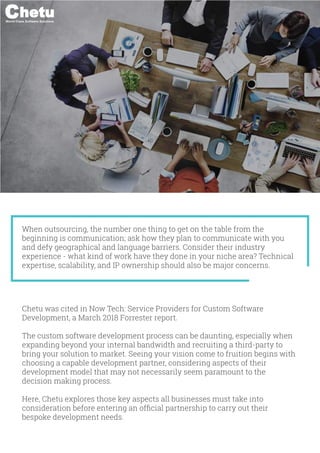
When outsourcing, the number one thing to get on the table from the
beginning is communication; ask how they plan to communicate with you
and defy geographical and language barriers. Consider their industry
experience - what kind of work have they done in your niche area? Technical
expertise, scalability, and IP ownership should also be major concerns.
Chetu was cited in Now Tech: Service Providers for Custom Software
Development, a March 2018 Forrester report.
The custom software development process can be daunting, especially when
expanding beyond your internal bandwidth and recruiting a third-party to
bring your solution to market. Seeing your vision come to fruition begins with
choosing a capable development partner, considering aspects of their
development model that may not necessarily seem paramount to the
decision making process.
Here, Chetu explores those key aspects all businesses must take into
consideration before entering an official partnership to carry out their
bespoke development needs.
1
World-Class Software Solutions
1. Key Takeaways
2. Choosing the Right Development Partner
3. Are They Experienced?
4. Are They New Implemented Technologies before?
5. Who will oversee my project?
6. Will they share my vision and how will I communicate it to the develop-
ers?
7. Can we scale the resources to match the scope of my project?
8. Who owns the proprietary data?
9. Are fixed-price models a trap?
Table of Contents
Key Takeaways
Choosing the Right Development
Partner
Are they Experienced?
Have They Implemented These
Technologies before?
Will They Share My Vision and How
Will I Communicate it to the
Developers?
Can We Scale the Resources to Match
the Scope of My Project?
Who Owns the Proprietary Data?
Are Fixed-price Models a Trap?
3
5
6
7
8
9
10
11
World-Class Software Solutions
Considering Industry Experience
Although many development options leverage extensive experience, there is
always a question of whether they are leveraging the right experience. Asking
the question, what kind of experience are they leveraging in my industry, will
allow you to find the needle in the haystack that services your specific
industry.
Technology Expertise
Review their case studies and get a feel for their experience with the
technologies you are looking to implement. How many years of experience do
their developers have? What technologies have they worked with and to what
degree? The technology is the engine of the project, so it is paramount to
make sure the mechanics understand the engine's working parts
Eliminating Communication Barriers
Understand exactly how you will communicate with your project team prior
to kickoff. For providers using international resources, communication is
usually a pain point. How will you overcome these barriers? Establish
guidelines and standards immediately to reduce miscommunication down
the road. Find a partner who values transparency between you and your
developer, ensuring no expectations go misinterpreted. Here you must
consider your potential partner's system for client-developer engagement
and project team dynamics.
3
Key Takeaways
World-Class Software Solutions
Scaling to Your Needs
Software development needs fluctuate as projects pivot and expand. Other
times, you scale down and need to scale back due to budgetary constraints. It
happens. For this reason, it is best to inquire about provider scalability. This
way you can build long-term strategic partners, rather than re-strategizing
every time a project changes course.
Owning Your Code
Sometimes this comes as an unanticipated cost as the development process
concludes, an extra fee for the release of the final deliverable or for the rights
to the code. Collaborating with a company that hits you with an additional
price tag at the end for a technology you envisioned is not a good look.
Review the contract closely to ensure you have the rights to your own idea.
Tailoring Price to Outfit Your Project
Do not fall into the fixed-price trap. This will result in a sub-par product that
will inevitably require additional development to rectify. Find a partner that
will thoroughly vet your project prior to estimating a development cost.
Ideally, price should come after the development of a project plan to reduce
speed bumps in the process.
4
World-Class Software Solutions
There is one constant for all operations: the need to evolve and reinvent to
remain relevant in a dynamic consumer climate. Businesses brainstorm
innovative software, intuitive website designs, and groundbreaking
applications to keep pace with market demands, but when it comes to seeing
these projects through to fruition, business owners are often met with limited
bandwidth. When internal resources cannot be scaled to meet project
demands, proprietors take to the internet for third-party development,
overwhelmed by the plethora of programmers and unsure of where to begin.
While budgetary concerns are a primary facet of the decision-making
process, choosing a development company based solely on cost structure
returns software that reflects the low investment. Unfortunately, low quality
and low cost often run parallel.
Rather than thinking one dimensionally, you need to think about the big
picture. Answering the following questions before committing to a software
provider will guarantee a robust, revenue-driving software that will usher
your operation toward an enlightened era.
Finding a true and seamless back-end
software partner can be challenging in a
saturated market. To refine your search,
it is important to review key elements
within each prospective development
model prior to committing to an official
partnership. Fully vetting each prospect
will ensure you not only complete your
project objectives, but supersede them.
5
Introduction :
Choosing the Right Development Partner
World-Class Software Solutions
What kind of experience are they leveraging in my industry? It is easy for
companies to misrepresent their experience, using the age of their operations
as a marketing maneuver. In reality, level of skill and industry expertise are a
product of the workforce, rather than the company. A business can be around
for many years, but only hire inexperienced developers to keep their overhead
down. In order to circumvent this discrepancy, business owners must get
down to the nitty-gritty, revealing what exists below the surface.
Establish the baseline by inquiring about their developer standards. Identify
whether their staff leverages the in-depth knowledge your project requires
and inquire about which technologies, standards, and regulations they are
fluent in. Each industry comes with a unique technological paradigm, so
hiring a software development company that is segmented by industry is
paramount to the success of the project. If a developer can substantiate
previous experience within your specific landscape, they will be able to
implement the proper techniques and meet all regulatory standards inherent
to your project.
The level of experience should be apparent early on in the relationship and
sales process, and both parties should proceed with total transparency, and
with the understanding that Chetu shares their vision and is fully capable of
delivering the code to market. Chetu's collective industry knowledge supports
cross-industry dialogue to meet all project needs.
6
Industry Experience
World-Class Software Solutions
Have they implemented these technologies
before? Hiring a software development
company that services a broad spectrum of
technologies ensures that you will be matched
with a development team ready to implement
your native programming language. This will
certainly reduce the number of unforeseen
roadblocks and the amount of time spent
assimilating to the project's code.
7
Technology Expertise
World-Class Software Solutions
Will they share my vision and how will they communicate it to the
developers? Above everything, communication will make or break the
project, especially when hiring a third-party based overseas.
The first possible problem clients address is the language and cultural barrier
that prevents effective communication between them and the development
team. The deficit can lead to the miscommunication of project requirements,
deliverable expectations, and debilitates the partnership in its entirety as
both parties become frustrated by the inability properly articulate themselves.
The second problem clients address is the time zone differences. When hiring
a company where the majority of development occurs overseas, it is possible
there will be 12 hours between client and developers. As a result, clients may
feel as though they must be awake at all hours, ready to address problems
occurring in the time zone of the development team. Additionally, the time
difference leads to delays in email communications and project updates.
Chetu is committed to maintaining open channels of
communication between all parties. We eliminate
time deficits by coming to you and aligning your
team and project needs cohesively. Rather than
providing the engineer in solidarity; we build clients
their own comprehensive project team. Where
competitors provide the minimum, we give our
clients a holistic development experience. What this
does is, it fills any potential communication gaps.
The majority of IT outsourcing services have not
adopted such an intense approach, depriving clients
of a functional platform for collaboration.
8
Communication
World-Class Software Solutions
Can we scale the resources to match the scope of my project? When
considering a new project, many companies are concerned with price,
communication, and expertise but one area that is often overlooked is
whether a company is capable of increasing or decreasing the size of a team
based on the needs of the project. This concern is typically one that comes
up after development has started. With a locked-in contract, the size of the
team remains the same through the lifetime of a project, regardless of
whether each developer is needed or if additional developers are required.
This limits flexibility in the project and can lead to costly problems down
the road if the company chosen for software development is unwilling or
unable to scale a project based on client needs.
Chetu operates as a work-for-hire firm. Without locked-in contracts, Chetu
maintains a high level of flexibility when it comes to scaling or changing a
team to meet the client's needs. The ideal development partner will be able
dedicate a team of developers that can fluctuate in size or change out one
expert for another based on the project requirements and the client's needs.
Being a flexible software development partner, Chetu will work with your
company to ensure that the appropriate technological needs are met while
continuously seeking ways to help you reduce your overall cost of
production.
9
Scalability and Flexibility
World-Class Software Solutions
Who owns the proprietary data? One very
important aspect to watch for when selecting a
software development partner is who owns the
intellectual property and source code once the
project is complete. Some companies may charge
licensing fees or usage fees for the software
developed by their teams for the client because they
retain full rights to any product they create.
This can be a surprise to many clients as they
expect that fully customized software should not
have additional fees or charges. Indeed, companies
should be wary of extra charges that are associated
with the release or use of proprietary data that
extends beyond the completion of the project. With
custom projects, the source code and intellectual
property should always belong to the client, as the
project is designed and created based on the ideas
of the individual who hired the software
development company.
10
Code Ownership
World-Class Software Solutions
Are fixed-price models a trap? Yes. Decision makers face tough choices in
being able to provide maximum business value within a limited budget.
Choosing the right software solutions partner is a critical decision as this
represents a potentially large cost to a company. Organizations need their
technical solutions provider to be reasonable, cost-effective, and proactive in
addressing potential issues. Many are quick to push for a fixed rate contract
because they feel that it gives them a flat cost to expect for the project.
However, the fixed rate model fails to address the issues that arise when the
project requirements change, which often happens during the process of
software development.
To put it into perspective, imagine you have a set, fixed price to build a three
bedroom, one bathroom house. Halfway through the project, you discover that
your mother will move in with you so you will need an additional bedroom
and bathroom. Now, the contractor is still obliged to add those additional
rooms without increasing the cost due to the limitations of the fixed price
contract. However, the contractor is not obligated to make sure the additions
are of the same quality as the rest of the house because even though the new
work will add time and resources to the project, there is no benefit to the
contractor in terms of an equivalent increase in pay. The work is essentially
done for free and the quality will reflect that.
To avoid the fixed price trap, many companies opt to get a number of quotes
from various providers then choose the lowest cost option. The problem with
11
Cost and Quotes
World-Class Software Solutions
this is that without knowing the full scope and specifications for the project,
development companies find themselves either severely underquoting to win
business or over-quoting in an attempt to cover every possible factor. Again,
this is often done without the software company knowing the full details of
the project.
Without knowing the complete scope of work it is nearly impossible to
accurately give a total-cost quote. That is why most companies use deceptive
practices by throwing out low ball quotes to entice your business, then to your
dismay, quickly increase that number as the full scope of the project is
revealed.
Chetu, Inc. does not affect the opinion of this article. Any mention of specific
names for software, companies or individuals does not constitute an
endorsement from either party unless otherwise specified. All case studies
and blogs are written with the full cooperation, knowledge and participation
of the individuals mentioned. This blog should not be construed as legal
advice.
Chetu was incorporated in 2000 and is headquartered in Florida. We deliver
World-Class Software Development Solutions serving entrepreneurs to
Fortune 500 clients. Our services include process and systems design,
package implementation, custom development, business intelligence and
reporting, systems integration, as well as testing, maintenance and support.
Chetu's expertise spans across the entire IT spectrum.
12
Disclaimer:
World-Class Software Solutions

9 Proven-Strategies

  • 1.
    9 9 for Successful SoftwareDevelopment Proven Strategies Proven Strategies World-Class Software Solutions
  • 2.
    World-Class Software Solutions Whenoutsourcing, the number one thing to get on the table from the beginning is communication; ask how they plan to communicate with you and defy geographical and language barriers. Consider their industry experience - what kind of work have they done in your niche area? Technical expertise, scalability, and IP ownership should also be major concerns. Chetu was cited in Now Tech: Service Providers for Custom Software Development, a March 2018 Forrester report. The custom software development process can be daunting, especially when expanding beyond your internal bandwidth and recruiting a third-party to bring your solution to market. Seeing your vision come to fruition begins with choosing a capable development partner, considering aspects of their development model that may not necessarily seem paramount to the decision making process. Here, Chetu explores those key aspects all businesses must take into consideration before entering an official partnership to carry out their bespoke development needs. 1 World-Class Software Solutions
  • 3.
    1. Key Takeaways 2.Choosing the Right Development Partner 3. Are They Experienced? 4. Are They New Implemented Technologies before? 5. Who will oversee my project? 6. Will they share my vision and how will I communicate it to the develop- ers? 7. Can we scale the resources to match the scope of my project? 8. Who owns the proprietary data? 9. Are fixed-price models a trap? Table of Contents Key Takeaways Choosing the Right Development Partner Are they Experienced? Have They Implemented These Technologies before? Will They Share My Vision and How Will I Communicate it to the Developers? Can We Scale the Resources to Match the Scope of My Project? Who Owns the Proprietary Data? Are Fixed-price Models a Trap? 3 5 6 7 8 9 10 11 World-Class Software Solutions
  • 4.
    Considering Industry Experience Althoughmany development options leverage extensive experience, there is always a question of whether they are leveraging the right experience. Asking the question, what kind of experience are they leveraging in my industry, will allow you to find the needle in the haystack that services your specific industry. Technology Expertise Review their case studies and get a feel for their experience with the technologies you are looking to implement. How many years of experience do their developers have? What technologies have they worked with and to what degree? The technology is the engine of the project, so it is paramount to make sure the mechanics understand the engine's working parts Eliminating Communication Barriers Understand exactly how you will communicate with your project team prior to kickoff. For providers using international resources, communication is usually a pain point. How will you overcome these barriers? Establish guidelines and standards immediately to reduce miscommunication down the road. Find a partner who values transparency between you and your developer, ensuring no expectations go misinterpreted. Here you must consider your potential partner's system for client-developer engagement and project team dynamics. 3 Key Takeaways World-Class Software Solutions
  • 5.
    Scaling to YourNeeds Software development needs fluctuate as projects pivot and expand. Other times, you scale down and need to scale back due to budgetary constraints. It happens. For this reason, it is best to inquire about provider scalability. This way you can build long-term strategic partners, rather than re-strategizing every time a project changes course. Owning Your Code Sometimes this comes as an unanticipated cost as the development process concludes, an extra fee for the release of the final deliverable or for the rights to the code. Collaborating with a company that hits you with an additional price tag at the end for a technology you envisioned is not a good look. Review the contract closely to ensure you have the rights to your own idea. Tailoring Price to Outfit Your Project Do not fall into the fixed-price trap. This will result in a sub-par product that will inevitably require additional development to rectify. Find a partner that will thoroughly vet your project prior to estimating a development cost. Ideally, price should come after the development of a project plan to reduce speed bumps in the process. 4 World-Class Software Solutions
  • 6.
    There is oneconstant for all operations: the need to evolve and reinvent to remain relevant in a dynamic consumer climate. Businesses brainstorm innovative software, intuitive website designs, and groundbreaking applications to keep pace with market demands, but when it comes to seeing these projects through to fruition, business owners are often met with limited bandwidth. When internal resources cannot be scaled to meet project demands, proprietors take to the internet for third-party development, overwhelmed by the plethora of programmers and unsure of where to begin. While budgetary concerns are a primary facet of the decision-making process, choosing a development company based solely on cost structure returns software that reflects the low investment. Unfortunately, low quality and low cost often run parallel. Rather than thinking one dimensionally, you need to think about the big picture. Answering the following questions before committing to a software provider will guarantee a robust, revenue-driving software that will usher your operation toward an enlightened era. Finding a true and seamless back-end software partner can be challenging in a saturated market. To refine your search, it is important to review key elements within each prospective development model prior to committing to an official partnership. Fully vetting each prospect will ensure you not only complete your project objectives, but supersede them. 5 Introduction : Choosing the Right Development Partner World-Class Software Solutions
  • 7.
    What kind ofexperience are they leveraging in my industry? It is easy for companies to misrepresent their experience, using the age of their operations as a marketing maneuver. In reality, level of skill and industry expertise are a product of the workforce, rather than the company. A business can be around for many years, but only hire inexperienced developers to keep their overhead down. In order to circumvent this discrepancy, business owners must get down to the nitty-gritty, revealing what exists below the surface. Establish the baseline by inquiring about their developer standards. Identify whether their staff leverages the in-depth knowledge your project requires and inquire about which technologies, standards, and regulations they are fluent in. Each industry comes with a unique technological paradigm, so hiring a software development company that is segmented by industry is paramount to the success of the project. If a developer can substantiate previous experience within your specific landscape, they will be able to implement the proper techniques and meet all regulatory standards inherent to your project. The level of experience should be apparent early on in the relationship and sales process, and both parties should proceed with total transparency, and with the understanding that Chetu shares their vision and is fully capable of delivering the code to market. Chetu's collective industry knowledge supports cross-industry dialogue to meet all project needs. 6 Industry Experience World-Class Software Solutions
  • 8.
    Have they implementedthese technologies before? Hiring a software development company that services a broad spectrum of technologies ensures that you will be matched with a development team ready to implement your native programming language. This will certainly reduce the number of unforeseen roadblocks and the amount of time spent assimilating to the project's code. 7 Technology Expertise World-Class Software Solutions
  • 9.
    Will they sharemy vision and how will they communicate it to the developers? Above everything, communication will make or break the project, especially when hiring a third-party based overseas. The first possible problem clients address is the language and cultural barrier that prevents effective communication between them and the development team. The deficit can lead to the miscommunication of project requirements, deliverable expectations, and debilitates the partnership in its entirety as both parties become frustrated by the inability properly articulate themselves. The second problem clients address is the time zone differences. When hiring a company where the majority of development occurs overseas, it is possible there will be 12 hours between client and developers. As a result, clients may feel as though they must be awake at all hours, ready to address problems occurring in the time zone of the development team. Additionally, the time difference leads to delays in email communications and project updates. Chetu is committed to maintaining open channels of communication between all parties. We eliminate time deficits by coming to you and aligning your team and project needs cohesively. Rather than providing the engineer in solidarity; we build clients their own comprehensive project team. Where competitors provide the minimum, we give our clients a holistic development experience. What this does is, it fills any potential communication gaps. The majority of IT outsourcing services have not adopted such an intense approach, depriving clients of a functional platform for collaboration. 8 Communication World-Class Software Solutions
  • 10.
    Can we scalethe resources to match the scope of my project? When considering a new project, many companies are concerned with price, communication, and expertise but one area that is often overlooked is whether a company is capable of increasing or decreasing the size of a team based on the needs of the project. This concern is typically one that comes up after development has started. With a locked-in contract, the size of the team remains the same through the lifetime of a project, regardless of whether each developer is needed or if additional developers are required. This limits flexibility in the project and can lead to costly problems down the road if the company chosen for software development is unwilling or unable to scale a project based on client needs. Chetu operates as a work-for-hire firm. Without locked-in contracts, Chetu maintains a high level of flexibility when it comes to scaling or changing a team to meet the client's needs. The ideal development partner will be able dedicate a team of developers that can fluctuate in size or change out one expert for another based on the project requirements and the client's needs. Being a flexible software development partner, Chetu will work with your company to ensure that the appropriate technological needs are met while continuously seeking ways to help you reduce your overall cost of production. 9 Scalability and Flexibility World-Class Software Solutions
  • 11.
    Who owns theproprietary data? One very important aspect to watch for when selecting a software development partner is who owns the intellectual property and source code once the project is complete. Some companies may charge licensing fees or usage fees for the software developed by their teams for the client because they retain full rights to any product they create. This can be a surprise to many clients as they expect that fully customized software should not have additional fees or charges. Indeed, companies should be wary of extra charges that are associated with the release or use of proprietary data that extends beyond the completion of the project. With custom projects, the source code and intellectual property should always belong to the client, as the project is designed and created based on the ideas of the individual who hired the software development company. 10 Code Ownership World-Class Software Solutions
  • 12.
    Are fixed-price modelsa trap? Yes. Decision makers face tough choices in being able to provide maximum business value within a limited budget. Choosing the right software solutions partner is a critical decision as this represents a potentially large cost to a company. Organizations need their technical solutions provider to be reasonable, cost-effective, and proactive in addressing potential issues. Many are quick to push for a fixed rate contract because they feel that it gives them a flat cost to expect for the project. However, the fixed rate model fails to address the issues that arise when the project requirements change, which often happens during the process of software development. To put it into perspective, imagine you have a set, fixed price to build a three bedroom, one bathroom house. Halfway through the project, you discover that your mother will move in with you so you will need an additional bedroom and bathroom. Now, the contractor is still obliged to add those additional rooms without increasing the cost due to the limitations of the fixed price contract. However, the contractor is not obligated to make sure the additions are of the same quality as the rest of the house because even though the new work will add time and resources to the project, there is no benefit to the contractor in terms of an equivalent increase in pay. The work is essentially done for free and the quality will reflect that. To avoid the fixed price trap, many companies opt to get a number of quotes from various providers then choose the lowest cost option. The problem with 11 Cost and Quotes World-Class Software Solutions
  • 13.
    this is thatwithout knowing the full scope and specifications for the project, development companies find themselves either severely underquoting to win business or over-quoting in an attempt to cover every possible factor. Again, this is often done without the software company knowing the full details of the project. Without knowing the complete scope of work it is nearly impossible to accurately give a total-cost quote. That is why most companies use deceptive practices by throwing out low ball quotes to entice your business, then to your dismay, quickly increase that number as the full scope of the project is revealed. Chetu, Inc. does not affect the opinion of this article. Any mention of specific names for software, companies or individuals does not constitute an endorsement from either party unless otherwise specified. All case studies and blogs are written with the full cooperation, knowledge and participation of the individuals mentioned. This blog should not be construed as legal advice. Chetu was incorporated in 2000 and is headquartered in Florida. We deliver World-Class Software Development Solutions serving entrepreneurs to Fortune 500 clients. Our services include process and systems design, package implementation, custom development, business intelligence and reporting, systems integration, as well as testing, maintenance and support. Chetu's expertise spans across the entire IT spectrum. 12 Disclaimer: World-Class Software Solutions