
Outsourcing IT Projects to Managed 
Hosting or the Cloud 
12 Critical Success Factors
Our Definition of Outsourcing IT 
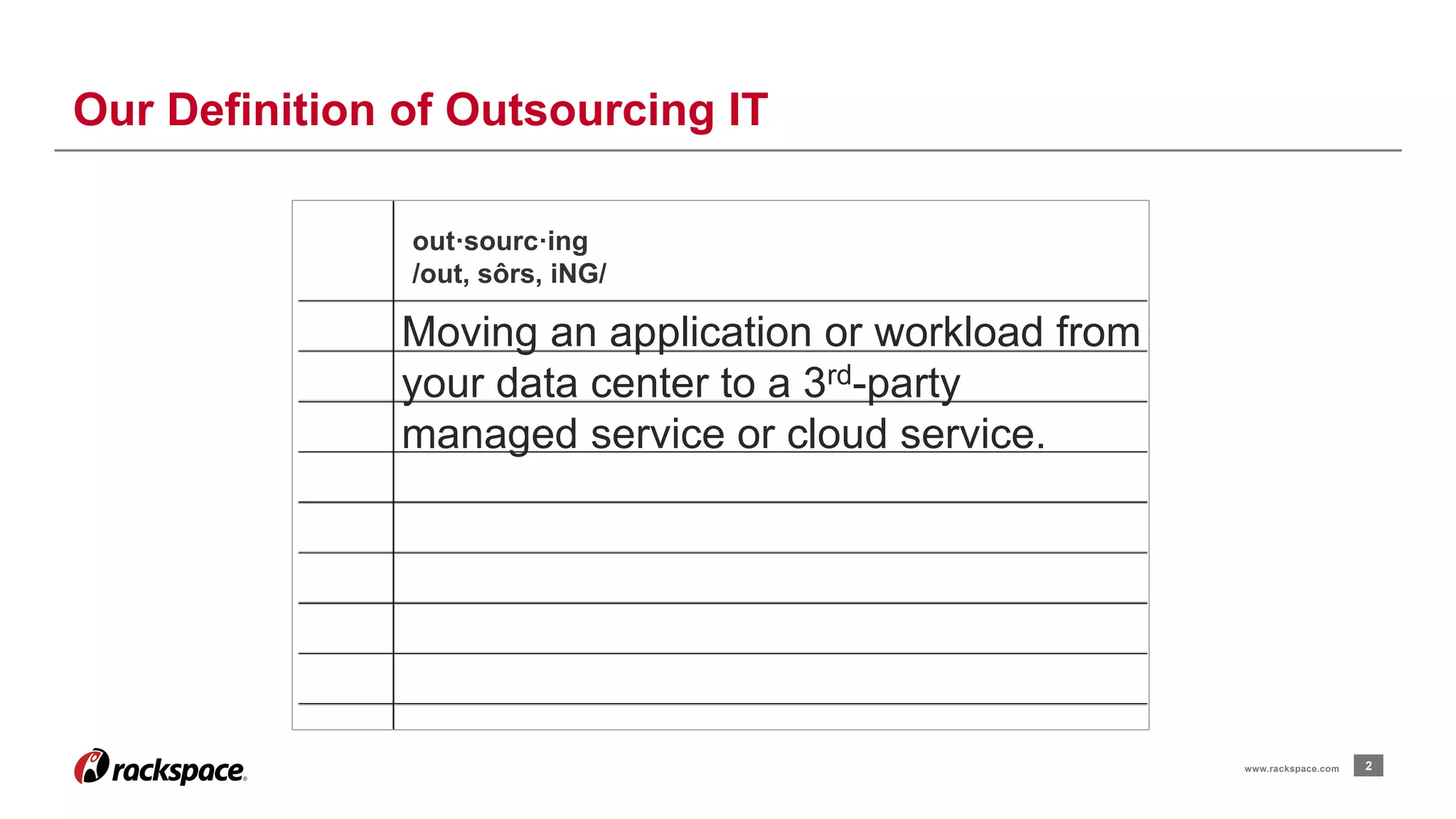
Moving an application or workload from 
your data center to a 3rd-party 
managed service or cloud service. 
www.rackspace.com 2 
out·sourc·ing 
/out, sôrs, iNG/
3 
Why Businesses Outsource IT 
www.rackspace.com 
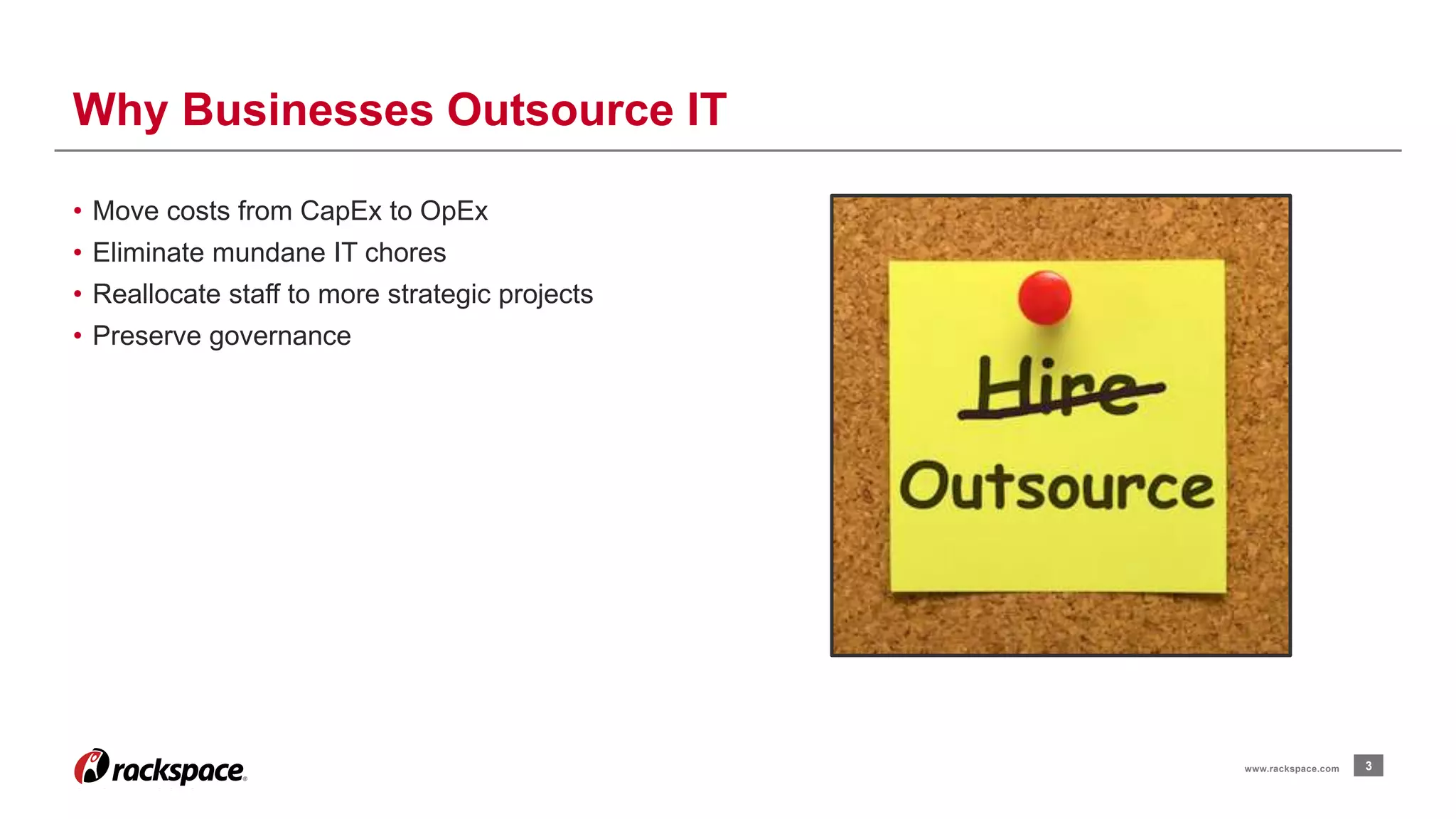
• Move costs from CapEx to OpEx 
• Eliminate mundane IT chores 
• Reallocate staff to more strategic projects 
• Preserve governance
What Factors Make Projects Successful? 
www.rackspace.com 4
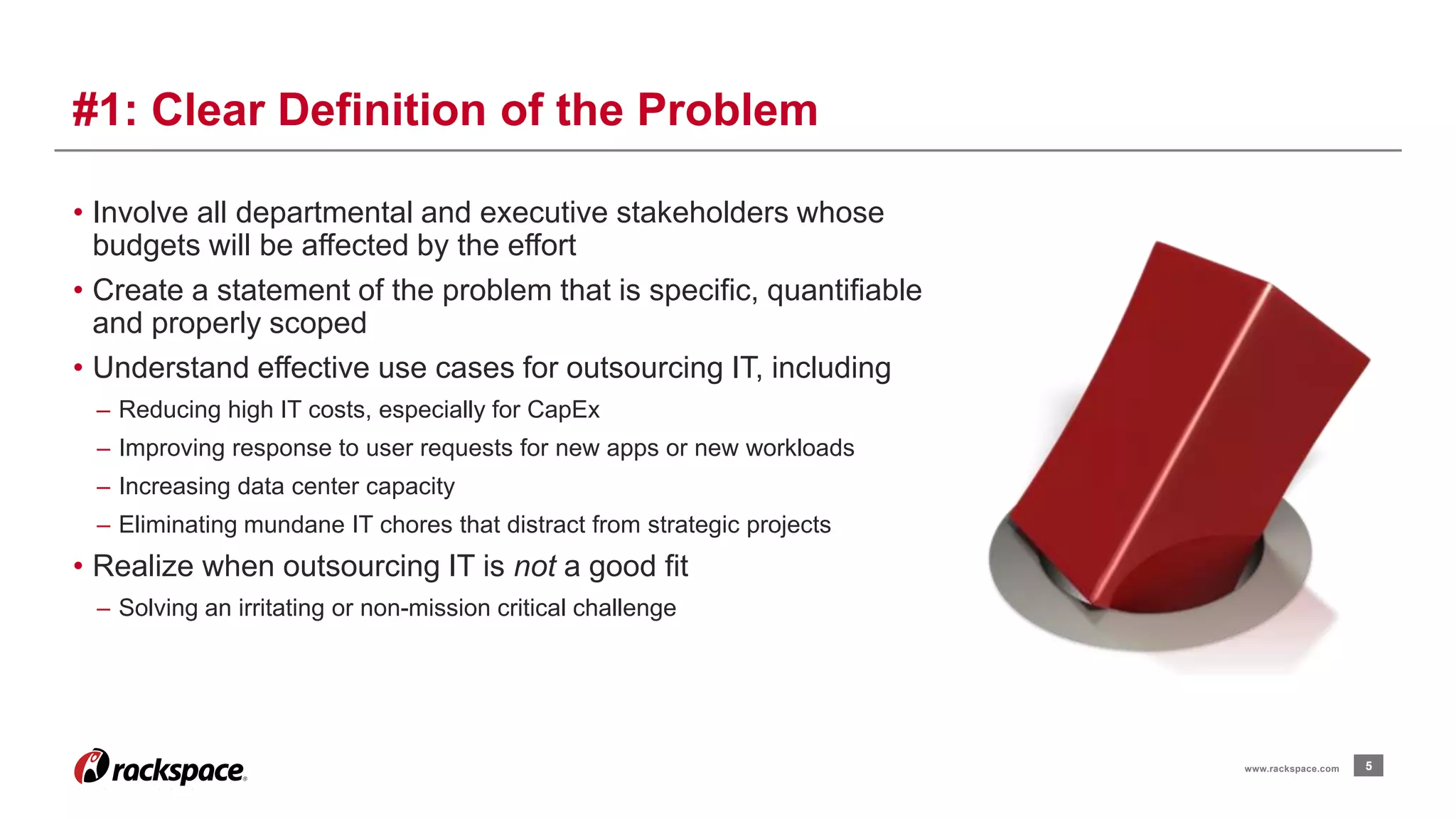
• Involve all departmental and executive stakeholders whose 
budgets will be affected by the effort 
• Create a statement of the problem that is specific, quantifiable 
and properly scoped 
• Understand effective use cases for outsourcing IT, including 
– Reducing high IT costs, especially for CapEx 
– Improving response to user requests for new apps or new workloads 
– Increasing data center capacity 
– Eliminating mundane IT chores that distract from strategic projects 
• Realize when outsourcing IT is not a good fit 
– Solving an irritating or non-mission critical challenge 
5 
#1: Clear Definition of the Problem 
www.rackspace.com
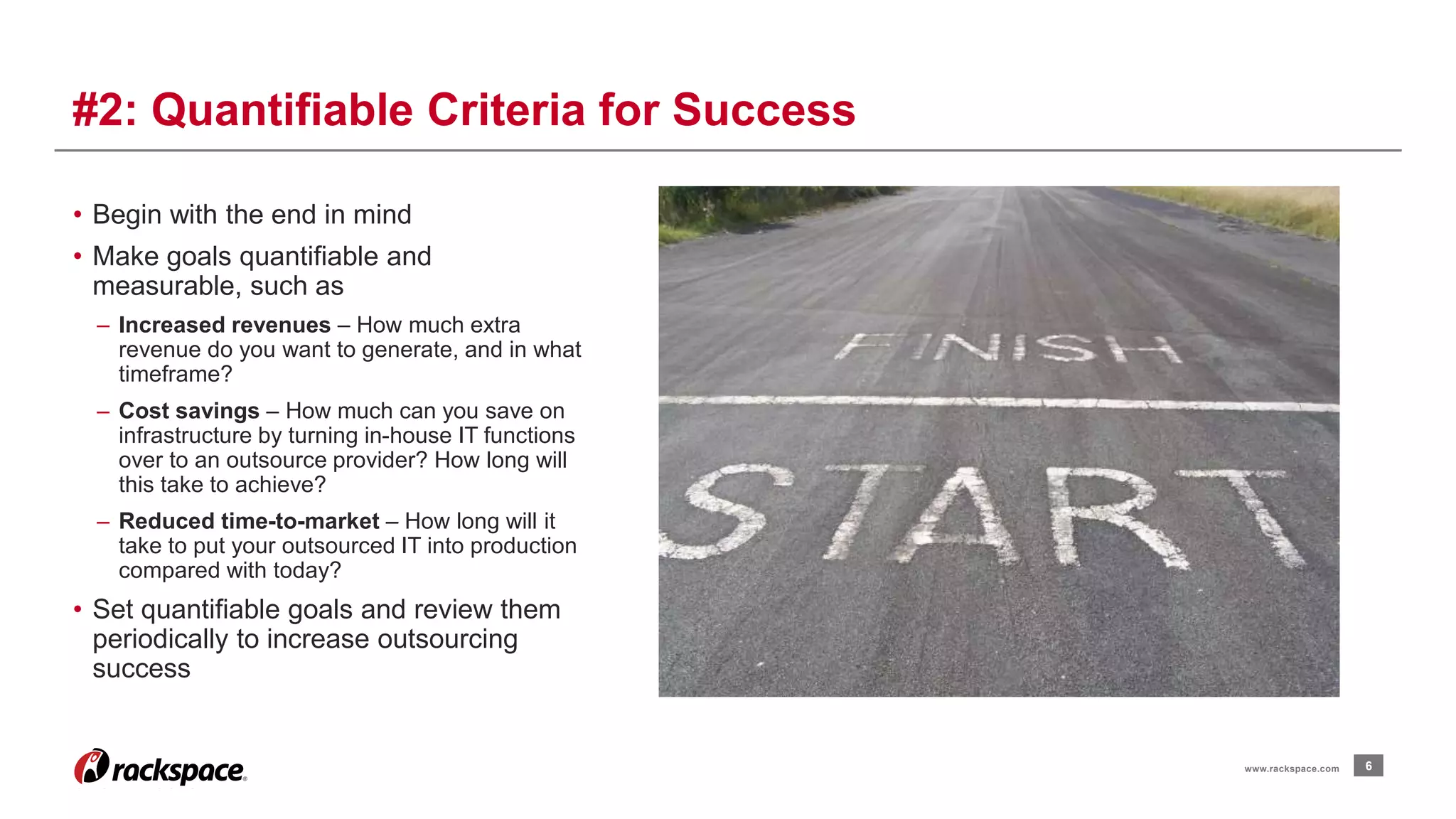
• Begin with the end in mind 
• Make goals quantifiable and 
measurable, such as 
– Increased revenues – How much extra 
revenue do you want to generate, and in what 
timeframe? 
– Cost savings – How much can you save on 
infrastructure by turning in-house IT functions 
over to an outsource provider? How long will 
this take to achieve? 
– Reduced time-to-market – How long will it 
take to put your outsourced IT into production 
compared with today? 
• Set quantifiable goals and review them 
periodically to increase outsourcing 
success 
6 
#2: Quantifiable Criteria for Success 
www.rackspace.com
“An engaged executive sponsor—with a vested 
business interest in the project from kickoff to close— 
can mean the difference between 
success and failure.” 
- Project Management Institute 
8 
www.rackspace.com
• An executive sponsor for an outsourcing project 
should have 
– Enough authority to see the project through 
– A vested interest in achieving the stated goals 
– Control of resources required for the project 
– A willingness to be actively involved, but comfortable 
delegating day-to-day authority to the project manager 
9 
#3: Appropriate Executive Sponsor 
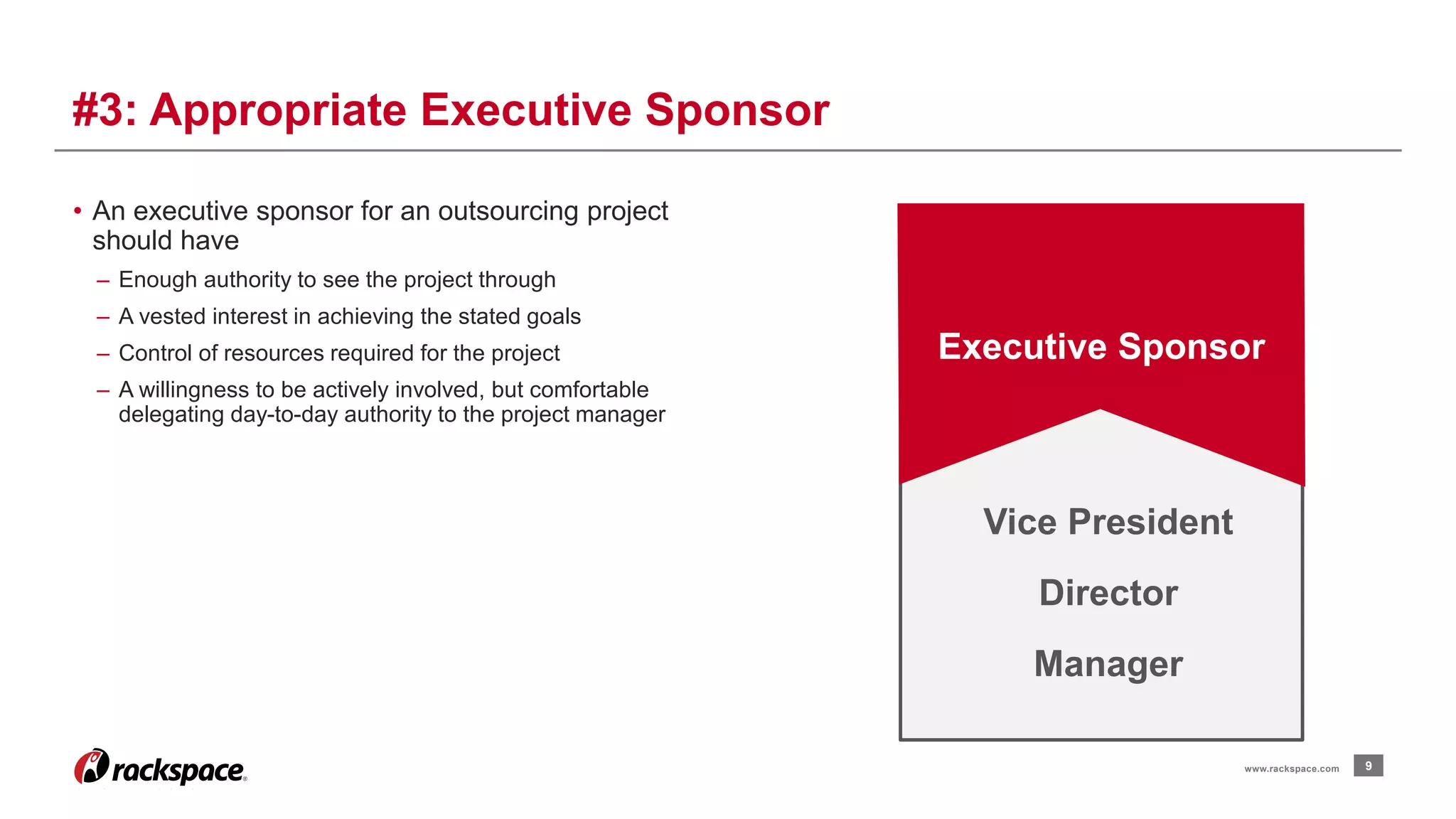
Executive Sponsor 
www.rackspace.com 
Vice President 
Director 
Manager
• Role 
– Add outsourced IT as a new project in the PM’s workload 
– Make PM final decision-maker and accountable for overall project success 
• Responsibilities 
– Serve as single point of contact for partner and internal resources 
– Oversee day-to-day decisions without constant approval from the executive sponsor 
10 
#4: Competent, Empowered Project Manager 
www.rackspace.com
“Every negative issue encountered boiled down to poor 
communication.” 
- Six managers who led 16 IT outsourcing projects over an eight-year 
period in a University of Portsmouth (UK) research study 
11 
Alessio Ishizaka and Rebecca Blakiston, “The 18C’s model for a 
successful long-term outsourcing arrangement”, Industrial Marketing 
Management, 41(7), 2012, pages 1071–1080, section 4.3.1 
www.rackspace.com
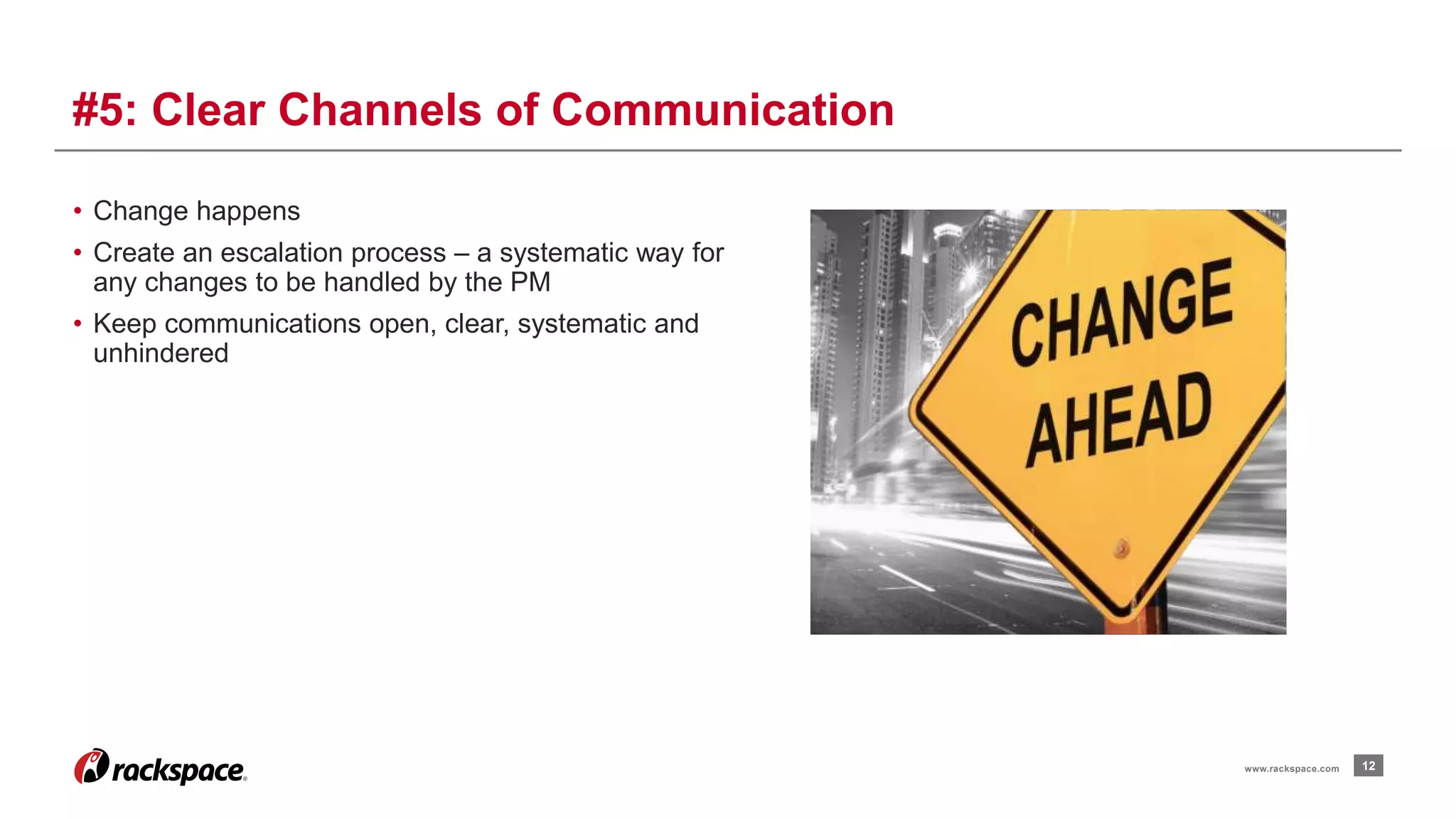
• Change happens 
• Create an escalation process – a systematic way for 
any changes to be handled by the PM 
• Keep communications open, clear, systematic and 
unhindered 
12 
#5: Clear Channels of Communication 
www.rackspace.com
• Identify clear phases 
• Organize the effort required during each stage 
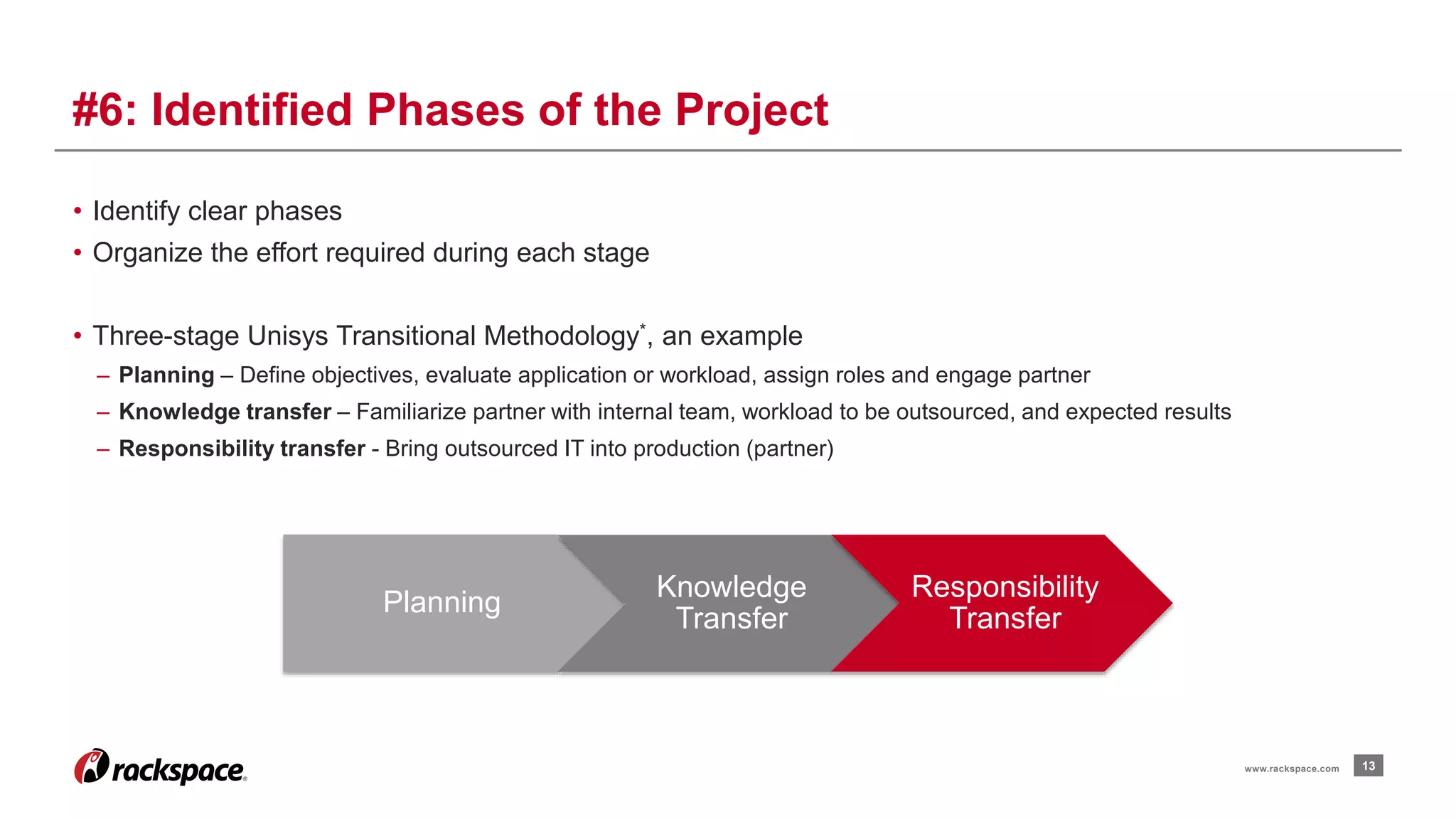
• Three-stage Unisys Transitional Methodology*, an example 
– Planning – Define objectives, evaluate application or workload, assign roles and engage partner 
– Knowledge transfer – Familiarize partner with internal team, workload to be outsourced, and expected results 
– Responsibility transfer - Bring outsourced IT into production (partner) 
13 
#6: Identified Phases of the Project 
www.rackspace.com 
Planning 
Knowledge 
Transfer 
Responsibility 
Transfer
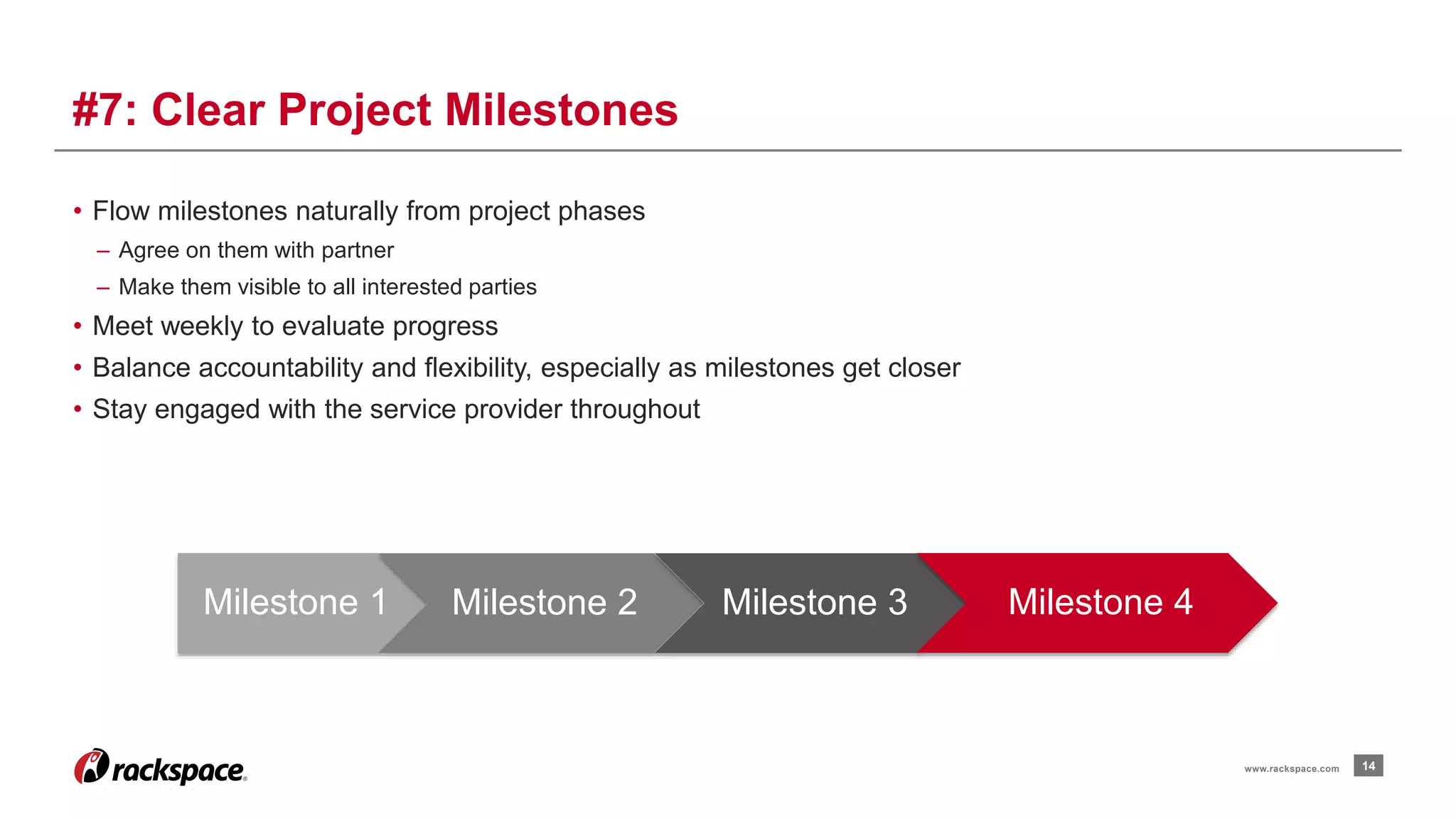
• Flow milestones naturally from project phases 
– Agree on them with partner 
– Make them visible to all interested parties 
• Meet weekly to evaluate progress 
• Balance accountability and flexibility, especially as milestones get closer 
• Stay engaged with the service provider throughout 
14 
#7: Clear Project Milestones 
www.rackspace.com 
Milestone 1 Milestone 2 Milestone 3 Milestone 4
• Listen to your outsourcing partner’s ideas 
– They know how to avoid issues that threaten success 
– They can suggest smart course corrections that save time or effort 
– They have experience on their side 
15 
#8: An Open Mind 
www.rackspace.com
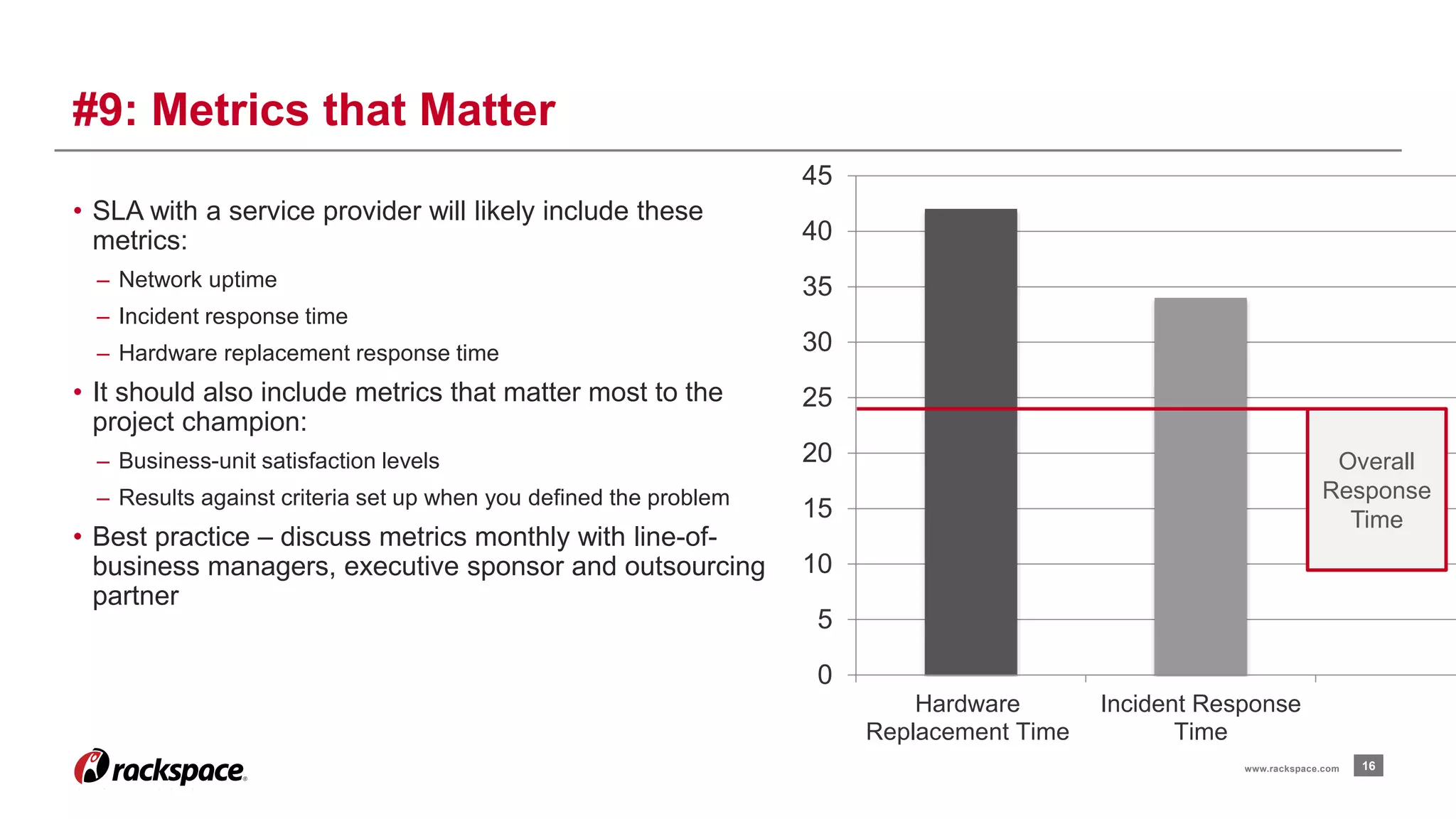
• SLA with a service provider will likely include these 
metrics: 
– Network uptime 
– Incident response time 
– Hardware replacement response time 
• It should also include metrics that matter most to the 
project champion: 
– Business-unit satisfaction levels 
– Results against criteria set up when you defined the problem 
• Best practice – discuss metrics monthly with line-of-business 
managers, executive sponsor and outsourcing 
partner 
16 
#9: Metrics that Matter 
www.rackspace.com 
45 
40 
35 
30 
25 
20 
15 
10 
5 
0 
Hardware 
Replacement Time 
Incident Response 
Time 
Overall 
Response 
Time
• Record the work the provider has done (or will do) and any 
issues encountered during implementation 
• Pay particular attention to transitions** 
– Asset ownership or transfer 
– Data protection and retention 
– Rights for departments or new contractors (e.g. gaining access to 
information, accounts, physical locations, etc.) 
– Labor termination and compensation 
• Create documentation templates to save time during future 
projects 
17 
#10: Adequate Documentation 
**Government of Hong Kong Efficiency Unit, “A General Guide to Outsourcing, March 2008, page 12, retrieved 21 May 2014 from www.rackspace.com 
http://www.eu.gov.hk/english/psi/psi_guides/psi_guides_ppgpop/files/guide_to_outsourcing_200803.pdf
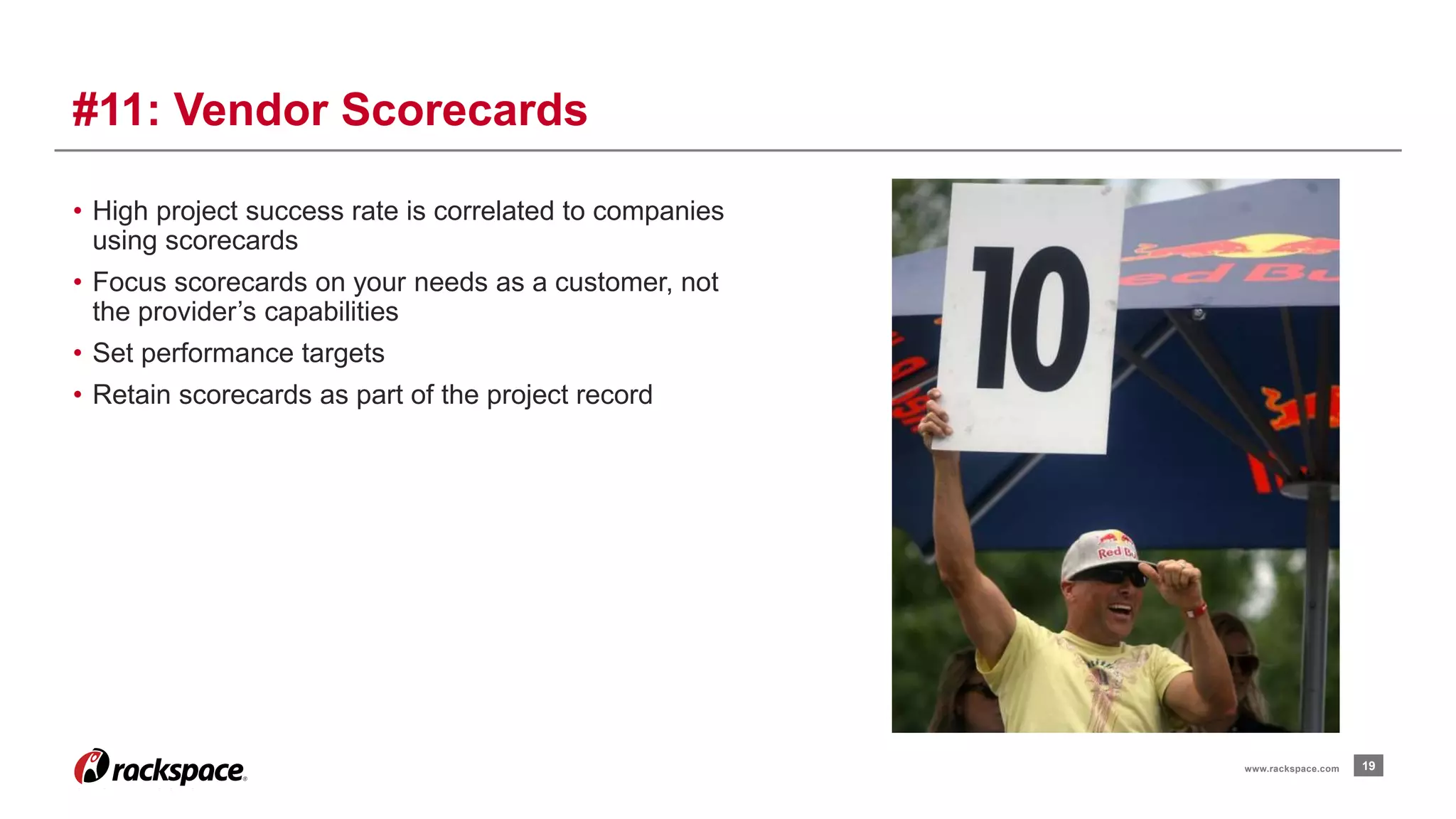
• High project success rate is correlated to companies 
using scorecards 
• Focus scorecards on your needs as a customer, not 
the provider’s capabilities 
• Set performance targets 
• Retain scorecards as part of the project record 
19 
#11: Vendor Scorecards 
www.rackspace.com
• Contract Management*** magazine suggests including: 
– System outages – The acceptable number of outages over a period of several months (“no more than two monthly outages 
in any given six-month timeframe”) 
– System interruptions – How long an interruption lasts (“no more than two interruptions of service lasting longer than 10 
minutes each between the hours of 8:00 AM to 5:00 PM weekdays”) 
– Time to resolution – How long it takes to fix any issues that require a skilled technician or developer (“95% of priority #1 
escalations will be fixed and deployed in no longer than 72 hours”) 
20 
What to Include in a Vendor Scorecard? 
www.rackspace.com
21 
#12: Scheduled Post-Mortem 
www.rackspace.com 
• Focus discussion on what happened, not on 
assigning blame 
• Cover issues such as 
– What worked well? 
– What didn’t work as well as it could have (or perhaps not at 
all)? 
– What painful processes could have been avoided? 
– What did you learn about working with this particular 
vendor? 
– What opportunities do you see to implement the successful 
points in future projects?
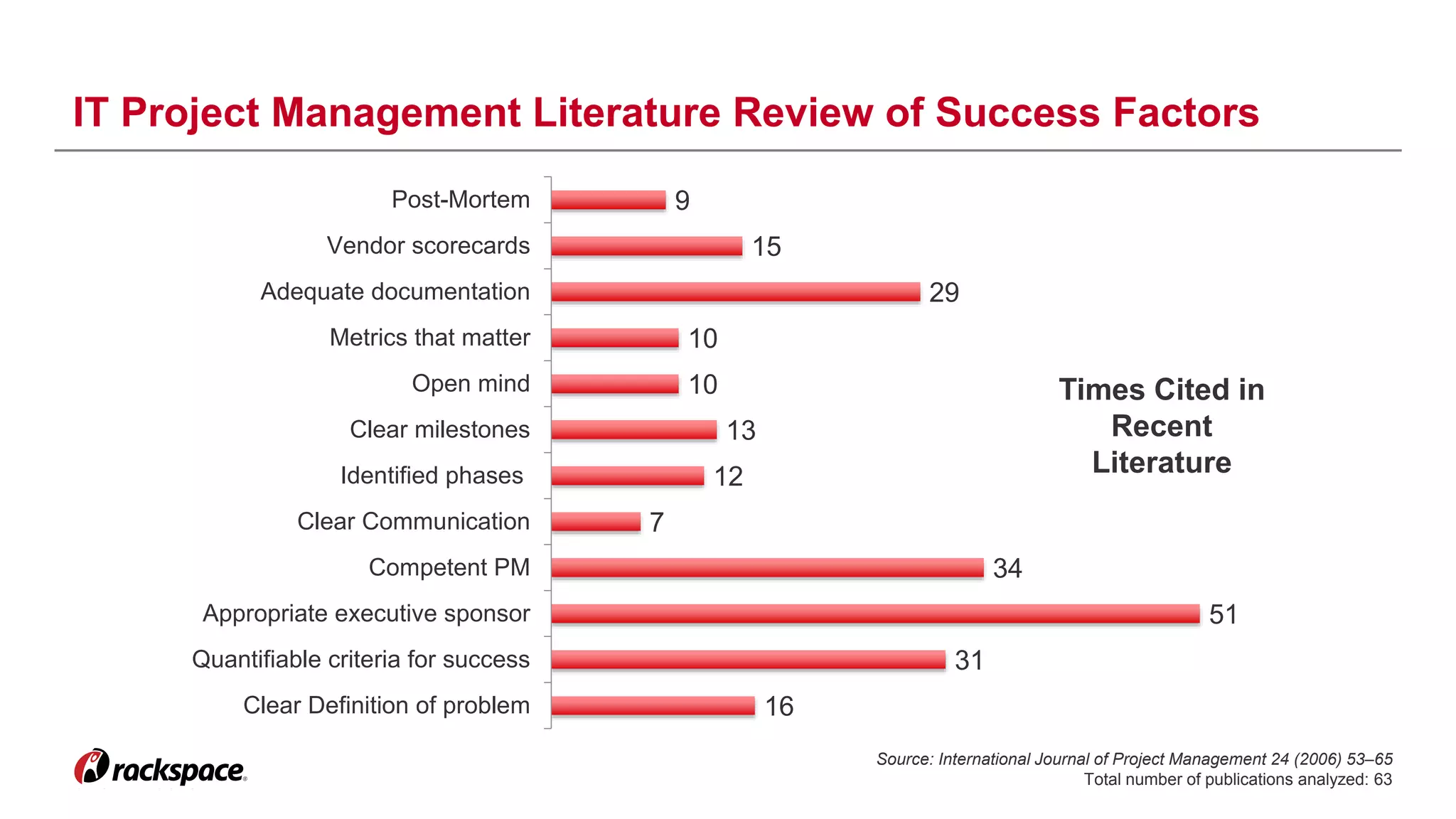
IT Project Management Literature Review of Success Factors 
Source: International Journal of Project Management 24 (2006) 53–65 
Total number of publications analyzed: 63 
16 
31 
51 
34 
7 
13 
10 
10 
12 
29 
15 
9 
Post-Mortem 
Vendor scorecards 
Adequate documentation 
Metrics that matter 
Open mind 
Clear milestones 
Identified phases 
Clear Communication 
Competent PM 
Appropriate executive sponsor 
Quantifiable criteria for success 
Clear Definition of problem 
Times Cited in 
Recent 
Literature
Need help outsourcing IT workloads? 
www.rackspace.com 23
24 
Next Steps... 
www.rackspace.com 
Rackspace consultants have years of experience 
helping businesses move applications and 
workloads off-premises. 
Contact Rackspace or read more at 
Outsourcing IT Projects to Managed Hosting or the Cloud – White Paper 
Call Rackspace at 800-961-2888 to talk to an expert.
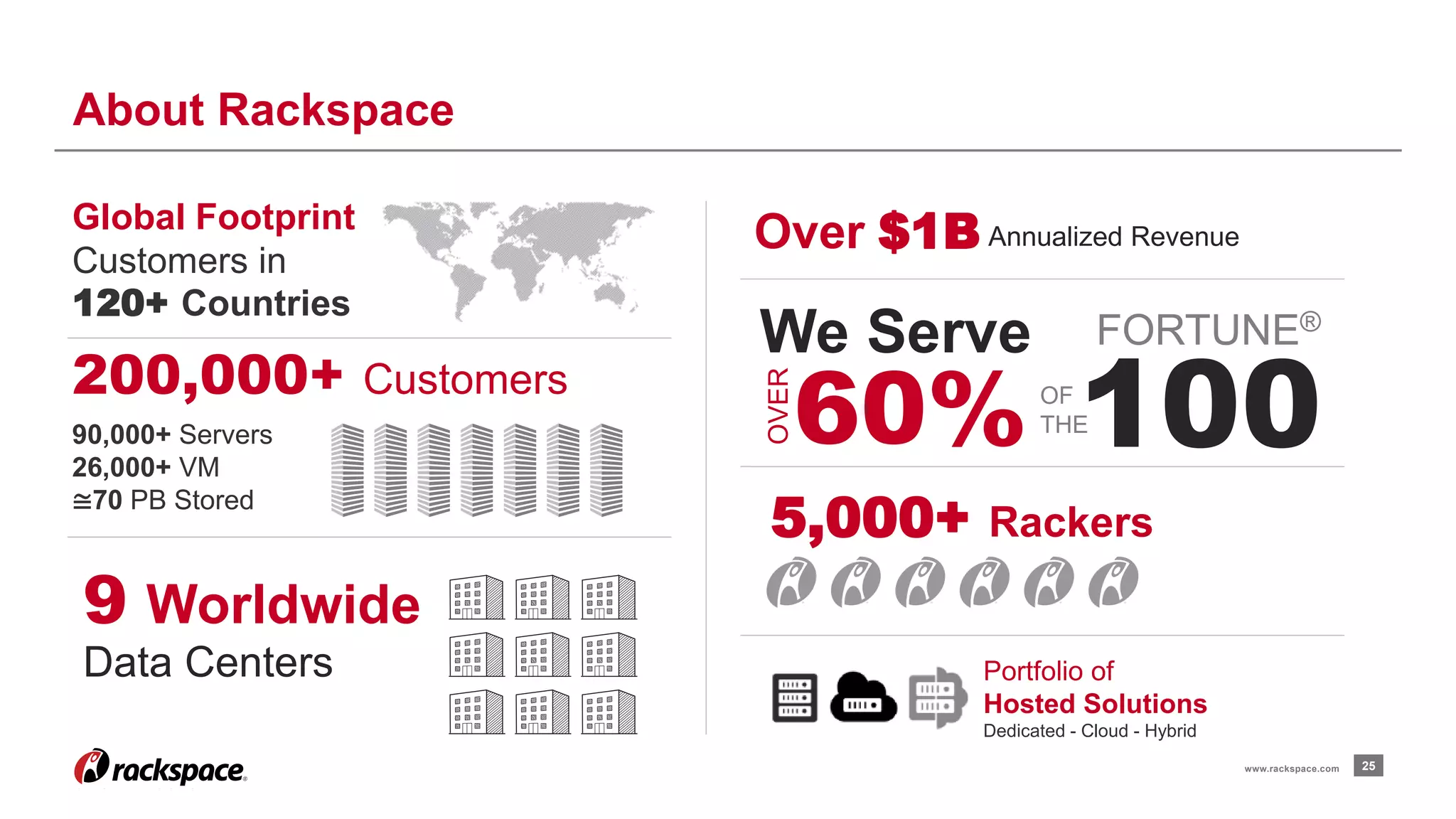
We Serve FORTUNE® 
60%OF100 
www.rackspace.com 25 
About Rackspace 
Global Footprint 
Customers in 
120+ Countries 
9 Worldwide 
Data Centers 
Over Annualized Revenue $1B 
THE 
5,000+ Rackers 
200,000+ Customers 
90,000+ Servers 
26,000+ VM 
≅70 PB Stored 
Portfolio of 
Hosted Solutions 
Dedicated - Cloud - Hybrid 
OVER
www.rackspace.com 26 
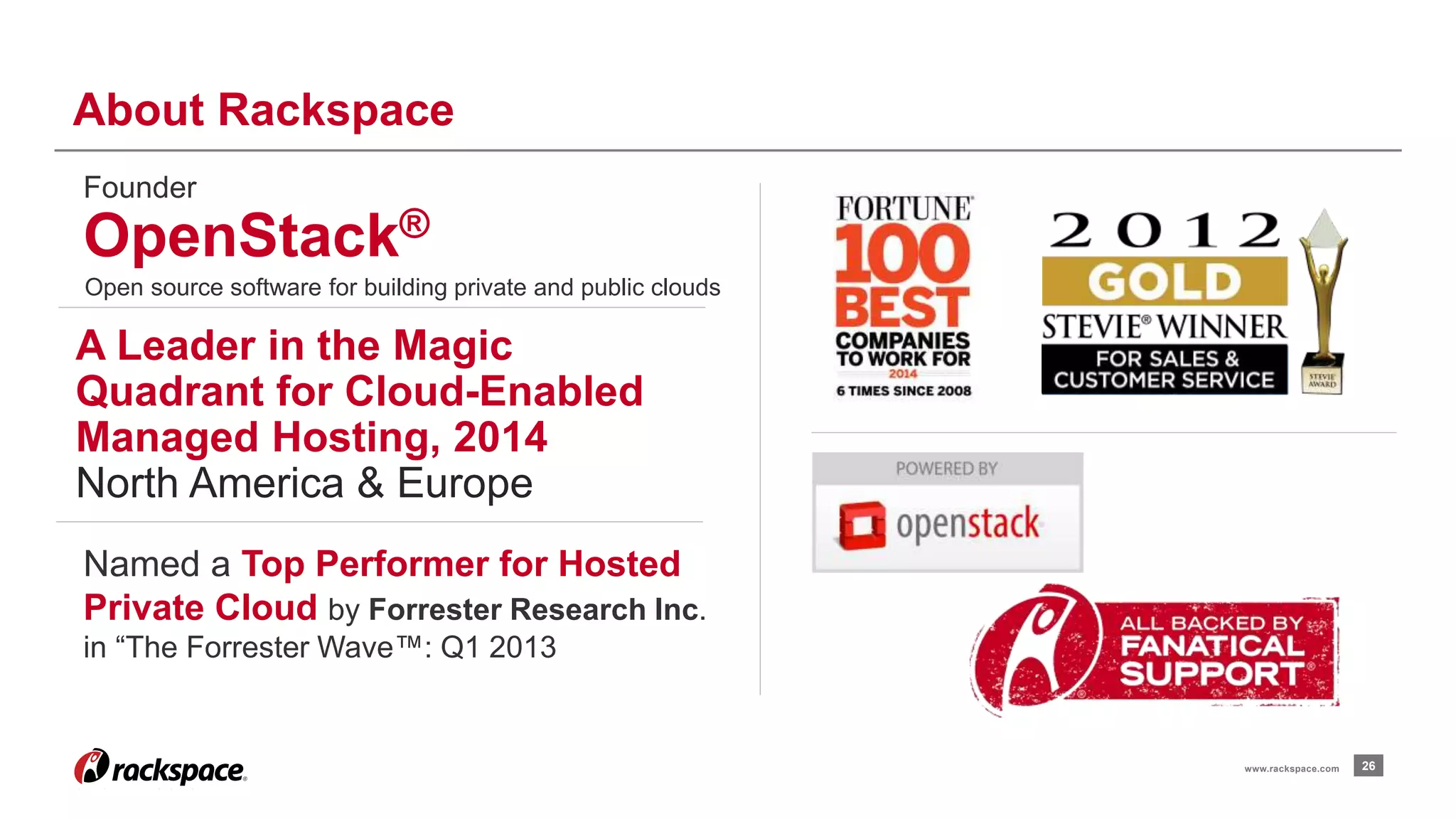
About Rackspace 
Founder 
OpenStack® 
Open source software for building private and public clouds 
A Leader in the Magic 
Quadrant for Cloud-Enabled 
Managed Hosting, 2014 
North America & Europe 
Named a Top Performer for Hosted 
Private Cloud by Forrester Research Inc. 
in “The Forrester Wave™: Q1 2013
THANK YOU 
RACKSPACE® | 1 FANATICAL PLACE, CITY OF WINDCREST | SAN ANTONIO, TX 78218 
US SALES: 1-800-961-2888 | US SUPPORT: 1-800-961-4454 | WWW.RACKSPACE.COM 
© RACKSPACE LTD. | RACKSPACE® AND FANATICAL SUPPORT® ARE SERVICE MARKS OF RACKSPACE US, INC. REGISTERED IN THE UNITED S TATES AND OTHER COUNTRIES. | WWW.RACKSPACE.COM

Outsourcing IT Projects to Managed Hosting of the Cloud

  • 1.
    Outsourcing IT Projectsto Managed Hosting or the Cloud 12 Critical Success Factors
  • 2.
    Our Definition ofOutsourcing IT Moving an application or workload from your data center to a 3rd-party managed service or cloud service. www.rackspace.com 2 out·sourc·ing /out, sôrs, iNG/
  • 3.
    3 Why BusinessesOutsource IT www.rackspace.com • Move costs from CapEx to OpEx • Eliminate mundane IT chores • Reallocate staff to more strategic projects • Preserve governance
  • 4.
    What Factors MakeProjects Successful? www.rackspace.com 4
  • 5.
    • Involve alldepartmental and executive stakeholders whose budgets will be affected by the effort • Create a statement of the problem that is specific, quantifiable and properly scoped • Understand effective use cases for outsourcing IT, including – Reducing high IT costs, especially for CapEx – Improving response to user requests for new apps or new workloads – Increasing data center capacity – Eliminating mundane IT chores that distract from strategic projects • Realize when outsourcing IT is not a good fit – Solving an irritating or non-mission critical challenge 5 #1: Clear Definition of the Problem www.rackspace.com
  • 6.
    • Begin withthe end in mind • Make goals quantifiable and measurable, such as – Increased revenues – How much extra revenue do you want to generate, and in what timeframe? – Cost savings – How much can you save on infrastructure by turning in-house IT functions over to an outsource provider? How long will this take to achieve? – Reduced time-to-market – How long will it take to put your outsourced IT into production compared with today? • Set quantifiable goals and review them periodically to increase outsourcing success 6 #2: Quantifiable Criteria for Success www.rackspace.com
  • 7.
    “An engaged executivesponsor—with a vested business interest in the project from kickoff to close— can mean the difference between success and failure.” - Project Management Institute 8 www.rackspace.com
  • 8.
    • An executivesponsor for an outsourcing project should have – Enough authority to see the project through – A vested interest in achieving the stated goals – Control of resources required for the project – A willingness to be actively involved, but comfortable delegating day-to-day authority to the project manager 9 #3: Appropriate Executive Sponsor Executive Sponsor www.rackspace.com Vice President Director Manager
  • 9.
    • Role –Add outsourced IT as a new project in the PM’s workload – Make PM final decision-maker and accountable for overall project success • Responsibilities – Serve as single point of contact for partner and internal resources – Oversee day-to-day decisions without constant approval from the executive sponsor 10 #4: Competent, Empowered Project Manager www.rackspace.com
  • 10.
    “Every negative issueencountered boiled down to poor communication.” - Six managers who led 16 IT outsourcing projects over an eight-year period in a University of Portsmouth (UK) research study 11 Alessio Ishizaka and Rebecca Blakiston, “The 18C’s model for a successful long-term outsourcing arrangement”, Industrial Marketing Management, 41(7), 2012, pages 1071–1080, section 4.3.1 www.rackspace.com
  • 11.
    • Change happens • Create an escalation process – a systematic way for any changes to be handled by the PM • Keep communications open, clear, systematic and unhindered 12 #5: Clear Channels of Communication www.rackspace.com
  • 12.
    • Identify clearphases • Organize the effort required during each stage • Three-stage Unisys Transitional Methodology*, an example – Planning – Define objectives, evaluate application or workload, assign roles and engage partner – Knowledge transfer – Familiarize partner with internal team, workload to be outsourced, and expected results – Responsibility transfer - Bring outsourced IT into production (partner) 13 #6: Identified Phases of the Project www.rackspace.com Planning Knowledge Transfer Responsibility Transfer
  • 13.
    • Flow milestonesnaturally from project phases – Agree on them with partner – Make them visible to all interested parties • Meet weekly to evaluate progress • Balance accountability and flexibility, especially as milestones get closer • Stay engaged with the service provider throughout 14 #7: Clear Project Milestones www.rackspace.com Milestone 1 Milestone 2 Milestone 3 Milestone 4
  • 14.
    • Listen toyour outsourcing partner’s ideas – They know how to avoid issues that threaten success – They can suggest smart course corrections that save time or effort – They have experience on their side 15 #8: An Open Mind www.rackspace.com
  • 15.
    • SLA witha service provider will likely include these metrics: – Network uptime – Incident response time – Hardware replacement response time • It should also include metrics that matter most to the project champion: – Business-unit satisfaction levels – Results against criteria set up when you defined the problem • Best practice – discuss metrics monthly with line-of-business managers, executive sponsor and outsourcing partner 16 #9: Metrics that Matter www.rackspace.com 45 40 35 30 25 20 15 10 5 0 Hardware Replacement Time Incident Response Time Overall Response Time
  • 16.
    • Record thework the provider has done (or will do) and any issues encountered during implementation • Pay particular attention to transitions** – Asset ownership or transfer – Data protection and retention – Rights for departments or new contractors (e.g. gaining access to information, accounts, physical locations, etc.) – Labor termination and compensation • Create documentation templates to save time during future projects 17 #10: Adequate Documentation **Government of Hong Kong Efficiency Unit, “A General Guide to Outsourcing, March 2008, page 12, retrieved 21 May 2014 from www.rackspace.com http://www.eu.gov.hk/english/psi/psi_guides/psi_guides_ppgpop/files/guide_to_outsourcing_200803.pdf
  • 17.
    • High projectsuccess rate is correlated to companies using scorecards • Focus scorecards on your needs as a customer, not the provider’s capabilities • Set performance targets • Retain scorecards as part of the project record 19 #11: Vendor Scorecards www.rackspace.com
  • 18.
    • Contract Management***magazine suggests including: – System outages – The acceptable number of outages over a period of several months (“no more than two monthly outages in any given six-month timeframe”) – System interruptions – How long an interruption lasts (“no more than two interruptions of service lasting longer than 10 minutes each between the hours of 8:00 AM to 5:00 PM weekdays”) – Time to resolution – How long it takes to fix any issues that require a skilled technician or developer (“95% of priority #1 escalations will be fixed and deployed in no longer than 72 hours”) 20 What to Include in a Vendor Scorecard? www.rackspace.com
  • 19.
    21 #12: ScheduledPost-Mortem www.rackspace.com • Focus discussion on what happened, not on assigning blame • Cover issues such as – What worked well? – What didn’t work as well as it could have (or perhaps not at all)? – What painful processes could have been avoided? – What did you learn about working with this particular vendor? – What opportunities do you see to implement the successful points in future projects?
  • 20.
    IT Project ManagementLiterature Review of Success Factors Source: International Journal of Project Management 24 (2006) 53–65 Total number of publications analyzed: 63 16 31 51 34 7 13 10 10 12 29 15 9 Post-Mortem Vendor scorecards Adequate documentation Metrics that matter Open mind Clear milestones Identified phases Clear Communication Competent PM Appropriate executive sponsor Quantifiable criteria for success Clear Definition of problem Times Cited in Recent Literature
  • 21.
    Need help outsourcingIT workloads? www.rackspace.com 23
  • 22.
    24 Next Steps... www.rackspace.com Rackspace consultants have years of experience helping businesses move applications and workloads off-premises. Contact Rackspace or read more at Outsourcing IT Projects to Managed Hosting or the Cloud – White Paper Call Rackspace at 800-961-2888 to talk to an expert.
  • 23.
    We Serve FORTUNE® 60%OF100 www.rackspace.com 25 About Rackspace Global Footprint Customers in 120+ Countries 9 Worldwide Data Centers Over Annualized Revenue $1B THE 5,000+ Rackers 200,000+ Customers 90,000+ Servers 26,000+ VM ≅70 PB Stored Portfolio of Hosted Solutions Dedicated - Cloud - Hybrid OVER
  • 24.
    www.rackspace.com 26 AboutRackspace Founder OpenStack® Open source software for building private and public clouds A Leader in the Magic Quadrant for Cloud-Enabled Managed Hosting, 2014 North America & Europe Named a Top Performer for Hosted Private Cloud by Forrester Research Inc. in “The Forrester Wave™: Q1 2013
  • 25.
    THANK YOU RACKSPACE®| 1 FANATICAL PLACE, CITY OF WINDCREST | SAN ANTONIO, TX 78218 US SALES: 1-800-961-2888 | US SUPPORT: 1-800-961-4454 | WWW.RACKSPACE.COM © RACKSPACE LTD. | RACKSPACE® AND FANATICAL SUPPORT® ARE SERVICE MARKS OF RACKSPACE US, INC. REGISTERED IN THE UNITED S TATES AND OTHER COUNTRIES. | WWW.RACKSPACE.COM