Exploring Identity Culture and Socialisation:
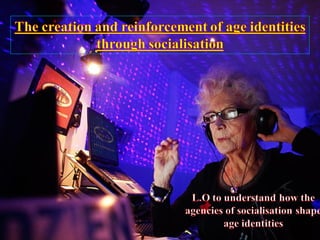
     The Formation of Age Identities
Identity, Socialisation, Culture: Age


• L.O to understand the idea that age is a
  social construction.
• To understand the different ways of
  understanding age
• To evaluate ways of understanding age
Youth


• What is youth?
• How much power
  and status do youths
  have in society?
• How are youths
  portrayed by the
  media?
• When does it begin?
• When does it end?
Youth

 The experience of youth differs depending on
  class, gender and ethnicity.
 Clarke (1976) – youth is based around the
  concepts of rebellion and resistance. This could be
  resisting the norm or rebelling against a relatively
  low status position.
 E.g. how the youth of the 1960s protested against
  the Vietnam war and racism in the USA.
 Subcultural groups such as Chavs are often used
  by the media to represent youth in contemporary
  UK – is this a true representation of youth identity
  today?
Middle Age


What is middle age?
When does it begin?
When does it end?
Is it a good or a bad time in a person’s life?
Explain your answers
Old Age

1.   List 10 words you would instantly associate with the term
     ‘elderly’
2.   Compare your words to person sat next to you and highlight
     any similarities
3.   Highlight words that appear positive and those that have
     negative connotations
4.   Listen to the song ‘My generation’ by The Who. What
     message does this give about old age
5.   Watch the video by The Zimmers and write down ways in
     which this reflects a changing view of the elderly
Age and the Family

• According to Jenks (1996) “childhood is not
  a natural but a social construct”, Therefore
  our idea of childhood is socially constructed
• Functionalists see that the move towards a
  child centred society is a positive step
• Feminists such as Firestone argue that the care
  and protection offered in this society is
  actually oppression and control
• For example protection from paid work is not
  seen as liberating, but as restrictive and as
  creating inequalities between children and
  adults
The views of childhood
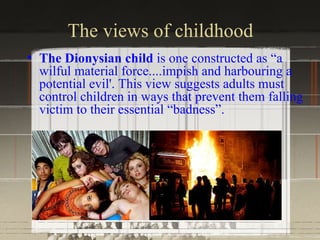
• The Dionysian child is one constructed as “a
  wilful material force....impish and harbouring a
  potential evil'. This view suggests adults must
  control children in ways that prevent them falling
  victim to their essential “badness”.
The Apollonian child

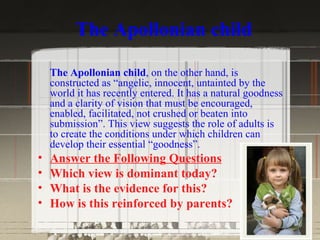
    The Apollonian child, on the other hand, is
    constructed as “angelic, innocent, untainted by the
    world it has recently entered. It has a natural goodness
    and a clarity of vision that must be encouraged,
    enabled, facilitated, not crushed or beaten into
    submission”. This view suggests the role of adults is
    to create the conditions under which children can
    develop their essential “goodness”.
•   Answer the Following Questions
•   Which view is dominant today?
•   What is the evidence for this?
•   How is this reinforced by parents?
Age and the Media
Cohen                          Santog
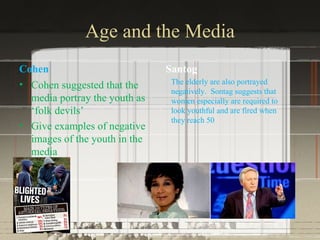
• Cohen suggested that the      The elderly are also portrayed
                                negatively. Sontag suggests that
  media portray the youth as    women especially are required to
  ‘folk devils’                 look youthful and are fired when
                                they reach 50
• Give examples of negative
  images of the youth in the
  media
Identity, Socialisation, Culture: Age


• To understand the impact of religion and
  the workplace on age identities
Age and Religion

• List reasons why the young are less
  likely to believe and practice religion.

• List reasons why the elderly are more
  likely to attend a religious orgainsation
Religion and Age

•   Paul Heelas’ sought to explain differences in religious
    participation between different age groups
•   He found that 73% of those active in the holistic milieu of
    Kendal are aged 45 and over
•   25% of adults aged 30-39 have downshifted over the last 10
    years
•   People in their forties and forties do this to spend time with their
    children
•   25% of over fifties stated that they do this because they are
    seeking a healthier lifestyle
•   They want to stay younger for longer
•   They are more likely to have affected by health problems
•   An awareness of the limits of life; feeling of “time running out”
The Workplace

• Why do young people suffer from high
  rates of unemployment?
• Why do young people earn mostly low
  wages?
The Workplace
The Young
The young are also disadvantaged in contemporary society.
The government has estimated that 5 million children in the UK live
in poverty and many young people of working age are disadvantaged
by low wages, student loans and ineligibility for state benefits.

Most young workers earn minimum wage, 235,000 18 – 20 year olds.

More than 2/3rds of Mcdonalds’ staff are under 20. Nearly 2 million
16 – 24 year olds in full time education are also in paid employment.
2/3rds of Pizza Hut’s crews and 1/5th of Sainsbury’s store staff are
included in this figure.

In 2001, the unemployment rate for those under 25 was over 20%
and some groups of young people face greater disadvantage because
of their social characteristics.
• Describe what is meant by age
  discrimination?
• What are the most significant figures to
  illustrate age discrimination?
• What research methods would you use
  measure age discrimination? (what
  problems would you have?)
• What would a society without age
  discrimination look like?

SociologyExchange.co.uk Shared Resource

  • 1.
    Exploring Identity Cultureand Socialisation: The Formation of Age Identities
  • 2.
    Identity, Socialisation, Culture:Age • L.O to understand the idea that age is a social construction. • To understand the different ways of understanding age • To evaluate ways of understanding age
  • 3.
    Youth • What isyouth? • How much power and status do youths have in society? • How are youths portrayed by the media? • When does it begin? • When does it end?
  • 4.
    Youth  The experienceof youth differs depending on class, gender and ethnicity.  Clarke (1976) – youth is based around the concepts of rebellion and resistance. This could be resisting the norm or rebelling against a relatively low status position.  E.g. how the youth of the 1960s protested against the Vietnam war and racism in the USA.  Subcultural groups such as Chavs are often used by the media to represent youth in contemporary UK – is this a true representation of youth identity today?
  • 5.
    Middle Age What ismiddle age? When does it begin? When does it end? Is it a good or a bad time in a person’s life? Explain your answers
  • 6.
    Old Age 1. List 10 words you would instantly associate with the term ‘elderly’ 2. Compare your words to person sat next to you and highlight any similarities 3. Highlight words that appear positive and those that have negative connotations 4. Listen to the song ‘My generation’ by The Who. What message does this give about old age 5. Watch the video by The Zimmers and write down ways in which this reflects a changing view of the elderly
  • 8.
    Age and theFamily • According to Jenks (1996) “childhood is not a natural but a social construct”, Therefore our idea of childhood is socially constructed • Functionalists see that the move towards a child centred society is a positive step • Feminists such as Firestone argue that the care and protection offered in this society is actually oppression and control • For example protection from paid work is not seen as liberating, but as restrictive and as creating inequalities between children and adults
  • 9.
    The views ofchildhood • The Dionysian child is one constructed as “a wilful material force....impish and harbouring a potential evil'. This view suggests adults must control children in ways that prevent them falling victim to their essential “badness”.
  • 10.
    The Apollonian child The Apollonian child, on the other hand, is constructed as “angelic, innocent, untainted by the world it has recently entered. It has a natural goodness and a clarity of vision that must be encouraged, enabled, facilitated, not crushed or beaten into submission”. This view suggests the role of adults is to create the conditions under which children can develop their essential “goodness”. • Answer the Following Questions • Which view is dominant today? • What is the evidence for this? • How is this reinforced by parents?
  • 11.
    Age and theMedia Cohen Santog • Cohen suggested that the The elderly are also portrayed negatively. Sontag suggests that media portray the youth as women especially are required to ‘folk devils’ look youthful and are fired when they reach 50 • Give examples of negative images of the youth in the media
  • 12.
    Identity, Socialisation, Culture:Age • To understand the impact of religion and the workplace on age identities
  • 13.
    Age and Religion •List reasons why the young are less likely to believe and practice religion. • List reasons why the elderly are more likely to attend a religious orgainsation
  • 14.
    Religion and Age • Paul Heelas’ sought to explain differences in religious participation between different age groups • He found that 73% of those active in the holistic milieu of Kendal are aged 45 and over • 25% of adults aged 30-39 have downshifted over the last 10 years • People in their forties and forties do this to spend time with their children • 25% of over fifties stated that they do this because they are seeking a healthier lifestyle • They want to stay younger for longer • They are more likely to have affected by health problems • An awareness of the limits of life; feeling of “time running out”
  • 15.
    The Workplace • Whydo young people suffer from high rates of unemployment? • Why do young people earn mostly low wages?
  • 16.
    The Workplace The Young Theyoung are also disadvantaged in contemporary society. The government has estimated that 5 million children in the UK live in poverty and many young people of working age are disadvantaged by low wages, student loans and ineligibility for state benefits. Most young workers earn minimum wage, 235,000 18 – 20 year olds. More than 2/3rds of Mcdonalds’ staff are under 20. Nearly 2 million 16 – 24 year olds in full time education are also in paid employment. 2/3rds of Pizza Hut’s crews and 1/5th of Sainsbury’s store staff are included in this figure. In 2001, the unemployment rate for those under 25 was over 20% and some groups of young people face greater disadvantage because of their social characteristics.
  • 18.
    • Describe whatis meant by age discrimination? • What are the most significant figures to illustrate age discrimination? • What research methods would you use measure age discrimination? (what problems would you have?) • What would a society without age discrimination look like?

Editor's Notes

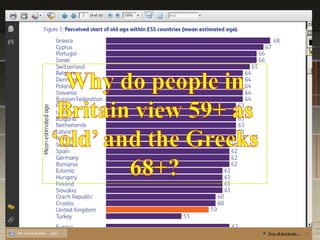
  • #18 Link this to discrimination in the workplace.; Why do people in Britain view 59+ as ‘old’ and the Greeks 68?