Anthropological and
Sociological
Perspectives on
Culture and
Society
OBJECTIVES:
1. Know the anthropological and sociological perspective
on culture and society.
2. Determined the different Perspective on culture, Aspects
of culture, types of culture, elements of culture and
theoretical perspective on society.
3. Appreciate the importance of studying Anthropological
and Sociological perspective on culture and society.
Perspectives on Culture
 Culture is generic term yet very difficult to define. Aside
from the famous definition of Tylor on culture, scholars
and social scientists vary different perspective on how to
properly define it. Also, because of its wider scope and it
encompasses everything of man, experts from several
field find it complicated to boxed culture into one
universal terminology. Spencer-Oatey (2012, p.2)
compiled perspectives from scholars about culture.
 Matthew Arnold in his Culture and Anarchy (1867)
mentioned that culture or high culture as opposed to popular
culture (or folkways in an earlier usage) is a product of a
special intellectual or artistic endeavor humans had invented.
 Kroeber & Kluckhohn (1952) defined that culture is
composed of behavior (explicit and implicit) acquired and
transmitted through symbols. It is a human group that
includes their distinctive achievements and embodiment in
artifacts, traditional and historical ideas, and formation of
values. They added that culture systems can be considered as
a product of action from conditional elements of a society
 Lastly, Schwartz (1992) stated that culture consists of
experiences that are organized, learned or created by the
individuals of a population, including those images and
images adding up their unique interpretations transmitted
from the past generations up to the future.
 With the complexities of culture, these are some important
aspects of culture that enhance the progress of human interaction
and socialization.
Dynamic - Culture changes constantly throughout the time. It varies
Flexible, & on the societal structure and the capacities of its
members to respond.
Adaptive - Culture through its elements is enjoyed by group of
people Shared & who lived together. It also allows its members to
predict the behavior of other members but it is no assurance that
they will think and act similarly.
Aspects of Culture
Enculturation– The process by which an individual learns the
traditional content of a culture and assimilates its practices
values.
Acculturation – Cultural modification of an individual, group,
or people by adapting to or borrowing traits from another
culture.
Assimilation – To adopt the ways of another culture: to fully
become part of a different society, country, etc.
Learned - Culture is learned with practice through continued
through process. It is a lifelong process in which social
interaction socialization or plays a vital role.
Enculturation Patterned social – Social interaction is the
process by which people act and react in relation to others
- Human beings rely on social structure to make sense of
everyday life.
Interactions – It is an interactive process between two or more
partners.
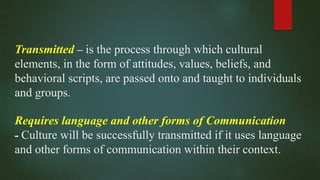
Transmitted – is the process through which cultural
elements, in the form of attitudes, values, beliefs, and
behavioral scripts, are passed onto and taught to individuals
and groups.
Requires language and other forms of Communication
- Culture will be successfully transmitted if it uses language
and other forms of communication within their context.
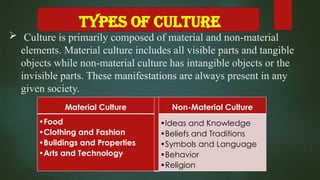
Types of culture
 Culture is primarily composed of material and non-material
elements. Material culture includes all visible parts and tangible
objects while non-material culture has intangible objects or the
invisible parts. These manifestations are always present in any
given society.
Material Culture Non-Material Culture
•Food
•Clothing and Fashion
•Buildings and Properties
•Arts and Technology
•Ideas and Knowledge
•Beliefs and Traditions
•Symbols and Language
•Behavior
•Religion
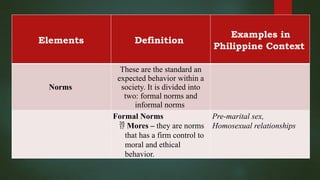
Elements Definition
Examples in
Philippine Context
Norms
These are the standard an
expected behavior within a
society. It is divided into
two: formal norms and
informal norms
Formal Norms
 Mores – they are norms
that has a firm control to
moral and ethical
behavior.
Pre-marital sex,
Homosexual relationships
Elements Definition
Examples in
Philippine Context
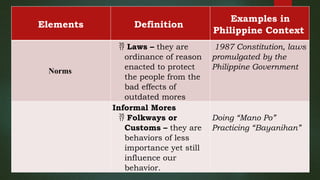
Norms
 Laws – they are
ordinance of reason
enacted to protect
the people from the
bad effects of
outdated mores
1987 Constitution, laws
promulgated by the
Philippine Government
Informal Mores
 Folkways or
Customs – they are
behaviors of less
importance yet still
influence our
behavior.
Doing “Mano Po”
Practicing “Bayanihan”
Elements Definition
Examples in
Philippine Context
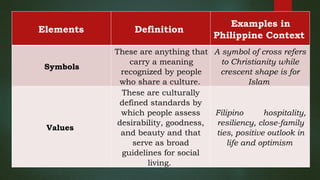
Symbols
These are anything that
carry a meaning
recognized by people
who share a culture.
A symbol of cross refers
to Christianity while
crescent shape is for
Islam
Values
These are culturally
defined standards by
which people assess
desirability, goodness,
and beauty and that
serve as broad
guidelines for social
living.
Filipino hospitality,
resiliency, close-family
ties, positive outlook in
life and optimism
Elements Definition
Examples in
Philippine Context
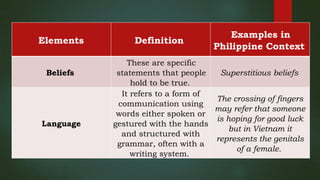
Beliefs
These are specific
statements that people
hold to be true.
Superstitious beliefs
Language
It refers to a form of
communication using
words either spoken or
gestured with the hands
and structured with
grammar, often with a
writing system.
The crossing of fingers
may refer that someone
is hoping for good luck
but in Vietnam it
represents the genitals
of a female.
Elements Definition
Examples in
Philippine Context
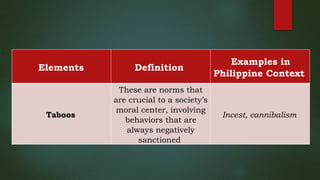
Taboos
These are norms that
are crucial to a society’s
moral center, involving
behaviors that are
always negatively
sanctioned
Incest, cannibalism
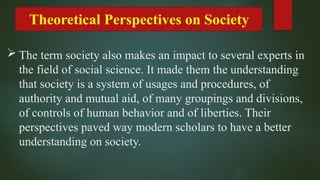
Theoretical Perspectives on Society
 The term society also makes an impact to several experts in
the field of social science. It made them the understanding
that society is a system of usages and procedures, of
authority and mutual aid, of many groupings and divisions,
of controls of human behavior and of liberties. Their
perspectives paved way modern scholars to have a better
understanding on society.
Auguste Comte
- He is the Father of Sociology
- He coined the term sociology and said that society is a
social organism possessing a harmony of structure and
function, his followers were motivated to give their own
perspective on this.
Herbert Spencer (1820-1903)
- described the emerging societies as societies of survival
and primarily based on the concept of natural law.
Members of each society must learn to adapt to their
surroundings to outlast the prevailing conditions present in
their environment.
Karl Marx (1818-1883)
- He had a different take on society
- He postulated that societies develop through class conflicts. There
is always s struggle between the workers and the capitalist due to
the exploitation of the latter to the former which is essential in
provoking social change. The only way to end this conflict is
through social revolution.
Emile Durkheim (1858-1917)
- said that society is composed of harmonious elements such as
individuals, organizations, and social institutions. These elements
must perform their role in the society for function effectively.
Dysfunction may occur if these elements are not in the state of
equilibrium.
George Herbert Mead (1863–1931)
- and other scholars who conceptualized the concept of symbolic
interactionism take a different point of view on society. According
to this, society can be seen in a micro-level that focuses on the
relationships of individuals within a society primarily centers in
their communication both language and symbols.
Herbert Blumer (1969)
- coined the term symbolic interactionism, studied how humans
interact to the meanings ascribed into a specific object under
circumstances.
Erving Goffman (1958)
- used dramaturgical analysis. In this approach, he used theater as
an analogy for social interaction and recognized that people like
actors and actresses, play their role and function according to it.
Charles Horton-Cooley (1902)
- said that society and individuals are not separated but are simply
collective and distributive aspects of the same thing.
- He theorized the concept of the looking glass self. According to
this, self-relation, or how one views oneself is not an isolated event
but rather includes others. It emphasized how we changed our
identity or personality based on how others see us.
 Contemporary scholar such as Morris Ginsberg (1921)
stated that society is a group of individuals bonded by
specific relation or manner of behavior which tend to differ
them from individuals who have a different set of patterned
behavior. Also, Franklin Giddings (1922) mentioned that
society is a unified itself, the organization, and the totality
of formal relations in which interacting humans are
guaranteed together.
THANK YOU!!!
GOD BLESS
Prepared by:
Richard d. Nicerio
Teacher-i

UCSP-LESSON-2.pptxpxxxxxxxxxxxxxxxxxxxxx

  • 1.
  • 2.
    OBJECTIVES: 1. Know theanthropological and sociological perspective on culture and society. 2. Determined the different Perspective on culture, Aspects of culture, types of culture, elements of culture and theoretical perspective on society. 3. Appreciate the importance of studying Anthropological and Sociological perspective on culture and society.
  • 3.
    Perspectives on Culture Culture is generic term yet very difficult to define. Aside from the famous definition of Tylor on culture, scholars and social scientists vary different perspective on how to properly define it. Also, because of its wider scope and it encompasses everything of man, experts from several field find it complicated to boxed culture into one universal terminology. Spencer-Oatey (2012, p.2) compiled perspectives from scholars about culture.
  • 4.
     Matthew Arnoldin his Culture and Anarchy (1867) mentioned that culture or high culture as opposed to popular culture (or folkways in an earlier usage) is a product of a special intellectual or artistic endeavor humans had invented.  Kroeber & Kluckhohn (1952) defined that culture is composed of behavior (explicit and implicit) acquired and transmitted through symbols. It is a human group that includes their distinctive achievements and embodiment in artifacts, traditional and historical ideas, and formation of values. They added that culture systems can be considered as a product of action from conditional elements of a society
  • 5.
     Lastly, Schwartz(1992) stated that culture consists of experiences that are organized, learned or created by the individuals of a population, including those images and images adding up their unique interpretations transmitted from the past generations up to the future.
  • 6.
     With thecomplexities of culture, these are some important aspects of culture that enhance the progress of human interaction and socialization. Dynamic - Culture changes constantly throughout the time. It varies Flexible, & on the societal structure and the capacities of its members to respond. Adaptive - Culture through its elements is enjoyed by group of people Shared & who lived together. It also allows its members to predict the behavior of other members but it is no assurance that they will think and act similarly. Aspects of Culture
  • 7.
    Enculturation– The processby which an individual learns the traditional content of a culture and assimilates its practices values. Acculturation – Cultural modification of an individual, group, or people by adapting to or borrowing traits from another culture. Assimilation – To adopt the ways of another culture: to fully become part of a different society, country, etc.
  • 8.
    Learned - Cultureis learned with practice through continued through process. It is a lifelong process in which social interaction socialization or plays a vital role. Enculturation Patterned social – Social interaction is the process by which people act and react in relation to others - Human beings rely on social structure to make sense of everyday life. Interactions – It is an interactive process between two or more partners.
  • 9.
    Transmitted – isthe process through which cultural elements, in the form of attitudes, values, beliefs, and behavioral scripts, are passed onto and taught to individuals and groups. Requires language and other forms of Communication - Culture will be successfully transmitted if it uses language and other forms of communication within their context.
  • 10.
    Types of culture Culture is primarily composed of material and non-material elements. Material culture includes all visible parts and tangible objects while non-material culture has intangible objects or the invisible parts. These manifestations are always present in any given society. Material Culture Non-Material Culture •Food •Clothing and Fashion •Buildings and Properties •Arts and Technology •Ideas and Knowledge •Beliefs and Traditions •Symbols and Language •Behavior •Religion
  • 11.
    Elements Definition Examples in PhilippineContext Norms These are the standard an expected behavior within a society. It is divided into two: formal norms and informal norms Formal Norms  Mores – they are norms that has a firm control to moral and ethical behavior. Pre-marital sex, Homosexual relationships
  • 12.
    Elements Definition Examples in PhilippineContext Norms  Laws – they are ordinance of reason enacted to protect the people from the bad effects of outdated mores 1987 Constitution, laws promulgated by the Philippine Government Informal Mores  Folkways or Customs – they are behaviors of less importance yet still influence our behavior. Doing “Mano Po” Practicing “Bayanihan”
  • 13.
    Elements Definition Examples in PhilippineContext Symbols These are anything that carry a meaning recognized by people who share a culture. A symbol of cross refers to Christianity while crescent shape is for Islam Values These are culturally defined standards by which people assess desirability, goodness, and beauty and that serve as broad guidelines for social living. Filipino hospitality, resiliency, close-family ties, positive outlook in life and optimism
  • 14.
    Elements Definition Examples in PhilippineContext Beliefs These are specific statements that people hold to be true. Superstitious beliefs Language It refers to a form of communication using words either spoken or gestured with the hands and structured with grammar, often with a writing system. The crossing of fingers may refer that someone is hoping for good luck but in Vietnam it represents the genitals of a female.
  • 15.
    Elements Definition Examples in PhilippineContext Taboos These are norms that are crucial to a society’s moral center, involving behaviors that are always negatively sanctioned Incest, cannibalism
  • 16.
    Theoretical Perspectives onSociety  The term society also makes an impact to several experts in the field of social science. It made them the understanding that society is a system of usages and procedures, of authority and mutual aid, of many groupings and divisions, of controls of human behavior and of liberties. Their perspectives paved way modern scholars to have a better understanding on society.
  • 17.
    Auguste Comte - Heis the Father of Sociology - He coined the term sociology and said that society is a social organism possessing a harmony of structure and function, his followers were motivated to give their own perspective on this. Herbert Spencer (1820-1903) - described the emerging societies as societies of survival and primarily based on the concept of natural law. Members of each society must learn to adapt to their surroundings to outlast the prevailing conditions present in their environment.
  • 18.
    Karl Marx (1818-1883) -He had a different take on society - He postulated that societies develop through class conflicts. There is always s struggle between the workers and the capitalist due to the exploitation of the latter to the former which is essential in provoking social change. The only way to end this conflict is through social revolution. Emile Durkheim (1858-1917) - said that society is composed of harmonious elements such as individuals, organizations, and social institutions. These elements must perform their role in the society for function effectively. Dysfunction may occur if these elements are not in the state of equilibrium.
  • 19.
    George Herbert Mead(1863–1931) - and other scholars who conceptualized the concept of symbolic interactionism take a different point of view on society. According to this, society can be seen in a micro-level that focuses on the relationships of individuals within a society primarily centers in their communication both language and symbols. Herbert Blumer (1969) - coined the term symbolic interactionism, studied how humans interact to the meanings ascribed into a specific object under circumstances.
  • 20.
    Erving Goffman (1958) -used dramaturgical analysis. In this approach, he used theater as an analogy for social interaction and recognized that people like actors and actresses, play their role and function according to it. Charles Horton-Cooley (1902) - said that society and individuals are not separated but are simply collective and distributive aspects of the same thing. - He theorized the concept of the looking glass self. According to this, self-relation, or how one views oneself is not an isolated event but rather includes others. It emphasized how we changed our identity or personality based on how others see us.
  • 21.
     Contemporary scholarsuch as Morris Ginsberg (1921) stated that society is a group of individuals bonded by specific relation or manner of behavior which tend to differ them from individuals who have a different set of patterned behavior. Also, Franklin Giddings (1922) mentioned that society is a unified itself, the organization, and the totality of formal relations in which interacting humans are guaranteed together.
  • 22.
    THANK YOU!!! GOD BLESS Preparedby: Richard d. Nicerio Teacher-i