Sociological Investigation
A logical system that derives knowledge
From direct, systematic observation
Forms of Truth
• Belief or faith
• Expert testimony
• Simple agreement
• Science
– Logical system that bases knowledge on
direct systematic observation
Common Sense vs.
Scientific Evidence
• “Poor people are far more likely than rich people to
break the law.”
• “Most poor people don’t want to work.”
• “Most people marry because they are in love.”
Three Frameworks
for Sociological Investigation
• Scientific sociology
– The study of society based on systematic
observation of social behavior
– Empirical evidence–Information we can verify with
our senses
• Interpretive sociology
– The study of society that focuses on the meanings
people attach to their social world
• Critical sociology
– The study of society that focuses on the need for
change
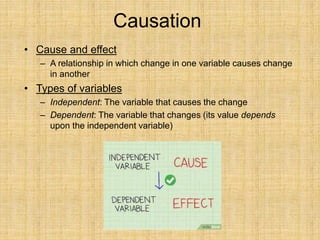
Causation
• Cause and effect
– A relationship in which change in one variable causes change
in another
• Types of variables
– Independent: The variable that causes the change
– Dependent: The variable that changes (its value depends
upon the independent variable)
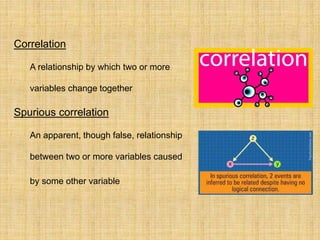
Correlation
A relationship by which two or more
variables change together
Spurious correlation
An apparent, though false, relationship
between two or more variables caused
by some other variable
Scientific Sociology
Terminology
• Concepts–A mental construct that represents
some part of the world in a simplified form
• Variables–Concepts whose values change from
case to case
• Measurement–A procedure for determining the
value of a variable in a specific case
• Operationalizing a variable–Specifying exactly
what is to be measured before assigning a value
to a variable
Scientific Sociology Terminology
• Reliability–Consistency in measurement
– Does an instrument provide for a consistent
measure of the subject matter?
• Validity–Precision in measuring exactly what one
intends to measure
– Does an instrument actually measure what it sets
out to measure?
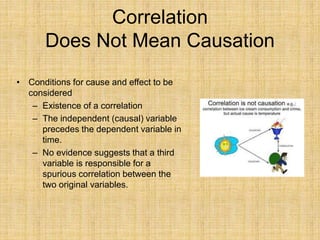
Correlation
Does Not Mean Causation
• Conditions for cause and effect to be
considered
– Existence of a correlation
– The independent (causal) variable
precedes the dependent variable in
time.
– No evidence suggests that a third
variable is responsible for a
spurious correlation between the
two original variables.
Scientific Sociology Terminology
• Objectivity
– A state of personal neutrality in
conducting research
• Value-free research
– Weber says sociologists should strive to
be dispassionate and detached.
• Replication
– Repetition of research by other
investigators
– Helps limit distortion caused by personal
values
Limitations
of Scientific Sociology
• Human behavior is too complex to
predict precisely any individual’s
actions.
• The mere presence of the
researcher might affect the behavior
being studied.
• Social patterns change.
• Sociologists are part of the world
they study, making value-free
research difficult.
Gender and Research
• Androcentricity
– Approaching the topic from a male-only
perspective
• Gynocentricity
– Approaching the topic from a female-only
perspective (less common than androcentricity)
• Overgeneralizing
– Using data collected from one sex and applying
the findings to both sexes
Gender and Research
• Gender blindness
– The failure to consider the effect of gender at all
• Double standards
– Using different standards to judge males and
females
• Interference
– This occurs when a subject reacts to the sex of
the researcher, interfering with the research
operation.
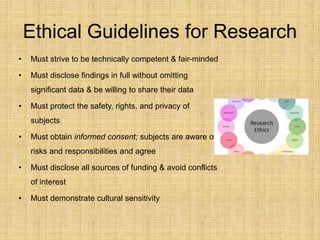
Ethical Guidelines for Research
• Must strive to be technically competent & fair-minded
• Must disclose findings in full without omitting
significant data & be willing to share their data
• Must protect the safety, rights, and privacy of
subjects
• Must obtain informed consent; subjects are aware of
risks and responsibilities and agree
• Must disclose all sources of funding & avoid conflicts
of interest
• Must demonstrate cultural sensitivity
Sociological Research Methods
A Systematic Plan for Conducting Research
• Experiment–A research method for investigating
cause and effect under highly controlled conditions
• Hypothesis–An unverified statement of a relationship
between variables (an educated guess)
• Placebo–A treatment that seems to be the same but
has no effect on the experiment
• Hawthorne effect–A change in a subject's behavior
caused by the awareness of being studied
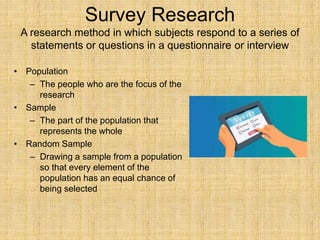
Survey Research
A research method in which subjects respond to a series of
statements or questions in a questionnaire or interview
• Population
– The people who are the focus of the
research
• Sample
– The part of the population that
represents the whole
• Random Sample
– Drawing a sample from a population
so that every element of the
population has an equal chance of
being selected
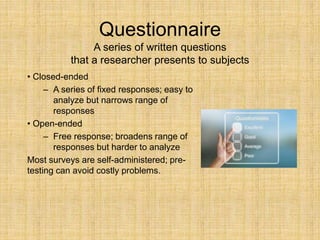
Questionnaire
A series of written questions
that a researcher presents to subjects
• Closed-ended
– A series of fixed responses; easy to
analyze but narrows range of
responses
• Open-ended
– Free response; broadens range of
responses but harder to analyze
Most surveys are self-administered; pre-
testing can avoid costly problems.
Other Research Methods
• Interview
– A series of questions that a
researcher administers in
person
• Participant observation
– A research method in
which investigators
systematically observe
people while joining in their
routine activities
Interplay Between
Theory and Method
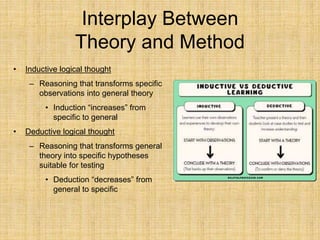
• Inductive logical thought
– Reasoning that transforms specific
observations into general theory
• Induction “increases” from
specific to general
• Deductive logical thought
– Reasoning that transforms general
theory into specific hypotheses
suitable for testing
• Deduction “decreases” from
general to specific
Ten Steps
In Sociological Investigation
1. Select and define topic
2. Review the literature
3. Develop key questions to ask
4. Assess requirements for study
5. Consider ethical issues
6. Select a research methodology
7. Collect the data
8. Interpret the findings
9. State conclusions
10.Publish the findings

Chapter 02 (4).ppt

  • 1.
    Sociological Investigation A logicalsystem that derives knowledge From direct, systematic observation
  • 2.
    Forms of Truth •Belief or faith • Expert testimony • Simple agreement • Science – Logical system that bases knowledge on direct systematic observation
  • 3.
    Common Sense vs. ScientificEvidence • “Poor people are far more likely than rich people to break the law.” • “Most poor people don’t want to work.” • “Most people marry because they are in love.”
  • 4.
    Three Frameworks for SociologicalInvestigation • Scientific sociology – The study of society based on systematic observation of social behavior – Empirical evidence–Information we can verify with our senses • Interpretive sociology – The study of society that focuses on the meanings people attach to their social world • Critical sociology – The study of society that focuses on the need for change
  • 5.
    Causation • Cause andeffect – A relationship in which change in one variable causes change in another • Types of variables – Independent: The variable that causes the change – Dependent: The variable that changes (its value depends upon the independent variable)
  • 6.
    Correlation A relationship bywhich two or more variables change together Spurious correlation An apparent, though false, relationship between two or more variables caused by some other variable
  • 7.
    Scientific Sociology Terminology • Concepts–Amental construct that represents some part of the world in a simplified form • Variables–Concepts whose values change from case to case • Measurement–A procedure for determining the value of a variable in a specific case • Operationalizing a variable–Specifying exactly what is to be measured before assigning a value to a variable
  • 8.
    Scientific Sociology Terminology •Reliability–Consistency in measurement – Does an instrument provide for a consistent measure of the subject matter? • Validity–Precision in measuring exactly what one intends to measure – Does an instrument actually measure what it sets out to measure?
  • 9.
    Correlation Does Not MeanCausation • Conditions for cause and effect to be considered – Existence of a correlation – The independent (causal) variable precedes the dependent variable in time. – No evidence suggests that a third variable is responsible for a spurious correlation between the two original variables.
  • 10.
    Scientific Sociology Terminology •Objectivity – A state of personal neutrality in conducting research • Value-free research – Weber says sociologists should strive to be dispassionate and detached. • Replication – Repetition of research by other investigators – Helps limit distortion caused by personal values
  • 11.
    Limitations of Scientific Sociology •Human behavior is too complex to predict precisely any individual’s actions. • The mere presence of the researcher might affect the behavior being studied. • Social patterns change. • Sociologists are part of the world they study, making value-free research difficult.
  • 12.
    Gender and Research •Androcentricity – Approaching the topic from a male-only perspective • Gynocentricity – Approaching the topic from a female-only perspective (less common than androcentricity) • Overgeneralizing – Using data collected from one sex and applying the findings to both sexes
  • 13.
    Gender and Research •Gender blindness – The failure to consider the effect of gender at all • Double standards – Using different standards to judge males and females • Interference – This occurs when a subject reacts to the sex of the researcher, interfering with the research operation.
  • 14.
    Ethical Guidelines forResearch • Must strive to be technically competent & fair-minded • Must disclose findings in full without omitting significant data & be willing to share their data • Must protect the safety, rights, and privacy of subjects • Must obtain informed consent; subjects are aware of risks and responsibilities and agree • Must disclose all sources of funding & avoid conflicts of interest • Must demonstrate cultural sensitivity
  • 15.
    Sociological Research Methods ASystematic Plan for Conducting Research • Experiment–A research method for investigating cause and effect under highly controlled conditions • Hypothesis–An unverified statement of a relationship between variables (an educated guess) • Placebo–A treatment that seems to be the same but has no effect on the experiment • Hawthorne effect–A change in a subject's behavior caused by the awareness of being studied
  • 16.
    Survey Research A researchmethod in which subjects respond to a series of statements or questions in a questionnaire or interview • Population – The people who are the focus of the research • Sample – The part of the population that represents the whole • Random Sample – Drawing a sample from a population so that every element of the population has an equal chance of being selected
  • 17.
    Questionnaire A series ofwritten questions that a researcher presents to subjects • Closed-ended – A series of fixed responses; easy to analyze but narrows range of responses • Open-ended – Free response; broadens range of responses but harder to analyze Most surveys are self-administered; pre- testing can avoid costly problems.
  • 18.
    Other Research Methods •Interview – A series of questions that a researcher administers in person • Participant observation – A research method in which investigators systematically observe people while joining in their routine activities
  • 19.
    Interplay Between Theory andMethod • Inductive logical thought – Reasoning that transforms specific observations into general theory • Induction “increases” from specific to general • Deductive logical thought – Reasoning that transforms general theory into specific hypotheses suitable for testing • Deduction “decreases” from general to specific
  • 20.
    Ten Steps In SociologicalInvestigation 1. Select and define topic 2. Review the literature 3. Develop key questions to ask 4. Assess requirements for study 5. Consider ethical issues 6. Select a research methodology 7. Collect the data 8. Interpret the findings 9. State conclusions 10.Publish the findings