DR.V. XAVIER, MBBS, MBA,PGDHM
Alumni , Stanley Medical College Chennai
 Socioeconomic status (SES) is one of the most
important social determinants of health and disease,
thus, a widely studied construct in the social
sciences.1
 SES influences the accessibility, affordability,
acceptability and actual utilization of available
health facilities2
 Socioeconomic status (SES) is a combination of
social and economic variables
• Ref:
• 1.M Bairwa, M Rajput, S Sachdeva :Kuppuswamy’s Socioeconomic Scale: Social Researcher Should
Include Updated Income Criteria: Indian J Community Med. 2013 Jul-Sep; 38(3): 185–186
• Agarwal AK. Social classification: The need to update in the present scenario. 2008:33(1); 50-1
 A composite measure that typically
incorporates economic, social, and work status1
.
 Economic status is measured by income.
 Social status is measured by education, and
 work status is measured by occupation.
• Each status is considered an indicator.
• These three indicators are related but do not overlap
Ref:
1.Adler, N.E., Socioeconomic status and health: The challenge of the gradient. American psychologist, 1994.49(1): p. 15.
 Low SES population presenting more
commonly with nutritional deficiency and
communicable diseases and
 High SES showing more of obesity and
noncommunicable diseases;
 Access to healthcare with high SES showing a
better access.
Ref: Sunil K. Raina: Use of Socioeconomic Status Scales in Medicine and Public Health :J Family
Med Prim Care. 2015 Jan-Mar; 4(1): 156
 Status inequalities between individuals are
common, so it becomes a quantitative issue to
determine how much social inequality
qualifies as stratification.
 In general, the more complex the society, the
more numerous the layers or strata of social
differentiation1
• Ref:
• 1.Grusky, David B. (2011). “Theories of Stratification and Inequality”. In Ritzer, George and J. Michael Ryan
(eds.). The Concise Encyclopedia of Sociology. Wiley-Blackwell. pp. 622–624. Retrieved 23 June 2014
 The position that an individual or family
occupies with reference to the prevailing
average standards of cultural and material
possessions, income, and participation in
group activity of the community
1. Understand the distribution of population
based on SES1
2. To develop a uniform system of socioeconomic
classification of the population universally
based on the income with scientific basis
3. Resources are scarce
a. Need to identify the most needy
b. Difficulty in identifying the exact number of people
living below the poverty line (BPL families) in India1
Ref :
1. Tendulkar SD. New Delhi: Government of India; 2009. Report of the expert group to review the
methodology for estimation of poverty. Planning commission; p. 29
 Hollingshead scale, (The Hollingshead Four
Factor Index of Socioeconomic Status is a
survey designed to measure social status of an
individual based on four domains: Marital
status, retired/employed status, educational
attainment, and occupational prestige.)
 Mac Arthur scale (Domains: Education,
income, occupational status and wealth)
Ref: Hollingshead, A. A. (1975). Four-factor index of social status. Unpublished manuscript, Yale University, New Haven, CT.
 (NFHS - II) had used the Standard of Living Index
(SLI) scale 1
 Contains 11 items viz. house type, source of
lighting, toilet facility, main fuel for cooking,
source of drinking water, separate room for
cooking, ownership of the house, ownership of
agricultural land, ownership of irrigated land,
ownership of livestock, ownership of durable
goods
 Used for measuring the SES both urban and rural
areas for the entire country
Ref:NFHS-2, India, 1998-99
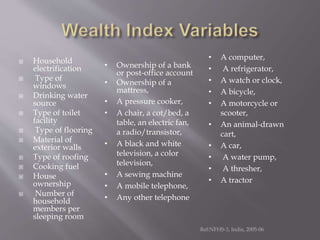
 The NFHS-3 wealth index is
based on the following 33
assets and housing
characteristics:
NFHS-3, India, 2005-06
 Household
electrification
 Type of
windows
 Drinking water
source
 Type of toilet
facility
 Type of flooring
 Material of
exterior walls
 Type of roofing
 Cooking fuel
 House
ownership
 Number of
household
members per
sleeping room
Ref:NFHS-3, India, 2005-06
• Ownership of a bank
or post-office account
• Ownership of a
mattress,
• A pressure cooker,
• A chair, a cot/bed, a
table, an electric fan,
a radio/transistor,
• A black and white
television, a color
television,
• A sewing machine
• A mobile telephone,
• Any other telephone
• A computer,
• A refrigerator,
• A watch or clock,
• A bicycle,
• A motorcycle or
scooter,
• An animal-drawn
cart,
• A car,
• A water pump,
• A thresher,
• A tractor
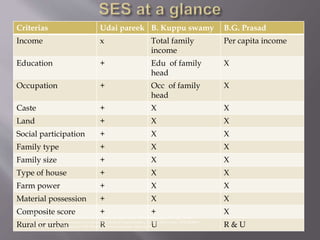
 Udai Pareek and G. Trivedi (1964)
 Kuppuswamy scale 1962
 B G Prasad classification proposed in the year
1961
Ref:
• Prasad BG. Changes proposed in social classification of Indian families. J Indian Med Assoc.
1970;55:98–9.
• Pareekh U. Delhi: Mansayan; 1981. Mannual of socio economic status (rural)
• Gupta MC, Mahajan BK. Social environment. In: Guptha MC, editor. Text book of preventive and
social medicine. 3rd ed. New Delhi: Jaypee Publications; 2005. p. 117.
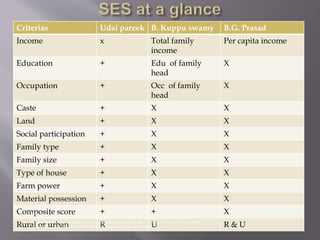
Criterias Udai pareek B. Kuppu swamy B.G. Prasad
Income x Total family
income
Per capita income
Education + Edu of family
head
X
Occupation + Occ of family
head
X
Caste + X X
Land + X X
Social participation + X X
Family type + X X
Family size + X X
Type of house + X X
Farm power + X X
Material possession + X X
Composite score + + X
Rural or urban R U R & U
• .Ref
• 1.Kuppuswamy B. Manual of Socioeconomic Status (Urban) 1st ed. Delhi: Manasayan; 1981. pp. 66–72
• 2.Prasad BG. Changes proposed in social classification of Indian families. J Indian Med Assoc. 1970;55:98–9.
• 3.Pareekh U. Delhi: Mansayan; 1981. Mannual of socio economic status (rural
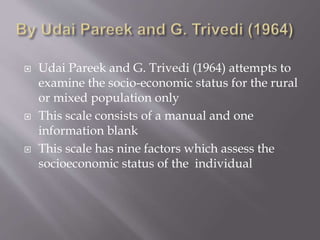
 Udai Pareek and G. Trivedi (1964) attempts to
examine the socio-economic status for the rural
or mixed population only
 This scale consists of a manual and one
information blank
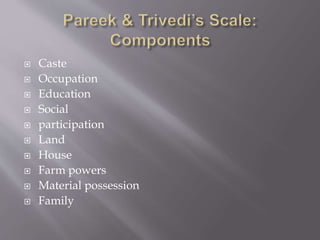
 This scale has nine factors which assess the
socioeconomic status of the individual
 Caste
 Occupation
 Education
 Social
 participation
 Land
 House
 Farm powers
 Material possession
 Family
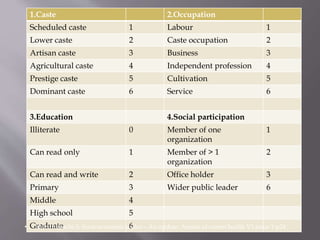
1.Caste 2.Occupation
Scheduled caste 1 Labour 1
Lower caste 2 Caste occupation 2
Artisan caste 3 Business 3
Agricultural caste 4 Independent profession 4
Prestige caste 5 Cultivation 5
Dominant caste 6 Service 6
3.Education 4.Social participation
Illiterate 0 Member of one
organization
1
Can read only 1 Member of > 1
organization
2
Can read and write 2 Office holder 3
Primary 3 Wider public leader 6
Middle 4
High school 5
Graduate 6• Ref: Holyachi S: Socio economic scales – An update: Annals of comm health V1:issue 1:p24
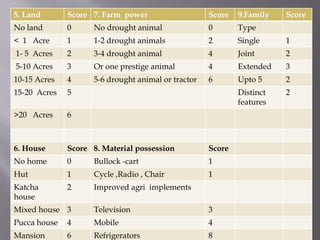
5. Land Score 7. Farm power Score 9.Family Score
No land 0 No drought animal 0 Type
< 1 Acre 1 1-2 drought animals 2 Single 1
1- 5 Acres 2 3-4 drought animal 4 Joint 2
5-10 Acres 3 Or one prestige animal 4 Extended 3
10-15 Acres 4 5-6 drought animal or tractor 6 Upto 5 2
15-20 Acres 5 Distinct
features
2
>20 Acres 6
6. House Score 8. Material possession Score
No home 0 Bullock -cart 1
Hut 1 Cycle ,Radio , Chair 1
Katcha
house
2 Improved agri implements
Mixed house 3 Television 3
Pucca house 4 Mobile 4
Mansion 6 Refrigerators 8
 After filling the information ,and scoring the
individual items, the total score is summed up.
 With the help of the key provided in the
manual, total score is interpreteding terms of
the class.
 This scale does not emphasize the income
aspect and can only be used for rural subjects
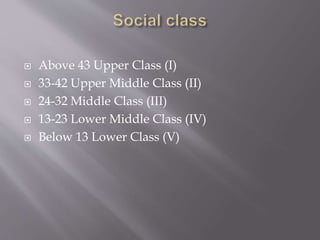
 Above 43 Upper Class (I)
 33-42 Upper Middle Class (II)
 24-32 Middle Class (III)
 13-23 Lower Middle Class (IV)
 Below 13 Lower Class (V)
 Modified BG Prasad socioeconomic scale is
widely used to determine the socioeconomic
status .
 The Consumer Price Index (CPI) for industrial
workers (IW) is used to calculate updated
income categories
 Income ranges in the scale lose their relevance
following the depreciation in the value of the
rupee1 .
 Steady inflation, lower interest rates, and
country’s current account deficits are the main
factors contributing to fall in the value of
currency2.
 Therefore, it is needed to update the scale
regularly for socioeconomic classification of study
populations. 3
1.Ref:Kuppuswamy B. Manual of Socioeconomic Status (Urban) 1st ed. Delhi: Manasayan; 1981. pp. 66–72.
2.Mishra D, Singh HP. Kuppuswamy’s socioeconomic status scale - A revision. Indian J Pediatr. 2003;70:273–4
.
3.Kumar P. Social classification - Need for constant updating. Indian J Community Med. 1993;18:60–1.
 Kumar had tried to update Prasad Scale’s
income limits using consumer price index (CPI)
 Kuppuswamy socioeconomic scale was revised
with CPI .
 Linking of the scale with price index makes it
relevant and meaningful and also provides a
opportunity for constant updation .
• Ref:
• 1.M Bairwa, M Rajput, S Sachdeva :Kuppuswamy’s Socioeconomic Scale: Social Researcher Should
Include Updated Income Criteria: Indian J Community Med. 2013 Jul-Sep; 38(3): 185–186
 Definition: A comprehensive measure used for
estimation of price changes in a basket of goods
and services representative of consumption
expenditure in an economy is called consumer
price index
• Ref: http://economictimes.indiatimes.com/definition/consumer-price-index
 The BG Prasad scale was formulated in
1961Consumer Price Index (CPI) for 1960 as
100.
 This was revised in 1982 by introducing a
linking factor of 4.93 to convert CPI (1982)
from the new base of 100 to the old base CPI
(1960).
 Again a need was felt in 2001 to revise the
base, which was done by introducing the
linking factor of 4.63.
 (CPI [IW]× 4.63) × 4.93 ÷ 100.
 [ 237 ]× 4.63) × 4.93 ÷ 100.
 = 54.09738
Class Prasad’s Classification
(1961) In Rupees
New Starting classes
before they are
rounded off
Modified Prasad’s
Classification after
rounding off to the
nearest Rs. 10/=
I 100 & above 5410 5410 & above
II 50-99 2705 2710 – 5409
III 30-49 1623 1620 – 2709
IV 15-29 811 810
V Below 15 811 Below 810
 It is only income-based scale
 The most widely used scale for urban population
was devised by Kuppuswamy in 1976.
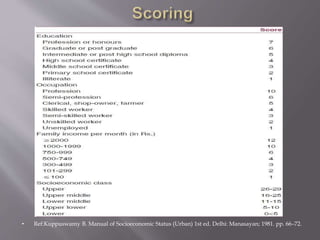
 Kuppuswamy scale is a composite score of
education and occupation of the head of the family
along with monthly income of the family, which
yields a score of 3-29.
 This scale classifies the study populations into
high, middle, and low SES
 To get current income group, a conversion factor
calculated based on current All India Consumer
Price Index (AICPI) is applied
 Manual
 Two information blanks (one for the person
concerned and second for the father or guardian)
 Score card
• The information is collected in the devised
Information blanks and with the help of
the score card the status score is obtained.
• On the basis of the total score, the
respective class is found out.
Scoring:
• Ref:Kuppuswamy B. Manual of Socioeconomic Status (Urban) 1st ed. Delhi: Manasayan; 1981. pp. 66–72.
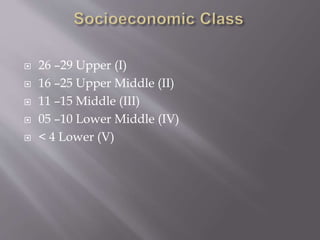
 26 –29 Upper (I)
 16 –25 Upper Middle (II)
 11 –15 Middle (III)
 05 –10 Lower Middle (IV)
 < 4 Lower (V)
 Steady inflation and consequent fall in the
value of currency make the economic criteria
in the scale less relevant.
Ref:
.Mishra D, Singh HP. Kuppuswamy’s socioeconomic status scale - A revision. Indian J Pediatr. 2003;70:273–4
.Kumar P. Social classification - Need for constant updating. Indian J Community Med. 1993;18:60–1.
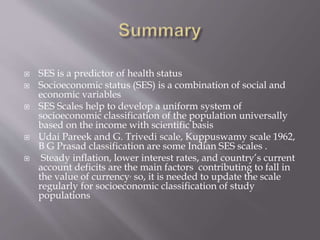
 SES is a predictor of health status
 Socioeconomic status (SES) is a combination of social and
economic variables
 SES Scales help to develop a uniform system of
socioeconomic classification of the population universally
based on the income with scientific basis
 Udai Pareek and G. Trivedi scale, Kuppuswamy scale 1962,
B G Prasad classification are some Indian SES scales .
 Steady inflation, lower interest rates, and country’s current
account deficits are the main factors contributing to fall in
the value of currency, so, it is needed to update the scale
regularly for socioeconomic classification of study
populations
Criterias Udai pareek B. Kuppu swamy B.G. Prasad
Income x Total family
income
Per capita income
Education + Edu of family
head
X
Occupation + Occ of family
head
X
Caste + X X
Land + X X
Social participation + X X
Family type + X X
Family size + X X
Type of house + X X
Farm power + X X
Material possession + X X
Composite score + + X
Rural or urban R U R & U
• .Ref
• 1.Kuppuswamy B. Manual of Socioeconomic Status (Urban) 1st ed. Delhi: Manasayan; 1981. pp. 66–72
• 2.Prasad BG. Changes proposed in social classification of Indian families. J Indian Med Assoc. 1970;55:98–9.
• 3.Pareekh U. Delhi: Mansayan; 1981. Mannual of socio economic status (rural
 Thank u

Socio eonomic status scale in India

  • 1.
    DR.V. XAVIER, MBBS,MBA,PGDHM Alumni , Stanley Medical College Chennai
  • 2.
     Socioeconomic status(SES) is one of the most important social determinants of health and disease, thus, a widely studied construct in the social sciences.1  SES influences the accessibility, affordability, acceptability and actual utilization of available health facilities2  Socioeconomic status (SES) is a combination of social and economic variables • Ref: • 1.M Bairwa, M Rajput, S Sachdeva :Kuppuswamy’s Socioeconomic Scale: Social Researcher Should Include Updated Income Criteria: Indian J Community Med. 2013 Jul-Sep; 38(3): 185–186 • Agarwal AK. Social classification: The need to update in the present scenario. 2008:33(1); 50-1
  • 3.
     A compositemeasure that typically incorporates economic, social, and work status1 .  Economic status is measured by income.  Social status is measured by education, and  work status is measured by occupation. • Each status is considered an indicator. • These three indicators are related but do not overlap Ref: 1.Adler, N.E., Socioeconomic status and health: The challenge of the gradient. American psychologist, 1994.49(1): p. 15.
  • 4.
     Low SESpopulation presenting more commonly with nutritional deficiency and communicable diseases and  High SES showing more of obesity and noncommunicable diseases;  Access to healthcare with high SES showing a better access. Ref: Sunil K. Raina: Use of Socioeconomic Status Scales in Medicine and Public Health :J Family Med Prim Care. 2015 Jan-Mar; 4(1): 156
  • 5.
     Status inequalitiesbetween individuals are common, so it becomes a quantitative issue to determine how much social inequality qualifies as stratification.  In general, the more complex the society, the more numerous the layers or strata of social differentiation1 • Ref: • 1.Grusky, David B. (2011). “Theories of Stratification and Inequality”. In Ritzer, George and J. Michael Ryan (eds.). The Concise Encyclopedia of Sociology. Wiley-Blackwell. pp. 622–624. Retrieved 23 June 2014
  • 6.
     The positionthat an individual or family occupies with reference to the prevailing average standards of cultural and material possessions, income, and participation in group activity of the community
  • 7.
    1. Understand thedistribution of population based on SES1 2. To develop a uniform system of socioeconomic classification of the population universally based on the income with scientific basis 3. Resources are scarce a. Need to identify the most needy b. Difficulty in identifying the exact number of people living below the poverty line (BPL families) in India1 Ref : 1. Tendulkar SD. New Delhi: Government of India; 2009. Report of the expert group to review the methodology for estimation of poverty. Planning commission; p. 29
  • 8.
     Hollingshead scale,(The Hollingshead Four Factor Index of Socioeconomic Status is a survey designed to measure social status of an individual based on four domains: Marital status, retired/employed status, educational attainment, and occupational prestige.)  Mac Arthur scale (Domains: Education, income, occupational status and wealth) Ref: Hollingshead, A. A. (1975). Four-factor index of social status. Unpublished manuscript, Yale University, New Haven, CT.
  • 9.
     (NFHS -II) had used the Standard of Living Index (SLI) scale 1  Contains 11 items viz. house type, source of lighting, toilet facility, main fuel for cooking, source of drinking water, separate room for cooking, ownership of the house, ownership of agricultural land, ownership of irrigated land, ownership of livestock, ownership of durable goods  Used for measuring the SES both urban and rural areas for the entire country Ref:NFHS-2, India, 1998-99
  • 10.
     The NFHS-3wealth index is based on the following 33 assets and housing characteristics: NFHS-3, India, 2005-06
  • 11.
     Household electrification  Typeof windows  Drinking water source  Type of toilet facility  Type of flooring  Material of exterior walls  Type of roofing  Cooking fuel  House ownership  Number of household members per sleeping room Ref:NFHS-3, India, 2005-06 • Ownership of a bank or post-office account • Ownership of a mattress, • A pressure cooker, • A chair, a cot/bed, a table, an electric fan, a radio/transistor, • A black and white television, a color television, • A sewing machine • A mobile telephone, • Any other telephone • A computer, • A refrigerator, • A watch or clock, • A bicycle, • A motorcycle or scooter, • An animal-drawn cart, • A car, • A water pump, • A thresher, • A tractor
  • 12.
     Udai Pareekand G. Trivedi (1964)  Kuppuswamy scale 1962  B G Prasad classification proposed in the year 1961 Ref: • Prasad BG. Changes proposed in social classification of Indian families. J Indian Med Assoc. 1970;55:98–9. • Pareekh U. Delhi: Mansayan; 1981. Mannual of socio economic status (rural) • Gupta MC, Mahajan BK. Social environment. In: Guptha MC, editor. Text book of preventive and social medicine. 3rd ed. New Delhi: Jaypee Publications; 2005. p. 117.
  • 13.
    Criterias Udai pareekB. Kuppu swamy B.G. Prasad Income x Total family income Per capita income Education + Edu of family head X Occupation + Occ of family head X Caste + X X Land + X X Social participation + X X Family type + X X Family size + X X Type of house + X X Farm power + X X Material possession + X X Composite score + + X Rural or urban R U R & U • .Ref • 1.Kuppuswamy B. Manual of Socioeconomic Status (Urban) 1st ed. Delhi: Manasayan; 1981. pp. 66–72 • 2.Prasad BG. Changes proposed in social classification of Indian families. J Indian Med Assoc. 1970;55:98–9. • 3.Pareekh U. Delhi: Mansayan; 1981. Mannual of socio economic status (rural
  • 14.
     Udai Pareekand G. Trivedi (1964) attempts to examine the socio-economic status for the rural or mixed population only  This scale consists of a manual and one information blank  This scale has nine factors which assess the socioeconomic status of the individual
  • 15.
     Caste  Occupation Education  Social  participation  Land  House  Farm powers  Material possession  Family
  • 16.
    1.Caste 2.Occupation Scheduled caste1 Labour 1 Lower caste 2 Caste occupation 2 Artisan caste 3 Business 3 Agricultural caste 4 Independent profession 4 Prestige caste 5 Cultivation 5 Dominant caste 6 Service 6 3.Education 4.Social participation Illiterate 0 Member of one organization 1 Can read only 1 Member of > 1 organization 2 Can read and write 2 Office holder 3 Primary 3 Wider public leader 6 Middle 4 High school 5 Graduate 6• Ref: Holyachi S: Socio economic scales – An update: Annals of comm health V1:issue 1:p24
  • 17.
    5. Land Score7. Farm power Score 9.Family Score No land 0 No drought animal 0 Type < 1 Acre 1 1-2 drought animals 2 Single 1 1- 5 Acres 2 3-4 drought animal 4 Joint 2 5-10 Acres 3 Or one prestige animal 4 Extended 3 10-15 Acres 4 5-6 drought animal or tractor 6 Upto 5 2 15-20 Acres 5 Distinct features 2 >20 Acres 6 6. House Score 8. Material possession Score No home 0 Bullock -cart 1 Hut 1 Cycle ,Radio , Chair 1 Katcha house 2 Improved agri implements Mixed house 3 Television 3 Pucca house 4 Mobile 4 Mansion 6 Refrigerators 8
  • 18.
     After fillingthe information ,and scoring the individual items, the total score is summed up.  With the help of the key provided in the manual, total score is interpreteding terms of the class.
  • 19.
     This scaledoes not emphasize the income aspect and can only be used for rural subjects
  • 20.
     Above 43Upper Class (I)  33-42 Upper Middle Class (II)  24-32 Middle Class (III)  13-23 Lower Middle Class (IV)  Below 13 Lower Class (V)
  • 21.
     Modified BGPrasad socioeconomic scale is widely used to determine the socioeconomic status .  The Consumer Price Index (CPI) for industrial workers (IW) is used to calculate updated income categories
  • 22.
     Income rangesin the scale lose their relevance following the depreciation in the value of the rupee1 .  Steady inflation, lower interest rates, and country’s current account deficits are the main factors contributing to fall in the value of currency2.  Therefore, it is needed to update the scale regularly for socioeconomic classification of study populations. 3 1.Ref:Kuppuswamy B. Manual of Socioeconomic Status (Urban) 1st ed. Delhi: Manasayan; 1981. pp. 66–72. 2.Mishra D, Singh HP. Kuppuswamy’s socioeconomic status scale - A revision. Indian J Pediatr. 2003;70:273–4 . 3.Kumar P. Social classification - Need for constant updating. Indian J Community Med. 1993;18:60–1.
  • 23.
     Kumar hadtried to update Prasad Scale’s income limits using consumer price index (CPI)  Kuppuswamy socioeconomic scale was revised with CPI .  Linking of the scale with price index makes it relevant and meaningful and also provides a opportunity for constant updation . • Ref: • 1.M Bairwa, M Rajput, S Sachdeva :Kuppuswamy’s Socioeconomic Scale: Social Researcher Should Include Updated Income Criteria: Indian J Community Med. 2013 Jul-Sep; 38(3): 185–186
  • 24.
     Definition: Acomprehensive measure used for estimation of price changes in a basket of goods and services representative of consumption expenditure in an economy is called consumer price index • Ref: http://economictimes.indiatimes.com/definition/consumer-price-index
  • 25.
     The BGPrasad scale was formulated in 1961Consumer Price Index (CPI) for 1960 as 100.  This was revised in 1982 by introducing a linking factor of 4.93 to convert CPI (1982) from the new base of 100 to the old base CPI (1960).  Again a need was felt in 2001 to revise the base, which was done by introducing the linking factor of 4.63.
  • 26.
     (CPI [IW]×4.63) × 4.93 ÷ 100.  [ 237 ]× 4.63) × 4.93 ÷ 100.  = 54.09738 Class Prasad’s Classification (1961) In Rupees New Starting classes before they are rounded off Modified Prasad’s Classification after rounding off to the nearest Rs. 10/= I 100 & above 5410 5410 & above II 50-99 2705 2710 – 5409 III 30-49 1623 1620 – 2709 IV 15-29 811 810 V Below 15 811 Below 810
  • 27.
     It isonly income-based scale
  • 28.
     The mostwidely used scale for urban population was devised by Kuppuswamy in 1976.  Kuppuswamy scale is a composite score of education and occupation of the head of the family along with monthly income of the family, which yields a score of 3-29.  This scale classifies the study populations into high, middle, and low SES  To get current income group, a conversion factor calculated based on current All India Consumer Price Index (AICPI) is applied
  • 29.
     Manual  Twoinformation blanks (one for the person concerned and second for the father or guardian)  Score card • The information is collected in the devised Information blanks and with the help of the score card the status score is obtained. • On the basis of the total score, the respective class is found out. Scoring:
  • 30.
    • Ref:Kuppuswamy B.Manual of Socioeconomic Status (Urban) 1st ed. Delhi: Manasayan; 1981. pp. 66–72.
  • 31.
     26 –29Upper (I)  16 –25 Upper Middle (II)  11 –15 Middle (III)  05 –10 Lower Middle (IV)  < 4 Lower (V)
  • 32.
     Steady inflationand consequent fall in the value of currency make the economic criteria in the scale less relevant. Ref: .Mishra D, Singh HP. Kuppuswamy’s socioeconomic status scale - A revision. Indian J Pediatr. 2003;70:273–4 .Kumar P. Social classification - Need for constant updating. Indian J Community Med. 1993;18:60–1.
  • 33.
     SES isa predictor of health status  Socioeconomic status (SES) is a combination of social and economic variables  SES Scales help to develop a uniform system of socioeconomic classification of the population universally based on the income with scientific basis  Udai Pareek and G. Trivedi scale, Kuppuswamy scale 1962, B G Prasad classification are some Indian SES scales .  Steady inflation, lower interest rates, and country’s current account deficits are the main factors contributing to fall in the value of currency, so, it is needed to update the scale regularly for socioeconomic classification of study populations
  • 34.
    Criterias Udai pareekB. Kuppu swamy B.G. Prasad Income x Total family income Per capita income Education + Edu of family head X Occupation + Occ of family head X Caste + X X Land + X X Social participation + X X Family type + X X Family size + X X Type of house + X X Farm power + X X Material possession + X X Composite score + + X Rural or urban R U R & U • .Ref • 1.Kuppuswamy B. Manual of Socioeconomic Status (Urban) 1st ed. Delhi: Manasayan; 1981. pp. 66–72 • 2.Prasad BG. Changes proposed in social classification of Indian families. J Indian Med Assoc. 1970;55:98–9. • 3.Pareekh U. Delhi: Mansayan; 1981. Mannual of socio economic status (rural
  • 35.