Socialization – process for keeping organization culture
alive
Socialization refers to the developmental processes through which individuals acquire
the values, behaviors and motivation necessary to become competent member of a
organisation.
Socialization is a lifelong process of inheriting norms , values and ideologies, providing an
individual with the skills & habits ,it is thus the means by which social & cultural continuity
are attained.
The process of socialization has an impact on the new employee’s work productivity,
commitment to the organization's objectives, and eventual decision to stay with the
organization
New employees go to the web portal to learn about the company & engage in some
activities that help them understand the culture of the organization. After they start work,
they continue to learn about org. through an ongoing Social networking applications that
links new workers with more established members of the firm and helps ensure that culture
is transmitted over time.
Socialization
2
3
STAGES :
Pre arrival – The period of learning in
the socialization process that occurs
Before a new employee joins the org.
Encounter stage – The stage in the
Socialization process in which a new
Employee sees what the org is really
Like & confronts the possibility that
expectation and reality may diverge.
Metamorphosis – It is the final stage of
the socialization process and this is when
the employee has finally made the
transition from being outsider to an insider.
4
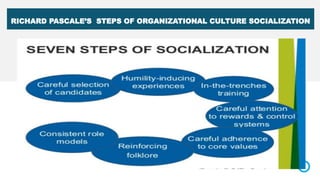
RICHARD PASCALE’S STEPS OF ORGANIZATIONAL CULTURE SOCIALIZATION
Once an organizational culture is started and begins to develop, there
are a number of practices that can help solidify the acceptance of core
values and ensure that the culture maintains itself. These practices can
be described in terms of several socialization steps.
Selection of Entry-Level Personnel
The first step is the careful selection of entry-level candidates. Using standardized procedures ,
trained recruiters interview candidates and attempt to screen out those whose personal styles and
values do not make a “fit” with the organization’s culture. The newcomers’ and their supervisors’
perceptions of organization culture fit are related to organizational commitment and intention to
leave the organization.
6
Placement on the Job
The second step occurs on the job itself, after the person with a
fit is hired. New personnel are subjected to a careful series of different
experiences whose purpose is to cause them to question the organization’s norms and
values and to decide whether or not they can accept them. For example, many organizations
with strong cultures make it a point to give newly hired personnel more work than they can
handle. Sometimes these assignments are beneath the individual’s abilities
Job Mastery
 Once the initial “cultural shock” is over, the next step is mastery of one’s job. This is typically
done via extensive and carefully reinforced field experience. For example, Japanese firms
typically put new employees through a training program for several years. As personnel move
along their career path, their performance is evaluated, and additional responsibilities are
assigned on the basis of progress. Quite often companies establish a step-by-step approach
to this career plan, which helps reduce efforts by the personnel to use political power or to
take shortcuts in order to get ahead at a faster pace.
Measuring and Rewarding Performance -
The next step of the socialization process consists of meticulous(careful )attention to
measuring operational results and to rewarding individual performance.
Typically, in companies with a strong culture, those who violate cultural norms, such as harsh
handling of a subordinate, are sent to the “penalty box.” This typically involves a lateral move
to a less-desirous location.
8
Adherence to Important Values
The next step involves careful adherence to the firm’s most important values.
Identification with these values helps employees reconcile personal sacrifices brought about by
their membership in the organization. They learn to accept these values and to trust the
organization not to do anything that would hurt them. As Pascale observes: “Placing one’s self ‘at
the mercy’ of an organization imposes real cost.
.
There are long hours of work, missed weekends, bosses one has to endure, criticism that seems
unfair, job assignments and rotations that are inconvenient or undesirable.”
However, the organization attempts to overcome these costs by connecting the
sacrifices to higher human values such as serving society with better products and/or services.
9
Reinforcing the Stories and Folklore
The next step involves reinforcing organizational folklore.
This entails keeping alive stories that validate the organization’s culture and way of doing
things. The folklore helps explain why the organization does things a particular way.
One of the most common forms of folklore is stories with morals the enterprise wants to
reinforce.
Recognition and Promotion
The final step is the recognition and promotion of individuals who have done their jobs
well and who can serve as role models to new people in the organization. By pointing out
these people as winners, the organization encourages others to follow their example.
Role models in strong-culture firms are regarded as the most powerful ongoing training
program of all.
How Employees Learn Culture:
10
1. STORIES- They typically includes narratives about the organization's founder , rule breaking, rags- to- riches
successes , reduction in the workforce, relocation of employees, reactions to past mistakes , and the
organization’s coping.
2.RITUALS – These are repetitive sequences of activities that express & reinforce the key values of the
organization- What goals are most important & which are expendable.
3. MATERIAL SYMBOL- The layout of headquarters, the types of automobiles top executives are given, & the
presence or absence of corporate aircraft are few examples of material symbols.
4 LANGUAGE - Many organizations & subunits within them use language to help members identify with the
culture ,attest to their acceptance of it, & help preserve it. Unique terms describe equipment ,officers, key
individuals, suppliers, customers , or products that relate to the business . New employees may be
overwhelmed by acronyms & jargon that once assimilated, act as a common denominator to unite
members of a given culture or subculture.
THANK YOU!

Socialization

  • 1.
    Socialization – processfor keeping organization culture alive
  • 2.
    Socialization refers tothe developmental processes through which individuals acquire the values, behaviors and motivation necessary to become competent member of a organisation. Socialization is a lifelong process of inheriting norms , values and ideologies, providing an individual with the skills & habits ,it is thus the means by which social & cultural continuity are attained. The process of socialization has an impact on the new employee’s work productivity, commitment to the organization's objectives, and eventual decision to stay with the organization New employees go to the web portal to learn about the company & engage in some activities that help them understand the culture of the organization. After they start work, they continue to learn about org. through an ongoing Social networking applications that links new workers with more established members of the firm and helps ensure that culture is transmitted over time. Socialization 2
  • 3.
    3 STAGES : Pre arrival– The period of learning in the socialization process that occurs Before a new employee joins the org. Encounter stage – The stage in the Socialization process in which a new Employee sees what the org is really Like & confronts the possibility that expectation and reality may diverge. Metamorphosis – It is the final stage of the socialization process and this is when the employee has finally made the transition from being outsider to an insider.
  • 4.
    4 RICHARD PASCALE’S STEPSOF ORGANIZATIONAL CULTURE SOCIALIZATION
  • 5.
    Once an organizationalculture is started and begins to develop, there are a number of practices that can help solidify the acceptance of core values and ensure that the culture maintains itself. These practices can be described in terms of several socialization steps.
  • 6.
    Selection of Entry-LevelPersonnel The first step is the careful selection of entry-level candidates. Using standardized procedures , trained recruiters interview candidates and attempt to screen out those whose personal styles and values do not make a “fit” with the organization’s culture. The newcomers’ and their supervisors’ perceptions of organization culture fit are related to organizational commitment and intention to leave the organization. 6 Placement on the Job The second step occurs on the job itself, after the person with a fit is hired. New personnel are subjected to a careful series of different experiences whose purpose is to cause them to question the organization’s norms and values and to decide whether or not they can accept them. For example, many organizations with strong cultures make it a point to give newly hired personnel more work than they can handle. Sometimes these assignments are beneath the individual’s abilities
  • 7.
    Job Mastery  Oncethe initial “cultural shock” is over, the next step is mastery of one’s job. This is typically done via extensive and carefully reinforced field experience. For example, Japanese firms typically put new employees through a training program for several years. As personnel move along their career path, their performance is evaluated, and additional responsibilities are assigned on the basis of progress. Quite often companies establish a step-by-step approach to this career plan, which helps reduce efforts by the personnel to use political power or to take shortcuts in order to get ahead at a faster pace. Measuring and Rewarding Performance - The next step of the socialization process consists of meticulous(careful )attention to measuring operational results and to rewarding individual performance. Typically, in companies with a strong culture, those who violate cultural norms, such as harsh handling of a subordinate, are sent to the “penalty box.” This typically involves a lateral move to a less-desirous location.
  • 8.
    8 Adherence to ImportantValues The next step involves careful adherence to the firm’s most important values. Identification with these values helps employees reconcile personal sacrifices brought about by their membership in the organization. They learn to accept these values and to trust the organization not to do anything that would hurt them. As Pascale observes: “Placing one’s self ‘at the mercy’ of an organization imposes real cost. . There are long hours of work, missed weekends, bosses one has to endure, criticism that seems unfair, job assignments and rotations that are inconvenient or undesirable.” However, the organization attempts to overcome these costs by connecting the sacrifices to higher human values such as serving society with better products and/or services.
  • 9.
    9 Reinforcing the Storiesand Folklore The next step involves reinforcing organizational folklore. This entails keeping alive stories that validate the organization’s culture and way of doing things. The folklore helps explain why the organization does things a particular way. One of the most common forms of folklore is stories with morals the enterprise wants to reinforce. Recognition and Promotion The final step is the recognition and promotion of individuals who have done their jobs well and who can serve as role models to new people in the organization. By pointing out these people as winners, the organization encourages others to follow their example. Role models in strong-culture firms are regarded as the most powerful ongoing training program of all.
  • 10.
    How Employees LearnCulture: 10 1. STORIES- They typically includes narratives about the organization's founder , rule breaking, rags- to- riches successes , reduction in the workforce, relocation of employees, reactions to past mistakes , and the organization’s coping. 2.RITUALS – These are repetitive sequences of activities that express & reinforce the key values of the organization- What goals are most important & which are expendable. 3. MATERIAL SYMBOL- The layout of headquarters, the types of automobiles top executives are given, & the presence or absence of corporate aircraft are few examples of material symbols. 4 LANGUAGE - Many organizations & subunits within them use language to help members identify with the culture ,attest to their acceptance of it, & help preserve it. Unique terms describe equipment ,officers, key individuals, suppliers, customers , or products that relate to the business . New employees may be overwhelmed by acronyms & jargon that once assimilated, act as a common denominator to unite members of a given culture or subculture.
  • 11.