
1Reported by:
Christopher Abne
SOCIALIZATION
APPROACHES
Introduction
Organizational “comings and
goings,” becomes useful to
understand the processes through
which individuals and
organizations adapt to each other.
Assimilationto referto “those ongoing
behavioural and cognitive processes by
which individuals join, become integrated
into, and exit organizations”.
(Jablin & Krone, 1987)
Assimilation is a dual
process.
SOCIALIZATION PROCESS
theorganizationis tryingto influencethe
adaptationof individuals throughformal
andinformal processes.
example:
when an individual learns about the requirements of the job
decides that dressing formally will help him fit into the
organizational culture.
INDIVIDUALIZATION PROCESS
anemployeemaytryto changesome
aspect of theorganizationto better
suit herneeds, abilities, ordesires.
example:
if a new employee develops an improved strategy for
collecting payments on overdue accounts
if a group of new employees starts a new tradition of
going out for beers on Friday after work.
MODELS OF ORGANIZATIONAL
SOCIALIZATION
Phases of Socialization
Content of Socialization
Anticipatory Socialization

Encounter
Metamorphosis

Two classes of information
role-related information
cultural information


Anticipatory Socialization
(Van Maanen, 1975)
 refers to socialization processes
that occur before an individual
actually enters an organization
Phases of Socialization
 learningabout workingeneral

participating in household chores

completing school assignments

part-time employment during the teen years

through interactions with friends

through media contact
Several aspects:
 learningabout aparticularoccupation
 involves ideas about the nature of specific careers and occupations
 learningabout aparticularorganization

go through the ritual of interviewing with prospective employers through
the campus placement center and investigate possible job sites through
the internet
Encounter
 encompasses learning about a new
organization and role and letting go of
old values, expectations, and behaviors
 involves extensive information-seeking
on the part of the employee
 Thesecondphaseof socializationoccurs at the
organizational “point of entry”, whenanew employee
first encounters lifeonthejob.
 Theencounterexperienceas oneof change, contrast, andsurprise,
andsheargues that thenewcomermust workto makesenseof the
new organizationalculture.
 Inorderto interpret lifeinthenew organization,
thenewcomerrelies onpredispositions, past
experiences, andtheinterpretations of others.
Metamorphosis
 the new employee has made the
transition from outsider to insider
 Thenew employeebegins tobecomeanaccepted,
participatingmemberof theorganizationbylearning
new behaviors andattitudes and/ormodifyingexisting
ones
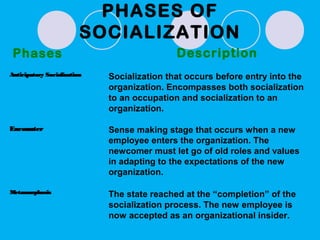
Anticipatory Socialization Socialization that occurs before entry into the
organization. Encompasses both socialization
to an occupation and socialization to an
organization.
PHASES OF
SOCIALIZATION
Encounter
Metamorphosis
Sense making stage that occurs when a new
employee enters the organization. The
newcomer must let go of old roles and values
in adapting to the expectations of the new
organization.
The state reached at the “completion” of the
socialization process. The new employee is
now accepted as an organizational insider.
Phases Description
Anticipatory Socialization
Encounter
Metamorphosis
 what must be learned in order to
adapt to the organizational context
Content of Socialization

Two classes of information
role-related information
cultural information


 Role-relatedinformation
encompasses the information, skills, procedures, and
rules that an individual must grasp to perform on the
job
Example:
A new secretary might need to learn about the
organization’s word-processing programs, filing
system, and bookkeeping procedures to adapt to his
role in the organization.
 Culturalinformation
A new organizational member must learn about the
organizational culture
 a“thing”that belongs to anorganization
Example:
Deal and Kennedy’s “Strong Cultures”
 Values are the beliefs and visions
 Heroes are the individuals who come to exemplify an
organization’s values
 Rites and rituals are the ceremonies through which an
organization celebrates its values
 Cultural network is the communication system through
which cultural values are instituted and reinforced
 The Employment Interview
• Recruiting and Screening Tool
• Information-Gathering Tool
• Tool forSocialization
 Newcomer Information-Seeking Tactics
 Role-Development Processes
• Role-Taking Phase
• Role-Making Phase
• Role-Routinization Phase
• Beyond the Leadership Dyad
 Technology and Socialization
COMMUNICATION PROCESSES DURING
SOCIALIZATION
TheEmployment Interview
the most widely used to recruit and screen
new employees
an important step in the anticipatory
socialization process
 threebasic functions:
Recruiting and Screening Tool
Information-Gathering Tool
Tool forSocialization
NewcomerInformation-SeekingTactics
newcomers actively seek information that will help
them adapt to their new roles and the norms and values
of the organizational culture
adaptation of newcomers occurs primarily during the
encounter phase of socialization
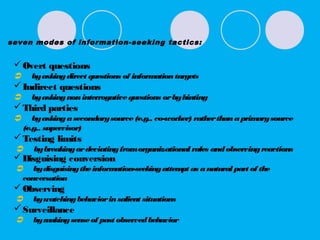
seven modes of information-seeking tactics:
Overt questions
 byaskingdirect questions of informationtargets
Indirect questions
 byaskingnoninterrogativequestions orbyhinting
Third parties
 byaskingasecondarysource(e.g., co-worker) ratherthanaprimarysource
(e.g., supervisor)
Testing limits
 bybreakingordeviatingfromorganizational rules andobservingreactions
Disguising conversion
 bydisguisingtheinformation-seekingattempt as anaturalpart of the
conversation
Observing
 bywatchingbehaviorinsalient situations
Surveillance
 bymakingsenseof past observedbehavior
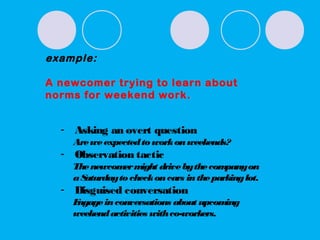
example:
A newcomer trying to learn about
norms for weekend work.
- Asking an overt question
Areweexpectedto workonweekends?
- Observation tactic
Thenewcomermight drivebythecompanyon
aSaturdayto checkoncars intheparkinglot.
- Disguised conversation
Engageinconversations about upcoming
weekendactivities withco-workers.
Role-Development Process
how individuals interact to define and develop their
organizational roles
begins at organizational entry and continues through
ongoing interactions with the supervisor and other
organizational members (metamorphosis stage of
socialization)
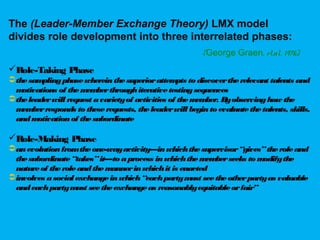
Role-Taking Phase
thesamplingphasewhereinthesuperiorattempts to discovertherelevant talents and
motivations of thememberthroughiterativetestingsequences
theleaderwill request avarietyof activities of themember. Byobservinghow the
memberresponds to theserequests, theleaderwill beginto evaluatethetalents, skills,
andmotivationof thesubordinate
Role-Making Phase
anevolutionfromtheone-wayactivity—inwhichthesupervisor“gives”theroleand
thesubordinate“takes”it—to aprocess inwhichthememberseeks to modifythe
natureof theroleandthemannerinwhichit is enacted
involves asocial exchangeinwhich“eachpartymust seetheotherpartyas valuable
andeachpartymust seetheexchangeas reasonablyequitableorfair”
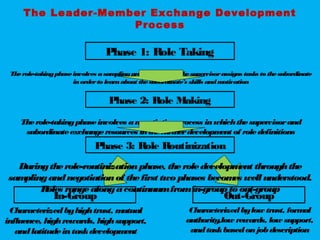
The (Leader-Member Exchange Theory) LMX model
divides role development into three interrelated phases:
(George Graen, et.al. 1976)
Role-Routinization Phase
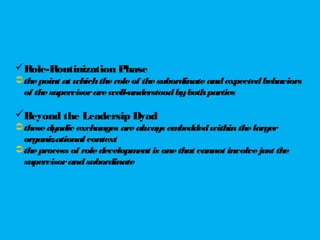
thepoint at whichtheroleof thesubordinateandexpectedbehaviors
of thesupervisorarewell-understoodbybothparties
Beyond the Leadersip Dyad
thesedyadic exchanges arealways embeddedwithinthelarger
organizational context
theprocess of roledevelopment is onethat cannot involvejust the
supervisorandsubordinate
Phase 1: Role Taking
Phase 2: Role Making
Phase 3: Role Routinization
In-Group Out-Group
Therole-takingphaseinvolves asamplingprocess inwhichthesupervisorassigns tasks tothesubordinate
inorderto learnabout thesubordinate’s skills andmotivation
Therole-takingphaseinvolves anegotiationprocess inwhichthesupervisorand
subordinateexchangeresources inthefurtherdevelopment of roledefinitions
Duringtherole-routinizationphase, theroledevelopment throughthe
samplingandnegotiationof thefirst two phases becomes well understood.
Roles rangealongacontinuumfromin-groupto out-group
Characterizedbyhightrust, mutual
influence, highrewards, highsupport,
andlatitudeintaskdevelopment
Characterizedbylow trust, formal
authority,low rewards, low support,
andtaskbasedonjobdescription
The Leader-Member Exchange Development
Process
TechnologyandSocialization
In applications online, some organizations use a “data
extractor” to determine if you’re a good match for the
company and job.
Once employed, communication technology can
enhance socialization by improving information search
procedures and through relationship building with social
networking applications.
Few generalizations about communicationduringtheexit process:
Likeorganizational entry, organizational exit is aprocess, not an
event. Individuals oftenanticipatetheirexit fromanorganization.

perhaps formanyyears (inthecaseof retirement)

forshortertimespans (inthecaseof jobtransfers)

layoffs (inthecaseof endof contract/bankrupcy)
 Organizational Disengagement
Retirement
Resignation
ORGANIZATIONAL EXIT
Organizationalexit is aprocess that influences boththosewho leave
andthosewho are“left behind.”
Communicationplays acriticalrole
inthedisengagement process.
Organizationalexit canhaveprofound
effects onthefamilies of thosewho leave
theorganization.
Conflict and Communication
Conflict
exists whenpeoplewho dependoneach
otherhavedifferent views, interests, values,
responsibilities, orobjectives andperceive
theirdifferences as incompatible.
Conflict and Communication
Examples:
 co-workers argue because they care about issues that affect all of
them;
 roommates experience conflict if they disagree about noise levels
in their room;
 romantic partners engage in conflict when they face tensions and
disagreements that jeopardize their relationship
Conflict can be:
Overt orCovert
ManagedWellorPoorly
Conflict can be Overt or Covert
 Overt conflict e xists whe n pe o ple e xpre ss diffe re nce s
in a straig htfo rward m anne r.
They might discuss a disagreement, honestly express different points of
view, or argue heatedly about ideas.
 Covert conflict e xists whe n pe o ple e xpre ss
disag re e m e nt o r diffe re nce o nly indire ctly.
If you’re annoyed that your roommate left the kitchen a mess, you might
play the stereo when she or he is sleeping.
Conflict can be Managed Well or Poorly
Clyde Feldman and Carl Ridley (2000) identify four key components
of the conflict process.
Conflicts of interest
Goals, interests, oropinionsthatseemincompatible
Conflict orientations
Individuals’ attitudestowardconflict
Conflict responses
Overtbehaviouralresponsestoconflict
Conflict outcomes
Howconflictismanagedandhowtheprocessofconflictaffectsrelationshipsbetween
people
Conflicts of Interest
Goals, interests, orviewsthatareperceivedasincompatible
Examples:

You want t o set up a t ime each day when you and a
f riend will bot h be online f or inst ant messages, but
your f riend doesn’t want t o do t hat .

You believe money should be enj oyed, and your
part ner believes in saving f or a rainy day.

You want your t eam t o meet t wice weekly, and
anot her member of t he t eam want s t o meet only
mont hly.
Conflicts Orientations
Howweperceivedconflict.
Three distinct orientations:

Los e – Los e Approach result s in
losses f or everyone.

Wi n – Los e Approach one person
wins at t he expense of t he ot her.

Wi n – Wi n Approach t here are
usually ways t o resolve dif f erences so
t hat everyone gains.
Conflicts Responses
Howweresponsetoit.

active or passive dependingonwhethertheyaddressthe
problems.

constructive or destructive intheireffecton
relationship
Four responses to conflict:

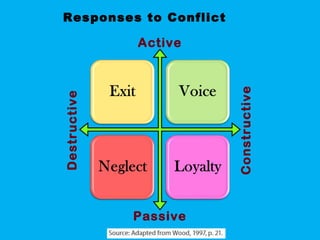
Exi t res pons e

Negl ect res pons e

Loyal t y res pons e

Voi ce
Fourresponses:

Exi t res pons e involves leaving a
relat ionship, eit her by walking out or by
psychological wit hdrawing.
 Active – becauseitisforceful

Destructive – itfailstoresolvetension

Negl ect res pons e occurs when a
person denies or minimizes problems.

Passive – becauseitdoesn’tactivelypromotediscussion

Destructive – itevadesdifficulties
Fourresponses:

Loyal t y res pons e is st aying commit t ed t o a
relat ionship despit e dif f erences.
 Passive – becauseitissilentallegiance

Constructive – becauseitdoesn’tendarelationshipandpreservestheoptionofaddressing
tensionlater

Voi ce occurs when a person denies or
minimizes problems.

Active (potentiallythemostactive)– becauseitfocusesondealingdirectlywithproblems

Constructive – becauseitistryingtohelptherelationshipbymanagingdifferences
Active
Constructive
Destructive
Passive
Responses to Conflict
Conflicts Outcomes
Thefinalcomponentofconflictistheoutcome.

A conflict’s impact on a relationship may be a more signif icant
and enduring out come t han t he act ual decision.

Relationship outcomes are inf luenced more by how we manage
conf lict t han by t he resolut ion it self .

Managed constructively, conf lict can help us grow personally and
prof essionally, and it can st rengt hen our connect ions wit h ot hers.

Conf lict can also increase our insight int o relat ionships, sit uat ions,
and ourselves.
THANK YOU!!!

Socialization Approaches

  • 1.
  • 2.
    Introduction Organizational “comings and goings,”becomes useful to understand the processes through which individuals and organizations adapt to each other. Assimilationto referto “those ongoing behavioural and cognitive processes by which individuals join, become integrated into, and exit organizations”. (Jablin & Krone, 1987)
  • 3.
    Assimilation is adual process. SOCIALIZATION PROCESS theorganizationis tryingto influencethe adaptationof individuals throughformal andinformal processes. example: when an individual learns about the requirements of the job decides that dressing formally will help him fit into the organizational culture.
  • 4.
    INDIVIDUALIZATION PROCESS anemployeemaytryto changesome aspectof theorganizationto better suit herneeds, abilities, ordesires. example: if a new employee develops an improved strategy for collecting payments on overdue accounts if a group of new employees starts a new tradition of going out for beers on Friday after work.
  • 5.
    MODELS OF ORGANIZATIONAL SOCIALIZATION Phasesof Socialization Content of Socialization Anticipatory Socialization  Encounter Metamorphosis  Two classes of information role-related information cultural information  
  • 6.
    Anticipatory Socialization (Van Maanen,1975)  refers to socialization processes that occur before an individual actually enters an organization Phases of Socialization
  • 7.
     learningabout workingeneral  participatingin household chores  completing school assignments  part-time employment during the teen years  through interactions with friends  through media contact Several aspects:  learningabout aparticularoccupation  involves ideas about the nature of specific careers and occupations  learningabout aparticularorganization  go through the ritual of interviewing with prospective employers through the campus placement center and investigate possible job sites through the internet
  • 8.
    Encounter  encompasses learningabout a new organization and role and letting go of old values, expectations, and behaviors  involves extensive information-seeking on the part of the employee
  • 9.
     Thesecondphaseof socializationoccursat the organizational “point of entry”, whenanew employee first encounters lifeonthejob.  Theencounterexperienceas oneof change, contrast, andsurprise, andsheargues that thenewcomermust workto makesenseof the new organizationalculture.  Inorderto interpret lifeinthenew organization, thenewcomerrelies onpredispositions, past experiences, andtheinterpretations of others.
  • 10.
    Metamorphosis  the newemployee has made the transition from outsider to insider  Thenew employeebegins tobecomeanaccepted, participatingmemberof theorganizationbylearning new behaviors andattitudes and/ormodifyingexisting ones
  • 11.
    Anticipatory Socialization Socializationthat occurs before entry into the organization. Encompasses both socialization to an occupation and socialization to an organization. PHASES OF SOCIALIZATION Encounter Metamorphosis Sense making stage that occurs when a new employee enters the organization. The newcomer must let go of old roles and values in adapting to the expectations of the new organization. The state reached at the “completion” of the socialization process. The new employee is now accepted as an organizational insider. Phases Description Anticipatory Socialization Encounter Metamorphosis
  • 12.
     what mustbe learned in order to adapt to the organizational context Content of Socialization  Two classes of information role-related information cultural information  
  • 13.
     Role-relatedinformation encompasses theinformation, skills, procedures, and rules that an individual must grasp to perform on the job Example: A new secretary might need to learn about the organization’s word-processing programs, filing system, and bookkeeping procedures to adapt to his role in the organization.
  • 14.
     Culturalinformation A neworganizational member must learn about the organizational culture  a“thing”that belongs to anorganization Example: Deal and Kennedy’s “Strong Cultures”  Values are the beliefs and visions  Heroes are the individuals who come to exemplify an organization’s values  Rites and rituals are the ceremonies through which an organization celebrates its values  Cultural network is the communication system through which cultural values are instituted and reinforced
  • 15.
     The EmploymentInterview • Recruiting and Screening Tool • Information-Gathering Tool • Tool forSocialization  Newcomer Information-Seeking Tactics  Role-Development Processes • Role-Taking Phase • Role-Making Phase • Role-Routinization Phase • Beyond the Leadership Dyad  Technology and Socialization COMMUNICATION PROCESSES DURING SOCIALIZATION
  • 16.
    TheEmployment Interview the mostwidely used to recruit and screen new employees an important step in the anticipatory socialization process  threebasic functions: Recruiting and Screening Tool Information-Gathering Tool Tool forSocialization
  • 17.
    NewcomerInformation-SeekingTactics newcomers actively seekinformation that will help them adapt to their new roles and the norms and values of the organizational culture adaptation of newcomers occurs primarily during the encounter phase of socialization
  • 18.
    seven modes ofinformation-seeking tactics: Overt questions  byaskingdirect questions of informationtargets Indirect questions  byaskingnoninterrogativequestions orbyhinting Third parties  byaskingasecondarysource(e.g., co-worker) ratherthanaprimarysource (e.g., supervisor) Testing limits  bybreakingordeviatingfromorganizational rules andobservingreactions Disguising conversion  bydisguisingtheinformation-seekingattempt as anaturalpart of the conversation Observing  bywatchingbehaviorinsalient situations Surveillance  bymakingsenseof past observedbehavior
  • 19.
    example: A newcomer tryingto learn about norms for weekend work. - Asking an overt question Areweexpectedto workonweekends? - Observation tactic Thenewcomermight drivebythecompanyon aSaturdayto checkoncars intheparkinglot. - Disguised conversation Engageinconversations about upcoming weekendactivities withco-workers.
  • 20.
    Role-Development Process how individualsinteract to define and develop their organizational roles begins at organizational entry and continues through ongoing interactions with the supervisor and other organizational members (metamorphosis stage of socialization)
  • 21.
    Role-Taking Phase thesamplingphasewhereinthesuperiorattempts todiscovertherelevant talents and motivations of thememberthroughiterativetestingsequences theleaderwill request avarietyof activities of themember. Byobservinghow the memberresponds to theserequests, theleaderwill beginto evaluatethetalents, skills, andmotivationof thesubordinate Role-Making Phase anevolutionfromtheone-wayactivity—inwhichthesupervisor“gives”theroleand thesubordinate“takes”it—to aprocess inwhichthememberseeks to modifythe natureof theroleandthemannerinwhichit is enacted involves asocial exchangeinwhich“eachpartymust seetheotherpartyas valuable andeachpartymust seetheexchangeas reasonablyequitableorfair” The (Leader-Member Exchange Theory) LMX model divides role development into three interrelated phases: (George Graen, et.al. 1976)
  • 22.
    Role-Routinization Phase thepoint atwhichtheroleof thesubordinateandexpectedbehaviors of thesupervisorarewell-understoodbybothparties Beyond the Leadersip Dyad thesedyadic exchanges arealways embeddedwithinthelarger organizational context theprocess of roledevelopment is onethat cannot involvejust the supervisorandsubordinate
  • 23.
    Phase 1: RoleTaking Phase 2: Role Making Phase 3: Role Routinization In-Group Out-Group Therole-takingphaseinvolves asamplingprocess inwhichthesupervisorassigns tasks tothesubordinate inorderto learnabout thesubordinate’s skills andmotivation Therole-takingphaseinvolves anegotiationprocess inwhichthesupervisorand subordinateexchangeresources inthefurtherdevelopment of roledefinitions Duringtherole-routinizationphase, theroledevelopment throughthe samplingandnegotiationof thefirst two phases becomes well understood. Roles rangealongacontinuumfromin-groupto out-group Characterizedbyhightrust, mutual influence, highrewards, highsupport, andlatitudeintaskdevelopment Characterizedbylow trust, formal authority,low rewards, low support, andtaskbasedonjobdescription The Leader-Member Exchange Development Process
  • 24.
    TechnologyandSocialization In applications online,some organizations use a “data extractor” to determine if you’re a good match for the company and job. Once employed, communication technology can enhance socialization by improving information search procedures and through relationship building with social networking applications.
  • 25.
    Few generalizations aboutcommunicationduringtheexit process: Likeorganizational entry, organizational exit is aprocess, not an event. Individuals oftenanticipatetheirexit fromanorganization.  perhaps formanyyears (inthecaseof retirement)  forshortertimespans (inthecaseof jobtransfers)  layoffs (inthecaseof endof contract/bankrupcy)  Organizational Disengagement Retirement Resignation ORGANIZATIONAL EXIT
  • 26.
    Organizationalexit is aprocessthat influences boththosewho leave andthosewho are“left behind.” Communicationplays acriticalrole inthedisengagement process. Organizationalexit canhaveprofound effects onthefamilies of thosewho leave theorganization.
  • 27.
  • 28.
    Conflict exists whenpeoplewho dependoneach otherhavedifferentviews, interests, values, responsibilities, orobjectives andperceive theirdifferences as incompatible. Conflict and Communication Examples:  co-workers argue because they care about issues that affect all of them;  roommates experience conflict if they disagree about noise levels in their room;  romantic partners engage in conflict when they face tensions and disagreements that jeopardize their relationship
  • 29.
    Conflict can be: OvertorCovert ManagedWellorPoorly Conflict can be Overt or Covert  Overt conflict e xists whe n pe o ple e xpre ss diffe re nce s in a straig htfo rward m anne r. They might discuss a disagreement, honestly express different points of view, or argue heatedly about ideas.  Covert conflict e xists whe n pe o ple e xpre ss disag re e m e nt o r diffe re nce o nly indire ctly. If you’re annoyed that your roommate left the kitchen a mess, you might play the stereo when she or he is sleeping.
  • 30.
    Conflict can beManaged Well or Poorly Clyde Feldman and Carl Ridley (2000) identify four key components of the conflict process. Conflicts of interest Goals, interests, oropinionsthatseemincompatible Conflict orientations Individuals’ attitudestowardconflict Conflict responses Overtbehaviouralresponsestoconflict Conflict outcomes Howconflictismanagedandhowtheprocessofconflictaffectsrelationshipsbetween people
  • 31.
    Conflicts of Interest Goals,interests, orviewsthatareperceivedasincompatible Examples:  You want t o set up a t ime each day when you and a f riend will bot h be online f or inst ant messages, but your f riend doesn’t want t o do t hat .  You believe money should be enj oyed, and your part ner believes in saving f or a rainy day.  You want your t eam t o meet t wice weekly, and anot her member of t he t eam want s t o meet only mont hly.
  • 32.
    Conflicts Orientations Howweperceivedconflict. Three distinctorientations:  Los e – Los e Approach result s in losses f or everyone.  Wi n – Los e Approach one person wins at t he expense of t he ot her.  Wi n – Wi n Approach t here are usually ways t o resolve dif f erences so t hat everyone gains.
  • 33.
    Conflicts Responses Howweresponsetoit.  active orpassive dependingonwhethertheyaddressthe problems.  constructive or destructive intheireffecton relationship Four responses to conflict:  Exi t res pons e  Negl ect res pons e  Loyal t y res pons e  Voi ce
  • 34.
    Fourresponses:  Exi t respons e involves leaving a relat ionship, eit her by walking out or by psychological wit hdrawing.  Active – becauseitisforceful  Destructive – itfailstoresolvetension  Negl ect res pons e occurs when a person denies or minimizes problems.  Passive – becauseitdoesn’tactivelypromotediscussion  Destructive – itevadesdifficulties
  • 35.
    Fourresponses:  Loyal t yres pons e is st aying commit t ed t o a relat ionship despit e dif f erences.  Passive – becauseitissilentallegiance  Constructive – becauseitdoesn’tendarelationshipandpreservestheoptionofaddressing tensionlater  Voi ce occurs when a person denies or minimizes problems.  Active (potentiallythemostactive)– becauseitfocusesondealingdirectlywithproblems  Constructive – becauseitistryingtohelptherelationshipbymanagingdifferences
  • 36.
  • 37.
    Conflicts Outcomes Thefinalcomponentofconflictistheoutcome.  A conflict’simpact on a relationship may be a more signif icant and enduring out come t han t he act ual decision.  Relationship outcomes are inf luenced more by how we manage conf lict t han by t he resolut ion it self .  Managed constructively, conf lict can help us grow personally and prof essionally, and it can st rengt hen our connect ions wit h ot hers.  Conf lict can also increase our insight int o relat ionships, sit uat ions, and ourselves.
  • 38.