Building a Social Platform
with MongoDB
MongoDB Inc
Darren Wood & Asya Kamsky
#MongoDBWorld
Building a Social Platform
Part 2:
Managing the Social Graph
Socialite
• Open Source
• Reference Implementation
– Various Fanout Feed Models
– User Graph Implementation
– Content storage
• Configurable models and options
• REST API in Dropwizard (Yammer)
– https://dropwizard.github.io/dropwizard/
• Built-in benchmarking
https://github.com/10gen-labs/socialite
Architecture
GraphServiceProxy
ContentProxy
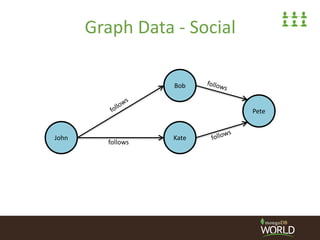
Graph Data - Social
John Kate
follows
Bob
Pete
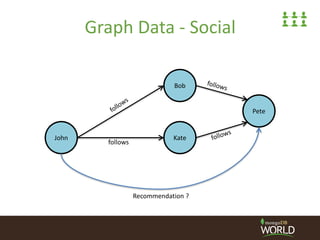
Graph Data - Social
John Kate
follows
Bob
Pete
Recommendation ?
Graph Data - Promotional
John Kate
follows
Bob
Pete
Acme
Soda
Mention
Recommendation ?
Graph Data - Everywhere
• Retail
• Complex product catalogues
• Product recommendation engines
• Manufacturing and Logistics
• Tracing failures to faulty component batches
• Determining fallout from supply interruption
• Healthcare
• Patient/Physician interactions
Design Considerations
The Tale of Two Biebers
VS
The Tale of Two Biebers
VS
Follower Churn
• Tempting to focus on scaling content
• Follow requests rival message send rates
• Twitter enforces per day follow limits
Edge Metadata
• Models – friends/followers
• Requirements typically start simple
• Add Groups, Favorites, Relationships
Storing Graphs in MongoDB
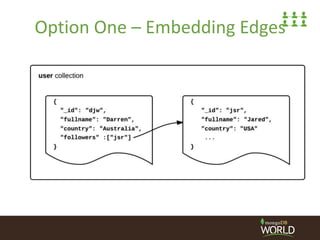
Option One – Embedding Edges
Embedded Edge Arrays
• Storing connections with user (popular choice)
 Most compact form
 Efficient for reads
• However….
– User documents grow
– Upper limit on degree (document size)
– Difficult to annotate (and index) edge
{
"_id" : "djw",
"fullname" : "Darren Wood",
"country" : "Australia",
"followers" : [ "jsr", "ian"],
"following" : [ "jsr", "pete"]
}
Embedded Edge Arrays
• Creating Rich Graph Information
– Can become cumbersome
{
"_id" : "djw",
"fullname" : "Darren Wood",
"country" : "Australia",
"friends" : [
{"uid" : "jsr", "grp" : "school"},
{"uid" : "ian", "grp" : "work"} ]
}
{
"_id" : "djw",
"fullname" : "Darren Wood",
"country" : "Australia",
"friends" : [ "jsr", "ian"],
"group" : [ ”school", ”work"]
}
Option Two – Edge Collection
Edge Collections
• Document per edge
• Very flexible for adding edge data
> db.followers.findOne()
{
"_id" : ObjectId(…),
"from" : "djw",
"to" : "jsr"
}
> db.friends.findOne()
{
"_id" : ObjectId(…),
"from" : "djw",
"to" : "jsr",
"grp" : "work",
"ts" : Date("2013-07-10")
}
Operational issues
• Updates of embedded arrays
– grow non-linearly with number of indexed array
elements
• Updating edge collection => inserts
– grows close to linearly with existing number of
edges/user
Edge Insert Rate
Edge Collection
Indexing Strategies
Finding Followers
Consider our single followercollection :
> db.followers.find({from : "djw"}, {_id:0, to:1})
{
"to" : "jsr"
}
Using index :
{
"v" : 1,
"key" : { "from" : 1, "to" : 1 },
"unique" : true,
"ns" : "socialite.followers",
"name" : "from_1_to_1"
}
Covered index when
searching on "from"
for all followers
Specify only if
multiple edges cannot
exist
Finding Following
What about who a user is following?
Can use a reverse covered index :
{
"v" : 1,
"key" : { "from" : 1, "to" : 1 },
"unique" : true,
"ns" : "socialite.followers",
"name" : "from_1_to_1"
}
{
"v" : 1,
"key" : { "to" : 1, "from" : 1 },
"unique" : true,
"ns" : "socialite.followers",
"name" : "to_1_from_1"
}
Notice the flipped
field order here
Finding Following
Wait ! There is an issue with the reverse index…..
SHARDING !
{
"v" : 1,
"key" : { "from" : 1, "to" : 1 },
"unique" : true,
"ns" : "socialite.followers",
"name" : "from_1_to_1"
}
{
"v" : 1,
"key" : { "to" : 1, "from" : 1 },
"unique" : true,
"ns" : "socialite.followers",
"name" : "to_1_from_1"
}
If we shard this collection by
"from", looking up followers
for a specific user is
"targeted" to a shard
To find who the user is
following however, it must
scatter-gather the query to
all shards
Dual Edge Collections
When "following" queries are common
– Not always the case
– Consider overhead carefully
Can use dual collections storing
– One for each direction
– Edges are duplicated reversed
– Can be sharded independently
Edge Query Rate Comparison
Number of shards
vs
Number of queries
Followers collection
with forward and
reverse indexes
Two collections,
followers, following
one index each
1 10,000 10,000
3 90,000 30,000
6 360,000 60,000
12 1,440,000 120,000
Follower Counts
Can use the edge indexes :
How to determine these counts ?
> db.followers.find({_f : "djw"}).count()
> db.following.find({_f : "djw"}).count()
However this can be heavy weight
- Especially for rendering landing page
- Consider maintaining counts on user document
Socialite User Service
• Manages user profiles and the follower graph
• Supports arbitrary user data passthrough
• Options for graph storage
– Uses edge collections (can shard by _f)
– Options for maintaining separate follower/ing graphs
– Storing counts vs counting
{
"_id" : ObjectId("52cd1d32a0ee9a1a76d369bb"),
"_f" : "jsr",
"_t" : "djw"
}
{
"v" : 1,
"key" : {"_f" : 1, "_t" : 1},
"unique" : true,
}
Next up @ 11:50am :
Scaling the Data Feed
• Delivering user content to followers
• Comparing fanout models
• Caching user timelines for fast retrieval
• Embedding vs Linking Content
Building a Social Platform
with MongoDB
MongoDB Inc
Darren Wood & Asya Kamsky
#MongoDBWorld

Socialite, the Open Source Status Feed Part 2: Managing the Social Graph

  • 1.
    Building a SocialPlatform with MongoDB MongoDB Inc Darren Wood & Asya Kamsky #MongoDBWorld
  • 2.
    Building a SocialPlatform Part 2: Managing the Social Graph
  • 3.
    Socialite • Open Source •Reference Implementation – Various Fanout Feed Models – User Graph Implementation – Content storage • Configurable models and options • REST API in Dropwizard (Yammer) – https://dropwizard.github.io/dropwizard/ • Built-in benchmarking https://github.com/10gen-labs/socialite
  • 4.
  • 5.
    Graph Data -Social John Kate follows Bob Pete
  • 6.
    Graph Data -Social John Kate follows Bob Pete Recommendation ?
  • 7.
    Graph Data -Promotional John Kate follows Bob Pete Acme Soda Mention Recommendation ?
  • 8.
    Graph Data -Everywhere • Retail • Complex product catalogues • Product recommendation engines • Manufacturing and Logistics • Tracing failures to faulty component batches • Determining fallout from supply interruption • Healthcare • Patient/Physician interactions
  • 9.
  • 10.
    The Tale ofTwo Biebers VS
  • 11.
    The Tale ofTwo Biebers VS
  • 12.
    Follower Churn • Temptingto focus on scaling content • Follow requests rival message send rates • Twitter enforces per day follow limits
  • 13.
    Edge Metadata • Models– friends/followers • Requirements typically start simple • Add Groups, Favorites, Relationships
  • 14.
  • 15.
    Option One –Embedding Edges
  • 16.
    Embedded Edge Arrays •Storing connections with user (popular choice)  Most compact form  Efficient for reads • However…. – User documents grow – Upper limit on degree (document size) – Difficult to annotate (and index) edge { "_id" : "djw", "fullname" : "Darren Wood", "country" : "Australia", "followers" : [ "jsr", "ian"], "following" : [ "jsr", "pete"] }
  • 17.
    Embedded Edge Arrays •Creating Rich Graph Information – Can become cumbersome { "_id" : "djw", "fullname" : "Darren Wood", "country" : "Australia", "friends" : [ {"uid" : "jsr", "grp" : "school"}, {"uid" : "ian", "grp" : "work"} ] } { "_id" : "djw", "fullname" : "Darren Wood", "country" : "Australia", "friends" : [ "jsr", "ian"], "group" : [ ”school", ”work"] }
  • 18.
    Option Two –Edge Collection
  • 19.
    Edge Collections • Documentper edge • Very flexible for adding edge data > db.followers.findOne() { "_id" : ObjectId(…), "from" : "djw", "to" : "jsr" } > db.friends.findOne() { "_id" : ObjectId(…), "from" : "djw", "to" : "jsr", "grp" : "work", "ts" : Date("2013-07-10") }
  • 20.
    Operational issues • Updatesof embedded arrays – grow non-linearly with number of indexed array elements • Updating edge collection => inserts – grows close to linearly with existing number of edges/user
  • 21.
  • 22.
  • 23.
    Finding Followers Consider oursingle followercollection : > db.followers.find({from : "djw"}, {_id:0, to:1}) { "to" : "jsr" } Using index : { "v" : 1, "key" : { "from" : 1, "to" : 1 }, "unique" : true, "ns" : "socialite.followers", "name" : "from_1_to_1" } Covered index when searching on "from" for all followers Specify only if multiple edges cannot exist
  • 24.
    Finding Following What aboutwho a user is following? Can use a reverse covered index : { "v" : 1, "key" : { "from" : 1, "to" : 1 }, "unique" : true, "ns" : "socialite.followers", "name" : "from_1_to_1" } { "v" : 1, "key" : { "to" : 1, "from" : 1 }, "unique" : true, "ns" : "socialite.followers", "name" : "to_1_from_1" } Notice the flipped field order here
  • 25.
    Finding Following Wait !There is an issue with the reverse index….. SHARDING ! { "v" : 1, "key" : { "from" : 1, "to" : 1 }, "unique" : true, "ns" : "socialite.followers", "name" : "from_1_to_1" } { "v" : 1, "key" : { "to" : 1, "from" : 1 }, "unique" : true, "ns" : "socialite.followers", "name" : "to_1_from_1" } If we shard this collection by "from", looking up followers for a specific user is "targeted" to a shard To find who the user is following however, it must scatter-gather the query to all shards
  • 26.
  • 27.
    Dual Edge Collections When"following" queries are common – Not always the case – Consider overhead carefully Can use dual collections storing – One for each direction – Edges are duplicated reversed – Can be sharded independently
  • 28.
    Edge Query RateComparison Number of shards vs Number of queries Followers collection with forward and reverse indexes Two collections, followers, following one index each 1 10,000 10,000 3 90,000 30,000 6 360,000 60,000 12 1,440,000 120,000
  • 29.
    Follower Counts Can usethe edge indexes : How to determine these counts ? > db.followers.find({_f : "djw"}).count() > db.following.find({_f : "djw"}).count() However this can be heavy weight - Especially for rendering landing page - Consider maintaining counts on user document
  • 30.
    Socialite User Service •Manages user profiles and the follower graph • Supports arbitrary user data passthrough • Options for graph storage – Uses edge collections (can shard by _f) – Options for maintaining separate follower/ing graphs – Storing counts vs counting { "_id" : ObjectId("52cd1d32a0ee9a1a76d369bb"), "_f" : "jsr", "_t" : "djw" } { "v" : 1, "key" : {"_f" : 1, "_t" : 1}, "unique" : true, }
  • 31.
    Next up @11:50am : Scaling the Data Feed • Delivering user content to followers • Comparing fanout models • Caching user timelines for fast retrieval • Embedding vs Linking Content
  • 32.
    Building a SocialPlatform with MongoDB MongoDB Inc Darren Wood & Asya Kamsky #MongoDBWorld

Editor's Notes

  • #3 Scaling the delivery of posts and content to the follower networks of millions of users has many challenges. In this section we look at the various approaches to fanning out posts and look at a performance comparison between them. We will highlight some tricks for caching the recent timeline of active users to drive down read latency.
  • #4 image at https://dropwizard.github.io/dropwizard of the hat 
  • #13 Tempting to focus on scaling content Follow requests rival message send rates Twitter enforces per day follow limits
  • #16 Single Collection
  • #21 How to test, show how growing documents are very painful to update. Add the MTV or appmetrics mtools plot showing what happens to outliers.
  • #22 actual performance – show how inserting million users was easy – no point even trying to update embedded documents...
  • #24 side-point of
  • #29 NEED TO GENERATE FOR broadcast (scatter gather) for following, direct for followers. Number of total queries by number of shards... TO GET WHOM THE USER IS FOLLOWING
  • #30 talk about real life trade-offs
  • #31 hidden in original