Welcome to my
Presentation on
Social Change
(Evolutionary
Theories)
Hello!I am here to discus about Social Change (Evolutionary Theories)
Definition of Social Change:
By social change is meant only such alteration as occur is social
organization, that I structure and functions of society. - Kingsley
Davis Social change may be defined as a new fashion or mode,
either modifying or replacing the old, in the life a people. -
Majumdar , H.T
on the other hand,
Social change refers to any significant alteration over time in
behavior patterns and cultural values and norms. By “significant”
alteration, sociologists mean changes yielding
profound social consequences.
“Sociologist and social
anthropologist have
proposed a number of
general theories of
social change. The
theories may
conveniently be
grouped into four main
categories
THEORIES OF SOCIAL CHANGE:
1. Evolutionary theories
2. Cyclical theories
3. Conflict theories
4. Functional theories
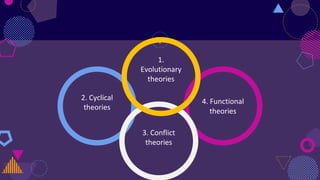
2. Cyclical
theories
4. Functional
theories
3. Conflict
theories
1.
Evolutionary
theories
This is a slide title
◍Here you have a list of items
◍And some text
◍But remember not to overload your
slides with content
Your audience will listen to you or read
the content, but won’t do both.
Evolutionary theories are based on the assumption that societies
gradually change from simple beginnings into even more complex
forms. Early sociologists beginning with Auguste Comte believed that
human societies evolve in a unilinear way- that is in one line of
development. According to them social change meant progress toward
something better. They saw change as positive and beneficial. To them
the evolutionary process implied that societies would necessarily reach
new and higher levels of civilization
1. Evolutionary Theories
2. Cyclical theories:
◍Cyclical theories of social change focus on the rise and fall of civilizations
attempting to discover and account for these patterns of growth and decay.
Spengler, Toynbee and Sorokin can be regarded as the champions of this
theory. Spengler pointed out that the fate of civilizations was a matter of
destiny. Each civilization is like a biological organism and has a similar life-
cycle, birth, maturity, old-age and death. After making a study of eight major
civilizations including the west he said that the modern western society is in
the last stage i.e. old age. He concluded that the western societies were
entering a period of decay as evidenced by wars, conflicts and social
breakdown that heralded their doom.
3. Conflict theories:
◍Whereas the equilibrium theories emphasize the stabilizing processes at
work in social systems the so-called conflict theories highlight the forces
producing instability, struggle and social disorganization. According to Ralf
Dahrendorf the conflict theories assume that - every society is subjected
at every moment to change, hence social change is ubiquitous. Every
society experiences at every moment social conflict, hence social conflict
is ubiquitous. Every element in society contributes to change. Every
society rests on constraint of some of its members by others. The most
famous and influential of the conflict theories is the one put forward by
Karl Marx who along with Engel wrote in Communist Manifesto 'all history
is the history of class conflict.
4. Functionalist or
Dynamic theories:
◍In the middle decades of the 20th century a number of American
sociologists shifted their attention from social dynamics to social static or
from social change to social stability. Talcott Parsons stressed the importance
of cultural patterns in controlling the stability of a society. According to him
society has the ability to absorb disruptive forces while maintaining overall
stability. Change is not as something that disturbs the social equilibrium but
as something that alters the state of equilibrium so that a qualitatively new
equilibrium results. He has stated that changes may arise from two sources.
They may come from outside the society through contact with other societies.
They may also come from inside the society through adjustment that must be
made to resolve strains within the system.
Thank You

Social change And Evaluation theories

  • 1.
    Welcome to my Presentationon Social Change (Evolutionary Theories)
  • 2.
    Hello!I am hereto discus about Social Change (Evolutionary Theories)
  • 3.
    Definition of SocialChange: By social change is meant only such alteration as occur is social organization, that I structure and functions of society. - Kingsley Davis Social change may be defined as a new fashion or mode, either modifying or replacing the old, in the life a people. - Majumdar , H.T on the other hand, Social change refers to any significant alteration over time in behavior patterns and cultural values and norms. By “significant” alteration, sociologists mean changes yielding profound social consequences.
  • 4.
    “Sociologist and social anthropologisthave proposed a number of general theories of social change. The theories may conveniently be grouped into four main categories THEORIES OF SOCIAL CHANGE: 1. Evolutionary theories 2. Cyclical theories 3. Conflict theories 4. Functional theories
  • 5.
    2. Cyclical theories 4. Functional theories 3.Conflict theories 1. Evolutionary theories
  • 6.
    This is aslide title ◍Here you have a list of items ◍And some text ◍But remember not to overload your slides with content Your audience will listen to you or read the content, but won’t do both.
  • 7.
    Evolutionary theories arebased on the assumption that societies gradually change from simple beginnings into even more complex forms. Early sociologists beginning with Auguste Comte believed that human societies evolve in a unilinear way- that is in one line of development. According to them social change meant progress toward something better. They saw change as positive and beneficial. To them the evolutionary process implied that societies would necessarily reach new and higher levels of civilization 1. Evolutionary Theories
  • 8.
    2. Cyclical theories: ◍Cyclicaltheories of social change focus on the rise and fall of civilizations attempting to discover and account for these patterns of growth and decay. Spengler, Toynbee and Sorokin can be regarded as the champions of this theory. Spengler pointed out that the fate of civilizations was a matter of destiny. Each civilization is like a biological organism and has a similar life- cycle, birth, maturity, old-age and death. After making a study of eight major civilizations including the west he said that the modern western society is in the last stage i.e. old age. He concluded that the western societies were entering a period of decay as evidenced by wars, conflicts and social breakdown that heralded their doom.
  • 9.
    3. Conflict theories: ◍Whereasthe equilibrium theories emphasize the stabilizing processes at work in social systems the so-called conflict theories highlight the forces producing instability, struggle and social disorganization. According to Ralf Dahrendorf the conflict theories assume that - every society is subjected at every moment to change, hence social change is ubiquitous. Every society experiences at every moment social conflict, hence social conflict is ubiquitous. Every element in society contributes to change. Every society rests on constraint of some of its members by others. The most famous and influential of the conflict theories is the one put forward by Karl Marx who along with Engel wrote in Communist Manifesto 'all history is the history of class conflict.
  • 10.
    4. Functionalist or Dynamictheories: ◍In the middle decades of the 20th century a number of American sociologists shifted their attention from social dynamics to social static or from social change to social stability. Talcott Parsons stressed the importance of cultural patterns in controlling the stability of a society. According to him society has the ability to absorb disruptive forces while maintaining overall stability. Change is not as something that disturbs the social equilibrium but as something that alters the state of equilibrium so that a qualitatively new equilibrium results. He has stated that changes may arise from two sources. They may come from outside the society through contact with other societies. They may also come from inside the society through adjustment that must be made to resolve strains within the system.
  • 11.