“ THE SOCIAL RESPONSIBILITY OF BUSINESS IS TO INCREASE ITS PROFITS” –  MILTON FRIEDMAN, 1970 –  A CRITICAL ANALYSIS by Cheryl Mayers-Goddard Claire Sargeant  Lisa Haynes  Group 3 of the Durham Caribbean MBA
CONTEXT OF STATEMENT THE STATEMENT: “ The social responsibility of a business is to increase its profits.” (Friedman) THE CONTEXT: Who When Where  Why
Social Responsibility + Profit Definition of Social Responsibility as it relates to Profit  Taking into account “the interests and concerns of a community rather than just its shareholders” (Sloman et al, 2010);  “ a business’ obligation, beyond that required by law and economics, to pursue long-term goals that are good for society” (Robbins et al, 2005);  2 views of the Responsibilties of Corporations in a Social Context:  Classical :  A company is committed solely to increasing the wealth of its  shareholders  Socioeconomic : a company must also consider others and society into its allocation of resources Reindhartd et al (2008) queried whether firms: Can do this within their scope as laid out by shareholders Have the wherewithal to sustain such an activity over time
Friedman’s Hypothesis Supporting arguments used by Friedman: “ A corporation is an artificial person and therefore cannot be socially responsible.” “ Social responsibility concerns the proprietors and corporate executives.” “ If social responsibility is exercised it is acting against the shareholders, owners of the business.”
Our Position A business should engage in socially responsible projects but under certain conditions: Criteria:  Create Future benefit to the business – direct or indirect Advance the corporation’s goals Be justifiable to shareholders VIEW:  A business has a responsibility to increase its profits and to be socially responsible towards its external environment. Adopting a synergistic approach vs. a singular approach, will benefit both the stakeholders and the corporation.
Pros & Cons of  Friedman’s Statement Points of Disagreement : Lost opportunities to build equity and goodwill Hurt corporate image in public’s eye Exclude entire segment of socially conscious  investors  Good corporate citizens perform equally well in market. Business are interdependent on elements in its ecosystem. Sound business sense not to alienate stakeholders.  Creates cognitive problems/ conflict within managers’ personal value system  (agency problem) Points of Agreement: Reduced profits in short run Possibility of discord with shareholders Increased cost of products
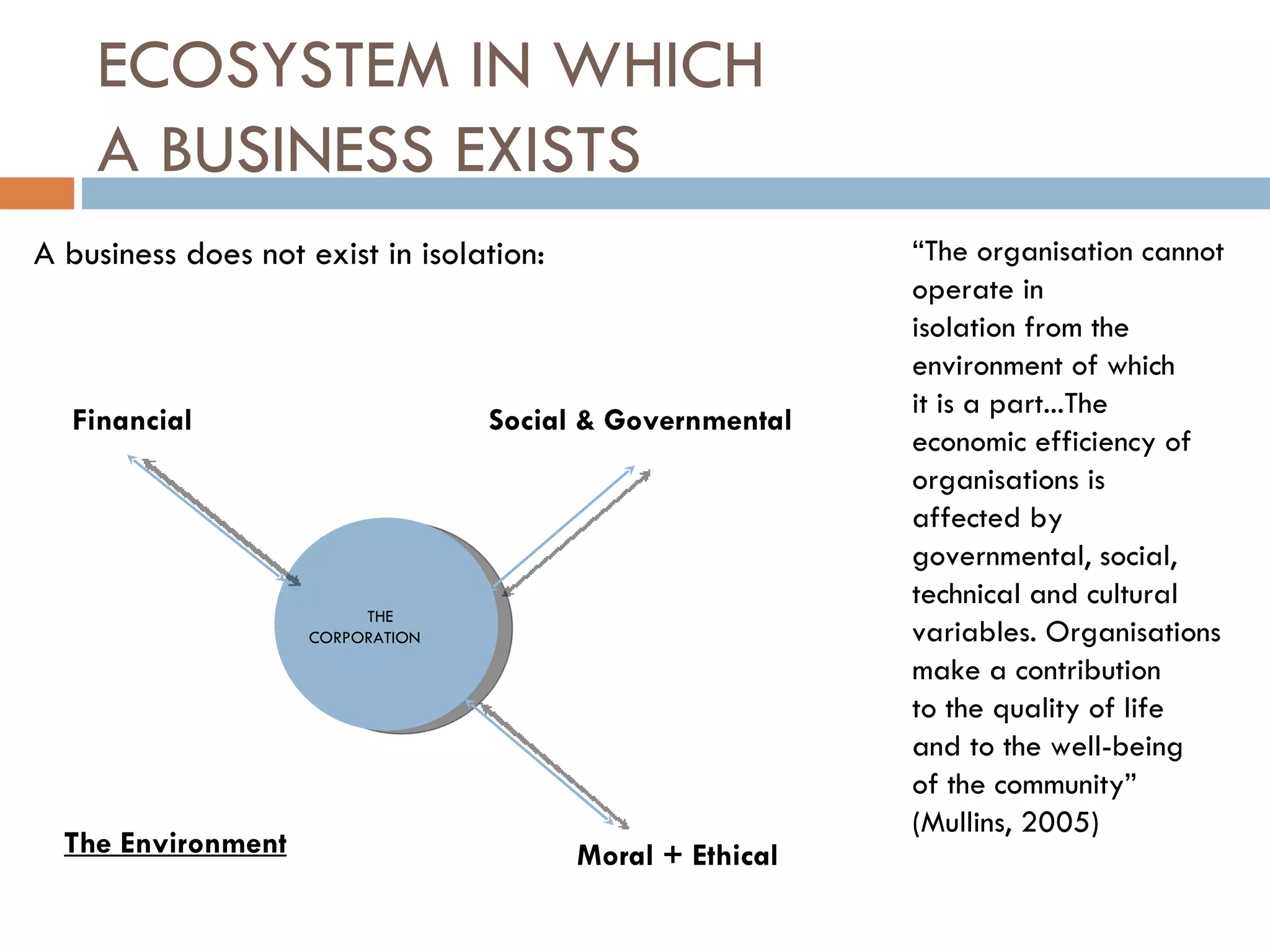
ECOSYSTEM IN WHICH  A BUSINESS EXISTS A business does not exist in isolation: “ The organisation cannot operate in isolation from the environment of which it is a part...The economic efficiency of organisations is affected by governmental, social, technical and cultural variables. Organisations make a contribution to the quality of life and to the well-being of the community” (Mullins, 2005) The Environment Moral + Ethical Financial Social & Governmental THE  CORPORATION
Examples Examples of companies and scenarios where Friedman’s recommendations were practiced (pure capitalism, free enterprise, free market system) and failed Enron, US Housing Market Crash, US Banking System, Stanford Financial Group, Bernard Madoff – Ponzi Scheme Examples of companies where a balanced  synergy  of profit seeking and social responsibility are being  achieved successfully Starbucks , IBM, Google, Nike,  Gap Inc ., Hallmark, Dell
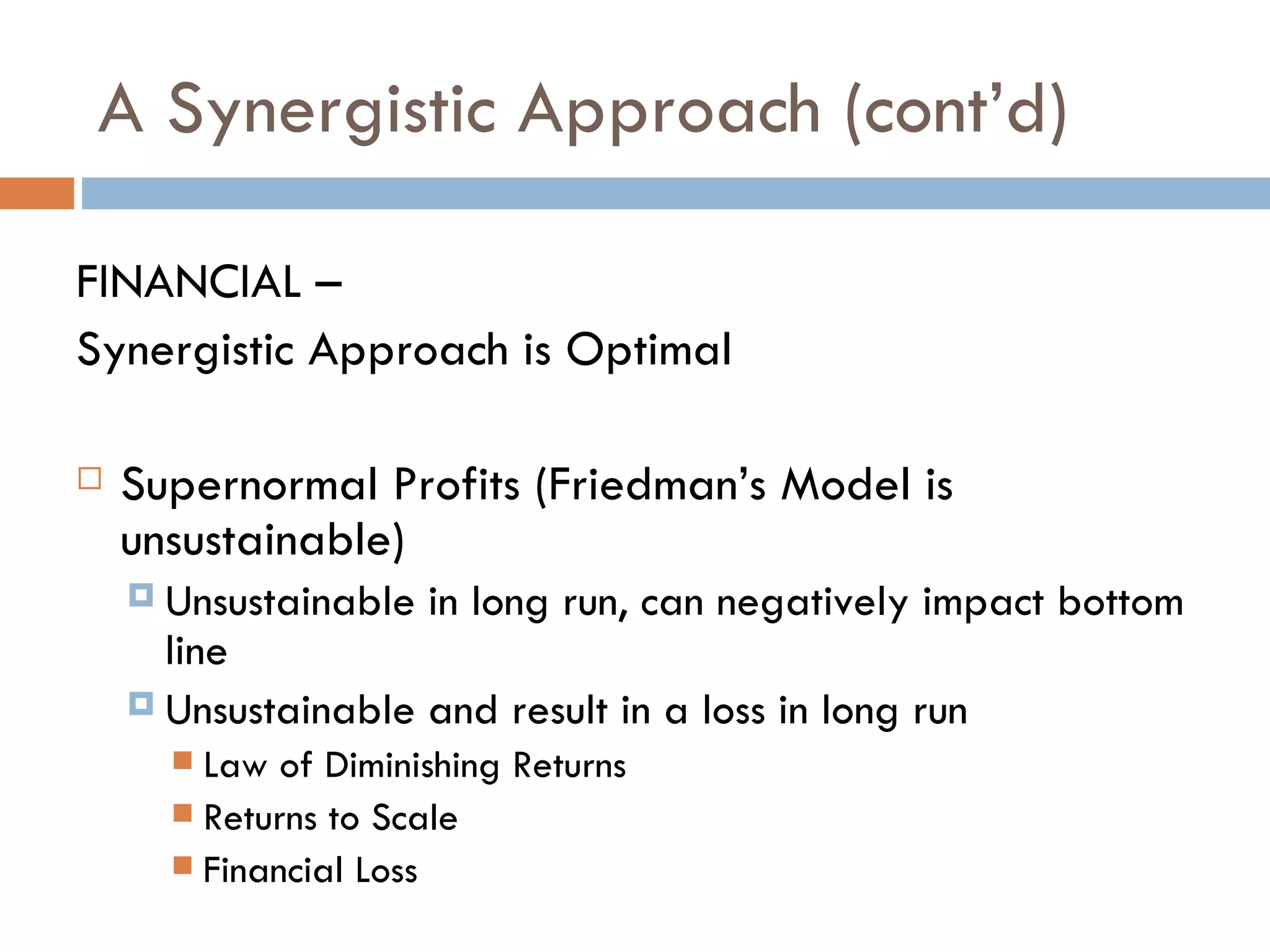
A Synergistic Approach (cont’d) FINANCIAL –  Synergistic Approach is Optimal Supernormal Profits (Friedman’s Model is unsustainable) Unsustainable in long run, can negatively impact bottom line Unsustainable and result in a loss in long run Law of Diminishing Returns Returns to Scale Financial Loss
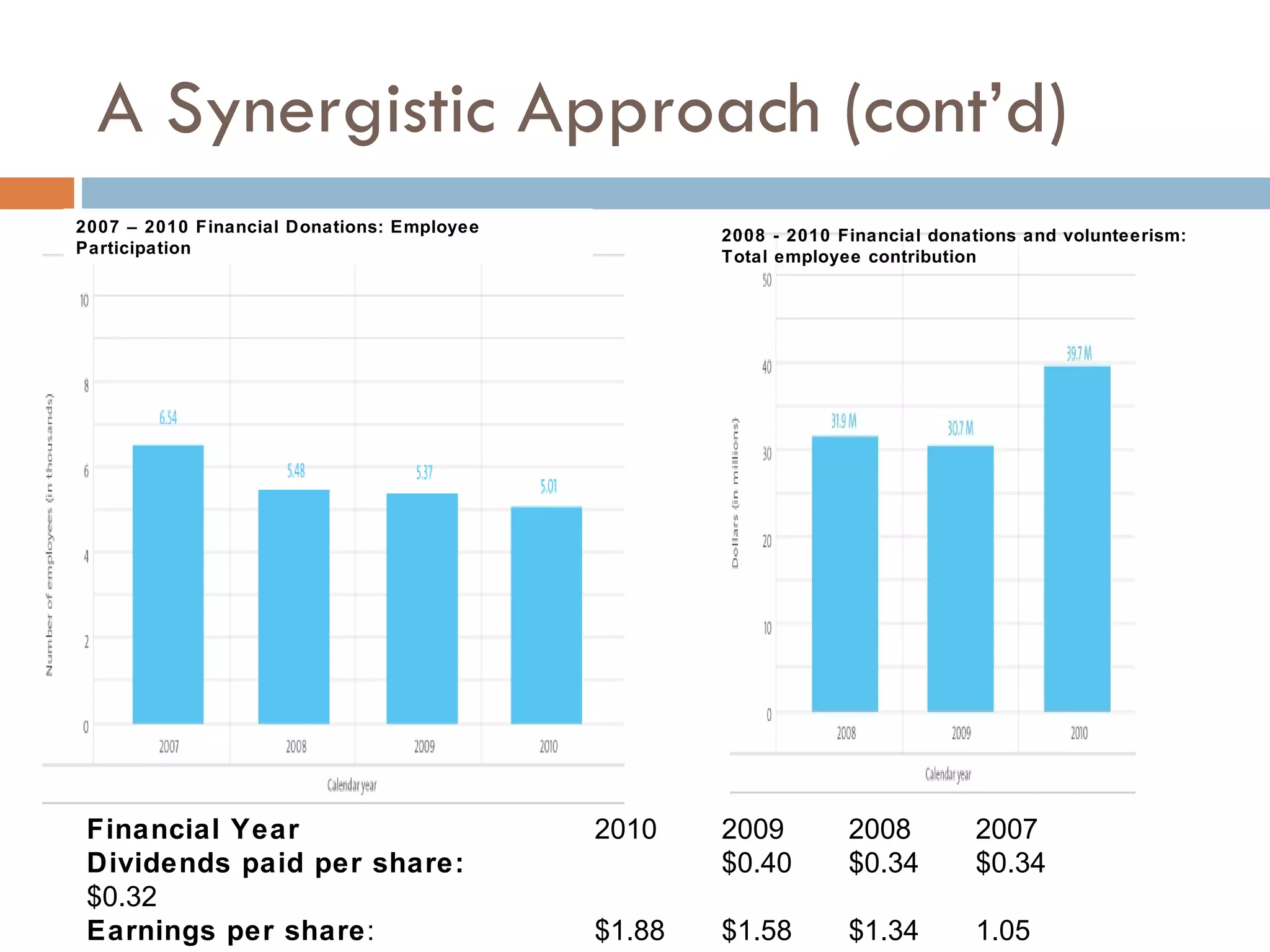
A Synergistic Approach (cont’d) 2007 – 2010 Financial Donations: Employee Participation 2008 - 2010 Financial donations and volunteerism: Total employee contribution Financial Year 2010  2009  2008  2007  Dividends paid per share:  $0.40  $0.34  $0.34  $0.32 Earnings per share :    $1.88 $1.58 $1.34 1.05
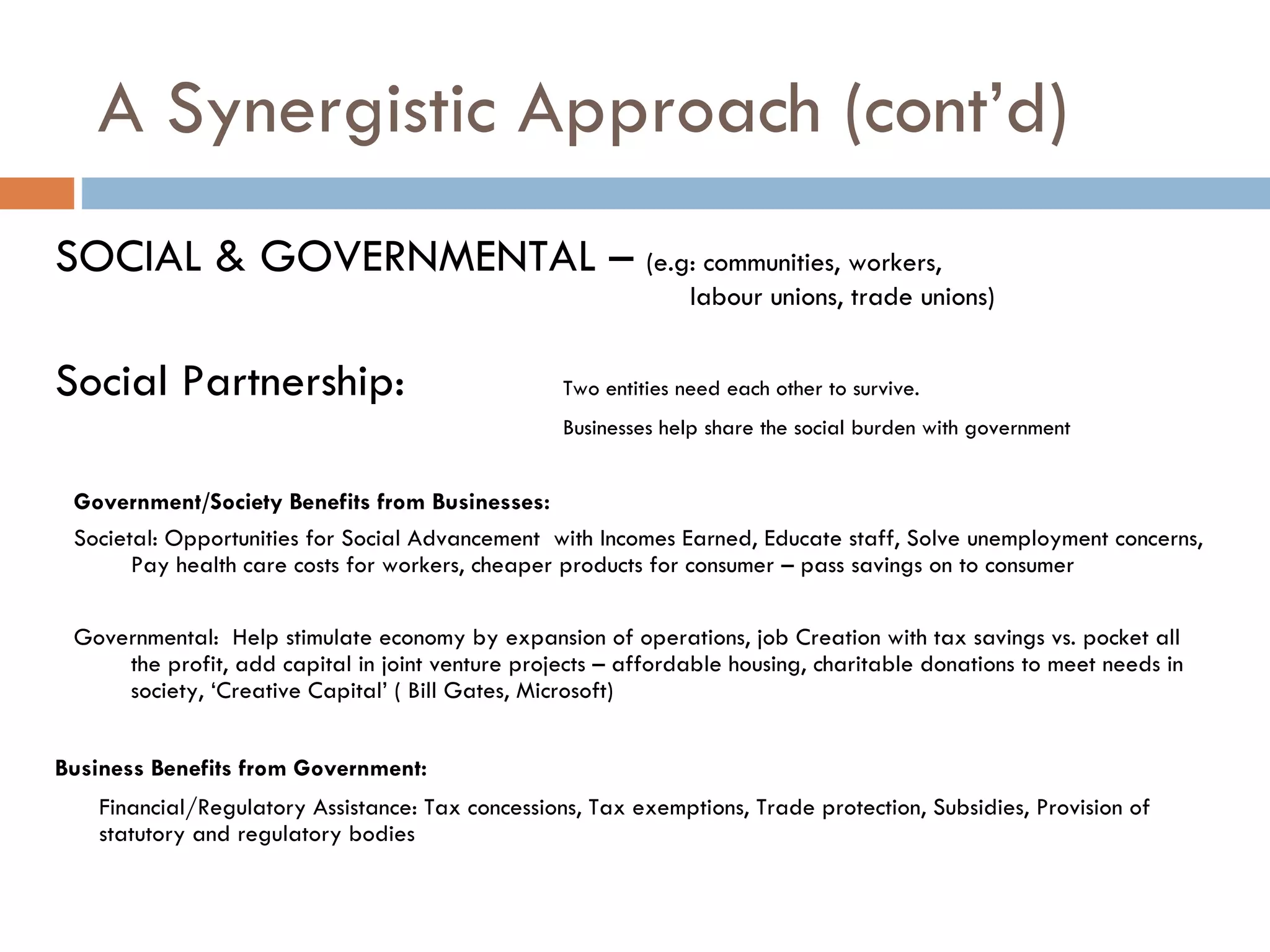
A Synergistic Approach (cont’d) SOCIAL & GOVERNMENTAL –  (e.g: communities, workers,  labour unions, trade unions)  Social Partnership:  Two entities need each other to survive.  Businesses help share the social burden with government Government/Society Benefits from Businesses: Societal: Opportunities for Social Advancement  with Incomes Earned, Educate staff, Solve unemployment concerns, Pay health care costs for workers, cheaper products for consumer – pass savings on to consumer Governmental:  Help stimulate economy by expansion of operations, job Creation with tax savings vs. pocket all the profit, add capital in joint venture projects – affordable housing, charitable donations to meet needs in society, ‘Creative Capital’ ( Bill Gates, Microsoft)  Business Benefits from Government: Financial/Regulatory Assistance: Tax concessions, Tax exemptions, Trade protection, Subsidies, Provision of statutory and regulatory bodies
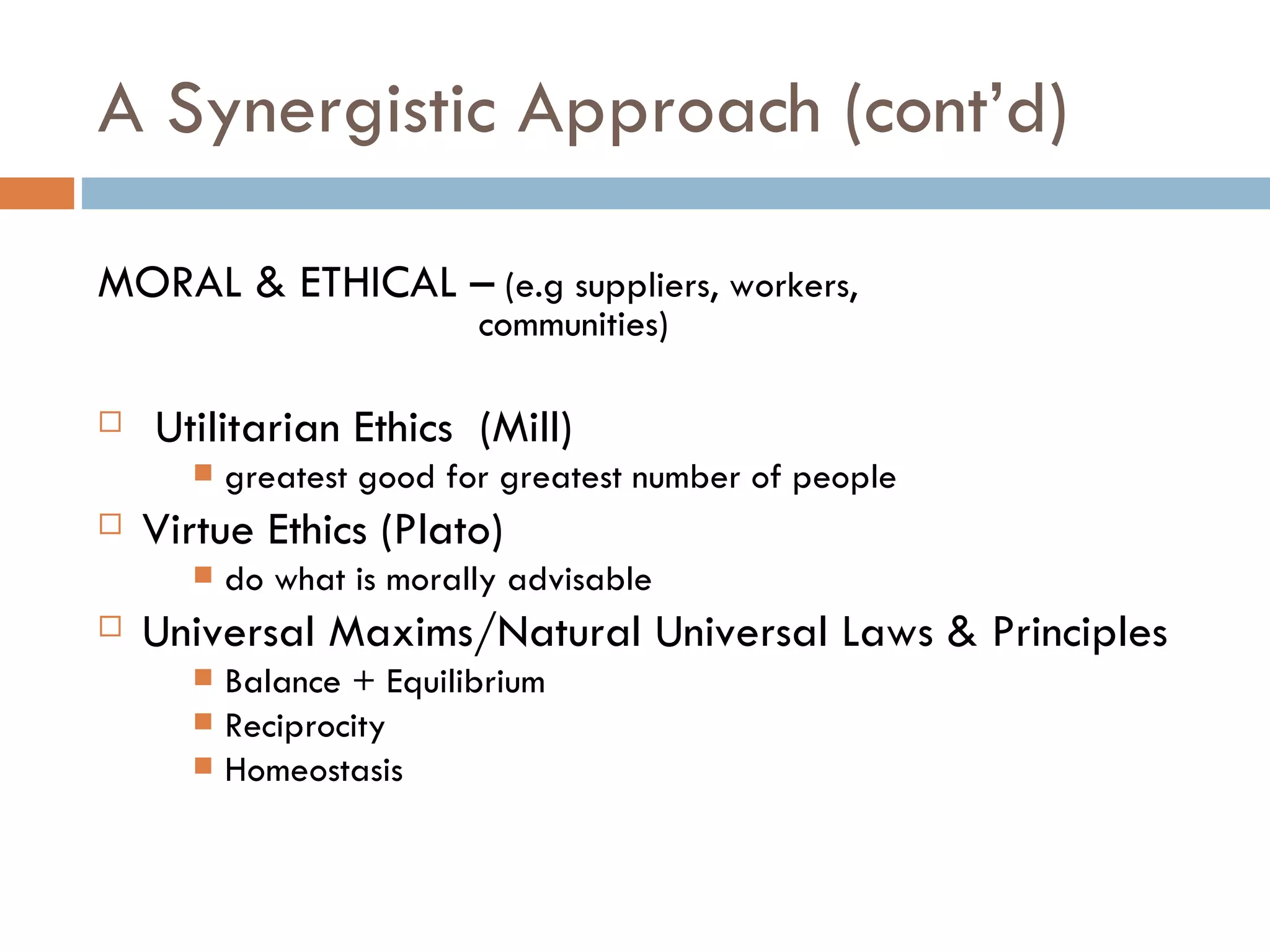
A Synergistic Approach (cont’d) MORAL & ETHICAL –  (e.g suppliers, workers,  communities) Utilitarian Ethics  (Mill) greatest good for greatest number of people Virtue Ethics (Plato) do what is morally advisable Universal Maxims/Natural Universal Laws & Principles Balance + Equilibrium Reciprocity Homeostasis

Social Responsibility + Profits - Friedman

  • 1.
    “ THE SOCIALRESPONSIBILITY OF BUSINESS IS TO INCREASE ITS PROFITS” – MILTON FRIEDMAN, 1970 – A CRITICAL ANALYSIS by Cheryl Mayers-Goddard Claire Sargeant Lisa Haynes Group 3 of the Durham Caribbean MBA
  • 2.
    CONTEXT OF STATEMENTTHE STATEMENT: “ The social responsibility of a business is to increase its profits.” (Friedman) THE CONTEXT: Who When Where Why
  • 3.
    Social Responsibility +Profit Definition of Social Responsibility as it relates to Profit Taking into account “the interests and concerns of a community rather than just its shareholders” (Sloman et al, 2010); “ a business’ obligation, beyond that required by law and economics, to pursue long-term goals that are good for society” (Robbins et al, 2005); 2 views of the Responsibilties of Corporations in a Social Context: Classical : A company is committed solely to increasing the wealth of its shareholders Socioeconomic : a company must also consider others and society into its allocation of resources Reindhartd et al (2008) queried whether firms: Can do this within their scope as laid out by shareholders Have the wherewithal to sustain such an activity over time
  • 4.
    Friedman’s Hypothesis Supportingarguments used by Friedman: “ A corporation is an artificial person and therefore cannot be socially responsible.” “ Social responsibility concerns the proprietors and corporate executives.” “ If social responsibility is exercised it is acting against the shareholders, owners of the business.”
  • 5.
    Our Position Abusiness should engage in socially responsible projects but under certain conditions: Criteria: Create Future benefit to the business – direct or indirect Advance the corporation’s goals Be justifiable to shareholders VIEW: A business has a responsibility to increase its profits and to be socially responsible towards its external environment. Adopting a synergistic approach vs. a singular approach, will benefit both the stakeholders and the corporation.
  • 6.
    Pros & Consof Friedman’s Statement Points of Disagreement : Lost opportunities to build equity and goodwill Hurt corporate image in public’s eye Exclude entire segment of socially conscious investors Good corporate citizens perform equally well in market. Business are interdependent on elements in its ecosystem. Sound business sense not to alienate stakeholders. Creates cognitive problems/ conflict within managers’ personal value system (agency problem) Points of Agreement: Reduced profits in short run Possibility of discord with shareholders Increased cost of products
  • 7.
    ECOSYSTEM IN WHICH A BUSINESS EXISTS A business does not exist in isolation: “ The organisation cannot operate in isolation from the environment of which it is a part...The economic efficiency of organisations is affected by governmental, social, technical and cultural variables. Organisations make a contribution to the quality of life and to the well-being of the community” (Mullins, 2005) The Environment Moral + Ethical Financial Social & Governmental THE CORPORATION
  • 8.
    Examples Examples ofcompanies and scenarios where Friedman’s recommendations were practiced (pure capitalism, free enterprise, free market system) and failed Enron, US Housing Market Crash, US Banking System, Stanford Financial Group, Bernard Madoff – Ponzi Scheme Examples of companies where a balanced synergy of profit seeking and social responsibility are being achieved successfully Starbucks , IBM, Google, Nike, Gap Inc ., Hallmark, Dell
  • 9.
    A Synergistic Approach(cont’d) FINANCIAL – Synergistic Approach is Optimal Supernormal Profits (Friedman’s Model is unsustainable) Unsustainable in long run, can negatively impact bottom line Unsustainable and result in a loss in long run Law of Diminishing Returns Returns to Scale Financial Loss
  • 10.
    A Synergistic Approach(cont’d) 2007 – 2010 Financial Donations: Employee Participation 2008 - 2010 Financial donations and volunteerism: Total employee contribution Financial Year 2010 2009 2008 2007 Dividends paid per share: $0.40 $0.34 $0.34 $0.32 Earnings per share : $1.88 $1.58 $1.34 1.05
  • 11.
    A Synergistic Approach(cont’d) SOCIAL & GOVERNMENTAL – (e.g: communities, workers, labour unions, trade unions) Social Partnership: Two entities need each other to survive. Businesses help share the social burden with government Government/Society Benefits from Businesses: Societal: Opportunities for Social Advancement with Incomes Earned, Educate staff, Solve unemployment concerns, Pay health care costs for workers, cheaper products for consumer – pass savings on to consumer Governmental: Help stimulate economy by expansion of operations, job Creation with tax savings vs. pocket all the profit, add capital in joint venture projects – affordable housing, charitable donations to meet needs in society, ‘Creative Capital’ ( Bill Gates, Microsoft) Business Benefits from Government: Financial/Regulatory Assistance: Tax concessions, Tax exemptions, Trade protection, Subsidies, Provision of statutory and regulatory bodies
  • 12.
    A Synergistic Approach(cont’d) MORAL & ETHICAL – (e.g suppliers, workers, communities) Utilitarian Ethics (Mill) greatest good for greatest number of people Virtue Ethics (Plato) do what is morally advisable Universal Maxims/Natural Universal Laws & Principles Balance + Equilibrium Reciprocity Homeostasis