DATE:      PREPARED BY:

9/9/2011   RICHA CHAUDHARY
Agenda
What is social networking?
History of social networking & how it
 works?
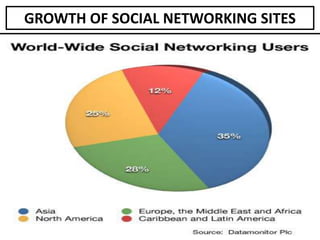
Growth of social networking sites.
Merits & Demerits of social
 networking.
Conclusion.
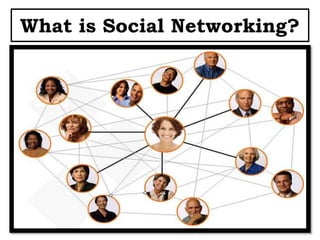
What is Social Networking?
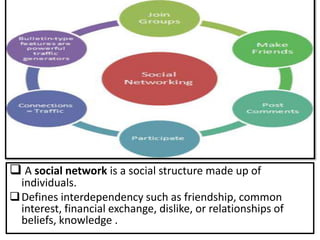
 A social network is a social structure made up of
  individuals.
 Defines interdependency such as friendship, common
  interest, financial exchange, dislike, or relationships of
  beliefs, knowledge .
HISTORY

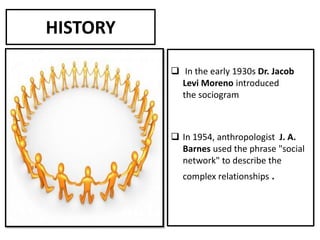
           In the early 1930s Dr. Jacob
            Levi Moreno introduced
            the sociogram


           In 1954, anthropologist J. A.
            Barnes used the phrase "social
            network" to describe the
            complex relationships .
Some social networking sites
HOW IT WORKS?
 Based on open source software.
 They use a Web Server.
 Most of the social networks also use
 Sun's MySql database management
 system.
 Their application programming
 interfaces are available.
GROWTH OF SOCIAL NETWORKING SITES
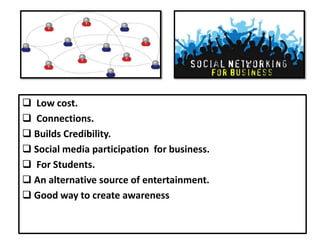
 Low cost.
 Connections.
 Builds Credibility.
 Social media participation for business.
 For Students.
 An alternative source of entertainment.
 Good way to create awareness
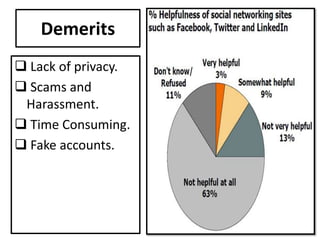
Demerits
 Lack of privacy.
 Scams and
 Harassment.
 Time Consuming.
 Fake accounts.
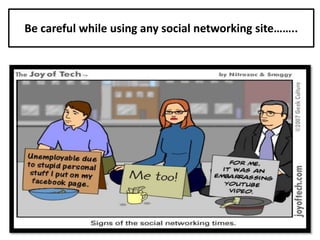
Be careful while using any social networking site……..
Conclusion

              Even though it has
             the benefits in the
             virtual world but the
             real world greatly
             impeded by the use of
             online social
             networking.
Social  networking

Social networking

  • 1.
    DATE: PREPARED BY: 9/9/2011 RICHA CHAUDHARY
  • 2.
    Agenda What is socialnetworking? History of social networking & how it works? Growth of social networking sites. Merits & Demerits of social networking. Conclusion.
  • 3.
    What is SocialNetworking?
  • 4.
     A socialnetwork is a social structure made up of individuals.  Defines interdependency such as friendship, common interest, financial exchange, dislike, or relationships of beliefs, knowledge .
  • 5.
    HISTORY  In the early 1930s Dr. Jacob Levi Moreno introduced the sociogram  In 1954, anthropologist J. A. Barnes used the phrase "social network" to describe the complex relationships .
  • 6.
  • 8.
    HOW IT WORKS? Based on open source software.  They use a Web Server.  Most of the social networks also use Sun's MySql database management system.  Their application programming interfaces are available.
  • 9.
    GROWTH OF SOCIALNETWORKING SITES
  • 11.
     Low cost. Connections.  Builds Credibility.  Social media participation for business.  For Students.  An alternative source of entertainment.  Good way to create awareness
  • 13.
    Demerits  Lack ofprivacy.  Scams and Harassment.  Time Consuming.  Fake accounts.
  • 14.
    Be careful whileusing any social networking site……..
  • 15.
    Conclusion  Even though it has the benefits in the virtual world but the real world greatly impeded by the use of online social networking.

Editor's Notes

  • #4 A social n/wking is a cloudi.e cluster of millions of people who r connected by their common areas of interest,these people can be frmproffesionalbackgnd,academicbackground,family members & so on.so I can say Social networking is defined as the bringing individuals together into to specific groups, often like a small community or a neighborhood.
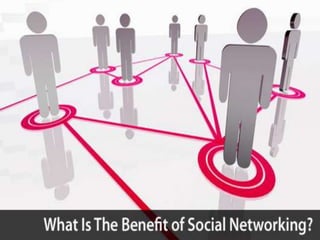
  • #5 If u see dispic u can see how exactly we work on a social n/king
  • #6 Sociogram is the first formal attempt to map out the relationships within a group of people.
  • #8 It represents the various sites dat u use for sharing, comm.,collaboration.Fb,orkutmyspace these r sm social n/king sites,utube,bliptv these r used for video purpoisesgoogle,yahoo these r sm customer serevice n/ks
  • #9 Now its important to hv the idea of hw social networkgworkdThe first thing that jumps out is that they're almost all based on open-source software.allsns uses platform independent concept For example, the operating systems behind Twitter, LinkedIn, and MySpaceare all Linux. . Apache is the Web server of choice and LinkedIn uses Sun ONE Web Servers in addition to Apache.Most of the social networks also use Sun's MySQL database management system to organize their users' messages and status updates.Their application programming interfaces are available, because they want developers to write applications that will run on their network.
  • #10 We all need a network to keep in touch with people and to get to know more people. Well, but where is the time for us to go personally and visit everyone . Its all possible now, just through these social networking sites.
  • #11 We use sns daily bthv u everthnkwat v r getting frm it…
  • #12 Definitely, it's cheaper to use online social networking for both personal and business use because most of it is usually free.Builds Credibility.You definitely can gain the customers' confidence if you can connect to them on both a personal and professional level.By using a social networking site, you can do what you can and get connected with these people to form a web of connections
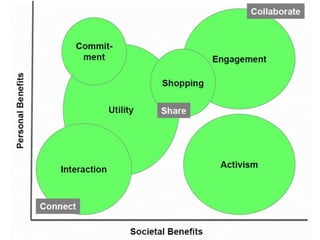
  • #13 In personal benefits I can say it provide an optimistic & humbled view of d world , provide a stronger sense of confidence,& in societal benefits I can say bring businesses & opportunities, increases visibility & so on
  • #14 What do you think? Should children be taught how to use websites like MySpace and Facebook safely in schools, or do Social Networking sites have no place in the school system?If this is not your kind of thing, that it would just be a waste of time for you. I do believe that you cannot become a safe and responsible Social Networker without actually getting into Social Networking.