EFFECTS OF SOCIAL
NETWORKING SITES
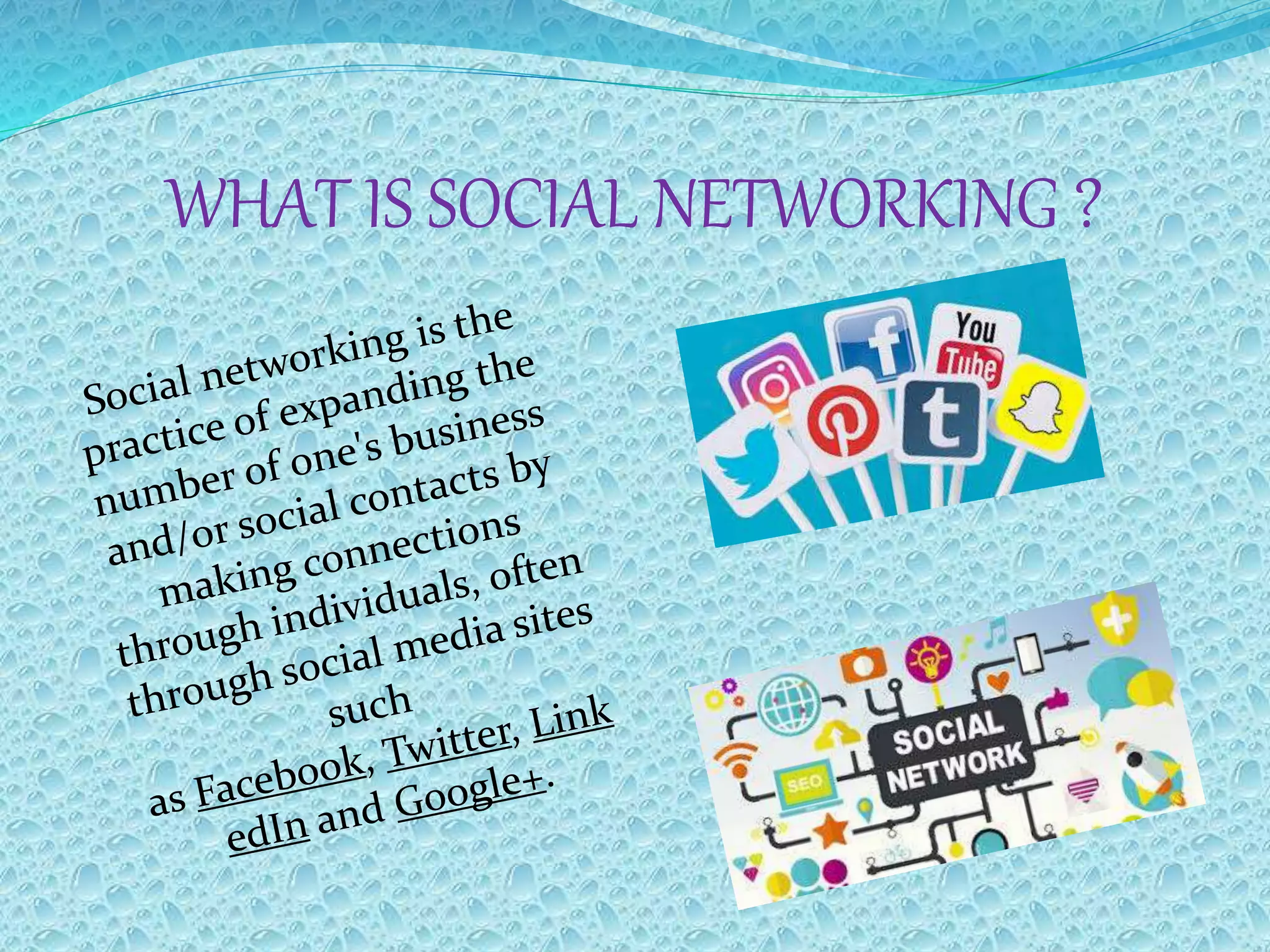
WHAT IS SOCIAL NETWORKING ?
HISTORY
 Social networking was born one day in 1971, when the first email was sent.
The two computers were sitting right next to each other. The message said
“qwertyuiop’.
In 1994, the first social networking site was created, Geocities. Geocities
allowed the users to create and customize their own web sites, grouping them
into different ‘cities’ based on the site’s content.
The following year, TheGlobe.com launched to public, giving users the ability
to interact with people who have the same hobbies and interests, and to publish
their own content.
A few years later, AOL Instant Messenger and SixDegrees.com launched in
1997.
Classmates allowed users to reconnect with old classmates, pals, bullies and
crushes. It was a hit immediately, and today Classmates still has some
40,000,000 registered users.
Other niche-driven sites are Asian Avenue–established in 1997. By 1999,
Black Planet was established and in 2000, MiGente.com for Hispanic servers.
 In the mid-1990s, the internet was at its full force. Yahoo! was established
and Amazon had begun selling books.
New Millennium: New Era in Social Networking
The first modern social networking site that we define today is
Friendster.
Soon MySpace followed suit, who cloned Friendster. It was
launched after only 10 days of coding. It soon became more popular
than Friendster.
Another site with considerable success is LinkedIn. It was
established in 2003, and took a more professional and business
approach to social networking.
Facebook came into the social networking scene a little bit later. It
was launched in 2004, and the primary intent was to connect US
college students.
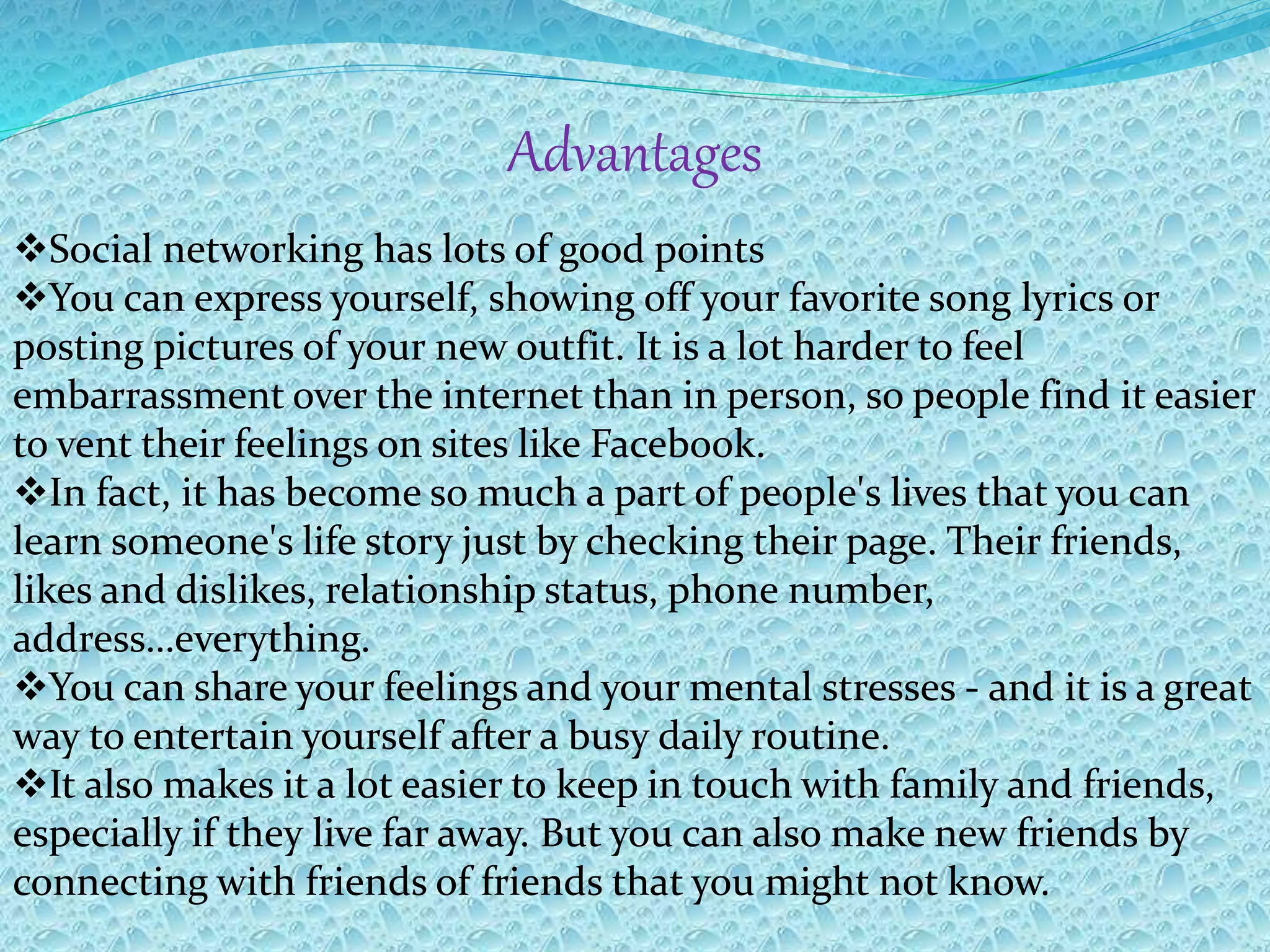
Advantages
Social networking has lots of good points
You can express yourself, showing off your favorite song lyrics or
posting pictures of your new outfit. It is a lot harder to feel
embarrassment over the internet than in person, so people find it easier
to vent their feelings on sites like Facebook.
In fact, it has become so much a part of people's lives that you can
learn someone's life story just by checking their page. Their friends,
likes and dislikes, relationship status, phone number,
address…everything.
You can share your feelings and your mental stresses - and it is a great
way to entertain yourself after a busy daily routine.
It also makes it a lot easier to keep in touch with family and friends,
especially if they live far away. But you can also make new friends by
connecting with friends of friends that you might not know.
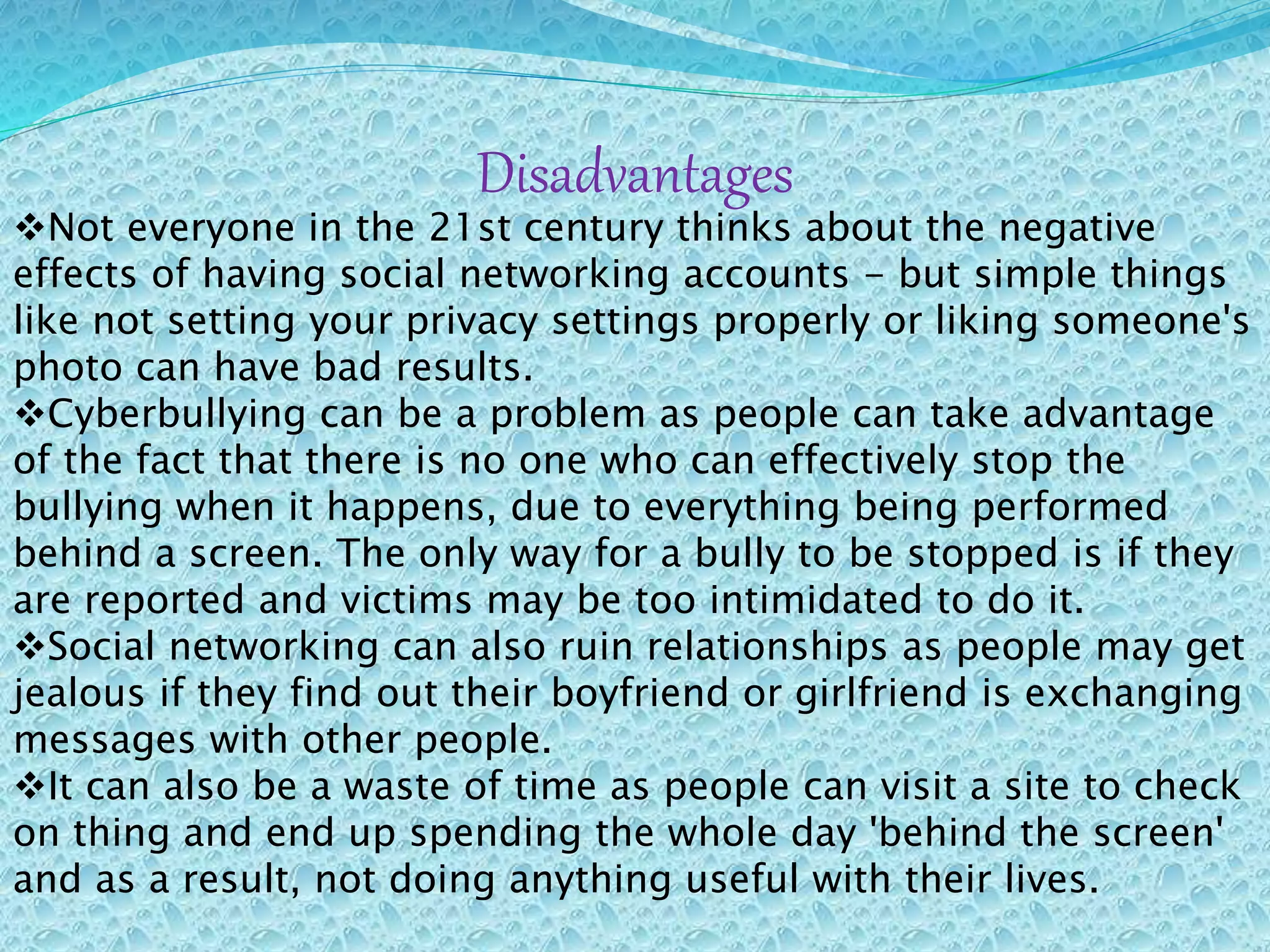
Disadvantages
Not everyone in the 21st century thinks about the negative
effects of having social networking accounts - but simple things
like not setting your privacy settings properly or liking someone's
photo can have bad results.
Cyberbullying can be a problem as people can take advantage
of the fact that there is no one who can effectively stop the
bullying when it happens, due to everything being performed
behind a screen. The only way for a bully to be stopped is if they
are reported and victims may be too intimidated to do it.
Social networking can also ruin relationships as people may get
jealous if they find out their boyfriend or girlfriend is exchanging
messages with other people.
It can also be a waste of time as people can visit a site to check
on thing and end up spending the whole day 'behind the screen'
and as a result, not doing anything useful with their lives.
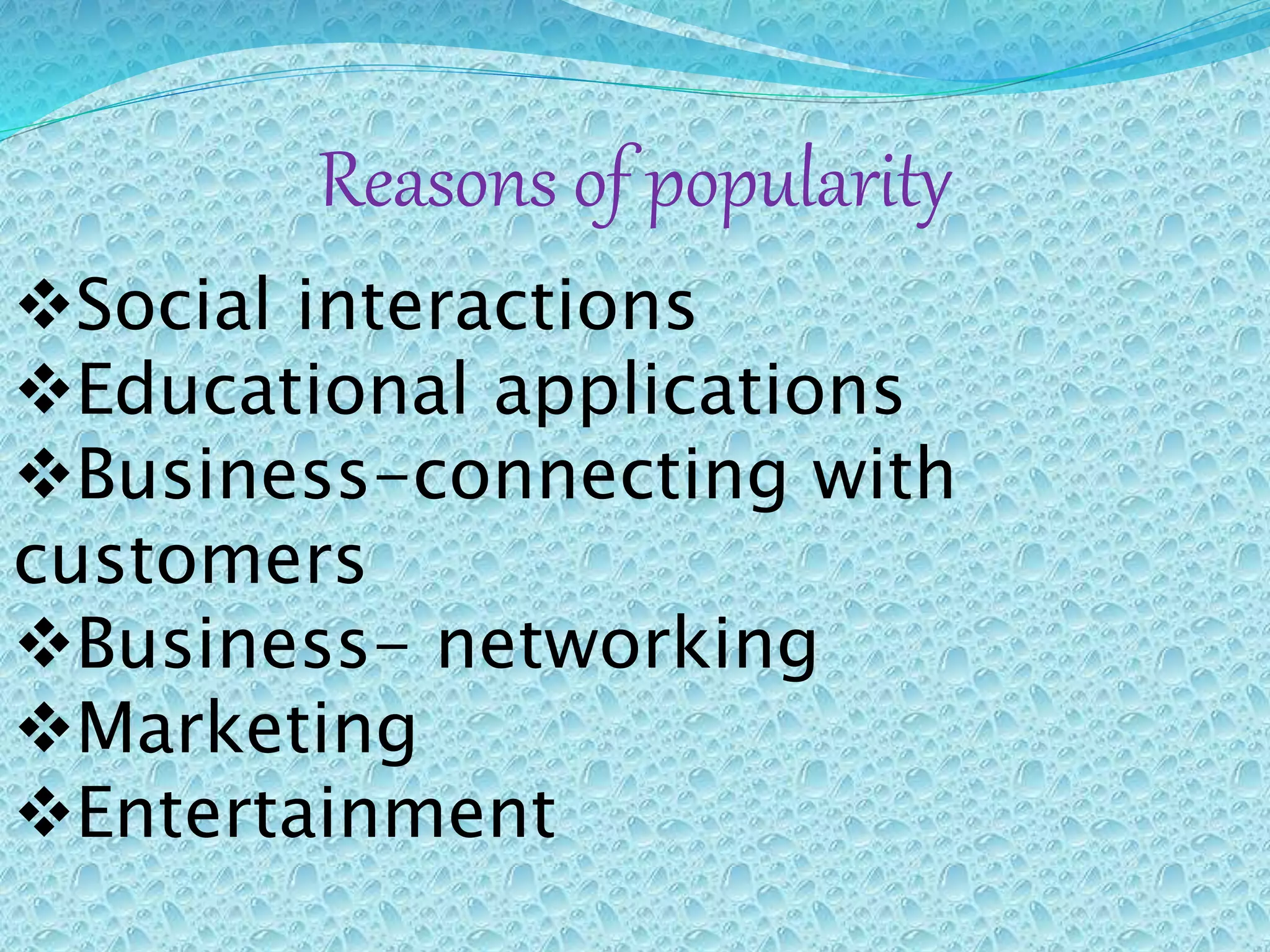
Reasons of popularity
Social interactions
Educational applications
Business-connecting with
customers
Business- networking
Marketing
Entertainment
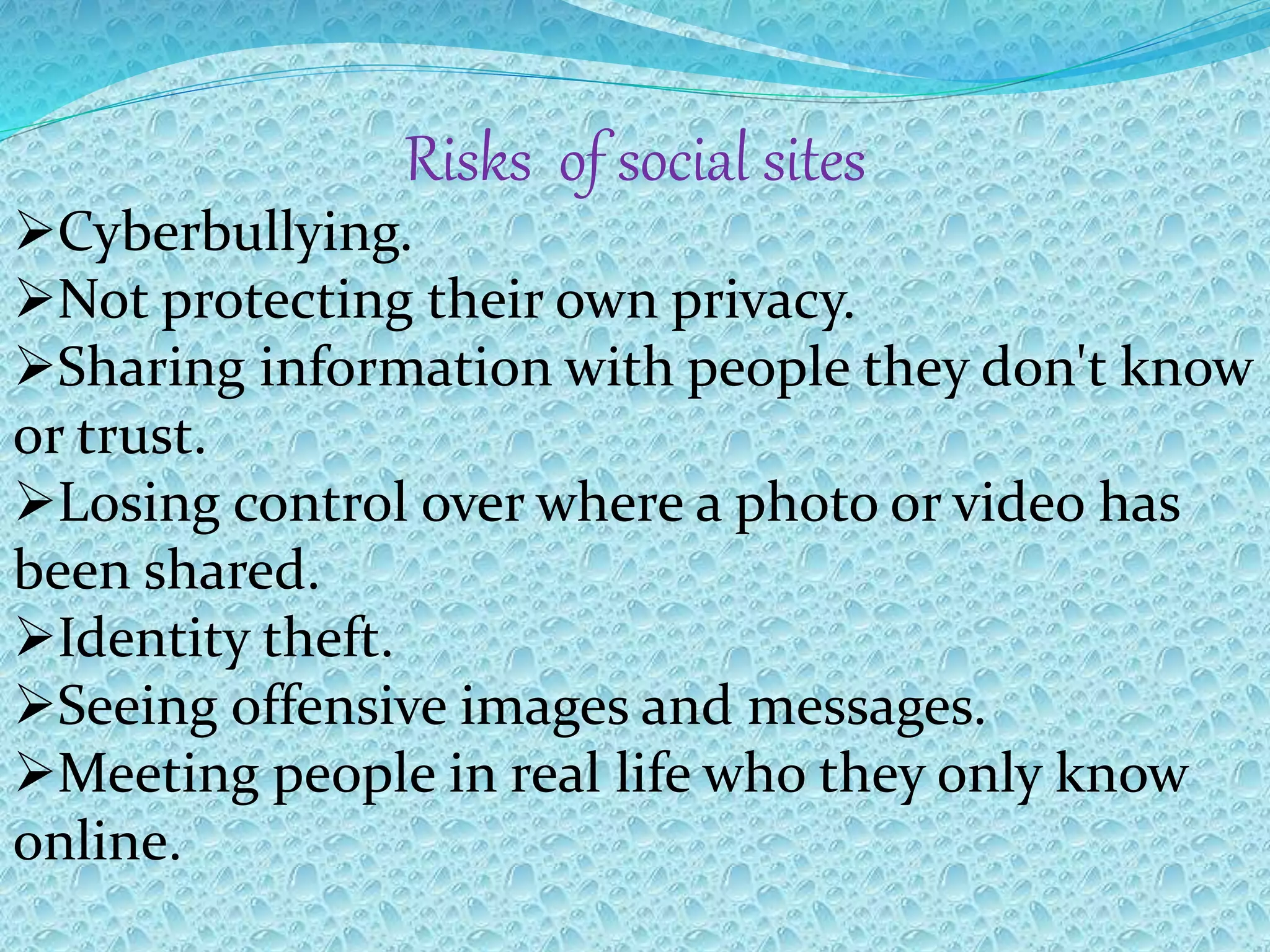
Risks of social sites
Cyberbullying.
Not protecting their own privacy.
Sharing information with people they don't know
or trust.
Losing control over where a photo or video has
been shared.
Identity theft.
Seeing offensive images and messages.
Meeting people in real life who they only know
online.
Interesting facts
•56 percent of Americans have a social networking site.
•91 percent of mobile access is used for social networking.
•More than 4.2 billion people use their mobile phones to accesses social
networking site.
•230,060 years is the total amount of time the United States spend on
social media.
•6.9 hours is the amount of time an average American spends on his/her
social networking site in a month.
•22 percent of online time is accounted by social networking.
•40 percent of people socialize through networking sites over face to face
communication.
•23 percent of Facebook users check on their account at least five times a
day.
•20 minutes per day is how much time people spend on Whisper
application for smartphone devices.
•400 million tweets is the average number of tweet being sent every day.
Conclusion
Effects of social networking

Effects of social networking

  • 1.
  • 2.
    WHAT IS SOCIALNETWORKING ?
  • 3.
    HISTORY  Social networkingwas born one day in 1971, when the first email was sent. The two computers were sitting right next to each other. The message said “qwertyuiop’. In 1994, the first social networking site was created, Geocities. Geocities allowed the users to create and customize their own web sites, grouping them into different ‘cities’ based on the site’s content. The following year, TheGlobe.com launched to public, giving users the ability to interact with people who have the same hobbies and interests, and to publish their own content. A few years later, AOL Instant Messenger and SixDegrees.com launched in 1997. Classmates allowed users to reconnect with old classmates, pals, bullies and crushes. It was a hit immediately, and today Classmates still has some 40,000,000 registered users. Other niche-driven sites are Asian Avenue–established in 1997. By 1999, Black Planet was established and in 2000, MiGente.com for Hispanic servers.  In the mid-1990s, the internet was at its full force. Yahoo! was established and Amazon had begun selling books.
  • 4.
    New Millennium: NewEra in Social Networking The first modern social networking site that we define today is Friendster. Soon MySpace followed suit, who cloned Friendster. It was launched after only 10 days of coding. It soon became more popular than Friendster. Another site with considerable success is LinkedIn. It was established in 2003, and took a more professional and business approach to social networking. Facebook came into the social networking scene a little bit later. It was launched in 2004, and the primary intent was to connect US college students.
  • 5.
    Advantages Social networking haslots of good points You can express yourself, showing off your favorite song lyrics or posting pictures of your new outfit. It is a lot harder to feel embarrassment over the internet than in person, so people find it easier to vent their feelings on sites like Facebook. In fact, it has become so much a part of people's lives that you can learn someone's life story just by checking their page. Their friends, likes and dislikes, relationship status, phone number, address…everything. You can share your feelings and your mental stresses - and it is a great way to entertain yourself after a busy daily routine. It also makes it a lot easier to keep in touch with family and friends, especially if they live far away. But you can also make new friends by connecting with friends of friends that you might not know.
  • 6.
    Disadvantages Not everyone inthe 21st century thinks about the negative effects of having social networking accounts - but simple things like not setting your privacy settings properly or liking someone's photo can have bad results. Cyberbullying can be a problem as people can take advantage of the fact that there is no one who can effectively stop the bullying when it happens, due to everything being performed behind a screen. The only way for a bully to be stopped is if they are reported and victims may be too intimidated to do it. Social networking can also ruin relationships as people may get jealous if they find out their boyfriend or girlfriend is exchanging messages with other people. It can also be a waste of time as people can visit a site to check on thing and end up spending the whole day 'behind the screen' and as a result, not doing anything useful with their lives.
  • 7.
    Reasons of popularity Socialinteractions Educational applications Business-connecting with customers Business- networking Marketing Entertainment
  • 8.
    Risks of socialsites Cyberbullying. Not protecting their own privacy. Sharing information with people they don't know or trust. Losing control over where a photo or video has been shared. Identity theft. Seeing offensive images and messages. Meeting people in real life who they only know online.
  • 9.
    Interesting facts •56 percentof Americans have a social networking site. •91 percent of mobile access is used for social networking. •More than 4.2 billion people use their mobile phones to accesses social networking site. •230,060 years is the total amount of time the United States spend on social media. •6.9 hours is the amount of time an average American spends on his/her social networking site in a month. •22 percent of online time is accounted by social networking. •40 percent of people socialize through networking sites over face to face communication. •23 percent of Facebook users check on their account at least five times a day. •20 minutes per day is how much time people spend on Whisper application for smartphone devices. •400 million tweets is the average number of tweet being sent every day.
  • 10.