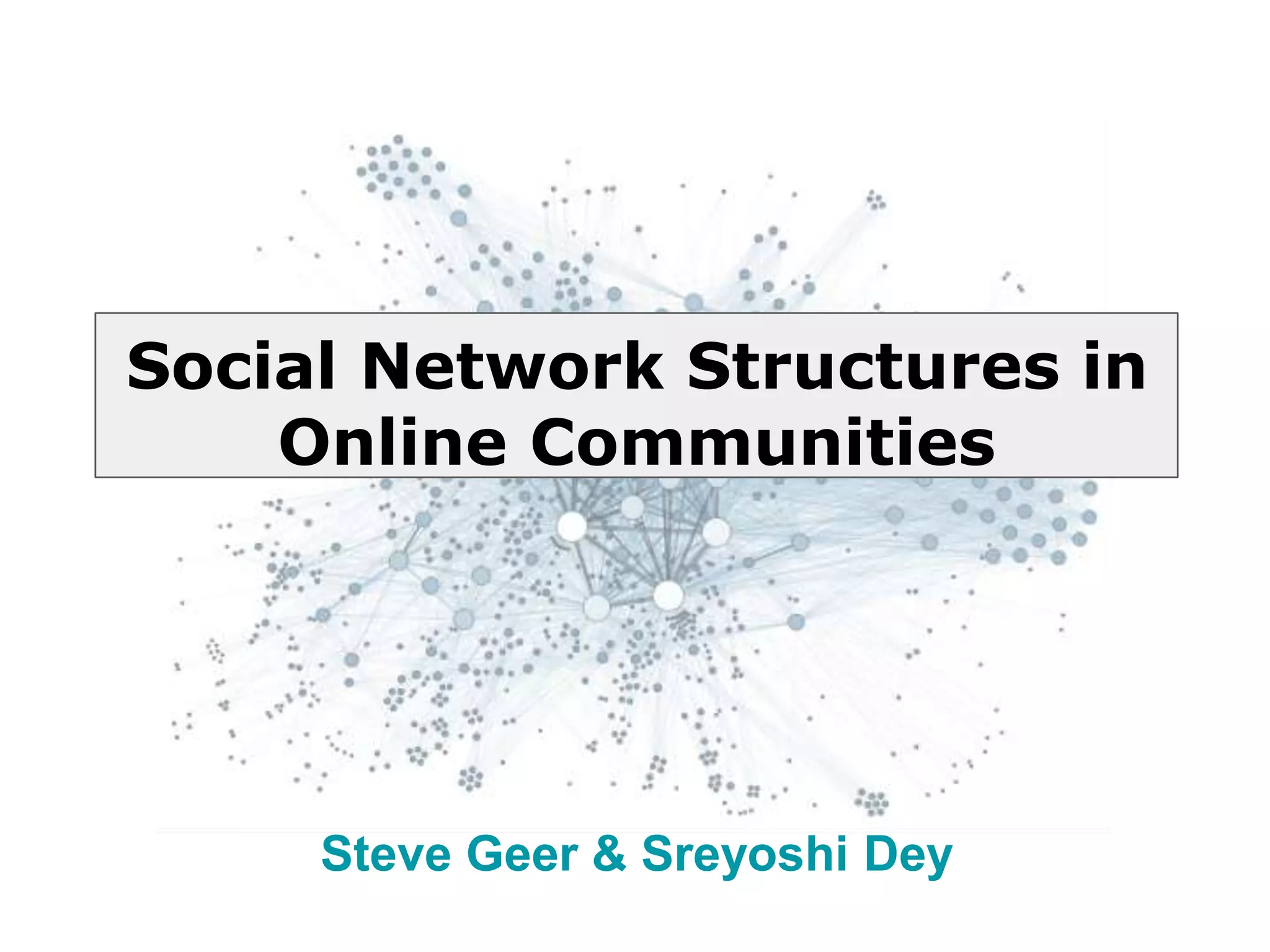







Social Network Structures in
Online Communities
Steve Geer & Sreyoshi Dey
OVERVIEW
➢Online groups are structured in many
different ways, creating varying degrees
of interconnectedness and separation.
➢Flow of information, efficiency, and
overall group (or corporate) cohesion all
depend on a well-structured network.
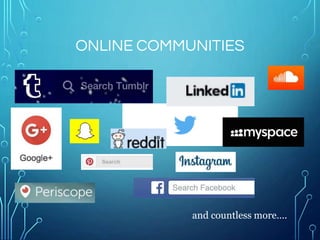
and countless more….
ONLINE COMMUNITIES
Some key terms and concepts essential to the
understanding of networking in online communities:
• Social network theory
• Social capital
• Structural holes
• Brokerage vs closure
• Between-ness vs constraint
Let’s first review the Social Network
Theory a little...
SOCIAL CAPITAL
•It is the value of one’s social network, or structure of
relationships and one’s position within it, there on the
advantage or benefits one may avail.
•In online communities, it is an incentive to
participate.
•# of Friends or Followers, # of Likes, Shares,
Karma, Klout, etc. all are seen as measures of
social capital
•The way a community is structured and managed
will affect its social capital
REPUTATION SYSTEM
• a way of achieving user feedback and facilitating
participation, legitimacy and authority over a network and
its flow of information
• a tool that changes the dynamics and transparency of a
network
• A concept applied to social network theory that describes
the gaps that exist between more dense subnetworks of
strong connections.
• The way information propagates differs based on what
structural gaps exist in the network.
• Also affects social capital.
STRUCTURAL HOLES
www.linkedin.com
STRUCTURAL HOLES
• “Structural holes are defined as a lightly connected bridge
between denser sub-network elements. If, in their collection
of networks, an individual has bridged one or more
structural holes they are “brokers” between the sub-
networks; at the other extreme they are participating in
“closed” networks.”
BROKERAGE V. CLOSURE
• Brokerage: “If the structural hole is large with very few
actors crossing it, brokerage allows the entry of new ideas
across a “bridge” or “brokerage” across sub- communities
in a way that can facilitate information flow in the larger
network.”
• Closure: “...individuals with a personal network that is
highly interconnected with few structural holes…”
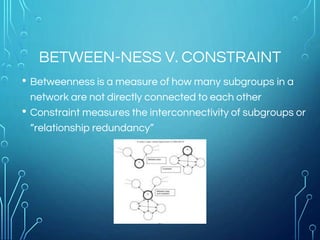
BETWEEN-NESS V. CONSTRAINT
• Betweenness is a measure of how many subgroups in a
network are not directly connected to each other
• Constraint measures the interconnectivity of subgroups or
“relationship redundancy”
DISCUSSION QUESTION #1
• If you were to start a business that required an online
network to help facilitate and manage operations or social
media, what service, structure and/or characteristics would
you use and why?
JOURNAL ARTICLE 1
THE TIES THAT BIND: SOCIAL NETWORK PRINCIPLES
IN ONLINE COMMUNITIES
BY
DALE GANLEY AND CLIFF LAMPE
Slashdot.com
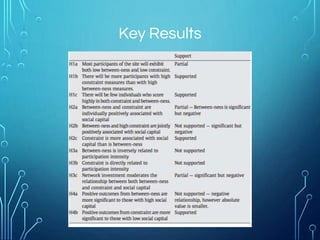
Key Results
Discussion question #2
Can you possibly think of any brokered and closed
networks from your own personal social media
networks?
JOURNAL ARTICLE 2
Virtual brokerage and closure: Network structure and
social capital in a massively multiplayer online game
BY
CUIHUA SHEN, PETER MONGE & DMITRI WILLIAMS
What’s this study about?
• Takes a structural approach towards understanding
brokerage and closure, or bridging and bonding in
the virtual world.
• Focuses on network structure within which individual
relationships are situated.
• In terms of social media, how does one assess social
capital? Researcher’s operationalized bridging and
bonding social capital according to their expected
outcomes.
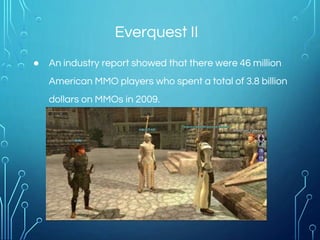
● An industry report showed that there were 46 million
American MMO players who spent a total of 3.8 billion
dollars on MMOs in 2009.
Everquest II
● Results provided strong support for the structural
model, demonstrating that players’ network
brokerage positively predicted their task
performance in the game and players embedded in
closed networks were more likely to trust each
other.
○ Brokers essentially had a wider network and
therefore better knowledge and gamed better.
○ Closed networks, where players knew each
other, fostered trust.
What did the study lead to?
Discussion question #3
How do you think this study can be
generalized? Does it impact your
understanding of brokerage and closed
networks?
How does this resonate with the previous
study?
Thank You...

Social network structures in online communities.pptx

  • 1.
    Social Network Structuresin Online Communities Steve Geer & Sreyoshi Dey
  • 2.
    OVERVIEW ➢Online groups arestructured in many different ways, creating varying degrees of interconnectedness and separation. ➢Flow of information, efficiency, and overall group (or corporate) cohesion all depend on a well-structured network.
  • 3.
  • 4.
    Some key termsand concepts essential to the understanding of networking in online communities: • Social network theory • Social capital • Structural holes • Brokerage vs closure • Between-ness vs constraint
  • 5.
    Let’s first reviewthe Social Network Theory a little...
  • 6.
    SOCIAL CAPITAL •It isthe value of one’s social network, or structure of relationships and one’s position within it, there on the advantage or benefits one may avail. •In online communities, it is an incentive to participate. •# of Friends or Followers, # of Likes, Shares, Karma, Klout, etc. all are seen as measures of social capital •The way a community is structured and managed will affect its social capital
  • 7.
    REPUTATION SYSTEM • away of achieving user feedback and facilitating participation, legitimacy and authority over a network and its flow of information • a tool that changes the dynamics and transparency of a network
  • 8.
    • A conceptapplied to social network theory that describes the gaps that exist between more dense subnetworks of strong connections. • The way information propagates differs based on what structural gaps exist in the network. • Also affects social capital. STRUCTURAL HOLES www.linkedin.com
  • 9.
    STRUCTURAL HOLES • “Structuralholes are defined as a lightly connected bridge between denser sub-network elements. If, in their collection of networks, an individual has bridged one or more structural holes they are “brokers” between the sub- networks; at the other extreme they are participating in “closed” networks.”
  • 10.
    BROKERAGE V. CLOSURE •Brokerage: “If the structural hole is large with very few actors crossing it, brokerage allows the entry of new ideas across a “bridge” or “brokerage” across sub- communities in a way that can facilitate information flow in the larger network.” • Closure: “...individuals with a personal network that is highly interconnected with few structural holes…”
  • 11.
    BETWEEN-NESS V. CONSTRAINT •Betweenness is a measure of how many subgroups in a network are not directly connected to each other • Constraint measures the interconnectivity of subgroups or “relationship redundancy”
  • 12.
    DISCUSSION QUESTION #1 •If you were to start a business that required an online network to help facilitate and manage operations or social media, what service, structure and/or characteristics would you use and why?
  • 13.
    JOURNAL ARTICLE 1 THETIES THAT BIND: SOCIAL NETWORK PRINCIPLES IN ONLINE COMMUNITIES BY DALE GANLEY AND CLIFF LAMPE
  • 14.
  • 15.
  • 16.
    Discussion question #2 Canyou possibly think of any brokered and closed networks from your own personal social media networks?
  • 17.
    JOURNAL ARTICLE 2 Virtualbrokerage and closure: Network structure and social capital in a massively multiplayer online game BY CUIHUA SHEN, PETER MONGE & DMITRI WILLIAMS
  • 18.
    What’s this studyabout? • Takes a structural approach towards understanding brokerage and closure, or bridging and bonding in the virtual world. • Focuses on network structure within which individual relationships are situated. • In terms of social media, how does one assess social capital? Researcher’s operationalized bridging and bonding social capital according to their expected outcomes.
  • 19.
    ● An industryreport showed that there were 46 million American MMO players who spent a total of 3.8 billion dollars on MMOs in 2009. Everquest II
  • 20.
    ● Results providedstrong support for the structural model, demonstrating that players’ network brokerage positively predicted their task performance in the game and players embedded in closed networks were more likely to trust each other. ○ Brokers essentially had a wider network and therefore better knowledge and gamed better. ○ Closed networks, where players knew each other, fostered trust. What did the study lead to?
  • 21.
    Discussion question #3 Howdo you think this study can be generalized? Does it impact your understanding of brokerage and closed networks? How does this resonate with the previous study?
  • 22.