Oliver Krone Knowledge Integration and Language relativism – Of the triade knowledge, language and thinking The International Conference on  Economics and Administration, ICEA – FAA Bucharest, 14-15th November 2009
Agenda Terminological clarifications Knowledge Integration Language relativism  Requirements Engineering Conceptional exploration Knowledge Language Thinking Consequences Summary Dr. Oliver Krone ICEA – FAA 2009 KI and language relativism
Leading questions of the presentation How do we manage to engage in inter- or multidisciplinary cooperation for the development of novelty? What happens in inter- or multidisciplinary cooperation? KI and language relativism Dr. Oliver Krone ICEA – FAA 2009
Terminological Clarifications Knowledge Integration Emerged during the late nineties  Is founded on multidisciplinary approach Aims to enhance the product development process More and more appropriated for  innovation development in general Knowledge Integration I KI and language relativism Dr. Oliver Krone ICEA – FAA 2009
Terminological Clarifications Knowledge Integration Knowledge Integration (KI) as an activity [..],  is a process in which individuals from different domains communicate information and knowledge in a way that the respective recipient [..], can act based on the information/knowledge obtained. It is an activity of knowledge generation. Knowledge Integration II KI and language relativism Dr. Oliver Krone ICEA – FAA 2009
Terminological Clarifications Language relativism Originates in the early 20 th  century Sapir-Whorf hypothesis Language available to a speaker shapes its perception of the world around him, and thus  Language and knowledge are interdependent objects (Cognitive Linguistics starting point; e.g. Tomasello, Fauconnier) Contested argument, and not falsified (Boroditsky) Pending on the field of examination evidence exists that there is some truth to this claim KI and language relativism Dr. Oliver Krone ICEA – FAA 2009
Terminological Clarifications Requirements Engineering gathering of “[..] realworld  goals for, functions of and constraints on software systems”  elicitation, modelling and analysing of requirements, communication of requirements for verification, and the agreement of requirements. Happens for any kind of product that is developed based on an engineering paradigm (also services are  result of requirements!) KI and language relativism Dr. Oliver Krone ICEA – FAA 2009
Concept exploration I Knowledge Knowledge, as negotiated outcome of a discourse, the value attached to it, and claim for acceptance, is dependent on the coherence of its descriptions to the processes as they are ensuing in reality (Krone, 2007) KI and language relativism Dr. Oliver Krone ICEA – FAA 2009
Concept exploration II Language Consists of grammar, words and categories Its acquisition by infants is a rather slow, but suggested to be a natural process Is a social shared good Delivers descriptions of real life objects and categorises those into families of objects that are of same kind according to Whorf(-Sapir) shapes our way of conceiving world  (Boroditsky, w/y) Is used  to formulate and develop knowledge  KI and language relativism Dr. Oliver Krone ICEA – FAA 2009
Concept exploration III Thinking Is suggested to be the process by which knowledge is applied  to solve problems According to Whorf is shaped by social factors that are engrained in the language used  Seems to happen by using language (Levi-Strauss, 2001, 3rd ed.) Languages used by individuals can infer on their cognitive process (Whorf; Berger & Luckmann, 1999; Searle, 1997; Boroditsky, 2007&w/y;) Can predicate solutions and make those less understandable to people that have dissimilar languages if understood right, question arises whether experts can move out of their universe of knowledge as this is built on language KI and language relativism Dr. Oliver Krone ICEA – FAA 2009
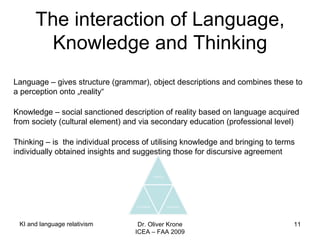
The interaction of Language, Knowledge and Thinking Language – gives structure (grammar), object descriptions and combines these to  a perception onto „reality“ Knowledge – social sanctioned description of reality based on language acquired from society (cultural element) and via secondary education (professional level) Thinking – is  the individual process of utilising knowledge and bringing to terms  individually obtained insights and suggesting those for discursive agreement KI and language relativism Dr. Oliver Krone ICEA – FAA 2009
Consequences I KI and language relativism Dr. Oliver Krone ICEA – FAA 2009
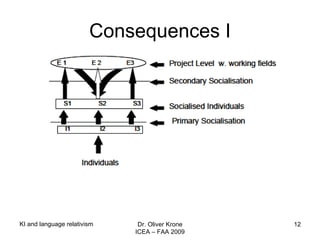
Consequences II –  The field of RE RE as process  of  communication and understanding seeking,  Empirically requires understanding based on the I level, and  (Krone, 2007 a/b) the capacity of the project participants to move to the S level in order to obtain a common level of knowledge understanding (Penrose; Nelson & Winter; Steinheider, 2001) Is seemingly eased in more open organisational environments (Goh; Ghoshal; Jassawalla & Sashittal) KI and language relativism Dr. Oliver Krone ICEA – FAA 2009
Consequences III - The field of RE Understanding based on the I level,  KI can be understood as norm generative process (Krone, 2007 b) When the “norm” is understood as a collective good that is shared among project members project members hold each other responsible to it Individuals’ have different socialisation backgrounds that hamper (knowledge) understanding and communication KI and language relativism Dr. Oliver Krone ICEA – FAA 2009
How can be understanding in projects achieved when there are differences in knowledge, conceptionalisation (thinking) of problems, and verbalisation (language)?? KI and language relativism Dr. Oliver Krone ICEA – FAA 2009
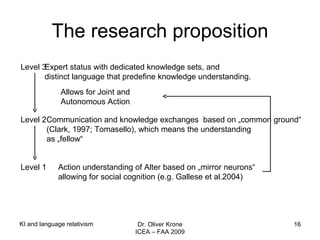
The research proposition Level 3  Expert status with dedicated knowledge sets, and  distinct language that predefine knowledge understanding. Level 2  Communication and knowledge exchanges  based on „common ground“ (Clark, 1997; Tomasello), which means the understanding as „fellow“ Level 1  Action understanding of Alter based on „mirror neurons“  allowing for social cognition (e.g. Gallese et al.2004) Allows for Joint and Autonomous Action KI and language relativism Dr. Oliver Krone ICEA – FAA 2009
Summary I Having similar backgrounds (socially and knowledge wise) allows for better understanding and allows mirror neurons quicker action anticipation (Gallese et al.; Phenomological stance in humanities), however  mirror neurons are a human property that allows for the move to “I”  in project work and  thus human understanding KI and language relativism Dr. Oliver Krone ICEA – FAA 2009
Summary II asks for more human approaches to RE, not more  technology or managerialism Improved collective sense-making as action are understood because of their  proximity to one’s experience Respecting hunches and intuitive understanding of others (and Ego) can be a productivity increasing measure KI and language relativism Dr. Oliver Krone ICEA – FAA 2009

Knowledge Integration and Language relativism–Of the triade knowledge,language and thinking

  • 1.
    Oliver Krone KnowledgeIntegration and Language relativism – Of the triade knowledge, language and thinking The International Conference on Economics and Administration, ICEA – FAA Bucharest, 14-15th November 2009
  • 2.
    Agenda Terminological clarificationsKnowledge Integration Language relativism Requirements Engineering Conceptional exploration Knowledge Language Thinking Consequences Summary Dr. Oliver Krone ICEA – FAA 2009 KI and language relativism
  • 3.
    Leading questions ofthe presentation How do we manage to engage in inter- or multidisciplinary cooperation for the development of novelty? What happens in inter- or multidisciplinary cooperation? KI and language relativism Dr. Oliver Krone ICEA – FAA 2009
  • 4.
    Terminological Clarifications KnowledgeIntegration Emerged during the late nineties Is founded on multidisciplinary approach Aims to enhance the product development process More and more appropriated for innovation development in general Knowledge Integration I KI and language relativism Dr. Oliver Krone ICEA – FAA 2009
  • 5.
    Terminological Clarifications KnowledgeIntegration Knowledge Integration (KI) as an activity [..], is a process in which individuals from different domains communicate information and knowledge in a way that the respective recipient [..], can act based on the information/knowledge obtained. It is an activity of knowledge generation. Knowledge Integration II KI and language relativism Dr. Oliver Krone ICEA – FAA 2009
  • 6.
    Terminological Clarifications Languagerelativism Originates in the early 20 th century Sapir-Whorf hypothesis Language available to a speaker shapes its perception of the world around him, and thus Language and knowledge are interdependent objects (Cognitive Linguistics starting point; e.g. Tomasello, Fauconnier) Contested argument, and not falsified (Boroditsky) Pending on the field of examination evidence exists that there is some truth to this claim KI and language relativism Dr. Oliver Krone ICEA – FAA 2009
  • 7.
    Terminological Clarifications RequirementsEngineering gathering of “[..] realworld goals for, functions of and constraints on software systems” elicitation, modelling and analysing of requirements, communication of requirements for verification, and the agreement of requirements. Happens for any kind of product that is developed based on an engineering paradigm (also services are result of requirements!) KI and language relativism Dr. Oliver Krone ICEA – FAA 2009
  • 8.
    Concept exploration IKnowledge Knowledge, as negotiated outcome of a discourse, the value attached to it, and claim for acceptance, is dependent on the coherence of its descriptions to the processes as they are ensuing in reality (Krone, 2007) KI and language relativism Dr. Oliver Krone ICEA – FAA 2009
  • 9.
    Concept exploration IILanguage Consists of grammar, words and categories Its acquisition by infants is a rather slow, but suggested to be a natural process Is a social shared good Delivers descriptions of real life objects and categorises those into families of objects that are of same kind according to Whorf(-Sapir) shapes our way of conceiving world (Boroditsky, w/y) Is used to formulate and develop knowledge KI and language relativism Dr. Oliver Krone ICEA – FAA 2009
  • 10.
    Concept exploration IIIThinking Is suggested to be the process by which knowledge is applied to solve problems According to Whorf is shaped by social factors that are engrained in the language used Seems to happen by using language (Levi-Strauss, 2001, 3rd ed.) Languages used by individuals can infer on their cognitive process (Whorf; Berger & Luckmann, 1999; Searle, 1997; Boroditsky, 2007&w/y;) Can predicate solutions and make those less understandable to people that have dissimilar languages if understood right, question arises whether experts can move out of their universe of knowledge as this is built on language KI and language relativism Dr. Oliver Krone ICEA – FAA 2009
  • 11.
    The interaction ofLanguage, Knowledge and Thinking Language – gives structure (grammar), object descriptions and combines these to a perception onto „reality“ Knowledge – social sanctioned description of reality based on language acquired from society (cultural element) and via secondary education (professional level) Thinking – is the individual process of utilising knowledge and bringing to terms individually obtained insights and suggesting those for discursive agreement KI and language relativism Dr. Oliver Krone ICEA – FAA 2009
  • 12.
    Consequences I KIand language relativism Dr. Oliver Krone ICEA – FAA 2009
  • 13.
    Consequences II – The field of RE RE as process of communication and understanding seeking, Empirically requires understanding based on the I level, and (Krone, 2007 a/b) the capacity of the project participants to move to the S level in order to obtain a common level of knowledge understanding (Penrose; Nelson & Winter; Steinheider, 2001) Is seemingly eased in more open organisational environments (Goh; Ghoshal; Jassawalla & Sashittal) KI and language relativism Dr. Oliver Krone ICEA – FAA 2009
  • 14.
    Consequences III -The field of RE Understanding based on the I level, KI can be understood as norm generative process (Krone, 2007 b) When the “norm” is understood as a collective good that is shared among project members project members hold each other responsible to it Individuals’ have different socialisation backgrounds that hamper (knowledge) understanding and communication KI and language relativism Dr. Oliver Krone ICEA – FAA 2009
  • 15.
    How can beunderstanding in projects achieved when there are differences in knowledge, conceptionalisation (thinking) of problems, and verbalisation (language)?? KI and language relativism Dr. Oliver Krone ICEA – FAA 2009
  • 16.
    The research propositionLevel 3 Expert status with dedicated knowledge sets, and distinct language that predefine knowledge understanding. Level 2 Communication and knowledge exchanges based on „common ground“ (Clark, 1997; Tomasello), which means the understanding as „fellow“ Level 1 Action understanding of Alter based on „mirror neurons“ allowing for social cognition (e.g. Gallese et al.2004) Allows for Joint and Autonomous Action KI and language relativism Dr. Oliver Krone ICEA – FAA 2009
  • 17.
    Summary I Havingsimilar backgrounds (socially and knowledge wise) allows for better understanding and allows mirror neurons quicker action anticipation (Gallese et al.; Phenomological stance in humanities), however mirror neurons are a human property that allows for the move to “I” in project work and thus human understanding KI and language relativism Dr. Oliver Krone ICEA – FAA 2009
  • 18.
    Summary II asksfor more human approaches to RE, not more technology or managerialism Improved collective sense-making as action are understood because of their proximity to one’s experience Respecting hunches and intuitive understanding of others (and Ego) can be a productivity increasing measure KI and language relativism Dr. Oliver Krone ICEA – FAA 2009