Social Media
 Explainvarious types of social media, including
 “The Big 3”

 Explore   the benefits of using social media

 Examine    how to use social media effectively

 Discussbest practices and federal/state agency
 use of social media
   ONLINE – connection to the Internet via a computer, mobile or Smartphone
    device

   MOBILE DEVICE – a small, hand-held computing device
    - Examples: Smartphone, Tablet PCs

   SMARTPHONE – a high-end mobile phone with advanced computing ability and
    connectivity
     - Examples: Android, iPhone, BlackBerry

   SOCIAL NETWORKING SITE (SNS) – an online service or website that focuses
    on building social relations among users who may share interests or activities

   REAL-TIME - events are portrayed at the same rate that the audience
    experiences them
   SOCIAL MARKETING
     • “Marketing for a social good”
     • Commercial practices to achieve non-commercial goals
       Two “parents”: a “social parent” (social sciences and social policy)
       + a “marketing parent” (commercial and public sector marketing
       approaches) = Social Marketing


   SOCIAL MEDIA MARKETING – social marketing that utilizes social
    media sites to provide messages and gain website traffic. Platforms:
    SNS and mobile devices.
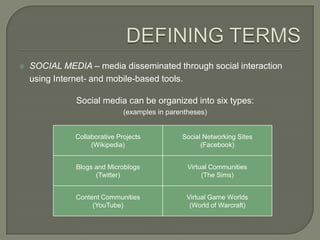
   SOCIAL MEDIA – media disseminated through social interaction
    using Internet- and mobile-based tools.

               Social media can be organized into six types:
                              (examples in parentheses)


              Collaborative Projects           Social Networking Sites
                   (Wikipedia)                       (Facebook)


               Blogs and Microblogs              Virtual Communities
                     (Twitter)                        (The Sims)


               Content Communities              Virtual Game Worlds
                    (YouTube)                    (World of Warcraft)
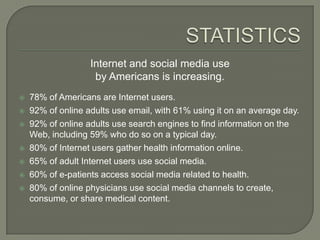
Internet and social media use
                    by Americans is increasing.
   78% of Americans are Internet users.
   92% of online adults use email, with 61% using it on an average day.
   92% of online adults use search engines to find information on the
    Web, including 59% who do so on a typical day.
   80% of Internet users gather health information online.
   65% of adult Internet users use social media.
   60% of e-patients access social media related to health.
   80% of online physicians use social media channels to create,
    consume, or share medical content.
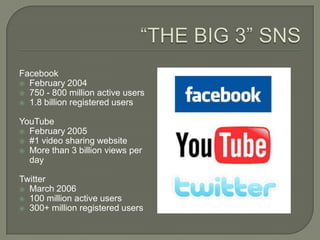
Facebook
 February 2004
 750 - 800 million active users
 1.8 billion registered users


YouTube
 February 2005
 #1 video sharing website
 More than 3 billion views per
  day

Twitter
 March 2006
 100 million active users
 300+ million registered users
   Anyone with Internet access can view.
   Creating an account is free.
   Users must create a personal profile to interact with
    people, groups, pages and places.
   Users can share information at a high capacity in various
    formats, including interests, contact information, blog
    postings, photos, videos, documents, links, and more.
   Users can communicate with Facebook friends and users publicly
    or privately, or use a chat feature.
   Users may join networks organized by school, college, or
    workplace and create their own "like" pages and interest groups.
   Posts are listed in real time.
   More than 800 million active users
   More than 50% of active users log on to Facebook on
    any given day
   Average user has 130 friends
   More than 900 million objects that people interact with
    (pages, groups, events and community pages)
   Average user is connected to 80 community
    pages, groups and events
   On average, more than 250 million photos are uploaded
    per day.

                                Source: www.facebook.com/press
   Provides on-demand viewing of videos and creates a
    venue for viewers to provide feedback about the videos
   Anyone with Internet access can view.
   Creating an account is free.
   Users can watch, upload, and share videos, add and
    accept friends, and subscribe to other users which
    enables them to interact and receive notifications when
    new content has been uploaded.
   Videos may be embedded and shared on websites and
    other SNS
 More  than 3 billion views per day - nearly double
  the prime time audience of all three major U.S.
  networks combined
 48 hours of video uploaded every minute

 800 million unique visitors each month

 #2 search engine after Google


                           Source: www.youtube.com/t/press
   Anyone with Internet access can view.
   Creating an account is free.
   Users can post short text updates called "tweets" of 140 characters
    or less on their profile page
   Users can subscribe to other user tweets and lists which contain
    more than one user. This is known as "following" and subscribers are
    known as "followers.“
   Users may also share links to blog
    postings, photos, videos, documents, links, and more.
   Followers may reply or “retweet” the tweet. When retweeting a
    tweet, a follower shares that tweet with their followers.
   Tweets are listed in real time.
   As of June 2011, users on Twitter are now averaging 200
    million tweets per day.
   55 million users log in to Twitter from their phone or tablet
    each month.
   40% of users don't tweet every month but watch others
    tweet.
   Today, Alexa (Web Information Company) ranks Twitter
    9th in the world’s most trafficked sites with Google.com in
    1st position, Facebook 2nd and YouTube 3rd.
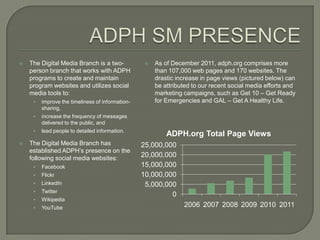
   The Digital Media Branch is a two-                As of December 2011, adph.org comprises more
    person branch that works with ADPH                 than 107,000 web pages and 170 websites. The
    programs to create and maintain                    drastic increase in page views (pictured below) can
    program websites and utilizes social               be attributed to our recent social media efforts and
    media tools to:                                    marketing campaigns, such as Get 10 – Get Ready
     •   improve the timeliness of information-        for Emergencies and GAL – Get A Healthy Life.
         sharing,
     •   increase the frequency of messages
         delivered to the public, and
     •   lead people to detailed information.
                                                           ADPH.org Total Page Views
   The Digital Media Branch has                  25,000,000
    established ADPH’s presence on the
    following social media websites:              20,000,000
     •   Facebook                                 15,000,000
     •   Flickr                                   10,000,000
     •   LinkedIn                                  5,000,000
     •   Twitter
                                                           0
     •   Wikipedia
     •   YouTube                                                 2006 2007 2008 2009 2010 2011
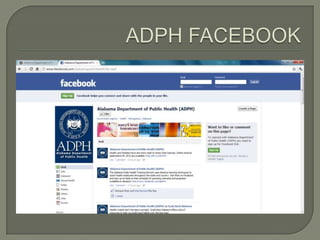
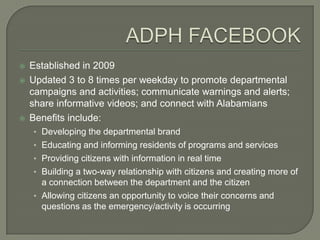
   Established in 2009
   Updated 3 to 8 times per weekday to promote departmental
    campaigns and activities; communicate warnings and alerts;
    share informative videos; and connect with Alabamians
   Benefits include:
    • Developing the departmental brand
    • Educating and informing residents of programs and services
    • Providing citizens with information in real time
    • Building a two-way relationship with citizens and creating more of
      a connection between the department and the citizen
    • Allowing citizens an opportunity to voice their concerns and
      questions as the emergency/activity is occurring
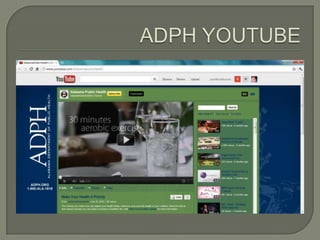
   Established in 2010
   Provides an on-demand review of departmental commercials
    and educational videos for viewers and creates a venue for
    them to provide feedback about the videos
   Benefits include:
    • Allowing viewers an opportunity to receive information that they may
      have missed in the first viewing
    • Generating feedback that be can used in the development of future
      advertising
    • Allowing the department and others to embed videos on websites to
      further promote messages
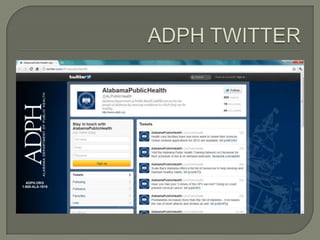
   Established in 2011
   Updated 3 to 8 times per weekday to promote departmental
    campaigns and activities; communicate warnings and alerts;
    share informative videos; and connect with Alabamians
   Benefits include:
    • Developing the departmental brand
    • Educating and informing residents of programs and services
    • Providing citizens with information in real time
    • Building a two-way relationship with citizens and creating more of
      a connection between the department and the citizen
    • Allowing citizens an opportunity to voice their concerns and
      questions as the emergency/activity is occurring
   RSS Feeds                                    LinkedIn (2003)
     • RSS Feeds (Really Simple                    • LinkedIn is the world’s largest
       Syndication) are subscriptions to
       website or blog content that allow
                                                     SNS specifically for
       subscribers to see updated                    professionals. The site has
       information as its published online.          100+ million users.

   Wikipedia (2001)                             Flickr (2004)
     • Wikipedia is a free, Web-
                                                   • Flickr is the most popular
       based, multi-lingual encyclopedia
       that is written collaboratively with          online photo management
       volunteers from around the world.             and sharing application. Flickr
                                                     also allows users to upload
                                                     video. As of August 2011, the
                                                     site hosts 6 billion photos.
   Foursquare (2009)
     • 15 million users
     • Foursquare is a location-based social network site that lets people
       “check in” to places, businesses, etc., via mobile device, text
       message, or a device specific application.

   Google+ or GooglePlus (2011)
     • 62 million users
     • Google+ is similar to Facebook in that it allows you to interact with
       friends with a streamline of information in chronological order.
   Can target a specific audience or segment of the
    population
   Builds relationships with your public/audience (before an
    emergency happens)
   Creates immediate redundancy
   Provides information in various formats
   Provides access to information regardless of physical
    constraints
   Does not require verbal communication
   Allows social interaction without physical contact
   Reduces social discomfort, non-acceptance, and
    discrimination due to stereotyping
   Provides a platform for specific special populations
   Keeps public informed in real-time
   Increases the frequency of messages (creates
    redundancy)
   Leads people to detailed information
   Engages people in the emergency response – aid in
    rapid recovery and resilience
   Puts emergency–management community in a better
    position to respond to emergencies
   Creates transparency
Virginia Tech (2007)

          2009 H1N1 Influenza Pandemic

                  Haiti Earthquake (2010)

Tornadoes in Joplin and Tuscaloosa (2011)
GETTING STARTED    ADPH FACEBOOK DISCLAIMER

   Research      Disclaimer: The ADPH fan page was created to share health
                  information, news, and events with the public. Posted

   Plan          comments and images do not necessarily represent the views
                  of ADPH, its officers or employees, or of the State of Alabama.

   Selection     We encourage feedback and information sharing, but ask that
                  you stay on topic and be respectful. You may not

   Image         sell, promote, or advertise any products or services on the
                  ADPH Facebook page nor represent any of such as being
   Description   endorsed in any way by ADPH or the State of Alabama. We
                  reserve the right to delete comments we deem
   Contact       inappropriate, profane, defamatory or harassing in nature and
                  to block repeat offenders without notification.
   Disclaimer
   Be genuine and honest
   Think before you speak type
   Rethink disciplinary action
   Reply promptly
   Personalize messages
   Obey doctor-patient confidentiality
   Less is more
   Communication effectively
   Reference others
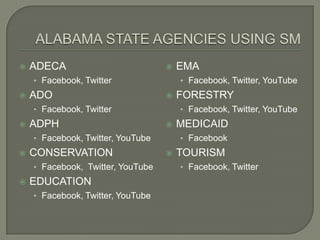
   ADECA                             EMA
    • Facebook, Twitter                • Facebook, Twitter, YouTube
   ADO                               FORESTRY
    • Facebook, Twitter                • Facebook, Twitter, YouTube
   ADPH                              MEDICAID
    • Facebook, Twitter, YouTube       • Facebook
   CONSERVATION                      TOURISM
    • Facebook, Twitter, YouTube       • Facebook, Twitter
   EDUCATION
    • Facebook, Twitter, YouTube
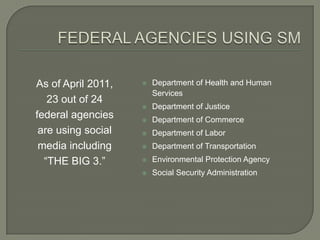
As of April 2011,      Department of Health and Human
                        Services
   23 out of 24
                       Department of Justice
federal agencies       Department of Commerce
 are using social      Department of Labor
 media including       Department of Transportation
  “THE BIG 3.”         Environmental Protection Agency
                       Social Security Administration
Facebook.com
                          Flickr.com
                   Foursquare.com
                     Mashable.com
                      LinkedIn.com
Pew Internet & American Life Project
                        Twitter.com
                     Wikipedia.com
                      YouTube.com

Social media

  • 1.
  • 2.
     Explainvarious typesof social media, including “The Big 3”  Explore the benefits of using social media  Examine how to use social media effectively  Discussbest practices and federal/state agency use of social media
  • 3.
    ONLINE – connection to the Internet via a computer, mobile or Smartphone device  MOBILE DEVICE – a small, hand-held computing device - Examples: Smartphone, Tablet PCs  SMARTPHONE – a high-end mobile phone with advanced computing ability and connectivity - Examples: Android, iPhone, BlackBerry  SOCIAL NETWORKING SITE (SNS) – an online service or website that focuses on building social relations among users who may share interests or activities  REAL-TIME - events are portrayed at the same rate that the audience experiences them
  • 4.
    SOCIAL MARKETING • “Marketing for a social good” • Commercial practices to achieve non-commercial goals Two “parents”: a “social parent” (social sciences and social policy) + a “marketing parent” (commercial and public sector marketing approaches) = Social Marketing  SOCIAL MEDIA MARKETING – social marketing that utilizes social media sites to provide messages and gain website traffic. Platforms: SNS and mobile devices.
  • 5.
    SOCIAL MEDIA – media disseminated through social interaction using Internet- and mobile-based tools. Social media can be organized into six types: (examples in parentheses) Collaborative Projects Social Networking Sites (Wikipedia) (Facebook) Blogs and Microblogs Virtual Communities (Twitter) (The Sims) Content Communities Virtual Game Worlds (YouTube) (World of Warcraft)
  • 6.
    Internet and socialmedia use by Americans is increasing.  78% of Americans are Internet users.  92% of online adults use email, with 61% using it on an average day.  92% of online adults use search engines to find information on the Web, including 59% who do so on a typical day.  80% of Internet users gather health information online.  65% of adult Internet users use social media.  60% of e-patients access social media related to health.  80% of online physicians use social media channels to create, consume, or share medical content.
  • 7.
    Facebook  February 2004 750 - 800 million active users  1.8 billion registered users YouTube  February 2005  #1 video sharing website  More than 3 billion views per day Twitter  March 2006  100 million active users  300+ million registered users
  • 8.
    Anyone with Internet access can view.  Creating an account is free.  Users must create a personal profile to interact with people, groups, pages and places.  Users can share information at a high capacity in various formats, including interests, contact information, blog postings, photos, videos, documents, links, and more.  Users can communicate with Facebook friends and users publicly or privately, or use a chat feature.  Users may join networks organized by school, college, or workplace and create their own "like" pages and interest groups.  Posts are listed in real time.
  • 9.
    More than 800 million active users  More than 50% of active users log on to Facebook on any given day  Average user has 130 friends  More than 900 million objects that people interact with (pages, groups, events and community pages)  Average user is connected to 80 community pages, groups and events  On average, more than 250 million photos are uploaded per day. Source: www.facebook.com/press
  • 10.
    Provides on-demand viewing of videos and creates a venue for viewers to provide feedback about the videos  Anyone with Internet access can view.  Creating an account is free.  Users can watch, upload, and share videos, add and accept friends, and subscribe to other users which enables them to interact and receive notifications when new content has been uploaded.  Videos may be embedded and shared on websites and other SNS
  • 11.
     More than 3 billion views per day - nearly double the prime time audience of all three major U.S. networks combined  48 hours of video uploaded every minute  800 million unique visitors each month  #2 search engine after Google Source: www.youtube.com/t/press
  • 12.
    Anyone with Internet access can view.  Creating an account is free.  Users can post short text updates called "tweets" of 140 characters or less on their profile page  Users can subscribe to other user tweets and lists which contain more than one user. This is known as "following" and subscribers are known as "followers.“  Users may also share links to blog postings, photos, videos, documents, links, and more.  Followers may reply or “retweet” the tweet. When retweeting a tweet, a follower shares that tweet with their followers.  Tweets are listed in real time.
  • 13.
    As of June 2011, users on Twitter are now averaging 200 million tweets per day.  55 million users log in to Twitter from their phone or tablet each month.  40% of users don't tweet every month but watch others tweet.  Today, Alexa (Web Information Company) ranks Twitter 9th in the world’s most trafficked sites with Google.com in 1st position, Facebook 2nd and YouTube 3rd.
  • 14.
    The Digital Media Branch is a two-  As of December 2011, adph.org comprises more person branch that works with ADPH than 107,000 web pages and 170 websites. The programs to create and maintain drastic increase in page views (pictured below) can program websites and utilizes social be attributed to our recent social media efforts and media tools to: marketing campaigns, such as Get 10 – Get Ready • improve the timeliness of information- for Emergencies and GAL – Get A Healthy Life. sharing, • increase the frequency of messages delivered to the public, and • lead people to detailed information. ADPH.org Total Page Views  The Digital Media Branch has 25,000,000 established ADPH’s presence on the following social media websites: 20,000,000 • Facebook 15,000,000 • Flickr 10,000,000 • LinkedIn 5,000,000 • Twitter 0 • Wikipedia • YouTube 2006 2007 2008 2009 2010 2011
  • 16.
    Established in 2009  Updated 3 to 8 times per weekday to promote departmental campaigns and activities; communicate warnings and alerts; share informative videos; and connect with Alabamians  Benefits include: • Developing the departmental brand • Educating and informing residents of programs and services • Providing citizens with information in real time • Building a two-way relationship with citizens and creating more of a connection between the department and the citizen • Allowing citizens an opportunity to voice their concerns and questions as the emergency/activity is occurring
  • 18.
    Established in 2010  Provides an on-demand review of departmental commercials and educational videos for viewers and creates a venue for them to provide feedback about the videos  Benefits include: • Allowing viewers an opportunity to receive information that they may have missed in the first viewing • Generating feedback that be can used in the development of future advertising • Allowing the department and others to embed videos on websites to further promote messages
  • 20.
    Established in 2011  Updated 3 to 8 times per weekday to promote departmental campaigns and activities; communicate warnings and alerts; share informative videos; and connect with Alabamians  Benefits include: • Developing the departmental brand • Educating and informing residents of programs and services • Providing citizens with information in real time • Building a two-way relationship with citizens and creating more of a connection between the department and the citizen • Allowing citizens an opportunity to voice their concerns and questions as the emergency/activity is occurring
  • 21.
    RSS Feeds  LinkedIn (2003) • RSS Feeds (Really Simple • LinkedIn is the world’s largest Syndication) are subscriptions to website or blog content that allow SNS specifically for subscribers to see updated professionals. The site has information as its published online. 100+ million users.  Wikipedia (2001)  Flickr (2004) • Wikipedia is a free, Web- • Flickr is the most popular based, multi-lingual encyclopedia that is written collaboratively with online photo management volunteers from around the world. and sharing application. Flickr also allows users to upload video. As of August 2011, the site hosts 6 billion photos.
  • 22.
    Foursquare (2009) • 15 million users • Foursquare is a location-based social network site that lets people “check in” to places, businesses, etc., via mobile device, text message, or a device specific application.  Google+ or GooglePlus (2011) • 62 million users • Google+ is similar to Facebook in that it allows you to interact with friends with a streamline of information in chronological order.
  • 23.
    Can target a specific audience or segment of the population  Builds relationships with your public/audience (before an emergency happens)  Creates immediate redundancy  Provides information in various formats
  • 24.
    Provides access to information regardless of physical constraints  Does not require verbal communication  Allows social interaction without physical contact  Reduces social discomfort, non-acceptance, and discrimination due to stereotyping  Provides a platform for specific special populations
  • 25.
    Keeps public informed in real-time  Increases the frequency of messages (creates redundancy)  Leads people to detailed information  Engages people in the emergency response – aid in rapid recovery and resilience  Puts emergency–management community in a better position to respond to emergencies  Creates transparency
  • 26.
    Virginia Tech (2007) 2009 H1N1 Influenza Pandemic Haiti Earthquake (2010) Tornadoes in Joplin and Tuscaloosa (2011)
  • 27.
    GETTING STARTED ADPH FACEBOOK DISCLAIMER  Research Disclaimer: The ADPH fan page was created to share health information, news, and events with the public. Posted  Plan comments and images do not necessarily represent the views of ADPH, its officers or employees, or of the State of Alabama.  Selection We encourage feedback and information sharing, but ask that you stay on topic and be respectful. You may not  Image sell, promote, or advertise any products or services on the ADPH Facebook page nor represent any of such as being  Description endorsed in any way by ADPH or the State of Alabama. We reserve the right to delete comments we deem  Contact inappropriate, profane, defamatory or harassing in nature and to block repeat offenders without notification.  Disclaimer
  • 28.
    Be genuine and honest  Think before you speak type  Rethink disciplinary action  Reply promptly  Personalize messages  Obey doctor-patient confidentiality  Less is more  Communication effectively  Reference others
  • 29.
    ADECA  EMA • Facebook, Twitter • Facebook, Twitter, YouTube  ADO  FORESTRY • Facebook, Twitter • Facebook, Twitter, YouTube  ADPH  MEDICAID • Facebook, Twitter, YouTube • Facebook  CONSERVATION  TOURISM • Facebook, Twitter, YouTube • Facebook, Twitter  EDUCATION • Facebook, Twitter, YouTube
  • 30.
    As of April2011,  Department of Health and Human Services 23 out of 24  Department of Justice federal agencies  Department of Commerce are using social  Department of Labor media including  Department of Transportation “THE BIG 3.”  Environmental Protection Agency  Social Security Administration
  • 31.
    Facebook.com Flickr.com Foursquare.com Mashable.com LinkedIn.com Pew Internet & American Life Project Twitter.com Wikipedia.com YouTube.com

Editor's Notes

  • #3 In this presentation, I will…
  • #4 Before we addresses these objectives, I’d like to define some terms and take a look at some statistics.<read slide>We have defined SNS. Now let us also discuss the difference between social marketing, social media marketing, and social media.
  • #5 Social Marketing can be summed up as “marketing for a social good.”It’s marketing that uses traditional marketing practices to achieve non-commercial goals, or for our purposes, changes in behaviors.You can think of social marketing as being the product of two parents… <read slide>Social marketing began in the 1980’s with health promotion campaigns: anti-tobacco and skin cancer prevention campaigns.Anything that comes out of our Communications department at ADPH is considered social marketing – prints and web materials.Social Media Marketing…
  • #6 Social Media… <read slide>I have come across different ways social media experts have categorized social media and this is the best one. Here are six media types as defined by marketing professors and consultants Andreas Kaplan and Michael Haenlin. Examples are in the parentheses.The Sims is one of the most successful life-simulation video game series. As of May 2011, the franchise has sold more than 150 million copies worldwide,and is also the best selling PC franchise in PC history. The player creates virtual people called "Sims,” places them in houses and helps direct their moods and satisfy their desires. Players can either place their Sims in pre-constructed homes or build them themselves. Each successive expansive pack and game in the series augmented what the player could do with their Sims.World of Warcraft is an online multiplayer role-playing game with 11.1 million subscribers as of June 2011.
  • #7 The following stats are from Pew Internet & American Life Project Tracking Surveys.Internet users who gather health information online have been coined “e-patients.”
  • #8 Facebook, YouTube, and Twitter are known as “The Big 3” social networking sites.Remember that these are relatively new. Facebook… <read slide>An active user is someone who logs into their account at least once a month.Social media experts are predicting that Facebook will have 2 billion registered users by the end of this year. That’s 37 percent of the world’s population!And Twitter will have 250 million active users and 900 million registered users by the end of this year.
  • #9 Anyone with Internet access can view Facebook pages, events, and some personal profiles depending on the profile settings. But to interact with people, groups, pages and placed, you must have a personal profile – which is free. With an account, users… <read slide>
  • #10 There are… <read slide>These stats were pulled from Facebook’s Press pages at www.facebook.com/press.
  • #11 YouTube is the #1 video sharing website.<read slide>How many of you occasionally watch YouTube videos? You may watch more than you realize. Videos that are embedded in websites, blogs, and on Facebook are often from YouTube.
  • #12 <read slide>Since 2008, YouTube has maintained its position as the #2 search engine in the U.S.
  • #13 Anyone with Internet access can view Twitter profiles depending on the profile settings. But to interact with profiles, you must have a personal profile – which is free. With an account, users can post short text updates… <read slide>
  • #14 <read slide>Twitter is not as forthcoming in providing stats on their registration numbers.95% of Twitter users own a mobile phone, and half of these users access the service on their handheld device.I have two friends that only have Twitter accounts so they can find out when their favorite brands are having sales or offering discounts and contests.
  • #15 My branch is the Digital Media Branch and we do all things website and social media related. ADPH has a presence on Facebook, Flickr, LinkedIn, Twitter, Wikipedia and YouTube. We have 107,000 web pages and 170 websites. Since we arrived on the social media scene, we’ve seen a drastic increase in page views. This chart provides a great illustration. In 2006, we had…2011 – 21.6 mill.2010 – 20 mill.2009 – 8.3 mill.2008 – 6.8 mill.2007 – 5.5 mill.2006 – 2.8 mill.Since Jan. 1 we’ve had 1.5 million page views. So in one month we have had half of the page views that we had in 2006.
  • #22 There are some additional social media tools that I’d like to mention.<read slide>A feed, also known as RSS feed, web feed, XML feed, or syndicated content is updated content published by a website.RSS feeds provide an easy way for you to keep up with news and information that is important to you without having to browse or search using conventional methods. Feed aggregators save time and effort by automatically retrieving the most up-to-date content from websites and providing the content in a single location for easy viewing. RSS feeds are commonly used for news and blog websites. Feeds can also be used to deliver pictures, audio, and video. A RSS feed that distributes audio content, generally in MP3 format played using a MP3 player, is a podcast. To subscribe to a feed on a website, locate and click a feed icon or link on the web page. Feeds may be read using a RSS/feed reader or aggregator. Feed aggregators are often a built-in feature of Internet browsers and email programs. The department has six RSS feeds that you can subscribe to including News Releases, ALPHTN Webcasts, Statewide Notices, Statewide Events, County Notices, and Swimming Advisories.<read slide>Since it’s creation in 2011, it has grown rapidly into one of the largest reference sites. I became one of the 91,000 active contributors when I created the ADPH article in 2010. There are more than 16 million articles in 270 languages.<read slide>LinkedIn allows users to create profiles that look similar to a resume with education and employment experience, references, etc. and allows users to connect with others in their professional field. Users can become members of groups and join discussion forums. ADPH is one of the 2 billion companies that have a company profile in which employees can connect their profile. As of Nov. 2011, LinkedIn has 135 million members from 200 countries. As of Sept. 2011, all executives from the 2011 Fortune 500 companies are members.<read slide>Flickrallows people to share photographs, as well as allow bloggers and Webmasters to host images that they can embed in blogs and social media.
  • #23 Google + expected to have 400 million users by end of 2012. Circles – allows you to group friends and family and specify which group you would like information to be seen by. Hangouts – similar to Facetime where you can chat with people via video Sparks – when you develop your profile you can select your interests and every time someone posts information containing one of your interests. Huddles – group texting
  • #24 Messages during a crisis need to be short – 3 to 7 bits of information. During a crisis people process information differently and shorter messages are easier to digest. Social media lets you deliver small bits of information throughout the emergency response. This keeps people continuously engaged, but not overwhelmed with information.
  • #25 Special populations include ethnic minorities, veterans, disabled people, prison inmates, refugees and immigrants, children, and the elderly.Social media can benefit special populations by… <read slide>
  • #26 Social media can assist in 1) Preparedness, 2) Response, 3) Recovery.Social media is becoming vital to recovery efforts after a crises, when infrastructure must be rebuilt and stress management is critical. SM allows people who are recovering from disasters to rapidly connect with needed resources. People can share tips and resources on surviving and recovering from a crisis.Social media not only sends and gathers information instantaneously – it fosters relationships and trust, while encouraging users to share important information. It also lets the public know that agency’s are listening and concerned about what they have to say.
  • #27 Virginia Tech – During the first hour and a half of the 2007 massacre at Virginia Tech in which a student gunman killed 32 people/injured 25, student posted on-scene updates on Facebook alerting family, students and friends.During the 2009 H1N1 influenza pandemic, the Department of Health and Human Services used a “Mommycast” – viewed on YouTube and downloaded as an iTunes video podcast – to tell 1 million viewers what was happening, what to expect, and how to prevent the spread of influenza.The organization Ushahidid monitored Twitter and other social media and geotagged them to create maps to assistance during the Haiti recovery. A geotagged photograph is a photograph which is associated with a geographical location by geotagging. Usually this is done by assigning at least a latitude and longitude to the image, and optionally altitude. The group matched volunteer health care providers with distressed areas.One of the hardest hit places during the Joplin tornado was St. Johns Regional Medical Center. The hospital took a direct hit during the tornado. At one time, there were 1,100 employees unaccounted for. The person tasked to try and locate the employees had exhausted all other avenues of trying to locate employees when she was finally instructed by her supervisor to utilize social media to try and locate them. She created a Facebook page that day for the first time and within 3 days had located all 1,100 employees.Tuscaloosa Tornado – During the recovery phase, people used Facebook to ask for assistance with everything from food delivery to cleanup assistance.
  • #28 Research - Before we created an account, we did our own research by visiting the SNS and familiarize ourselves with it.We visited local, state, and federal partner’s websites to find out what they are doing with social media. At the time we were one of the few out there. Recognize limitations in reaching at-risk, vulnerable populations. Be sure you select the right SNS for you.Plan - Develop a social media plan. Does not have to be a formal policy. It’s important for you to outline your goals and how you plant achieve them. The plan may include: a definition for social marketing, an explanation of why and how you are using social networking to promote your program, and ways you are measuring the ROI.Selection - Determine how much time and effort you have to maintain a site (and how much money you have to invest in someone to maintain it). One mistake that people make is signing up for too many sites. Choose one or two sites that specifically targets your audience and if time permits, expand from there.Image - Most, if not all accounts have a place for an image. A professional logo is ideal. If you do not have this, then a quality photo of people will suffice.Contact- Decide who your contacts will be for social media and be consistent with the information you provide if maintaining multiple sites. Always provide a phone number, website address, and e-mail address. Disclaimer- Make sure to provide a disclaimer that protects you and your agency. You may have to shorten your disclaimer if there is limited space. Disclaimers give your readers boundaries. You can use your disclaimer as a reference or protection in the event you take disciplinary action against a reader.
  • #29 Refer to sheet