
Definition of socmed
Social media refers to the means of interactions among
people in which they create, share, and exchange information and
ideas in virtual communities and networks. Andreas Kaplan and
Michael Haenlein define social media as "a group of Internet-
based applications that build on the ideological and technological
foundations of Web 2.0, and that allow the creation and exchange
of user-generated content." Furthermore, social media depends
on mobile and web-based technologies to create highly interactive
platforms through which individuals and communities share, co-
create, discuss, and modify user-generated content. It introduces
substantial and pervasive changes to communication between
organizations, communities, and individuals.
 Social media differentiates from
traditional/industrial media in many aspects such as
quality, reach, frequency, usability, immediacy, and
permanence. There are many effects that stem from
internet usage. According to Nielsen, internet users
continue to spend more time with social media sites
than any other type of site. At the same time, the total
time spent on social media in the U.S. across PC and
mobile devices increased by 37 percent to 121 billion
minutes in July 2012 compared to 88 billion minutes in
July 2011. For content contributors, the benefits of
participating in social media have gone beyond simply
social sharing to building reputation and bringing in
career opportunities and monetary income.
The characteristics of socmed
:
 Message is conveyed not only for one person but
can control every aspect of a lot people.
 Message conveyed freely.
 Conveyed the message tends to be faster in other
media appeal.
 Recipient determines the interaction time.
The most popular kind of social
media in the world :
Not surprisingly, Facebook is the top social
network on the web. Nothing quite compares
to it, not even Google+. With all the changes
it has gone through over the years and the
recent roll out of the Timeline profile,
Facebook has always remained one step
ahead of everything else on the web.
Like Facebook, Twitter has also changed for
the better over the years of its existence and
continues to expand in popularity. Centered
around microblogging and a 140-character
text limit, Twitter has become a popular social
network of choice for mobile web users who
own smartphones and tablet computers.
1.
2.
3.
4.
As it made its debut in the early
summer of 2011, Google+ was the fastest
growing social network the web has ever
seen. It seems as if Google has finally
created something that people are actually
excited to use – unlike previously failed
attempts at jumping on the social media
bandwagon with projects like Google
Wave and Google Buzz.
Good old YouTube. Nothing quite
compares to YouTube when it comes to
video sharing. Although owned by Google,
YouTube is still recognized as a separate
social network all its own, and one that
revolves entirely around video production,
vlogging, movie-making and music
sharing. YouTube is localized in 56
countries and across 61 languages, 100
hours of video are uploaded to YouTube
The Classification
Kaplan and Haenlein created a classification scheme in
their Business Horizons (2010) article, with six different
types of social media :
 Collaborative projects (for example, Wikipedia)
 Blogs and microblogs (for example, Twitter)
 Content communities (for example, YouTube and
DailyMotion)
 Social networking sites (for example, Facebook)
 Virtual game worlds (World of Warcraft)
 Virtual social worlds (Second Life).
Sosial Media Made Indonesian People :
 Adandu.com Site was launched beta in October 2009.
Video sharing websites and video upload service is a free
service for the general user and the manufacturer or
independent video publisher.
 AkuCintaSekolah.com Community website that aims to
be a forum and everyone who ever was in school
Indonesia. This social networking site according to its safe
enough for school children. All data were obtained by the
site is the result of a survey that recorded directly to each
school.
 digli.com In concept, this website combines Facebook
with Kaskus. The number of members has reached
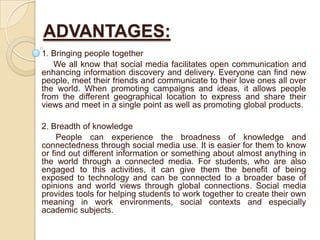
ADVANTAGES:
1. Bringing people together
We all know that social media facilitates open communication and
enhancing information discovery and delivery. Everyone can find new
people, meet their friends and communicate to their love ones all over
the world. When promoting campaigns and ideas, it allows people
from the different geographical location to express and share their
views and meet in a single point as well as promoting global products.
2. Breadth of knowledge
People can experience the broadness of knowledge and
connectedness through social media use. It is easier for them to know
or find out different information or something about almost anything in
the world through a connected media. For students, who are also
engaged to this activities, it can give them the benefit of being
exposed to technology and can be connected to a broader base of
opinions and world views through global connections. Social media
provides tools for helping students to work together to create their own
meaning in work environments, social contexts and especially
academic subjects.
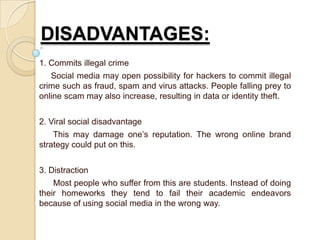
DISADVANTAGES:
1. Commits illegal crime
Social media may open possibility for hackers to commit illegal
crime such as fraud, spam and virus attacks. People falling prey to
online scam may also increase, resulting in data or identity theft.
2. Viral social disadvantage
This may damage one’s reputation. The wrong online brand
strategy could put on this.
3. Distraction
Most people who suffer from this are students. Instead of doing
their homeworks they tend to fail their academic endeavors
because of using social media in the wrong way.
Contoh Report Bahasa Inggris

Contoh Report Bahasa Inggris

  • 2.
    Definition of socmed Socialmedia refers to the means of interactions among people in which they create, share, and exchange information and ideas in virtual communities and networks. Andreas Kaplan and Michael Haenlein define social media as "a group of Internet- based applications that build on the ideological and technological foundations of Web 2.0, and that allow the creation and exchange of user-generated content." Furthermore, social media depends on mobile and web-based technologies to create highly interactive platforms through which individuals and communities share, co- create, discuss, and modify user-generated content. It introduces substantial and pervasive changes to communication between organizations, communities, and individuals.
  • 3.
     Social mediadifferentiates from traditional/industrial media in many aspects such as quality, reach, frequency, usability, immediacy, and permanence. There are many effects that stem from internet usage. According to Nielsen, internet users continue to spend more time with social media sites than any other type of site. At the same time, the total time spent on social media in the U.S. across PC and mobile devices increased by 37 percent to 121 billion minutes in July 2012 compared to 88 billion minutes in July 2011. For content contributors, the benefits of participating in social media have gone beyond simply social sharing to building reputation and bringing in career opportunities and monetary income.
  • 4.
    The characteristics ofsocmed :  Message is conveyed not only for one person but can control every aspect of a lot people.  Message conveyed freely.  Conveyed the message tends to be faster in other media appeal.  Recipient determines the interaction time.
  • 5.
    The most popularkind of social media in the world : Not surprisingly, Facebook is the top social network on the web. Nothing quite compares to it, not even Google+. With all the changes it has gone through over the years and the recent roll out of the Timeline profile, Facebook has always remained one step ahead of everything else on the web. Like Facebook, Twitter has also changed for the better over the years of its existence and continues to expand in popularity. Centered around microblogging and a 140-character text limit, Twitter has become a popular social network of choice for mobile web users who own smartphones and tablet computers. 1. 2.
  • 6.
    3. 4. As it madeits debut in the early summer of 2011, Google+ was the fastest growing social network the web has ever seen. It seems as if Google has finally created something that people are actually excited to use – unlike previously failed attempts at jumping on the social media bandwagon with projects like Google Wave and Google Buzz. Good old YouTube. Nothing quite compares to YouTube when it comes to video sharing. Although owned by Google, YouTube is still recognized as a separate social network all its own, and one that revolves entirely around video production, vlogging, movie-making and music sharing. YouTube is localized in 56 countries and across 61 languages, 100 hours of video are uploaded to YouTube
  • 7.
    The Classification Kaplan andHaenlein created a classification scheme in their Business Horizons (2010) article, with six different types of social media :  Collaborative projects (for example, Wikipedia)  Blogs and microblogs (for example, Twitter)  Content communities (for example, YouTube and DailyMotion)  Social networking sites (for example, Facebook)  Virtual game worlds (World of Warcraft)  Virtual social worlds (Second Life).
  • 8.
    Sosial Media MadeIndonesian People :  Adandu.com Site was launched beta in October 2009. Video sharing websites and video upload service is a free service for the general user and the manufacturer or independent video publisher.  AkuCintaSekolah.com Community website that aims to be a forum and everyone who ever was in school Indonesia. This social networking site according to its safe enough for school children. All data were obtained by the site is the result of a survey that recorded directly to each school.  digli.com In concept, this website combines Facebook with Kaskus. The number of members has reached
  • 9.
    ADVANTAGES: 1. Bringing peopletogether We all know that social media facilitates open communication and enhancing information discovery and delivery. Everyone can find new people, meet their friends and communicate to their love ones all over the world. When promoting campaigns and ideas, it allows people from the different geographical location to express and share their views and meet in a single point as well as promoting global products. 2. Breadth of knowledge People can experience the broadness of knowledge and connectedness through social media use. It is easier for them to know or find out different information or something about almost anything in the world through a connected media. For students, who are also engaged to this activities, it can give them the benefit of being exposed to technology and can be connected to a broader base of opinions and world views through global connections. Social media provides tools for helping students to work together to create their own meaning in work environments, social contexts and especially academic subjects.
  • 10.
    DISADVANTAGES: 1. Commits illegalcrime Social media may open possibility for hackers to commit illegal crime such as fraud, spam and virus attacks. People falling prey to online scam may also increase, resulting in data or identity theft. 2. Viral social disadvantage This may damage one’s reputation. The wrong online brand strategy could put on this. 3. Distraction Most people who suffer from this are students. Instead of doing their homeworks they tend to fail their academic endeavors because of using social media in the wrong way.