Onsite Sewage and Disposal Rules
Where are we?
Where are we going?
Thad Pittman,  Acting Director
Division of Community 
Environmental Protection
Revision
• Around 180 proposed 
changes
– Majority 
• Grammatical
• Clarification

• Some are changes 
worth noting
Complete Reorganization and 
Renumbering
• Divided into 3 main sections
– General Rules
• Definitions, Septic Tanks, Pumpers, Certifications

– Site Evaluation
• Percolation testing, Morphology, Unified, Soil Mapping

– Design 
• Sizing, Construction requirements, Control Fill, Lot 
modification
Small Flow vs Large Flow
• Current Rule
– Small Flow – < 8 bedrooms or <1200 gpd total 
development flow.
– Large Flow – > 8 bedrooms or > 1200 gpd total 
development flow.

• Proposed Change
– Small Flow ‐ < 12 bedrooms or <1800 gpd total 
development flow
– Large Flow ‐ > 12 bedrooms or > 1800 gpd total 
development flow
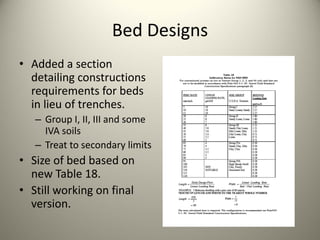
Bed Designs
• Added a section 
detailing constructions 
requirements for beds 
in lieu of trenches.
– Group I, II, III and some 
IVA soils
– Treat to secondary limits

• Size of bed based on 
new Table 18.
• Still working on final 
version.
Tables/Figures/Forms
• Table numbers will change in new rule due to new 
and deleted ones from the current rule.
• Additions/deletions/clarification to Table 1 Flow and 
Organic Loading
• Table 2 removed
• Table 3/3a 
– Changes and clarification to last two columns
• BOD loading rates and Hydraulic loading rates

• Table 5 Setbacks
– Minor adjustments
– Drip irrigation added to reduced setback for cuts/drains 

• Table 17 – new
– Minimum lot sizes based on recorded date
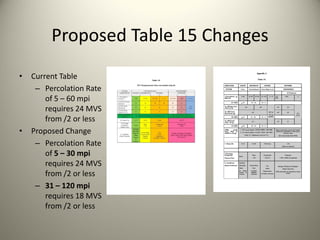
Proposed Table 15 Changes
•

•

Current Table
– Percolation Rate 
of 5 – 60 mpi
requires 24 MVS 
from /2 or less
Proposed Change
– Percolation Rate 
of 5 – 30 mpi
requires 24 MVS 
from /2 or less
– 31 – 120 mpi
requires 18 MVS 
from /2 or less
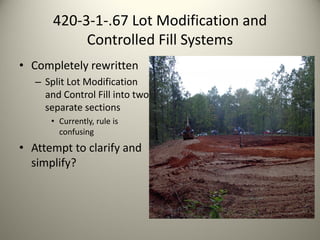
420‐3‐1‐.67 Lot Modification and 
Controlled Fill Systems
• Completely rewritten 
– Split Lot Modification 
and Control Fill into two 
separate sections
• Currently, rule is 
confusing

• Attempt to clarify and 
simplify?
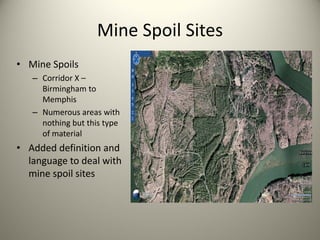
Mine Spoil Sites
• Mine Spoils
– Corridor X –
Birmingham to 
Memphis
– Numerous areas with 
nothing but this type 
of material

• Added definition and 
language to deal with 
mine spoil sites
Plat Signing
• Proposing new section
– Refines under what conditions the ADPH will sign a 
surveyed plat
• Large Flow Development with Small Flow Systems
• Large Flow Development with Large Flow System
– Management Entity
– ADEM systems

• Does have a caveat for special local circumstances
Forms
• All Forms removed from rule.
– Separate so as to be able to make corrections 
without having to go thru rule‐making procedure.
– CEP‐2, CEP‐2/3, CEP‐3, CEP‐5, CEP‐6, CEP‐7 and 
CEP‐11
ADPH – Onsite Update
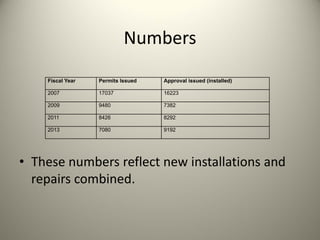
Numbers
Fiscal Year

Permits Issued

Approval issued (installed)

2007

17037

16223

2009

9480

7382

2011

8426

8292

2013

7080

9192

• These numbers reflect new installations and 
repairs combined.
ADPH – Onsite Program Changes
Budgetary Cut Impacts
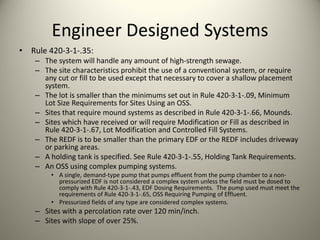
Engineer Designed Systems
•

Rule 420‐3‐1‐.35:
– The system will handle any amount of high‐strength sewage.
– The site characteristics prohibit the use of a conventional system, or require 
any cut or fill to be used except that necessary to cover a shallow placement 
system.
– The lot is smaller than the minimums set out in Rule 420‐3‐1‐.09, Minimum 
Lot Size Requirements for Sites Using an OSS.
– Sites that require mound systems as described in Rule 420‐3‐1‐.66, Mounds.
– Sites which have received or will require Modification or Fill as described in 
Rule 420‐3‐1‐.67, Lot Modification and Controlled Fill Systems.
– The REDF is to be smaller than the primary EDF or the REDF includes driveway 
or parking areas.
– A holding tank is specified. See Rule 420‐3‐1‐.55, Holding Tank Requirements.
– An OSS using complex pumping systems.
• A single, demand‐type pump that pumps effluent from the pump chamber to a non‐
pressurized EDF is not considered a complex system unless the field must be dosed to 
comply with Rule 420‐3‐1‐.43, EDF Dosing Requirements.  The pump used must meet the 
requirements of Rule 420‐3‐1‐.65, OSS Requiring Pumping of Effluent.
• Pressurized fields of any type are considered complex systems.

– Sites with a percolation rate over 120 min/inch.
– Sites with slope of over 25%.
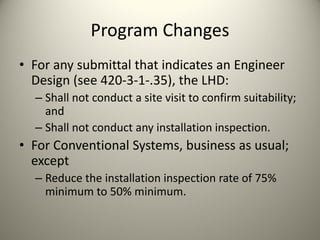
Program Changes
• For any submittal that indicates an Engineer 
Design (see 420‐3‐1‐.35), the LHD:
– Shall not conduct a site visit to confirm suitability; 
and
– Shall not conduct any installation inspection.

• For Conventional Systems, business as usual; 
except
– Reduce the installation inspection rate of 75% 
minimum to 50% minimum.
Questions?

Onsite program adjustments