SOCIAL INFLUENCE/ SOCIAL LEARNING
GROUP MEMBERS
 ZARAK ASHRAF
 SIDRA SULTAN
 FIZA JAVED
 MUNTAHA AMIR
 ALIYAH MUSTANSAR
 WARDAH
 MALAIKA SADDIQUE
SOCIAL INFLUENCE
CONFORMITY
TYPES OF CONFORMITY
BY ZARAK ASHRAF
SOCIAL INFLUENCE/ SOCIAL LEARNING
WHAT IS SOCIAL INFLUENCE
 How our thoughts, feelings, and behaviors respond to our social world or society
 People change their way of behaving to fulfill the needs of a social climate
 Based on specific task, actions, commands or request
FORMS OF SOCIAL INFLUENCE
 Two forms
1. Implicit Expectation (conformity)
2. Explicit Expectation (compliance and obedience)
FORMS OF SOCIAL INFLUENCE
Implicit Expectation:
 Implicit expectations are unspoken rules
Example:
 No one has to tell you about formal and religious
dress
Explicit Expectation:
 It is stated clearly
 Leaving no room for confusion or doubt
Example:
 Law and order
IMPACT OF SOCIAL INFLUENCE
 It will be constructive, destructive or neutral
 It makes pressure on person
 Also it changes person's feeling and thought.
CONFORMITY
 Process that involves modifying behavior
 Changing an individual’s own behavior to match of others
TYPES OF CONFORMITY
 Herbert Kelman identified three types of conformity.
1. Compliance (gain rewards and avoid punishments)
2. Identification (a person changes their behavior or believe
while they are present is specific group)
3. Internalization (the content of the new behavior)
VIDEO LINK
 https://youtu.be/MSZkwCijXeY
THEORIES OF CONFORMITY
CLASSICAL EXPERIMENT OF
SOLOMAN ASCH
BY SIDRA SULTAN
THEORIES OF CONFORMITY
There are two theories of Conformity on the basis
of why people need to conform.
 Informational Influence
 Normative Influence
THEORIES OF CONFORMITY
.
Informational Influence
 It occurs because we see others as a source of information to guide our behavior.
 We conform because we believe that other’s interpretation of an ambiguous situation is more correct
than ours
 Usually results in private acceptance, wherein people genuinely believe in what other people are doing
or saying
THEORIES OF CONFORMITY
.
Normative Influence
 It occurs when we conform to the group’s social norms so that we are liked by others.
Types of Norms
It has three norms
1. Injunctive Norms
2. Descriptive Norms
3. Situational Norms
 Usually results in public compliance, but not private acceptance of other’s ideas.
CLASSICAL EXPERIMENT OF SOLOMAN ASCH:
 Soloman Asch was conducted a classical study of
Conformity in 1951
 8 Subjects seated around the table, out of which only
one was the genuine subject, rest all were the
confederates.
CLASSICAL EXPERIMENT OF SOLOMAN ASCH:
.
Task
 To determine which comparison line was the similar to the
standard line
Experiment Procedure
 50 male students from Swarthmore College in the USA
participated
 The real participant did not know anything
 The answer was always obvious
 There were 18 trials in total, and the confederates gave the wrong
answer on 12 trial.
CLASSICAL EXPERIMENT OF SOLOMAN ASCH:
.
Findings
 Asch measured the number of times each participant conformed to the majority view
 75% of participants conformed with the incorrect and 25% of participants never conformed
Conclusion
 Why did the participants conform so readily?
 According to research, there are two main reasons why people conform
 A desire to fit in with the group (normative influence)
 A conviction that the collective is more knowledgeable than they are (informational influence)
OBEDIENCE
 It is a form of influence where a person’s behaviour is
being dictated by an authority figure.
 Obedience is different from conformity and compliance
because in both conformity and compliance the
behaviour is not being modified by an authority figure
and there is no order involved.
MILLIGRAMS OBEDIENCE EXPERIMENT
 Stanley milligram
 Will people really obey authority? How far will they go to obey an authority
figure?
 65% of them were administered maximum shock that can kill a
person due to the repeated orders of examiner who was the
authority figure in this experiment.
ZIMBARDO’S PRISON EXPERIMENT
 1970s phillip zimbardo
 Basement of Stanford University
 24 physically and mentally healthy men were chosen.
 Offered $15 per day to take part in the experiment.
 All the participants were randomly assigned to either the role of prisoner or
guard in the simulated prison environment.

 Guards and prisoners adapted to their roles very quickly.
 The experiment proved that people obey authority to a great extend
whether it was guards who became almost sadistic while following the
orders of zimbardo the authority figure or it was the prisoners who behaved
more submissive and compliant with the authority figures governing them
which were the guards.
PROPAGANDA
SOCIAL IMPACT THEORY
PERSUASION
PRESENTED BY: MUNTAHA AMIR
PROPAGANDA
The concept of propaganda acts systematically in support of a doctrine, in order to
persuade a large mass of individuals.
 It is generally associated with a negative action, considered to be reprehensible,
and this is the consequence of the attempts that various totalitarian regimes have
manifested abusively.
 Basically, propaganda is a conscious communication act with a political and
revolutionary character representing a strategy of social influence.
PROPAGANDA
TECHNIQUES
TO MAKE IT
EFFECTIVE
Ideas should be
placed in attractive
surroundings.
Expressions should
be made in a
simple language
and should be
repeated.
Direct and indirect
suggestions should
be used to make
propaganda
effective.
Methods should be
adopted to appeal
the interest,
attitude and beliefs
of people
Attempts should be
made to create
favourable attitude
by positive
suggestion
SOCIAL MEDIA AND PROPAGANDA
Social media platforms have influenced the spread of fake news and how governments have used
social media as a propaganda tool such as using social Bots which are software agents that
communicates autonomously on social media.
 The messages they deliver (such as tweets) are simple, work in groups, and work in a variety of
configurations with partial human control (hybrid) via algorithms.
SOCIAL IMPACT THEORY
 Social impact theory was created by Bibb Latane in
1981, who is also credited as one of the psychologists
who brought the bystander effect to light.
 We can be persuaded, inhibited, threatened, and
supported by others. Latane’s theory proposes that
individuals can be the sources or targets of social
influence.
 Social impact theory is a model that conceives of
influence from other people as being the result of social
forces acting on the individual.
SOCIAL IMPACT THEORY VARIABLE
1. Strength:
This is how important the influencing individual or group of people is to the person. There are thought to be two categories of
strength that determine a source’s impact: Trans-situational strength – this exists no matter what the situation is, including the
source’s age, physical appearance, authority, and perceived intelligence. Situation-specific – this looks closer at the situation at
hand and the behaviour that the target is being asked to perform
2. Immediacy:
Someone is more likely to influence another if they are close to each other at the time of the influence attempt. There are
three types of immediacy: Physical immediacy – how physically close the source is to a target. Temporal immediacy – a target
is more likely to be influenced immediately after a source has asked them to do so. Social immediacy – if the source is close
friends or family members with the target, they may be more likely to influence.
3. Number of sources:
This only affects the number of people in the group. There is a rule called the psychosocial law that the number of influencers
will ultimately have less impact on the target.
HOW DOES SOCIAL IMPACT THEORY RELATE TO SOCIAL
MEDIA.!
 Social impact theory was obviously developed long
before social media platforms existed. Nevertheless,
social impact theory can be observed and utilised by
people and brands to influence others. If we have
friends, family, and co-workers who post on social
media, we are more likely to be influenced by their
opinions if they are trusted people who are close to us
(strength and social immediacy). Likewise, the numbers
of people who share the same opinion on social media
are likely to influence others.
PERSUASION
 Persuasion or persuasion is an umbrella term for influence. Beliefs can affect a person's beliefs,
attitudes, intentions, motivations, or actions.
Robert Ciadini’s principles of persuasion:
 Reciprocity
 Commitment
 Social proof
 Authority
 Liking
 Scarcity
 Unity
 Reciprocity: People dislike feeling indebted
We have a responsibility to return to others what they have
originally given to us in the way of behavior. In essence, ``thou
shalt not Stred without repaying´´. People enjoy giving Favours
Ciadini showcases this principle by citing an infamous social
experiment.
 Commitment: People require consistency
People strive to appear consistent. It comes from our desire
to match our outward action with our internal ideals and
beliefs.
 Social Proof: People do what they observe others doing
Humans are tribal creatures by nature. we observe individuals
around us for cues when we are unsure of how to behave. The
bandwagon effect is the name for it.
Authority: People trust authority
Building trust is ultimately what good marketing is all
about. Positioning your brand as an authority is one of
the main strategies to achieve this.
Liking: People prefer similarities
Ciadini used Tupperware parties to illustrate his third
rule of persuasion like, these get-togethers, which a
Tupperware sales representative organizes, gives
friends and Neighbours a chance to share, talk about
and recommend Tupperware items.
 Scarcity: Less quantity equals more demand
You want something more when less of it is available.
This is scarcity, a concept most ecommerce websites
employ because, simply put, it works. The idea
of scarcity plays on our desire to avoid missing out,
whether it is through flash sales or limited edition
products.
 Unity: Us and them​
Humans are social—The unity principle, which Cialdini
penned a few years ago, concerns this desire for shared
identities. They’re about relationships and bonds. You
have a strong bond with your best friend, that’s the
main reason you trust their judgment. Brands can boost
conversions by communicating with their audience
like they’re family.​
SOCIAL LEARNING
PROCESS OF SOCIAL LEARNING
HISTORY OF SOCIAL LEARNING
BOBO DOLL EXPERIMENT
BY ALIYAH MUSTANSAR
SOCIAL LEARNING
 People learn social conduct through seeing and copying the actions of others.
 Social learning theory was created by psychologist Albert Bandura as an alternative work of his
colleague B.F. Skinner.
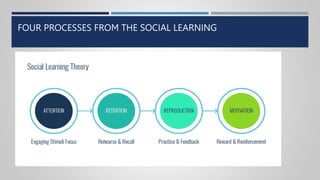
FOUR PROCESSES FROM THE SOCIAL LEARNING
HISTORY OF SOCIAL LEARNING
 In 1961 and 1963, Albert Bandura conducted experiments to determine whether social behaviors could
be accrued by observation and imitation.
 These experiments were collectively known as the Bobo doll experiments.
 Bandura expanded his theory to include an important element missing from theories on social learning:
self-beliefs.
BOBO DOLL EXPERIMENT
OBSERVATION AND DIRECT EXPERIENCE
MODELLING AND UNDERLYING COGNITIVE PROCESSES
EVOLUTION AND CULTURAL INTELLIGENCE
REINFORCEMENT LEARNING VS VICARIOUS LEARNING
BY WARDAH
OBSERVATION AND DIRECT EXPERIENCE
According to Albert Bandura’s learning is a cognitive process which take place in social
context purely occur through observation and direct experiences.
Observation
 The process of learning by watching the behavior of others is observation.
 Albert Bandura's social leaning theory proposes that new behavior can be acquired by observing others
and imitating them.
Example
 Observation of an end of life care conversation between a senior doctor and patient.
DIRECT EXPERIENCE
.
 Direct experience is defined as worked in potential open doors for dynamic commitment.
 Direct experience helps to develop subject – explicit and adaptable skills promotes active
leaning .
 It is supposed to be the attachment you experience on your own
Example
 For instance, spiral of leaning
 The junior doctor undertakes a follow-up second conversation with patient.
MODELING AND UNDERLYING COGNITIVE PROCESSES
.
 A model pivots upon mental thoughts, showing how individuals go about critical
thinking.
 Mental displaying can be framed just on paper or might be created on a more
convoluted framework.
Modeling
 Modeling is defined as a method used in certain cognitive behavioral techniques
of psychotherapy.
 Bandura describe specific steps in the process of modeling .
TYPES OF MODELING
.
There are three types of modeling.
 Live (it involves to demonstrates a behavior in person)
 Verbal (it involves description and explanation of a behavior)
 Symbolic (it involves real or fictional characters display their behavior in
books, novels, films, online media)
COGNITIVE PROCESS
.
 Cognitive process helps us understand information about the world around us and interact safely with our
environment.
Steps of cognitive processes
 Cognitive processes include five steps
 Attention
 Language
 Memory
 Perception
 Thought
EVOLUTION AND CULTURAL INTELLIGENCE
.
 The evolutionary adaptation of the cultural intelligence speculation
 The perceptions and investigations explored above show that people with additional open doors
for social advancing efficiently secure.
 Cultural intelligence speculation, which supplements the conventional advantage speculations for
the advancement of insight by determining the circumstances.
 The evolutionary rendition of the speculation contends that species with incessant open doors for
social learning ought to all the more promptly answer choice for a more noteworthy number of
mastered abilities.
Example
 Somebody in the population may either design or gain from another general public a new and
better expertise or skill.
EVOLUTION AND CULTURAL INTELLIGENCE
.Types:
 Mutation
 Gene flow
 Genetic drift
 Non- random mating
 Natural selection
REINFORCEMENT LEARNING V/S VACARIOUS LEARNING
.
Reinforcement learning
Reinforcement learning is defined as a science of decision making.
It is tied in with learning the ideal conduct in a climate to acquire most extreme prize.
Example
For instance, a robotic machine learn to move its parts.
Types:
 Positive Reinforcement
It is characterized as when an occasion, happens because of explicit way of behaving.
 Negative Reinforcement
It is represented as the strengthening of a behavior.
REINFORCEMENT LEARNING V/S VACARIOUS LEARNING
.
Vicarious learning
Vicarious learning is an approach to discovering that permits people to gain
from the experience of others.
A cognizant cycle includes detecting, feeling, and sympathizing with what
individuals are doing and taking notes, and assessing.
Example
 For instance, when a person read a book, listen a story, or watches a video
etc.
PRINCIPAL OF SOCIAL LEARNING
APPLICATION OF SOCIAL LEARNING
CONCLUSION
BY MALAIKA
PRINCIPLES OF SOCIAL LEARNING
There are four principles of Social Learning
• Attention
• Retention
• Reproduction
• Motivation
PRINCIPLES OF SOCIAL LEARNING
 Attention-The circumstances of an observed event can influence our level of attention
 Retention- Retention is based on how well this behaviour is remembered
 Reproduction- Ability to perform actions
 Motivation- Motivation can be considered one of the most important
principles of social learning theory
APPLICATION OF SOCIAL LEARNING
 Criminology
 Developmental psychology
 Managements
 Media Violence
 Psychotherapy
APPLICATION OF SOCIAL LEARNING
 Criminology-
Criminal behaviour intensifies and they learn the beliefs that fuel their crimes
 Development psychology
used to study how positive role models inspire desired behaviours
 Management-
To take ownership of their own learning
APPLICATION OF SOCIAL LEARNING
 Media Violence-
the aggressive behaviour they see on television and in movies
 Psychotherapy-
Social learning theory has been applied to change
problem behaviours in psychotherapy
CONCLUSION
 The social influence is evident in all societies around the world.
 A person's decision-making process is greatly influenced by the
people around them.
 Society influences the way individuals think, behave, and act.

Social Influence .pptx

  • 1.
    SOCIAL INFLUENCE/ SOCIALLEARNING GROUP MEMBERS  ZARAK ASHRAF  SIDRA SULTAN  FIZA JAVED  MUNTAHA AMIR  ALIYAH MUSTANSAR  WARDAH  MALAIKA SADDIQUE
  • 2.
    SOCIAL INFLUENCE CONFORMITY TYPES OFCONFORMITY BY ZARAK ASHRAF
  • 3.
    SOCIAL INFLUENCE/ SOCIALLEARNING WHAT IS SOCIAL INFLUENCE  How our thoughts, feelings, and behaviors respond to our social world or society  People change their way of behaving to fulfill the needs of a social climate  Based on specific task, actions, commands or request
  • 4.
    FORMS OF SOCIALINFLUENCE  Two forms 1. Implicit Expectation (conformity) 2. Explicit Expectation (compliance and obedience)
  • 5.
    FORMS OF SOCIALINFLUENCE Implicit Expectation:  Implicit expectations are unspoken rules Example:  No one has to tell you about formal and religious dress Explicit Expectation:  It is stated clearly  Leaving no room for confusion or doubt Example:  Law and order
  • 6.
    IMPACT OF SOCIALINFLUENCE  It will be constructive, destructive or neutral  It makes pressure on person  Also it changes person's feeling and thought.
  • 7.
    CONFORMITY  Process thatinvolves modifying behavior  Changing an individual’s own behavior to match of others
  • 8.
    TYPES OF CONFORMITY Herbert Kelman identified three types of conformity. 1. Compliance (gain rewards and avoid punishments) 2. Identification (a person changes their behavior or believe while they are present is specific group) 3. Internalization (the content of the new behavior)
  • 9.
  • 10.
    THEORIES OF CONFORMITY CLASSICALEXPERIMENT OF SOLOMAN ASCH BY SIDRA SULTAN
  • 11.
    THEORIES OF CONFORMITY Thereare two theories of Conformity on the basis of why people need to conform.  Informational Influence  Normative Influence
  • 12.
    THEORIES OF CONFORMITY . InformationalInfluence  It occurs because we see others as a source of information to guide our behavior.  We conform because we believe that other’s interpretation of an ambiguous situation is more correct than ours  Usually results in private acceptance, wherein people genuinely believe in what other people are doing or saying
  • 13.
    THEORIES OF CONFORMITY . NormativeInfluence  It occurs when we conform to the group’s social norms so that we are liked by others. Types of Norms It has three norms 1. Injunctive Norms 2. Descriptive Norms 3. Situational Norms  Usually results in public compliance, but not private acceptance of other’s ideas.
  • 14.
    CLASSICAL EXPERIMENT OFSOLOMAN ASCH:  Soloman Asch was conducted a classical study of Conformity in 1951  8 Subjects seated around the table, out of which only one was the genuine subject, rest all were the confederates.
  • 15.
    CLASSICAL EXPERIMENT OFSOLOMAN ASCH: . Task  To determine which comparison line was the similar to the standard line Experiment Procedure  50 male students from Swarthmore College in the USA participated  The real participant did not know anything  The answer was always obvious  There were 18 trials in total, and the confederates gave the wrong answer on 12 trial.
  • 16.
    CLASSICAL EXPERIMENT OFSOLOMAN ASCH: . Findings  Asch measured the number of times each participant conformed to the majority view  75% of participants conformed with the incorrect and 25% of participants never conformed Conclusion  Why did the participants conform so readily?  According to research, there are two main reasons why people conform  A desire to fit in with the group (normative influence)  A conviction that the collective is more knowledgeable than they are (informational influence)
  • 17.
    OBEDIENCE  It isa form of influence where a person’s behaviour is being dictated by an authority figure.  Obedience is different from conformity and compliance because in both conformity and compliance the behaviour is not being modified by an authority figure and there is no order involved.
  • 18.
    MILLIGRAMS OBEDIENCE EXPERIMENT Stanley milligram  Will people really obey authority? How far will they go to obey an authority figure?
  • 19.
     65% ofthem were administered maximum shock that can kill a person due to the repeated orders of examiner who was the authority figure in this experiment.
  • 20.
    ZIMBARDO’S PRISON EXPERIMENT 1970s phillip zimbardo  Basement of Stanford University  24 physically and mentally healthy men were chosen.  Offered $15 per day to take part in the experiment.  All the participants were randomly assigned to either the role of prisoner or guard in the simulated prison environment.  Guards and prisoners adapted to their roles very quickly.  The experiment proved that people obey authority to a great extend whether it was guards who became almost sadistic while following the orders of zimbardo the authority figure or it was the prisoners who behaved more submissive and compliant with the authority figures governing them which were the guards.
  • 22.
  • 23.
    PROPAGANDA The concept ofpropaganda acts systematically in support of a doctrine, in order to persuade a large mass of individuals.  It is generally associated with a negative action, considered to be reprehensible, and this is the consequence of the attempts that various totalitarian regimes have manifested abusively.  Basically, propaganda is a conscious communication act with a political and revolutionary character representing a strategy of social influence.
  • 24.
    PROPAGANDA TECHNIQUES TO MAKE IT EFFECTIVE Ideasshould be placed in attractive surroundings. Expressions should be made in a simple language and should be repeated. Direct and indirect suggestions should be used to make propaganda effective. Methods should be adopted to appeal the interest, attitude and beliefs of people Attempts should be made to create favourable attitude by positive suggestion
  • 25.
    SOCIAL MEDIA ANDPROPAGANDA Social media platforms have influenced the spread of fake news and how governments have used social media as a propaganda tool such as using social Bots which are software agents that communicates autonomously on social media.  The messages they deliver (such as tweets) are simple, work in groups, and work in a variety of configurations with partial human control (hybrid) via algorithms.
  • 26.
    SOCIAL IMPACT THEORY Social impact theory was created by Bibb Latane in 1981, who is also credited as one of the psychologists who brought the bystander effect to light.  We can be persuaded, inhibited, threatened, and supported by others. Latane’s theory proposes that individuals can be the sources or targets of social influence.  Social impact theory is a model that conceives of influence from other people as being the result of social forces acting on the individual.
  • 27.
    SOCIAL IMPACT THEORYVARIABLE 1. Strength: This is how important the influencing individual or group of people is to the person. There are thought to be two categories of strength that determine a source’s impact: Trans-situational strength – this exists no matter what the situation is, including the source’s age, physical appearance, authority, and perceived intelligence. Situation-specific – this looks closer at the situation at hand and the behaviour that the target is being asked to perform 2. Immediacy: Someone is more likely to influence another if they are close to each other at the time of the influence attempt. There are three types of immediacy: Physical immediacy – how physically close the source is to a target. Temporal immediacy – a target is more likely to be influenced immediately after a source has asked them to do so. Social immediacy – if the source is close friends or family members with the target, they may be more likely to influence. 3. Number of sources: This only affects the number of people in the group. There is a rule called the psychosocial law that the number of influencers will ultimately have less impact on the target.
  • 28.
    HOW DOES SOCIALIMPACT THEORY RELATE TO SOCIAL MEDIA.!  Social impact theory was obviously developed long before social media platforms existed. Nevertheless, social impact theory can be observed and utilised by people and brands to influence others. If we have friends, family, and co-workers who post on social media, we are more likely to be influenced by their opinions if they are trusted people who are close to us (strength and social immediacy). Likewise, the numbers of people who share the same opinion on social media are likely to influence others.
  • 29.
    PERSUASION  Persuasion orpersuasion is an umbrella term for influence. Beliefs can affect a person's beliefs, attitudes, intentions, motivations, or actions. Robert Ciadini’s principles of persuasion:  Reciprocity  Commitment  Social proof  Authority  Liking  Scarcity  Unity
  • 30.
     Reciprocity: Peopledislike feeling indebted We have a responsibility to return to others what they have originally given to us in the way of behavior. In essence, ``thou shalt not Stred without repaying´´. People enjoy giving Favours Ciadini showcases this principle by citing an infamous social experiment.  Commitment: People require consistency People strive to appear consistent. It comes from our desire to match our outward action with our internal ideals and beliefs.  Social Proof: People do what they observe others doing Humans are tribal creatures by nature. we observe individuals around us for cues when we are unsure of how to behave. The bandwagon effect is the name for it.
  • 31.
    Authority: People trustauthority Building trust is ultimately what good marketing is all about. Positioning your brand as an authority is one of the main strategies to achieve this. Liking: People prefer similarities Ciadini used Tupperware parties to illustrate his third rule of persuasion like, these get-togethers, which a Tupperware sales representative organizes, gives friends and Neighbours a chance to share, talk about and recommend Tupperware items.
  • 32.
     Scarcity: Lessquantity equals more demand You want something more when less of it is available. This is scarcity, a concept most ecommerce websites employ because, simply put, it works. The idea of scarcity plays on our desire to avoid missing out, whether it is through flash sales or limited edition products.  Unity: Us and them​ Humans are social—The unity principle, which Cialdini penned a few years ago, concerns this desire for shared identities. They’re about relationships and bonds. You have a strong bond with your best friend, that’s the main reason you trust their judgment. Brands can boost conversions by communicating with their audience like they’re family.​
  • 33.
    SOCIAL LEARNING PROCESS OFSOCIAL LEARNING HISTORY OF SOCIAL LEARNING BOBO DOLL EXPERIMENT BY ALIYAH MUSTANSAR
  • 34.
    SOCIAL LEARNING  Peoplelearn social conduct through seeing and copying the actions of others.  Social learning theory was created by psychologist Albert Bandura as an alternative work of his colleague B.F. Skinner.
  • 35.
    FOUR PROCESSES FROMTHE SOCIAL LEARNING
  • 36.
    HISTORY OF SOCIALLEARNING  In 1961 and 1963, Albert Bandura conducted experiments to determine whether social behaviors could be accrued by observation and imitation.  These experiments were collectively known as the Bobo doll experiments.  Bandura expanded his theory to include an important element missing from theories on social learning: self-beliefs.
  • 37.
  • 38.
    OBSERVATION AND DIRECTEXPERIENCE MODELLING AND UNDERLYING COGNITIVE PROCESSES EVOLUTION AND CULTURAL INTELLIGENCE REINFORCEMENT LEARNING VS VICARIOUS LEARNING BY WARDAH
  • 39.
    OBSERVATION AND DIRECTEXPERIENCE According to Albert Bandura’s learning is a cognitive process which take place in social context purely occur through observation and direct experiences. Observation  The process of learning by watching the behavior of others is observation.  Albert Bandura's social leaning theory proposes that new behavior can be acquired by observing others and imitating them. Example  Observation of an end of life care conversation between a senior doctor and patient.
  • 40.
    DIRECT EXPERIENCE .  Directexperience is defined as worked in potential open doors for dynamic commitment.  Direct experience helps to develop subject – explicit and adaptable skills promotes active leaning .  It is supposed to be the attachment you experience on your own Example  For instance, spiral of leaning  The junior doctor undertakes a follow-up second conversation with patient.
  • 41.
    MODELING AND UNDERLYINGCOGNITIVE PROCESSES .  A model pivots upon mental thoughts, showing how individuals go about critical thinking.  Mental displaying can be framed just on paper or might be created on a more convoluted framework. Modeling  Modeling is defined as a method used in certain cognitive behavioral techniques of psychotherapy.  Bandura describe specific steps in the process of modeling .
  • 42.
    TYPES OF MODELING . Thereare three types of modeling.  Live (it involves to demonstrates a behavior in person)  Verbal (it involves description and explanation of a behavior)  Symbolic (it involves real or fictional characters display their behavior in books, novels, films, online media)
  • 43.
    COGNITIVE PROCESS .  Cognitiveprocess helps us understand information about the world around us and interact safely with our environment. Steps of cognitive processes  Cognitive processes include five steps  Attention  Language  Memory  Perception  Thought
  • 44.
    EVOLUTION AND CULTURALINTELLIGENCE .  The evolutionary adaptation of the cultural intelligence speculation  The perceptions and investigations explored above show that people with additional open doors for social advancing efficiently secure.  Cultural intelligence speculation, which supplements the conventional advantage speculations for the advancement of insight by determining the circumstances.  The evolutionary rendition of the speculation contends that species with incessant open doors for social learning ought to all the more promptly answer choice for a more noteworthy number of mastered abilities. Example  Somebody in the population may either design or gain from another general public a new and better expertise or skill.
  • 45.
    EVOLUTION AND CULTURALINTELLIGENCE .Types:  Mutation  Gene flow  Genetic drift  Non- random mating  Natural selection
  • 46.
    REINFORCEMENT LEARNING V/SVACARIOUS LEARNING . Reinforcement learning Reinforcement learning is defined as a science of decision making. It is tied in with learning the ideal conduct in a climate to acquire most extreme prize. Example For instance, a robotic machine learn to move its parts. Types:  Positive Reinforcement It is characterized as when an occasion, happens because of explicit way of behaving.  Negative Reinforcement It is represented as the strengthening of a behavior.
  • 47.
    REINFORCEMENT LEARNING V/SVACARIOUS LEARNING . Vicarious learning Vicarious learning is an approach to discovering that permits people to gain from the experience of others. A cognizant cycle includes detecting, feeling, and sympathizing with what individuals are doing and taking notes, and assessing. Example  For instance, when a person read a book, listen a story, or watches a video etc.
  • 48.
    PRINCIPAL OF SOCIALLEARNING APPLICATION OF SOCIAL LEARNING CONCLUSION BY MALAIKA
  • 49.
    PRINCIPLES OF SOCIALLEARNING There are four principles of Social Learning • Attention • Retention • Reproduction • Motivation
  • 50.
    PRINCIPLES OF SOCIALLEARNING  Attention-The circumstances of an observed event can influence our level of attention  Retention- Retention is based on how well this behaviour is remembered  Reproduction- Ability to perform actions  Motivation- Motivation can be considered one of the most important principles of social learning theory
  • 51.
    APPLICATION OF SOCIALLEARNING  Criminology  Developmental psychology  Managements  Media Violence  Psychotherapy
  • 52.
    APPLICATION OF SOCIALLEARNING  Criminology- Criminal behaviour intensifies and they learn the beliefs that fuel their crimes  Development psychology used to study how positive role models inspire desired behaviours  Management- To take ownership of their own learning
  • 53.
    APPLICATION OF SOCIALLEARNING  Media Violence- the aggressive behaviour they see on television and in movies  Psychotherapy- Social learning theory has been applied to change problem behaviours in psychotherapy
  • 54.
    CONCLUSION  The socialinfluence is evident in all societies around the world.  A person's decision-making process is greatly influenced by the people around them.  Society influences the way individuals think, behave, and act.