Social Welfare Programs
For Community
Introduction
 Nurturing the children, who are the tender
seedlings of the social field is necessary.
 Poor widows, destitute women, pregnant
and lactating women need greater
attention and support.
 Keeping these needs in mind, special
attention has been given by the State
through a number of programmes under
Social Welfare sector.
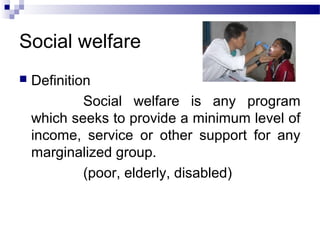
Social welfare
 Definition
Social welfare is any program
which seeks to provide a minimum level of
income, service or other support for any
marginalized group.
(poor, elderly, disabled)
Social Institutions
Social institutions are networks of
relationships that carry out the essential
social functions.
They are formalized way of providing
resources for helping to meet human
needs.
The priorities of social welfare service
(a)To establish a social security system;
(b) To extend facilities for community development;
(c) To improve the quality and scope of services;
(d) To ensure that adequate facilities are available for the
disabled;
(e) To provide services for the elderly
(f) To ensure the adequate provision of probation and
correctional services; and
(g) To support training, planning, research and evaluation.
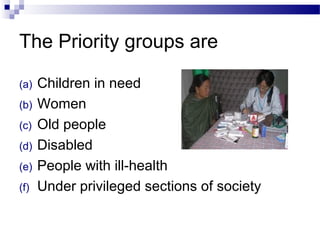
The Priority groups are
(a) Children in need
(b) Women
(c) Old people
(d) Disabled
(e) People with ill-health
(f) Under privileged sections of society
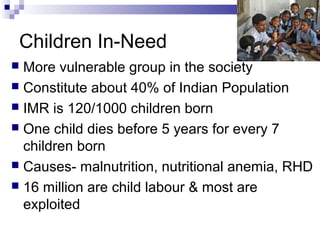
Children In-Need
 More vulnerable group in the society
 Constitute about 40% of Indian Population
 IMR is 120/1000 children born
 One child dies before 5 years for every 7
children born
 Causes- malnutrition, nutritional anemia, RHD
 16 million are child labour & most are
exploited
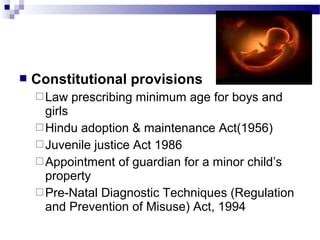
 Constitutional provisions
Law prescribing minimum age for boys and
girls
Hindu adoption & maintenance Act(1956)
Juvenile justice Act 1986
Appointment of guardian for a minor child’s
property
Pre-Natal Diagnostic Techniques (Regulation
and Prevention of Misuse) Act, 1994
Welfare services for children
Girl Child Protection Scheme(GCPS 1-4-05)
 The families who have one girl child and no male
children and parents has undergone sterilization, aged
below 35 years and their family income is below
Rs.50000/- p.a.,
 Initial deposit of Rs.22200/- for one girl child or
Rs.15200/- each for 2 girl children will be made.
 An amount of Rs.150/- as monthly incentive will be
given to the child from the 5th year for educational
purpose
 On completion of 20 years, the girl child will receive
the lump sum amount on condition that she has
appeared for the 10th Std.
Welfare services for children
cont….
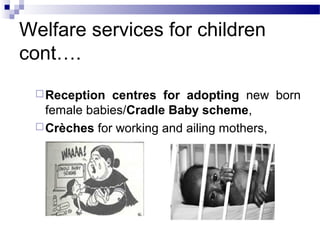
Reception centres for adopting new born
female babies/Cradle Baby scheme,
Crèches for working and ailing mothers,
Women’s Welfare
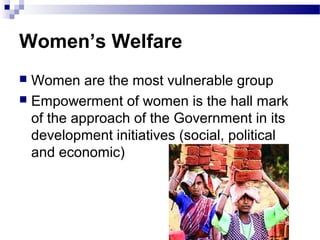
 Women are the most vulnerable group
 Empowerment of women is the hall mark
of the approach of the Government in its
development initiatives (social, political
and economic)
The government is playing a conscious
role in empowering of women by
The reservation of 33, 1/3rd Jobs for women in
Govt. and public sector with carry forward
policy.
1/3rd of budget of all departments for
developmental programmes for women.
The year 2001 was celebrated as ‘Year of
Women Empowerment and the year 2003 as
the Year of Adolescent Girls’.
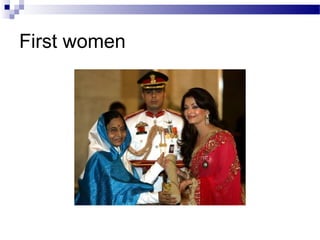
First women
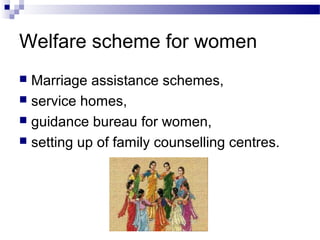
Welfare scheme for women
 Marriage assistance schemes,
 service homes,
 guidance bureau for women,
 setting up of family counselling centres.
Marriage assistance
schemes
 Financial assistance is given to daughters of
poor widows, orphan girls, widow's remarriage
and inter-caste marriage.
 Minimum age limit of marriage is 20 years
 The quantum of assistance of all marriage
schemes except inter-caste marriage is fixed as
Rs.10,000/- per beneficiary.
 For inter-caste marriage, the quantum of
assistance is fixed as Rs.20,000/- for SC/ ST
with FC/ BC/ MBC and Rs.10,000/- for BC/
MBC with FC.
Guidance Bureau For Women
 Helps needy women especially widows,
deserted wives and destitute in
obtaining bank loan,
helps women to liaison with other Government
departments
in settling LIC dues, provident fund and pension
benefits and
helps to get admissions for needy children in
orphanages, creches etc.
Service homes
 Women in the age group of 18 to 40 and
with income not exceeding Rs.12000 p.a.
are admitted in the service homes with
their children.
 they are provided food, shelter, education,
stipend, clothing allowance, vocational
training in secretarial course and tailoring,
 a lump sum grant for the purchase of raw
material
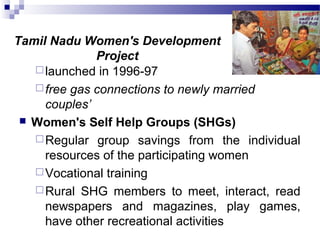
Tamil Nadu Women's Development
Project
launched in 1996-97
free gas connections to newly married
couples’
 Women's Self Help Groups (SHGs)
Regular group savings from the individual
resources of the participating women
Vocational training
Rural SHG members to meet, interact, read
newspapers and magazines, play games,
have other recreational activities
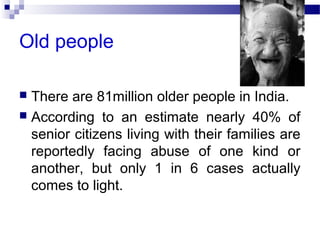
Old people
 There are 81million older people in India.
 According to an estimate nearly 40% of
senior citizens living with their families are
reportedly facing abuse of one kind or
another, but only 1 in 6 cases actually
comes to light.
Legislation
 The President has given her assent to the
Maintenance and Welfare of Parents and
Senior Citizens Act
 punishes children who abandon parents with
a prison term of three months or a fine,
situation is grim for elderly people in India.
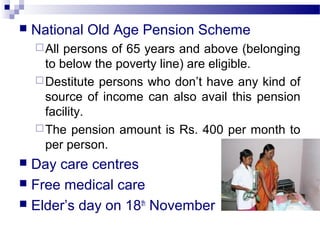
 National Old Age Pension Scheme
All persons of 65 years and above (belonging
to below the poverty line) are eligible.
Destitute persons who don’t have any kind of
source of income can also avail this pension
facility.
The pension amount is Rs. 400 per month to
per person.
 Day care centres
 Free medical care
 Elder’s day on 18th
November
Voluntary Organizations Involvement
 Old-age homes
 Help-Age India
Create awareness on need of aged in society,
Medicare units, old-age home, day centre
 Age-Care India
Mobile free geriatric health checkup to rural
elderly
Welfare of the disabled
 A disabled is a person who has a
disadvantage from an impairment or
disability, which alters his/her normal life in
the society
 Disability can result from accidents,
disease or birth
 10% of world population are disabled
In Tamilnadu
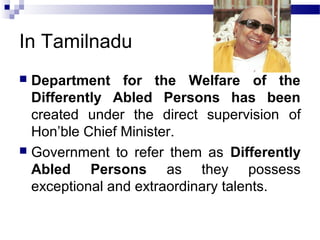
 Department for the Welfare of the
Differently Abled Persons has been
created under the direct supervision of
Hon’ble Chief Minister.
 Government to refer them as Differently
Abled Persons as they possess
exceptional and extraordinary talents.
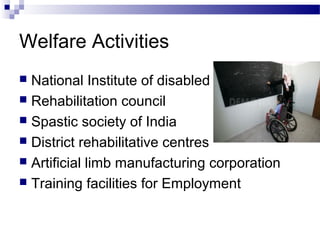
Welfare Activities
 National Institute of disabled
 Rehabilitation council
 Spastic society of India
 District rehabilitative centres
 Artificial limb manufacturing corporation
 Training facilities for Employment
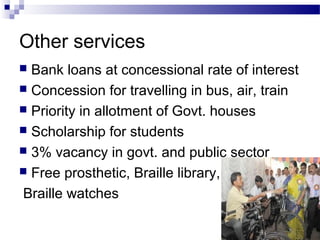
Other services
 Bank loans at concessional rate of interest
 Concession for travelling in bus, air, train
 Priority in allotment of Govt. houses
 Scholarship for students
 3% vacancy in govt. and public sector
 Free prosthetic, Braille library,
Braille watches
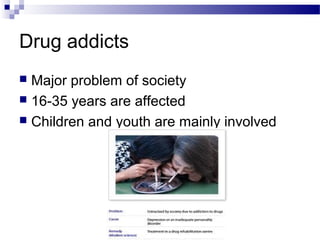
Drug addicts
 Major problem of society
 16-35 years are affected
 Children and youth are mainly involved
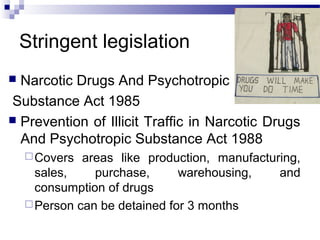
Stringent legislation
 Narcotic Drugs And Psychotropic
Substance Act 1985
 Prevention of Illicit Traffic in Narcotic Drugs
And Psychotropic Substance Act 1988
Covers areas like production, manufacturing,
sales, purchase, warehousing, and
consumption of drugs
Person can be detained for 3 months
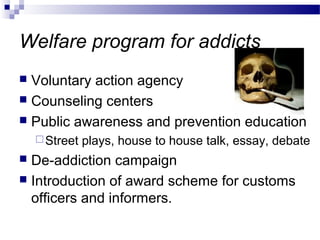
Welfare program for addicts
 Voluntary action agency
 Counseling centers
 Public awareness and prevention education
Street plays, house to house talk, essay, debate
 De-addiction campaign
 Introduction of award scheme for customs
officers and informers.
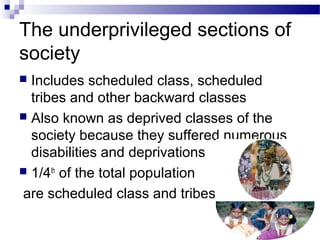
The underprivileged sections of
society
 Includes scheduled class, scheduled
tribes and other backward classes
 Also known as deprived classes of the
society because they suffered numerous
disabilities and deprivations
 1/4th
of the total population
are scheduled class and tribes
 Scheduled Castes Development Bureau,
ensure financial and physical benefits for the
benefit of Scheduled Castes.
 Under the strategy, States/UTs are required to
formulate and implement Special Component
Plan (SCP) for Scheduled Castes as part of their
Annual Plans by earmarking resources.
 Special Central Assistance to Special
Component Plan, in which cent percent
assistance is given as additive to Schedules
Caste Sub-Plan of the States/UTs
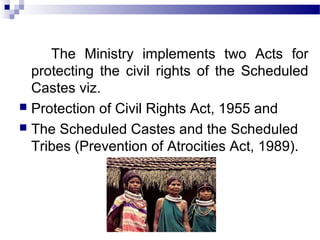
The Ministry implements two Acts for
protecting the civil rights of the Scheduled
Castes viz.
 Protection of Civil Rights Act, 1955 and
 The Scheduled Castes and the Scheduled
Tribes (Prevention of Atrocities Act, 1989).
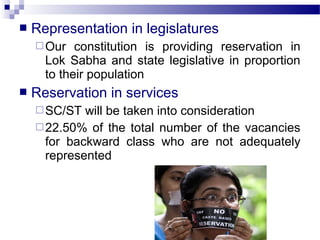
 Representation in legislatures
Our constitution is providing reservation in
Lok Sabha and state legislative in proportion
to their population
 Reservation in services
SC/ST will be taken into consideration
22.50% of the total number of the vacancies
for backward class who are not adequately
represented
Centrally sponsored schemes
 Post metric scholarship for students
 Premetric scholarship for parents in under
occupation
 Book banks
 Hostel for girls and boys
 National Overseas Scholarship-to go
abroad for higher education
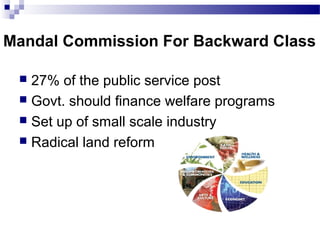
Mandal Commission For Backward Class
 27% of the public service post
 Govt. should finance welfare programs
 Set up of small scale industry
 Radical land reform
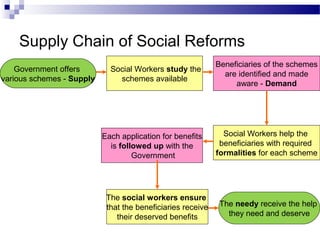
Supply Chain of Social Reforms
Government offers
various schemes - Supply
Beneficiaries of the schemes
are identified and made
aware - Demand
Social Workers help the
beneficiaries with required
formalities for each scheme
Social Workers study the
schemes available
Each application for benefits
is followed up with the
Government
The social workers ensure
that the beneficiaries receive
their deserved benefits
The needy receive the help
they need and deserve
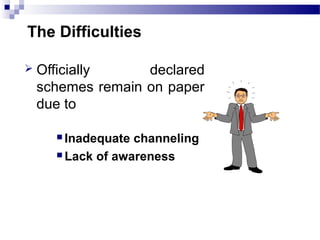
The Difficulties
 Officially declared
schemes remain on paper
due to
 Inadequate channeling
 Lack of awareness
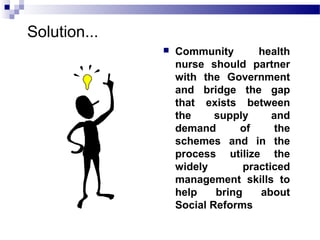
Solution...
 Community health
nurse should partner
with the Government
and bridge the gap
that exists between
the supply and
demand of the
schemes and in the
process utilize the
widely practiced
management skills to
help bring about
Social Reforms
THANK YOU

Social welfare-programs-for-community-community-health-nursing-ppt

  • 1.
  • 2.
    Introduction  Nurturing thechildren, who are the tender seedlings of the social field is necessary.  Poor widows, destitute women, pregnant and lactating women need greater attention and support.  Keeping these needs in mind, special attention has been given by the State through a number of programmes under Social Welfare sector.
  • 3.
    Social welfare  Definition Socialwelfare is any program which seeks to provide a minimum level of income, service or other support for any marginalized group. (poor, elderly, disabled)
  • 4.
    Social Institutions Social institutionsare networks of relationships that carry out the essential social functions. They are formalized way of providing resources for helping to meet human needs.
  • 5.
    The priorities ofsocial welfare service (a)To establish a social security system; (b) To extend facilities for community development; (c) To improve the quality and scope of services; (d) To ensure that adequate facilities are available for the disabled; (e) To provide services for the elderly (f) To ensure the adequate provision of probation and correctional services; and (g) To support training, planning, research and evaluation.
  • 6.
    The Priority groupsare (a) Children in need (b) Women (c) Old people (d) Disabled (e) People with ill-health (f) Under privileged sections of society
  • 7.
    Children In-Need  Morevulnerable group in the society  Constitute about 40% of Indian Population  IMR is 120/1000 children born  One child dies before 5 years for every 7 children born  Causes- malnutrition, nutritional anemia, RHD  16 million are child labour & most are exploited
  • 8.
     Constitutional provisions Lawprescribing minimum age for boys and girls Hindu adoption & maintenance Act(1956) Juvenile justice Act 1986 Appointment of guardian for a minor child’s property Pre-Natal Diagnostic Techniques (Regulation and Prevention of Misuse) Act, 1994
  • 9.
    Welfare services forchildren Girl Child Protection Scheme(GCPS 1-4-05)  The families who have one girl child and no male children and parents has undergone sterilization, aged below 35 years and their family income is below Rs.50000/- p.a.,  Initial deposit of Rs.22200/- for one girl child or Rs.15200/- each for 2 girl children will be made.  An amount of Rs.150/- as monthly incentive will be given to the child from the 5th year for educational purpose  On completion of 20 years, the girl child will receive the lump sum amount on condition that she has appeared for the 10th Std.
  • 10.
    Welfare services forchildren cont…. Reception centres for adopting new born female babies/Cradle Baby scheme, Crèches for working and ailing mothers,
  • 11.
    Women’s Welfare  Womenare the most vulnerable group  Empowerment of women is the hall mark of the approach of the Government in its development initiatives (social, political and economic)
  • 12.
    The government isplaying a conscious role in empowering of women by The reservation of 33, 1/3rd Jobs for women in Govt. and public sector with carry forward policy. 1/3rd of budget of all departments for developmental programmes for women. The year 2001 was celebrated as ‘Year of Women Empowerment and the year 2003 as the Year of Adolescent Girls’.
  • 13.
  • 14.
    Welfare scheme forwomen  Marriage assistance schemes,  service homes,  guidance bureau for women,  setting up of family counselling centres.
  • 15.
    Marriage assistance schemes  Financialassistance is given to daughters of poor widows, orphan girls, widow's remarriage and inter-caste marriage.  Minimum age limit of marriage is 20 years  The quantum of assistance of all marriage schemes except inter-caste marriage is fixed as Rs.10,000/- per beneficiary.  For inter-caste marriage, the quantum of assistance is fixed as Rs.20,000/- for SC/ ST with FC/ BC/ MBC and Rs.10,000/- for BC/ MBC with FC.
  • 16.
    Guidance Bureau ForWomen  Helps needy women especially widows, deserted wives and destitute in obtaining bank loan, helps women to liaison with other Government departments in settling LIC dues, provident fund and pension benefits and helps to get admissions for needy children in orphanages, creches etc.
  • 17.
    Service homes  Womenin the age group of 18 to 40 and with income not exceeding Rs.12000 p.a. are admitted in the service homes with their children.  they are provided food, shelter, education, stipend, clothing allowance, vocational training in secretarial course and tailoring,  a lump sum grant for the purchase of raw material
  • 18.
    Tamil Nadu Women'sDevelopment Project launched in 1996-97 free gas connections to newly married couples’  Women's Self Help Groups (SHGs) Regular group savings from the individual resources of the participating women Vocational training Rural SHG members to meet, interact, read newspapers and magazines, play games, have other recreational activities
  • 19.
    Old people  Thereare 81million older people in India.  According to an estimate nearly 40% of senior citizens living with their families are reportedly facing abuse of one kind or another, but only 1 in 6 cases actually comes to light.
  • 20.
    Legislation  The Presidenthas given her assent to the Maintenance and Welfare of Parents and Senior Citizens Act  punishes children who abandon parents with a prison term of three months or a fine, situation is grim for elderly people in India.
  • 21.
     National OldAge Pension Scheme All persons of 65 years and above (belonging to below the poverty line) are eligible. Destitute persons who don’t have any kind of source of income can also avail this pension facility. The pension amount is Rs. 400 per month to per person.  Day care centres  Free medical care  Elder’s day on 18th November
  • 22.
    Voluntary Organizations Involvement Old-age homes  Help-Age India Create awareness on need of aged in society, Medicare units, old-age home, day centre  Age-Care India Mobile free geriatric health checkup to rural elderly
  • 23.
    Welfare of thedisabled  A disabled is a person who has a disadvantage from an impairment or disability, which alters his/her normal life in the society  Disability can result from accidents, disease or birth  10% of world population are disabled
  • 24.
    In Tamilnadu  Departmentfor the Welfare of the Differently Abled Persons has been created under the direct supervision of Hon’ble Chief Minister.  Government to refer them as Differently Abled Persons as they possess exceptional and extraordinary talents.
  • 25.
    Welfare Activities  NationalInstitute of disabled  Rehabilitation council  Spastic society of India  District rehabilitative centres  Artificial limb manufacturing corporation  Training facilities for Employment
  • 26.
    Other services  Bankloans at concessional rate of interest  Concession for travelling in bus, air, train  Priority in allotment of Govt. houses  Scholarship for students  3% vacancy in govt. and public sector  Free prosthetic, Braille library, Braille watches
  • 27.
    Drug addicts  Majorproblem of society  16-35 years are affected  Children and youth are mainly involved
  • 28.
    Stringent legislation  NarcoticDrugs And Psychotropic Substance Act 1985  Prevention of Illicit Traffic in Narcotic Drugs And Psychotropic Substance Act 1988 Covers areas like production, manufacturing, sales, purchase, warehousing, and consumption of drugs Person can be detained for 3 months
  • 29.
    Welfare program foraddicts  Voluntary action agency  Counseling centers  Public awareness and prevention education Street plays, house to house talk, essay, debate  De-addiction campaign  Introduction of award scheme for customs officers and informers.
  • 30.
    The underprivileged sectionsof society  Includes scheduled class, scheduled tribes and other backward classes  Also known as deprived classes of the society because they suffered numerous disabilities and deprivations  1/4th of the total population are scheduled class and tribes
  • 31.
     Scheduled CastesDevelopment Bureau, ensure financial and physical benefits for the benefit of Scheduled Castes.  Under the strategy, States/UTs are required to formulate and implement Special Component Plan (SCP) for Scheduled Castes as part of their Annual Plans by earmarking resources.  Special Central Assistance to Special Component Plan, in which cent percent assistance is given as additive to Schedules Caste Sub-Plan of the States/UTs
  • 32.
    The Ministry implementstwo Acts for protecting the civil rights of the Scheduled Castes viz.  Protection of Civil Rights Act, 1955 and  The Scheduled Castes and the Scheduled Tribes (Prevention of Atrocities Act, 1989).
  • 33.
     Representation inlegislatures Our constitution is providing reservation in Lok Sabha and state legislative in proportion to their population  Reservation in services SC/ST will be taken into consideration 22.50% of the total number of the vacancies for backward class who are not adequately represented
  • 34.
    Centrally sponsored schemes Post metric scholarship for students  Premetric scholarship for parents in under occupation  Book banks  Hostel for girls and boys  National Overseas Scholarship-to go abroad for higher education
  • 35.
    Mandal Commission ForBackward Class  27% of the public service post  Govt. should finance welfare programs  Set up of small scale industry  Radical land reform
  • 36.
    Supply Chain ofSocial Reforms Government offers various schemes - Supply Beneficiaries of the schemes are identified and made aware - Demand Social Workers help the beneficiaries with required formalities for each scheme Social Workers study the schemes available Each application for benefits is followed up with the Government The social workers ensure that the beneficiaries receive their deserved benefits The needy receive the help they need and deserve
  • 37.
    The Difficulties  Officiallydeclared schemes remain on paper due to  Inadequate channeling  Lack of awareness
  • 38.
    Solution...  Community health nurseshould partner with the Government and bridge the gap that exists between the supply and demand of the schemes and in the process utilize the widely practiced management skills to help bring about Social Reforms
  • 39.