How America  Divides SOCIAL CLASSES
Social Class Divisions Sociologists have labeled six classes that exist in the United States: 1) Upper Class 2) Upper Middle Class 3) Lower Middle Class 4) Working Class 5) Working Poor 6) Underclass
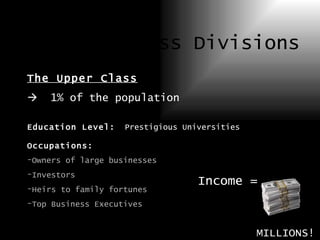
Social Class Divisions The Upper Class    1% of the population Education Level:   Prestigious Universities Occupations:   Owners of large businesses Investors Heirs to family fortunes Top Business Executives Income =  MILLIONS!
Old $$$ vs. New $$$ Old Money = wealth that has been in the family for generations (born into, inherit) Ex:  The Kennedy’s, Rockefeller’s, Vanderbilt’s New Money = newly rich, acquired their money through own efforts rather than inheritance. (Not as prestigious, but can still buy it) Ex:  Bill Gates, Mark Cuban, Michael Jordan
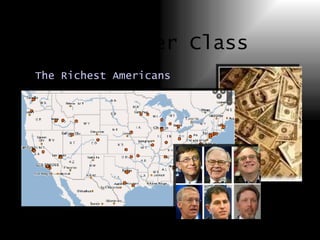
The Upper Class The Richest Americans
Upper Class-  Bill Gates’ Home
Reception Room- Gates’ home
View from Gates’ home
Bill Gates’ Car
The Upper Class Facts about:  The Richest Americans 1 in 10 Americans makes over $100,000 Less than 0.5% makes a $1,000,000 (150,000) There are currently 371 billionaires in the United  States. You are twice as likely to be struck by lightning than you are of becoming a billionaire.
Social Class Divisions Upper Middle Class    10% of population Education Level:  College/ University Degree Occupation:  High income business people, professionals Membership based on income, not assets (career oriented) Influence in community, not nationally. Income:   $100,000-$250,000
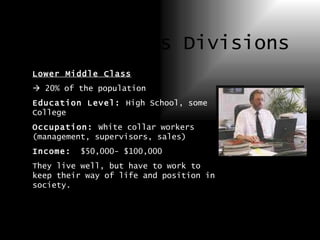
Social Class Divisions Lower Middle Class    20% of the population Education Level:  High School, some College Occupation:  White collar workers (management, supervisors, sales) Income:   $50,000- $100,000 They live well, but have to work to keep their way of life and position in society.
Social Class Divisions The Working Class    20% of the population Education Level:   High school diploma Occupation:  Blue Collar or Manual labor jobs (factory workers, tradespeople, low service jobs) Income:   $30,000- $50,000 They work very hard and often do not have much reserve to deal with extra expenses.
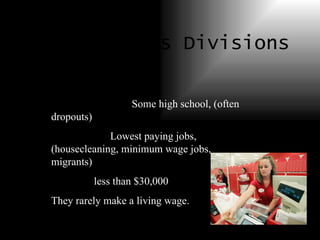
Social Class Divisions The Working Poor    45% of the population Education Level:  Some high school, (often dropouts) Occupation:  Lowest paying jobs, (housecleaning, minimum wage jobs, migrants) Income:   less than $30,000 They rarely make a living wage.
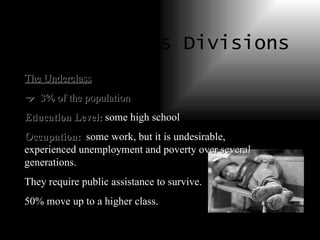
Social Class Divisions The Underclass    3% of the population Education Level:  some high school Occupation:  some work, but it is undesirable, experienced unemployment and poverty over several generations. They require public assistance to survive. 50% move up to a higher class.
Types of Jobs/ Salaries The divide b/t rich and poor: Bill Gates = $50 billion net worth Dave Matthews= $28 million/ yr. Jerry Seinfeld = $98 million/yr. Tyra Banks= $14 million/ yr. Lawyer= $98,930/ yr. Firefighter= $39,090/ yr. Janitor= $19,390/ yr. Cashier= $16,260/ yr.
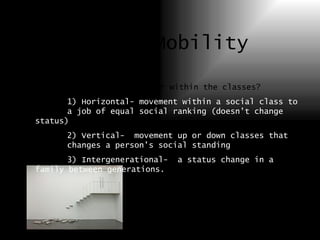
Social Mobility How can you move between or within the classes? 1) Horizontal- movement within a social class to  a job of equal social ranking (doesn’t change  status) 2) Vertical-  movement up or down classes that  changes a person’s social standing 3) Intergenerational-  a status change in a  family between generations.
Social Mobility Factors that affect upward mobility: -  Individual Effort -  Technology shifts -  Education Level Factors that affect downward mobility: -  Illness -  Divorce -  Retirement -  Technology changes -  Low Unemployment-  lack of quality jobs in  field
Poverty 31 million or 11% of Americans live below the poverty level. Poverty-   standard of living that is below the minimum level considered adequate by society.  (varies by society) **What is poor in US, may be comfortable living in another country.  (Due to differences in standard of living)
Poverty US Census-   defines poverty as:  minimum annual amount of income needed to  survive The poverty line is established by:  calculating the cost of an adequate diet (USDA standards) and multiplying that by 3 (1/3 of income is spent on food) In 2000, 1 Person = $8,794 2 People = $11,239 3 People = $13,738 4 People = $17, 603 5 People = $20,819
Poverty States with the largest rates of poverty (over 15%):
Poverty Other Factors Age:  Children most likely group to be in poverty (37%) Sex:  Women more likely than men (57%) Race and Ethnicity-  African Americans and Hispanics are more likely to be poor in the US. 11% of total White population are poor. 26.5% of total African American population are poor. 27.1% of total Hispanic population are poor.
Poverty Patterns of Behavior More likely to be divorced. More likely to be arrested, convicted and sent to prison.  (commit crimes that police pursue more- burglary, auto theft) More likely to be victims of crimes.
Poverty Government Response to Poverty: -  1960’s, LBJ declared a “War on Poverty” -  Increased social welfare programs to aid the  poor. Two methods of assisting the poor: Giving tax money to groups to assist the needy. --TANF (Temporary Assistance to Needy Families) Giving goods to those who are poor.   -- Food stamp/ LINK program (Giving a card or     coupon in exchange for food.
Poverty Welfare A program designed in the 1980’s to aid those who could not afford a living wage.  Financial assistance is given to recipients in the form of money and goods (such as food) to those who are in need. Initially, it created a “welfare class”, a group of people who refused to find work and lived off the government until 1996. Limits were put into effect that required welfare recipients to find work within in a two year period. **the number of recipients has decreased from 14.1million in 1993 to 6.3 million in 1999.
Poverty Welfare (con’t) Some Barriers to getting off of welfare: -  very poor mental or physical health -  education less than high school -  last worked three or more years ago -  has an infant -  Spanish interview Those reporting barriers: NONE = 22.9 ONE = 33.3 TWO = 43.8

Social Classes And Poverty2

  • 1.
    How America Divides SOCIAL CLASSES
  • 2.
    Social Class DivisionsSociologists have labeled six classes that exist in the United States: 1) Upper Class 2) Upper Middle Class 3) Lower Middle Class 4) Working Class 5) Working Poor 6) Underclass
  • 3.
    Social Class DivisionsThe Upper Class  1% of the population Education Level: Prestigious Universities Occupations: Owners of large businesses Investors Heirs to family fortunes Top Business Executives Income = MILLIONS!
  • 4.
    Old $$$ vs.New $$$ Old Money = wealth that has been in the family for generations (born into, inherit) Ex: The Kennedy’s, Rockefeller’s, Vanderbilt’s New Money = newly rich, acquired their money through own efforts rather than inheritance. (Not as prestigious, but can still buy it) Ex: Bill Gates, Mark Cuban, Michael Jordan
  • 5.
    The Upper ClassThe Richest Americans
  • 6.
    Upper Class- Bill Gates’ Home
  • 7.
  • 8.
  • 9.
  • 10.
    The Upper ClassFacts about: The Richest Americans 1 in 10 Americans makes over $100,000 Less than 0.5% makes a $1,000,000 (150,000) There are currently 371 billionaires in the United States. You are twice as likely to be struck by lightning than you are of becoming a billionaire.
  • 11.
    Social Class DivisionsUpper Middle Class  10% of population Education Level: College/ University Degree Occupation: High income business people, professionals Membership based on income, not assets (career oriented) Influence in community, not nationally. Income: $100,000-$250,000
  • 12.
    Social Class DivisionsLower Middle Class  20% of the population Education Level: High School, some College Occupation: White collar workers (management, supervisors, sales) Income: $50,000- $100,000 They live well, but have to work to keep their way of life and position in society.
  • 13.
    Social Class DivisionsThe Working Class  20% of the population Education Level: High school diploma Occupation: Blue Collar or Manual labor jobs (factory workers, tradespeople, low service jobs) Income: $30,000- $50,000 They work very hard and often do not have much reserve to deal with extra expenses.
  • 14.
    Social Class DivisionsThe Working Poor  45% of the population Education Level: Some high school, (often dropouts) Occupation: Lowest paying jobs, (housecleaning, minimum wage jobs, migrants) Income: less than $30,000 They rarely make a living wage.
  • 15.
    Social Class DivisionsThe Underclass  3% of the population Education Level: some high school Occupation: some work, but it is undesirable, experienced unemployment and poverty over several generations. They require public assistance to survive. 50% move up to a higher class.
  • 16.
    Types of Jobs/Salaries The divide b/t rich and poor: Bill Gates = $50 billion net worth Dave Matthews= $28 million/ yr. Jerry Seinfeld = $98 million/yr. Tyra Banks= $14 million/ yr. Lawyer= $98,930/ yr. Firefighter= $39,090/ yr. Janitor= $19,390/ yr. Cashier= $16,260/ yr.
  • 17.
    Social Mobility Howcan you move between or within the classes? 1) Horizontal- movement within a social class to a job of equal social ranking (doesn’t change status) 2) Vertical- movement up or down classes that changes a person’s social standing 3) Intergenerational- a status change in a family between generations.
  • 18.
    Social Mobility Factorsthat affect upward mobility: - Individual Effort - Technology shifts - Education Level Factors that affect downward mobility: - Illness - Divorce - Retirement - Technology changes - Low Unemployment- lack of quality jobs in field
  • 19.
    Poverty 31 millionor 11% of Americans live below the poverty level. Poverty- standard of living that is below the minimum level considered adequate by society. (varies by society) **What is poor in US, may be comfortable living in another country. (Due to differences in standard of living)
  • 20.
    Poverty US Census- defines poverty as: minimum annual amount of income needed to survive The poverty line is established by: calculating the cost of an adequate diet (USDA standards) and multiplying that by 3 (1/3 of income is spent on food) In 2000, 1 Person = $8,794 2 People = $11,239 3 People = $13,738 4 People = $17, 603 5 People = $20,819
  • 21.
    Poverty States withthe largest rates of poverty (over 15%):
  • 22.
    Poverty Other FactorsAge: Children most likely group to be in poverty (37%) Sex: Women more likely than men (57%) Race and Ethnicity- African Americans and Hispanics are more likely to be poor in the US. 11% of total White population are poor. 26.5% of total African American population are poor. 27.1% of total Hispanic population are poor.
  • 23.
    Poverty Patterns ofBehavior More likely to be divorced. More likely to be arrested, convicted and sent to prison. (commit crimes that police pursue more- burglary, auto theft) More likely to be victims of crimes.
  • 24.
    Poverty Government Responseto Poverty: - 1960’s, LBJ declared a “War on Poverty” - Increased social welfare programs to aid the poor. Two methods of assisting the poor: Giving tax money to groups to assist the needy. --TANF (Temporary Assistance to Needy Families) Giving goods to those who are poor. -- Food stamp/ LINK program (Giving a card or coupon in exchange for food.
  • 25.
    Poverty Welfare Aprogram designed in the 1980’s to aid those who could not afford a living wage. Financial assistance is given to recipients in the form of money and goods (such as food) to those who are in need. Initially, it created a “welfare class”, a group of people who refused to find work and lived off the government until 1996. Limits were put into effect that required welfare recipients to find work within in a two year period. **the number of recipients has decreased from 14.1million in 1993 to 6.3 million in 1999.
  • 26.
    Poverty Welfare (con’t)Some Barriers to getting off of welfare: - very poor mental or physical health - education less than high school - last worked three or more years ago - has an infant - Spanish interview Those reporting barriers: NONE = 22.9 ONE = 33.3 TWO = 43.8