What is a“caste”?
"Caste" is the term used to
describe the complex system of
social divisions that pervades life
in India. Caste is an ancient
hereditary system that developed
alongside and became
intertwined with Hinduism. Caste
determines whom a person can
marry, specifies what kind of work
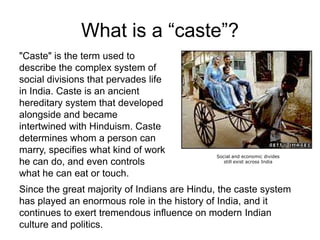
Social and economic divides
he can do, and even controls still exist across India
what he can eat or touch.
Since the great majority of Indians are Hindu, the caste system
has played an enormous role in the history of India, and it
continues to exert tremendous influence on modern Indian
culture and politics.
3.
Where does thissystem come
from?
The most widely accepted
theory is that the four
basic divisions of the
Hindu caste system—the
varna—developed in the
period 1500-1000 B.C. as
a result of the Aryan
conquest of India.
4.
Where does thissystem come
from?
The earliest known mention of caste is
found in the Aryan’s Vedic hymns,
perhaps dating from about 1000 B.C.E. In
a famous passage, the metaphor of the
human body was used to describe Indian
society. The brahman, or priestly, caste
represents society's head; the kshatriya,
or warrior, caste are its arms; the vaishya
caste—traders and landowners—are the
legs; and the sudra caste—the servants of
the other three—are the feet.
This metaphor stresses the idea of
hierarchy as well as that of
interdependence.
5.
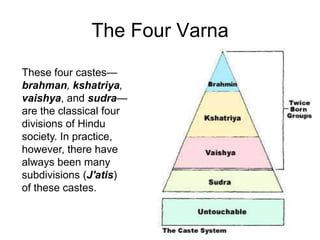
The Four Varna
Thesefour castes—
brahman, kshatriya,
vaishya, and sudra—
are the classical four
divisions of Hindu
society. In practice,
however, there have
always been many
subdivisions (J'atis)
of these castes.
6.
Caste and Dharma
InHindu religious texts, the dharma—the law, or duty—of
each varna is described. It was thought that this dharma
was an inherited, or inborn, quality. Consequently, people
thought that if intermarriages took place, there would be
much confusion as to the dharma of the next generation of
children. As a result of such concerns, marriage between
different castes was strictly prohibited. The practice of
marrying only a person of "one's own kind" is called
endogamy and is still a central rule in many Hindu
communities.
7.
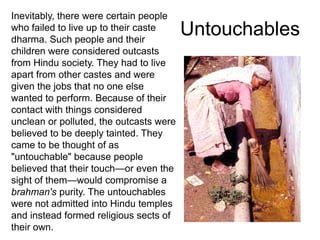
Inevitably, there werecertain people
who failed to live up to their caste
dharma. Such people and their
Untouchables
children were considered outcasts
from Hindu society. They had to live
apart from other castes and were
given the jobs that no one else
wanted to perform. Because of their
contact with things considered
unclean or polluted, the outcasts were
believed to be deeply tainted. They
came to be thought of as
"untouchable" because people
believed that their touch—or even the
sight of them—would compromise a
brahman's purity. The untouchables
were not admitted into Hindu temples
and instead formed religious sects of
their own.
8.
Harijans or “ScheduledCastes”
Over the centuries, they also
organized into sub-castes much
like those of orthodox Hindu
society. In the 20th century,
Mahatma Gandhi made it one of
his life's goals to bring the
untouchables back into Hindu
society. He renamed them the
harijans, or "children of God,"
and tried to convince orthodox
Hindus to admit them into their
temples and their everyday lives.
9.
Harijans or “ScheduledCastes”
However, other leaders doubted that
upper-caste Hindus would ever treat
the harijans as equals. Dr. B. R.
Ambedkar, a distinguished scholar
who had been born an "untouchable,"
was a leading spokesman for this view.
He used the term scheduled castes
when referring to this group, for he
believed that the term harijans was
demeaning. The scheduled castes, he
said, should withdraw from Hinduism
altogether and join another religion,
such as Buddhism, which does not
recognize caste distinctions.
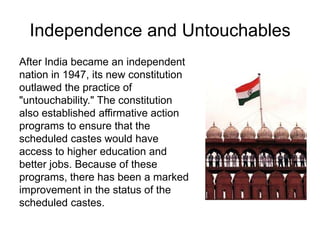
10.
Independence and Untouchables
AfterIndia became an independent
nation in 1947, its new constitution
outlawed the practice of
"untouchability." The constitution
also established affirmative action
programs to ensure that the
scheduled castes would have
access to higher education and
better jobs. Because of these
programs, there has been a marked
improvement in the status of the
scheduled castes.
11.
Why does thesystem persist?
Today, the caste system continues to be
the main form of government in villages
throughout India. In large part, its
continuity depends on two central Hindu
concepts: caste dharma and karma. In
Hindu society, caste dharma is
considered to be a divine law. In the
words of Mahatma Gandhi, caste dharma
is "the duty one has to perform" and "the
law of one's being." Many Hindus believe
that this obligation tends to enhance the
spiritual development of the individual.
Because of it, each person learns from an
early age to overcome selfish desires and
instead focus on group goals and ideals.
12.
Why does thesystem persist?
The concept of karma helps to
explain differences in status that
might otherwise be considered
unfair. Because one's caste
membership is thought to be a
result of actions in a previous life, a
person tends to accept this status
rather than complain about it. By the
same token, a successful
performance of caste duty will
improve one's karma and perhaps
lead to improved status in the next
life.
13.
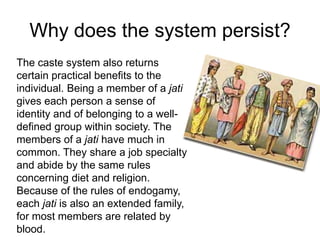
Why does thesystem persist?
The caste system also returns
certain practical benefits to the
individual. Being a member of a jati
gives each person a sense of
identity and of belonging to a well-
defined group within society. The
members of a jati have much in
common. They share a job specialty
and abide by the same rules
concerning diet and religion.
Because of the rules of endogamy,
each jati is also an extended family,
for most members are related by
blood.
14.
In 1950, thewriters of The
independent India's Constitution
adopted a policy of reserving jobs Reservation
in the government and seats in
state-funded educational
System
institutes for the "scheduled
castes and tribes," as the people
marginalized by the caste system
were then known.
India sets aside 22.5% of its
government jobs for the lowest
castes, and an additional 27% for
what are called the other
"backward" castes, the next step
up in the caste system.
15.
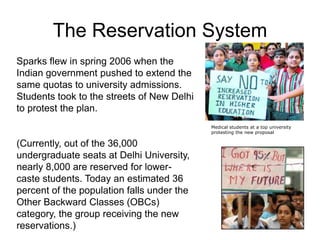
The Reservation System
Sparksflew in spring 2006 when the
Indian government pushed to extend the
same quotas to university admissions.
Students took to the streets of New Delhi
to protest the plan.
Medical students at a top university
protesting the new proposal
(Currently, out of the 36,000
undergraduate seats at Delhi University,
nearly 8,000 are reserved for lower-
caste students. Today an estimated 36
percent of the population falls under the
Other Backward Classes (OBCs)
category, the group receiving the new
reservations.)
16.
Is it Fair?
India’sconstitution guarantees “equal rights.”
• Article 14 says that the state gives to every person
“equality before the law” and “equal protection of the
laws.”
• Article 15 prohibits discrimination against any citizen
on grounds of religion, race, caste, sex, place of birth,
etc.
• Article 16 guarantees equality of opportunity in
matters of public employment, etc.
17.
Is it Fair?
Atthe same time, the constitution provides for a
“reservation system.”
Article 46 says “The state shall promote with special
care the education and economic interests of the
weaker sections of the people, and, in particular of the
scheduled castes and the scheduled tribes, and shall
protect them from social injustice and all forms of
exploitation.”
Respond: Does India’s reservation system contradict (go
against) her constitution’s promise of “equal rights”?










![Democratic Politics Chapter 4 Grade 10 CBSE [ Gender, Religion and Caste ]](https://cdn.slidesharecdn.com/ss_thumbnails/finalchapter41-150513185335-lva1-app6892-thumbnail.jpg?width=640&height=640&fit=bounds)


