Presidential Elections
The Role of the Electoral
College
Rita Davis, Presenter
John Marshall Inn of Court
Richmond ,Virginia 2004
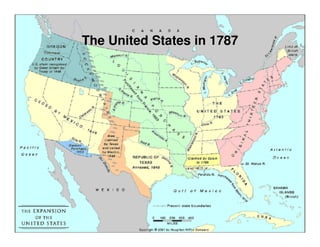
The United States in 1787
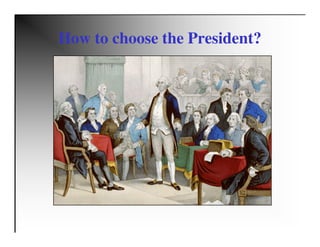
How to choose the President?
First Design
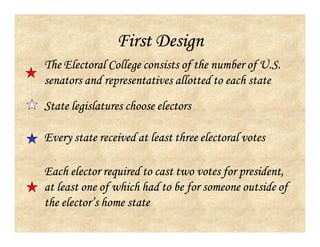
The Electoral College consists of the number of U.S.
senators and representatives allotted to each state
Every state received at least three electoral votes
Each elector required to cast two votes for president,
at least one of which had to be for someone outside of
the elector’s home state
State legislatures choose electors
First Design
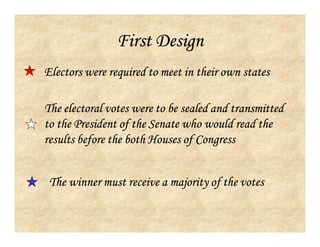
Electors were required to meet in their own states
The electoral votes were to be sealed and transmitted
to the President of the Senate who would read the
results before the both Houses of Congress
The winner must receive a majority of the votes
First Design
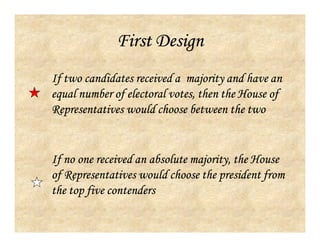
If no one received an absolute majority, the House
of Representatives would choose the president from
the top five contenders
If two candidates received a majority and have an
equal number of electoral votes, then the House of
Representatives would choose between the two
First Design
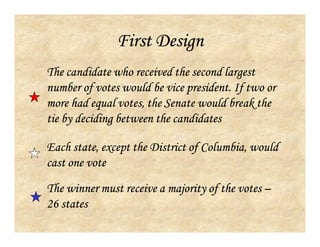
The winner must receive a majority of the votes –
26 states
Each state, except the District of Columbia, would
cast one vote
The candidate who received the second largest
number of votes would be vice president. If two or
more had equal votes, the Senate would break the
tie by deciding between the candidates
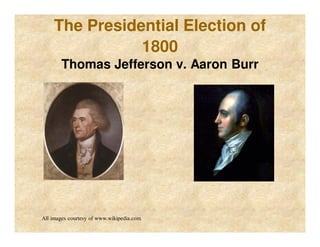
The Presidential Election of
1800
Thomas Jefferson v. Aaron Burr
All images courtesy of www.wikipedia.com
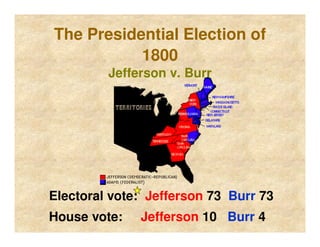
The Presidential Election of
1800
Jefferson v. Burr
House vote: Jefferson 10 Burr 4
Electoral vote: Jefferson 73 Burr 73
Second Design
1804
Each elector was to cast a vote for president
and a vote for vice president
If there is a tie, then the House will select from the
top three candidates with the candidate receiving
the most votes becoming president
If no candidate received an absolute majority for
vice president, then the U.S. Senate would select
from the two candidates with the most votes
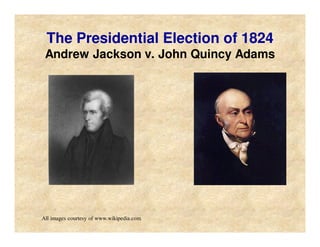
The Presidential Election of 1824
Andrew Jackson v. John Quincy Adams
All images courtesy of www.wikipedia.com
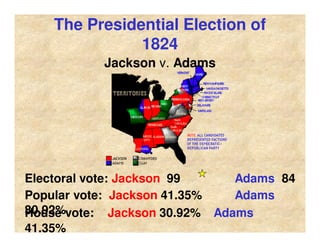
The Presidential Election of
1824
Jackson v. Adams
House vote: Jackson 30.92% Adams
41.35%
Electoral vote: Jackson 99 Adams 84
Popular vote: Jackson 41.35% Adams
30.92%
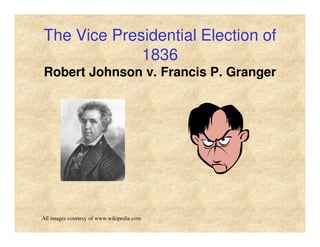
The Vice Presidential Election of
1836
Robert Johnson v. Francis P. Granger
All images courtesy of www.wikipedia.com
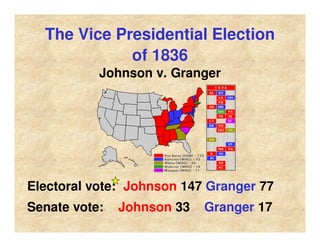
The Vice Presidential Election
of 1836
Johnson v. Granger
Senate vote: Johnson 33 Granger 17
Electoral vote: Johnson 147 Granger 77
The Presidential Election of
1876
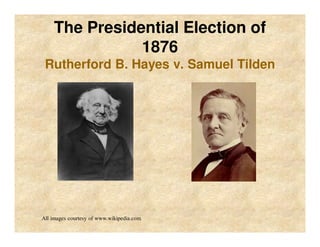
Rutherford B. Hayes v. Samuel Tilden
All images courtesy of www.wikipedia.com
The Presidential Election of
1876
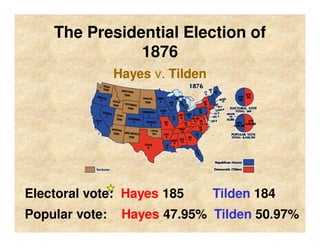
Hayes v. Tilden
Popular vote: Hayes 47.95% Tilden 50.97%
Electoral vote: Hayes 185 Tilden 184
The Presidential Election of 1888
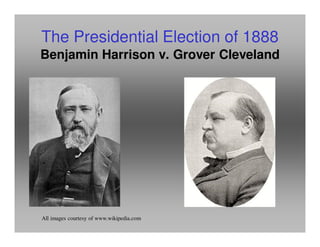
Benjamin Harrison v. Grover Cleveland
All images courtesy of www.wikipedia.com
The Presidential Election of
1888
Harrison v. Cleveland
Popular vote: Harrison 47.82% Cleveland 48.62%
Electoral vote: Harrison 233 Cleveland 168
The Presidential Election of
2000
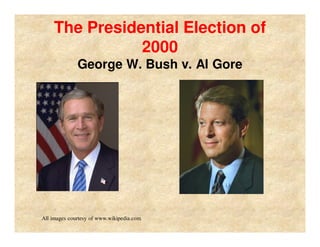
George W. Bush v. Al Gore
All images courtesy of www.wikipedia.com
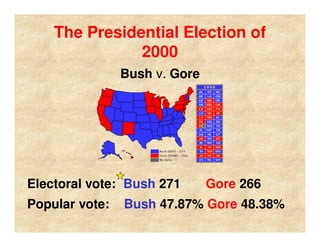
The Presidential Election of
2000
Bush v. Gore
Popular vote: Bush 47.87% Gore 48.38%
Electoral vote: Bush 271 Gore 266
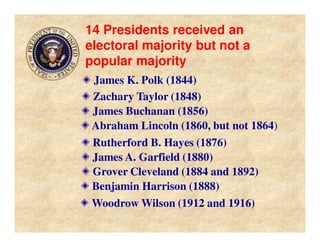
14 Presidents received an
electoral majority but not a
popular majority
James K. Polk (1844)
Zachary Taylor (1848)
James Buchanan (1856)
Abraham Lincoln (1860, but not 1864)
Rutherford B. Hayes (1876)
James A. Garfield (1880)
Grover Cleveland (1884 and 1892)
Benjamin Harrison (1888)
Woodrow Wilson (1912 and 1916)
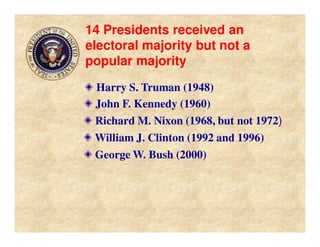
14 Presidents received an
electoral majority but not a
popular majority
Harry S. Truman (1948)
John F. Kennedy (1960)
Richard M. Nixon (1968, but not 1972)
William J. Clinton (1992 and 1996)
George W. Bush (2000)
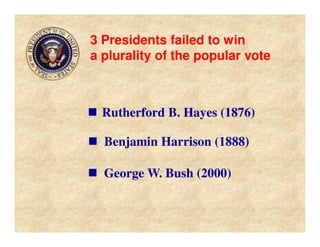
3 Presidents failed to win
a plurality of the popular vote
Rutherford B. Hayes (1876)
Benjamin Harrison (1888)
George W. Bush (2000)
Presidential Elections
The Role of the Electoral College
Presidential Elections
The Role of the Electoral
College

Microsoft PowerPoint - Electoral Collegeiv

  • 1.
    Presidential Elections The Roleof the Electoral College Rita Davis, Presenter John Marshall Inn of Court Richmond ,Virginia 2004
  • 2.
  • 3.
    How to choosethe President?
  • 4.
    First Design The ElectoralCollege consists of the number of U.S. senators and representatives allotted to each state Every state received at least three electoral votes Each elector required to cast two votes for president, at least one of which had to be for someone outside of the elector’s home state State legislatures choose electors
  • 5.
    First Design Electors wererequired to meet in their own states The electoral votes were to be sealed and transmitted to the President of the Senate who would read the results before the both Houses of Congress The winner must receive a majority of the votes
  • 6.
    First Design If noone received an absolute majority, the House of Representatives would choose the president from the top five contenders If two candidates received a majority and have an equal number of electoral votes, then the House of Representatives would choose between the two
  • 7.
    First Design The winnermust receive a majority of the votes – 26 states Each state, except the District of Columbia, would cast one vote The candidate who received the second largest number of votes would be vice president. If two or more had equal votes, the Senate would break the tie by deciding between the candidates
  • 8.
    The Presidential Electionof 1800 Thomas Jefferson v. Aaron Burr All images courtesy of www.wikipedia.com
  • 9.
    The Presidential Electionof 1800 Jefferson v. Burr House vote: Jefferson 10 Burr 4 Electoral vote: Jefferson 73 Burr 73
  • 11.
    Second Design 1804 Each electorwas to cast a vote for president and a vote for vice president If there is a tie, then the House will select from the top three candidates with the candidate receiving the most votes becoming president If no candidate received an absolute majority for vice president, then the U.S. Senate would select from the two candidates with the most votes
  • 12.
    The Presidential Electionof 1824 Andrew Jackson v. John Quincy Adams All images courtesy of www.wikipedia.com
  • 13.
    The Presidential Electionof 1824 Jackson v. Adams House vote: Jackson 30.92% Adams 41.35% Electoral vote: Jackson 99 Adams 84 Popular vote: Jackson 41.35% Adams 30.92%
  • 14.
    The Vice PresidentialElection of 1836 Robert Johnson v. Francis P. Granger All images courtesy of www.wikipedia.com
  • 15.
    The Vice PresidentialElection of 1836 Johnson v. Granger Senate vote: Johnson 33 Granger 17 Electoral vote: Johnson 147 Granger 77
  • 16.
    The Presidential Electionof 1876 Rutherford B. Hayes v. Samuel Tilden All images courtesy of www.wikipedia.com
  • 17.
    The Presidential Electionof 1876 Hayes v. Tilden Popular vote: Hayes 47.95% Tilden 50.97% Electoral vote: Hayes 185 Tilden 184
  • 18.
    The Presidential Electionof 1888 Benjamin Harrison v. Grover Cleveland All images courtesy of www.wikipedia.com
  • 19.
    The Presidential Electionof 1888 Harrison v. Cleveland Popular vote: Harrison 47.82% Cleveland 48.62% Electoral vote: Harrison 233 Cleveland 168
  • 20.
    The Presidential Electionof 2000 George W. Bush v. Al Gore All images courtesy of www.wikipedia.com
  • 21.
    The Presidential Electionof 2000 Bush v. Gore Popular vote: Bush 47.87% Gore 48.38% Electoral vote: Bush 271 Gore 266
  • 22.
    14 Presidents receivedan electoral majority but not a popular majority James K. Polk (1844) Zachary Taylor (1848) James Buchanan (1856) Abraham Lincoln (1860, but not 1864) Rutherford B. Hayes (1876) James A. Garfield (1880) Grover Cleveland (1884 and 1892) Benjamin Harrison (1888) Woodrow Wilson (1912 and 1916)
  • 23.
    14 Presidents receivedan electoral majority but not a popular majority Harry S. Truman (1948) John F. Kennedy (1960) Richard M. Nixon (1968, but not 1972) William J. Clinton (1992 and 1996) George W. Bush (2000)
  • 24.
    3 Presidents failedto win a plurality of the popular vote Rutherford B. Hayes (1876) Benjamin Harrison (1888) George W. Bush (2000)
  • 25.
    Presidential Elections The Roleof the Electoral College
  • 26.
    Presidential Elections The Roleof the Electoral College