Warm-up Match the following!
• Light bulb
• Telephone
• Airplane
• Assembly line
• Steel
• Oil
• Finance
• Railroads
• Rockefeller
• Ford
• Bell
• Morgan
• Wright brothers
• Carnegie
• Edison
• Vanderbilt
How Reconstruction Failed
•No economic gains were made by freedmen
•Political gains were only temporary
•Reconstruction did not guarantee African
Americans of equal rights
•State governments found loopholes in 14th and
15th Amendments and passed discriminatory
laws
1. What does this image
show?
2. What images does
Thomas Nast use to
make his point?
3. What does Nast want
to happen?
Worse than Slavery by Thomas
Nast
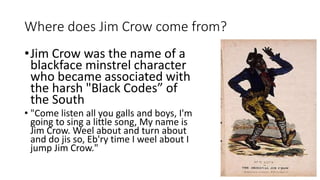
Where does Jim Crow come from?
•Jim Crow was the name of a
blackface minstrel character
who became associated with
the harsh "Black Codes” of
the South
• "Come listen all you galls and boys, I'm
going to sing a little song, My name is
Jim Crow. Weel about and turn about
and do jis so, Eb'ry time I weel about I
jump Jim Crow."
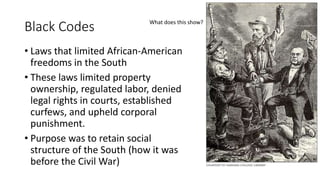
Black Codes
• Laws that limited African-American
freedoms in the South
• These laws limited property
ownership, regulated labor, denied
legal rights in courts, established
curfews, and upheld corporal
punishment.
• Purpose was to retain social
structure of the South (how it was
before the Civil War)
What does this show?
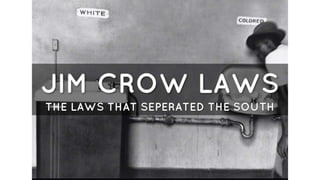
Jim Crow Laws
•After reconstruction,
many southern state
governments passed “Jim
Crow” laws forcing
separation of the races in
public places.
Discrimination and Segregation
• Intimidation and crimes
were directed against
African Americans
(lynchings).
• Lynching: illegally execute,
usually by hanging
• African Americans looked to
the U.S. courts to protect
their rights.
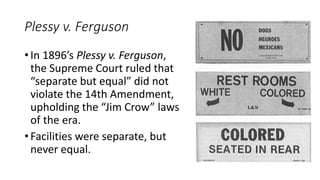
Plessy v. Ferguson
• In 1896’s Plessy v. Ferguson,
the Supreme Court ruled that
“separate but equal” did not
violate the 14th Amendment,
upholding the “Jim Crow” laws
of the era.
• Facilities were separate, but
never equal.
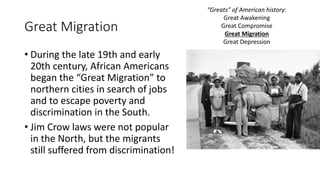
Great Migration
• During the late 19th and early
20th century, African Americans
began the “Great Migration” to
northern cities in search of jobs
and to escape poverty and
discrimination in the South.
• Jim Crow laws were not popular
in the North, but the migrants
still suffered from discrimination!
“Greats” of American history:
Great Awakening
Great Compromise
Great Migration
Great Depression
Northern Problems
•African Americans faced racism and
discrimination in the North, too.
•Confrontations with immigrant groups were a
result of competition for jobs.
•De facto segregation arose as African Americans
settled in their own ethnic communities.
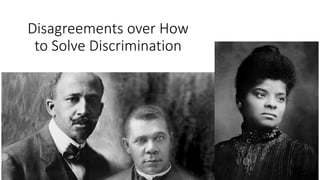
Disagreements over How
to Solve Discrimination
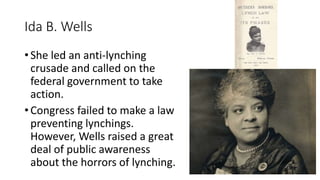
Ida B. Wells
• She led an anti-lynching
crusade and called on the
federal government to take
action.
• Congress failed to make a law
preventing lynchings.
However, Wells raised a great
deal of public awareness
about the horrors of lynching.
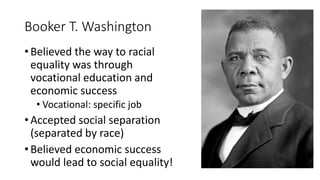
Booker T. Washington
• Believed the way to racial
equality was through
vocational education and
economic success
• Vocational: specific job
• Accepted social separation
(separated by race)
• Believed economic success
would lead to social equality!
W.E.B. DuBois
• Believed that education was
meaningless without equality.
• Helped found the National
Association for the
Advancement of Colored
People (NAACP) to advocate
for political equality for
African Americans.

Jim crow era

  • 2.
    Warm-up Match thefollowing! • Light bulb • Telephone • Airplane • Assembly line • Steel • Oil • Finance • Railroads • Rockefeller • Ford • Bell • Morgan • Wright brothers • Carnegie • Edison • Vanderbilt
  • 3.
    How Reconstruction Failed •Noeconomic gains were made by freedmen •Political gains were only temporary •Reconstruction did not guarantee African Americans of equal rights •State governments found loopholes in 14th and 15th Amendments and passed discriminatory laws
  • 4.
    1. What doesthis image show? 2. What images does Thomas Nast use to make his point? 3. What does Nast want to happen? Worse than Slavery by Thomas Nast
  • 5.
    Where does JimCrow come from? •Jim Crow was the name of a blackface minstrel character who became associated with the harsh "Black Codes” of the South • "Come listen all you galls and boys, I'm going to sing a little song, My name is Jim Crow. Weel about and turn about and do jis so, Eb'ry time I weel about I jump Jim Crow."
  • 6.
    Black Codes • Lawsthat limited African-American freedoms in the South • These laws limited property ownership, regulated labor, denied legal rights in courts, established curfews, and upheld corporal punishment. • Purpose was to retain social structure of the South (how it was before the Civil War) What does this show?
  • 7.
    Jim Crow Laws •Afterreconstruction, many southern state governments passed “Jim Crow” laws forcing separation of the races in public places.
  • 8.
    Discrimination and Segregation •Intimidation and crimes were directed against African Americans (lynchings). • Lynching: illegally execute, usually by hanging • African Americans looked to the U.S. courts to protect their rights.
  • 9.
    Plessy v. Ferguson •In 1896’s Plessy v. Ferguson, the Supreme Court ruled that “separate but equal” did not violate the 14th Amendment, upholding the “Jim Crow” laws of the era. • Facilities were separate, but never equal.
  • 11.
    Great Migration • Duringthe late 19th and early 20th century, African Americans began the “Great Migration” to northern cities in search of jobs and to escape poverty and discrimination in the South. • Jim Crow laws were not popular in the North, but the migrants still suffered from discrimination! “Greats” of American history: Great Awakening Great Compromise Great Migration Great Depression
  • 13.
    Northern Problems •African Americansfaced racism and discrimination in the North, too. •Confrontations with immigrant groups were a result of competition for jobs. •De facto segregation arose as African Americans settled in their own ethnic communities.
  • 14.
    Disagreements over How toSolve Discrimination
  • 15.
    Ida B. Wells •She led an anti-lynching crusade and called on the federal government to take action. • Congress failed to make a law preventing lynchings. However, Wells raised a great deal of public awareness about the horrors of lynching.
  • 16.
    Booker T. Washington •Believed the way to racial equality was through vocational education and economic success • Vocational: specific job • Accepted social separation (separated by race) • Believed economic success would lead to social equality!
  • 17.
    W.E.B. DuBois • Believedthat education was meaningless without equality. • Helped found the National Association for the Advancement of Colored People (NAACP) to advocate for political equality for African Americans.