Whitepaper
       How SOA helps in building Interoperability, Agility, and Flexibility in mission critical systems


                                                               Published on: August 2010 | Author: Oracle Pratice


© Hexaware Technologies. All rights reserved.                                                          www.hexaware.com
Whitepaper
                                                  How SOA helps in building Interoperability, Agility, and Flexibility in mission critical systems


     Table of Contents
     1. Introduction                                                                                                                           03
     2. Common Challenges with Systems                                                                                                         03
     3. Why SOA?                                                                                                                               03
         3.1. Example of an SOA-based Work Order Process System                                                                                04
     5. Benefits of Using SOA-Based Composite Applications                                                                                     04
     6. Conclusion                                                                                                                             04


© Hexaware Technologies. All rights reserved.                           2                                                       www.hexaware.com
Whitepaper
                                                       How SOA helps in building Interoperability, Agility, and Flexibility in mission critical systems


     1. Introduction
     Estimated at approximately $55 billion, the global Maintenance, Repair, and Overhaul (MRO) industry is set to grow at rates between 3 and
     5 percent year-on-year. With modest growth rates and the global economic slowdown, reduced travel has played a large factor in increasing
     the cost pressures on MRO service providers in recent times. This, in turn, has forced MRO service providers to reexamine costs and
     increase efficiency.

     One area where MRO service providers have continuously faced inefficiencies is in the area of MRO systems. With heterogeneous IT
     infrastructure (with respect to operating systems, applications, application infrastructure, and system software), rigid legacy systems, and
     little or no interoperability between these systems, MRO companies often struggle to find a way to completely leverage their IT assets.

     In this paper, we will examine how a Service Oriented Architecture (SOA) approach can serve to build composite applications to help deliver
     better ROI on IT investments, more specifically in work order processing.


     2. Common Challenges with Systems
     There are several challenges that enterprises face with existing systems. Typically, software systems end up being ‘tightly coupled’. This
     means that modules within the system that execute different business processes are closely interlinked with each other. As a result:
       Software updates across modules can become troublesome. For example, an update to one module may inadvertently cause unexpected
       changes to another module.
       Changes or modifications to specific modules require significant investment in terms of time and money, which is not always feasible or
       justified.
       Reusing modules for various business processes isn’t always possible leading to greater redundancy across systems.

     While tightly coupled systems present their own problems, IT strategies that are integration or application-focused create another problem
     because they result in purchases of numerous independent applications that do not ‘talk’ to each other.

     The consequences of these limitations in business terms can be far-reaching. Enterprises are unable to respond quickly to changes in the
     business landscape or use existing IT infrastructure to tackle new business requirements; systems lack the capability to support new channel
     interactions that involve suppliers, partners, and customers; IT ends up deploying multiple systems that perform the same task; all of which
     lead to tremendous inefficiency within the organization.


     3. Why SOA?
     Most often, business demands more agility and flexibility without spending more. At the same time, IT needs resources to ensure that legacy
     systems are running effectively, the infrastructure is as agile and productive as possible, and required new business capabilities can be
     added.

     Irrespective of their differences, most business and IT folks agree that an organization’s business processes differentiate them from others.
     And it is a focus on these business processes that can enable organizations to evolve to a more flexible goal-oriented model by pursuing an
     SOA approach.

     In SOA, an application’s independent functions or business rules are converted into modules and presented to client or consumer applica-
     tions as services. This ‘loose coupling’ ensures that implementation and the service interface remain independent of each other. As a result,
     developers can create applications by composing one or more services even though they may not understand the underlying implementa-
     tions of the services.

     SOA enables enterprises to seamlessly upgrade existing services or plug in new ones in a granular manner to support new business require-
     ments. It also adds the capability to make services accessible across different channels and exposes existing systems and applications as
     services to create better security for the existing IT infrastructure.


© Hexaware Technologies. All rights reserved.                                3                                                       www.hexaware.com
Whitepaper
                                                     How SOA helps in building Interoperability, Agility, and Flexibility in mission critical systems


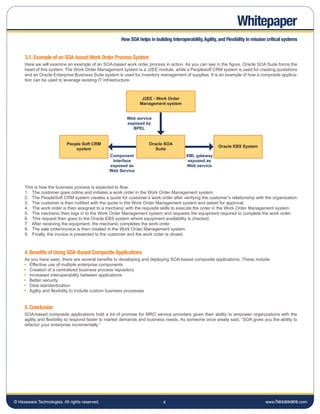
     3.1. Example of an SOA-based Work Order Process System
     Here we will examine an example of an SOA-based work order process in action. As you can see in the figure, Oracle SOA Suite forms the
     heart of this system. The Work Order Management system is a J2EE module, while a Peoplesoft CRM system is used for creating quotations
     and an Oracle Enterprise Business Suite system is used for inventory management of supplies. It is an example of how a composite applica-
     tion can be used to leverage existing IT infrastructure.


                                                                J2EE - Work Order
                                                               Management system


                                                        Web service
                                                        exposed by
                                                           BPEL


                           People Soft CRM                          Oracle SOA
                                                                                                         Oracle EBS System
                               system                                  Suite
                                                Component                               XML gateway
                                                 Interface                               exposed as
                                                exposed as                              Web service
                                                Web Service


     This is how the business process is expected to flow:
     1. The customer goes online and initiates a work order in the Work Order Management system.
     2. The PeopleSoft CRM system creates a quote for customer’s work order after verifying the customer’s relationship with the organization.
     3. The customer is then notified with the quote in the Work Order Management system and asked for approval.
     4. The work order is then assigned to a mechanic with the requisite skills to execute the order in the Work Order Management system.
     5. The mechanic then logs in to the Work Order Management system and requests the equipment required to complete the work order.
     6. This request then goes to the Oracle EBS system where equipment availability is checked.
     7. After receiving the equipment, the mechanic completes the work order.
     8. The sale order/invoice is then created in the Work Order Management system.
     9. Finally, the invoice is presented to the customer and the work order is closed.


     4. Benefits of Using SOA-Based Composite Applications
     As you have seen, there are several benefits to developing and deploying SOA-based composite applications. These include:
       Effective use of multiple enterprise components
       Creation of a centralized business process repository
       Increased interoperability between applications
       Better security
       Data standardization
       Agility and flexibility to include custom business processes


     5. Conclusion
     SOA-based composite applications hold a lot of promise for MRO service providers given their ability to empower organizations with the
     agility and flexibility to respond faster to market demands and business needs. As someone once wisely said, “SOA gives you the ability to
     refactor your enterprise incrementally.”


© Hexaware Technologies. All rights reserved.                              4                                                       www.hexaware.com
Whitepaper
                                                                       How SOA helps in building Interoperability, Agility, and Flexibility in mission critical systems


     To learn more, visit http.//www.hexaware.com/wp-oracle.htm

     Address
     1095 Cranbury South River Road, Suite 10, Jamesburg, NJ 08831. Main: 609-409-6950 | Fax: 609-409-6910


     Safe Harbor
     Certain statements on this whitepaper concerning our future growth prospects are forward-looking statements, which involve a number of risks, and uncertainties that could cause
     actual results to differ materially from those in such forward-looking statements. The risks and uncertainties relating to these statements include, but are not limited to, risks and
     uncertainties regarding fluctuations in earnings, our ability to manage growth, intense competition in IT services including those factors which may affect our cost advantage, wage
     increases in India, our ability to attract and retain highly skilled professionals, time and cost overruns on fixed-price, fixed-time frame contracts, client concentration, restrictions on
     immigration, our ability to manage our international operations, reduced demand for technology in our key focus areas, disruptions in telecommunication networks, our ability to
     successfully complete and integrate potential acquisitions, liability for damages on our service contracts, the success of the companies in which Hexaware has made strategic
     investments, withdrawal of governmental fiscal incentives, political instability, legal restrictions on raising capital or acquiring companies outside India, and unauthorized use of our
     intellectual property and general economic conditions affecting our industry.


© Hexaware Technologies. All rights reserved.                                                        5                                                                      www.hexaware.com

SOA helps in building Interoperability, Agility, and Flexibility

  • 1.
    Whitepaper How SOA helps in building Interoperability, Agility, and Flexibility in mission critical systems Published on: August 2010 | Author: Oracle Pratice © Hexaware Technologies. All rights reserved. www.hexaware.com
  • 2.
    Whitepaper How SOA helps in building Interoperability, Agility, and Flexibility in mission critical systems Table of Contents 1. Introduction 03 2. Common Challenges with Systems 03 3. Why SOA? 03 3.1. Example of an SOA-based Work Order Process System 04 5. Benefits of Using SOA-Based Composite Applications 04 6. Conclusion 04 © Hexaware Technologies. All rights reserved. 2 www.hexaware.com
  • 3.
    Whitepaper How SOA helps in building Interoperability, Agility, and Flexibility in mission critical systems 1. Introduction Estimated at approximately $55 billion, the global Maintenance, Repair, and Overhaul (MRO) industry is set to grow at rates between 3 and 5 percent year-on-year. With modest growth rates and the global economic slowdown, reduced travel has played a large factor in increasing the cost pressures on MRO service providers in recent times. This, in turn, has forced MRO service providers to reexamine costs and increase efficiency. One area where MRO service providers have continuously faced inefficiencies is in the area of MRO systems. With heterogeneous IT infrastructure (with respect to operating systems, applications, application infrastructure, and system software), rigid legacy systems, and little or no interoperability between these systems, MRO companies often struggle to find a way to completely leverage their IT assets. In this paper, we will examine how a Service Oriented Architecture (SOA) approach can serve to build composite applications to help deliver better ROI on IT investments, more specifically in work order processing. 2. Common Challenges with Systems There are several challenges that enterprises face with existing systems. Typically, software systems end up being ‘tightly coupled’. This means that modules within the system that execute different business processes are closely interlinked with each other. As a result: Software updates across modules can become troublesome. For example, an update to one module may inadvertently cause unexpected changes to another module. Changes or modifications to specific modules require significant investment in terms of time and money, which is not always feasible or justified. Reusing modules for various business processes isn’t always possible leading to greater redundancy across systems. While tightly coupled systems present their own problems, IT strategies that are integration or application-focused create another problem because they result in purchases of numerous independent applications that do not ‘talk’ to each other. The consequences of these limitations in business terms can be far-reaching. Enterprises are unable to respond quickly to changes in the business landscape or use existing IT infrastructure to tackle new business requirements; systems lack the capability to support new channel interactions that involve suppliers, partners, and customers; IT ends up deploying multiple systems that perform the same task; all of which lead to tremendous inefficiency within the organization. 3. Why SOA? Most often, business demands more agility and flexibility without spending more. At the same time, IT needs resources to ensure that legacy systems are running effectively, the infrastructure is as agile and productive as possible, and required new business capabilities can be added. Irrespective of their differences, most business and IT folks agree that an organization’s business processes differentiate them from others. And it is a focus on these business processes that can enable organizations to evolve to a more flexible goal-oriented model by pursuing an SOA approach. In SOA, an application’s independent functions or business rules are converted into modules and presented to client or consumer applica- tions as services. This ‘loose coupling’ ensures that implementation and the service interface remain independent of each other. As a result, developers can create applications by composing one or more services even though they may not understand the underlying implementa- tions of the services. SOA enables enterprises to seamlessly upgrade existing services or plug in new ones in a granular manner to support new business require- ments. It also adds the capability to make services accessible across different channels and exposes existing systems and applications as services to create better security for the existing IT infrastructure. © Hexaware Technologies. All rights reserved. 3 www.hexaware.com
  • 4.
    Whitepaper How SOA helps in building Interoperability, Agility, and Flexibility in mission critical systems 3.1. Example of an SOA-based Work Order Process System Here we will examine an example of an SOA-based work order process in action. As you can see in the figure, Oracle SOA Suite forms the heart of this system. The Work Order Management system is a J2EE module, while a Peoplesoft CRM system is used for creating quotations and an Oracle Enterprise Business Suite system is used for inventory management of supplies. It is an example of how a composite applica- tion can be used to leverage existing IT infrastructure. J2EE - Work Order Management system Web service exposed by BPEL People Soft CRM Oracle SOA Oracle EBS System system Suite Component XML gateway Interface exposed as exposed as Web service Web Service This is how the business process is expected to flow: 1. The customer goes online and initiates a work order in the Work Order Management system. 2. The PeopleSoft CRM system creates a quote for customer’s work order after verifying the customer’s relationship with the organization. 3. The customer is then notified with the quote in the Work Order Management system and asked for approval. 4. The work order is then assigned to a mechanic with the requisite skills to execute the order in the Work Order Management system. 5. The mechanic then logs in to the Work Order Management system and requests the equipment required to complete the work order. 6. This request then goes to the Oracle EBS system where equipment availability is checked. 7. After receiving the equipment, the mechanic completes the work order. 8. The sale order/invoice is then created in the Work Order Management system. 9. Finally, the invoice is presented to the customer and the work order is closed. 4. Benefits of Using SOA-Based Composite Applications As you have seen, there are several benefits to developing and deploying SOA-based composite applications. These include: Effective use of multiple enterprise components Creation of a centralized business process repository Increased interoperability between applications Better security Data standardization Agility and flexibility to include custom business processes 5. Conclusion SOA-based composite applications hold a lot of promise for MRO service providers given their ability to empower organizations with the agility and flexibility to respond faster to market demands and business needs. As someone once wisely said, “SOA gives you the ability to refactor your enterprise incrementally.” © Hexaware Technologies. All rights reserved. 4 www.hexaware.com
  • 5.
    Whitepaper How SOA helps in building Interoperability, Agility, and Flexibility in mission critical systems To learn more, visit http.//www.hexaware.com/wp-oracle.htm Address 1095 Cranbury South River Road, Suite 10, Jamesburg, NJ 08831. Main: 609-409-6950 | Fax: 609-409-6910 Safe Harbor Certain statements on this whitepaper concerning our future growth prospects are forward-looking statements, which involve a number of risks, and uncertainties that could cause actual results to differ materially from those in such forward-looking statements. The risks and uncertainties relating to these statements include, but are not limited to, risks and uncertainties regarding fluctuations in earnings, our ability to manage growth, intense competition in IT services including those factors which may affect our cost advantage, wage increases in India, our ability to attract and retain highly skilled professionals, time and cost overruns on fixed-price, fixed-time frame contracts, client concentration, restrictions on immigration, our ability to manage our international operations, reduced demand for technology in our key focus areas, disruptions in telecommunication networks, our ability to successfully complete and integrate potential acquisitions, liability for damages on our service contracts, the success of the companies in which Hexaware has made strategic investments, withdrawal of governmental fiscal incentives, political instability, legal restrictions on raising capital or acquiring companies outside India, and unauthorized use of our intellectual property and general economic conditions affecting our industry. © Hexaware Technologies. All rights reserved. 5 www.hexaware.com