Hexaware Business Intelligence & Analytics Blogs Guide to

“A Practitioner’s View”
Latest Trends and Information on BI/ DW Technologies for 2012
Actionable Intelligence Enabled


                         www.hexaware.com
                         © Hexaware Technologies. All rights reserved.
TOC
·    Trim Tabs in Business Intelligence           1
                                                Click Here


·    2012 Wish list for Data Integration
     Platforms                                    5
                                                Click Here


·    Managing Counterparty Risk with
     Actionable BI Solutions                      9
                                                Click Here


·    Data Management, Information
     Management and then Decision
     management                                 13
                                                Click Here


·    Business Intelligence and Analytics- The
     Different Dimensions
                                                17
                                                Click Here


www.hexaware.com
© Hexaware Technologies. All rights reserved.
What are Trim Tabs? – Trim tabs are small surfaces connected to the
                                                    trailing edge of a larger control surface on a boat or aircraft, used to
                                                    control the trim of the controls, i.e. to counteract hydro- or
                                                    aero-dynamic forces and stabilize the boat or aircraft in a particular
                                                    desired altitude without the need for the operator to constantly apply a
                                                    control force. This is done by adjusting the angle of the tab relative to
                                                    the larger surface.
                                                    As a metaphor, Trim Tabs are used to denote tiny components, which


   Trim Tabs in
                                                    nevertheless have a great impact on things that they are attached to.
                                                    This blog post is about the relevance of this metaphor to BI in
                                                    enterprises.


   Business
                                                    Business Intelligence practitioners acknowledge the fact that BI &
                                                    Analytics in any organization is a journey, an evolution over a period of
                                                    time. The canvas for BI is extensive and spans the business
                                                    technology continuum.


   Intelligence                                     Given that BI can add value in many areas of an organization and there
                                                    are many solutions possible in each of those areas, it is important to


www.hexaware.com
© Hexaware Technologies. All rights reserved.   1       2                                                         Click Here >
identify the BI ‘Trim Tabs’, i.e. those small areas that can provide the      7) What are the regulatory requirements for the company?
maximum value for invested money. In one of my earlier blogs, I had           And many more. In essence, clarity on one aspect of the problem
talked about the concept of “analytics anchor points” – Business              (business model) will go a long way in selecting the analytics anchor
processes that should be considered first for optimization through            points (BI Trim Tabs) for that particular organization.
analytics.
Identifying the analytics anchor points in an organization is a non-trivial   -by Karthikeyan Sankaran
exercise. In my humble opinion, such a process should start with a
complete understanding of the organization’s ‘Business Model’.
Business Model is a set of assumptions about how an organization will
perform by creating value for all the players, on whom it depends,
including its customers. From BI perspective, once the practitioner
understands the business model of the company, many questions
gets answered:
1) What drives the company’s success and how BI can help?
2) Who are the stakeholders and what information are they looking
    for?
3) What needs to be optimized and how it can be done?
4) What is the architectural blueprint and how will it evolve?
5) How fast should information get delivered?
6) How much data needs to be collated and how far into the past
    should one go?


www.hexaware.com
© Hexaware Technologies. All rights reserved.                       3             4                                                      Click Here >
Data Integration (DI) platforms like Informatica, DataStage, BODS,
                       ODI, SSIS and others are the backbone for a well designed Business
                       Intelligence application. DI platforms ensure that all the required data
                       are provisioned at the right time, with quality.
                       In the process of configuring and running DI platforms, we come
                       across few scenarios where DI platform needs to be extended with
                       tools/utilities. Some of these scenarios are like analysis of the
                       metadata captured by DI platform, integration with other applications
                       like helpdesk and others. These scenarios can be added as a product


2012 Wish list         feature to the DI platform.
                       Following are the features that Data Integration platform vendors
                       should consider introducing in the DI product.
for Data Integration
Platforms              • A feature which can provide a Network-like view to understand the
                         dependency between tables present in DI process components.
                         DI process components are ‘Jobs in DataStage’ or ‘mappings in
                         Informatica’. The Network view should enable us to drag a table
                         and focus on its dependency on other DI processes and tables


                   5       6                                                        Click Here >
• Provide an interface to configure the default object names that        • Design templates for scenarios like data archival or data cleanup
  would be assigned to an object, like widget or transformation (as in     from large tables, for comparison of two data sets (data set can be
  Informatica), or an object like stage (as in DataStage). The             a table or file), auto data type conversion will be useful for migration
  configured name should be assigned when the icon is dragged              of data from one database to another database
  into the design interface by developer.
• Prebuilt integration with Helpdesk applications like Remedy to log     Thanks for reading, let me know your thoughts on what are the other
  data errors and job failures as a ticket into the helpdesk system      features that you feel should be considered in a DI platform.
• ‘Data Element Aware’: This feature should understand a column’s        -by Muneeswara C Pandian
  data values like of ‘people name’ and then suggest checks and
  validations that needs to be performed for such columns
• ‘Domain Data Aware’: This feature should understand the business
  areas like Investment Bank, and have pre built data validation rules
  to handle external data like Bloomberg
• Enable calculations like aggregation and metric derivation to be
  interoperable with the semantic layer metadata of reporting tools.
  For example if a Business Objects Universe is given as input to a
  DI product, then the DI product should be able to suggest what
  calculations in the Universe can be moved to the DI layer and the
  suggested data structure to store the calculations
• Data Correction interface for analysts with the workflow feature to
  look at the error data, correct, approve and re-process them back
  into the target tables


www.hexaware.com
© Hexaware Technologies. All rights reserved.                  7             8                                                          Click Here >
What is Counterparty risk?
                                                    Counterparty credit risk is traditionally defined as the risk that a
                                                    counterparty to a transaction fails to perform under its contractual
                                                    commitment for the variety of products that the Bank trades with the
                                                    counterparty such as forex instruments, letters of credits,
                                                    repossessions, derivatives, etc. Counterparty credit risk is an
                                                    inevitable component of capital markets trading businesses and
                                                    banking activities. The ability to measure, aggregate and monitor
                                                    counterparty credit risk ensures that bank’s external customers are
                                                    willing and able to honor their contractual commitments and credit
                                                    losses are minimized. Any changes to the credit quality and the
                                                    exposures should be regularly evaluated and communicated to the

   Managing Counterparty                            senior management to make prudent credit decisions in their
                                                    investment portfolios and to reduce exposure to the deteriorating

   Risk with Actionable                             counterparties.


   BI Solutions                                     Why is it important?
                                                    A counterparty credit rating reflects the best expectation of its
                                                    Probability of Default (PD) based on an analysis of its economic and
                                                    financial strength. In our experience it is typically assessed at the level
                                                    of senior unsecured creditor. Some of the banks and financial
                                                    institutions also consider country risk ratings and adjust the
                                                    counterparty rating based on this. This rating reflects a long term view


www.hexaware.com
© Hexaware Technologies. All rights reserved.   9       10                                                          Click Here >
of the creditworthiness of the counterparty (i.e. through a credit cycle)   The framework should also create a work flow to make manual
though suitable adjustments (normally downgrades) are made based            additions and changes to the counterparty and exposure information
on the market data.                                                         easily. Also provide critical alerts for risk rating and exposure
All trading counterparties are categorized into broad, high level           downgrades and upgrades in the desired frequency.
industry classes. These broad classifications are designed to identify
pools of counterparties with similar business environment, regulatory       Some of the common business benefits are
requirements and common macro-economic risk drivers. This                   • Reduce your turn around time for consolidation of counterparty
segmentation helps in tracking credit quality across different portfolios     reporting.
and setting portfolio limits.                                               • Create a Master repository of counterparties, grouping, products,
                                                                              exposures and risk factors.
                                                                            • Get alerts for ratings, total exposure fluctuations beyond
What should you look for in a framework that captures all analytics
                                                                              thresholds.
dimensions?
                                                                            • Monitor trends for dimensions mentioned above and faster
Counterparty risk analytics framework should provide automated                decision making.
aggregation of data from various source systems that house the credit
and limit information for domestic and international counterparties.
                                                                            Technical benefits are
Additionally this should enable automation of the agency ratings and
                                                                            • Pre-Built connectors across source systems using excel interfaces
CDS swap spread data based on the information available.
                                                                            • Prebuilt data models , Business metrics and scenarios
The framework should help create a central risk database that stores        • Prebuilt data loaders
master data around counterparties, products, exposures and risk             • Standard KPIs covered
factors. It should also provide an application to extract and manipulate    • Prebuilt Reports and Dashboards
exposure & ratings data from underlying source system. MS Excel files       • Data and Report Centralization analytics.
can be linked to load data into the historical risk database. This
database can be used to produce a set of reports and dashboards             -by Sheba Fernando
that enables senior management to take critical decisions around
counterparties and their exposures.


www.hexaware.com
© Hexaware Technologies. All rights reserved.                     11           12                                                    Click Here >
In the architectural set up of a Data Warehouse (or Business
                                                     Intelligence/BI) system, we can define two layers, they are
                                                     • Data Management and
                                                     • Information Management
                                                     Data Management performs the function of data collection from
                                                     Business Transaction systems, validation of data, integration of data
                                                     and provisioning the data for analysis and interpretation.
                                                     Information Management performs the function of deriving information
                                                     from the data stored in the Data Management layer and presenting
                                                     them as analytical reports and dashboards.
                                                     Decision Management is a new layer that gets added into a Data
                                                     Warehouse landscape acting as a connector between the Information
Data Manageent,                                      Management layer and the Business Transaction Systems.
Information Management                               To understand further on Decision Management, let us define what is
                                                     decision and types of decisions.
and then Decision Management
                                                     What is Decision?
                                                     Decision is defined as ‘a solution or direction provided to resolve a
                                                     problem’. A decision leads to an action and in a Business context
                                                     action invokes a business process. Some examples of decisions in a
                                                     business are


www.hexaware.com
© Hexaware Technologies. All rights reserved.   13      14                                                      Click Here >
1. A manager initiating a training program for resources on observing   Tactical Decisions are made by Managers who work on predefined
   quality issues in deliverable                                           target values set against a metric and have continuous monitoring
2. A store manager providing the discounted price for preferred            process over the metrics. Metrics are measures which define
   customers on observing lesser stock and faster movement of              performance of a business process like revenue per sales person.
   products                                                                The decisions here are based on how a metric is performing
                                                                           against a target value. These decisions are covered by the
3. An accountant sending an e-mail note to supplier on seeing a
                                                                           Decision Management Systems.
   repeated delay in delivery
                                                                        • With the increase in the regulatory requirements, enforcement on
                                                                            data trail and auditing is becoming very vital for every decisions
What is Decision Management?                                                being made in the business. In the future organizations will have
Managing the ‘data of decisions’. Being able to capture and                 Decision Management as one of their key initiatives to address
understand the decisions that have been taken is called Decision            regulatory requirements.
Management.                                                             Current products in the market serving ‘Decision Management’ area
                                                                        look at automation of the decision process and do not to define
What ‘Decisions’ can be Managed?                                        process or tools to ‘capture and store the decisions’. To build an
There are three types of Decisions, they are                            effective Decision Management System, a repository of ‘Decisions’ is
                                                                        very essential.
• Strategic
• Tactical
                                                                        Thanks for reading, let me know your observations.
• Operational
                                                                        -by Muneeswara C Pandian

Strategic Decisions are made by Senior Management and CXO’s;
these are long term in nature and are dependent on the market
conditions. These are not covered by the Decision Management
Systems.


www.hexaware.com
© Hexaware Technologies. All rights reserved.                 15           16                                                       Click Here >
One of the most interesting aspects of Business Intelligence is the
                                                     fact that it has a wide canvas for the practitioners to paint their strokes.
                                                     We at Hexaware have made an attempt to draw a boundary around BI
                                                     to make sense of its different dimensions. The artifacts that have been
                                                     used in this exercise are mentioned below.
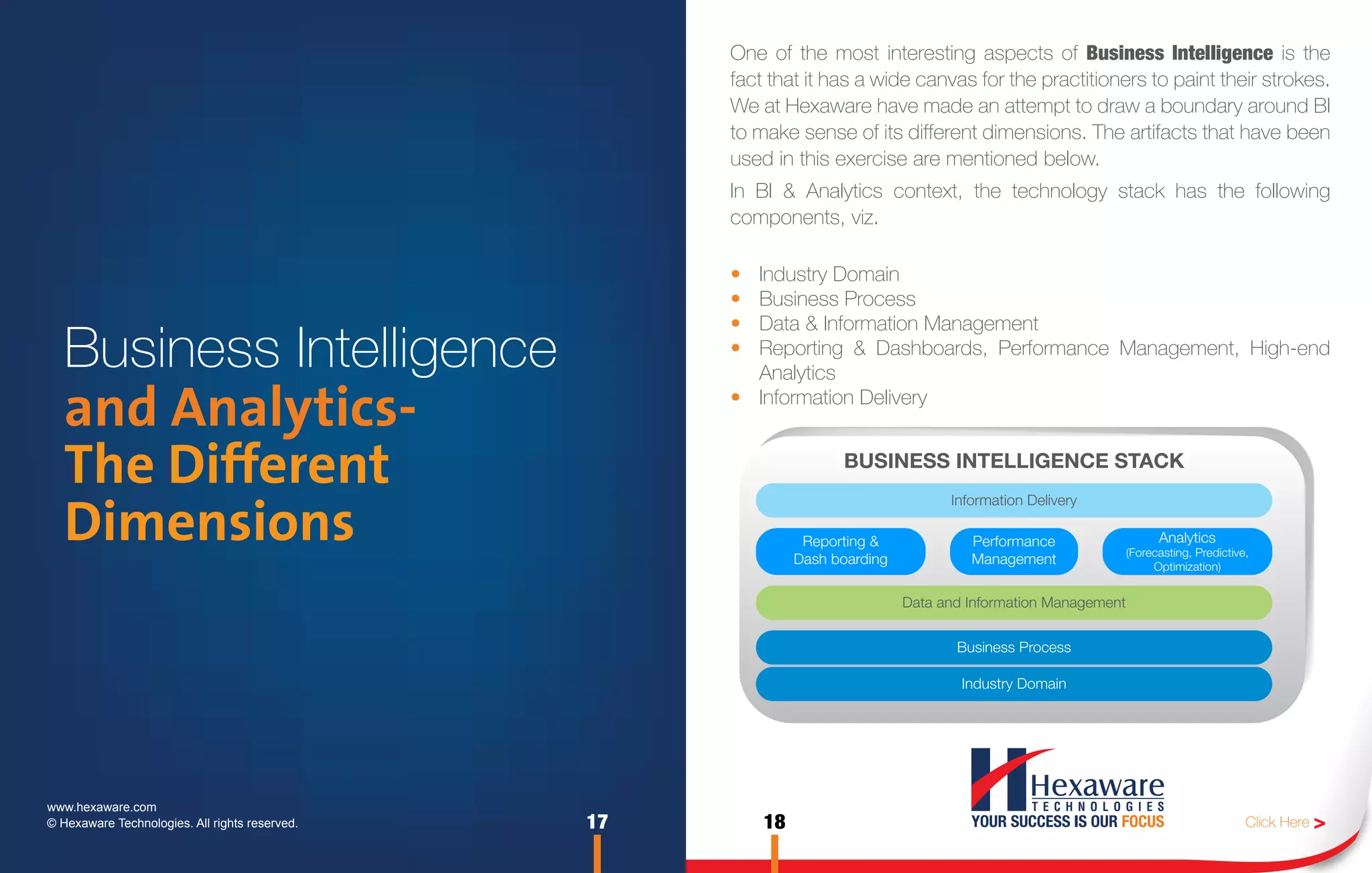
                                                     In BI & Analytics context, the technology stack has the following
                                                     components, viz.

                                                     • Industry Domain
                                                     • Business Process
                                                     • Data & Information Management
   Business Intelligence                             • Reporting & Dashboards, Performance Management, High-end
                                                       Analytics

   and Analytics-                                    • Information Delivery


   The Different                                                    BUSINESS INTELLIGENCE STACK
                                                                                    Information Delivery

   Dimensions                                                  Reporting &
                                                              Dash boarding
                                                                                       Performance
                                                                                       Management
                                                                                                                      Analytics
                                                                                                                (Forecasting, Predictive,
                                                                                                                     Optimization)


                                                                              Data and Information Management


                                                                                     Business Process

                                                                                      Industry Domain


www.hexaware.com
© Hexaware Technologies. All rights reserved.   17       18                                                                             Click Here >
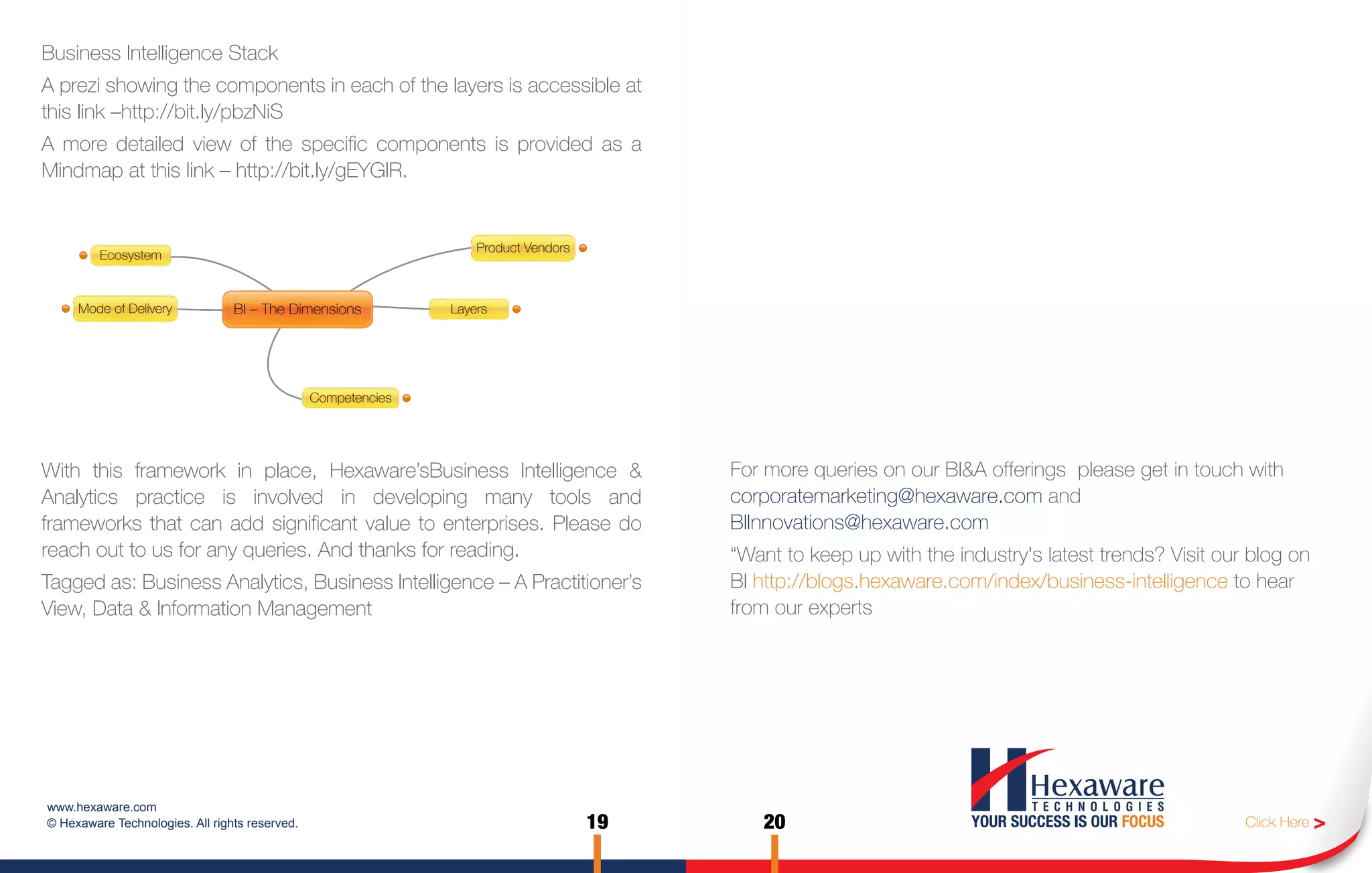
Business Intelligence Stack
A prezi showing the components in each of the layers is accessible at
this link –http://bit.ly/pbzNiS
A more detailed view of the specific components is provided as a
Mindmap at this link – http://bit.ly/gEYGIR.


                                                                   Product Vendors
         Ecosystem


     Mode of Delivery            BI – The Dimensions           Layers


                                                Competencies


With this framework in place, Hexaware’sBusiness Intelligence &                           For more queries on our BI&A offerings please get in touch with
Analytics practice is involved in developing many tools and                               corporatemarketing@hexaware.com and
frameworks that can add significant value to enterprises. Please do                       BIInnovations@hexaware.com
reach out to us for any queries. And thanks for reading.                                  “Want to keep up with the industry's latest trends? Visit our blog on
Tagged as: Business Analytics, Business Intelligence – A Practitioner’s                   BI http://blogs.hexaware.com/index/business-intelligence to hear
View, Data & Information Management                                                       from our experts


www.hexaware.com
© Hexaware Technologies. All rights reserved.                                        19      20                                                        Click Here >

“A Practitioner’s View” on the latest trends and information on BI/ DW technologies for 2012

  • 1.
    Hexaware Business Intelligence& Analytics Blogs Guide to “A Practitioner’s View” Latest Trends and Information on BI/ DW Technologies for 2012 Actionable Intelligence Enabled www.hexaware.com © Hexaware Technologies. All rights reserved.
  • 2.
    TOC · Trim Tabs in Business Intelligence 1 Click Here · 2012 Wish list for Data Integration Platforms 5 Click Here · Managing Counterparty Risk with Actionable BI Solutions 9 Click Here · Data Management, Information Management and then Decision management 13 Click Here · Business Intelligence and Analytics- The Different Dimensions 17 Click Here www.hexaware.com © Hexaware Technologies. All rights reserved.
  • 3.
    What are TrimTabs? – Trim tabs are small surfaces connected to the trailing edge of a larger control surface on a boat or aircraft, used to control the trim of the controls, i.e. to counteract hydro- or aero-dynamic forces and stabilize the boat or aircraft in a particular desired altitude without the need for the operator to constantly apply a control force. This is done by adjusting the angle of the tab relative to the larger surface. As a metaphor, Trim Tabs are used to denote tiny components, which Trim Tabs in nevertheless have a great impact on things that they are attached to. This blog post is about the relevance of this metaphor to BI in enterprises. Business Business Intelligence practitioners acknowledge the fact that BI & Analytics in any organization is a journey, an evolution over a period of time. The canvas for BI is extensive and spans the business technology continuum. Intelligence Given that BI can add value in many areas of an organization and there are many solutions possible in each of those areas, it is important to www.hexaware.com © Hexaware Technologies. All rights reserved. 1 2 Click Here >
  • 4.
    identify the BI‘Trim Tabs’, i.e. those small areas that can provide the 7) What are the regulatory requirements for the company? maximum value for invested money. In one of my earlier blogs, I had And many more. In essence, clarity on one aspect of the problem talked about the concept of “analytics anchor points” – Business (business model) will go a long way in selecting the analytics anchor processes that should be considered first for optimization through points (BI Trim Tabs) for that particular organization. analytics. Identifying the analytics anchor points in an organization is a non-trivial -by Karthikeyan Sankaran exercise. In my humble opinion, such a process should start with a complete understanding of the organization’s ‘Business Model’. Business Model is a set of assumptions about how an organization will perform by creating value for all the players, on whom it depends, including its customers. From BI perspective, once the practitioner understands the business model of the company, many questions gets answered: 1) What drives the company’s success and how BI can help? 2) Who are the stakeholders and what information are they looking for? 3) What needs to be optimized and how it can be done? 4) What is the architectural blueprint and how will it evolve? 5) How fast should information get delivered? 6) How much data needs to be collated and how far into the past should one go? www.hexaware.com © Hexaware Technologies. All rights reserved. 3 4 Click Here >
  • 5.
    Data Integration (DI)platforms like Informatica, DataStage, BODS, ODI, SSIS and others are the backbone for a well designed Business Intelligence application. DI platforms ensure that all the required data are provisioned at the right time, with quality. In the process of configuring and running DI platforms, we come across few scenarios where DI platform needs to be extended with tools/utilities. Some of these scenarios are like analysis of the metadata captured by DI platform, integration with other applications like helpdesk and others. These scenarios can be added as a product 2012 Wish list feature to the DI platform. Following are the features that Data Integration platform vendors should consider introducing in the DI product. for Data Integration Platforms • A feature which can provide a Network-like view to understand the dependency between tables present in DI process components. DI process components are ‘Jobs in DataStage’ or ‘mappings in Informatica’. The Network view should enable us to drag a table and focus on its dependency on other DI processes and tables 5 6 Click Here >
  • 6.
    • Provide aninterface to configure the default object names that • Design templates for scenarios like data archival or data cleanup would be assigned to an object, like widget or transformation (as in from large tables, for comparison of two data sets (data set can be Informatica), or an object like stage (as in DataStage). The a table or file), auto data type conversion will be useful for migration configured name should be assigned when the icon is dragged of data from one database to another database into the design interface by developer. • Prebuilt integration with Helpdesk applications like Remedy to log Thanks for reading, let me know your thoughts on what are the other data errors and job failures as a ticket into the helpdesk system features that you feel should be considered in a DI platform. • ‘Data Element Aware’: This feature should understand a column’s -by Muneeswara C Pandian data values like of ‘people name’ and then suggest checks and validations that needs to be performed for such columns • ‘Domain Data Aware’: This feature should understand the business areas like Investment Bank, and have pre built data validation rules to handle external data like Bloomberg • Enable calculations like aggregation and metric derivation to be interoperable with the semantic layer metadata of reporting tools. For example if a Business Objects Universe is given as input to a DI product, then the DI product should be able to suggest what calculations in the Universe can be moved to the DI layer and the suggested data structure to store the calculations • Data Correction interface for analysts with the workflow feature to look at the error data, correct, approve and re-process them back into the target tables www.hexaware.com © Hexaware Technologies. All rights reserved. 7 8 Click Here >
  • 7.
    What is Counterpartyrisk? Counterparty credit risk is traditionally defined as the risk that a counterparty to a transaction fails to perform under its contractual commitment for the variety of products that the Bank trades with the counterparty such as forex instruments, letters of credits, repossessions, derivatives, etc. Counterparty credit risk is an inevitable component of capital markets trading businesses and banking activities. The ability to measure, aggregate and monitor counterparty credit risk ensures that bank’s external customers are willing and able to honor their contractual commitments and credit losses are minimized. Any changes to the credit quality and the exposures should be regularly evaluated and communicated to the Managing Counterparty senior management to make prudent credit decisions in their investment portfolios and to reduce exposure to the deteriorating Risk with Actionable counterparties. BI Solutions Why is it important? A counterparty credit rating reflects the best expectation of its Probability of Default (PD) based on an analysis of its economic and financial strength. In our experience it is typically assessed at the level of senior unsecured creditor. Some of the banks and financial institutions also consider country risk ratings and adjust the counterparty rating based on this. This rating reflects a long term view www.hexaware.com © Hexaware Technologies. All rights reserved. 9 10 Click Here >
  • 8.
    of the creditworthinessof the counterparty (i.e. through a credit cycle) The framework should also create a work flow to make manual though suitable adjustments (normally downgrades) are made based additions and changes to the counterparty and exposure information on the market data. easily. Also provide critical alerts for risk rating and exposure All trading counterparties are categorized into broad, high level downgrades and upgrades in the desired frequency. industry classes. These broad classifications are designed to identify pools of counterparties with similar business environment, regulatory Some of the common business benefits are requirements and common macro-economic risk drivers. This • Reduce your turn around time for consolidation of counterparty segmentation helps in tracking credit quality across different portfolios reporting. and setting portfolio limits. • Create a Master repository of counterparties, grouping, products, exposures and risk factors. • Get alerts for ratings, total exposure fluctuations beyond What should you look for in a framework that captures all analytics thresholds. dimensions? • Monitor trends for dimensions mentioned above and faster Counterparty risk analytics framework should provide automated decision making. aggregation of data from various source systems that house the credit and limit information for domestic and international counterparties. Technical benefits are Additionally this should enable automation of the agency ratings and • Pre-Built connectors across source systems using excel interfaces CDS swap spread data based on the information available. • Prebuilt data models , Business metrics and scenarios The framework should help create a central risk database that stores • Prebuilt data loaders master data around counterparties, products, exposures and risk • Standard KPIs covered factors. It should also provide an application to extract and manipulate • Prebuilt Reports and Dashboards exposure & ratings data from underlying source system. MS Excel files • Data and Report Centralization analytics. can be linked to load data into the historical risk database. This database can be used to produce a set of reports and dashboards -by Sheba Fernando that enables senior management to take critical decisions around counterparties and their exposures. www.hexaware.com © Hexaware Technologies. All rights reserved. 11 12 Click Here >
  • 9.
    In the architecturalset up of a Data Warehouse (or Business Intelligence/BI) system, we can define two layers, they are • Data Management and • Information Management Data Management performs the function of data collection from Business Transaction systems, validation of data, integration of data and provisioning the data for analysis and interpretation. Information Management performs the function of deriving information from the data stored in the Data Management layer and presenting them as analytical reports and dashboards. Decision Management is a new layer that gets added into a Data Warehouse landscape acting as a connector between the Information Data Manageent, Management layer and the Business Transaction Systems. Information Management To understand further on Decision Management, let us define what is decision and types of decisions. and then Decision Management What is Decision? Decision is defined as ‘a solution or direction provided to resolve a problem’. A decision leads to an action and in a Business context action invokes a business process. Some examples of decisions in a business are www.hexaware.com © Hexaware Technologies. All rights reserved. 13 14 Click Here >
  • 10.
    1. A managerinitiating a training program for resources on observing Tactical Decisions are made by Managers who work on predefined quality issues in deliverable target values set against a metric and have continuous monitoring 2. A store manager providing the discounted price for preferred process over the metrics. Metrics are measures which define customers on observing lesser stock and faster movement of performance of a business process like revenue per sales person. products The decisions here are based on how a metric is performing against a target value. These decisions are covered by the 3. An accountant sending an e-mail note to supplier on seeing a Decision Management Systems. repeated delay in delivery • With the increase in the regulatory requirements, enforcement on data trail and auditing is becoming very vital for every decisions What is Decision Management? being made in the business. In the future organizations will have Managing the ‘data of decisions’. Being able to capture and Decision Management as one of their key initiatives to address understand the decisions that have been taken is called Decision regulatory requirements. Management. Current products in the market serving ‘Decision Management’ area look at automation of the decision process and do not to define What ‘Decisions’ can be Managed? process or tools to ‘capture and store the decisions’. To build an There are three types of Decisions, they are effective Decision Management System, a repository of ‘Decisions’ is very essential. • Strategic • Tactical Thanks for reading, let me know your observations. • Operational -by Muneeswara C Pandian Strategic Decisions are made by Senior Management and CXO’s; these are long term in nature and are dependent on the market conditions. These are not covered by the Decision Management Systems. www.hexaware.com © Hexaware Technologies. All rights reserved. 15 16 Click Here >
  • 11.
    One of themost interesting aspects of Business Intelligence is the fact that it has a wide canvas for the practitioners to paint their strokes. We at Hexaware have made an attempt to draw a boundary around BI to make sense of its different dimensions. The artifacts that have been used in this exercise are mentioned below. In BI & Analytics context, the technology stack has the following components, viz. • Industry Domain • Business Process • Data & Information Management Business Intelligence • Reporting & Dashboards, Performance Management, High-end Analytics and Analytics- • Information Delivery The Different BUSINESS INTELLIGENCE STACK Information Delivery Dimensions Reporting & Dash boarding Performance Management Analytics (Forecasting, Predictive, Optimization) Data and Information Management Business Process Industry Domain www.hexaware.com © Hexaware Technologies. All rights reserved. 17 18 Click Here >
  • 12.
    Business Intelligence Stack Aprezi showing the components in each of the layers is accessible at this link –http://bit.ly/pbzNiS A more detailed view of the specific components is provided as a Mindmap at this link – http://bit.ly/gEYGIR. Product Vendors Ecosystem Mode of Delivery BI – The Dimensions Layers Competencies With this framework in place, Hexaware’sBusiness Intelligence & For more queries on our BI&A offerings please get in touch with Analytics practice is involved in developing many tools and corporatemarketing@hexaware.com and frameworks that can add significant value to enterprises. Please do BIInnovations@hexaware.com reach out to us for any queries. And thanks for reading. “Want to keep up with the industry's latest trends? Visit our blog on Tagged as: Business Analytics, Business Intelligence – A Practitioner’s BI http://blogs.hexaware.com/index/business-intelligence to hear View, Data & Information Management from our experts www.hexaware.com © Hexaware Technologies. All rights reserved. 19 20 Click Here >