Service-Oriented Computing:State of the Art and Research ChallengesAiesa bin Saad, 4209A126-2Nakazato Lab
Paper backgroundAuthor:Micheal P. Papazoglou, Tilburg UniversityPaolo Traverso, Instituto per la Ricerca Scientifica e TechnologicaSchahram Dustdar, Vienna University of TechnologyFrank Leymann, University of StuttgartThe First International Conference on Service Oriented Computing 15-18 December 2003, Trento - Italy2
What is SOC?Promotes the idea of assembling application components into a network of services to create applications.Uses “services-oriented” programming to develop application by using network-available services.Web services are currently the most promising SOC-based technology. Uses internet-based standards:Simple Object Access Protocol (SOAP)Web Services Description Language (WSDL)Business Process Execution Language for Web Services (BPEL4WS)3
What is SOC?SOC vision: it will be possible to easily assemble application components into a loosely coupled network of services.These services is used to create dynamic business process and agile applications across organizations and computing platforms.Key to achieve this vision: Service-oriented Architecture (SOA):Logical way of designing a software system;Provide services either to end-user applications or other services distributed in a network;Published and discoverable interfaces.4
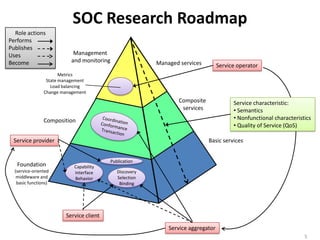
SOC Research RoadmapRole actionsPerformsPublishesUsesBecome Management and monitoringManaged servicesService operatorMetricsState managementLoad balancingChange managementService characteristic: Semantics
 Nonfunctional characteristics
 Quality of Service (QoS)Composite servicesCoordinationConformanceTransaction CompositionBasic servicesService providerPublicationFoundation(service-oriented middleware and basic functions)DiscoverySelectionBindingCapabilityInterfaceBehaviorService clientService aggregator5
SERVICE FOUNDATIONConsists of service-oriented middleware backbone.Basic service funcionality definition: description, publishing, finding and binding of services.Typical service-based scenario:Provider hosts network-accessible software module, defines a service description and publish the service and make it discoverable.Client discovers a service, retrieve the service description.Client use service desc. to bind to the provider and invoke the service.Service aggregators group services by other providers and can also act as providers.6
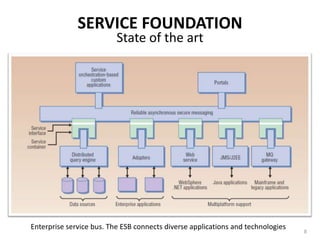
SERVICE FOUNDATIONThe concept of enterprise services bus – a capable and manageable integration infrastructure for web services and SOA.Two objectives of ESB:Loosely couple the systems taking part in the integration, andBreak up the integration logic into distinct, easily manageable pieces.Open-standards-based message backbone.Using middleware technology to enable SOA and alleviate disparity problemsState of the art7
SERVICE FOUNDATIONState of the art8Enterprise service bus. The ESB connects diverse applications and technologies
SERVICE FOUNDATIONDynamically reconfigurable runtime architecture.End-to-end security solutions.Infrastructure support for data and process integration.Semantically enhanced service discovery.Research challenges9
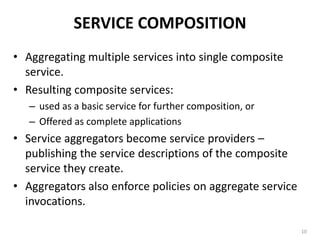
SERVICE COMPOSITIONAggregating multiple services into single composite service.Resulting composite services:used as a basic service for further composition, orOffered as complete applicationsService aggregators become service providers – publishing the service descriptions of the composite service they create.Aggregators also enforce policies on aggregate service invocations.10
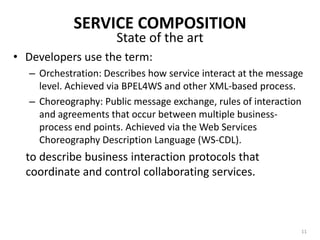
SERVICE COMPOSITIONDevelopers use the term:Orchestration: Describes how service interact at the message level. Achieved via BPEL4WS and other XML-based process.Choreography: Public message exchange, rules of interaction and agreements that occur between multiple business-process end points. Achieved via the Web Services Choreography Description Language (WS-CDL).to describe business interaction protocols that coordinate and control collaborating services.State of the art11
SERVICE COMPOSITIONCompatibility analysis for replaceability, compatibility, and process conformance.Dynamic and adaptive processes.QoS-aware service compositions.Business-driven automated compositions.Research challenges12
SERVICE MANAGEMENT AND MONITORINGService management: A range of activities, from installation and configuration to collecting metrics and tuning, to ensure responsive service execution.Service monitoring: Monitoring events or information produced by the services and processes; viewing process-instance statistics; viewing the status of selected process instances; and suspending, resuming or terminating selected process instances.13
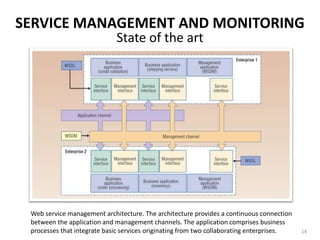
SERVICE MANAGEMENT AND MONITORINGState of the art14Web service management architecture. The architecture provides a continuous connection between the application and management channels. The application comprises business processes that integrate basic services originating from two collaborating enterprises.
SERVICE MANAGEMENT AND MONITORINGSelf-configuring management services.Self-adapting management services.Self-healing management services.Self-optimizing management services.Self-protecting management services.Research challenges15
SERVICE DESIGN AND DEVELOPMENTWell-constructed SOA provides flexible infrastructure and processing environments to business entity.Provisioning independent, reuseable automated business processes as services and providing a foundation for leveraging these services.SOAs must rely on an evolutionary software engineering approach.Partly builds upon earlier processes including component-based development and business process modeling.16
SERVICE DESIGN AND DEVELOPMENTSOA’s key element (services, information flows, and components realizing services) has to be address in software development.Currently developers use SOAP/WDSL/UDDI atop existing applications or components that implement the Web services.They port existing components to Web services by creating wrappers and leaving the underlying component untouched – focus on interface.This is insufficient and properly delivering components’ functionality through a Web service takes serious redesign effort.* older software development paradigm for object-oriented and component-based development cannot be blindly applied to SOA and  Web services.State of the art17

Service Oriented Computing

  • 1.
    Service-Oriented Computing:State ofthe Art and Research ChallengesAiesa bin Saad, 4209A126-2Nakazato Lab
  • 2.
    Paper backgroundAuthor:Micheal P.Papazoglou, Tilburg UniversityPaolo Traverso, Instituto per la Ricerca Scientifica e TechnologicaSchahram Dustdar, Vienna University of TechnologyFrank Leymann, University of StuttgartThe First International Conference on Service Oriented Computing 15-18 December 2003, Trento - Italy2
  • 3.
    What is SOC?Promotesthe idea of assembling application components into a network of services to create applications.Uses “services-oriented” programming to develop application by using network-available services.Web services are currently the most promising SOC-based technology. Uses internet-based standards:Simple Object Access Protocol (SOAP)Web Services Description Language (WSDL)Business Process Execution Language for Web Services (BPEL4WS)3
  • 4.
    What is SOC?SOCvision: it will be possible to easily assemble application components into a loosely coupled network of services.These services is used to create dynamic business process and agile applications across organizations and computing platforms.Key to achieve this vision: Service-oriented Architecture (SOA):Logical way of designing a software system;Provide services either to end-user applications or other services distributed in a network;Published and discoverable interfaces.4
  • 5.
    SOC Research RoadmapRoleactionsPerformsPublishesUsesBecome Management and monitoringManaged servicesService operatorMetricsState managementLoad balancingChange managementService characteristic: Semantics
  • 6.
  • 7.
    Quality ofService (QoS)Composite servicesCoordinationConformanceTransaction CompositionBasic servicesService providerPublicationFoundation(service-oriented middleware and basic functions)DiscoverySelectionBindingCapabilityInterfaceBehaviorService clientService aggregator5
  • 8.
    SERVICE FOUNDATIONConsists ofservice-oriented middleware backbone.Basic service funcionality definition: description, publishing, finding and binding of services.Typical service-based scenario:Provider hosts network-accessible software module, defines a service description and publish the service and make it discoverable.Client discovers a service, retrieve the service description.Client use service desc. to bind to the provider and invoke the service.Service aggregators group services by other providers and can also act as providers.6
  • 9.
    SERVICE FOUNDATIONThe conceptof enterprise services bus – a capable and manageable integration infrastructure for web services and SOA.Two objectives of ESB:Loosely couple the systems taking part in the integration, andBreak up the integration logic into distinct, easily manageable pieces.Open-standards-based message backbone.Using middleware technology to enable SOA and alleviate disparity problemsState of the art7
  • 10.
    SERVICE FOUNDATIONState ofthe art8Enterprise service bus. The ESB connects diverse applications and technologies
  • 11.
    SERVICE FOUNDATIONDynamically reconfigurableruntime architecture.End-to-end security solutions.Infrastructure support for data and process integration.Semantically enhanced service discovery.Research challenges9
  • 12.
    SERVICE COMPOSITIONAggregating multipleservices into single composite service.Resulting composite services:used as a basic service for further composition, orOffered as complete applicationsService aggregators become service providers – publishing the service descriptions of the composite service they create.Aggregators also enforce policies on aggregate service invocations.10
  • 13.
    SERVICE COMPOSITIONDevelopers usethe term:Orchestration: Describes how service interact at the message level. Achieved via BPEL4WS and other XML-based process.Choreography: Public message exchange, rules of interaction and agreements that occur between multiple business-process end points. Achieved via the Web Services Choreography Description Language (WS-CDL).to describe business interaction protocols that coordinate and control collaborating services.State of the art11
  • 14.
    SERVICE COMPOSITIONCompatibility analysisfor replaceability, compatibility, and process conformance.Dynamic and adaptive processes.QoS-aware service compositions.Business-driven automated compositions.Research challenges12
  • 15.
    SERVICE MANAGEMENT ANDMONITORINGService management: A range of activities, from installation and configuration to collecting metrics and tuning, to ensure responsive service execution.Service monitoring: Monitoring events or information produced by the services and processes; viewing process-instance statistics; viewing the status of selected process instances; and suspending, resuming or terminating selected process instances.13
  • 16.
    SERVICE MANAGEMENT ANDMONITORINGState of the art14Web service management architecture. The architecture provides a continuous connection between the application and management channels. The application comprises business processes that integrate basic services originating from two collaborating enterprises.
  • 17.
    SERVICE MANAGEMENT ANDMONITORINGSelf-configuring management services.Self-adapting management services.Self-healing management services.Self-optimizing management services.Self-protecting management services.Research challenges15
  • 18.
    SERVICE DESIGN ANDDEVELOPMENTWell-constructed SOA provides flexible infrastructure and processing environments to business entity.Provisioning independent, reuseable automated business processes as services and providing a foundation for leveraging these services.SOAs must rely on an evolutionary software engineering approach.Partly builds upon earlier processes including component-based development and business process modeling.16
  • 19.
    SERVICE DESIGN ANDDEVELOPMENTSOA’s key element (services, information flows, and components realizing services) has to be address in software development.Currently developers use SOAP/WDSL/UDDI atop existing applications or components that implement the Web services.They port existing components to Web services by creating wrappers and leaving the underlying component untouched – focus on interface.This is insufficient and properly delivering components’ functionality through a Web service takes serious redesign effort.* older software development paradigm for object-oriented and component-based development cannot be blindly applied to SOA and Web services.State of the art17