Moving eGovernment
   to the Cloud
   Chintana Wilamuna
    Senior Technical Lead
     chintana@wso2.com
Open source software
• A license that legally give the right to,
   – Run the program for any purpose
   – Study and modify the program
   – Redistribute the program (in modified and
     unmodified states)
• Free software, OSS, FOSS, FLOSS
• Many licenses
   – http://opensource.org/licenses/alphabetical
Why open source?
•   Brings transparency
•   Faster security fixes/patches
•   Use of open standards
•   Broad usage in many verticals
•   Commercial support available
•   Used in many business critical applications
Why open source in government?
• Transparency
  – Not at the mercy of a proprietary vendor

• Detailed evaluation before using
  – Evaluation of different aspects – functionality, security, extensibility
  – Open forums for discussion, bug tracking, community

• No vendor lock-in
  – Use of open standards, many providers of commercial support
Cloud computing
Cloud computing is a model for enabling ubiquitous,
convenient, on-demand network access to a shared
pool of configurable computing resources (e.g.,
networks, servers, storage, applications, and services)
that can be rapidly provisioned and released with
minimal management effort or service provider
interaction.
    -   National Institute of Standards and Technology (NIST – www.nist.gov)
Cloud computing characteristics
• On-demand self service
  – CPU, storage, RAM - without an admin

• Broad network access
  – Accessible over a network

• Resource pooling
  – Accessibility through a multi-tenant model

• Rapid elasticity
• Measured service
Service models
• Software as a Service (SaaS)
  – Application running on the cloud
  – Accessed from web, mobile, native apps

• Platform as a Service (PaaS)
  – Deploy applications into the cloud
  – Provide libraries/frameworks/tools to build applications

• Infrastructure as a Service (IaaS)
  – Provision fundamental computing resources; CPU, RAM, storage etc…
  – Has control from the operating system to deployed apps
Deployment models
• Private cloud
• Community cloud
  – Provisioned to be used by a specific community of consumers

• Public cloud
• Hybrid cloud
  – Combination of two cloud infrastructures
  – Technology enables data and application portability
  – Used for cloud bursting
Issues – Effective eGovernment
•   Collection of massive amounts of data
•   Scattered in different data repositories
•   Transactions spanning multiple agencies
•   Intergovernmental data access
•   High capital and operational expenditure
•   Provisioning resources become cumbersome
•   Ensure data integrity of disparate systems
Data collection
• Citizen data
• Documents needed for a specific function
  – Loan approval
  – Vehicle license renewal etc…

• Importance of having a single consistent set of
  information about a citizen
Scattered repositories
• A citizen can belong to a single province
  – The geographical area where he cast his vote

• Can have information scattered in different
  provinces
• Ability to view information from a central
  portal
Transactions with multiple agencies
• Refer/executing processes from another local
  government agency (from another
  province/state)
• Authorization model that can grant permission to
  needed local agencies


How to solving these issues with a cloud native
middleware platform in an eGovernment solution?
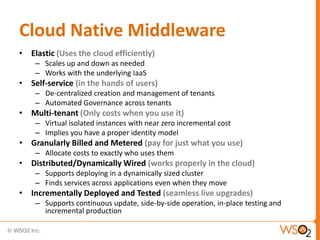
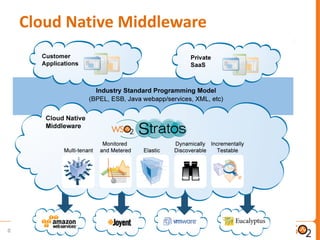
Cloud Native Middleware
• Elastic (Uses the cloud efficiently)
    – Scales up and down as needed
    – Works with the underlying IaaS
• Self-service (in the hands of users)
    – De-centralized creation and management of tenants
    – Automated Governance across tenants
• Multi-tenant (Only costs when you use it)
    – Virtual isolated instances with near zero incremental cost
    – Implies you have a proper identity model
• Granularly Billed and Metered (pay for just what you use)
    – Allocate costs to exactly who uses them
• Distributed/Dynamically Wired (works properly in the cloud)
    – Supports deploying in a dynamically sized cluster
    – Finds services across applications even when they move
• Incrementally Deployed and Tested (seamless live upgrades)
    – Supports continuous update, side-by-side operation, in-place testing and
      incremental production
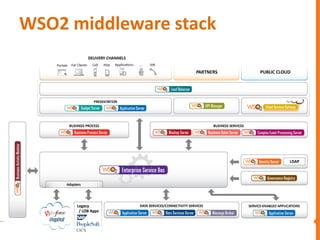
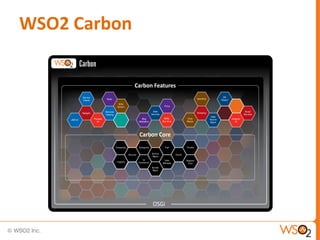
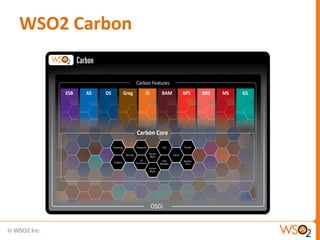
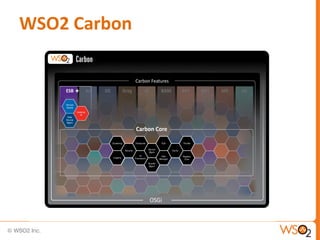
WSO2 middleware stack
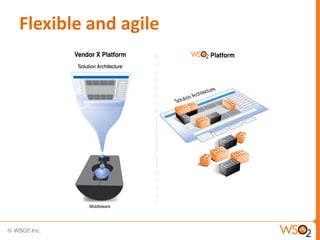
Flexible and agile
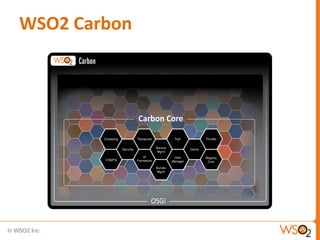
WSO2 Carbon
WSO2 Carbon
WSO2 Carbon
WSO2 Carbon
WSO2 Carbon
Cloud Native Middleware
Importance of multi-tenancy
• Every service can support multiple tenants in
  the same container. A tenant is a local
  government agency or can be a state.
  – Higher efficiency, lower resources
  – Can be split tenant per-VM using the MT-aware Load Balancer

• Isolation includes classloaders, code signing
  and Java security policies
  – Cross-tenant sharing is via the network (REST, SOAP, etc)


                                                                  22
Importance of multi-tenancy cont.
• Every tenant has all services by default but
  they can be turned off
• Central government deploying services that
  are common to all states/local/provincial
  agencies
• Provincial agencies can have their own
  services/business processes
• Provincial offices work on their dataset
Importance of multi-tenancy cont.
• Central government can access the portal and
  can have a holistic view of the entire system
• Can find out detailed statistics about the
  operation of each local government agency
• If required a privileged user can perform
  activities of a local agency. Governed by
  authorization policies defined by the
  provincial agency
Importance of multi-tenancy cont.
• Data and processes of a local agency is
  isolated from another. Can grant selective
  access via authorization policies (XACML)
• Flexibility of multi-tenant architecture – Ability
  to have a common set of functions across all
  local agencies and at the same time can have
  specific services/processes as well
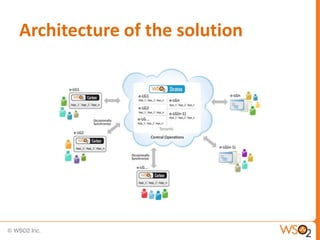
Architecture of the solution
• LG – Local Government Agency
  – Deployed

• Central operations
  –   Public cloud deployment by the central government
  –   All local/provincial agencies have a tenant in Stratos (e-LG1, e-LG2 etc)
  –   eGov apps runs under each tenant
  –   e-LGs are isolated from each other (both data and execution)
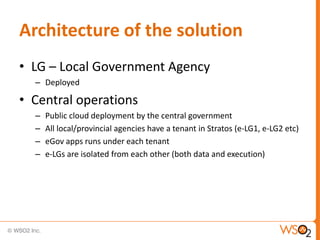
Architecture of the solution
• Some local agencies have good internet
  connection
  –   e-LGn and e-LG(n-1)
  –   No local deployments
  –   Directly connects to central
  –   Application state and data for e-LG tenant in central cloud reflect the
      latest state
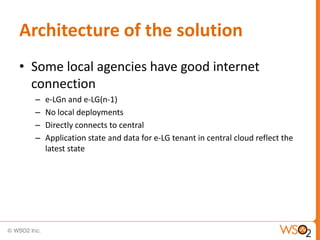
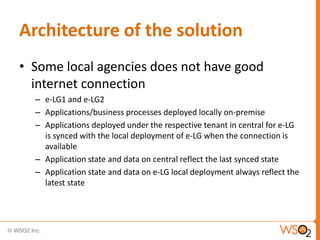
Architecture of the solution
• Some local agencies does not have good
  internet connection
  – e-LG1 and e-LG2
  – Applications/business processes deployed locally on-premise
  – Applications deployed under the respective tenant in central for e-LG
    is synced with the local deployment of e-LG when the connection is
    available
  – Application state and data on central reflect the last synced state
  – Application state and data on e-LG local deployment always reflect the
    latest state
References
• NIST cloud computing definition
  – http://csrc.nist.gov/publications/nistpubs/800-145/SP800-145.pdf

• White paper: Moving eGovernment to the
  Cloud
  – http://wso2.com/whitepapers/moving-egovernment-to-the-cloud/
Questions?
Thank you!

Moving E Government to the Cloud

  • 1.
    Moving eGovernment to the Cloud Chintana Wilamuna Senior Technical Lead chintana@wso2.com
  • 2.
    Open source software •A license that legally give the right to, – Run the program for any purpose – Study and modify the program – Redistribute the program (in modified and unmodified states) • Free software, OSS, FOSS, FLOSS • Many licenses – http://opensource.org/licenses/alphabetical
  • 3.
    Why open source? • Brings transparency • Faster security fixes/patches • Use of open standards • Broad usage in many verticals • Commercial support available • Used in many business critical applications
  • 4.
    Why open sourcein government? • Transparency – Not at the mercy of a proprietary vendor • Detailed evaluation before using – Evaluation of different aspects – functionality, security, extensibility – Open forums for discussion, bug tracking, community • No vendor lock-in – Use of open standards, many providers of commercial support
  • 5.
    Cloud computing Cloud computingis a model for enabling ubiquitous, convenient, on-demand network access to a shared pool of configurable computing resources (e.g., networks, servers, storage, applications, and services) that can be rapidly provisioned and released with minimal management effort or service provider interaction. - National Institute of Standards and Technology (NIST – www.nist.gov)
  • 6.
    Cloud computing characteristics •On-demand self service – CPU, storage, RAM - without an admin • Broad network access – Accessible over a network • Resource pooling – Accessibility through a multi-tenant model • Rapid elasticity • Measured service
  • 7.
    Service models • Softwareas a Service (SaaS) – Application running on the cloud – Accessed from web, mobile, native apps • Platform as a Service (PaaS) – Deploy applications into the cloud – Provide libraries/frameworks/tools to build applications • Infrastructure as a Service (IaaS) – Provision fundamental computing resources; CPU, RAM, storage etc… – Has control from the operating system to deployed apps
  • 8.
    Deployment models • Privatecloud • Community cloud – Provisioned to be used by a specific community of consumers • Public cloud • Hybrid cloud – Combination of two cloud infrastructures – Technology enables data and application portability – Used for cloud bursting
  • 9.
    Issues – EffectiveeGovernment • Collection of massive amounts of data • Scattered in different data repositories • Transactions spanning multiple agencies • Intergovernmental data access • High capital and operational expenditure • Provisioning resources become cumbersome • Ensure data integrity of disparate systems
  • 10.
    Data collection • Citizendata • Documents needed for a specific function – Loan approval – Vehicle license renewal etc… • Importance of having a single consistent set of information about a citizen
  • 11.
    Scattered repositories • Acitizen can belong to a single province – The geographical area where he cast his vote • Can have information scattered in different provinces • Ability to view information from a central portal
  • 12.
    Transactions with multipleagencies • Refer/executing processes from another local government agency (from another province/state) • Authorization model that can grant permission to needed local agencies How to solving these issues with a cloud native middleware platform in an eGovernment solution?
  • 13.
    Cloud Native Middleware •Elastic (Uses the cloud efficiently) – Scales up and down as needed – Works with the underlying IaaS • Self-service (in the hands of users) – De-centralized creation and management of tenants – Automated Governance across tenants • Multi-tenant (Only costs when you use it) – Virtual isolated instances with near zero incremental cost – Implies you have a proper identity model • Granularly Billed and Metered (pay for just what you use) – Allocate costs to exactly who uses them • Distributed/Dynamically Wired (works properly in the cloud) – Supports deploying in a dynamically sized cluster – Finds services across applications even when they move • Incrementally Deployed and Tested (seamless live upgrades) – Supports continuous update, side-by-side operation, in-place testing and incremental production
  • 14.
  • 15.
  • 16.
  • 17.
  • 18.
  • 19.
  • 20.
  • 21.
  • 22.
    Importance of multi-tenancy •Every service can support multiple tenants in the same container. A tenant is a local government agency or can be a state. – Higher efficiency, lower resources – Can be split tenant per-VM using the MT-aware Load Balancer • Isolation includes classloaders, code signing and Java security policies – Cross-tenant sharing is via the network (REST, SOAP, etc) 22
  • 23.
    Importance of multi-tenancycont. • Every tenant has all services by default but they can be turned off • Central government deploying services that are common to all states/local/provincial agencies • Provincial agencies can have their own services/business processes • Provincial offices work on their dataset
  • 24.
    Importance of multi-tenancycont. • Central government can access the portal and can have a holistic view of the entire system • Can find out detailed statistics about the operation of each local government agency • If required a privileged user can perform activities of a local agency. Governed by authorization policies defined by the provincial agency
  • 25.
    Importance of multi-tenancycont. • Data and processes of a local agency is isolated from another. Can grant selective access via authorization policies (XACML) • Flexibility of multi-tenant architecture – Ability to have a common set of functions across all local agencies and at the same time can have specific services/processes as well
  • 26.
  • 27.
    Architecture of thesolution • LG – Local Government Agency – Deployed • Central operations – Public cloud deployment by the central government – All local/provincial agencies have a tenant in Stratos (e-LG1, e-LG2 etc) – eGov apps runs under each tenant – e-LGs are isolated from each other (both data and execution)
  • 28.
    Architecture of thesolution • Some local agencies have good internet connection – e-LGn and e-LG(n-1) – No local deployments – Directly connects to central – Application state and data for e-LG tenant in central cloud reflect the latest state
  • 29.
    Architecture of thesolution • Some local agencies does not have good internet connection – e-LG1 and e-LG2 – Applications/business processes deployed locally on-premise – Applications deployed under the respective tenant in central for e-LG is synced with the local deployment of e-LG when the connection is available – Application state and data on central reflect the last synced state – Application state and data on e-LG local deployment always reflect the latest state
  • 30.
    References • NIST cloudcomputing definition – http://csrc.nist.gov/publications/nistpubs/800-145/SP800-145.pdf • White paper: Moving eGovernment to the Cloud – http://wso2.com/whitepapers/moving-egovernment-to-the-cloud/
  • 31.
  • 32.