SUBMITTED BY:
A N T A R A * , A K S H A R A , S A P N A & M E E N A K S H I
SUPERVISED BY:
P R A S U N K . G U P T A #
GEOINFORMATICS DEPARTMENT
INDIAN INSTITUTE OF REMOTE SENSING
SNOW COVER ASSESSMENT
TOOL USING PYTHON
* antaradasgupta26@gmail.com # prasun@iirs.gov.in
INTRODUCTION
 AIM:
To create a tool using PYTHON which calculates the
snow cover area using MODIS Terra Temporal
Datasets and plots a graph of the change in the
same over time.
 DATASETS USED:
MOD10A2-L8 (8-day composite data)
Subdataset used - Maximum Snow Extent over the
8 day period
MATERIALS AND METHODS
 SOFTWARES USED:
Enthought Canopy
Qt Designer
 PYTHON LIBRARIES USED:
For UI design - PyQt4 and PySide
For image processing – GDAL
For the arithmetic and file listing functions –
numpy, glob
For the graph - pylab
MATERIALS AND METHODS(2)
 METHODOLOGY FOLLOWED
 Create a GUI using QtDesigner and save the
.ui file.
 Export it to a .py file using the in built utility
in PyQt4 – pyuic4.
 Open the .py file in Canopy, define the
required functions and connect the buttons
to the requisite functions
PYQT4 & PYSIDE
 PyQt is a Python binding of the cross-platform GUI toolkit Qt. It is
one of Python's options for GUI programming.
 PyQt implements around 440 classes and over 6,000 functions and
methods including:
a substantial set of GUI widgets
classes for accessing SQL databases (MYSQL, ORACLE), etc.
 Notable applications that use PyQt :
Orange, a data mining and visualization framework
QGIS, a free software desktop GIS, etc.
 PySide is the Canopy alternative for PyQt4.
GDAL
 GDAL (Geospatial Data Abstraction Library) is
a library for reading and writing raster geospatial
data formats.
 The related OGR library (OGR Simple Features
Library), which is part of the GDAL source tree,
provides a similar capability for simple
features vector data.
 Software that uses GDAL/OGR are: ARCGIS,
GOOGLE EARTH, MAPSERVER, GRASS GIS, QGIS,
etc.
NUMPY
o NumPy is the fundamental package for scientific
computing with Python. It is an extension to
the Python programming language.
o It contains :
 a powerful N-dimensional array object
 sophisticated (broadcasting) functions
 tools for integrating C/C++ and Fortran code
 useful linear algebra, Fourier transform, and
random number capabilities
PYLAB
 Pylab is the module for scientific computing with
Python.
 Pylab is part of matplotlib (in matplotlib.pylab)
and tries to give a MatLab like environment.
 matplotlib.pylab which allow the user to create
plots with code quite similar to MATLAB figure
generating code.
GLOB
 The glob module finds all the pathnames matching a
specified pattern according to the rules used by the
Unix shell. No tilde expansion is done, but *, ?, and
character ranges expressed with [] will be correctly
matched.
 glob.glob(pathname):
Return a possibly-empty list of path names that
match pathname, which must be a string containing a
path specification. pathname can be either absolute
(like /usr/src/Python-1.5/Makefile) or relative
(like ../../Tools/*/*.gif), and can contain shell-style
wildcards.
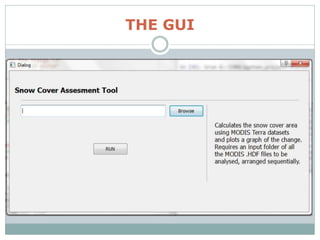
THE GUI
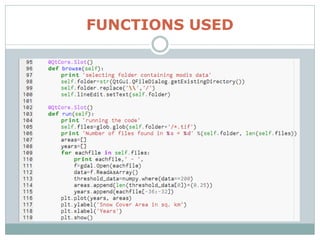
FUNCTIONS USED
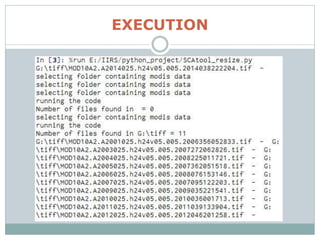
EXECUTION
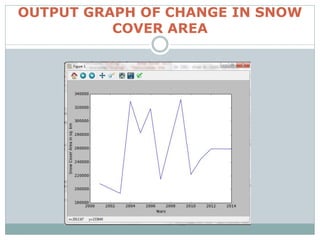
OUTPUT GRAPH OF CHANGE IN SNOW
COVER AREA
FUTURE SCOPE
 The program is currently just generating the
area numerically, in future it could be
modified using GDAL to generate the output
binary files for snow cover and generate
permanent and seasonal snow cover maps
using OGR capabilities.
 Such a platform could also be created for the
processing of AMSR-E Data for Soil Moisture
Studies.
THANK
YOU!

Snow cover assessment tool using Python

  • 1.
    SUBMITTED BY: A NT A R A * , A K S H A R A , S A P N A & M E E N A K S H I SUPERVISED BY: P R A S U N K . G U P T A # GEOINFORMATICS DEPARTMENT INDIAN INSTITUTE OF REMOTE SENSING SNOW COVER ASSESSMENT TOOL USING PYTHON * antaradasgupta26@gmail.com # prasun@iirs.gov.in
  • 2.
    INTRODUCTION  AIM: To createa tool using PYTHON which calculates the snow cover area using MODIS Terra Temporal Datasets and plots a graph of the change in the same over time.  DATASETS USED: MOD10A2-L8 (8-day composite data) Subdataset used - Maximum Snow Extent over the 8 day period
  • 3.
    MATERIALS AND METHODS SOFTWARES USED: Enthought Canopy Qt Designer  PYTHON LIBRARIES USED: For UI design - PyQt4 and PySide For image processing – GDAL For the arithmetic and file listing functions – numpy, glob For the graph - pylab
  • 4.
    MATERIALS AND METHODS(2) METHODOLOGY FOLLOWED  Create a GUI using QtDesigner and save the .ui file.  Export it to a .py file using the in built utility in PyQt4 – pyuic4.  Open the .py file in Canopy, define the required functions and connect the buttons to the requisite functions
  • 5.
    PYQT4 & PYSIDE PyQt is a Python binding of the cross-platform GUI toolkit Qt. It is one of Python's options for GUI programming.  PyQt implements around 440 classes and over 6,000 functions and methods including: a substantial set of GUI widgets classes for accessing SQL databases (MYSQL, ORACLE), etc.  Notable applications that use PyQt : Orange, a data mining and visualization framework QGIS, a free software desktop GIS, etc.  PySide is the Canopy alternative for PyQt4.
  • 6.
    GDAL  GDAL (GeospatialData Abstraction Library) is a library for reading and writing raster geospatial data formats.  The related OGR library (OGR Simple Features Library), which is part of the GDAL source tree, provides a similar capability for simple features vector data.  Software that uses GDAL/OGR are: ARCGIS, GOOGLE EARTH, MAPSERVER, GRASS GIS, QGIS, etc.
  • 7.
    NUMPY o NumPy isthe fundamental package for scientific computing with Python. It is an extension to the Python programming language. o It contains :  a powerful N-dimensional array object  sophisticated (broadcasting) functions  tools for integrating C/C++ and Fortran code  useful linear algebra, Fourier transform, and random number capabilities
  • 8.
    PYLAB  Pylab isthe module for scientific computing with Python.  Pylab is part of matplotlib (in matplotlib.pylab) and tries to give a MatLab like environment.  matplotlib.pylab which allow the user to create plots with code quite similar to MATLAB figure generating code.
  • 9.
    GLOB  The globmodule finds all the pathnames matching a specified pattern according to the rules used by the Unix shell. No tilde expansion is done, but *, ?, and character ranges expressed with [] will be correctly matched.  glob.glob(pathname): Return a possibly-empty list of path names that match pathname, which must be a string containing a path specification. pathname can be either absolute (like /usr/src/Python-1.5/Makefile) or relative (like ../../Tools/*/*.gif), and can contain shell-style wildcards.
  • 10.
  • 11.
  • 12.
  • 13.
    OUTPUT GRAPH OFCHANGE IN SNOW COVER AREA
  • 14.
    FUTURE SCOPE  Theprogram is currently just generating the area numerically, in future it could be modified using GDAL to generate the output binary files for snow cover and generate permanent and seasonal snow cover maps using OGR capabilities.  Such a platform could also be created for the processing of AMSR-E Data for Soil Moisture Studies.
  • 15.